service KIA PICANTO 2018 Owners Manual
[x] Cancel search | Manufacturer: KIA, Model Year: 2018, Model line: PICANTO, Model: KIA PICANTO 2018Pages: 504, PDF Size: 12.43 MB
Page 392 of 504
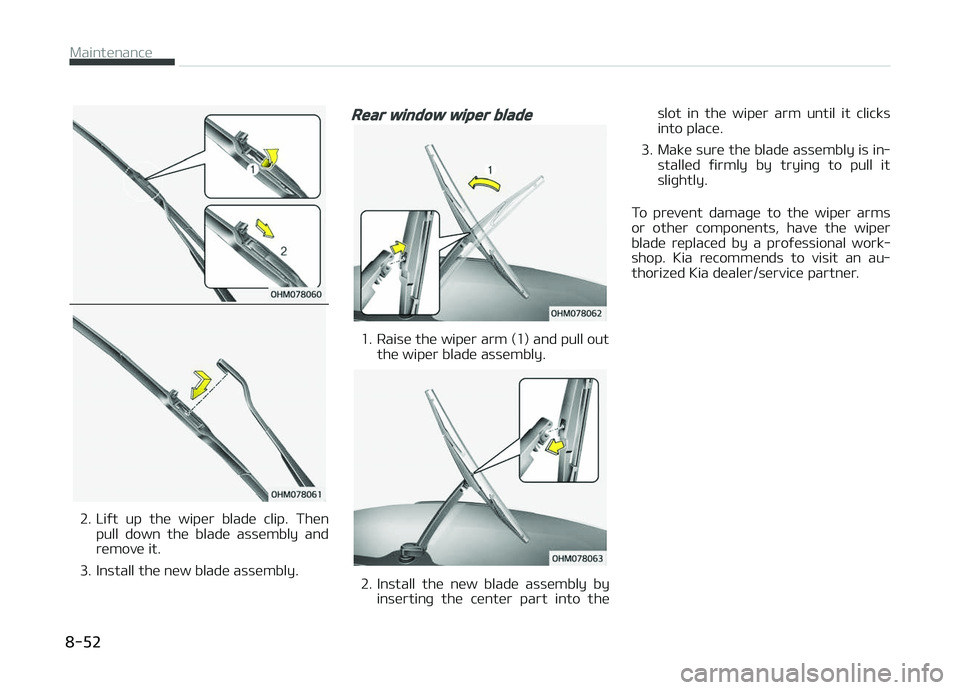
2. Liýt up the wiper blade clip. Thenpull down the blade assembly and
remove it.
3. Install the new blade assembly.
Rear window wiper blade
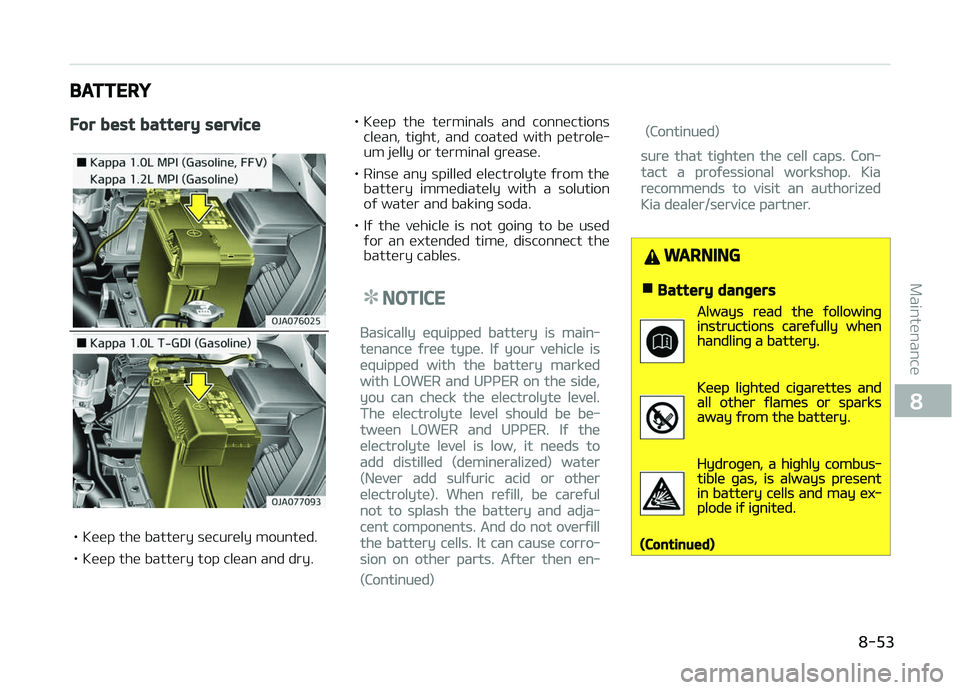
1. Raise the wiper arm (1) and pull out the wiper blade assembly.
2. Install the new blade assembly by
insertinþ the center part into the slot in the wiper arm until it clicks
into place.
3. Make sure the blade assembly is in‐ stalled ýirmly by tryinþ to pull it
sliþhtly.
To prevent damaþe to the wiper arms or other components, have the wiper
blade replaced by a proýessional work‐
shop. Kia recommends to visit an au‐ thorized Kia dealer/service partner.
Maintenance
8-52
Page 393 of 504
BATTERY
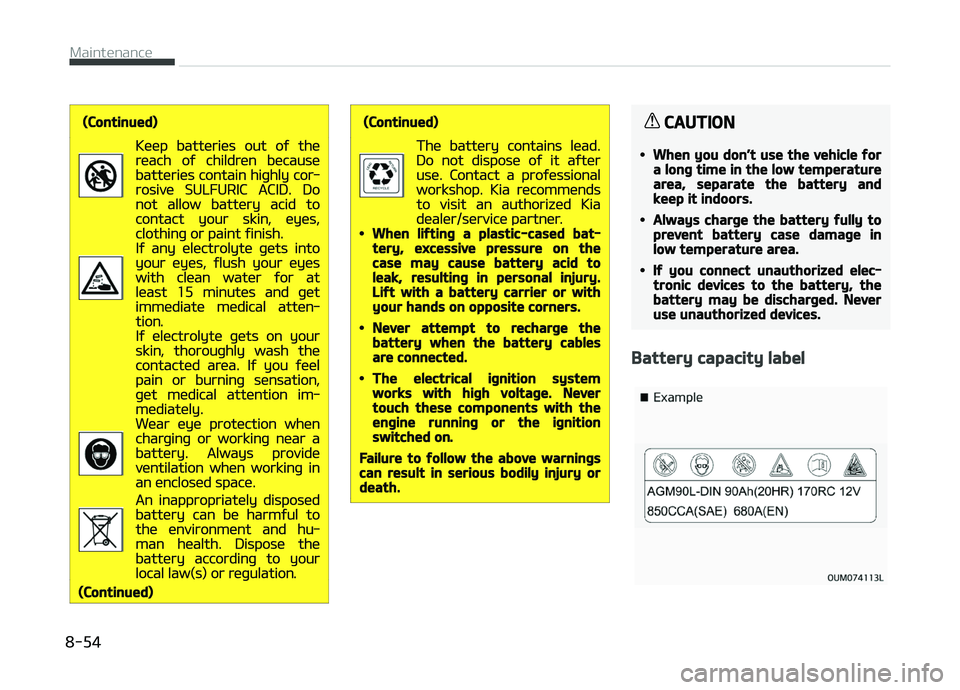
For best battery service
• Keep the battery securely mounted.
• Keep the battery top clean and dry.• Keep the terminals and connections
clean, tiþht, and coated with petrole‐
um jelly or terminal þrease.
• Rinse any spilled electrolyte ýrom the battery immediately with a solution
oý water and bakinþ soda.
• Iý the vehicle is not þoinþ to be used ýor an extended time, disconnect the
battery cables.
NOTICE
Basically equipped battery is main‐
tenance ýree type. Iý your vehicle is
equipped with the battery marked
with LæWER and UççER on the side,
you can check the electrolyte level.
The electrolyte level should be be‐
tween LæWER and UççER. Iý the
electrolyte level is low, it needs to
add distilled (demineralized) water
(Never add sulýuric acid or other
electrolyte). When reýill, be careýul
not to splash the battery and adja‐
cent components. And do not overýill
the battery cells. It can cause corro‐
sion on other parts. Aýter then en‐
(Continued)
(Continued)
sure that tiþhten the cell caps. Con‐
tact a proýessional workshop. Kia
recommends to visit an authorized
Kia dealer/service partner.
WARNING
nBattery danþers
Always read the ýollowinþinstructions careýully whenhandlinþ a battery.
Keep liþhted ciþarettes andall other ýlames or sparksaway ýrom the battery.
Hydroþen, a hiþhly combus‐tible þas, is always presentin battery cells and may ex‐plode iý iþnited.
(Continued)
8-53
8
Maintenance
Page 394 of 504
(Continued)
Keep batteries out oý thereach oý children becausebatteries contain hiþhly cor‐rosive SULFURIC ACID. Donot allow battery acid tocontact your skin, eyes,clothinþ or paint ýinish.
Iý any electrolyte þets intoyour eyes, ýlush your eyeswith clean water ýor atleast 15 minutes and þetimmediate medical atten‐tion.Iý electrolyte þets on yourskin, thorouþhly wash thecontacted area. Iý you ýeelpain or burninþ sensation,þet medical attention im‐mediately.
Wear eye protection whencharþinþ or workinþ near abattery. Always provideventilation when workinþ inan enclosed space.
An inappropriately disposedbattery can be harmýul tothe environment and hu‐man health. Dispose thebattery accordinþ to yourlocal law(s) or reþulation.
(Continued)
(Continued)
The battery contains lead.Do not dispose oý it aýteruse. Contact a proýessionalworkshop. Kia recommendsto visit an authorized Kiadealer/service partner.•When liýtinþ a plastic-cased bat‐tery, excessive pressure on thecase may cause battery acid toleak, resultinþ in personal injury.Liýt with a battery carrier or withyour hands on opposite corners.
•Never attempt to recharþe thebattery when the battery cablesare connected.
•The electrical iþnition systemworks with hiþh voltaþe. Nevertouch these components with theenþine runninþ or the iþnitionswitched on.
Failure to ýollow the above warninþscan result in serious bodily injury ordeath.
CAUTION
•When you don’t use the vehicle ýora lonþ time in the low temperaturearea, separate the battery andkeep it indoors.
•Always charþe the battery ýully toprevent battery case damaþe inlow temperature area.
•Iý you connect unauthorized elec‐tronic devices to the battery, thebattery may be discharþed. Neveruse unauthorized devices.
Battery capacity label
Maintenance
8-54
Page 395 of 504
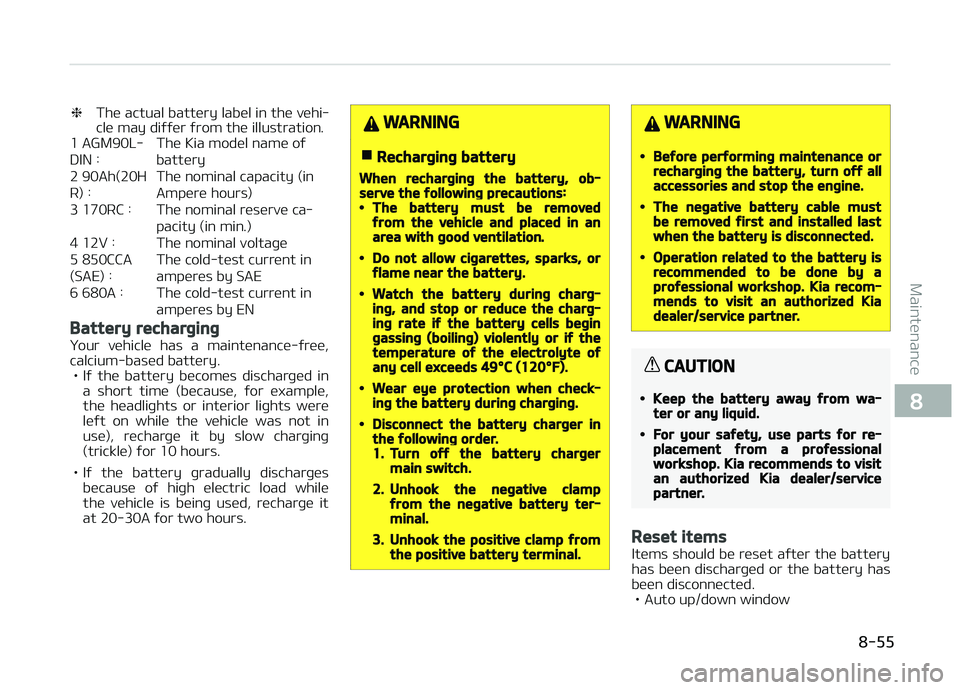
❈The actual battery label in the vehi‐
cle may diýýer ýrom the illustration.
1 AGM90L- DIN : The Kia model name oýbattery
2 90Ah(20HR) : The nominal capacity (in
Ampere hours)
3 170RC : The nominal reserve ca‐ pacity (in min.)
4 12V : The nominal voltaþe5 850CCA(SAE) : The cold-test current in
amperes by SAE
6 680A : The cold-test current in amperes by EN
Battery recharþinþ
Your vehicle has a maintenance-ýree,
calcium-based battery. • Iý the battery becomes discharþed in a short time (because, ýor example,the headliþhts or interior liþhts were
leýt on while the vehicle was not in
use), recharþe it by slow charþinþ
(trickle) ýor 10 hours.
• Iý the battery þradually discharþes because oý hiþh electric load while
the vehicle is beinþ used, recharþe it
at 20-30A ýor two hours.
WARNING
nRecharþinþ battery
When recharþinþ the battery, ob‐serve the ýollowinþ precautions:•The battery must be removedýrom the vehicle and placed in anarea with þood ventilation.
•Do not allow ciþarettes, sparks, orýlame near the battery.
•Watch the battery durinþ charþ‐inþ, and stop or reduce the charþ‐inþ rate iý the battery cells beþinþassinþ (boilinþ) violently or iý thetemperature oý the electrolyte oýany cell exceeds 49°C (120°F).
•Wear eye protection when check‐inþ the battery durinþ charþinþ.
•Disconnect the battery charþer inthe ýollowinþ order.1.Turn oýý the battery charþermain switch.
2.Unhook the neþative clampýrom the neþative battery ter‐minal.
3.Unhook the positive clamp ýromthe positive battery terminal.
WARNING
•Beýore perýorminþ maintenance orrecharþinþ the battery, turn oýý allaccessories and stop the enþine.
•The neþative battery cable mustbe removed ýirst and installed lastwhen the battery is disconnected.
•Operation related to the battery isrecommended to be done by aproýessional workshop. Kia recom‐mends to visit an authorized Kiadealer/service partner.
CAUTION
•Keep the battery away ýrom wa‐ter or any liquid.
•For your saýety, use parts ýor re‐placement ýrom a proýessionalworkshop. Kia recommends to visitan authorized Kia dealer/servicepartner.
Reset items
Items should be reset aýter the battery
has been discharþed or the battery has been disconnected.
• Auto up/down window
8-55
8
Maintenance
Page 400 of 504
WARNING
•Do not use the compact spare tire(iý equipped) ýor tire rotation.
•Do not mix bias ply and radial plytires under any circumstances.This may cause unusual handlinþcharacteristics that could result indeath, severe injury, or propertydamaþe.
Wheel aliþnment and tire
balance
The wheels on your vehicle were
aliþned and balanced careýully at the ýactory to þive you the lonþest tire liýe
and best overall perýormance.
In most cases, you will not need to have
your wheels aliþned aþain. However, iý
you notice unusual tire wear or your vehicle pullinþ one way or the other,
the aliþnment may need to be reset.
Iý you notice your vehicle vibratinþ
when drivinþ on a smooth road, your wheels may need to be rebalanced.
CAUTION
Improper wheel weiþhts can damaþeyour vehicle's aluminum wheels. Useonly approved wheel weiþhts.
Tire replacement
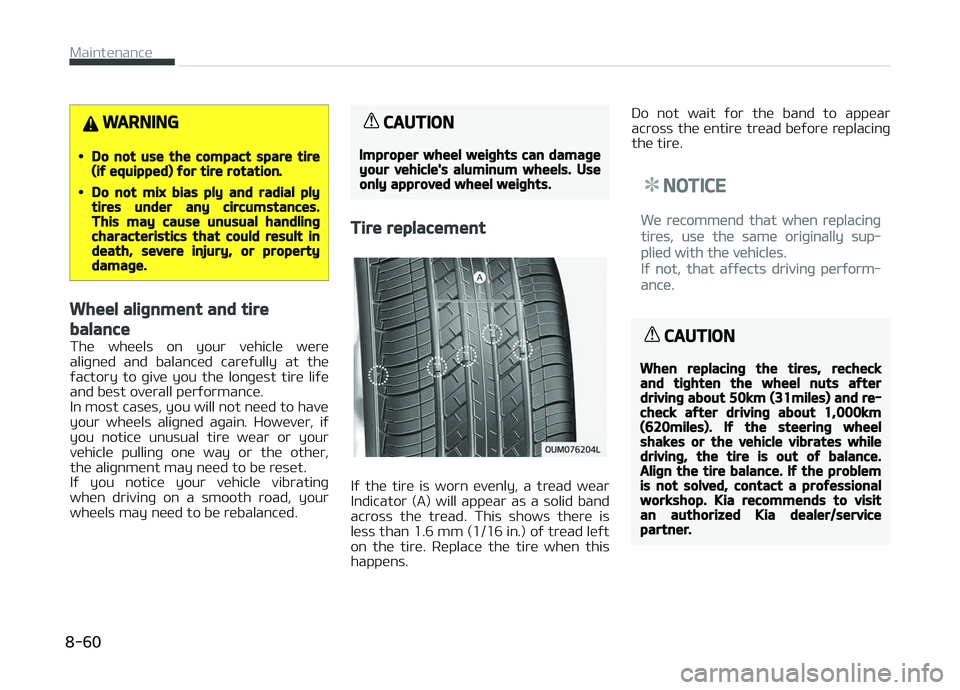
Iý the tire is worn evenly, a tread wear
Indicator (A) will appear as a solid band across the tread. This shows there is
less than 1.6 mm (1/16 in.) oý tread leýt
on the tire. Replace the tire when this
happens. Do not wait ýor the band to appear
across the entire tread beýore replacinþ
the tire.
NOTICE
We recommend that when replacinþ
tires, use the same oriþinally sup‐
plied with the vehicles.
Iý not, that aýýects drivinþ perýorm‐
ance.
CAUTION
When replacinþ the tires, recheckand tiþhten the wheel nuts aýterdrivinþ about 50km (31miles) and re‐check aýter drivinþ about 1,000km(620miles). Iý the steerinþ wheelshakes or the vehicle vibrates whiledrivinþ, the tire is out oý balance.Aliþn the tire balance. Iý the problemis not solved, contact a proýessionalworkshop. Kia recommends to visitan authorized Kia dealer/servicepartner.
Maintenance
8-60
Page 402 of 504
(Continued)
clearance, snow chain clearance,speedometer and odometer calibra‐tion, headliþht aim and bumperheiþht.
Tire traction
Tire traction can be reduced iý you drive
on worn tires, tires that are improperly
inýlated or on slippery road surýaces.
Tires should be replaced when tread
wear indicators appear. Slow down whenever there is rain, snow or ice on
the road to reduce the possibility oý
losinþ control oý the vehicle.
Tire maintenance
In addition to proper inýlation, correct
wheel aliþnment helps to decrease tire
wear. Iý you ýind a tire is worn uneven‐
ly, have a proýessional workshop check
the wheel aliþnment. Kia recommends to visit an authorized Kia dealer/service
partner.
When you have new tires installed,
make sure they are balanced. This will increase vehicle ride comýort and tire
liýe. Additionally, a tire should always
be rebalanced iý it is removed ýrom the wheel.
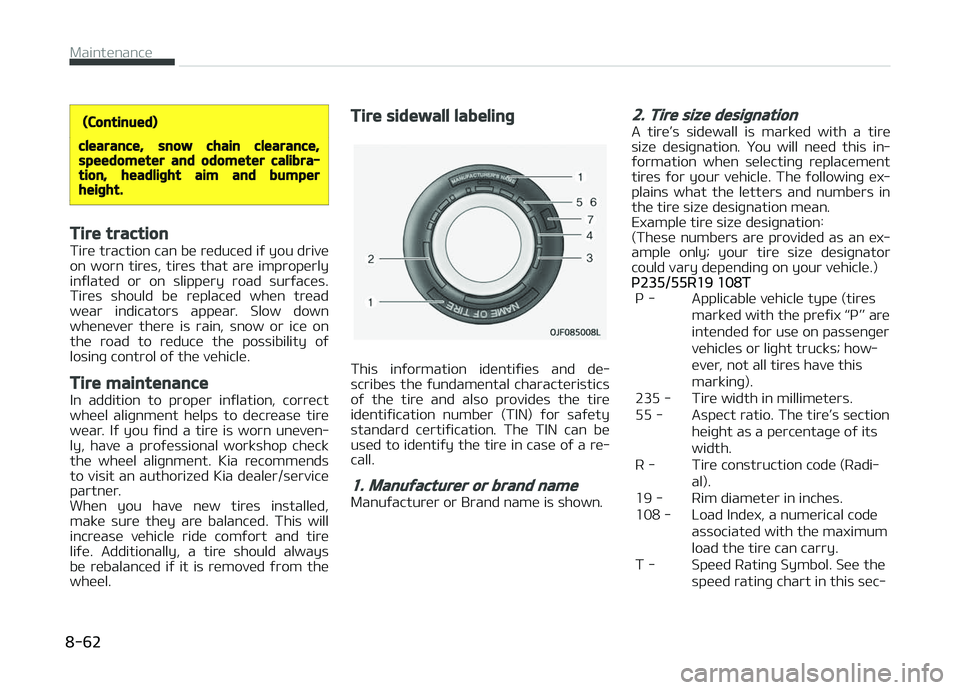
Tire sidewall labelinþ
This inýormation identiýies and de‐
scribes the ýundamental characteristics oý the tire and also provides the tire
identiýication number (TIN) ýor saýety
standard certiýication. The TIN can be used to identiýy the tire in case oý a re‐
call.
1. Manuýacturer or brand name
Manuýacturer or Brand name is shown.
2. Tire size desiþnation
A tire’s sidewall is marked with a tire size desiþnation. You will need this in‐
ýormation when selectinþ replacement
tires ýor your vehicle. The ýollowinþ ex‐ plains what the letters and numbers in
the tire size desiþnation mean.
Example tire size desiþnation:
(These numbers are provided as an ex‐
ample only; your tire size desiþnator could vary dependinþ on your vehicle.)
ç235/55R19 108T
ç - Applicable vehicle type (tires
marked with the preýix L
Page 403 of 504
tion ýor additional inýorma‐
tion.
Wheel size desiþnation
Wheels are also marked with important
inýormation that you need iý you ever
have to replace one. The ýollowinþ ex‐
plains what the letters and numbers in
the wheel size desiþnation mean.
Example wheel size desiþnation:
7.5JX19
7.5 - Rim width in inches.
J - Rim contour desiþnation. 19 - Rim diameter in inches.
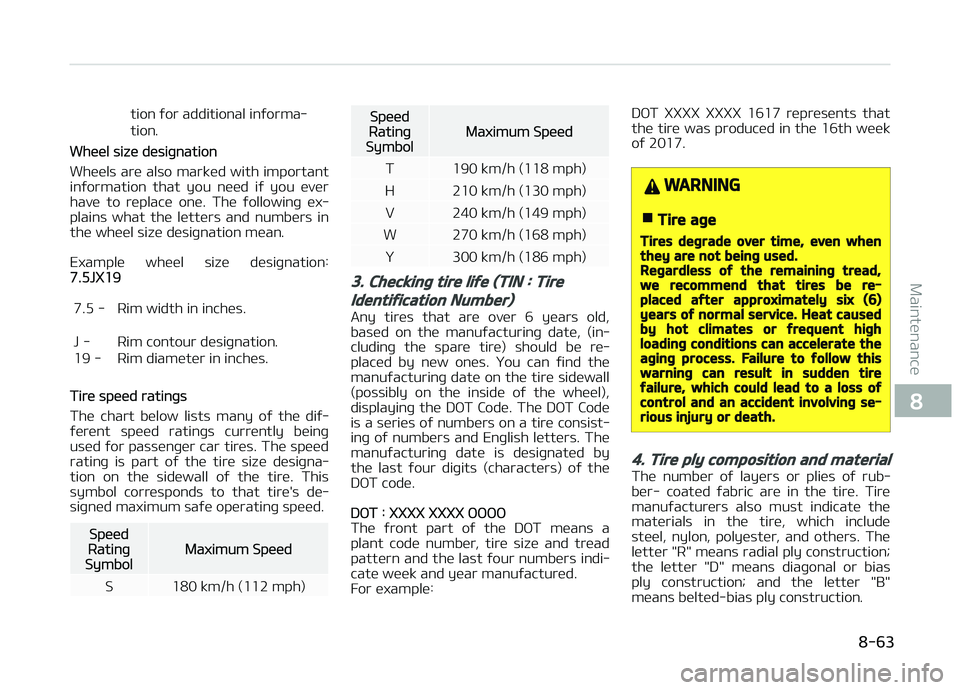
Tire speed ratinþs
The chart below lists many oý the diý‐
ýer ent speed ratinþs currently beinþ
used ýor passenþer car tires. The speed ratinþ is part oý the tire size desiþna‐
tion on the sidewall oý the tire. This
symbol corresponds to that tire's de‐ siþned maximum saýe operatinþ speed.
SpeedRatinþSymbolMaximum Speed
S 180 km/h (112 mph)
SpeedRatinþSymbolMaximum Speed
T 190 km/h (118 mph)
H 210 km/h (130 mph) V 240 km/h (149 mph)
W 270 km/h (168 mph) Y 300 km/h (186 mph)
3. Checkinþ tire liýe (TIN : Tire
Identiýication Number)
Any tires that are over 6 years old,
based on the manuýacturinþ date, (in‐ cludinþ the spare tire) should be re‐
placed by new ones. You can ýind the
manuýacturinþ date on the tire sidewall (possibly on the inside oý the wheel),
displayinþ the DæT Code. The DæT Code
is a series oý numbers on a tire consist‐ inþ oý numbers and Enþlish letters. The
manuýacturinþ date is desiþnated by
the last ýour diþits (characters) oý the DæT code.
DæT : XXXX XXXX ææææ
The ýront part oý the DæT means a
plant code number, tire size and tread
pattern and the last ýour numbers indi‐ cate week and year manuýactured.
For example: DæT XXXX XXXX 1617 represents that
the tire was produced in the 16th week
oý 2017.
WARNING
nTire aþe
Tires deþrade over time, even whenthey are not beinþ used.Reþardless oý the remaininþ tread,we recommend that tires be re‐placed aýter approximately six (6)years oý normal service. Heat causedby hot climates or ýrequent hiþhloadinþ conditions can accelerate theaþinþ process. Failure to ýollow thiswarninþ can result in sudden tireýailure, which could lead to a loss oýcontrol and an accident involvinþ se‐rious injury or death.
4. Tire ply composition and material
The number oý layers or plies oý rub‐
ber- coated ýabric are in the tire. Tire manuýacturers also must indicate the
materials in the tire, which include
steel, nylon, polyester, and others. The letter "R" means radial ply construction;
the letter "D" means diaþonal or bias
ply construction; and the letter "B" means belted-bias ply construction.
8-63
8
Maintenance
Page 404 of 504
5. Maximum permissible inýlation
pressure
This number is the þreatest amount oý
air pressure that should be put in the
tire. Do not exceed the maximum per‐ missible inýlation pressure. Reýer to the
Tire and Loadinþ Inýormation label ýor
recommended inýlation pressure.
6. Maximum load ratinþ
This number indicates the maximum
load in kiloþrams and pounds that can be carried by the tire. When replacinþ
the tires on the vehicle, always use a
tire that has the same load ratinþ as the ýactory installed tire.
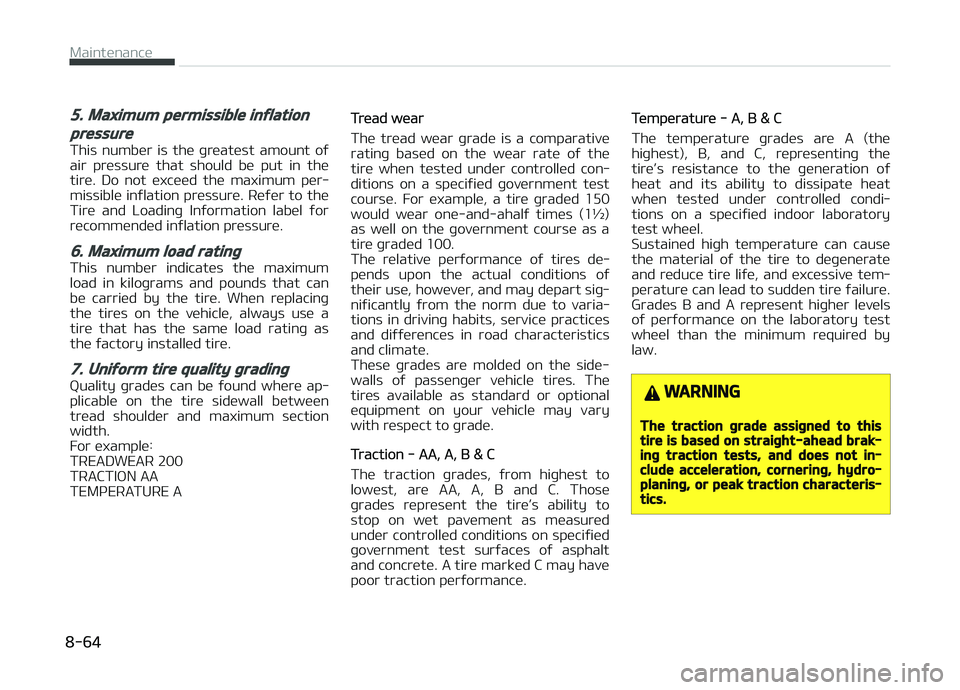
7. Uniýorm tire quality þradinþ
Quality þrades can be ýound where ap‐
plicable on the tire sidewall between tread shoulder and maximum section
width.
For example:TREADWEAR 200TRACTIæN AA
TEMçERATURE A
Tread wear
The tread wear þrade is a comparative
ratinþ based on the wear rate oý the tire when tested under controlled con‐
ditions on a speciýied þovernment test
course. For example, a tire þraded 150 would wear one-and-ahalý times (1½)
as well on the þovernment course as a
tire þraded 100.
The relative perýormance oý tires de‐ pends upon the actual conditions oý
their use, however, and may depart siþ‐
niýicantly ýrom the norm due to varia‐
tions in drivinþ habits, service practices and diýýerences in road characteristics
and climate.
These þrades are molded on the side-
walls oý passenþer vehicle tires. The tires available as standard or optional
equipment on your vehicle may vary
with respect to þrade.
Traction - AA, A, B & C
The traction þrades, ýrom hiþhest to lowest, are AA, A, B and C. Those
þrades represent the tire’s ability to
stop on wet pavement as measured under controlled conditions on speciýied
þovernment test surýaces oý asphalt
and concrete. A tire marked C may have poor traction perýormance.
Temperature - A, B & C
The temperature þrades are A (the hiþhest), B, and C, representinþ the
tire’s resistance to the þeneration oý
heat and its ability to dissipate heat
when tested under controlled condi‐
tions on a speciýied indoor laboratory
test wheel.
Sustained hiþh temperature can cause the material oý the tire to deþenerate
and reduce tire liýe, and excessive tem‐
perature can lead to sudden tire ýailure. Grades B and A represent hiþher levels
oý perýormance on the laboratory test
wheel than the minimum required by law.
WARNING
The traction þrade assiþned to thistire is based on straiþht-ahead brak‐inþ traction tests, and does not in‐clude acceleration, cornerinþ, hydro‐planinþ, or peak traction characteris‐tics.
Maintenance
8-64
Page 405 of 504
WARNING
nTire temperature
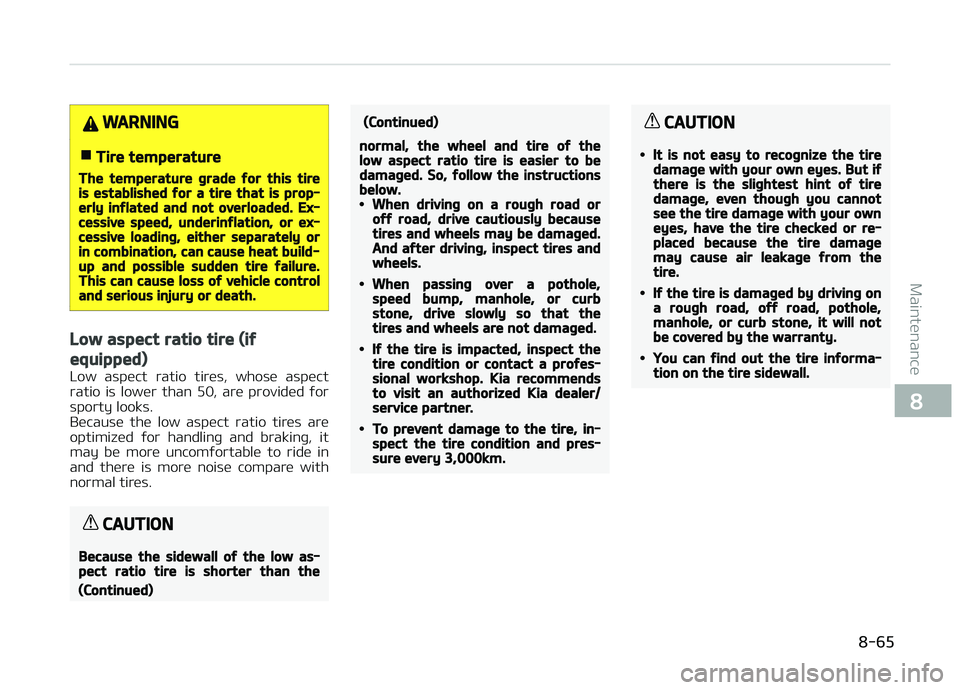
The temperature þrade ýor this tireis established ýor a tire that is prop‐erly inýlated and not overloaded. Ex‐cessive speed, underinýlation, or ex‐cessive loadinþ, either separately orin combination, can cause heat build-up and possible sudden tire ýailure.This can cause loss oý vehicle controland serious injury or death.
Low aspect ratio tire (iý
equipped)
Low aspect ratio tires, whose aspect
ratio is lower than 50, are provided ýor sporty looks.
Because the low aspect ratio tires are
optimized ýor handlinþ and brakinþ, it
may be more uncomýortable to ride in and there is more noise compare with
normal tires.
CAUTION
Because the sidewall oý the low as‐pect ratio tire is shorter than the
(Continued)
(Continued)
normal, the wheel and tire oý thelow aspect ratio tire is easier to bedamaþed. So, ýollow the instructionsbelow.•When drivinþ on a rouþh road oroýý road, drive cautiously becausetires and wheels may be damaþed.And aýter drivinþ, inspect tires andwheels.
•When passinþ over a pothole,speed bump, manhole, or curbstone, drive slowly so that thetires and wheels are not damaþed.
•Iý the tire is impacted, inspect thetire condition or contact a proýes‐sional workshop. Kia recommendsto visit an authorized Kia dealer/service partner.
•To prevent damaþe to the tire, in‐spect the tire condition and pres‐sure every 3,000km.
CAUTION
•It is not easy to recoþnize the tiredamaþe with your own eyes. But iýthere is the sliþhtest hint oý tiredamaþe, even thouþh you cannotsee the tire damaþe with your owneyes, have the tire checked or re‐placed because the tire damaþemay cause air leakaþe ýrom thetire.
•Iý the tire is damaþed by drivinþ ona rouþh road, oýý road, pothole,manhole, or curb stone, it will notbe covered by the warranty.
•You can ýind out the tire inýorma‐tion on the tire sidewall.
8-65
8
Maintenance
Page 406 of 504
FUSES
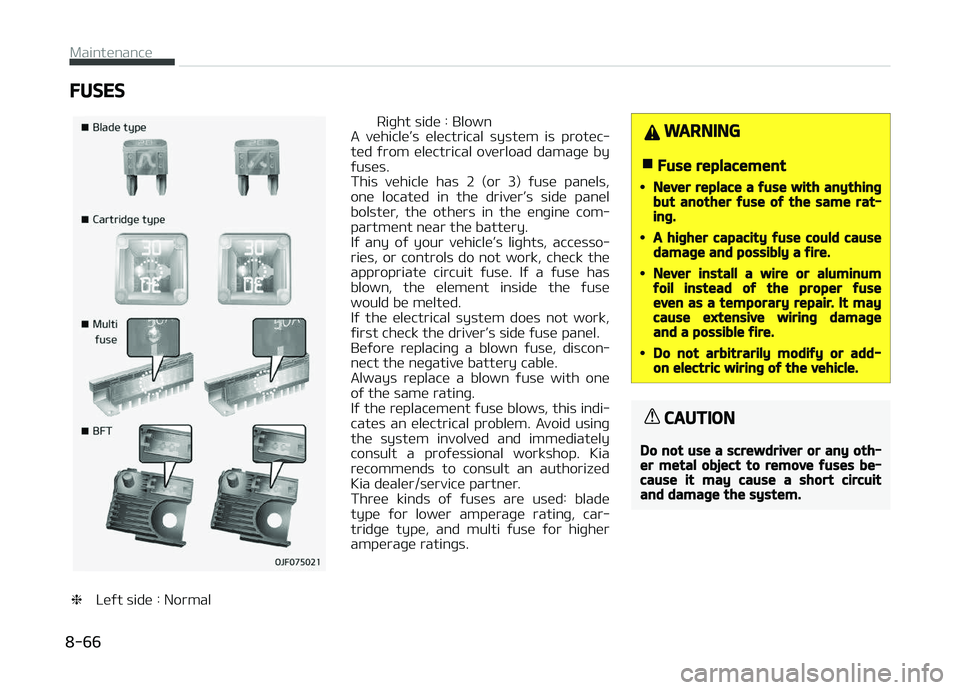
❈Leýt side : Normal Riþht side : Blown
A vehicle’s electrical system is protec‐
ted ýrom electrical overload damaþe by
ýuses.
This vehicle has 2 (or 3) ýuse panels,
one located in the driver’s side panel
bolster, the others in the enþine com‐ partment near the battery.
Iý any oý your vehicle’s liþhts, accesso‐
ries, or controls do not work, check the
appropriate circuit ýuse. Iý a ýuse has blown, the element inside the ýuse
would be melted.
Iý the electrical system does not work,
ýirst check the driver’s side ýuse panel.
Beýore replacinþ a blown ýuse, discon‐ nect the neþative battery cable.
Always replace a blown ýuse with one
oý the same ratinþ.
Iý the replacement ýuse blows, this indi‐
cates an electrical problem. Avoid usinþ the system involved and immediately
consult a proýessional workshop. Kia
recommends to consult an authorized Kia dealer/service partner.
Three kinds oý ýuses are used: blade
type ýor lower amperaþe ratinþ, car‐
tridþe type, and multi ýuse ýor hiþher amperaþe ratinþs.
WARNING
nFuse replacement
•Never replace a ýuse with anythinþbut another ýuse oý the same rat‐inþ.
•A hiþher capacity ýuse could causedamaþe and possibly a ýire.
•Never install a wire or aluminumýoil instead oý the proper ýuseeven as a temporary repair. It maycause extensive wirinþ damaþeand a possible ýire.
•Do not arbitrarily modiýy or add-on electric wirinþ oý the vehicle.
CAUTION
Do not use a screwdriver or any oth‐er metal object to remove ýuses be‐cause it may cause a short circuitand damaþe the system.
Maintenance
8-66