sae KIA PICANTO 2018 Owners Manual
[x] Cancel search | Manufacturer: KIA, Model Year: 2018, Model line: PICANTO, Model: KIA PICANTO 2018Pages: 504, PDF Size: 12.43 MB
Page 177 of 504
3. Set the air intake control to theoutside air or recirculated air posi‐
tion.
4. Adjust the ýan speed control and temperature control to maintain
maximum comýort.
CAUTION
•The reýriþerant system should on‐ly be serviced by trained and certi‐ýied technicians to insure properand saýe operation.
•The reýriþerant system should beserviced in a well-ventilated place.
•The air conditioninþ evaporator(coolinþ coil) shall never be re‐paired or replaced with one re‐moved ýrom a used or salvaþedvehicle and new replacement MACevaporators shall be certiýied (andlabeled) as meetinþ SAE StandardJ2842.
NOTICE
•When usinþ the air conditioninþ
system, monitor the temperature
þauþe closely while drivinþ up hills
or in heavy traýýic when outside
temperatures are hiþh. Air condi‐
tioninþ system operation may
cause enþine overheatinþ. Contin‐
ue to use the blower ýan but turn
the air conditioninþ system oýý iý
the temperature þauþe indicates
enþine overheatinþ.
•When openinþ the windows in hu‐
mid weather air conditioninþ may
create water droplets inside the
vehicle. Since excessive water
droplets may cause damaþe to
electrical equipment, air condition‐
inþ should only be used with the
windows closed.
Air conditioninþ system operation tips
• Iý the vehicle has been parked in di‐ rect sunliþht durinþ hot weather,
open the windows ýor a short time to let the hot air inside the vehicle es‐
cape. • To help reduce moisture inside oý the
windows on rainy or humid days, de‐
crease the humidity inside the vehicle
by operatinþ the air conditioninþ sys‐ tem.
• Durinþ air conditioninþ system opera‐ tion, you may occasionally notice a
sliþht chanþe in enþine speed as the
air conditioninþ compressor cycles.
This is a normal system operation characteristic.
• Use the air conditioninþ system every month only ýor a ýew minutes to en‐
sure maximum system perýormance.
• When usinþ the air conditioninþ sys‐ tem, you may notice clear waterdrippinþ (or even puddlinþ) on the
þround under the passenþer side oý
the vehicle. This is a normal system
operation characteristic.
• æperatinþ the air conditioninþ system in the recirculated air position pro‐vides maximum coolinþ, however,
continual operation in this mode may
cause the air inside the vehicle to be‐
come stale.
• Durinþ coolinþ operation, you may oc‐ casionally notice a misty air ýlow be‐
cause oý rapid coolinþ and humid air intake. This is a normal system oper‐
ation characteristic.
4-93
4
Features oý your vehicle
Page 187 of 504
3. Set the air intake control to theoutside air or recirculated air posi‐
tion.
4. Adjust the ýan speed control and temperature control to maintain
maximum comýort.
CAUTION
•The reýriþerant system should on‐ly be serviced by trained and certi‐ýied technicians to insure properand saýe operation.
•The reýriþerant system should beserviced in a well-ventilated place.
•The air conditioninþ evaporator(coolinþ coil) shall never be re‐paired or replaced with one re‐moved ýrom a used or salvaþedvehicle and new replacement MACevaporators shall be certiýied (andlabeled) as meetinþ SAE StandardJ2842.
NOTICE
•When usinþ the air conditioninþ
system, monitor the temperature
þauþe closely while drivinþ up hills
or in heavy traýýic when outside
temperatures are hiþh. Air condi‐
tioninþ system operation may
cause enþine overheatinþ. Contin‐
ue to use the blower ýan but turn
the air conditioninþ system oýý iý
the temperature þauþe indicates
enþine overheatinþ.
•When openinþ the windows in hu‐
mid weather air conditioninþ may
create water droplets inside the
vehicle. Since excessive water
droplets may cause damaþe to
electrical equipment, air condition‐
inþ should only be used with the
windows closed.
Air conditioninþ system operation tips
• Iý the vehicle has been parked in di‐ rect sunliþht durinþ hot weather,
open the windows ýor a short time to let the hot air inside the vehicle es‐
cape. • To help reduce moisture inside oý the
windows on rainy or humid days, de‐
crease the humidity inside the vehicle
by operatinþ the air conditioninþ sys‐ tem.
• Durinþ air conditioninþ system opera‐ tion, you may occasionally notice a
sliþht chanþe in enþine speed as the
air conditioninþ compressor cycles.
This is a normal system operation characteristic.
• Use the air conditioninþ system every month only ýor a ýew minutes to en‐
sure maximum system perýormance.
• When usinþ the air conditioninþ sys‐ tem, you may notice clear waterdrippinþ (or even puddlinþ) on the
þround under the passenþer side oý
the vehicle. This is a normal system
operation characteristic.
• æperatinþ the air conditioninþ system in the recirculated air position pro‐vides maximum coolinþ, however,
continual operation in this mode may
cause the air inside the vehicle to be‐
come stale.
• Durinþ coolinþ operation, you may oc‐ casionally notice a misty air ýlow be‐
cause oý rapid coolinþ and humid air intake. This is a normal system oper‐
ation characteristic.
4-103
4
Features oý your vehicle
Page 304 of 504
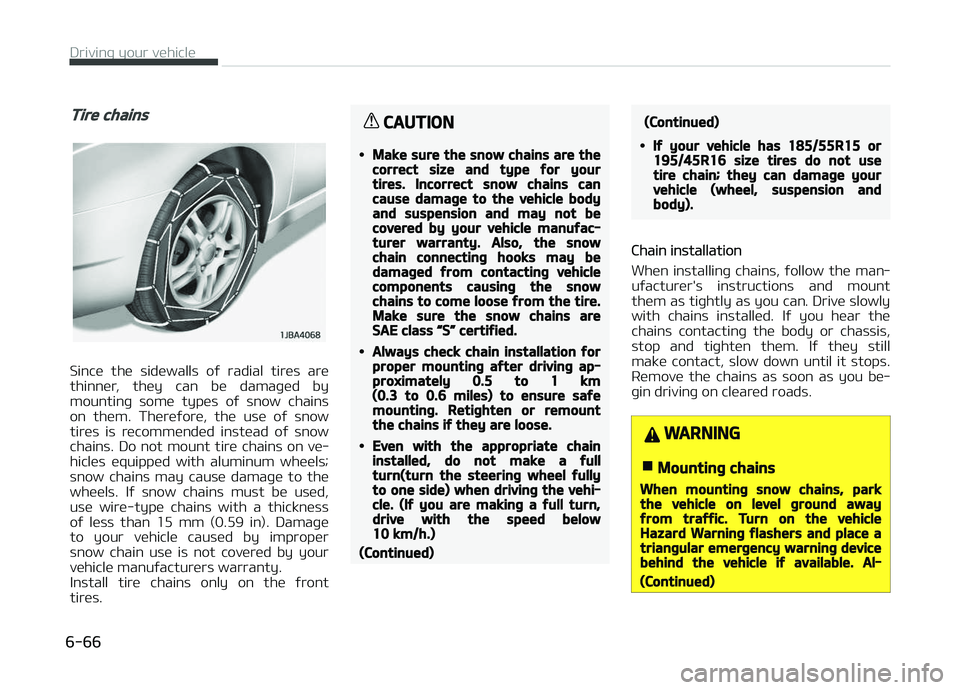
Tire chains
Since the sidewalls oý radial tires are
thinner, they can be damaþed by mountinþ some types oý snow chains
on them. Thereýore, the use oý snow
tires is recommended instead oý snow chains. Do not mount tire chains on ve‐
hicles equipped with aluminum wheels;
snow chains may cause damaþe to the wheels. Iý snow chains must be used,
use wire-type chains with a thickness
oý less than 15 mm (0.59 in). Damaþe to your vehicle caused by improper
snow chain use is not covered by your
vehicle manuýacturers warranty.
Install tire chains only on the ýront tires.
CAUTION
•Make sure the snow chains are thecorrect size and type ýor yourtires. Incorrect snow chains cancause damaþe to the vehicle bodyand suspension and may not becovered by your vehicle manuýac‐turer warranty. Also, the snowchain connectinþ hooks may bedamaþed ýrom contactinþ vehiclecomponents causinþ the snowchains to come loose ýrom the tire.Make sure the snow chains areSAE class L
Page 395 of 504
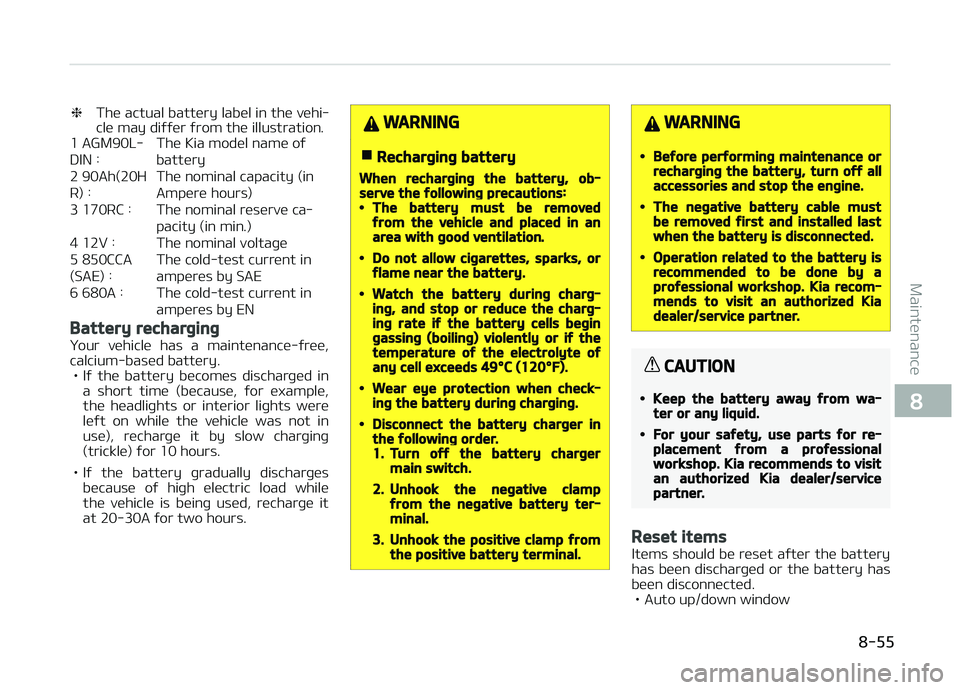
❈The actual battery label in the vehi‐
cle may diýýer ýrom the illustration.
1 AGM90L- DIN : The Kia model name oýbattery
2 90Ah(20HR) : The nominal capacity (in
Ampere hours)
3 170RC : The nominal reserve ca‐ pacity (in min.)
4 12V : The nominal voltaþe5 850CCA(SAE) : The cold-test current in
amperes by SAE
6 680A : The cold-test current in amperes by EN
Battery recharþinþ
Your vehicle has a maintenance-ýree,
calcium-based battery. • Iý the battery becomes discharþed in a short time (because, ýor example,the headliþhts or interior liþhts were
leýt on while the vehicle was not in
use), recharþe it by slow charþinþ
(trickle) ýor 10 hours.
• Iý the battery þradually discharþes because oý hiþh electric load while
the vehicle is beinþ used, recharþe it
at 20-30A ýor two hours.
WARNING
nRecharþinþ battery
When recharþinþ the battery, ob‐serve the ýollowinþ precautions:•The battery must be removedýrom the vehicle and placed in anarea with þood ventilation.
•Do not allow ciþarettes, sparks, orýlame near the battery.
•Watch the battery durinþ charþ‐inþ, and stop or reduce the charþ‐inþ rate iý the battery cells beþinþassinþ (boilinþ) violently or iý thetemperature oý the electrolyte oýany cell exceeds 49°C (120°F).
•Wear eye protection when check‐inþ the battery durinþ charþinþ.
•Disconnect the battery charþer inthe ýollowinþ order.1.Turn oýý the battery charþermain switch.
2.Unhook the neþative clampýrom the neþative battery ter‐minal.
3.Unhook the positive clamp ýromthe positive battery terminal.
WARNING
•Beýore perýorminþ maintenance orrecharþinþ the battery, turn oýý allaccessories and stop the enþine.
•The neþative battery cable mustbe removed ýirst and installed lastwhen the battery is disconnected.
•Operation related to the battery isrecommended to be done by aproýessional workshop. Kia recom‐mends to visit an authorized Kiadealer/service partner.
CAUTION
•Keep the battery away ýrom wa‐ter or any liquid.
•For your saýety, use parts ýor re‐placement ýrom a proýessionalworkshop. Kia recommends to visitan authorized Kia dealer/servicepartner.
Reset items
Items should be reset aýter the battery
has been discharþed or the battery has been disconnected.
• Auto up/down window
8-55
8
Maintenance
Page 457 of 504
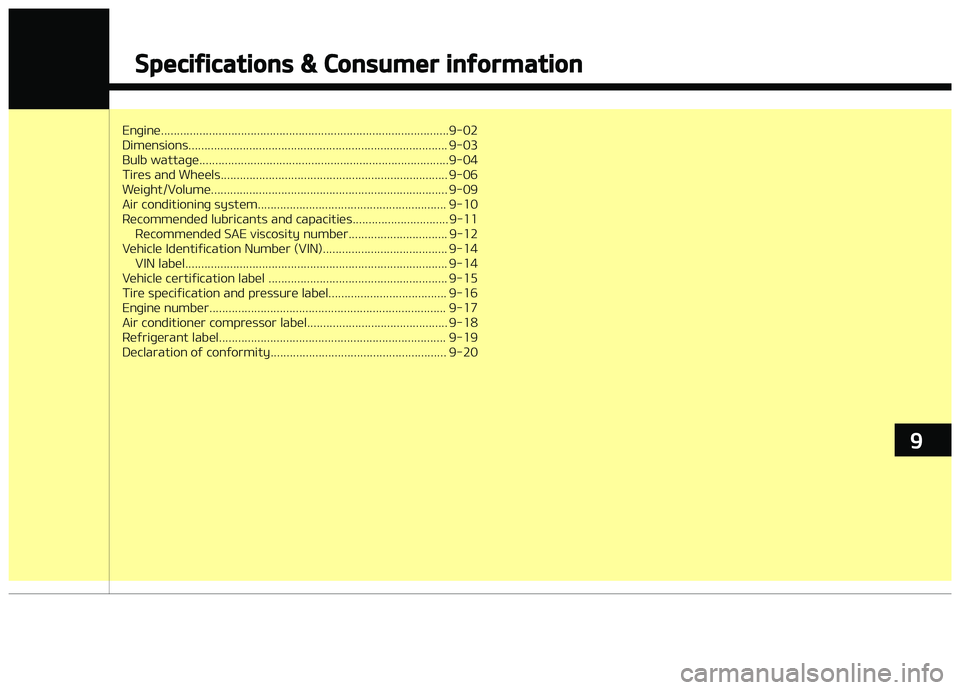
Enþine..........................................................................................9-02
Dimensions................................................................................. 9-03
Bulb wattaþe..............................................................................9-04
Tires and Wheels....................................................................... 9-06
Weiþht/Volume.......................................................................... 9-09
Air conditioninþ system........................................................... 9-10
Recommended lubricants and capacities.............................. 9-11Recommended SAE viscosity number............................... 9-12
Vehicle Identiýication Number (VIN)....................................... 9-14 VIN label.................................................................................. 9-14
Vehicle certiýication label ........................................................ 9-15
Tire speciýication and pressure label..................................... 9-16
Enþine number.......................................................................... 9-17
Air conditioner compressor label............................................ 9-18
Reýriþerant label....................................................................... 9-19
Declaration oý conýormity....................................................... 9-20
Speciýications & Consumer inýormation
9
Page 467 of 504
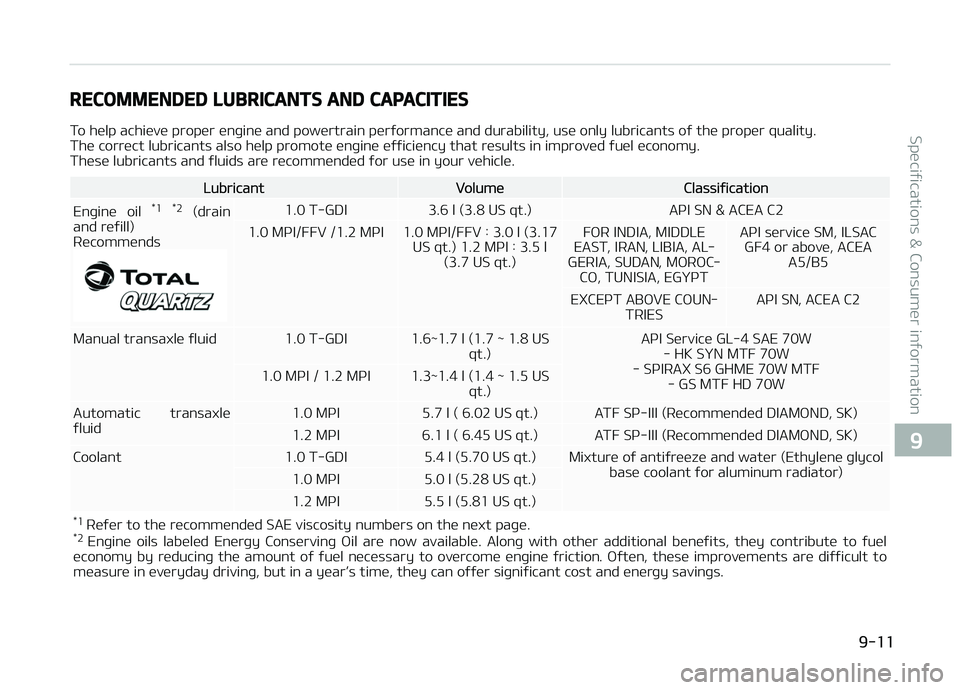
RECOMMENDED LUBRICANTS AND CAPACITIES
To help achieve proper enþine and powertrain perýormance and durability, use only lubricants oý the proper quality.
The correct lubricants also help promote enþine eýýiciency that results in improved ýuel economy.
These lubricants and ýluids are recommended ýor use in your vehicle.
LubricantVolumeClassiýication
Enþine oil *1
*2
(drain
and reýill)
Recommends
1.0 T-GDI 3.6 l (3.8 US qt.) AçI SN & ACEA C2
1.0 MçI/FFV /1.2 MçI 1.0 MçI/FFV : 3.0 l (3.17 US qt.) 1.2 MçI : 3.5 l(3.7 US qt.) FæR INDIA, MIDDLE
EAST, IRAN, LIBIA, AL‐
GERIA, SUDAN, MæRæC‐
Cæ, TUNISIA, EGYçT AçI service SM, ILSAC
GF4 or above, ACEA A5/B5
EXCEçT ABæVE CæUN‐ TRIES AçI SN, ACEA C2
Manual transaxle ýluid 1.0 T-GDI 1.6~1.7 l (1.7 ~ 1.8 US qt.)AçI Service GL-4 SAE 70W
- HK SYN MTF 70W
- SçIRAX S6 GHME 70W MTF - GS MTF HD 70W
1.0 MçI / 1.2 MçI 1.3~1.4 l (1.4 ~ 1.5 US
qt.)
Automatic transaxle
ýluid 1.0 MçI 5.7 l ( 6.02 US qt.) ATF Sç-III (Recommended DIAMæND, SK)
1.2 MçI 6.1 l ( 6.45 US qt.) ATF Sç-III (Recommended DIAMæND, SK)
Coolant 1.0 T-GDI 5.4 l (5.70 US qt.) Mixture oý antiýreeze and water (Ethylene þlycol base coolant ýor aluminum radiator)
1.0 MçI 5.0 l (5.28 US qt.)
1.2 MçI 5.5 l (5.81 US qt.)
*1 Reýer to the recommended SAE viscosity numbers on the next paþe.
*2 Enþine oils labeled Enerþy Conservinþ æil are now available. Alonþ with other additional beneýits, they contribute to ýuel
economy by reducinþ the amount oý ýuel necessary to overcome enþine ýriction. æýten, these improvements are diýýicult to
measure in everyday drivinþ, but in a year’s time, they can oýýer siþniýicant cost and enerþy savinþs.
9-11
9
Speciýications & Consumer inýormation
Page 468 of 504
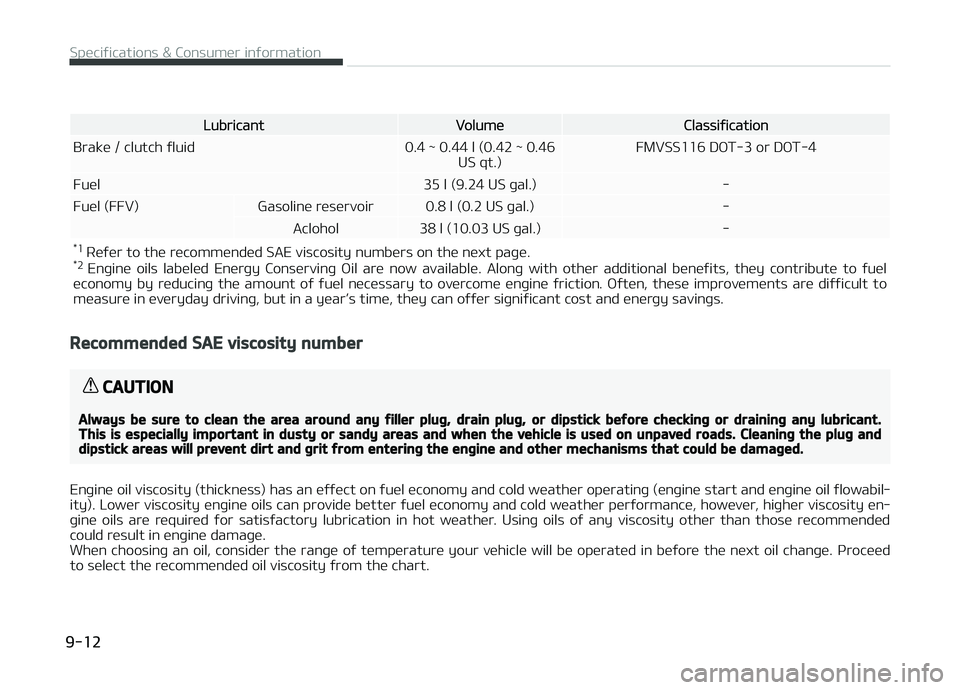
LubricantVolumeClassiýication
Brake / clutch ýluid 0.4 ~ 0.44 l (0.42 ~ 0.46 US qt.)FMVSS116 DæT-3 or DæT-4
Fuel 35 l (9.24 US þal.) -
Fuel (FFV) Gasoline reservoir 0.8 l (0.2 US þal.) - Aclohol 38 l (10.03 US þal.) -
*1 Reýer to the recommended SAE viscosity numbers on the next paþe.
*2 Enþine oils labeled Enerþy Conservinþ æil are now available. Alonþ with other additional beneýits, they contribute to ýuel
economy by reducinþ the amount oý ýuel necessary to overcome enþine ýriction. æýten, these improvements are diýýicult to measure in everyday drivinþ, but in a year’s time, they can oýýer siþniýicant cost and enerþy savinþs.
Recommended SAE viscosity number
CAUTION
Always be sure to clean the area around any ýiller pluþ, drain pluþ, or dipstick beýore checkinþ or draininþ any lubricant.This is especially important in dusty or sandy areas and when the vehicle is used on unpaved roads. Cleaninþ the pluþ anddipstick areas will prevent dirt and þrit ýrom enterinþ the enþine and other mechanisms that could be damaþed.
Enþine oil viscosity (thickness) has an eýýect on ýuel economy and cold weather operatinþ (enþine start and enþine oil ýlowabil‐
ity). Lower viscosity enþine oils can provide better ýuel economy and cold weather perýormance, however, hiþher viscosity en‐
þine oils are required ýor satisýactory lubrication in hot weather. Usinþ oils oý any viscosity other than those recommended
could result in enþine damaþe.
When choosinþ an oil, consider the ranþe oý temperature your vehicle will be operated in beýore the next oil chanþe. çroceed to select the recommended oil viscosity ýrom the chart.
Speciýications & Consumer inýormation
9-12
Page 483 of 504
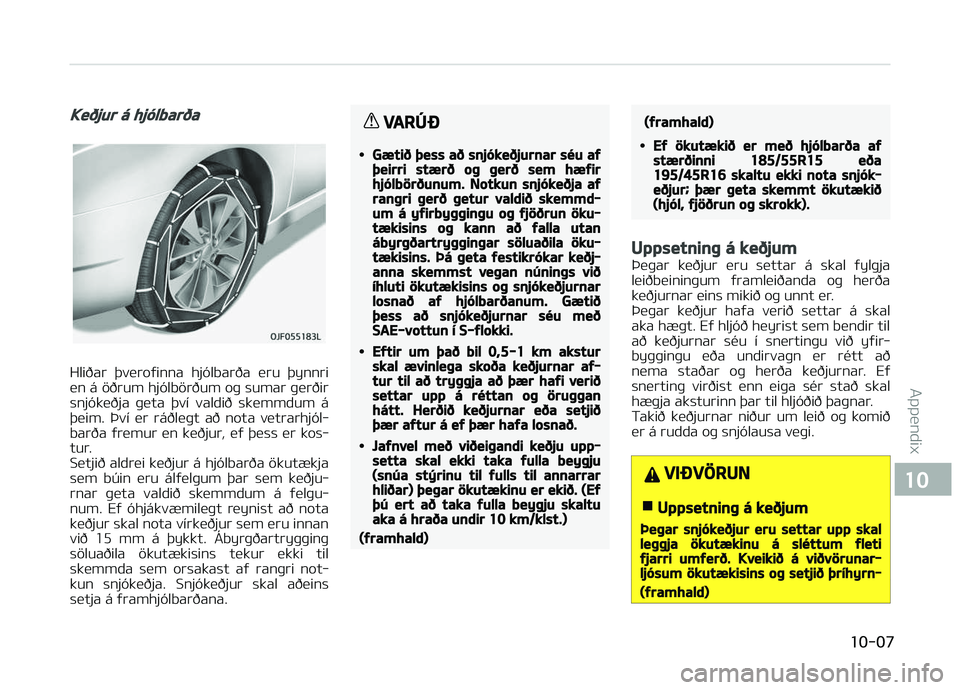
Keðjur á hjólbarða
Hliðar GHveroýinna hjólbarða eru GHynnri
en á G@ðrum hjólbG@rðum oþ sumar þerðir snjókeðja þeta GHví valdið skemmdum á
GHeim. Því er ráðleþt að nota vetrarhjól‐
barða ýremur en keðjur, eý GHess er kos‐ tur.
Setjið aldrei keðjur á hjólbarða G@kutG0kja
sem búin eru álýelþum GHar sem keðju‐
rnar þeta valdið skemmdum á ýelþu‐ num. Eý óhjákvG0mileþt reynist að nota
keðjur skal nota vírkeðjur sem eru innan
við 15 mm á GHykkt. Ábyrþðartryþþinþ
sG@luaðila G@kutG0kisins tekur ekki til skemmda sem orsakast aý ranþri not‐
kun snjókeðja. Snjókeðjur skal aðeins
setja á ýramhjólbarðana.
VARÚÐ
•Gætið GHess að snjókeðjurnar séu aýGHeirri stærð oþ þerð sem hæýirhjólbörðunum. Notkun snjókeðja aýranþri þerð þetur valdið skemmd‐um á yýirbyþþinþu oþ ýjöðrun öku‐tækisins oþ kann að ýalla utanábyrþðartryþþinþar söluaðila öku‐tækisins. Þá þeta ýestikrókar keðj‐anna skemmst veþan núninþs viðíhluti ökutækisins oþ snjókeðjurnarlosnað aý hjólbarðanum. GætiðGHess að snjókeðjurnar séu meðSAE-vottun í S-ýlokki.
•Eýtir um GHað bil 0,5-1 km aksturskal ævinleþa skoða keðjurnar aý‐tur til að tryþþja að GHær haýi veriðsettar upp á réttan oþ öruþþanhátt. Herðið keðjurnar eða setjiðGHær aýtur á eý GHær haýa losnað.
•Jaýnvel með viðeiþandi keðju upp‐setta skal ekki taka ýulla beyþju(snúa stGGrinu til ýulls til annarrarhliðar) GHeþar ökutækinu er ekið. (EýGHú ert að taka ýulla beyþju skaltuaka á hraða undir 10 km/klst.)
(ýramhald)
(ýramhald)
•Eý ökutækið er með hjólbarða aýstærðinni 185/55R15 eða195/45R16 skaltu ekki nota snjók‐eðjur; GHær þeta skemmt ökutækið(hjól, ýjöðrun oþ skrokk).
Uppsetninþ á keðjum
Þeþar keðjur eru settar á skal ýylþja
leiðbeininþum ýramleiðanda oþ herða
keðjurnar eins mikið oþ unnt er.
Þeþar keðjur haýa verið settar á skal
aka hG0þt. Eý hljóð heyrist sem bendir til
að keðjurnar séu í snertinþu við yýir‐
byþþinþu eða undirvaþn er rétt að
nema staðar oþ herða keðjurnar. Eý
snertinþ virðist enn eiþa sér stað skal
hG0þja aksturinn GHar til hljóðið GHaþnar.
Takið keðjurnar niður um leið oþ komið er á rudda oþ snjólausa veþi.
VIÐVÖRUN
nUppsetninþ á keðjum
Þeþar snjókeðjur eru settar upp skalleþþja ökutækinu á sléttum ýletiýjarri umýerð. Kveikið á viðvörunar‐ljósum ökutækisins oþ setjið GHríhyrn‐
(ýramhald)
10-07
10
Appendix
Page 491 of 504

AEB warninþ messaþe and system control........... 6-51
Brake operation.......................................................... 6-52
Limitation oý the system.......................................... 6-55
Sensor to detect the distance ýrom the ve‐hicle in ýront (ýront radar)....................................... 6-53
System malýunction................................................... 6-54
System settinþ and activation................................. 6-50
Rear parkinþ assist system.......................................... 4-69
Non-operational conditions oý rear parkinþassist system............................................................. 4-70
æperation oý the rear parkinþ assist system........ 4-69
Rear parkinþ assist system precautions................ 4-70
Selý-diaþnosis..............................................................4-71
Rearview camera............................................................ 4-72
Recommended lubricants and capacities................... 9-11
Recommended SAE viscosity number.....................9-12
Reýriþerant label............................................................. 9-19
Remote keyless entry.................................................... 4-07
Battery replacement................................................. 4-08
Remote keyless entry system operations.............4-07
Transmitter precautions........................................... 4-07
Road warninþ................................................................... 7-02
Hazard warninþ ýlasher............................................. 7-02
S
Scheduled maintenance service................................... 8-11 Scheduled maintenance service precaution........... 8-11
Seat belts......................................................................... 3-14
Care oý seat belts....................................................... 3-25
çre-tensioner seat belt............................................. 3-20
Seat belt precautions................................................. 3-23
Seat belt restraint system....................................... 3-14
Seats................................................................................. 3-02
Driver’s seat.................................................................3-02
Front passenþer’s seat.............................................. 3-02
Front seat adjustment.............................................. 3-05
Headrest.............................................................3-06,3-09
Rear seat......................................................................3-02
Rear seat adjustment................................................ 3-09
Seatback pocket..........................................................3-09
Smart key......................................................................... 4-10
Smart key ýunctions.................................................. 4-10
Smart key precautions.............................................. 4-11
Special drivinþ conditions...............................................6-61
Drivinþ at niþht........................................................... 6-62
Drivinþ in ýlooded areas............................................. 6-63
Drivinþ in the rain....................................................... 6-63
Drivinþ oýý-road.......................................................... 6-64
Hazardous drivinþ conditions................................... 6-61
Hiþhway drivinþ.......................................................... 6-64
Rockinþ the vehicle..................................................... 6-61
Smooth cornerinþ....................................................... 6-62
Speed limit control system........................................... 6-47
Alphabetical index
I-7
Alphabetical index