ECO mode KIA QUORIS 2015 Owner's Manual
[x] Cancel search | Manufacturer: KIA, Model Year: 2015, Model line: QUORIS, Model: KIA QUORIS 2015Pages: 486, PDF Size: 35.55 MB
Page 272 of 486
![KIA QUORIS 2015 Owners Manual Driving your vehicle
28
5
Moving up a steep grade from a
standing start
To move up a steep grade from a
standing start, depress the brake
pedal, shift the shift lever to D (Drive)
or [1st] gear of [M](/img/2/57972/w960_57972-271.png "KIA QUORIS 2015 Owners Manual Driving your vehicle
28
5
Moving up a steep grade from a
standing start
To move up a steep grade from a
standing start, depress the brake
pedal, shift the shift lever to D (Drive)
or [1st] gear of [M")
Driving your vehicle
28
5
Moving up a steep grade from a
standing start
To move up a steep grade from a
standing start, depress the brake
pedal, shift the shift lever to D (Drive)
or [1st] gear of [M] mode. Select the
appropriate gear depending on load
weight and steepness of the grade,
and release the parking brake.
Depress the accelerator gradually
while releasing the service brakes.
WARNING
If your vehicle becomes stuck in
snow, mud, sand, etc., then you
may attempt to rock the vehicle
free by moving it forward and
backward. Do not attempt this
procedure if people or objects
are anywhere near the vehicle.
During the rocking operation the
vehicle may suddenly move for-
ward or backward as it becomes
unstuck, causing injury or dam-
age to nearby people or objects.
Page 298 of 486
Driving your vehicle
54
5
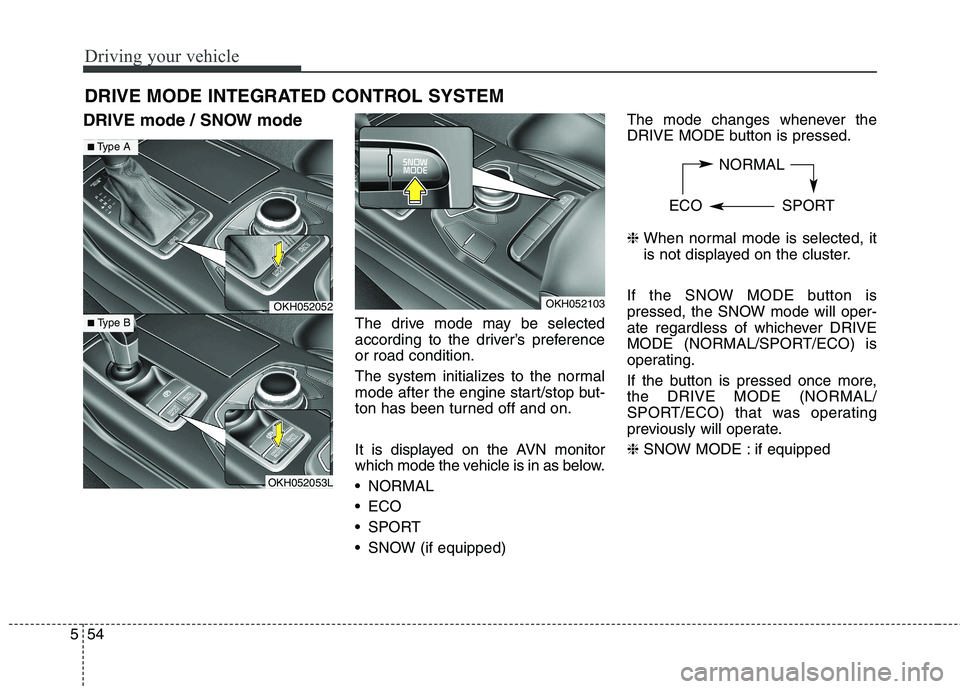
DRIVE mode / SNOW mode
The drive mode may be selected
according to the driver’s preferenceor road condition.
The system initializes to the normal
mode after the engine start/stop but-
ton has been turned off and on.
It is displayed on the AVN monitor
which mode the vehicle is in as below.
NORMAL
ECO
SPORT
SNOW (if equipped)The mode changes whenever the
DRIVE MODE button is pressed. ❈
When normal mode is selected, it
is not displayed on the cluster.
If the SNOW MODE button is
pressed, the SNOW mode will oper-
ate regardless of whichever DRIVE
MODE (NORMAL/SPORT/ECO) is
operating.
If the button is pressed once more, the DRIVE MODE (NORMAL/
SPORT/ECO) that was operating
previously will operate. ❈ SNOW MODE : if equipped
DRIVE MODE INTEGRATED CONTROL SYSTEM
OKH052052
OKH052053L
■
Type A
■ Type B
OKH052103 NORMAL
ECO SPORT
Page 299 of 486
555
Driving your vehicle
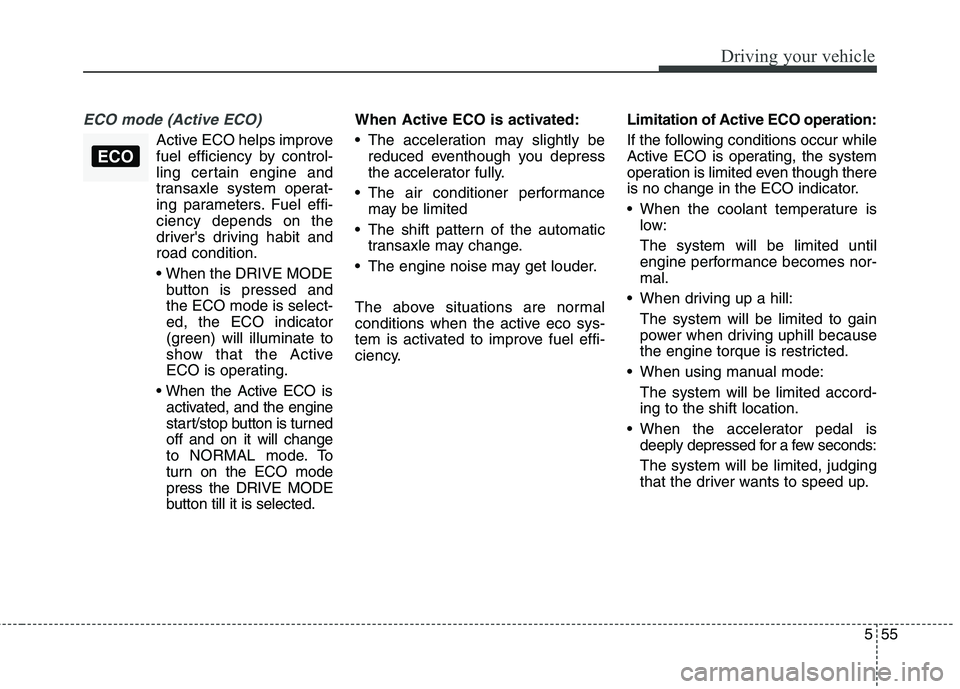
ECO mode (Active ECO)
Active ECO helps improve
fuel efficiency by control-
ling certain engine and
transaxle system operat-
ing parameters. Fuel effi-ciency depends on the
driver's driving habit androad condition.
button is pressed and the ECO mode is select-ed, the ECO indicator
(green) will illuminate to
show that the Active
ECO is operating.
activated, and the engine
start/stop button is turnedoff and on it will change
to NORMAL mode. To
turn on the ECO modepress the DRIVE MODE
button till it is selected. When Active ECO is activated:
The acceleration may slightly be
reduced eventhough you depress
the accelerator fully.
The air conditioner performance may be limited
The shift pattern of the automatic transaxle may change.
The engine noise may get louder.
The above situations are normal
conditions when the active eco sys-
tem is activated to improve fuel effi-
ciency. Limitation of Active ECO operation:
If the following conditions occur while
Active ECO is operating, the system
operation is limited even though there
is no change in the ECO indicator.
When the coolant temperature is
low:The system will be limited until
engine performance becomes nor-mal.
When driving up a hill: The system will be limited to gain
power when driving uphill because
the engine torque is restricted.
When using manual mode: The system will be limited accord-ing to the shift location.
When the accelerator pedal is deeply depressed for a few seconds: The system will be limited, judging
that the driver wants to speed up.
ECO
Page 300 of 486
Driving your vehicle
56
5
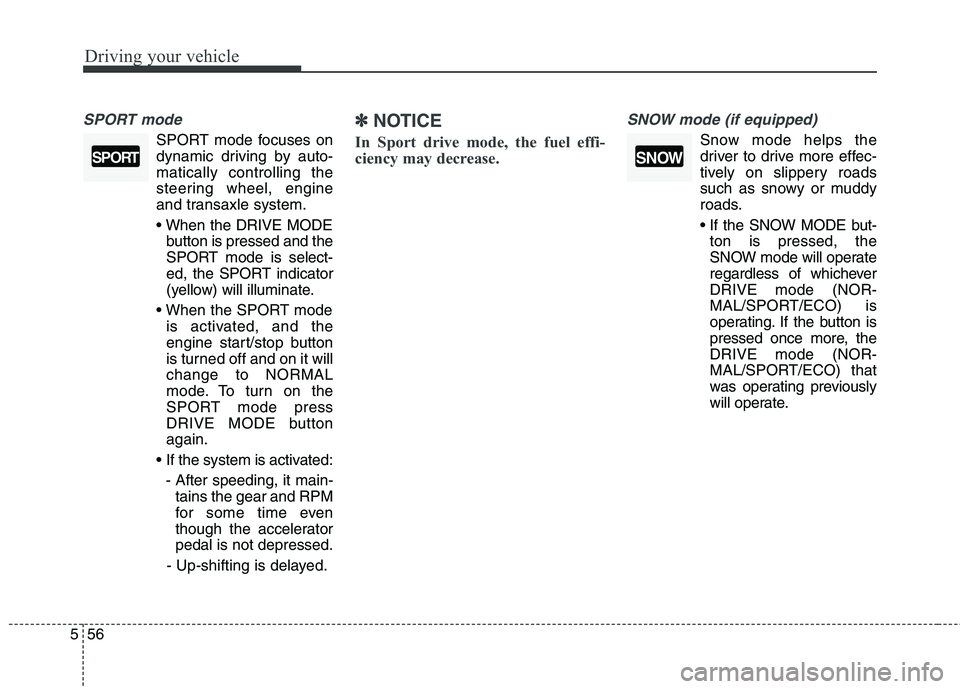
SPORT mode
SPORT mode focuses on
dynamic driving by auto-matically controlling the
steering wheel, engine
and transaxle system.
button is pressed and the
SPORT mode is select-
ed, the SPORT indicator
(yellow) will illuminate.
is activated, and the
engine start/stop button
is turned off and on it willchange to NORMAL
mode. To turn on the
SPORT mode press
DRIVE MODE buttonagain.
- After speeding, it main- tains the gear and RPM
for some time even
though the acceleratorpedal is not depressed.
- Up-shifting is delayed.
✽✽
NOTICE
In Sport drive mode, the fuel effi-
ciency may decrease.SNOW mode (if equipped)
Snow mode helps the
driver to drive more effec-
tively on slippery roads
such as snowy or muddy
roads.
If the SNOW MODE but- ton is pressed, the
SNOW mode will operate
regardless of whicheverDRIVE mode (NOR-
MAL/SPORT/ECO) is
operating. If the button is
pressed once more, theDRIVE mode (NOR-
MAL/SPORT/ECO) that
was operating previously
will operate.
SNOWSPORT
Page 318 of 486
Driving your vehicle
74
5
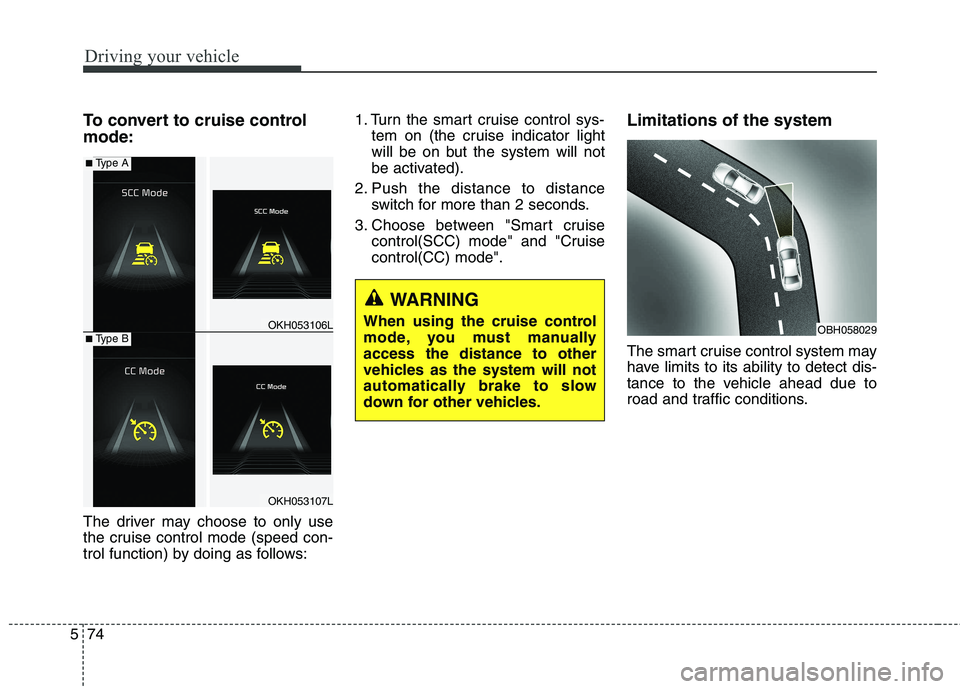
To convert to cruise control mode:
The driver may choose to only use
the cruise control mode (speed con-
trol function) by doing as follows: 1. Turn the smart cruise control sys-
tem on (the cruise indicator light
will be on but the system will not
be activated).
2. Push the distance to distance switch for more than 2 seconds.
3. Choose between "Smart cruise control(SCC) mode" and "Cruisecontrol(CC) mode". Limitations of the system
The smart cruise control system may
have limits to its ability to detect dis-
tance to the vehicle ahead due to
road and traffic conditions.
WARNING
When using the cruise control
mode, you must manuallyaccess the distance to other
vehicles as the system will not
automatically brake to slow
down for other vehicles.
OBH058029OKH053106L
OKH053107L
■ Type A■Type A
■Type B
Page 336 of 486
Driving your vehicle
92
5
ECONOMICAL OPERATION
Your vehicle's fuel economy depends
mainly on your style of driving, where
you drive and when you drive.
Each of these factors affects how
many kilometers (miles) you can get
from a liter (gallon) of fuel. To operate
your vehicle as economically as pos-
sible, use the following driving sug-
gestions to help save money in bothfuel and repairs:
Drive smoothly. Accelerate at a moderate rate. Do not make "jack-
rabbit" starts or full-throttle shifts and
maintain a steady cruising speed.
Do not race between stoplights. Try
to adjust your speed to the traffic so
you do not have to change speeds
unnecessarily. Avoid heavy traffic
whenever possible. Always maintain
a safe distance from other vehicles
so you can avoid unnecessary brak-
ing. This also reduces brake wear.
Drive at a moderate speed. The faster you drive, the more fuel your
vehicle uses. Driving at a moderate
speed, especially on the highway,
is one of the most effective ways toreduce fuel consumption. Do not "ride" the brake pedal. This
can increase fuel consumption and
also increase wear on these com-
ponents. In addition, driving with
your foot resting on the brake pedal
may cause the brakes to overheat,
which reduces their effectiveness
and may lead to more serious con-
sequences.
Take care of your tires. Keep them inflated to the recommended pres-
sure. Incorrect inflation, either too
much or too little, results in unnec-
essary tire wear. Check the tirepressures at least once a month.
Be sure that the wheels are aligned correctly. Improper align-ment can result from hitting curbs
or driving too fast over irregular
surfaces. Poor alignment causes
faster tire wear and may also result
in other problems as well as
greater fuel consumption. Keep your vehicle in good condi-
tion. For better fuel economy and
reduced maintenance costs, main-
tain your vehicle in accordancewith the maintenance schedule in
section 7. If you drive your vehicle
in severe conditions, more frequentmaintenance is required (see sec-
tion 7 for details).
Keep your vehicle clean. For maxi- mum service, your vehicle should
be kept clean and free of corrosive
materials. It is especially important
that mud, dirt, ice, etc. not be
allowed to accumulate on the
underside of the vehicle. This extra
weight can result in increased fuel
consumption and also contribute tocorrosion.
Travel lightly. Do not carry unnec- essary weight in your vehicle.
Weight reduces fuel economy.
Do not let the engine idle longer than necessary. If you are waiting
(and not in traffic), turn off your
engine and restart only when
you're ready to go.
Page 357 of 486
What to do in an emergency
10
6
TIRE PRESSURE MONITORING SYSTEM (TPMS) (IF EQUIPPED)
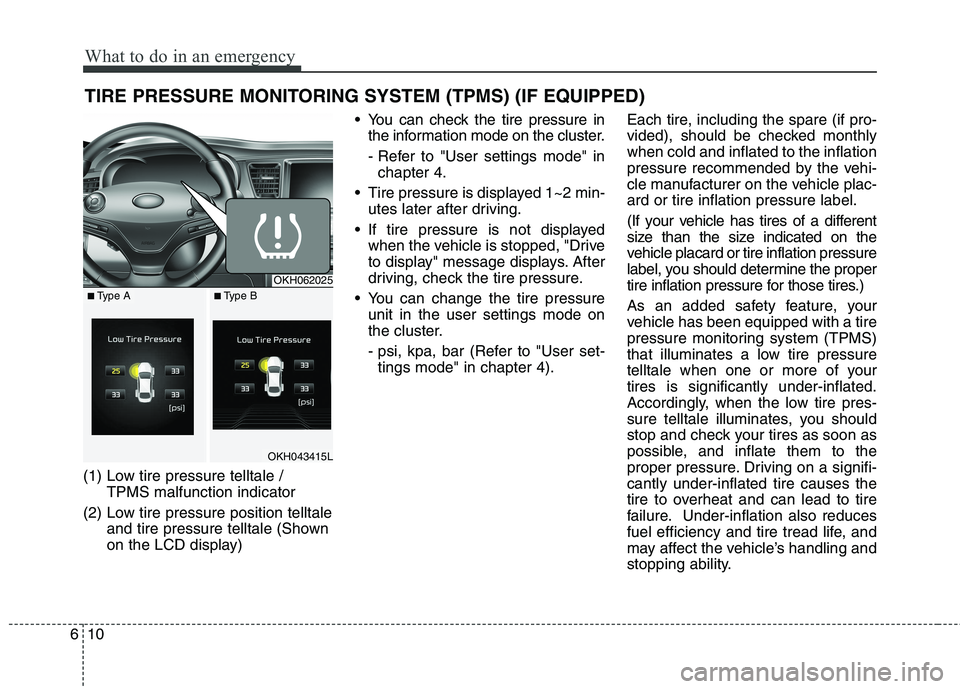
(1) Low tire pressure telltale / TPMS malfunction indicator
(2) Low tire pressure position telltale and tire pressure telltale (Shown
on the LCD display) You can check the tire pressure in
the information mode on the cluster.
- Refer to "User settings mode" inchapter 4.
Tire pressure is displayed 1~2 min- utes later after driving.
If tire pressure is not displayed when the vehicle is stopped, "Drive
to display" message displays. After
driving, check the tire pressure.
You can change the tire pressure unit in the user settings mode on
the cluster.
- psi, kpa, bar (Refer to "User set-tings mode" in chapter 4). Each tire, including the spare (if pro-
vided), should be checked monthlywhen cold and inflated to the inflation
pressure recommended by the vehi-
cle manufacturer on the vehicle plac-ard or tire inflation pressure label.
(If your vehicle has tires of a different
size than the size indicated on the
vehicle placard or tire inflation pressure
label, you should determine the proper
tire inflation pressure for those tires.)
As an added safety feature, your
vehicle has been equipped with a tire
pressure monitoring system (TPMS)
that illuminates a low tire pressure
telltale when one or more of yourtires is significantly under-inflated.
Accordingly, when the low tire pres-
sure telltale illuminates, you should
stop and check your tires as soon as
possible, and inflate them to the
proper pressure. Driving on a signifi-cantly under-inflated tire causes the
tire to overheat and can lead to tire
failure. Under-inflation also reduces
fuel efficiency and tire tread life, and
may affect the vehicle’s handling and
stopping ability.
OKH062025
OKH043415L
■
Type A ■Type B
Page 362 of 486
615
What to do in an emergency
WARNING- Protecting
TPMS
Tampering with, modifying, or
disabling the Tire PressureMonitoring System (TPMS)
components may interfere withthe system's ability to warn the
driver of low tire pressure con-
ditions and/or TPMS malfunc-
tions. Tampering with, modify-
ing, or disabling the TirePressure Monitoring System
(TPMS) components may void
the warranty for that portion of
the vehicle.
WARNING - For EUROPE
Do not modify the vehicle, it may interfere with the TPMS function.
The wheels on the market do not have a TPMS sensor.
For your safety, we recom-
mend that you use parts for
replacement from an author-
ized Kia dealer.
If you use the wheels on the market, use a TPMS sensor
approved by a Kia dealer.
If your vehicle is not equipped
with a TPMS sensor or TPMS
does not work properly, you
may fail the periodic vehicle
inspection conducted in your
country.
❈
❈ All vehicles sold in the
EUROPE market during below
period must be equipped withTPMS.
- New model vehicle : Nov. 1, 2012 ~
- Current model vehicle : Nov. 1, 2014~ (Based on vehi-
cle registrations)
WARNING - TPMS
The TPMS cannot alert you to severe and sudden tire dam-
age caused by external factors
such as nails or road debris.
If you feel any vehicle instabil- ity, immediately take your foot
off the accelerator, apply the
brakes gradually and with
light force, and slowly move to
a safe position off the road.
Page 418 of 486
741
Maintenance
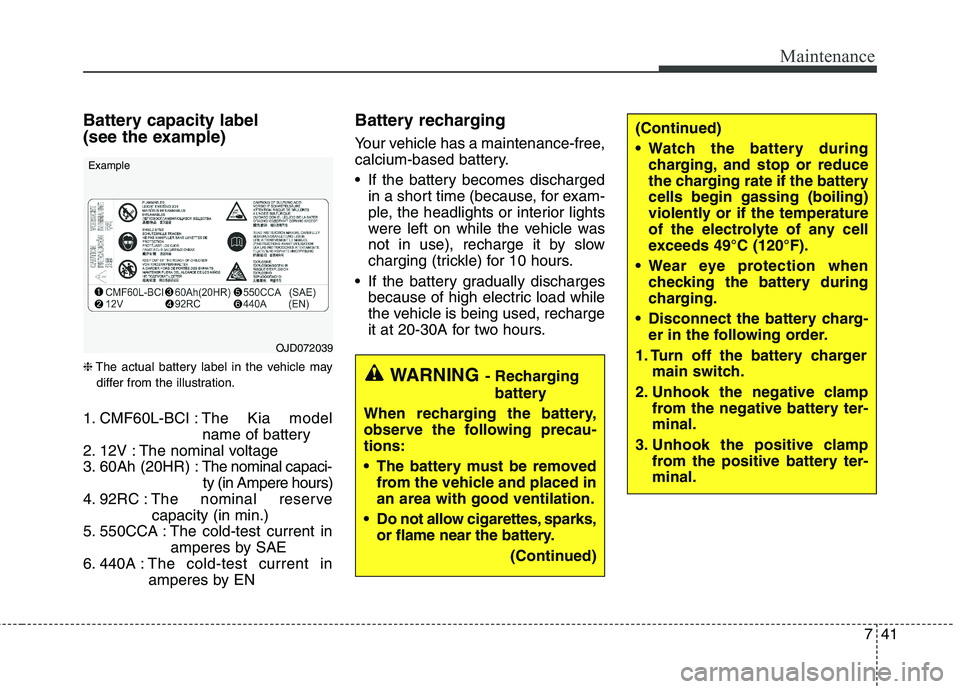
Battery capacity label
(see the example) ❈The actual battery label in the vehicle may
differ from the illustration.
1. CMF60L-BCI : The Kia model
name of battery
2. 12V : The nominal voltage
3. 60Ah (20HR) : The nominal capaci-
ty (in Ampere hours)
4. 92RC : The nominal reserve
capacity (in min.)
5. 550CCA : The cold-test current in amperes by SAE
6. 440A : The cold-test current in
amperes by EN Battery recharging
Your vehicle has a maintenance-free,
calcium-based battery.
If the battery becomes discharged
in a short time (because, for exam-
ple, the headlights or interior lights
were left on while the vehicle was
not in use), recharge it by slow
charging (trickle) for 10 hours.
If the battery gradually discharges because of high electric load while
the vehicle is being used, recharge
it at 20-30A for two hours.(Continued)
Watch the battery during charging, and stop or reduce
the charging rate if the batterycells begin gassing (boiling)
violently or if the temperature
of the electrolyte of any cell
exceeds 49°C (120°F).
Wear eye protection when checking the battery during
charging.
Disconnect the battery charg- er in the following order.
1. Turn off the battery charger main switch.
2. Unhook the negative clamp from the negative battery ter-minal.
3. Unhook the positive clamp from the positive battery ter-minal.
WARNING - Recharging
battery
When recharging the battery,
observe the following precau-tions:
The battery must be removed from the vehicle and placed in an area with good ventilation.
Do not allow cigarettes, sparks, or flame near the battery.
(Continued)
OJD072039
Example
Page 475 of 486
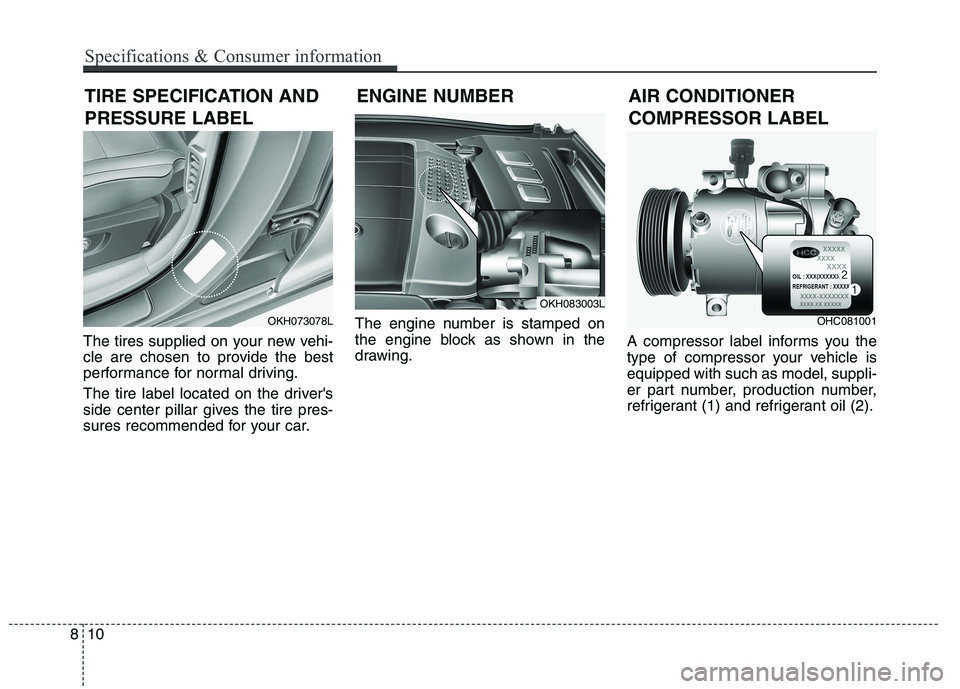
The tires supplied on your new vehi-
cle are chosen to provide the best
performance for normal driving.
The tire label located on the driver's
side center pillar gives the tire pres-
sures recommended for your car.The engine number is stamped on
the engine block as shown in the
drawing.
A compressor label informs you the
type of compressor your vehicle isequipped with such as model, suppli-
er part number, production number,
refrigerant (1) and refrigerant oil (2).
TIRE SPECIFICATION AND PRESSURE LABEL
OKH073078L
ENGINE NUMBER
OKH083003L
AIR CONDITIONER COMPRESSOR LABEL
OHC081001
810
Specifications & Consumer information