steering KIA QUORIS 2016 User Guide
[x] Cancel search | Manufacturer: KIA, Model Year: 2016, Model line: QUORIS, Model: KIA QUORIS 2016Pages: 513, PDF Size: 30.14 MB
Page 68 of 513
351
Safety features of your vehicle
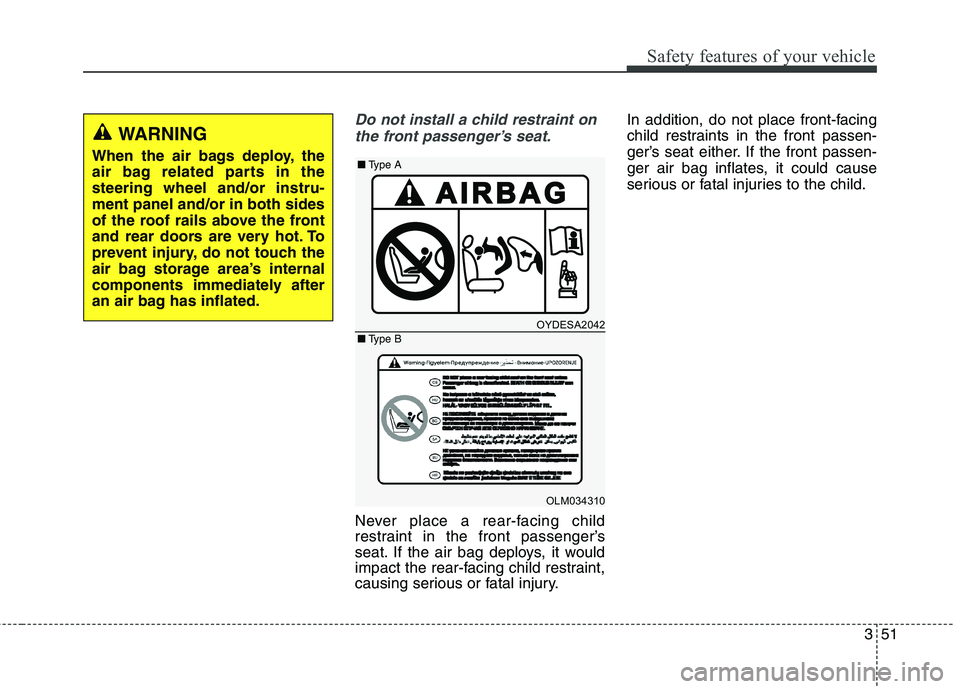
Do not install a child restraint onthe front passenger’s seat.
Never place a rear-facing child
restraint in the front passenger’s
seat. If the air bag deploys, it would
impact the rear-facing child restraint,
causing serious or fatal injury. In addition, do not place front-facing
child restraints in the front passen-
ger’s seat either. If the front passen-
ger air bag inflates, it could cause
serious or fatal injuries to the child.
OYDESA2042
OLM034310
■
Type A
■Type B
WARNING
When the air bags deploy, the
air bag related parts in thesteering wheel and/or instru-ment panel and/or in both sides
of the roof rails above the front
and rear doors are very hot. To
prevent injury, do not touch the
air bag storage area’s internal
components immediately after
an air bag has inflated.
Page 71 of 513
Safety features of your vehicle
54
3
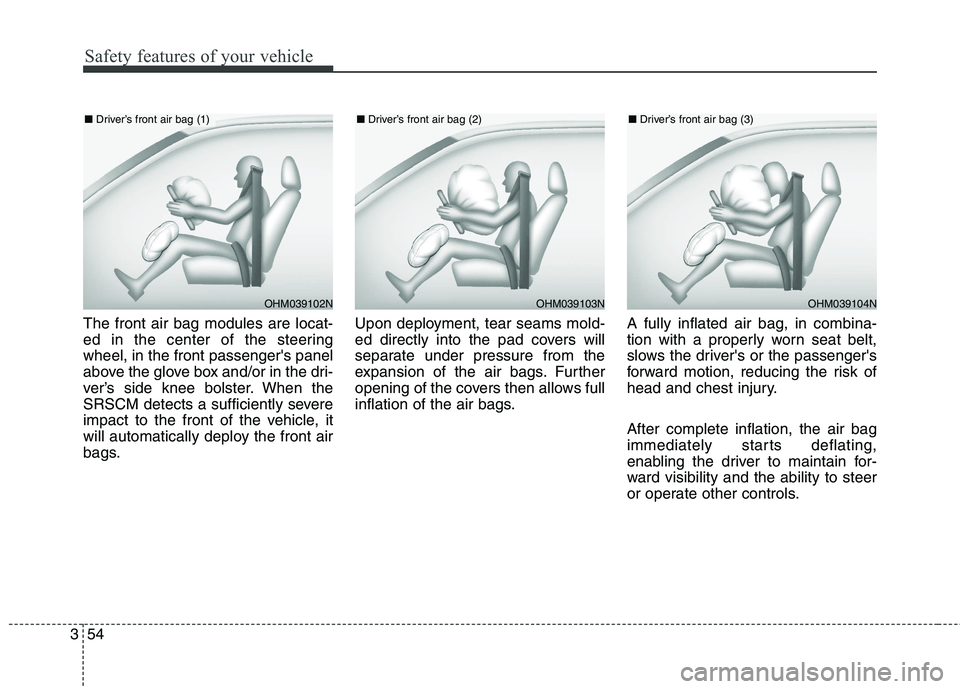
The front air bag modules are locat-
ed in the center of the steeringwheel, in the front passenger's panel
above the glove box and/or in the dri-
ver’s side knee bolster. When the
SRSCM detects a sufficiently severe
impact to the front of the vehicle, it
will automatically deploy the front air
bags. Upon deployment, tear seams mold-
ed directly into the pad covers will
separate under pressure from the
expansion of the air bags. Further
opening of the covers then allows full
inflation of the air bags.
A fully inflated air bag, in combina-
tion with a properly worn seat belt,
slows the driver's or the passenger's
forward motion, reducing the risk of
head and chest injury. After complete inflation, the air bag
immediately starts deflating,
enabling the driver to maintain for-
ward visibility and the ability to steer
or operate other controls.
OHM039103N
■
Driver’s front air bag (2)
OHM039104N
■Driver’s front air bag (3)
OHM039102N
■Driver’s front air bag (1)
Page 73 of 513

Safety features of your vehicle
56
3
Driver's and passenger's front
air bag
Your vehicle is equipped with a
Supplemental Restraint (Air Bag)System and the lap/shoulder belts at
both the driver and passenger seat-
ing positions. The indications of the system's pres-
ence are the letters "SRS AIR BAG"
embossed on the air bag pad cover
in the steering wheel and/or on the
cover of the driver's side knee bolster
located below the steering wheel andthe passenger's side front panel pad
above the glove box.
OKH032053
OKH032054
■
Driver’s knee air bag
■ Driver’s front air bag
(Continued)
The SRS can function only
when the Engine Start/Stop
button is in the ON position. If
the SRS air bag warning light
does not illuminate, or continu-
ously remains on after illumi-
nating for about 6 seconds
when the Engine Start/Stop
button is turned to the ON posi-
tion, or after the engine is start-
ed, comes on while driving, the
SRS is not working properly.
If this occurs, we recommend that the system be inspected
by an authorized Kia dealer.
Before you replace a fuse or disconnect a battery terminal,
turn the engine start/stop but-
ton to the OFF position. Never
remove or replace the air bagrelated fuse(s) when the
engine start/stop button is in
the ON position. Failure toheed this warning will cause
the SRS “ ” warning light to
illuminate.
Page 74 of 513
357
Safety features of your vehicle
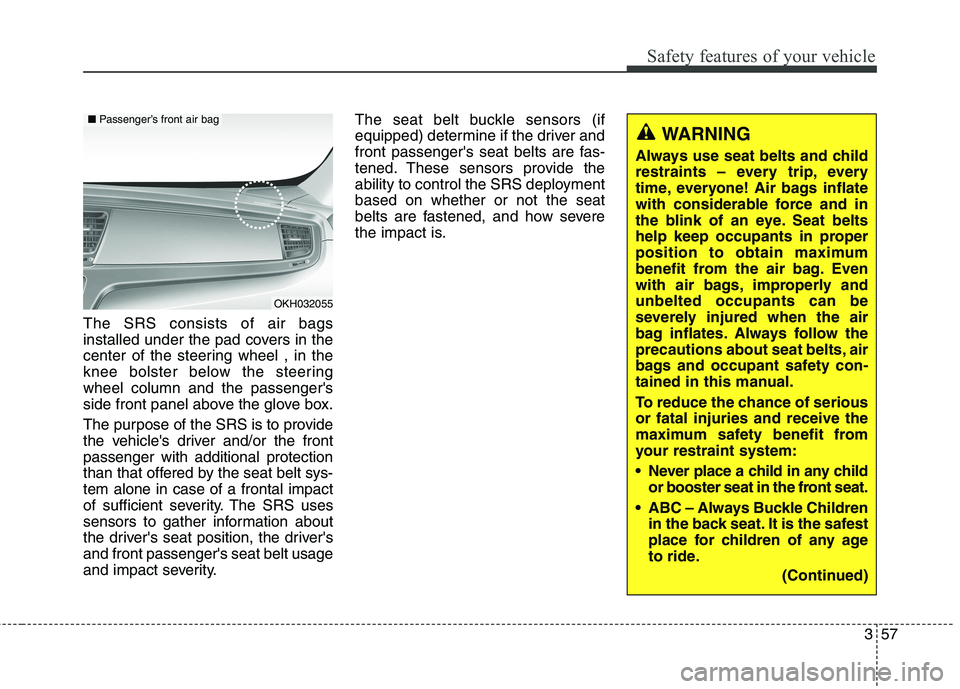
The SRS consists of air bags
installed under the pad covers in the
center of the steering wheel , in the
knee bolster below the steeringwheel column and the passenger's
side front panel above the glove box.
The purpose of the SRS is to provide
the vehicle's driver and/or the frontpassenger with additional protection
than that offered by the seat belt sys-tem alone in case of a frontal impact
of sufficient severity. The SRS uses
sensors to gather information about
the driver's seat position, the driver'sand front passenger's seat belt usage
and impact severity.The seat belt buckle sensors (if
equipped) determine if the driver and
front passenger's seat belts are fas-
tened. These sensors provide the
ability to control the SRS deploymentbased on whether or not the seat
belts are fastened, and how severe
the impact is.
OKH032055
■
Passenger’s front air bag
WARNING
Always use seat belts and child
restraints – every trip, every
time, everyone! Air bags inflate
with considerable force and in
the blink of an eye. Seat belts
help keep occupants in proper
position to obtain maximum
benefit from the air bag. Even
with air bags, improperly andunbelted occupants can be
severely injured when the air
bag inflates. Always follow the
precautions about seat belts, air
bags and occupant safety con-
tained in this manual.
To reduce the chance of serious or fatal injuries and receive the
maximum safety benefit from
your restraint system:
Never place a child in any child or booster seat in the front seat.
ABC – Always Buckle Children in the back seat. It is the safest
place for children of any age
to ride.
(Continued)
Page 75 of 513
Safety features of your vehicle
58
3
(Continued)
Front air bags are not intended
to deploy in side-impact, rear-
impact or rollover crashes. In
addition, front air bags will not
deploy in frontal crashes below
the deployment threshold.
A child restraint system must never be placed in the front
seat. The infant or child could
be severely injured or killed
by an air bag deployment incase of an accident.
Children age 12 and under must always be properlyrestrained in the rear seat.
Never allow children to ride in
the front passenger seat. If a
child over 12 must be seated
in the front seat, he or she
must be properly belted and
the seat should be moved as
far back as possible.
(Continued)(Continued)
Do not tamper with or discon-nect SRS wiring or other com- ponents of the SRS system.
Doing so could result in injury,
due to accidental deployment
of the air bags or by rendering
the SRS inoperative.
If the SRS air bag warning light remains illuminated
while the vehicle is being driv-
en, we recommend that the
system be inspected by an
authorized Kia dealer.
Air bags can only be used once – we recommend that
the system be replaced by an
authorized Kia dealer.
The SRS is designed to deploy the front air bags only when an
impact is sufficiently severe.
Additionally, the air bags will
only deploy once. Seat belts
must be worn at all times.
(Continued)(Continued)
Front and side air bags caninjure occupants improperly
positioned in the front seats.
Move your seat as far back as practical from the front air
bags, while still maintaining
control of the vehicle.
You and your passengers should never sit or lean unnec-
essarily close to the air bags.
Improperly positioned drivers
and passengers can be severe-
ly injured by inflating air bags.
Never lean agai nst the door or
center console – always sit in an upright position.
No objects should be placed over or near the air bag mod- ules on the steering wheel,
instrument panel or the front
passenger's panel above the
glove box, because any suchobject could cause harm if the
vehicle is in a crash severe
enough to cause the air bags
to deploy.
(Continued)
Page 77 of 513
Safety features of your vehicle
60
3
Your vehicle is equipped with a side air bag in each front and outboard rear
seat. The purpose of the air bag is to
provide the vehicle's driver and/or thefront and outboard rear passengerswith additional protection than that
offered by the seat belt alone.
The side air bags are designed to
deploy during certain side-impact
collisions, depending on the crash
severity, angle, speed and point ofimpact.
The side air bags are not designed to deploy in all side impact.
WARNING
The side air bag is supple- mental to the driver’s and the
passengers seat belt systems
and is not a substitute for
them. Therefore your seat
belts must be worn at all times
while the vehicle is in motion.
The air bags deploy only in
certain side impact conditions
severe enough to cause sig-
nificant injury to the vehicleoccupants.
For best protection from the side air bag system and to
avoid being injured by the
deploying side air bag, both
front and all rear (if equipped)seat occupants should sit inan upright position with the
seat belt properly fastened.The driver's hands should beplaced on the steering wheelat the 9:00 and 3:00 positions.
The passenger’ arms andhands should be placed ontheir laps.
(Continued)WARNING
Do not allow the passengers to lean their heads or bodies onto
doors, put their arms on the
doors, stretch their arms out of
the window, or place objects
between the doors and passen-
gers when they are seated onseats equipped with side and/or
curtain air bags.
Page 85 of 513
Safety features of your vehicle
68
3
SRS Care
The SRS is virtually maintenance-free
and so there are no parts you can
safely service by yourself. If the SRS
air bag warning light does not illumi-
nate, or continuously remains on, werecommend that the system be
inspected by an authorized Kia dealer.(Continued)
No objects should be placed
over or near the air bag mod- ules on the steering wheel,
instrument panel, and the
front passenger's panel above
the glove box, because any
such object could cause harm
if the vehicle is in a crash
severe enough to cause the
air bags to inflate.
If the air bags inflate, we rec- ommend that the system be
replaced by an authorized Kia
dealer.
Do not tamper with or discon- nect SRS wiring, or othercomponents of the SRS sys-
tem. Doing so could result in
injury, due to accidental infla-
tion of the air bags or by ren-
dering the SRS inoperative.
(Continued)
WARNING
Modification to SRS compo- nents or wiring, including the
addition of any kind of badges
to the pad covers or modifica-
tions to the body structure,
can adversely affect SRS per-
formance and lead to possible
injury.
For cleaning the air bag pad covers, use only a soft, dry
cloth or one which has been
moistened with plain water.
Solvents or cleaners could
adversely affect the air bag
covers and proper deploy-ment of the system.
(Continued)
(Continued)
If components of the air bagsystem must be discarded, or
if the vehicle must be
scrapped, certain safety pre-
cautions must be observed.
An authorized Kia dealer
knows these precautions and
can give you the necessary
information. Failure to follow
these precautions and proce-dures could increase the risk
of personal injury.
If your car was flooded and has soaked carpeting or water
on flooring, you shouldn't try
to start the engine; we recom-
mend that you contact an
authorized Kia dealer.
Page 88 of 513

Features of your vehicle
Smart key . . . . . . . . . . . . . . . . . . . . . . . . . . . . . . . . . 4-4• Record your key number . . . . . . . . . . . . . . . . . . . . . . . 4-4
. . . . . . . . . . . . . . . . . . . . . . . . . . . . 4-4
. . . . . . . . . . . . . . . . . . . . . . . 4-6
. . . . . . . . . . . . . . . . . . . . . . . . . 4-8
. . . . . . . . . . . . . . . . . . . . . . . . . . . . 4-9
. . . . . . . . . . . . . . . . . . . . . . . . . . 4-11
Theft-alarm system . . . . . . . . . . . . . . . . . . . . . . . . 4-12 . . . . . . . . . . . . . . . . . . . . . . . . . . . . . . . . . 4-12
. . . . . . . . . . . . . . . . . . . . . . . . . . . . 4-13
Door locks . . . . . . . . . . . . . . . . . . . . . . . . . . . . . . . 4-15 . . . . . . . . . . . . . . . . . . . . . . . . . . . . . . . . 4-15
. . . . . . . . . . . . . . . . . . . . . . . . . . . . . 4-16
. . . . . . . . . . . . . . . . . . . . . . . . . . . . . . . . . 4-16
. . . . . . . . . . . . . . . . . 4-19
Trunk . . . . . . . . . . . . . . . . . . . . . . . . . . . . . . . . . . . . 4-20 . . . . . . . . . . . . . . . . . . . . . . . . . . . 4-20
. . . . . . . . . . . . . . . . . . . . . . . . . . . . . . . . . 4-22
. . . . . . . . . . . . . . . . . 4-27
Smart trunk . . . . . . . . . . . . . . . . . . . . . . . . . . . . . . 4-28
Windows . . . . . . . . . . . . . . . . . . . . . . . . . . . . . . . . . 4-32 . . . . . . . . . . . . . . . . . . . . . . . . . . . . . . 4-33
Hood . . . . . . . . . . . . . . . . . . . . . . . . . . . . . . . . . . . . 4-36 . . . . . . . . . . . . . . . . . . . . . . . . . . . . 4-36 . . . . . . . . . . . . . . . . . . . . . . . . . . . . . 4-36
Fuel filler lid . . . . . . . . . . . . . . . . . . . . . . . . . . . . . 4-38 . . . . . . . . . . . . . . . . . . . . . . 4-38
. . . . . . . . . . . . . . . . . . . . . . . 4-38
. . . . . . . . . . . . . . . . 4-40
Panoramic sunroof . . . . . . . . . . . . . . . . . . . . . . . . . 4-41
. . . . . . . . . . . . . . . . . . . . . . . . . . . 4-42
. . . . . . . . . . . . . . . . . . . . . . . . . . . 4-42
. . . . . . . . . . . . . . . . . . . . . . . . . . . . 4-43
. . . . . . . . . . . . . . . . . . . . . . . . . . . . . . . . . . . 4-44
. . . . . . . . . . . . . . . . . . . . . . . . . 4-45
Steering wheel . . . . . . . . . . . . . . . . . . . . . . . . . . . . . 4-46 . . . . . . 4-46
. . . . . . . . . . . . . . . . . . . . . . . . . . . . . . . . . 4-46
. . . . . . . . . . . . . . . . . . . . . . . . . 4-47
. . . . . . . . . . . . . . . . . . . . . . . . . . . . . . . . . . . . . . . 4-47
Mirrors . . . . . . . . . . . . . . . . . . . . . . . . . . . . . . . . . . 4-49 . . . . . . . . . . . . . . . . . . . . . . . . 4-49
. . . . . . . . . . . . . . . . . . . . . . . 4-50
Instrument cluster . . . . . . . . . . . . . . . . . . . . . . . . . 4-54 . . . . . . . . . . . . . . . . . . . . . 4-55
. . . . . . . . . . . . . . . . . . . . . . . . . . 4-56
. . . . . . . . . . . . . . . . . . . . . . . . . . . . . . . . . . . . . 4-57
. . . . . . . . . . . . . . . . . . . . . . . 4-60
4
Page 133 of 513
Features of your vehicle
46
4
Electronic Hydraulic Power Steering (EHPS) EHPS uses an electromotor to assist
you in steering the vehicle. It senses
the vehicle speed and road condition.
If the engine is off or if the power
steering system becomes inoperative,
the vehicle may still be steered, but it
will require increased steering effort.
Should you notice any change in the
effort required to steer during normal
vehicle operation, we recommend
that the system be checked by an
authorized Kia dealer.✽✽
NOTICE
If the power steering drive belt
breaks or if the power steering
pump malfunctions, the steering
effort will greatly increase.
✽
✽ NOTICE
If the vehicle is parked for extended
periods outside in cold weather
(below -10°C/14°F), the power steer-
ing may require increased effort
when the engine is first started. This
is caused by increased fluid viscosity
due to the cold weather and does not
indicate a malfunction.
When this happens, increase the
engine RPM by depressing accelera-
tor until the RPM reaches 1,500 rpm
then release or let the engine idle for
two or three minutes to warm up the
fluid.
Tilt steering
Tilt steering allows you to adjust the
steering wheel before you drive. You
can also raise it to give your legs
more room when you exit and enter
the vehicle.
The steering wheel should be posi-
tioned so that it is comfortable for
you to drive, while permitting you to
see the instrument panel warning
lights and gauges.
STEERING WHEEL
WARNING
Never adjust the angle of the steering wheel while driving.
You may lose steering control
and cause severe personal
injury, death or accidents.
After adjusting, push the steering wheel both up and
down to be certain it is lockedin position.
CAUTION
Never hold the steering wheel
against a stop (extreme right orleft turn) for more than 5 sec- onds with the engine running.Holding the steering wheel formore than 5 seconds in either position may cause damage tothe power steering pump.
Page 134 of 513
447
Features of your vehicle
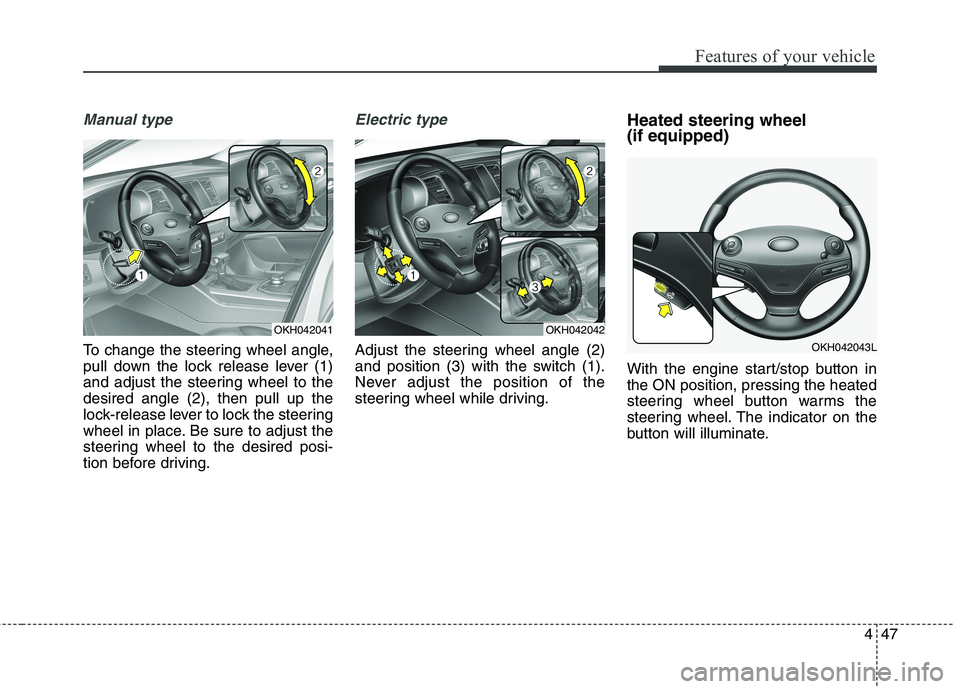
Manual type
To change the steering wheel angle,
pull down the lock release lever (1)
and adjust the steering wheel to thedesired angle (2), then pull up the
lock-release lever to lock the steering
wheel in place. Be sure to adjust the
steering wheel to the desired posi-
tion before driving.
Electric type
Adjust the steering wheel angle (2)
and position (3) with the switch (1).
Never adjust the position of the
steering wheel while driving.Heated steering wheel (if equipped)
With the engine start/stop button in the ON position, pressing the heated
steering wheel button warms the
steering wheel. The indicator on the
button will illuminate.
OKH042041OKH042042
OKH042043L