lock KIA QUORIS 2016 Owners Manual
[x] Cancel search | Manufacturer: KIA, Model Year: 2016, Model line: QUORIS, Model: KIA QUORIS 2016Pages: 513, PDF Size: 30.14 MB
Page 7 of 513
Introduction
4
1
Other fuels
Using fuels such as; - Silicone (Si) contained fuel,
- MMT (Manganese, Mn) contained
fuel,
- Ferrocene (Fe) contained fuel, and
- Other metallic additives contained fuels,
may cause vehicle and engine dam-
age or cause plugging, misfiring,
poor acceleration, engine stalling,
catalyst melting, abnormal corrosion,
life cycle reduction, etc.
Also, the Malfunction Indicator Lamp
(MIL) may illuminate.
✽✽
NOTICE
Damage to the fuel system or per-
formance problem caused by the use
of these fuels may not be covered by
your New Vehicle Limited Warranty.
Use of MTBE
Kia recommends avoiding fuels con-
taining MTBE (Methyl Tertiary Butyl
Ether) over 15.0% vol. (Oxygen
Content 2.7% weight) in your vehicle.
Fuel containing MTBE over 15.0%
vol. (Oxygen Content 2.7% weight)
may reduce vehicle performance and
produce vapor lock or hard starting.CAUTION
Never use gasohol which con- tains methanol. Discontinue useof any gasohol product which impairs drivability.
CAUTION
Your New Vehicle LimitedWarranty may not cover damageto the fuel system and any per- formance problems that arecaused by the use of fuels con-taining methanol or fuels con-taining MTBE (Methyl Tertiary Butyl Ether) over 15.0% vol.(Oxygen Content 2.7% weight.)
Page 13 of 513

Your vehicle at a glance
4
2
INTERIOR OVERVIEW
1. Inside door handle ...................................4-16
2. Front power seat adjust switch ..................3-5
3. Outside rearview mirror folding ...............4-52
4. Outside rearview mirror control ...............4-51
5. Power window lock switch .......................4-35
6. Central door lock switch ..........................4-17
7. Power window switch...............................4-32
8. BSD On/OFF button ................................5-91
9. HUD On/OFF button..............................4-104
10. Parking assist system On/Off button...4-106
11. ESC Off button ......................................5-44
12. Trunk lid open button .............................4-20
13. Trunk lid close button .............................4-22
14. Trunk lid open / close button .................4-22
15. Instrument panel illumination control lever
...............................................................4-55
16. Electric parking brake switch .................5-32
17. Fuel filler lid open switch .......................4-38
18. Hood release lever.................................4-36
19. Steering wheel .......................................4-46
20. Tilt and telescopic steering control lever ...4-46
21. Brake pedal............................................5-29
22. Accelerator pedal ....................................5-8
OKH013003K
❈The actual shape may differ from the illustration.
Page 14 of 513
25
Your vehicle at a glance
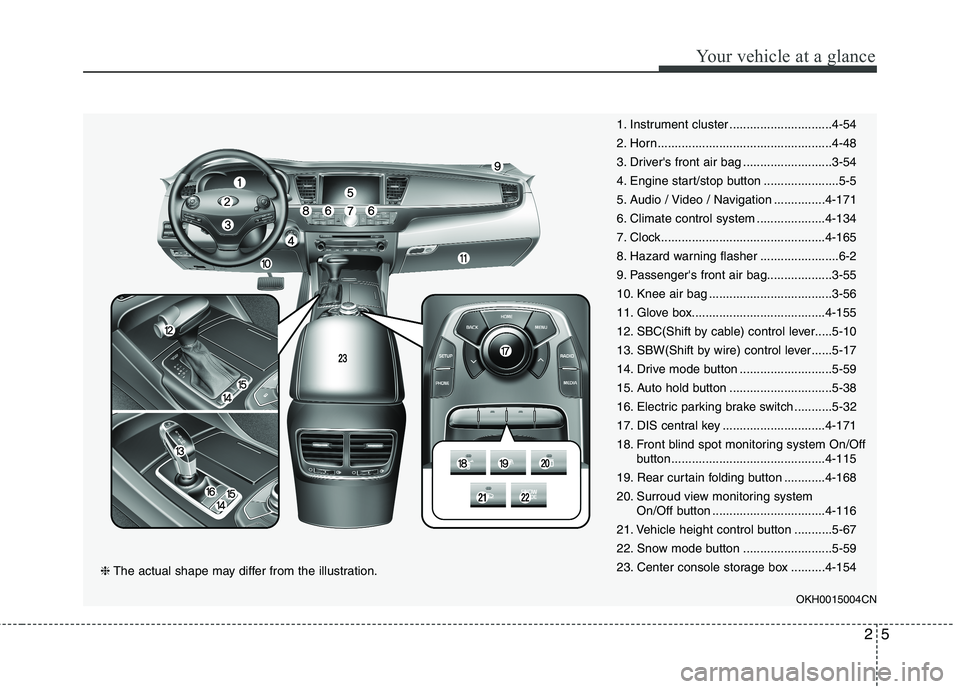
1. Instrument cluster ..............................4-54
2. Horn...................................................4-48
3. Driver's front air bag ..........................3-54
4. Engine start/stop button ......................5-5
5. Audio / Video / Navigation ...............4-171
6. Climate control system ....................4-134
7. Clock................................................4-165
8. Hazard warning flasher .......................6-2
9. Passenger's front air bag...................3-55
10. Knee air bag ....................................3-56
11. Glove box.......................................4-155
12. SBC(Shift by cable) control lever.....5-10
13. SBW(Shift by wire) control lever......5-17
14. Drive mode button ...........................5-59
15. Auto hold button ..............................5-38
16. Electric parking brake switch ...........5-32
17. DIS central key ..............................4-171
18. Front blind spot monitoring system On/Offbutton.............................................4-115
19. Rear curtain folding button ............4-168
20. Surroud view monitoring system On/Off button .................................4-116
21. Vehicle height control button ...........5-67
22. Snow mode button ..........................5-59
23. Center console storage box ..........4-154
OKH0015004CN
❈The actual shape may differ from the illustration.
Page 19 of 513
Safety features of your vehicle
2
3
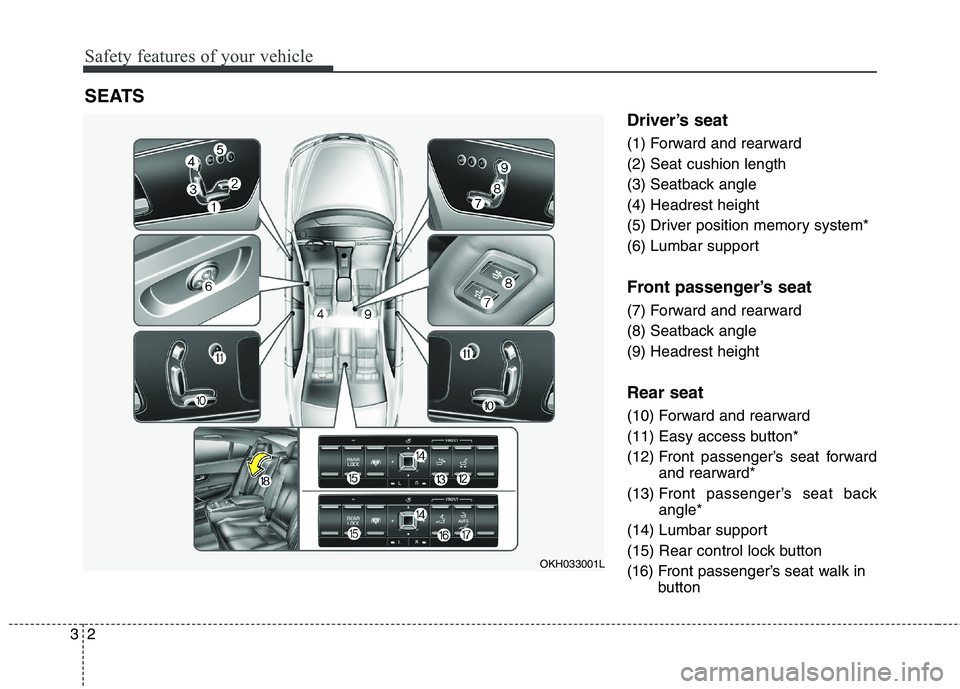
Driver’s seat
(1) Forward and rearward (2) Seat cushion length
(3) Seatback angle(4) Headrest height
(5) Driver position memory system*
(6) Lumbar support
Front passenger’s seat
(7) Forward and rearward
(8) Seatback angle(9) Headrest height Rear seat
(10) Forward and rearward
(11) Easy access button*
(12) Front passenger’s seat forward
and rearward*
(13) F ront passenger’s seat back
angle*
(14) Lumbar support
(15) Rear control lock button
(16) Front passenger’s seat walk in button
SEATS
OKH033001L
Page 21 of 513
Safety features of your vehicle
4
3
WARNING
Do not adjust the seat while wearing seat belts. Moving the
seat cushion forward may
cause strong pressure on theabdomen.
Use extreme caution so that hands or other objects are not
caught in the seat mechanisms
while the seat is moving.
Use extreme caution when picking small objects trappedunder the seats or betweenthe seat and the center con-
sole. Your hands might be cut
or injured by the sharp edges
of the seats mechanism.
Do not put a cigarette lighter on the floor or seat. When you
operate the seat, gas maygush out of the lighter and
cause fire.
If there are occupants in the rear seats, be careful while
adjusting the front seat posi-tion.(Continued)
In order to avoid unnecessaryand perhaps severe air bag
injuries, always sit as far back
as possible from the steeringwheel while maintaining com-
fortable control of the vehicle.
We recommend that your chest
be at least 250 mm (10 inches)
away from the steering wheel.WARNING - Driver’s seat
Never attempt to adjust the seat while the vehicle is mov-
ing. This could result in loss
of control, and an accident
causing death, serious injury,
or property damage.
Do not allow anything to inter- fere with the normal position
of the seatback. Storing items
against a seatback or in any
other way interfering with
proper locking of a seatbackcould result in serious or fatal
injury in a sudden stop or col-lision.
Always drive and ride with your seatback upright and the lap
portion of the seat belt snug
and low across the hips. This
is the best position to protect
you in case of an accident.
(Continued)
Page 31 of 513
Safety features of your vehicle
14
3
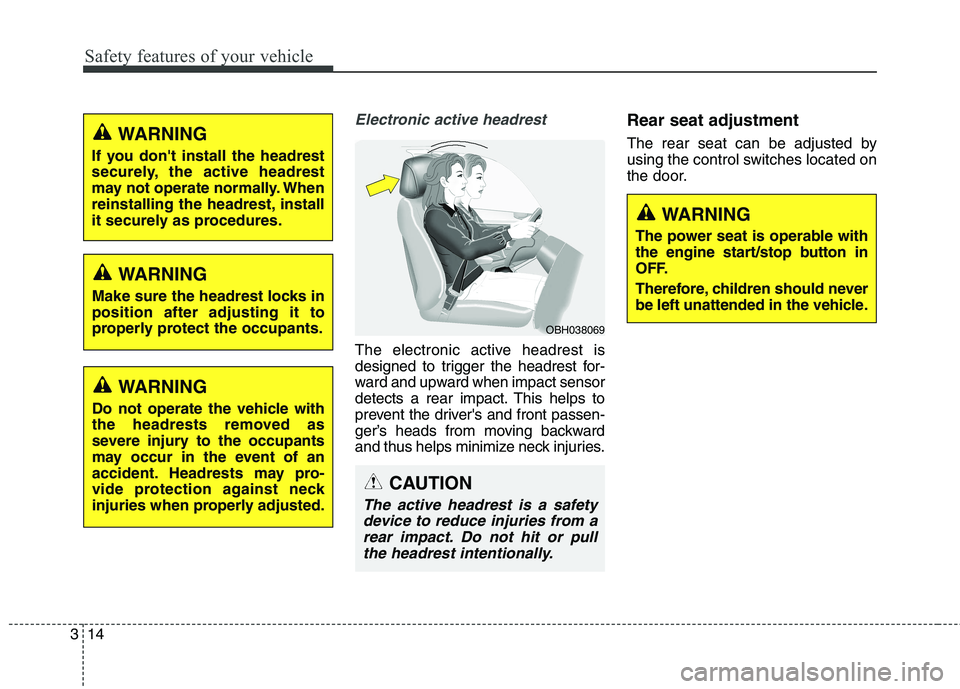
Electronic active headrest
The electronic active headrest is
designed to trigger the headrest for-
ward and upward when impact sensor
detects a rear impact. This helps to
prevent the driver's and front passen-
ger’s heads from moving backward
and thus helps minimize neck injuries. Rear seat adjustment
The rear seat can be adjusted by
using the control switches located on
the door.
WARNING
If you don't install the headrest
securely, the active headrest
may not operate normally. When
reinstalling the headrest, install
it securely as procedures.
OBH038069
WARNING
Do not operate the vehicle with
the headrests removed as
severe injury to the occupants
may occur in the event of an
accident. Headrests may pro-
vide protection against neck
injuries when properly adjusted.
WARNING
Make sure the headrest locks in position after adjusting it to
properly protect the occupants.
CAUTION
The active headrest is a safety device to reduce injuries from arear impact. Do not hit or pull the headrest intentionally.
WARNING
The power seat is operable with
the engine start/stop button in
OFF.
Therefore, children should never
be left unattended in the vehicle.
Page 36 of 513
319
Safety features of your vehicle
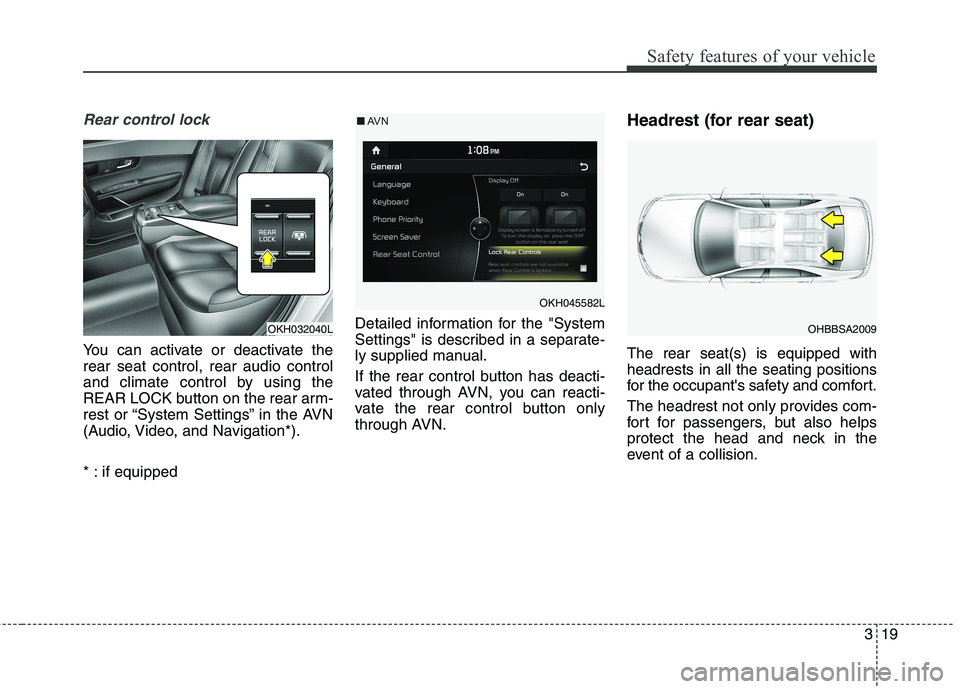
Rear control lock
You can activate or deactivate the rear seat control, rear audio control
and climate control by using the
REAR LOCK button on the rear arm-
rest or “System Settings” in the AVN
(Audio, Video, and Navigation*).
* : if equippedDetailed information for the "System
Settings" is described in a separate-
ly supplied manual.
If the rear control button has deacti-
vated through AVN, you can reacti-
vate the rear control button only
through AVN.Headrest (for rear seat) The rear seat(s) is equipped with headrests in all the seating positions
for the occupant's safety and comfort.
The headrest not only provides com-
fort for passengers, but also helps
protect the head and neck in the
event of a collision.
OHBBSA2009OKH032040L
OKH045582L
■
AV N
Page 38 of 513
321
Safety features of your vehicle
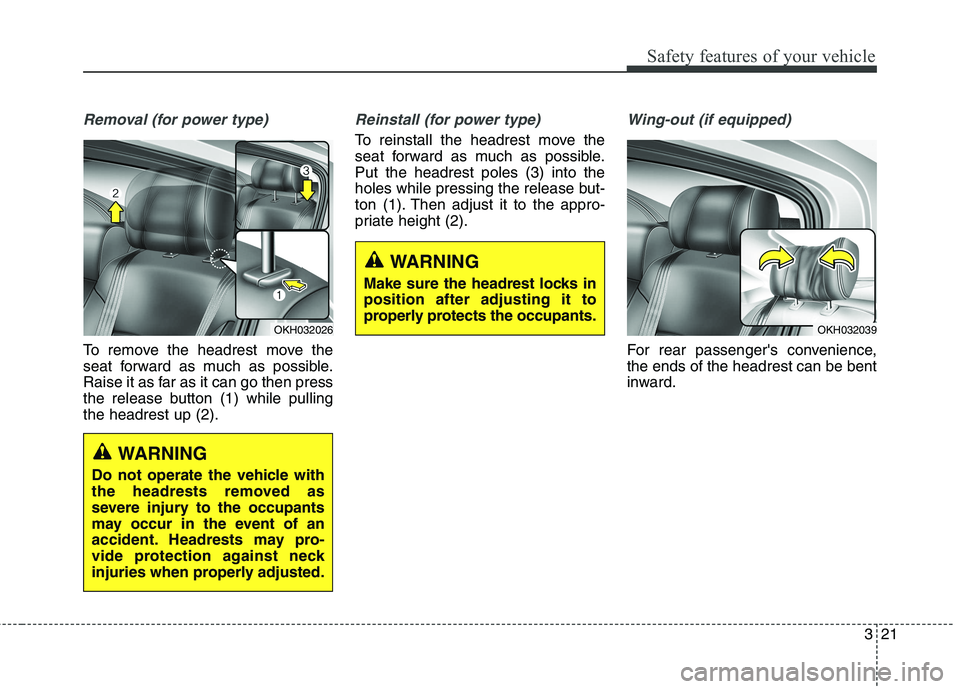
Removal (for power type)
To remove the headrest move the
seat forward as much as possible.
Raise it as far as it can go then press
the release button (1) while pullingthe headrest up (2).
Reinstall (for power type)
To reinstall the headrest move the
seat forward as much as possible.Put the headrest poles (3) into the
holes while pressing the release but-
ton (1). Then adjust it to the appro-
priate height (2).
Wing-out (if equipped)
For rear passenger's convenience, the ends of the headrest can be bent
inward.
OKH032039
WARNING
Make sure the headrest locks in position after adjusting it to
properly protects the occupants.
OKH032026
WARNING
Do not operate the vehicle with
the headrests removed as
severe injury to the occupants
may occur in the event of an
accident. Headrests may pro-
vide protection against neck
injuries when properly adjusted.
Page 41 of 513
Safety features of your vehicle
24
3
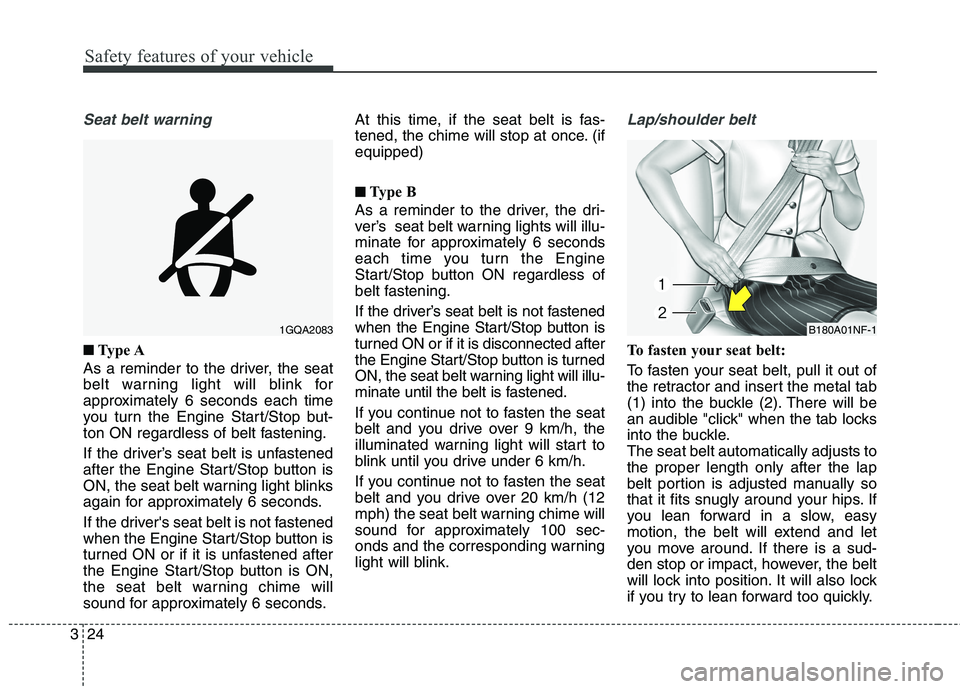
Seat belt warning
■■
Type A
As a reminder to the driver, the seat
belt warning light will blink for
approximately 6 seconds each time
you turn the Engine Start/Stop but-
ton ON regardless of belt fastening.
If the driver’s seat belt is unfastened
after the Engine Start/Stop button is
ON, the seat belt warning light blinks
again for approximately 6 seconds.
If the driver's seat belt is not fastened
when the Engine Start/Stop button is
turned ON or if it is unfastened after
the Engine Start/Stop button is ON,
the seat belt warning chime will
sound for approximately 6 seconds. At this time, if the seat belt is fas-
tened, the chime will stop at once. (ifequipped)
■
■
Type B
As a reminder to the driver, the dri-
ver’s seat belt warning lights will illu-
minate for approximately 6 seconds
each time you turn the Engine
Start/Stop button ON regardless of
belt fastening.
If the driver’s seat belt is not fastened
when the Engine Start/Stop button is
turned ON or if it is disconnected after
the Engine Start/Stop button is turned
ON, the seat belt warning light will illu-
minate until the belt is fastened.
If you continue not to fasten the seat
belt and you drive over 9 km/h, the
illuminated warning light will start to
blink until you drive under 6 km/h.
If you continue not to fasten the seat
belt and you drive over 20 km/h (12
mph) the seat belt warning chime will
sound for approximately 100 sec-
onds and the corresponding warning
light will blink.
Lap/shoulder belt
To fasten your seat belt:
To fasten your seat belt, pull it out of
the retractor and insert the metal tab
(1) into the buckle (2). There will be
an audible "click" when the tab locks
into the buckle.The seat belt automatically adjusts tothe proper length only after the lap
belt portion is adjusted manually so
that it fits snugly around your hips. If
you lean forward in a slow, easy
motion, the belt will extend and let
you move around. If there is a sud-
den stop or impact, however, the belt
will lock into position. It will also lock
if you try to lean forward too quickly.
1GQA2083B180A01NF-1
Page 42 of 513
325
Safety features of your vehicle
✽✽NOTICE
If you are not able to pull out the
seat belt from the retractor, firmly
pull the belt out and release it. Then
you will be able to pull the belt out
smoothly.
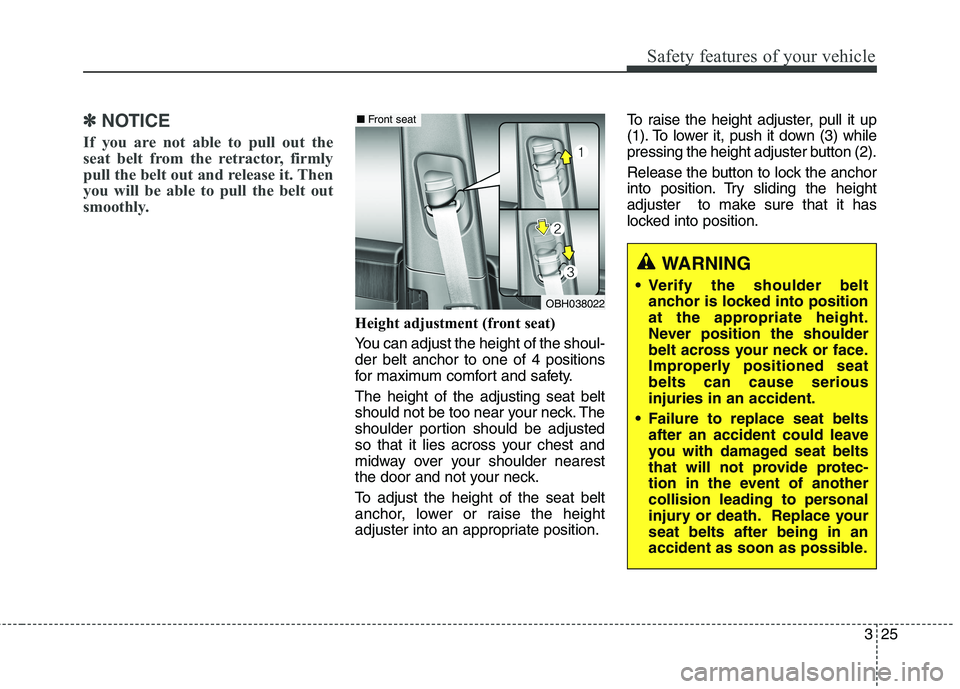
Height adjustment (front seat)
You can adjust the height of the shoul- der belt anchor to one of 4 positions
for maximum comfort and safety. The height of the adjusting seat belt
should not be too near your neck. The
shoulder portion should be adjusted
so that it lies across your chest and
midway over your shoulder nearest
the door and not your neck.
To adjust the height of the seat belt
anchor, lower or raise the height
adjuster into an appropriate position. To raise the height adjuster, pull it up
(1). To lower it, push it down (3) while
pressing the height adjuster button (2).
Release the button to lock the anchor
into position. Try sliding the height
adjuster to make sure that it has
locked into position.
WARNING
Verify the shoulder belt anchor is locked into position
at the appropriate height.
Never position the shoulder
belt across your neck or face.
Improperly positioned seatbelts can cause seriousinjuries in an accident.
Failure to replace seat belts after an accident could leave
you with damaged seat belts
that will not provide protec-
tion in the event of another
collision leading to personal
injury or death. Replace yourseat belts after being in an
accident as soon as possible.
OBH038022
■Front seat