light KIA Rio 2005 2.G Workshop Manual
[x] Cancel search | Manufacturer: KIA, Model Year: 2005, Model line: Rio, Model: KIA Rio 2005 2.GPages: 238, PDF Size: 2.6 MB
Page 143 of 238

5-9 Driving at Night
Because night driving presents many more hazards
than driving in the daylight, here are some important
tips to remember:
Slow down and keep more distance between you
and other vehicles as it may be more difficult to see
at night, especially in rural areas where there may
not be any street lights.
Adjust your mirrors to reduce the glare from other
driver’s headlights.
Keep your headlights clean and properly aimed.
Dirty or misaimed headlights will make it much
more difficult to see at night.
Avoid staring directly at the headlights of oncoming
vehicles. You could be temporarily blinded and it
will take several seconds for your eyes to readjust to
the darkness.
Driving in the RainRain and wet roads can make driving dangerous,
especially if you’re not prepared for the slick
pavement. Here are a few things to consider when
driving in the rain:
Be sure your windshield wipers are in good
condition.
A heavy rainfall will make it harder to see and will
increase the distance needed to stop your vehicle, so
slow down.
If your tires aren’t in good condition, making a
quick stop on wet pavement can cause a skid and
possibly lead to an accident. Be sure your tires and
windshield wipers are in good shape.
Turn on your headlights to make it easier for others
to see you.
Driving too fast through large puddles can affect
your brakes. If you must go through puddles, try to
drive through them slowly.
If you believe you may have gotten your brakes wet,
apply them lightly while driving until normal
braking operation returns.
RIO ENG CNA 5.qxd 7/29/05 5:07 PM Page 9
Page 151 of 238
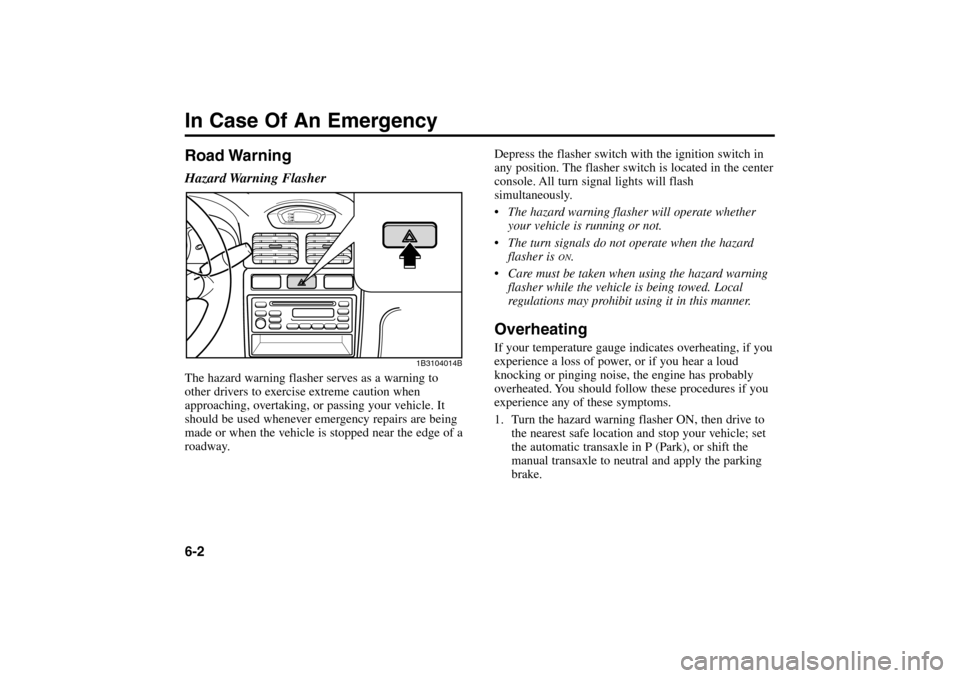
Road WarningHazard Warning FlasherThe hazard warning flasher serves as a warning to
other drivers to exercise extreme caution when
approaching, overtaking, or passing your vehicle. It
should be used whenever emergency repairs are being
made or when the vehicle is stopped near the edge of a
roadway.
Depress the flasher switch with the ignition switch in
any position. The flasher switch is located in the center
console. All turn signal lights will flash
simultaneously.
•The hazard warning flasher will operate whether
your vehicle is running or not.
The turn signals do not operate when the hazard
flasher is
ON
.
Care must be taken when using the hazard warning
flasher while the vehicle is being towed. Local
regulations may prohibit using it in this manner.
OverheatingIf your temperature gauge indicates overheating, if you
experience a loss of power, or if you hear a loud
knocking or pinging noise, the engine has probably
overheated. You should follow these procedures if you
experience any of these symptoms.
1. Turn the hazard warning flasher ON, then drive to
the nearest safe location and stop your vehicle; set
the automatic transaxle in P (Park), or shift the
manual transaxle to neutral and apply the parking
brake.
In Case Of An Emergency6-2
1B3104014B
RIO ENG CNA 6.qxd 7/29/05 5:15 PM Page 2
Page 155 of 238
4. Turn off all unnecessary electrical loads.
5. Connect the jumper cables in the exact sequence
shown in the illustration on the previous page.
First, connect one end of a jumper cable to the
positive terminal (+) of the discharged battery ,
then the other end of the same cable to the positive
terminal (+) on the booster battery . Next,
connect one end of the other jumper cable to the
negative terminal (–) of the booster battery , then
the other end to a solid, stationary, metallic point
(for example, the engine lifting bracket) away
from the battery. Do not connect the jumper cable
to or near any part that moves when the engine is
cranked. Do not connect the jumper cable from the
negative terminal (–) of the booster battery to the
negative terminal (–) of the discharged battery. Do
not allow the jumper cables to contact anything
except the correct battery terminals or the correct
ground. Do not lean over the battery when making
connections.6. Start the engine of the vehicle with the booster
battery and run it at 2,000 rpm. Then, start the
engine of the vehicle with the discharged battery.
If the cause of your battery discharging is not apparent
(for example, having left the lights on accidentally),
you should have your vehicle checked by an Authorized
Kia Dealer.
Push-StartingA vehicle equipped with an automatic transaxle cannot
be started by pushing. A vehicle equipped with a
manual transaxle should not be push-started because it
could damage the emission control system. Follow the
directions for jump starting.
In Case Of An Emergency6-6
CAUTION
Never tow a vehicle to start it. A sudden surge
forward when the engine starts could cause a
collision with the tow vehicle.
1
2
3
4
RIO ENG CNA 6.qxd 7/29/05 5:15 PM Page 6
Page 156 of 238
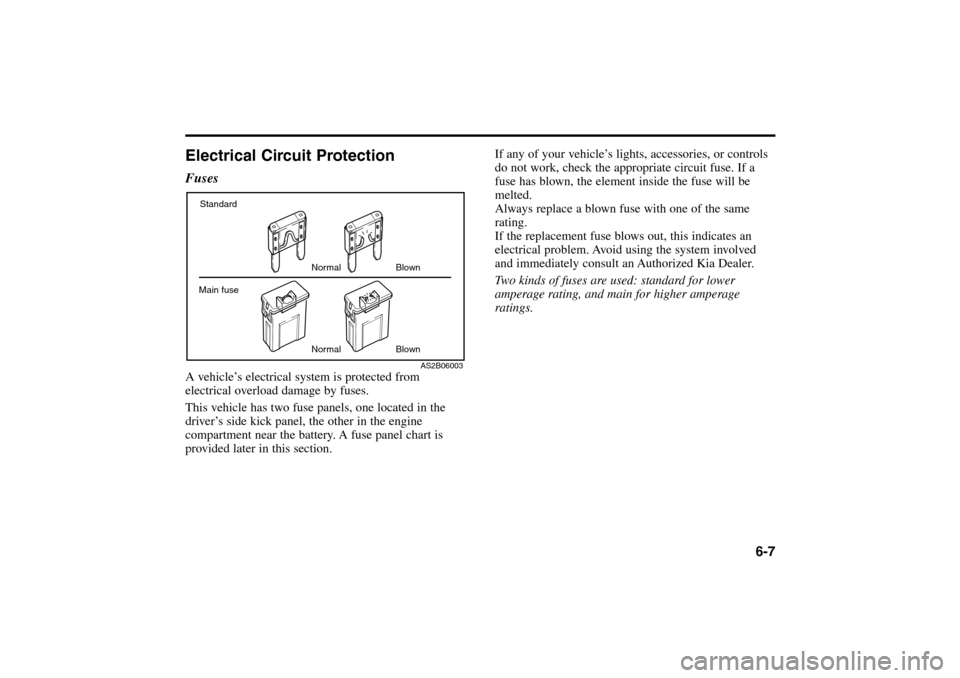
Electrical Circuit ProtectionFusesA vehicle’s electrical system is protected from
electrical overload damage by fuses.
This vehicle has two fuse panels, one located in the
driver’s side kick panel, the other in the engine
compartment near the battery. A fuse panel chart is
provided later in this section.
If any of your vehicle’s lights, accessories, or controls
do not work, check the appropriate circuit fuse. If a
fuse has blown, the element inside the fuse will be
melted.
Always replace a blown fuse with one of the same
rating.
If the replacement fuse blows out, this indicates an
electrical problem. Avoid using the system involved
and immediately consult an Authorized Kia Dealer.
Two kinds of fuses are used: standard for lower
amperage rating, and main for higher amperage
ratings.
6-7
Standard
Normal
NormalBlown
Blown Main fuse
AS2B06003
RIO ENG CNA 6.qxd 7/29/05 5:15 PM Page 7
Page 158 of 238
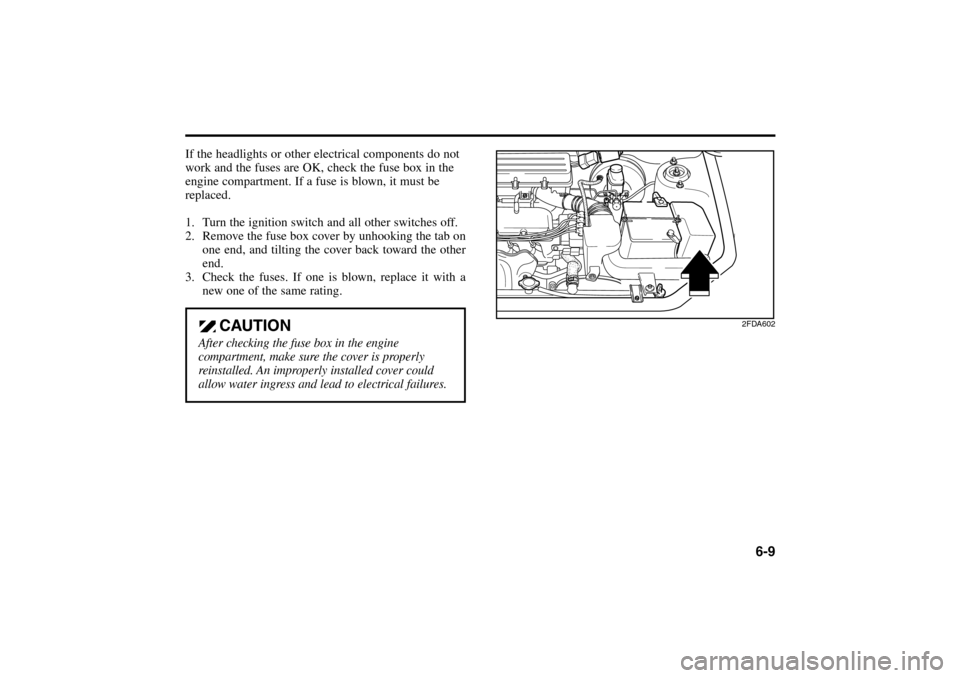
If the headlights or other electrical components do not
work and the fuses are OK, check the fuse box in the
engine compartment. If a fuse is blown, it must be
replaced.
1. Turn the ignition switch and all other switches off.
2. Remove the fuse box cover by unhooking the tab on
one end, and tilting the cover back toward the other
end.
3. Check the fuses. If one is blown, replace it with a
new one of the same rating.
6-9
CAUTION
After checking the fuse box in the engine
compartment, make sure the cover is properly
reinstalled. An improperly installed cover could
allow water ingress and lead to electrical failures.
2FDA602
RIO ENG CNA 6.qxd 7/29/05 5:15 PM Page 9
Page 159 of 238
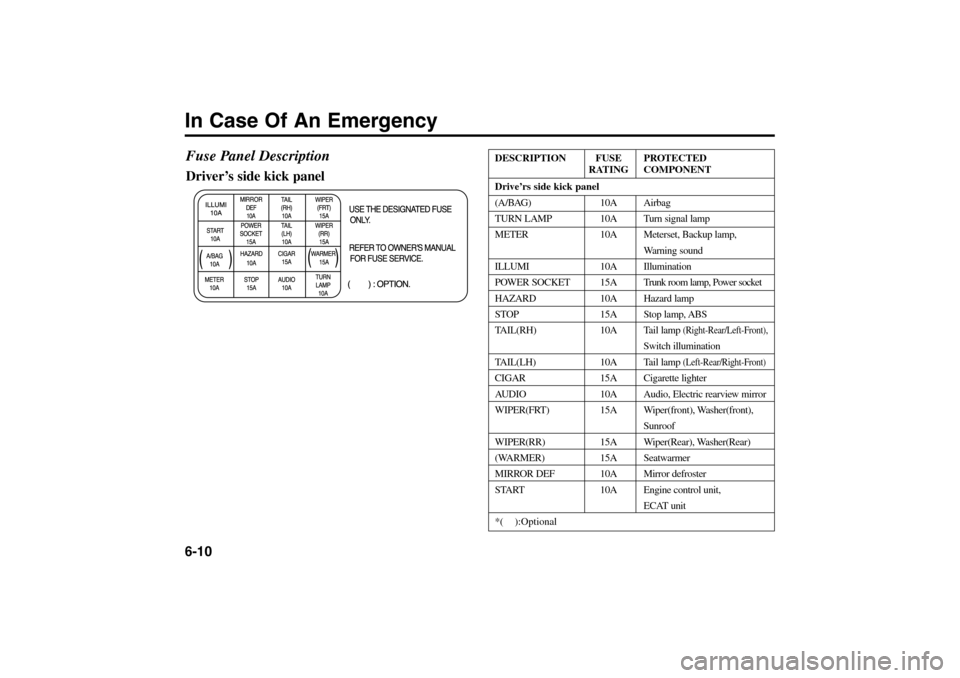
In Case Of An Emergency6-10Fuse Panel DescriptionDriver’s side kick panel
DESCRIPTION FUSE PROTECTED
RATING COMPONENT
Drive’rs side kick panel
(A/BAG) 10A Airbag
TURN LAMP 10A Turn signal lamp
METER 10A Meterset, Backup lamp,
Warning sound
ILLUMI 10A Illumination
POWER SOCKET 15A Trunk room lamp, Power socket
HAZARD 10A Hazard lamp
STOP 15A Stop lamp, ABS
TAIL(RH) 10A Tail lamp
(Right-Rear/Left-Front),
Switch illumination
TAIL(LH) 10A Tail lamp
(Left-Rear/Right-Front)
CIGAR 15A Cigarette lighter
AUDIO 10A Audio, Electric rearview mirror
WIPER(FRT) 15A Wiper(front), Washer(front),
Sunroof
WIPER(RR) 15A Wiper(Rear), Washer(Rear)
(WARMER) 15A Seatwarmer
MIRROR DEF 10A Mirror defroster
START 10A Engine control unit,
ECAT unit
*( ):Optional
RIO ENG CNA 6.qxd 7/29/05 5:15 PM Page 10
Page 160 of 238
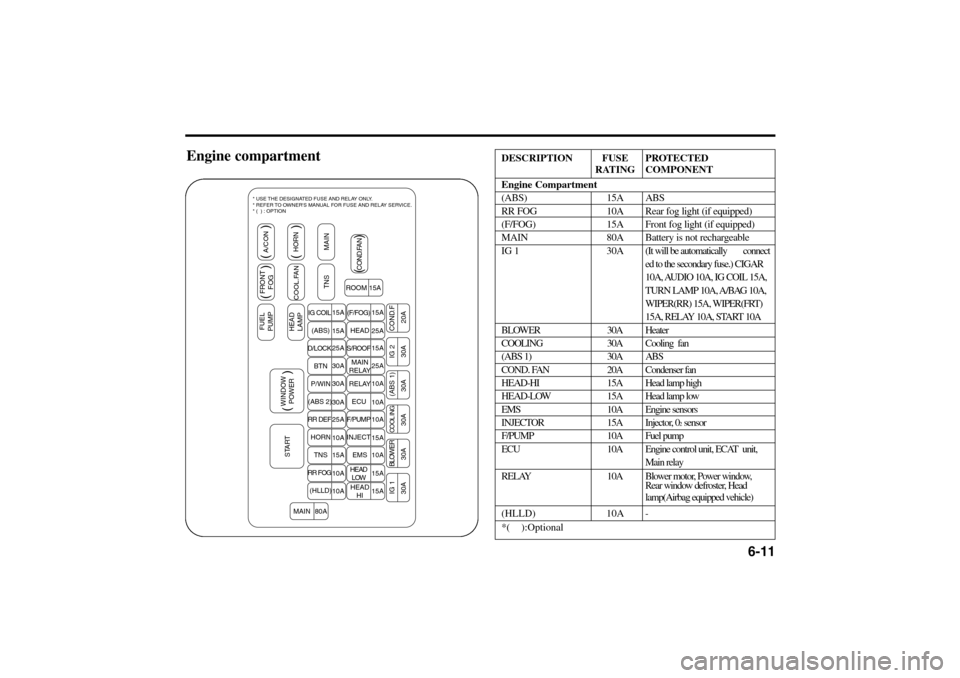
6-11
Engine compartment
DESCRIPTION FUSE PROTECTED
RATING COMPONENT
Engine Compartment
(ABS) 15A ABS
RR FOG 10A Rear fog light (if equipped)
(F/FOG) 15A Front fog light (if equipped)
MAIN 80A Battery is not rechargeable
IG 1 30A (It will be automatically connect
ed to the secondary fuse.) CIGAR
10A, AUDIO 10A, IG COIL 15A,
TURN LAMP 10A, A/BAG 10A,
WIPER(RR) 15A, WIPER(FRT)
15A, RELAY 10A, START 10A
BLOWER 30A Heater
COOLING 30A Cooling fan
(ABS 1) 30A ABS
COND. FAN 20A Condenser fan
HEAD-HI 15A Head lamp high
HEAD-LOW 15A Head lamp low
EMS 10A Engine sensors
INJECTOR 15A Injector, 0
2sensor
F/PUMP 10A Fuel pump
ECU 10A Engine control unit, ECAT unit,
Main relay
RELAY 10A Blower motor, Power window,
Rear window defroster, Head
lamp(Airbag equipped vehicle)
(HLLD) 10A
-
*( ):Optional
STARTWINDOW
POWERFUEL
PUMPFRONT
FOGA/CON
HEAD
LAMPCOOL.FANHORN
TNS MAIN
IG 1 BLOWER
COOL ING(ABS 1) IG 2 COND.F
( )( ) ( )
( )
( )
COND.FAN
ROOM 15A
IG COIL
(ABS)
D/LOCK
BTN
P/WIN
(ABS 2)
RR DEF
HORN
TNS
RR FOG
(HLLD)(F/FOG)
HEAD
S/ROOF
MAIN
RELAY
RELAY
ECU
F/PUMP
INJECT
EMS
HEAD
LOW
HEAD
HI 15A
15A
25A
30A
30A
30A
25A
10A
15A
10A
10A
80A15A
25A
15A
25A
10A
10A
10A
15A
10A
15A
15A
MAIN
30A 30A 30A 30A 30A 20A
* USE THE DESIGNATED FUSE AND RELAY ONLY.
* REFER TO OWNER'S MANUAL FOR FUSE AND RELAY SERVICE.
* ( ) : OPTION
RIO ENG CNA 6.qxd 7/29/05 5:15 PM Page 11
Page 162 of 238
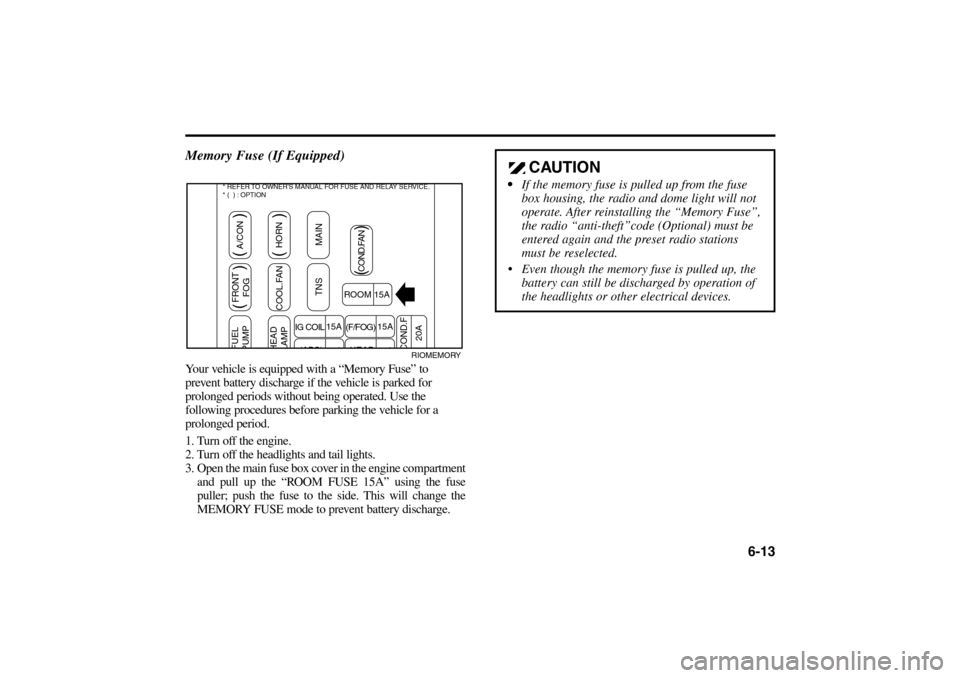
6-13 Memory Fuse (If Equipped)
Your vehicle is equipped with a “Memory Fuse” to
prevent battery discharge if the vehicle is parked for
prolonged periods without being operated. Use the
following procedures before parking the vehicle for a
prolonged period.
1. Turn off the engine.
2. Turn off the headlights and tail lights.
3. Open the main fuse box cover in the engine compartment
and pull up the “ROOM FUSE 15A” using the fuse
puller; push the fuse to the side. This will change the
MEMORY FUSE mode to prevent battery discharge.
FUEL
PUMPFRONT
FOGA/CON
HEAD
LAMPCOOL.FANHORN
TNS MAIN
COND.F( ) ( )
( )
( )
COND.FAN
ROOM 15A
IG COIL
(ABS)(F/FOG)
HEAD 15A
15A15A
25A
20A
* REFER TO OWNER'S MANUAL FOR FUSE AND RELAY SERVICE.
* ( ) : OPTION
RIOMEMORY
CAUTION
•If the memory fuse is pulled up from the fuse
box housing, the radio and dome light will not
operate. After reinstalling the “Memory Fuse”,
the radio “anti-theft”code (Optional) must be
entered again and the preset radio stations
must be reselected.
Even though the memory fuse is pulled up, the
battery can still be discharged by operation of
the headlights or other electrical devices.
RIO ENG CNA 6.qxd 7/29/05 5:15 PM Page 13
Page 203 of 238
Battery
7-31
WARNING - Battery dangers
Always read the following instructions
carefully when handling a battery.
Keep lighted cigarettes and all other
flames or sparks away from the
battery.
Hydrogen, which is a highly
combustible gas, is always present in
battery cells and may explode if
ignited.
Keep batteries out of the reach of
children because batteries contain
highly corrosive SULFURIC ACID.
Do not allow battery acid to contact
your skin, eyes, clothing or paint finish.
Wear eye protection when charging or
working near a battery. Always provide
ventilation when working in an
enclosed space.
(Continued)
(Continued)
If any electrolyte gets into your eyes,
flush your eyes with clean water for at
least 15 minutes and get immediate
medical attention. If possible, continue
to apply water with a sponge or cloth
until medical attention is received.
If electrolyte gets on your skin,
thoroughly wash the contacted area. If
you feel a pain or a burning sensation,
get medical attention immediately.
• When lifting a plastic-cased battery,
excessive pressure on the case may cause
battery acid to leak, resulting in personal
injury. Lift with a battery carrier or with
your hands on opposite corners.
Never attempt to charge the battery when
the battery cables are connected.
The electrical ignition system works with
high voltage. Never touch these components
with the engine running or the ignition
switched on.
RIO ENG CNA 7-2.qxd 7/29/05 5:18 PM Page 31
Page 204 of 238

Battery MaintenanceFor best battery service:
Keep the battery securely mounted.
Keep the battery top clean and dry.
Keep the terminals and connections clean, tight, and
coated with petroleum jelly or terminal grease.
Immediately rinse any spilled electrolyte from the
battery with a solution of water and baking soda.
If the vehicle is not going to be used for an extended
period of time, disconnect the battery cables.Maintenance7-32Battery Recharging
Your vehicle has a maintenance-free, calcium-based
battery.
If the battery becomes discharged in a short time
(headlights or interior lights were left on while the
vehicle was not in use), recharge it by slow (trickle)
charging for 10 hours.
If the battery gradually discharges because of high
electric load while the vehicle is being used,
recharge it at 20-30A for two hours.
AS2B07020
RIO ENG CNA 7-2.qxd 7/29/05 5:18 PM Page 32