radiator KIA Rio 2006 2.G User Guide
[x] Cancel search | Manufacturer: KIA, Model Year: 2006, Model line: Rio, Model: KIA Rio 2006 2.GPages: 220, PDF Size: 2.69 MB
Page 190 of 220
Maintenance12
7Engine coolantHave coolant changed by an authorized
Kia dealer according to the Maintenance
Schedule at the beginning of this section.
Use only soft (de-mineralized) water in
the coolant mixture.
The engine in your vehicle has alu- minum engine parts and must be pro-
tected by an ethylene-glycol-based
coolant to prevent corrosion and freez-
ing.
DO NOT USE alcohol or methanol coolant or mix them with the specified
coolant.
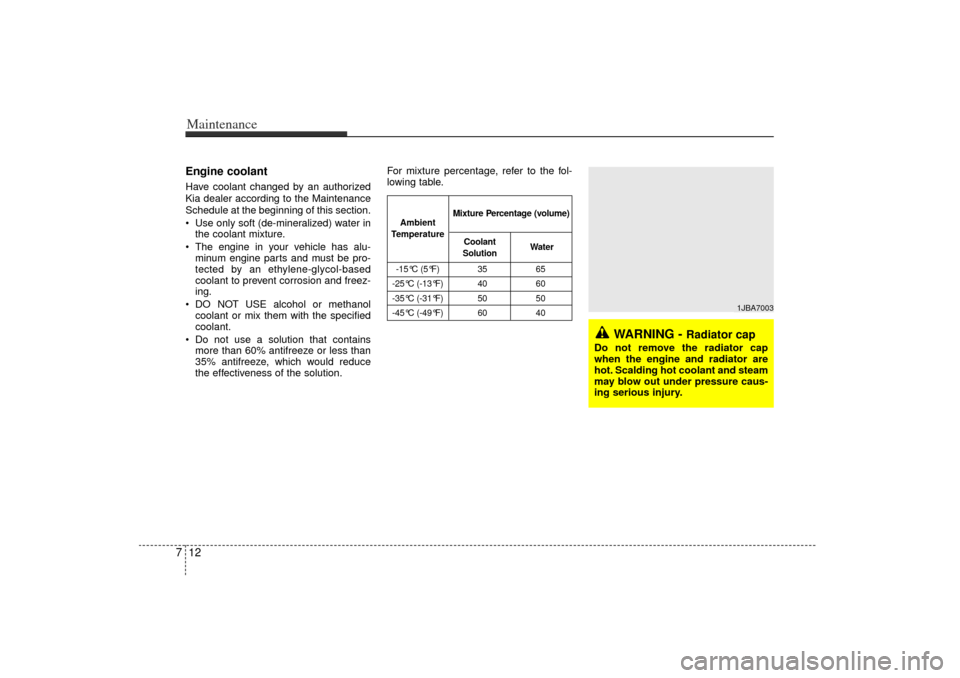
Do not use a solution that contains more than 60% antifreeze or less than
35% antifreeze, which would reduce
the effectiveness of the solution. For mixture percentage, refer to the fol-
lowing table.
1JBA7003
WARNING -
Radiator cap
Do not remove the radiator cap
when the engine and radiator are
hot. Scalding hot coolant and steam
may blow out under pressure caus-
ing serious injury.
-15°C (5°F) 35
65
-25°C (-13°F) 40 60
-35°C (-31°F) 50 50
-45°C (-49°F) 60 40Ambient
Temperature Mixture Percentage (volume)
Coolant
Solution Water
JB CAN 7.qxd 7/29/05 9:11 AM Page 12
Page 193 of 220
715
Maintenance
AUTOMATIC TRANSAXLE (IF EQUIPPED)Checking the automatic transaxle
fluid level The automatic transaxle fluid level
should be checked regularly.
The volume of the transaxle fluid
changes with temperature. Although it is
best to check the level after having driv-
en the vehicle for at least 30 minutes, the
level can be checked after warming the
fluid using the following procedure.
1. Park the vehicle on level ground andfirmly apply the parking brake.
2. Allow the engine to idle for about 2 minutes.
3. Depress the brake pedal and move the shift lever slowly through all ranges
then set it in P (Park). 4. With the engine still idling, pull out the
dipstick, wipe it clean and reinsert it
fully.
5. Pull out the dipstick again and check the fluid level.
✽ ✽NOTICE Low fluid level causes transaxle slip-
page. Overfilling can cause foaming,
loss of fluid and transaxle malfunc-
tion.
The use of a non-specified fluid could result in transaxle malfunction and
failure.
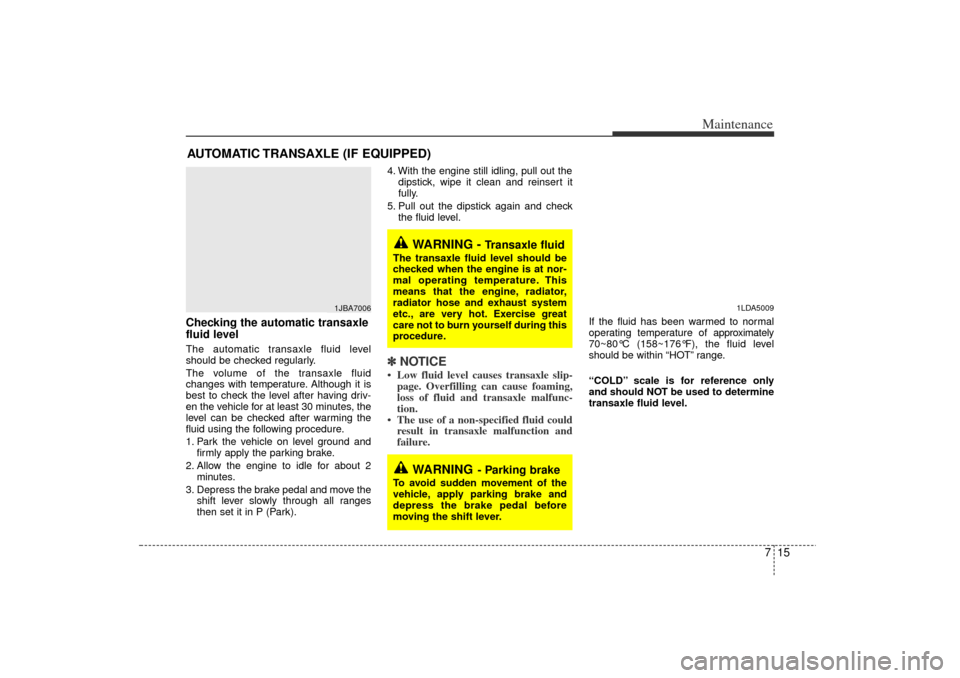
If the fluid has been warmed to normal
operating temperature of approximately
70~80°C (158~176°F), the fluid level
should be within “HOT” range.
“COLD” scale is for reference only
and should NOT be used to determine
transaxle fluid level.
1JBA7006
WARNING -
Transaxle fluid
The transaxle fluid level should be
checked when the engine is at nor-
mal operating temperature. This
means that the engine, radiator,
radiator hose and exhaust system
etc., are very hot. Exercise great
care not to burn yourself during this
procedure.
WARNING
- Parking brake
To avoid sudden movement of the
vehicle, apply parking brake and
depress the brake pedal before
moving the shift lever.
1LDA5009
JB CAN 7.qxd 7/29/05 9:11 AM Page 15
Page 194 of 220
Maintenance16
7New automatic transaxle fluid should
be red. The red dye is added so the
assembly plant can identify it as auto-
matic transaxle fluid and distinguish it
from engine oil or antifreeze. The red
dye, which is not an indicator of fluid
quality, is not permanent. As the vehi-
cle is driven, the automatic transaxle
fluid will begin to look darker. The
color may eventually appear light
brown.✽ ✽
NOTICEHave an authorized Kia dealer inspect
or change the automatic transaxle fluid
according to the Scheduled
Maintenance at the beginning of this
section.Changing automatic transaxle
fluidHave automatic transaxle fluid changed
by an authorized Kia dealer according to
the Maintenance Schedule at the begin-
ning of this section.
Use only the specified automatic
transaxle fluid. (Refer to "Recommended
Lubricants" later in this section.)
Checking the washer fluid level The reservoir is translucent so that you
can check the level with a quick visual
inspection.
Check the fluid level in the washer fluid
reservoir and add fluid if necessary. Plain
water may be used if washer fluid is not
available. However, use washer solvent
with antifreeze characteristics in cold cli-
mates to prevent freezing.LUBRICANTS AND FLUIDS
WARNING
- Coolant
Do not use radiator coolant or
antifreeze in the washer fluid
reservoir.
Radiator coolant can severely obscure visibility when sprayed
on the windshield and may cause
loss of vehicle control or damage
to paint and body trim.
Windshield washer fluid agents contain some amounts of alcohol
and can be flammable under cer-
tain circumstances. Do not allow
sparks or flame to contact the
washer fluid or the washer fluid
reservoir. Damage to the vehicle
or it's occupants could occur.
Windshield washer fluid is poi- sonous to humans and animals.
Do not drink and avoid contacting
windshield washer fluid. Serious
injury or death could occur.
1JBA7008
JB CAN 7.qxd 7/29/05 9:11 AM Page 16
Page 217 of 220
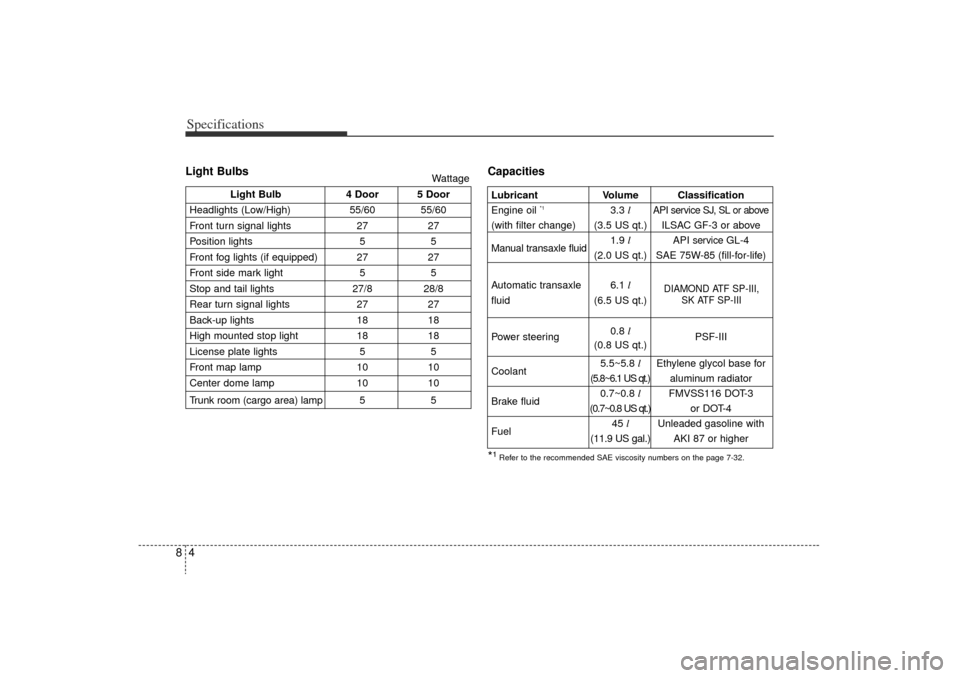
Specifications48Light BulbsCapacities
Light Bulb4 Door 5 Door
Headlights (Low/High) 55/60 55/60
Front turn signal lights 2727
Position lights 55
Front fog lights (if equipped) 27 27
Front side mark light 55
Stop and tail lights 27/8 28/8
Rear turn signal lights 2727
Back-up lights 1818
High mounted stop light 1818
License plate lights 55
Front map lamp 1010
Center dome lamp 1010
Trunk room (cargo area) lamp 5 5
Wattage
LubricantVolume Classification
Engine oil
*1
3.3 l
API service SJ, SL or above
(with filter change) (3.5 US qt.) ILSAC GF-3 or aboveManual transaxle fluid
1.9 l API
service
GL-4
(2.0 US qt.) SAE 75W-85 (fill-for-life)
Automatic transaxle 6.1 l
fluid (6.5 US qt.)
Power steering 0.8
l
PSF-III
(0.8 US qt.)
Coolant 5.5~5.8
lEthylene glycol base for
(5.8~6.1 US qt.) aluminum radiator
Brake fluid 0.7~0.8
lFMVSS116 DOT-3
(0.7~0.8 US qt.) o r D OT- 4
Fuel 45
l Unleaded gasoline with
(11.9 US gal.) AKI 87 or higher
*¹Refer to the recommended SAE viscosity numbers on the page 7-32.
DIAMOND ATF SP-III,
SK ATF SP-III
JB CAN 8.qxd 7/29/05 9:12 AM Page 4