Eco KIA Rio 2010 2.G User Guide
[x] Cancel search | Manufacturer: KIA, Model Year: 2010, Model line: Rio, Model: KIA Rio 2010 2.GPages: 236, PDF Size: 4.54 MB
Page 23 of 236
Knowing your vehicle
14
3
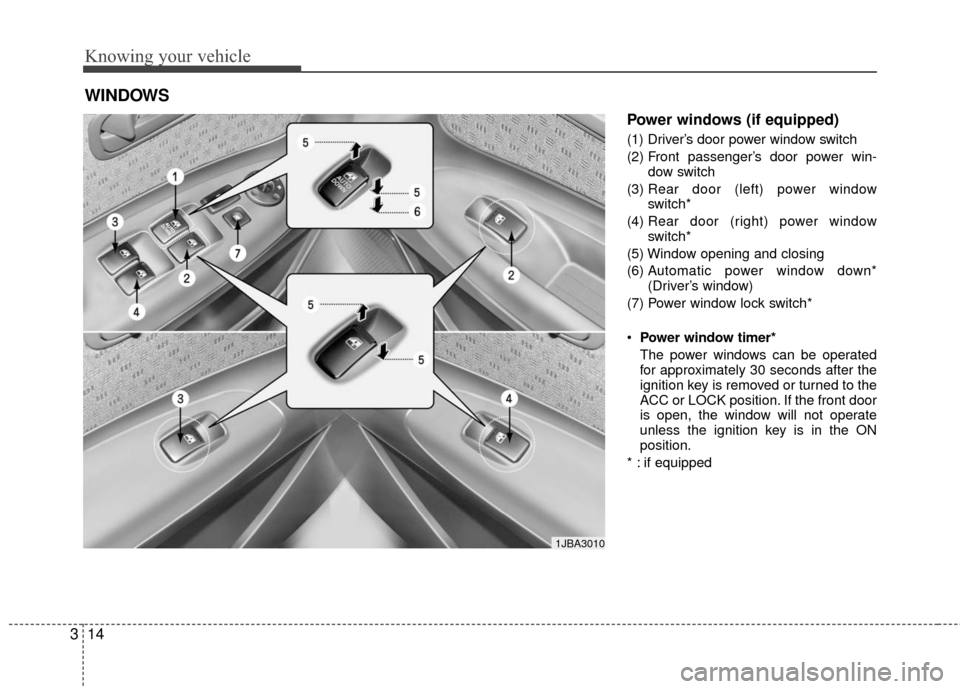
Power windows (if equipped)
(1) Driver’s door power window switch
(2) Front passenger’s door power win-
dow switch
(3) Rear door (left) power window
switch*
(4) Rear door (right) power window
switch*
(5) Window opening and closing
(6) A utomatic power window down*
(Driver’s window)
(7) Power window lock switch*
Power window timer*
The power windows can be operated
for approximately 30 seconds after the
ignition key is removed or turned to the
ACC or LOCK position. If the front door
is open, the window will not operate
unless the ignition key is in the ON
position.
* : if equipped
WINDOWS
1JBA3010
Page 24 of 236
315
Knowing your vehicle
Power windows (if equipped)
The ignition switch must be in the ON
position for power windows to operate.
Each door has a power window switch
that controls that door’s window.
However, the driver has a power window
lock switch which can block the operation
of passenger windows.
✽ ✽NOTICE
While driving with the rear windows
down or with the sunroof (if equipped)
in an open(or partially open position),
your vehicle may demonstrate a wind
buffeting or pulsation noise. This noise
is a normal occurrence and can be
reduced or eliminated by taking the fol-
lowing actions. If the noise occurs with
one or both of the rear windows down,
partially lower both front windows
approximately one inch. If you experi-
ence the noise with the snroof open,
slightly reduce the size of the sunroof
opening.
✽ ✽NOTICE
• To prevent the power window system
from the possibility of damage, do not
open or close two windows at the same
time. This will also ensure the longevi-
ty of the fuse. (Continued)(Continued)
• Never try to operate the main switch
on the driver's door and the individ-
ual door window switch in opposing
directions at the same time. If this is
done, the window will stop and cannot
be opened or closed.
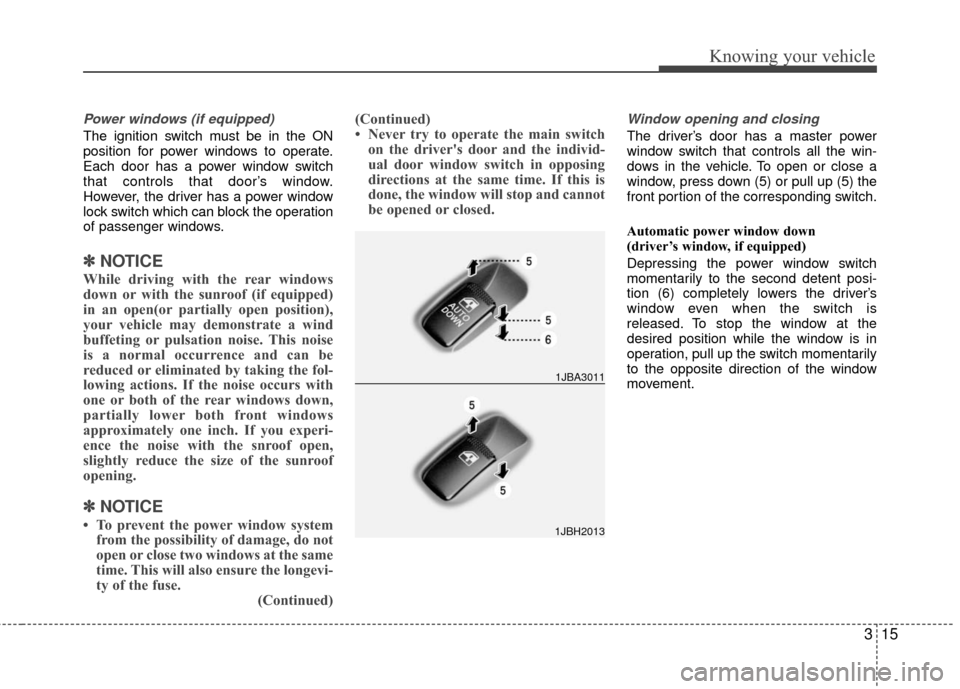
Window opening and closing
The driver’s door has a master power
window switch that controls all the win-
dows in the vehicle. To open or close a
window, press down (5) or pull up (5) the
front portion of the corresponding switch.
Automatic power window down
(driver’s window, if equipped)
Depressing the power window switch
momentarily to the second detent posi-
tion (6) completely lowers the driver’s
window even when the switch is
released. To stop the window at the
desired position while the window is in
operation, pull up the switch momentarily
to the opposite direction of the window
movement.
1JBH20131JBA3011
Page 30 of 236
321
Knowing your vehicle
Headrest
The driver's and front passenger's seats
are equipped with a headrest for the
occupant's safety and comfort.
The headrest not only provides comfort
for the driver and front passenger, but
also helps to protect the head and neck
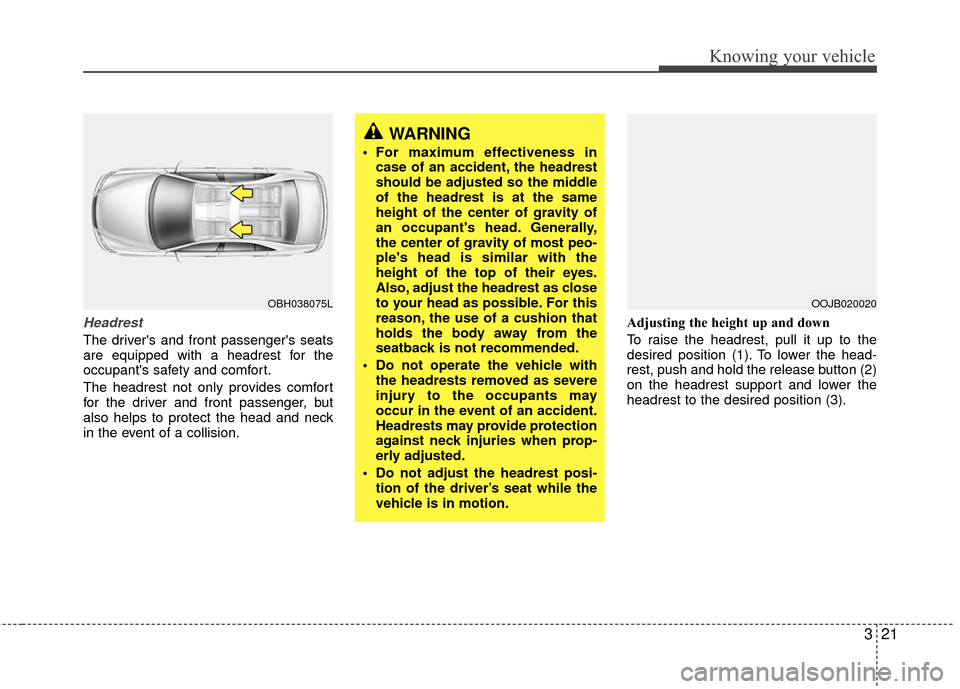
in the event of a collision.Adjusting the height up and down
To raise the headrest, pull it up to the
desired position (1). To lower the head-
rest, push and hold the release button (2)
on the headrest support and lower the
headrest to the desired position (3).
OBH038075L
WARNING
For maximum effectiveness in
case of an accident, the headrest
should be adjusted so the middle
of the headrest is at the same
height of the center of gravity of
an occupant's head. Generally,
the center of gravity of most peo-
ple's head is similar with the
height of the top of their eyes.
Also, adjust the headrest as close
to your head as possible. For this
reason, the use of a cushion that
holds the body away from the
seatback is not recommended.
Do not operate the vehicle with the headrests removed as severe
injury to the occupants may
occur in the event of an accident.
Headrests may provide protection
against neck injuries when prop-
erly adjusted.
Do not adjust the headrest posi- tion of the driver’s seat while the
vehicle is in motion.
OOJB020020
Page 32 of 236
323
Knowing your vehicle
Rear seat
Split folding rear seat (if equipped)
The rear seatbacks fold forward to pro-
vide additional cargo space and to pro-
vide access to the cargo area.
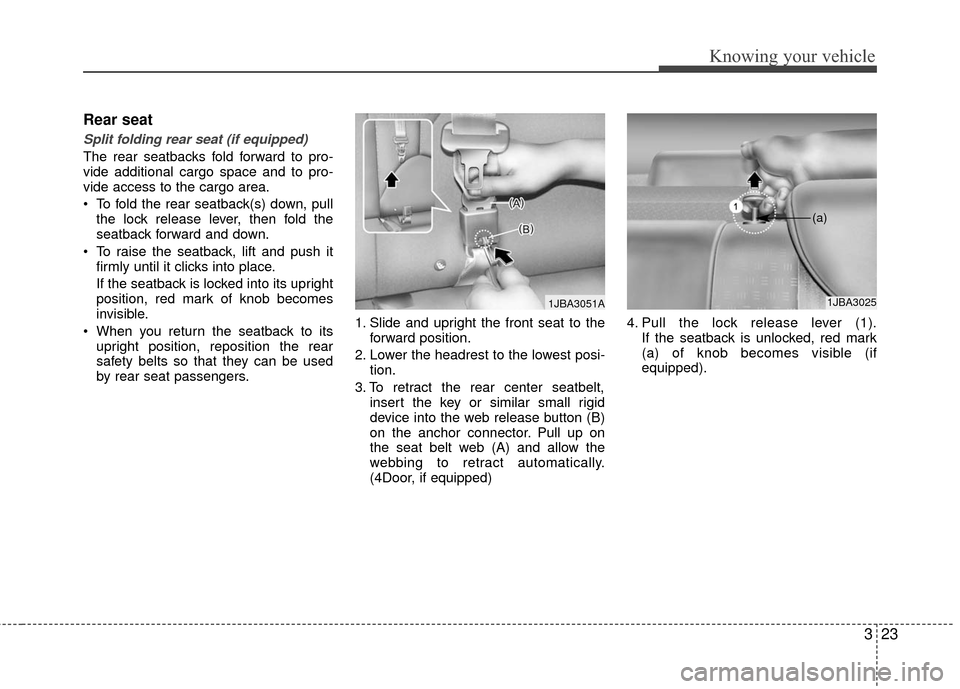
To fold the rear seatback(s) down, pullthe lock release lever, then fold the
seatback forward and down.
To raise the seatback, lift and push it firmly until it clicks into place.
If the seatback is locked into its upright
position, red mark of knob becomes
invisible.
When you return the seatback to its upright position, reposition the rear
safety belts so that they can be used
by rear seat passengers. 1. Slide and upright the front seat to the
forward position.
2. Lower the headrest to the lowest posi- tion.
3. To retract the rear center seatbelt, insert the key or similar small rigid
device into the web release button (B)
on the anchor connector. Pull up on
the seat belt web (A) and allow the
webbing to retract automatically.
(4Door, if equipped) 4. Pull the lock release lever (1).
If the seatback is unlocked, red mark
(a) of knob becomes visible (if
equipped).
1JBA3025
(a)
1JBA3051A
Page 35 of 236
Knowing your vehicle
26
3
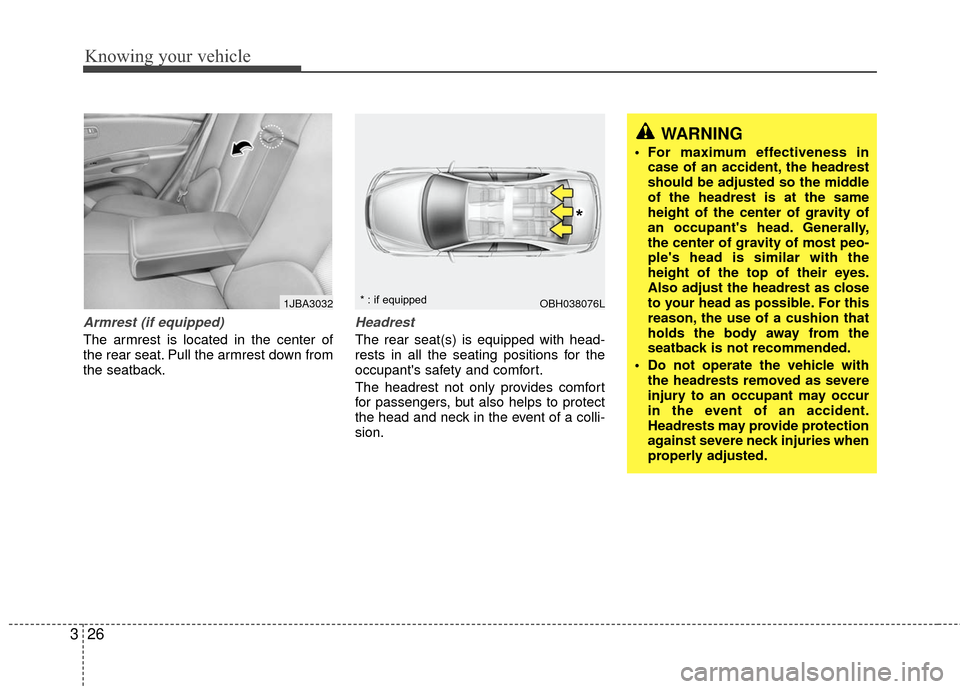
Armrest (if equipped)
The armrest is located in the center of
the rear seat. Pull the armrest down from
the seatback.
Headrest
The rear seat(s) is equipped with head-
rests in all the seating positions for the
occupant's safety and comfort.
The headrest not only provides comfort
for passengers, but also helps to protect
the head and neck in the event of a colli-
sion.
1JBA3032
WARNING
For maximum effectiveness in
case of an accident, the headrest
should be adjusted so the middle
of the headrest is at the same
height of the center of gravity of
an occupant's head. Generally,
the center of gravity of most peo-
ple's head is similar with the
height of the top of their eyes.
Also adjust the headrest as close
to your head as possible. For this
reason, the use of a cushion that
holds the body away from the
seatback is not recommended.
Do not operate the vehicle with the headrests removed as severe
injury to an occupant may occur
in the event of an accident.
Headrests may provide protection
against severe neck injuries when
properly adjusted.
OBH038076L
*
* : if equipped
Page 38 of 236
329
Knowing your vehicle
CAUTION - Air bag/Pre-
tensioner dust
When the air bags and pre-tension-
ers are activated, a loud noise maybe heard and fine dust, which mayappear to be smoke, may be visiblein the passenger compartment. Thisdust is not toxic. The dust maycause skin irritation and should notbe breathed for prolonged periods.Ventilate the vehicle after impact and wash your hands and face thor-oughly after an accident.
WARNING- Air bag/pre-
tensioner warning light
If the SRS air bag warning light
does not illuminate when the igni-
tion key is turned to “ON” , or if it
remains illuminated after approxi-
mately 6 seconds, or if it illuminates
while the vehicle is being driven,
please have an authorized Kia deal-
er inspect the pre-tensioner and air
bag system as soon as possible.
WARNING- Safety belt adjustment
To obtain maximum benefit from a
pre-tensioner seat belt:
The safety belt must be worn cor-
rectly.
The safety belt must be adjusted to the correct position.
WARNING- Replacing
used pre-tensioners
Pre-tensioners are designed to
operate once. After activation,
pre-tensioner seat belts must be
replaced. All seat belts, of any
type, should always be replaced
after they have been worn during
a collision.
Do not attempt to replace the pre- tensioners yourself. This must be
done by an authorized Kia dealer.
CAUTION - Hot parts
The pre-tensioner assembly mecha-nism becomes hot during activa-tion. Do not touch the pre-tensionerseat belt assembly for several min-utes after they have been activated.WARNING- Damaging the
pre-tensioners
Do not hit or strike the pre-ten-
sioner assemblies, especially
with a tool or heavy object.
Do not attempt to service or repair the pre-tensioners.
If the vehicle or pre-tensioner seat belt must be discarded, con-
tact an authorized Kia dealer.
Page 39 of 236
Knowing your vehicle
30
3
Safety belt restraint system We strongly recommend that the driver
and all passengers be properly
restrained at all times by using the safety
belts provided with the vehicle. Proper
use of the safety belts decreases the risk
of severe injury or death in accidents or
sudden stops. In most states, and in
Canada, the law requires their use.
All seats have lap/shoulder belts. Inertial
locks in the safety belt retractors allow all
of the lap/shoulder safety belts to remain
unlocked during normal vehicle opera-
tion. This allows the occupants some
freedom of movement and increased
comfort while using the safety belts. If a
force is applied to the vehicle, such as a
strong stop, a sharp turn, or a collision,
the safety belt retractors will automatical-
ly lock the safety belts.
Since the inertial locks do not require a
collision in order to lock up, you may
become aware of the safety belts locking
while braking or going around sharp cor-
ners.
Always use the rear seat position(s) to
install your child restraint(s). The rear safety belts use a special auto-
lock feature designed to allow a child
restraint to be used in these positions
without an added locking clip. They nor-
mally lock only under extreme or emer-
gency conditions (emergency lock
mode). However they can be adjusted so
that they remain fixed and locked when a
child restraint system is placed in these
positions. (Use this auto-lock mode only
to secure a child restraint, never for pas-
sengers restrained by the safety belts.)
Page 3-42 gives instructions on placing
the safety belt in the auto lock mode.
The drivers safety belt can only operate
in the emergency lock mode.
WARNING- Safety belts
To minimize the risk of serious or
fatal injury in an accident, the driv-
er and all passengers should use
the appropriate safety restraints for
their age and size. The presence of
air bags does not change the need
to be properly restrained by a safe-
ty belt or size-appropriate child
restraint. In fact, air bags are
designed to work the best when
passengers are correctly restrained
in the vehicle.
Be sure you are familiar with the
information in this section,
including the information on
infant and child restraints.
Read the safety warnings on the sun visors of your vehicle also.
WARNING- Child restraint
in front seat
Never install a child restraint sys-
tem in the front passenger position,
as an inflating air bag could cause
serious or fatal injury to a child in
that position.
Page 42 of 236
333
Knowing your vehicle
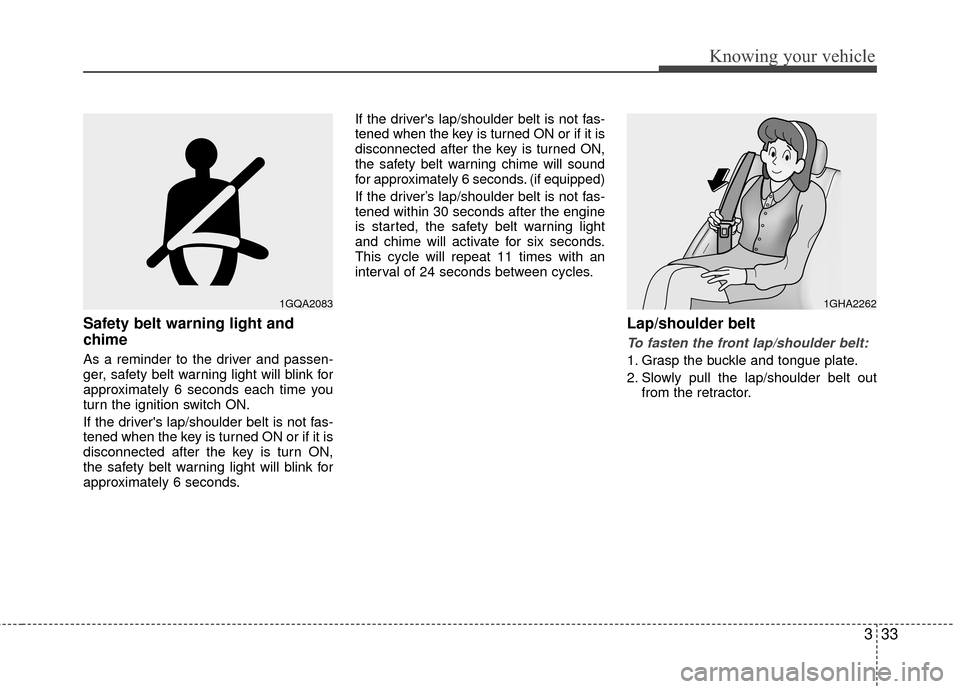
Safety belt warning light and
chime
As a reminder to the driver and passen-
ger, safety belt warning light will blink for
approximately 6 seconds each time you
turn the ignition switch ON.
If the driver's lap/shoulder belt is not fas-
tened when the key is turned ON or if it is
disconnected after the key is turn ON,
the safety belt warning light will blink for
approximately 6 seconds.If the driver's lap/shoulder belt is not fas-
tened when the key is turned ON or if it is
disconnected after the key is turned ON,
the safety belt warning chime will sound
for approximately 6 seconds. (if equipped)
If the driver’s lap/shoulder belt is not fas-
tened within 30 seconds after the engine
is started, the safety belt warning light
and chime will activate for six seconds.
This cycle will repeat 11 times with an
interval of 24 seconds between cycles.
Lap/shoulder belt
To fasten the front lap/shoulder belt:
1. Grasp the buckle and tongue plate.
2. Slowly pull the lap/shoulder belt out
from the retractor.
1GQA20831GHA2262
Page 48 of 236
339
Knowing your vehicle
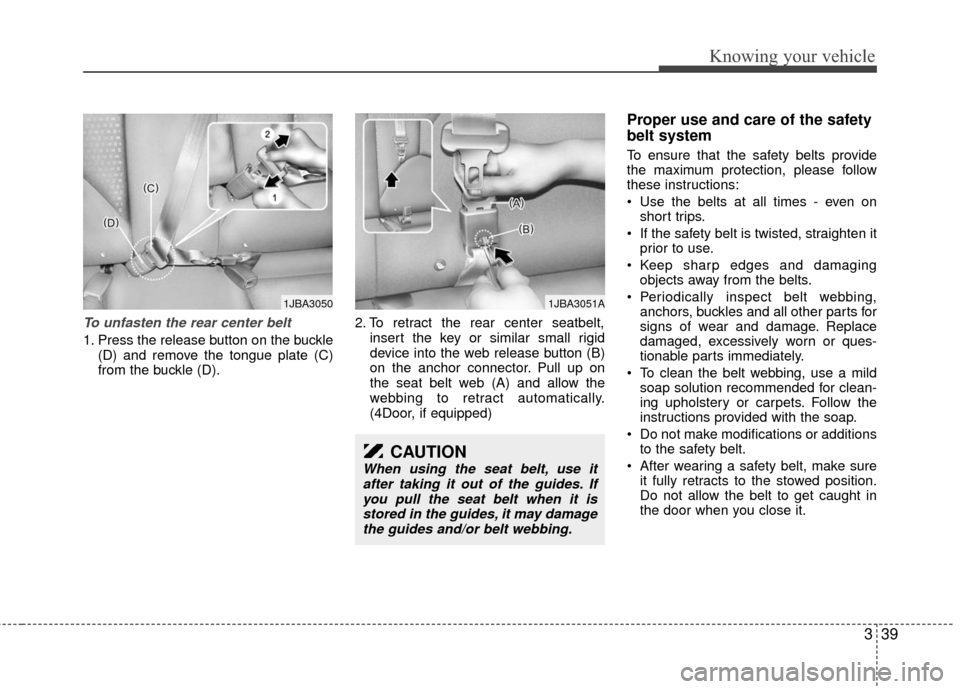
To unfasten the rear center belt
1. Press the release button on the buckle(D) and remove the tongue plate (C)
from the buckle (D). 2. To retract the rear center seatbelt,
insert the key or similar small rigid
device into the web release button (B)
on the anchor connector. Pull up on
the seat belt web (A) and allow the
webbing to retract automatically.
(4Door, if equipped)
Proper use and care of the safety
belt system
To ensure that the safety belts provide
the maximum protection, please follow
these instructions:
Use the belts at all times - even onshort trips.
If the safety belt is twisted, straighten it prior to use.
Keep sharp edges and damaging objects away from the belts.
Periodically inspect belt webbing, anchors, buckles and all other parts for
signs of wear and damage. Replace
damaged, excessively worn or ques-
tionable parts immediately.
To clean the belt webbing, use a mild soap solution recommended for clean-
ing upholstery or carpets. Follow the
instructions provided with the soap.
Do not make modifications or additions to the safety belt.
After wearing a safety belt, make sure it fully retracts to the stowed position.
Do not allow the belt to get caught in
the door when you close it.
1JBA30501JBA3051A
CAUTION
When using the seat belt, use it
after taking it out of the guides. If you pull the seat belt when it isstored in the guides, it may damagethe guides and/or belt webbing.
Page 49 of 236
Knowing your vehicle
40
3
Restraint of pregnant women
Pregnant women should wear lap/shoul-
der belt assemblies whenever possible
according to specific recommendations
by their doctors. The lap portion of the
belt should be worn AS SNUGLY AND
LOW AS POSSIBLE.
Restraint of infants and small
children
To increase their safety, infants and
young children should always be
restrained by a restraint system
approved for their age and size.
Never allow a child to stand or kneel on
the seat of a moving vehicle. Never allow
a safety belt to be placed around both a
child and an adult or around two children
at the same time.
It is best for children to be seated in the
rear seats.
Many companies manufacture child
restraint systems (often called child
seats) for infants and small children. An
acceptable child restraint system must
always satisfy Canadian Motor Vehicle
Safety Standards. Make sure that any
child-restraint system you use in your
vehicle is labelled as complying with
Federal Safety Standards.
The child-restraint system should be
chosen to fit both the size of the child and
the size of the vehicle seat. Be sure to fol-
low any instructions provided by the
child-restraint system manufacturer
when installing the child-restraint system.
WARNING - Pregnant
women
Pregnant women must never place
the lap portion of the safety belt
over the area of the abdomen where
the fetus is located or above the
abdomen where the belt could
crush the fetus during an impact.
WARNING
Do not bleach or dye the webbing
because this may weaken the web-
bing fibers and allow them to fail
when loaded in a collision.