Eco KIA Rio 2010 2.G Owner's Guide
[x] Cancel search | Manufacturer: KIA, Model Year: 2010, Model line: Rio, Model: KIA Rio 2010 2.GPages: 236, PDF Size: 4.54 MB
Page 50 of 236
341
Knowing your vehicle
Restraint of larger children
As children grow, they may need to use
new child-restraint systems, including
larger child seats or booster seats, which
are appropriate for their increased size.
A child who has outgrown available child-
restraint systems should use the belts
provided in the vehicle. When seated in
the rear outboard seats, the child should
be restrained by the lap/shoulder belt.
If the shoulder belt portion slightly touch-
es the child’s neck or face, try placing the
child closer to the center of the vehicle. If
the shoulder belt still touches their face
or neck they need to be returned to a
child restraint system. In addition, after-
market devices are available from inde-
pendent manufacturers which help pull
the shoulder belt down and away from
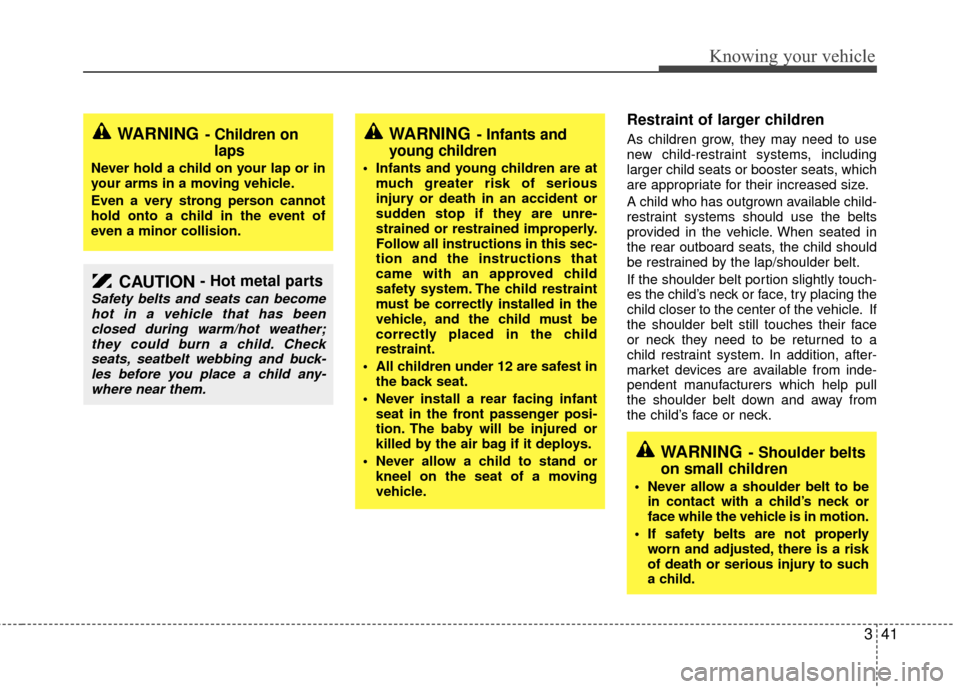
the child’s face or neck.WARNING- Infants and
young children
Infants and young children are at
much greater risk of serious
injury or death in an accident or
sudden stop if they are unre-
strained or restrained improperly.
Follow all instructions in this sec-
tion and the instructions that
came with an approved child
safety system. The child restraint
must be correctly installed in the
vehicle, and the child must be
correctly placed in the child
restraint.
All children under 12 are safest in the back seat.
Never install a rear facing infant seat in the front passenger posi-
tion. The baby will be injured or
killed by the air bag if it deploys.
Never allow a child to stand or kneel on the seat of a moving
vehicle.
WARNING- Children onlaps
Never hold a child on your lap or in
your arms in a moving vehicle.
Even a very strong person cannot
hold onto a child in the event of
even a minor collision.
CAUTION- Hot metal parts
Safety belts and seats can become
hot in a vehicle that has been closed during warm/hot weather;they could burn a child. Checkseats, seatbelt webbing and buck-les before you place a child any-where near them.
WARNING- Shoulder belts
on small children
Never allow a shoulder belt to be
in contact with a child’s neck or
face while the vehicle is in motion.
If safety belts are not properly worn and adjusted, there is a risk
of death or serious injury to such
a child.
Page 51 of 236
Knowing your vehicle
42
3
Child restraint system
For small children and babies, the use of
a child seat or infant seat is strongly rec-
ommended and is required by law in
almost all states. This child seat or infant
seat should be of appropriate size for the
child and should be installed in accor-
dance with the manufacturer's instruc-
tions.
Children riding in the car should sit on
the rear seat and must always be proper-
ly restrained to minimize the risk of injury
in an accident, sudden stop or sudden
maneuver. According to accident statis-
tics, children are safer when properly
restrained in the rear seats than in the
front seat.
Child restraint systems are designed to
be secured in vehicle seats by lap belts
or the lap belt portion of a lap/shoulder
belt, or by a LATCH system (if equipped).
Children could be injured or killed in a
crash if their restraints are not properly
secured. For small children and babies, a
child seat or infant seat must be used.
Before buying a particular child restraint
system, make sure it fits your car and
seat belts, and fits your child. Follow all
the instructions provided by the child
seat manufacturer when installing the
child restraint system.
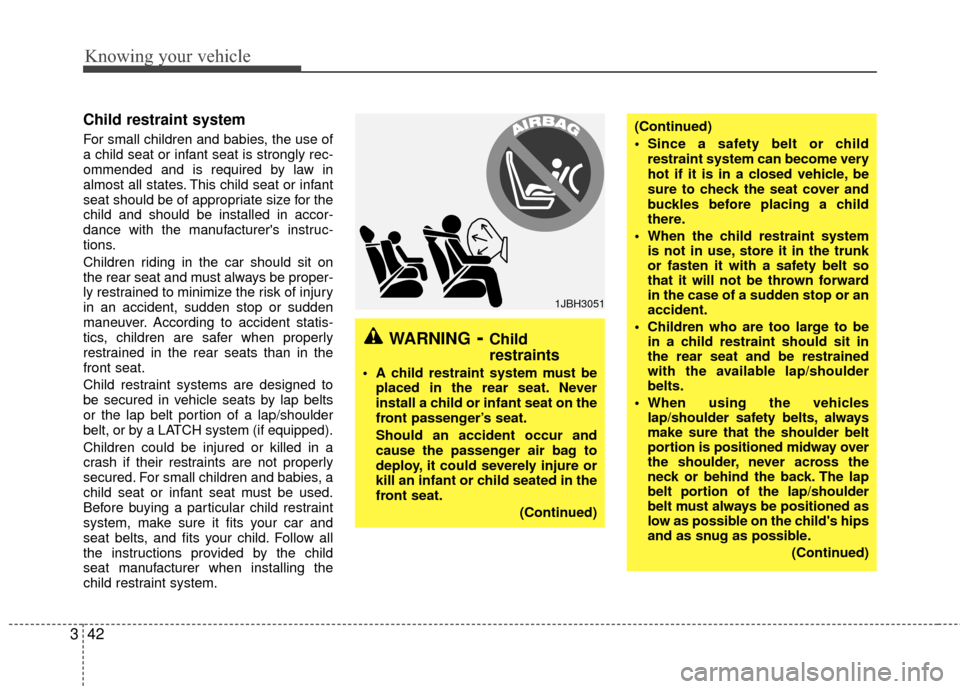
1JBH3051
WARNING- Child
restraints
A child restraint system must be
placed in the rear seat. Never
install a child or infant seat on the
front passenger’s seat.
Should an accident occur and
cause the passenger air bag to
deploy, it could severely injure or
kill an infant or child seated in the
front seat.
(Continued)
(Continued)
Since a safety belt or childrestraint system can become very
hot if it is in a closed vehicle, be
sure to check the seat cover and
buckles before placing a child
there.
When the child restraint system is not in use, store it in the trunk
or fasten it with a safety belt so
that it will not be thrown forward
in the case of a sudden stop or an
accident.
Children who are too large to be in a child restraint should sit in
the rear seat and be restrained
with the available lap/shoulder
belts.
When using the vehicles lap/shoulder safety belts, always
make sure that the shoulder belt
portion is positioned midway over
the shoulder, never across the
neck or behind the back. The lap
belt portion of the lap/shoulder
belt must always be positioned as
low as possible on the child's hips
and as snug as possible.
(Continued)
Page 52 of 236
343
Knowing your vehicle
Installing a child restraint system
For safety reasons, we recommend that
the child restraint system be used in the
rear seats.
Never place a rear-facing child
restraint in the front passenger seat,
because of the danger that an inflat-
ing passenger side air bag could
impact the rear-facing child restraint
and kill the child.
Since all passenger safety belts move
freely under normal conditions and only
lock under extreme or emergency condi-
tions (emergency lock mode), you must
manually change these safety belts to
the auto lock mode to secure a child
restraint.(Continued)
If the vehicle’s safety belt will notproperly fit the child, you must
use an appropriate child restraint
or booster seat in the rear.
Never allow a child to stand up or kneel while the vehicle is moving.
Never use an infant carrier or child seat that "hooks" over a
seatback. It will not provide ade-
quate protection in an accident.
Never allow a child to be held while they are in a moving vehi-
cle, as this could result in serious
injury or death to the child in the
event of an accident or sudden
stop. Holding a child in a moving
vehicle does not provide the child
with any protection during an
accident, even if the person hold-
ing the child is wearing a seat
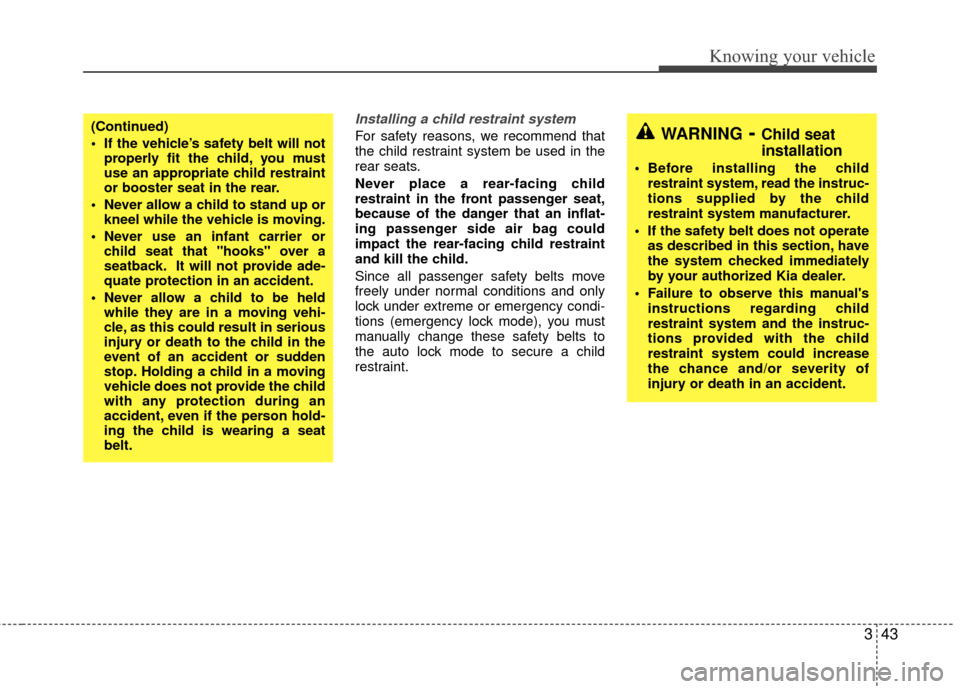
belt.WARNING- Child seat
installation
Before installing the child
restraint system, read the instruc-
tions supplied by the child
restraint system manufacturer.
If the safety belt does not operate as described in this section, have
the system checked immediately
by your authorized Kia dealer.
Failure to observe this manual's instructions regarding child
restraint system and the instruc-
tions provided with the child
restraint system could increase
the chance and/or severity of
injury or death in an accident.
Page 59 of 236
Knowing your vehicle
50
3
What your air bag system does
Driver’s air bag and front passenger’s air
bag are designed to supplement the pro-
tection offered by the safety belt in cer-
tain frontal collisions. Likewise, side air
bag and curtain air bags are designed to
supplement the protection offered by the
safety belt in side collisions. Safety belts
are designed to reduce the injury of the
driver or passengers in case of light
impact or collision. No safety belt or air
bag system can completely eliminate
injuries that may cause in collisions or
impacts. To help reduce impact on driver
or passengers in any collision, safety
belts must be correctly worn.
What your air bag system does
not do
The air bag system is designed to sup-
plement the protection offered by the
safety belt system. IT IS NOT A SUBSTI-
TUTE FOR THE SAFETY BELT.
The importance of using
safety belts
There are four very important reasons to
use safety belts even with an air bag sup-
plemental restraint system. They:
help keep you in the proper position
(away from the air bag) when it inflates.
reduce the risk of harm in rollover, side impact (vehicles not equipped with
side and curtain air bags) or rear
impact collisions, because an air bag is
not designed to inflate in such situa-
tions and even a side curtain air bag is
designed to inflate only in certain side
impact collisions.
reduce the risk of harm in frontal or side collisions which are not severe
enough to actuate the air bag supple-
mental restraint system.
reduce the risk of being ejected from your vehicle. Your vehicle’s Supplemental Restraint
System Control Module is equipped
with a recording device that may
record the use or status of the safety
belt restraint system by the driver and
front passenger in certain collisions.
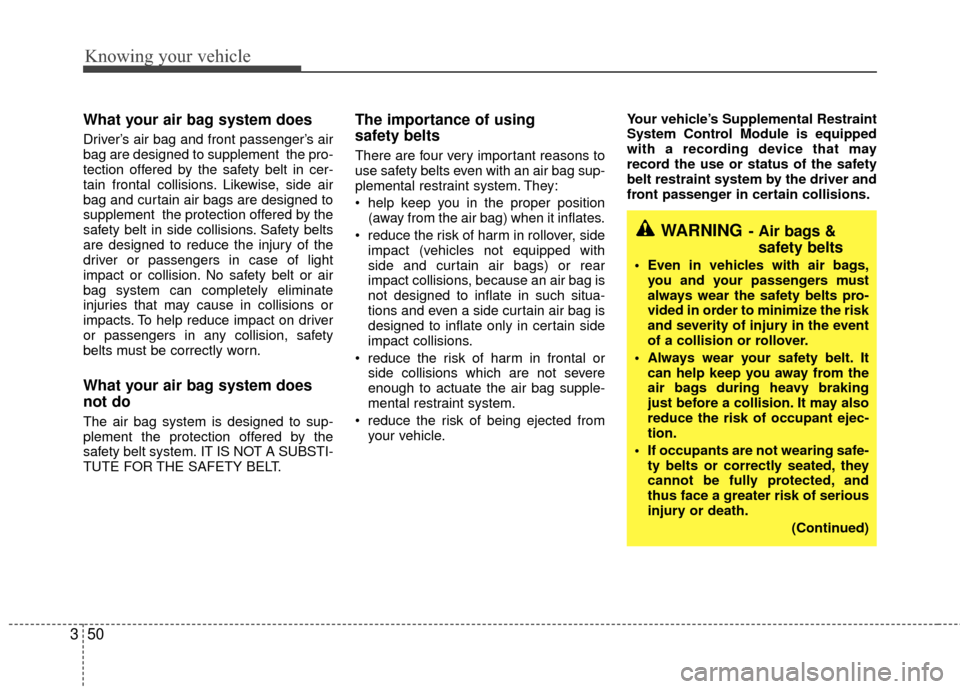
WARNING- Air bags &
safety belts
Even in vehicles with air bags,
you and your passengers must
always wear the safety belts pro-
vided in order to minimize the risk
and severity of injury in the event
of a collision or rollover.
Always wear your safety belt. It can help keep you away from the
air bags during heavy braking
just before a collision. It may also
reduce the risk of occupant ejec-
tion.
If occupants are not wearing safe- ty belts or correctly seated, they
cannot be fully protected, and
thus face a greater risk of serious
injury or death.
(Continued)
Page 60 of 236
351
Knowing your vehicle
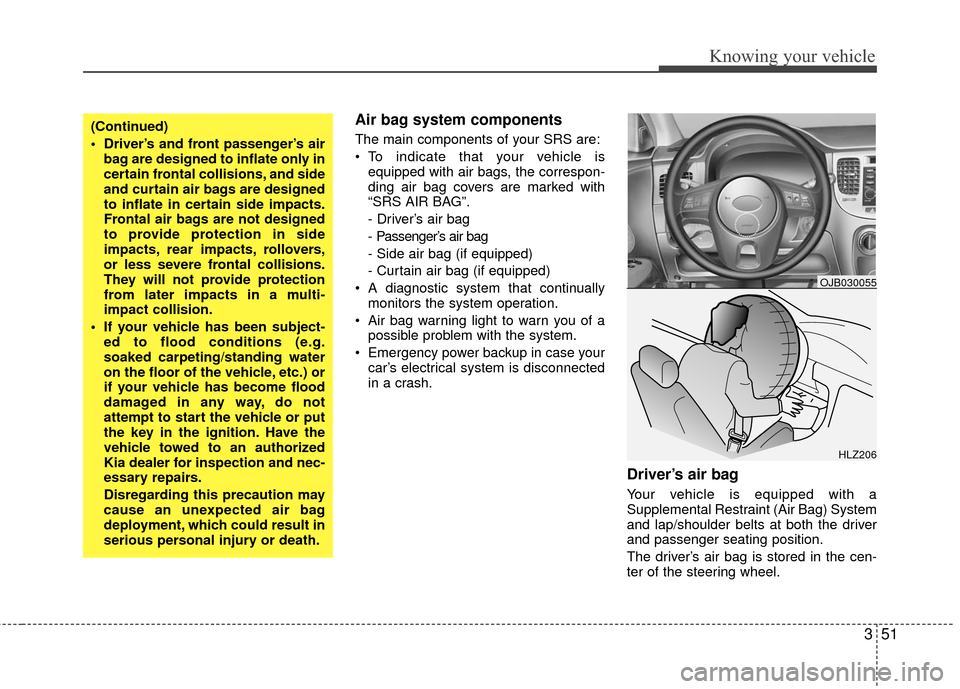
Air bag system components
The main components of your SRS are:
To indicate that your vehicle isequipped with air bags, the correspon-
ding air bag covers are marked with
“SRS AIR BAG”.
- Driver’s air bag
- Passenger’s air bag
- Side air bag (if equipped)
- Curtain air bag (if equipped)
A diagnostic system that continually monitors the system operation.
Air bag warning light to warn you of a possible problem with the system.
Emergency power backup in case your car’s electrical system is disconnected
in a crash.
Driver’s air bag
Your vehicle is equipped with a
Supplemental Restraint (Air Bag) System
and lap/shoulder belts at both the driver
and passenger seating position.
The driver’s air bag is stored in the cen-
ter of the steering wheel.
(Continued)
Driver’s and front passenger’s airbag are designed to inflate only in
certain frontal collisions, and side
and curtain air bags are designed
to inflate in certain side impacts.
Frontal air bags are not designed
to provide protection in side
impacts, rear impacts, rollovers,
or less severe frontal collisions.
They will not provide protection
from later impacts in a multi-
impact collision.
If your vehicle has been subject- ed to flood conditions (e.g.
soaked carpeting/standing water
on the floor of the vehicle, etc.) or
if your vehicle has become flood
damaged in any way, do not
attempt to start the vehicle or put
the key in the ignition. Have the
vehicle towed to an authorized
Kia dealer for inspection and nec-
essary repairs.
Disregarding this precaution may
cause an unexpected air bag
deployment, which could result in
serious personal injury or death.
HLZ206
OJB030055
Page 64 of 236
355
Knowing your vehicle
Why didn’t my air bag go off in a
collision?
(Inflation and non-inflation conditionsof the air bag)
There are many types of accidents in
which one or more of the air bags
would not be expected to provide
additional protection.
These include rear impacts, second or
third collisions in multiple impact acci-
dents, as well as low speed impacts.
Just because your vehicle is damaged
and even if it is totally unusable, don’t
be surprised that the air bags did not
inflate.
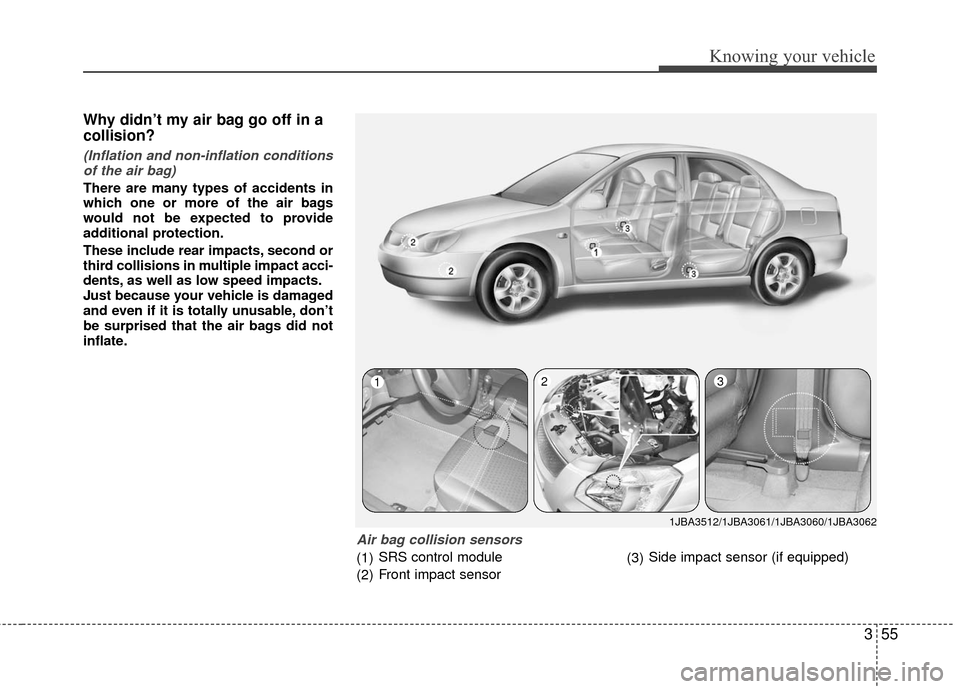
Air bag collision sensors
(1) SRS control module
(2) Front impact sensor (3)
Side impact sensor (if equipped)
1JBA3512/1JBA3061/1JBA3060/1JBA3062
123
Page 71 of 236
Knowing your vehicle
62
3
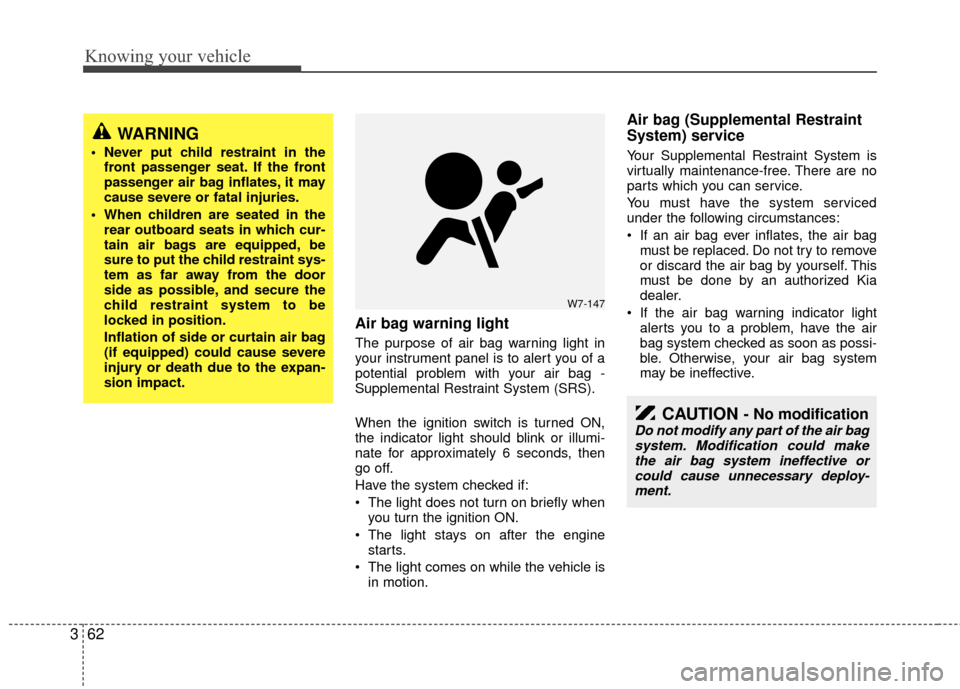
Air bag warning light
The purpose of air bag warning light in
your instrument panel is to alert you of a
potential problem with your air bag -
Supplemental Restraint System (SRS).
When the ignition switch is turned ON,
the indicator light should blink or illumi-
nate for approximately 6 seconds, then
go off.
Have the system checked if:
The light does not turn on briefly when
you turn the ignition ON.
The light stays on after the engine starts.
The light comes on while the vehicle is in motion.
Air bag (Supplemental Restraint
System) service
Your Supplemental Restraint System is
virtually maintenance-free. There are no
parts which you can service.
You must have the system serviced
under the following circumstances:
If an air bag ever inflates, the air bagmust be replaced. Do not try to remove
or discard the air bag by yourself. This
must be done by an authorized Kia
dealer.
If the air bag warning indicator light alerts you to a problem, have the air
bag system checked as soon as possi-
ble. Otherwise, your air bag system
may be ineffective.
WARNING
Never put child restraint in thefront passenger seat. If the front
passenger air bag inflates, it may
cause severe or fatal injuries.
When children are seated in the rear outboard seats in which cur-
tain air bags are equipped, be
sure to put the child restraint sys-
tem as far away from the door
side as possible, and secure the
child restraint system to be
locked in position.
Inflation of side or curtain air bag
(if equipped) could cause severe
injury or death due to the expan-
sion impact.
CAUTION - No modification
Do not modify any part of the air bagsystem. Modification could make the air bag system ineffective orcould cause unnecessary deploy- ment.
W7-147
Page 74 of 236
365
Knowing your vehicle
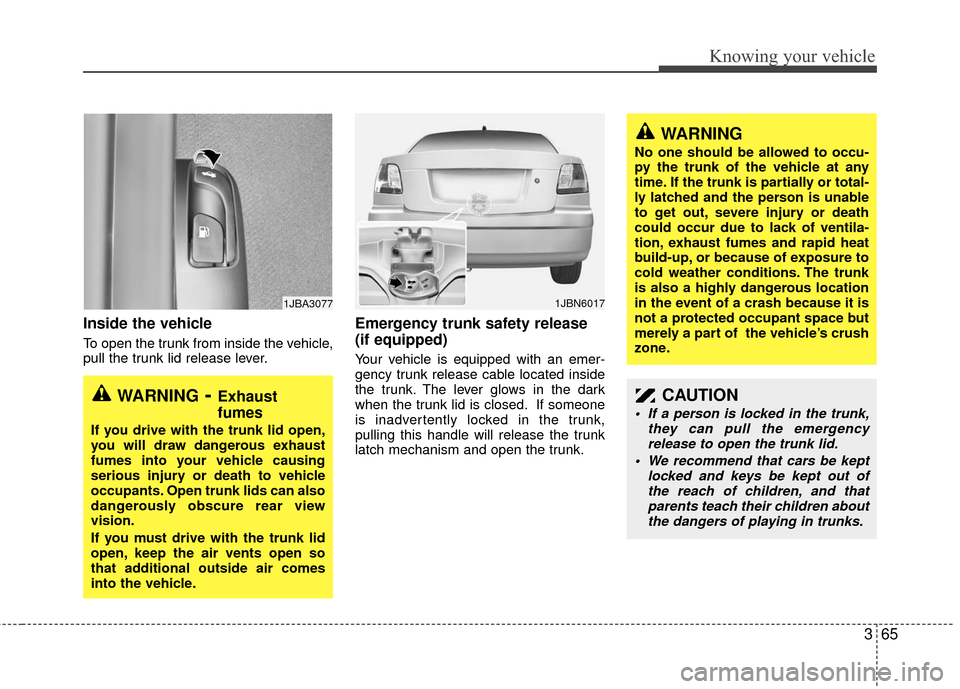
Inside the vehicle
To open the trunk from inside the vehicle,
pull the trunk lid release lever.
Emergency trunk safety release
(if equipped)
Your vehicle is equipped with an emer-
gency trunk release cable located inside
the trunk. The lever glows in the dark
when the trunk lid is closed. If someone
is inadvertently locked in the trunk,
pulling this handle will release the trunk
latch mechanism and open the trunk.
WARNING- Exhaust
fumes
If you drive with the trunk lid open,
you will draw dangerous exhaust
fumes into your vehicle causing
serious injury or death to vehicle
occupants. Open trunk lids can also
dangerously obscure rear view
vision.
If you must drive with the trunk lid
open, keep the air vents open so
that additional outside air comes
into the vehicle.
1JBA30771JBN6017
WARNING
No one should be allowed to occu-
py the trunk of the vehicle at any
time. If the trunk is partially or total-
ly latched and the person is unable
to get out, severe injury or death
could occur due to lack of ventila-
tion, exhaust fumes and rapid heat
build-up, or because of exposure to
cold weather conditions. The trunk
is also a highly dangerous location
in the event of a crash because it is
not a protected occupant space but
merely a part of the vehicle’s crush
zone.
CAUTION
If a person is locked in the trunk,they can pull the emergencyrelease to open the trunk lid.
We recommend that cars be kept locked and keys be kept out ofthe reach of children, and thatparents teach their children about the dangers of playing in trunks.
Page 75 of 236
Knowing your vehicle
66
3
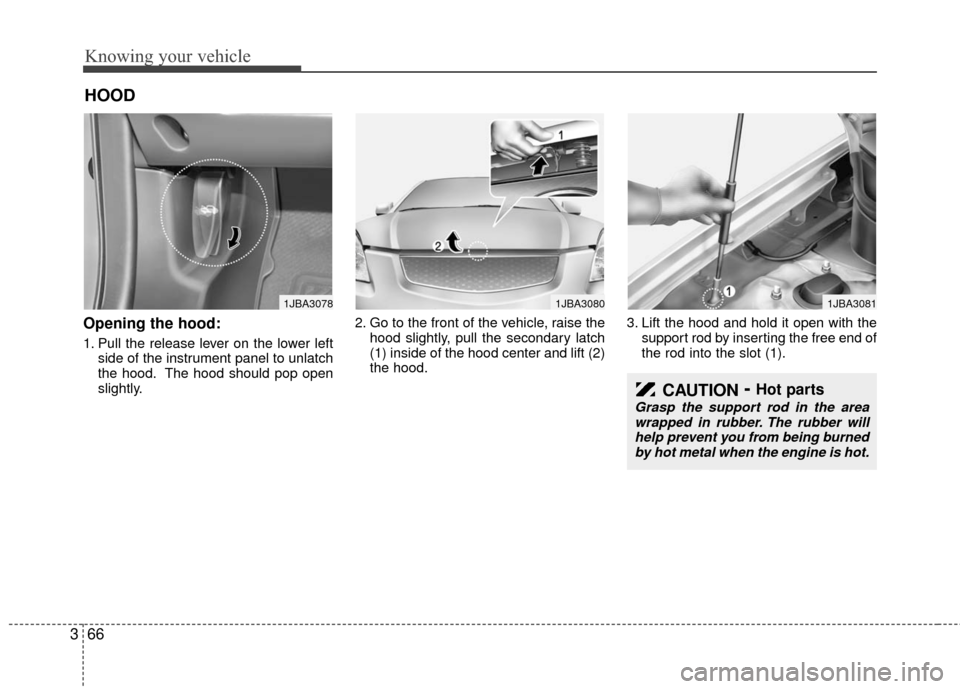
Opening the hood:
1. Pull the release lever on the lower left
side of the instrument panel to unlatch
the hood. The hood should pop open
slightly. 2. Go to the front of the vehicle, raise the
hood slightly, pull the secondary latch
(1) inside of the hood center and lift (2)
the hood. 3. Lift the hood and hold it open with the
support rod by inserting the free end of
the rod into the slot (1).
HOOD
1JBA30781JBA30801JBA3081
CAUTION- Hot parts
Grasp the support rod in the areawrapped in rubber. The rubber willhelp prevent you from being burned by hot metal when the engine is hot.
Page 76 of 236
367
Knowing your vehicle
Closing the hood
1. Before closing the hood, check the fol-lowing:
• All filler caps in engine compartment must be correctly installed.
bustible material must be removed
from the engine compartment.
2. Secure the support rod in its clip.
3. Lower the hood to about 30 cm (12 inches) height and then let it drop to
properly lock in place.
Make sure the hood is properly locked
before driving.
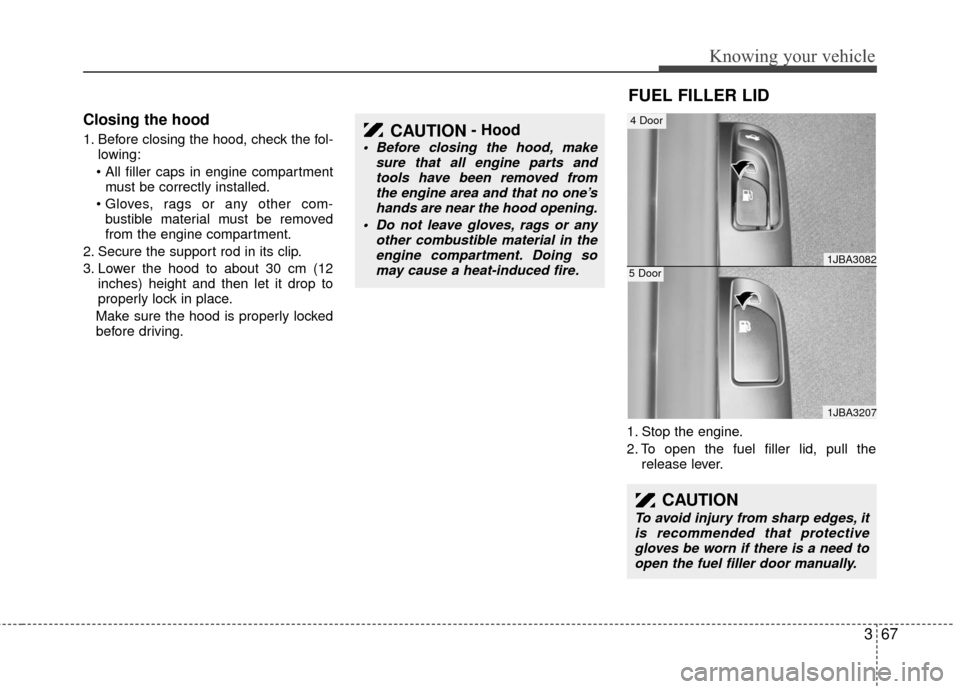
1. Stop the engine.
2. To open the fuel filler lid, pull therelease lever.CAUTION- Hood
• Before closing the hood, make sure that all engine parts andtools have been removed fromthe engine area and that no one’shands are near the hood opening.
Do not leave gloves, rags or any other combustible material in theengine compartment. Doing so may cause a heat-induced fire.
CAUTION
To avoid injury from sharp edges, itis recommended that protective gloves be worn if there is a need toopen the fuel filler door manually.
1JBA3082
1JBA3207
5 Door
4 Door
FUEL FILLER LID