cooling KIA RIO 2018 Owner's Manual
[x] Cancel search | Manufacturer: KIA, Model Year: 2018, Model line: RIO, Model: KIA RIO 2018Pages: 490, PDF Size: 11.28 MB
Page 376 of 490
819
Maintenance
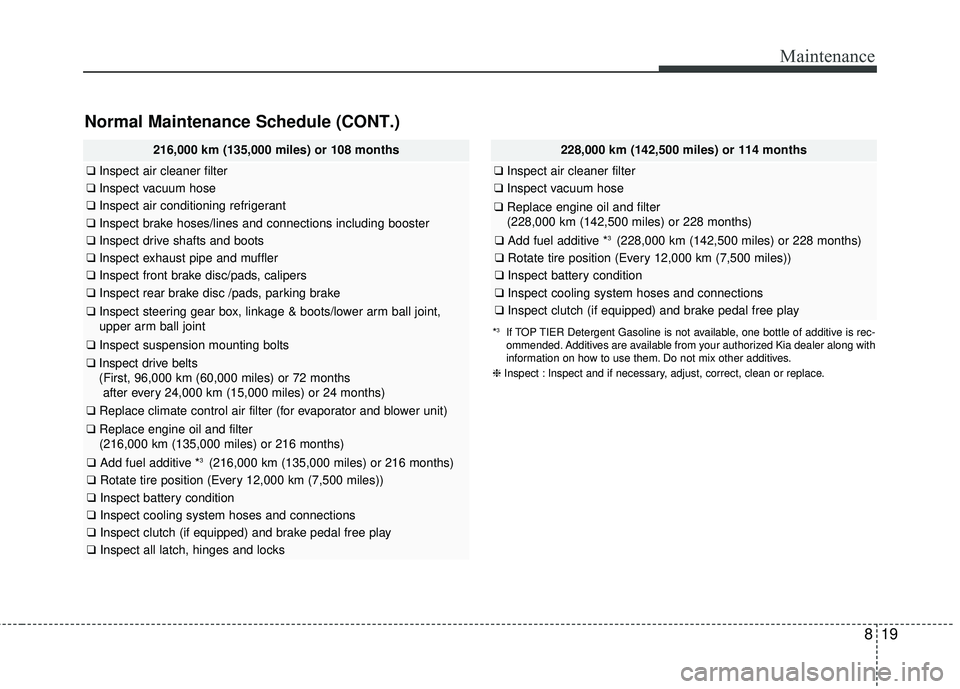
Normal Maintenance Schedule (CONT.)
216,000 km (135,000 miles) or 108 months
❑Inspect air cleaner filter
❑Inspect vacuum hose
❑Inspect air conditioning refrigerant
❑Inspect brake hoses/lines and connections including booster
❑Inspect drive shafts and boots
❑Inspect exhaust pipe and muffler
❑Inspect front brake disc/pads, calipers
❑Inspect rear brake disc /pads, parking brake
❑Inspect steering gear box, linkage & boots/lower arm ball joint,
upper arm ball joint
❑ Inspect suspension mounting bolts
❑Inspect drive belts
(First, 96,000 km (60,000 miles) or 72 months
after every 24,000 km (15,000 miles) or 24 months)
❑ Replace climate control air filter (for evaporator and blower unit)
❑Replace engine oil and filter
(216,000 km (135,000 miles) or 216 months)
❑ Add fuel additive *3 (216,000 km (135,000 miles) or 216 months)
❑Rotate tire position (Every 12,000 km (7,500 miles))
❑Inspect battery condition
❑Inspect cooling system hoses and connections
❑Inspect clutch (if equipped) and brake pedal free play
❑Inspect all latch, hinges and locks
228,000 km (142,500 miles) or 114 months
❑Inspect air cleaner filter
❑Inspect vacuum hose
❑Replace engine oil and filter
(228,000 km (142,500 miles) or 228 months)
❑ Add fuel additive *3 (228,000 km (142,500 miles) or 228 months)
❑Rotate tire position (Every 12,000 km (7,500 miles))
❑Inspect battery condition
❑Inspect cooling system hoses and connections
❑Inspect clutch (if equipped) and brake pedal free play
*3If TOP TIER Detergent Gasoline is not available, one bottle of additive is rec-
ommended. Additives are available from your authorized Kia dealer along with
information on how to use them. Do not mix other additives.
❈ Inspect : Inspect and if necessary, adjust, correct, clean or replace.
Page 377 of 490
Maintenance
20
8
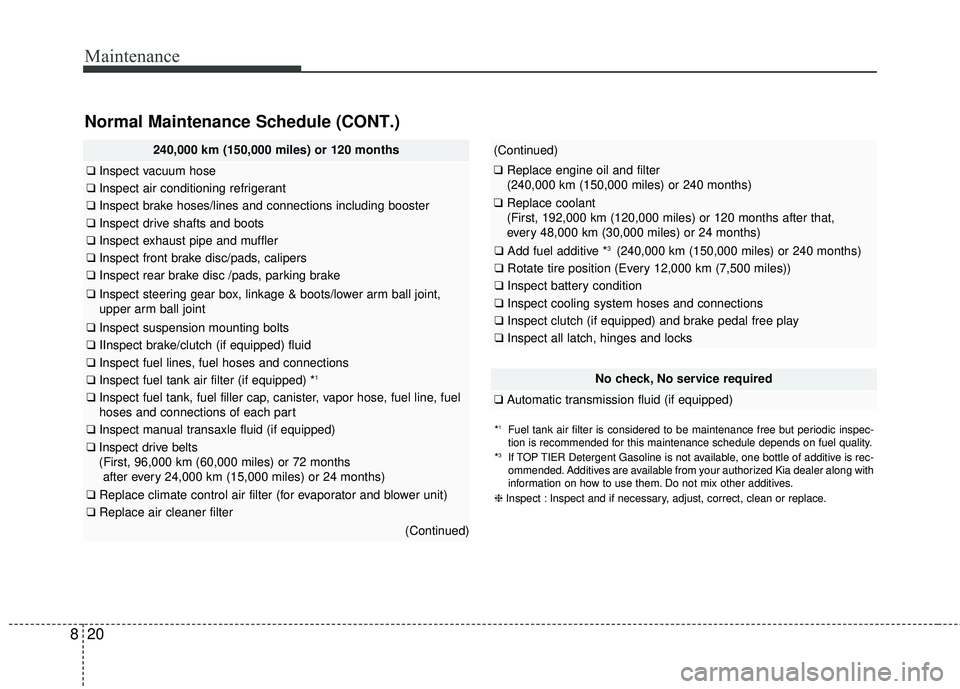
Normal Maintenance Schedule (CONT.)
240,000 km (150,000 miles) or 120 months
❑ Inspect vacuum hose
❑Inspect air conditioning refrigerant
❑Inspect brake hoses/lines and connections including booster
❑Inspect drive shafts and boots
❑Inspect exhaust pipe and muffler
❑Inspect front brake disc/pads, calipers
❑Inspect rear brake disc /pads, parking brake
❑Inspect steering gear box, linkage & boots/lower arm ball joint,
upper arm ball joint
❑ Inspect suspension mounting bolts
❑IInspect brake/clutch (if equipped) fluid
❑Inspect fuel lines, fuel hoses and connections
❑Inspect fuel tank air filter (if equipped) *1
❑Inspect fuel tank, fuel filler cap, canister, vapor hose, fuel line, fuel
hoses and connections of each part
❑ Inspect manual transaxle fluid (if equipped)
❑Inspect drive belts
(First, 96,000 km (60,000 miles) or 72 months
after every 24,000 km (15,000 miles) or 24 months)
❑ Replace climate control air filter (for evaporator and blower unit)
❑Replace air cleaner filter
(Continued)
(Continued)
❑Replace engine oil and filter
(240,000 km (150,000 miles) or 240 months)
❑Replace coolant
(First, 192,000 km (120,000 miles) or 120 months after that,
every 48,000 km (30,000 miles) or 24 months)
❑ Add fuel additive *3 (240,000 km (150,000 miles) or 240 months)
❑Rotate tire position (Every 12,000 km (7,500 miles))
❑Inspect battery condition
❑Inspect cooling system hoses and connections
❑Inspect clutch (if equipped) and brake pedal free play
❑Inspect all latch, hinges and locks
No check, No service required
❑Automatic transmission fluid (if equipped)
*1Fuel tank air filter is considered to be maintenance free but periodic inspec-
tion is recommended for this maintenance schedule depends on fuel quality.
*
3If TOP TIER Detergent Gasoline is not available, one bottle of additive is rec-
ommended. Additives are available from your authorized Kia dealer along with
information on how to use them. Do not mix other additives.
❈ Inspect : Inspect and if necessary, adjust, correct, clean or replace.
Page 380 of 490
823
Maintenance
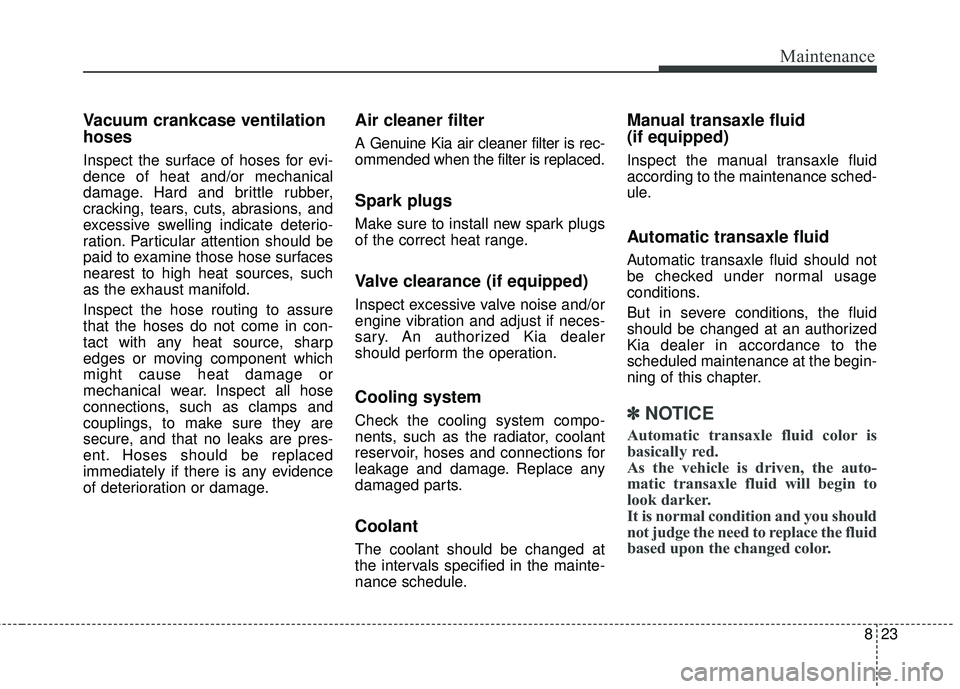
Vacuum crankcase ventilation
hoses
Inspect the surface of hoses for evi-
dence of heat and/or mechanical
damage. Hard and brittle rubber,
cracking, tears, cuts, abrasions, and
excessive swelling indicate deterio-
ration. Particular attention should be
paid to examine those hose surfaces
nearest to high heat sources, such
as the exhaust manifold.
Inspect the hose routing to assure
that the hoses do not come in con-
tact with any heat source, sharp
edges or moving component which
might cause heat damage or
mechanical wear. Inspect all hose
connections, such as clamps and
couplings, to make sure they are
secure, and that no leaks are pres-
ent. Hoses should be replaced
immediately if there is any evidence
of deterioration or damage.
Air cleaner filter
A Genuine Kia air cleaner filter is rec-
ommended when the filter is replaced.
Spark plugs
Make sure to install new spark plugs
of the correct heat range.
Valve clearance (if equipped)
Inspect excessive valve noise and/or
engine vibration and adjust if neces-
sary. An authorized Kia dealer
should perform the operation.
Cooling system
Check the cooling system compo-
nents, such as the radiator, coolant
reservoir, hoses and connections for
leakage and damage. Replace any
damaged parts.
Coolant
The coolant should be changed at
the intervals specified in the mainte-
nance schedule.
Manual transaxle fluid
(if equipped)
Inspect the manual transaxle fluid
according to the maintenance sched-
ule.
Automatic transaxle fluid
Automatic transaxle fluid should not
be checked under normal usage
conditions.
But in severe conditions, the fluid
should be changed at an authorized
Kia dealer in accordance to the
scheduled maintenance at the begin-
ning of this chapter.
✽ ✽NOTICE
Automatic transaxle fluid color is
basically red.
As the vehicle is driven, the auto-
matic transaxle fluid will begin to
look darker.
It is normal condition and you should
not judge the need to replace the fluid
based upon the changed color.
Page 386 of 490
829
Maintenance
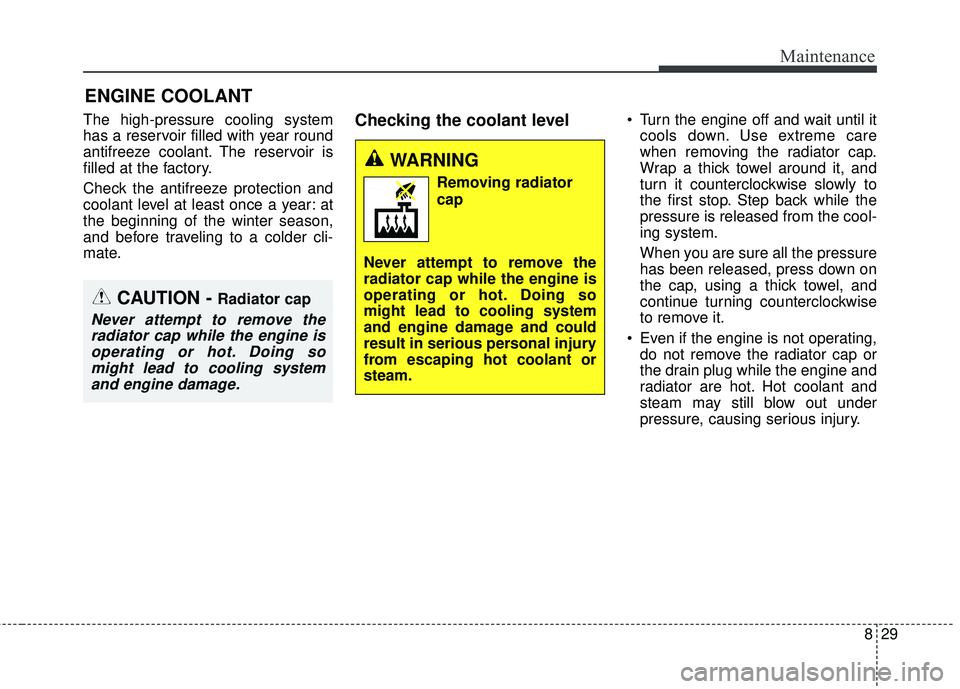
ENGINE COOLANT
The high-pressure cooling system
has a reservoir filled with year round
antifreeze coolant. The reservoir is
filled at the factory.
Check the antifreeze protection and
coolant level at least once a year: at
the beginning of the winter season,
and before traveling to a colder cli-
mate.Checking the coolant level Turn the engine off and wait until itcools down. Use extreme care
when removing the radiator cap.
Wrap a thick towel around it, and
turn it counterclockwise slowly to
the first stop. Step back while the
pressure is released from the cool-
ing system.
When you are sure all the pressure
has been released, press down on
the cap, using a thick towel, and
continue turning counterclockwise
to remove it.
Even if the engine is not operating, do not remove the radiator cap or
the drain plug while the engine and
radiator are hot. Hot coolant and
steam may still blow out under
pressure, causing serious injury.
WARNING
Removing radiator
cap
Never attempt to remove the
radiator cap while the engine is
operating or hot. Doing so
might lead to cooling system
and engine damage and could
result in serious personal injury
from escaping hot coolant or
steam.
CAUTION - Radiator cap
Never attempt to remove the radiator cap while the engine isoperating or hot. Doing somight lead to cooling systemand engine damage.
Page 387 of 490
Maintenance
30
8
Check the condition and connections
of all cooling system hoses and
heater hoses. Replace any swollen
or deteriorated hoses.
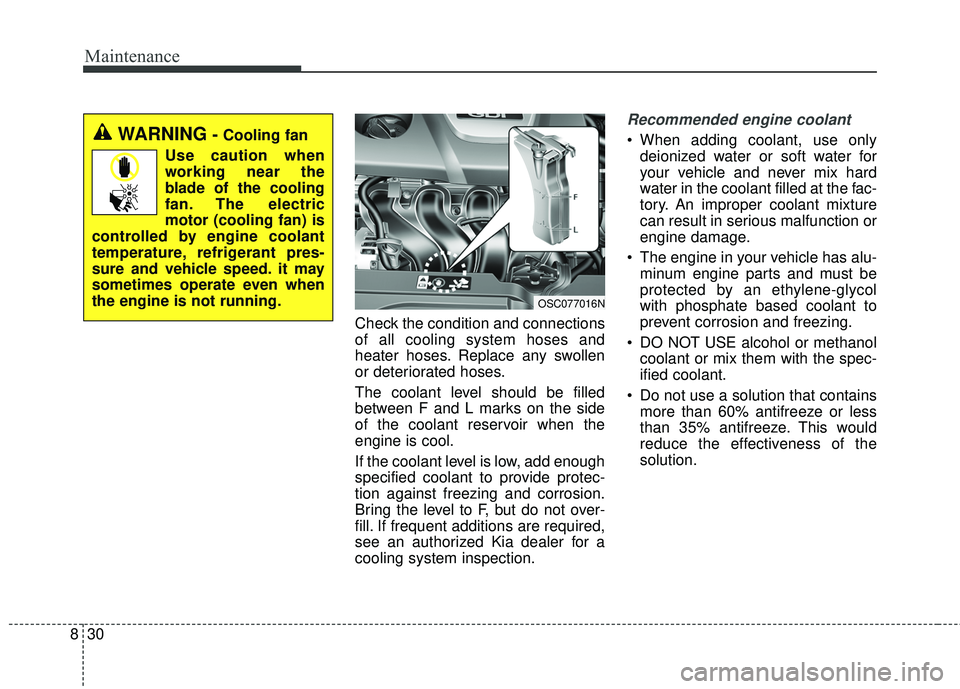
The coolant level should be filled
between F and L marks on the side
of the coolant reservoir when the
engine is cool.
If the coolant level is low, add enough
specified coolant to provide protec-
tion against freezing and corrosion.
Bring the level to F, but do not over-
fill. If frequent additions are required,
see an authorized Kia dealer for a
cooling system inspection.
Recommended engine coolant
When adding coolant, use only
deionized water or soft water for
your vehicle and never mix hard
water in the coolant filled at the fac-
tory. An improper coolant mixture
can result in serious malfunction or
engine damage.
The engine in your vehicle has alu- minum engine parts and must be
protected by an ethylene-glycol
with phosphate based coolant to
prevent corrosion and freezing.
DO NOT USE alcohol or methanol coolant or mix them with the spec-
ified coolant.
Do not use a solution that contains more than 60% antifreeze or less
than 35% antifreeze. This would
reduce the effectiveness of the
solution.
OSC077016N
WARNING- Cooling fan
Use caution when
working near the
blade of the cooling
fan. The electric
motor (cooling fan) is
controlled by engine coolant
temperature, refrigerant pres-
sure and vehicle speed. it may
sometimes operate even when
the engine is not running.
Page 429 of 490
Maintenance
72
8
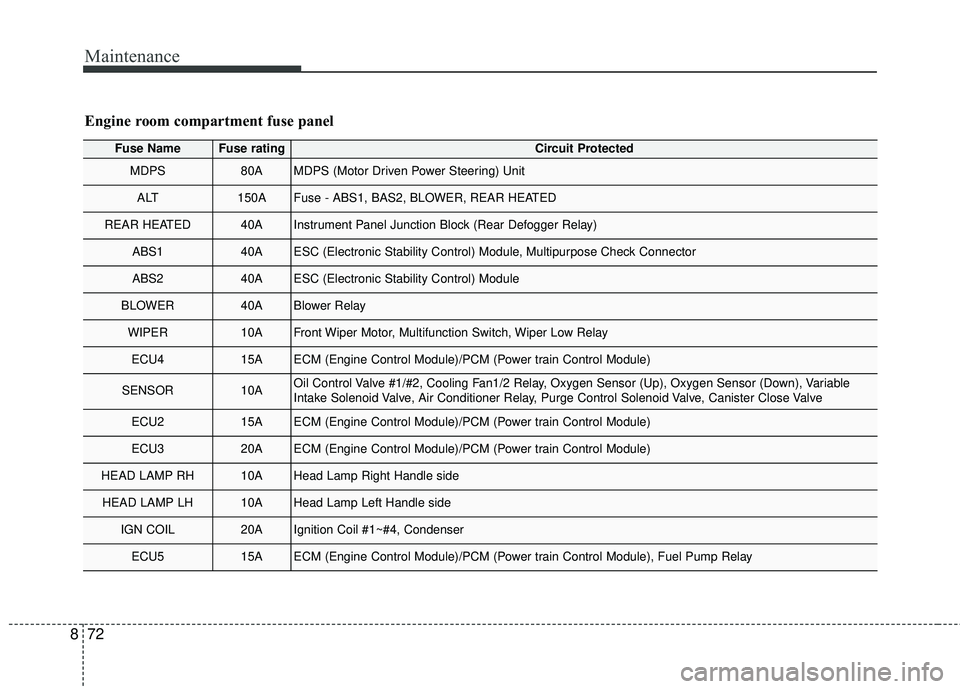
Engine room compartment fuse panel
Fuse NameFuse ratingCircuit Protected
MDPS80AMDPS (Motor Driven Power Steering) Unit
ALT150AFuse - ABS1, BAS2, BLOWER, REAR HEATED
REAR HEATED40AInstrument Panel Junction Block (Rear Defogger Relay)
ABS140AESC (Electronic Stability Control) Module, Multipurpose Check Connector
ABS240AESC (Electronic Stability Control) Module
BLOWER40ABlower Relay
WIPER10AFront Wiper Motor, Multifunction Switch, Wiper Low Relay
ECU415AECM (Engine Control Module)/PCM (Power train Control Module)
SENSOR10AOil Control Valve #1/#2, Cooling Fan1/2 Relay, Oxygen Sensor (Up), Oxygen Sensor (Down), Variable
Intake Solenoid Valve, Air Conditioner Relay, Purge Control Solenoid Valve, Canister Close Valve
ECU215AECM (Engine Control Module)/PCM (Power train Control Module)
ECU320AECM (Engine Control Module)/PCM (Power train Control Module)
HEAD LAMP RH10AHead Lamp Right Handle side
HEAD LAMP LH10AHead Lamp Left Handle side
IGN COIL20AIgnition Coil #1~#4, Condenser
ECU515AECM (Engine Control Module)/PCM (Power train Control Module), Fuel Pump Relay
Page 430 of 490
873
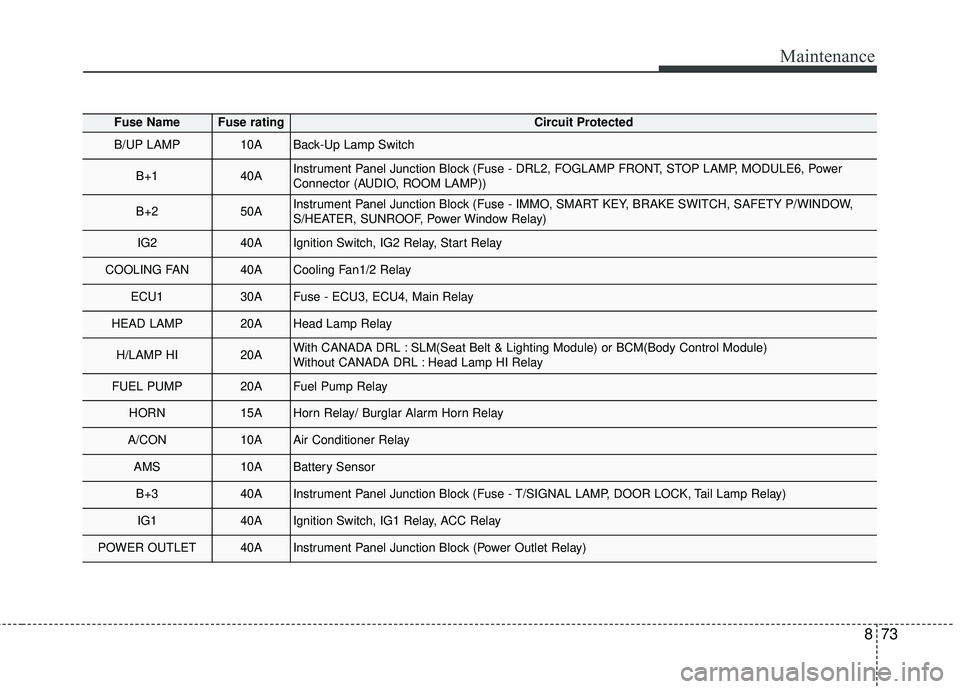
Maintenance
Fuse NameFuse ratingCircuit Protected
B/UP LAMP10ABack-Up Lamp Switch
B+140AInstrument Panel Junction Block (Fuse - DRL2, FOGLAMP FRONT, STOP LAMP, MODULE6, Power
Connector (AUDIO, ROOM LAMP))
B+250AInstrument Panel Junction Block (Fuse - IMMO, SMART KEY, BRAKE SWITCH, SAFETY P/WINDOW,
S/HEATER, SUNROOF, Power Window Relay)
IG240AIgnition Switch, IG2 Relay, Start Relay
COOLING FAN40ACooling Fan1/2 Relay
ECU130AFuse - ECU3, ECU4, Main Relay
HEAD LAMP20AHead Lamp Relay
H/LAMP HI20AWith CANADA DRL : SLM(Seat Belt & Lighting Module) or BCM(Body Control Module)
Without CANADA DRL : Head Lamp HI Relay
FUEL PUMP20AFuel Pump Relay
HORN15AHorn Relay/ Burglar Alarm Horn Relay
A/CON10AAir Conditioner Relay
AMS10ABattery Sensor
B+340AInstrument Panel Junction Block (Fuse - T/SIGNAL LAMP, DOOR LOCK, Tail Lamp Relay)
IG140AIgnition Switch, IG1 Relay, ACC Relay
POWER OUTLET40AInstrument Panel Junction Block (Power Outlet Relay)
Page 431 of 490
Maintenance
74
8
Relay NameType
Main RelayMINI
Start RelayMICRO
Fuel Pump RelayMICRO
Wiper HI RelayMICRO
H/Lamp HI RelayMICRO
Cooling Fan2 RelayMICRO
B/Alarm Horn RelayMICRO
Blower RelayMICRO
Cooling Fan1 RelayMICRO
Wiper LO RelayMICRO
Head Lamp RelayMICRO
Horn RelayMICRO
A/Con RelayMICRO
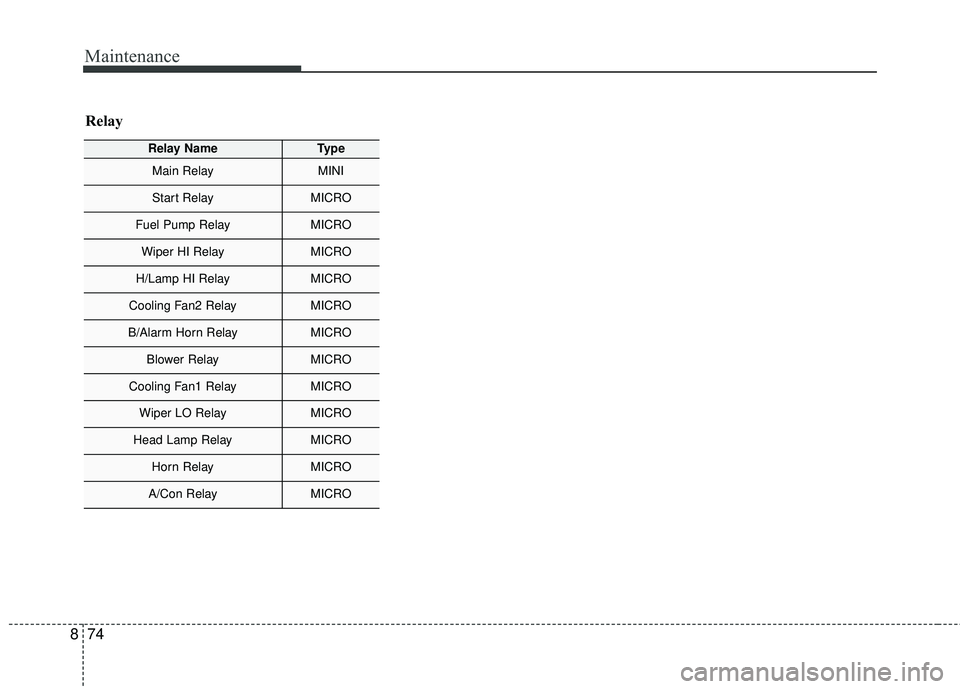
Relay
Page 477 of 490
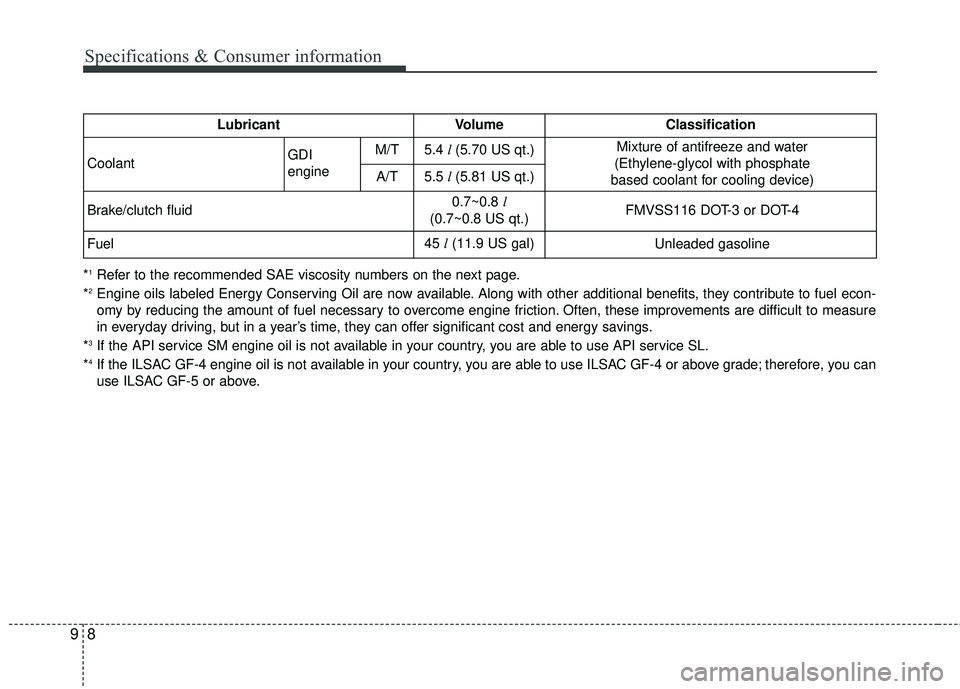
Specifications & Consumer information
89
*1Refer to the recommended SAE viscosity numbers on the next page.
*2Engine oils labeled Energy Conserving Oil are now available. Along with other additional benefits, they contribute to fuel econ-
omy by reducing the amount of fuel necessary to overcome engine friction. Often, these improvements are difficult to measure
in everyday driving, but in a year’s time, they can offer significant cost and energy savings.
*
3If the API service SM engine oil is not available in your country, you are able to use API service SL.
*4If the ILSAC GF-4 engine oil is not available in your country, you are able to use ILSAC GF-4 or above grade; therefore, you can
use ILSAC GF-5 or above.
LubricantVolumeClassification
Coolant GDI
engineM/T5.4 l (5.70 US qt.)Mixture of antifreeze and water
(Ethylene-glycol with phosphate
based coolant for cooling device)
A/T5.5 l (5.81 US qt.)
Brake/clutch fluid0.7~0.8 l
(0.7~0.8 US qt.)FMVSS116 DOT-3 or DOT-4
Fuel45 l(11.9 US gal)Unleaded gasoline