parking brake KIA RIO 2018 Service Manual
[x] Cancel search | Manufacturer: KIA, Model Year: 2018, Model line: RIO, Model: KIA RIO 2018Pages: 490, PDF Size: 11.28 MB
Page 375 of 490
Maintenance
18
8
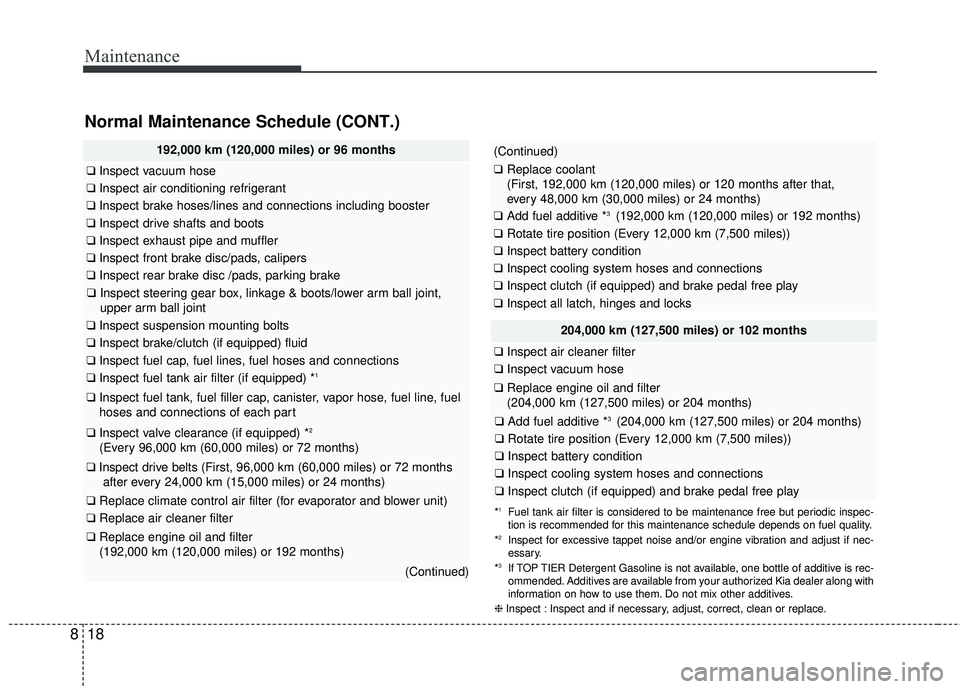
Normal Maintenance Schedule (CONT.)
192,000 km (120,000 miles) or 96 months
❑ Inspect vacuum hose
❑Inspect air conditioning refrigerant
❑Inspect brake hoses/lines and connections including booster
❑Inspect drive shafts and boots
❑Inspect exhaust pipe and muffler
❑Inspect front brake disc/pads, calipers
❑Inspect rear brake disc /pads, parking brake
❑Inspect steering gear box, linkage & boots/lower arm ball joint,
upper arm ball joint
❑ Inspect suspension mounting bolts
❑Inspect brake/clutch (if equipped) fluid
❑Inspect fuel cap, fuel lines, fuel hoses and connections
❑Inspect fuel tank air filter (if equipped) *1
❑Inspect fuel tank, fuel filler cap, canister, vapor hose, fuel line, fuel
hoses and connections of each part
❑Inspect valve clearance (if equipped) *2
(Every 96,000 km (60,000 miles) or 72 months)
❑Inspect drive belts (First, 96,000 km (60,000 miles) or 72 months
after every 24,000 km (15,000 miles) or 24 months)
❑ Replace climate control air filter (for evaporator and blower unit)
❑Replace air cleaner filter
❑Replace engine oil and filter
(192,000 km (120,000 miles) or 192 months)
(Continued)
*1Fuel tank air filter is considered to be maintenance free but periodic inspec-
tion is recommended for this maintenance schedule depends on fuel quality.
*
2Inspect for excessive tappet noise and/or engine vibration and adjust if nec-
essary.
*
3If TOP TIER Detergent Gasoline is not available, one bottle of additive is rec-
ommended. Additives are available from your authorized Kia dealer along with
information on how to use them. Do not mix other additives.
❈ Inspect : Inspect and if necessary, adjust, correct, clean or replace.
204,000 km (127,500 miles) or 102 months
❑Inspect air cleaner filter
❑Inspect vacuum hose
❑Replace engine oil and filter
(204,000 km (127,500 miles) or 204 months)
❑ Add fuel additive *3 (204,000 km (127,500 miles) or 204 months)
❑Rotate tire position (Every 12,000 km (7,500 miles))
❑Inspect battery condition
❑Inspect cooling system hoses and connections
❑Inspect clutch (if equipped) and brake pedal free play
(Continued)
❑Replace coolant
(First, 192,000 km (120,000 miles) or 120 months after that,
every 48,000 km (30,000 miles) or 24 months)
❑ Add fuel additive *3 (192,000 km (120,000 miles) or 192 months)
❑Rotate tire position (Every 12,000 km (7,500 miles))
❑Inspect battery condition
❑Inspect cooling system hoses and connections
❑Inspect clutch (if equipped) and brake pedal free play
❑Inspect all latch, hinges and locks
Page 376 of 490
819
Maintenance
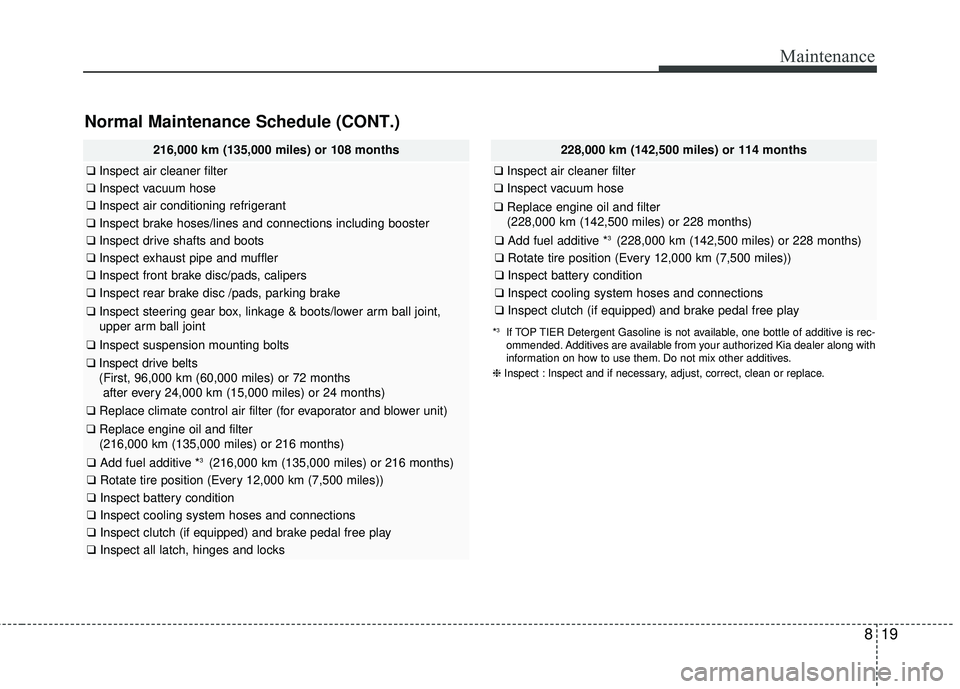
Normal Maintenance Schedule (CONT.)
216,000 km (135,000 miles) or 108 months
❑Inspect air cleaner filter
❑Inspect vacuum hose
❑Inspect air conditioning refrigerant
❑Inspect brake hoses/lines and connections including booster
❑Inspect drive shafts and boots
❑Inspect exhaust pipe and muffler
❑Inspect front brake disc/pads, calipers
❑Inspect rear brake disc /pads, parking brake
❑Inspect steering gear box, linkage & boots/lower arm ball joint,
upper arm ball joint
❑ Inspect suspension mounting bolts
❑Inspect drive belts
(First, 96,000 km (60,000 miles) or 72 months
after every 24,000 km (15,000 miles) or 24 months)
❑ Replace climate control air filter (for evaporator and blower unit)
❑Replace engine oil and filter
(216,000 km (135,000 miles) or 216 months)
❑ Add fuel additive *3 (216,000 km (135,000 miles) or 216 months)
❑Rotate tire position (Every 12,000 km (7,500 miles))
❑Inspect battery condition
❑Inspect cooling system hoses and connections
❑Inspect clutch (if equipped) and brake pedal free play
❑Inspect all latch, hinges and locks
228,000 km (142,500 miles) or 114 months
❑Inspect air cleaner filter
❑Inspect vacuum hose
❑Replace engine oil and filter
(228,000 km (142,500 miles) or 228 months)
❑ Add fuel additive *3 (228,000 km (142,500 miles) or 228 months)
❑Rotate tire position (Every 12,000 km (7,500 miles))
❑Inspect battery condition
❑Inspect cooling system hoses and connections
❑Inspect clutch (if equipped) and brake pedal free play
*3If TOP TIER Detergent Gasoline is not available, one bottle of additive is rec-
ommended. Additives are available from your authorized Kia dealer along with
information on how to use them. Do not mix other additives.
❈ Inspect : Inspect and if necessary, adjust, correct, clean or replace.
Page 377 of 490
Maintenance
20
8
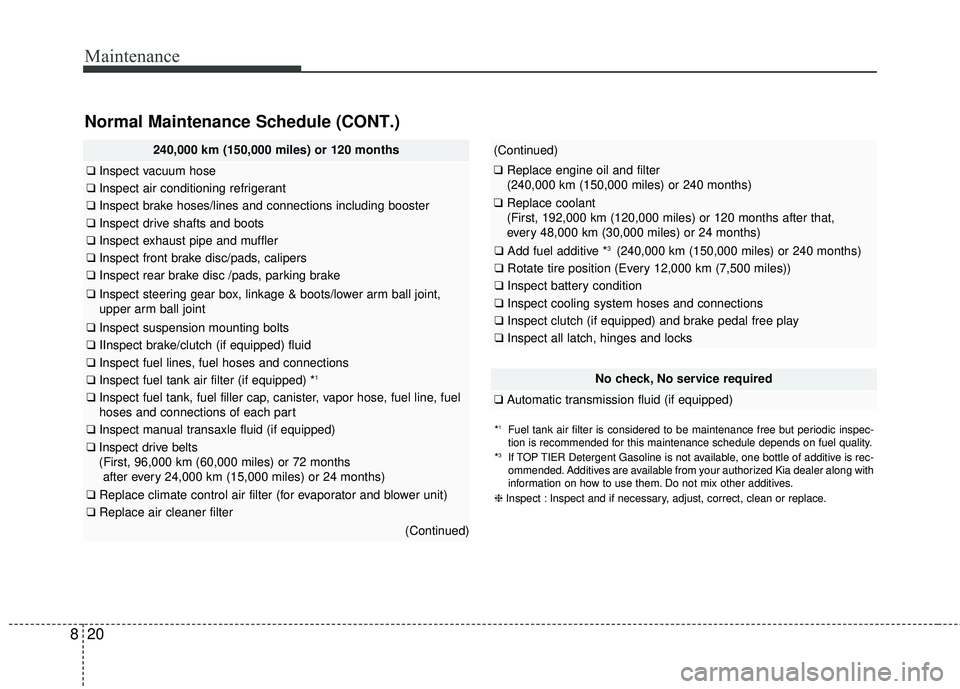
Normal Maintenance Schedule (CONT.)
240,000 km (150,000 miles) or 120 months
❑ Inspect vacuum hose
❑Inspect air conditioning refrigerant
❑Inspect brake hoses/lines and connections including booster
❑Inspect drive shafts and boots
❑Inspect exhaust pipe and muffler
❑Inspect front brake disc/pads, calipers
❑Inspect rear brake disc /pads, parking brake
❑Inspect steering gear box, linkage & boots/lower arm ball joint,
upper arm ball joint
❑ Inspect suspension mounting bolts
❑IInspect brake/clutch (if equipped) fluid
❑Inspect fuel lines, fuel hoses and connections
❑Inspect fuel tank air filter (if equipped) *1
❑Inspect fuel tank, fuel filler cap, canister, vapor hose, fuel line, fuel
hoses and connections of each part
❑ Inspect manual transaxle fluid (if equipped)
❑Inspect drive belts
(First, 96,000 km (60,000 miles) or 72 months
after every 24,000 km (15,000 miles) or 24 months)
❑ Replace climate control air filter (for evaporator and blower unit)
❑Replace air cleaner filter
(Continued)
(Continued)
❑Replace engine oil and filter
(240,000 km (150,000 miles) or 240 months)
❑Replace coolant
(First, 192,000 km (120,000 miles) or 120 months after that,
every 48,000 km (30,000 miles) or 24 months)
❑ Add fuel additive *3 (240,000 km (150,000 miles) or 240 months)
❑Rotate tire position (Every 12,000 km (7,500 miles))
❑Inspect battery condition
❑Inspect cooling system hoses and connections
❑Inspect clutch (if equipped) and brake pedal free play
❑Inspect all latch, hinges and locks
No check, No service required
❑Automatic transmission fluid (if equipped)
*1Fuel tank air filter is considered to be maintenance free but periodic inspec-
tion is recommended for this maintenance schedule depends on fuel quality.
*
3If TOP TIER Detergent Gasoline is not available, one bottle of additive is rec-
ommended. Additives are available from your authorized Kia dealer along with
information on how to use them. Do not mix other additives.
❈ Inspect : Inspect and if necessary, adjust, correct, clean or replace.
Page 378 of 490
821
Maintenance
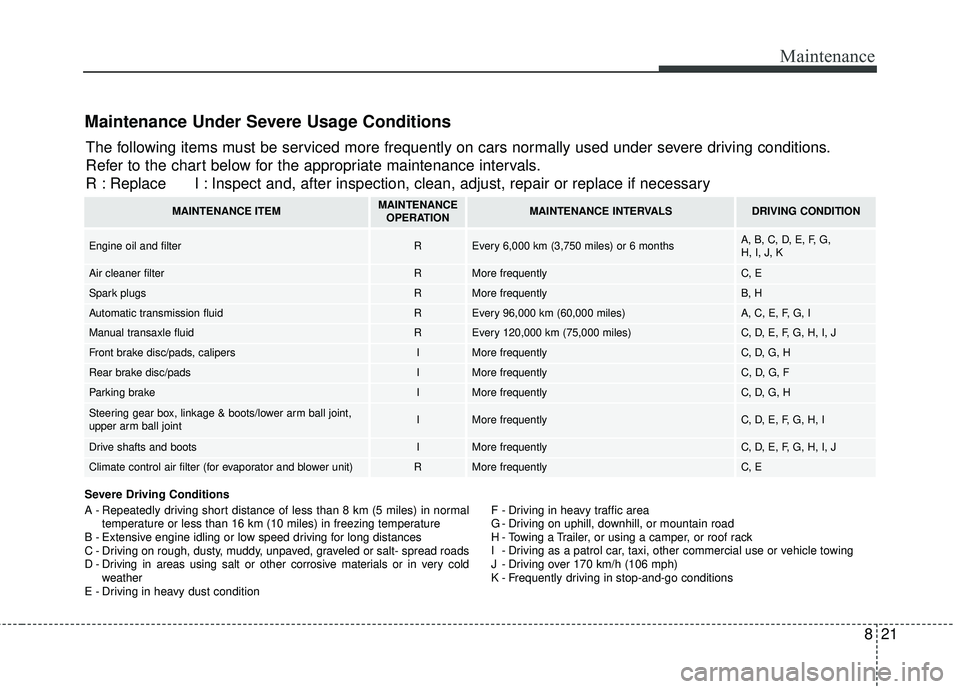
Maintenance Under Severe Usage Conditions
Severe Driving Conditions
A - Repeatedly driving short distance of less than 8 km (5 miles) in normaltemperature or less than 16 km (10 miles) in freezing temperature
B - Extensive engine idling or low speed driving for long distances
C - Driving on rough, dusty, muddy, unpaved, graveled or salt- spread roads
D - Driving in areas using salt or other corrosive materials or in very cold weather
E - Driving in heavy dust condition F - Driving in heavy traffic area
G - Driving on uphill, downhill, or mountain road
H - Towing a Trailer, or using a camper, or roof rack
I - Driving as a patrol car, taxi, other commercial use or vehicle towing
J - Driving over 170 km/h (106 mph)
K - Frequently driving in stop-and-go conditions
The following items must be serviced more frequently on cars normally used under severe driving conditions.
Refer to the chart below for the appropriate maintenance intervals.
R : Replace I : Inspect and, after inspection, clean, adjust, repair or replace if neces\
sary
MAINTENANCE ITEMMAINTENANCE
OPERATIONMAINTENANCE INTERVALSDRIVING CONDITION
Engine oil and filterREvery 6,000 km (3,750 miles) or 6 monthsA, B, C, D, E, F, G,
H, I, J, K
Air cleaner filterRMore frequentlyC, E
Spark plugsRMore frequentlyB, H
Automatic transmission fluidREvery 96,000 km (60,000 miles)A, C, E, F, G, I
Manual transaxle fluidREvery 120,000 km (75,000 miles)C, D, E, F, G, H, I, J
Front brake disc/pads, calipersIMore frequentlyC, D, G, H
Rear brake disc/padsIMore frequentlyC, D, G, F
Parking brakeIMore frequentlyC, D, G, H
Steering gear box, linkage & boots/lower arm ball joint,
upper arm ball jointIMore frequentlyC, D, E, F, G, H, I
Drive shafts and bootsIMore frequentlyC, D, E, F, G, H, I, J
Climate control air filter (for evaporator and blower unit)RMore frequentlyC, E
Page 381 of 490
Maintenance
24
8
Brake hoses and lines
Visually check for proper installation,
chafing, cracks, deterioration and
any leakage. Replace any deteriorat-
ed or damaged parts immediately.
Brake/Clutch fluid
Check the brake/clutch fluid level in
the brake/clutch fluid reservoir. The
level should be between “MIN” and
“MAX” marks on the side of the
reservoir. Use only hydraulic
brake/clutch fluid conforming to DOT
3 or DOT 4 specification.
Parking brake
Inspect the parking brake system
including the parking brake pedal
and cables.
Brake discs, pads, calipers
and rotors
Check the pads for excessive wear,
discs for run out and wear, and
calipers for fluid leakage.
Exhaust pipe and muffler
Visually inspect the exhaust pipes,
muffler and hangers for cracks, dete-
rioration, or damage. Start the
engine and listen carefully for any
exhaust gas leakage. Tighten con-
nections or replace parts as neces-
sary.
Suspension mounting bolts
Check the suspension connections
for looseness or damage. Retighten
to the specified torque.
CAUTION
Use only specified automatic
transaxle fluid. The use of a non-specified fluid could result in atransaxle malfunction and fail-ure. (Refer to "Recommendedlubricants and capacities" inchapter 9.)
Page 391 of 490
Maintenance
34
8
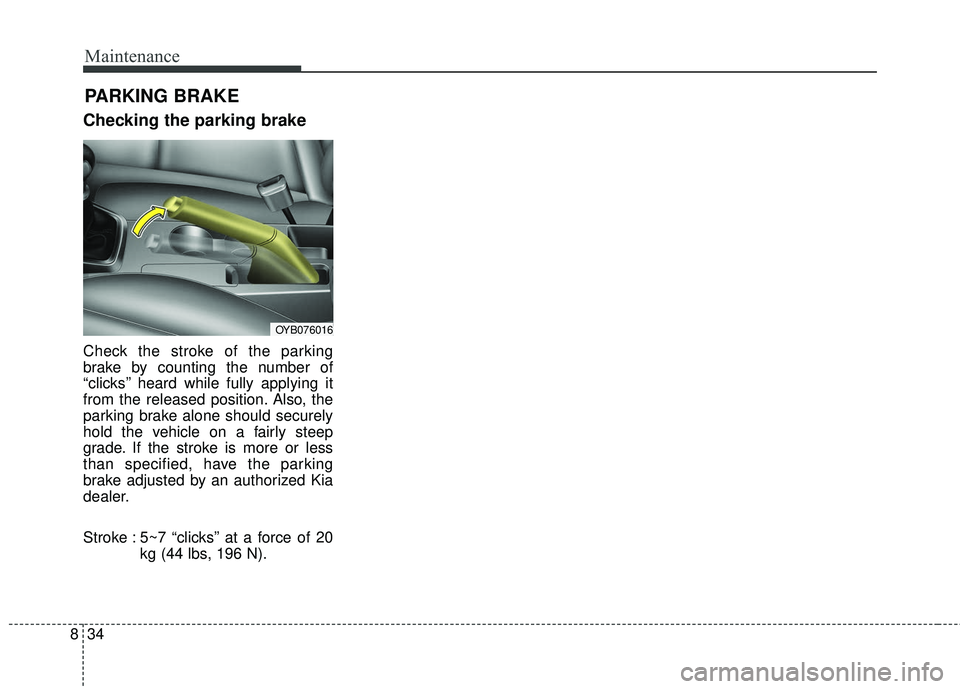
Checking the parking brake
Check the stroke of the parking
brake by counting the number of
“clicks’’ heard while fully applying it
from the released position. Also, the
parking brake alone should securely
hold the vehicle on a fairly steep
grade. If the stroke is more or less
than specified, have the parking
brake adjusted by an authorized Kia
dealer.
Stroke : 5~7 “clicks’’ at a force of 20
kg (44 lbs, 196 N).
PARKING BRAKE
OYB076016
Page 432 of 490
875
Maintenance
LIGHT BULBS
Bulb replacement precaution
Please keep extra bulbs on hand
with appropriate wattage ratings in
case of emergencies.
Refer to “Bulb Wattage” in chapter 9.
When changing lamps, first turn off
the engine at a safe place, firmly
apply the parking brake and detach
the battery’s negative (-) terminal.
Use only bulbs of the specifiedwattage. net-work failure
The headlamp, taillight, and fog light
may light up when the head lamp
switch is turned ON, and not light up
when the taillight or for light switch is
turned ON. This may be cause by
network failure or vehicle electrical
control system malfunction. If there is
a problem, we recommend the sys-
tem be serviced by an authorized Kia
dealer.
trical control system stabilization
A normally functioning lamp may
flicker momentarily. This momentary
occurrence is due to stabilization
function of the vehicle's electrical on
control system. If the lamp soon
returns to normal, the vehicle does
not require service.
However, if the lamp goes out after
the momentary flickering, or the flick-
ering continues, we recommend the
system be serviced by an authorized
Kia dealer.
WARNING- Working on the lights
Prior to working on the light,
firmly apply the parking brake,
ensure that the ignition switch
is turned to the LOCK position
and turn off the lights to avoid
sudden movement of the vehi-
cle and burning your fingers or
receiving an electric shock.
CAUTION -Light replace-
ment
Be sure to replace the burned- out bulb with one of the samewattage rating. Otherwise, itmay cause damage to the fuseor electric wiring system.
CAUTION -Headlamp
Lens
To prevent damage, do notclean the headlamp lens withchemical solvents or strongdetergents.
Page 483 of 490
I3
Index
Good braking practices ..............................................6-35
Hill-start assist control (HAC) ....................................6-33
Parking brake ..............................................................6-25
Power brakes ..............................................................5-23
Vehicle stability management (VSM) ........................6-34
Brake/clutch fluid ..........................................................8-32 Checking the brake/clutch fluid level ........................8-32
Bulb wattage ....................................................................9-3
Checking fluid levels ....................................................8-26
Child restraint system ....................................................3-23 Using a child restraint system ....................................3-24
Climate control air filter ................................................8-37 Filter inspection ..........................................................8-37
Cruise control system ....................................................6-48 Cruise control switch ..................................................6-48
To cancel cruise control, do one of the following ......6-51
To decrease the cruising speed ..................................6-50
To increase cruise control set speed ..........................6-50
To resume cruising speed at more than approximately 30 km/h (20 mph) ....................................................6-51
To set cruise control speed..........................................6-49
To temporarily accelerate with the cruise control on 6-50
To turn cruise control off, do one of the following ....6-52 Declaration of conformity ............................................5-39
Be sure the exhaust system does not leak ....................6-3
IC ........................................................................\
........5-39
Defroster ......................................................................4-\
103 Rear window defroster ..............................................4-103
Dimensions ......................................................................9-\
2
Door locks......................................................................4-\
18 Auto door lock/unlock feature ....................................4-20
Child-protector rear door lock ....................................4-21
Impact sensing door unlock system ............................4-20
Operating door locks from inside the vehicle ............4-19
Operating door locks from outside the vehicle ..........4-18
Speed sensing door lock system ................................4-21
Economical operation ....................................................6-55
Emergency starting ..........................................................7-5 Jump starting ................................................................7-5
Emission control system ..............................................8-109 Crankcase emission control system ..........................8-109
Evaporative emission control (including ORVR: Onboard Refueling Vapor Recovery) system ........8-109
Exhaust emission control system ..............................8-110
Engine ........................................................................\
......9-2
Engine compartment ................................................2-7, 8-4
C
D
E
Page 487 of 490
I7
Index
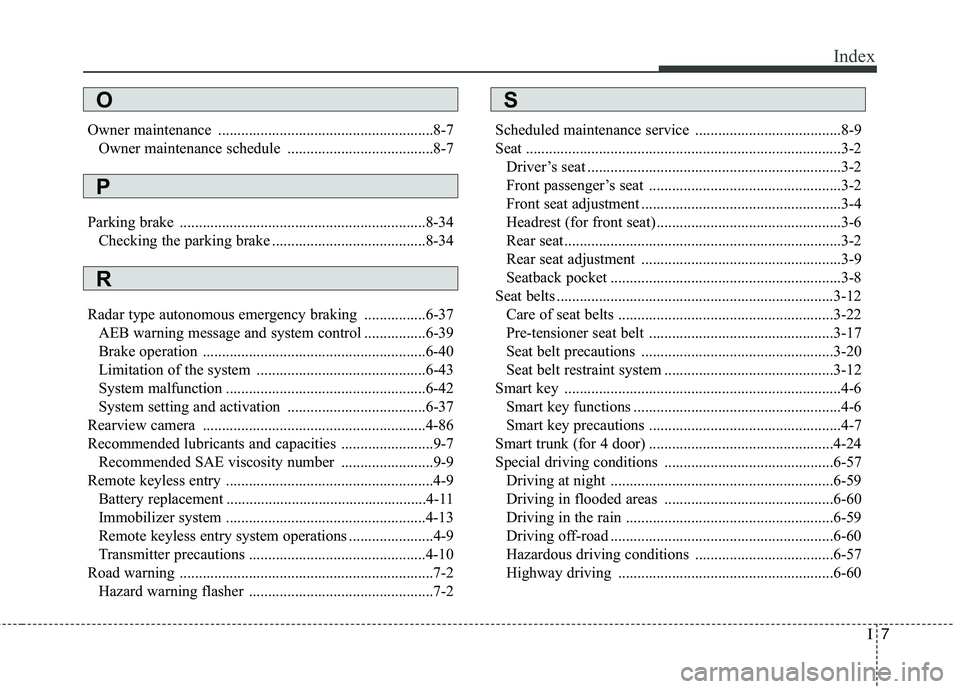
Owner maintenance ........................................................8-7Owner maintenance schedule ......................................8-7
Parking brake ................................................................8-34 Checking the parking brake ........................................8-34
Radar type autonomous emergency braking ................6-37 AEB warning message and system control ................6-39
Brake operation ..........................................................6-40
Limitation of the system ............................................6-43
System malfunction ....................................................6-42
System setting and activation ....................................6-37
Rearview camera ..........................................................4-86
Recommended lubricants and capacities ........................9-7 Recommended SAE viscosity number ........................9-9
Remote keyless entry ......................................................4-9 Battery replacement ....................................................4-11
Immobilizer system ....................................................4-13
Remote keyless entry system operations ......................4-9
Transmitter precautions ..............................................4-10
Road warning ..................................................................7-2 Hazard warning flasher ................................................7-2 Scheduled maintenance service ......................................8-9
Seat ........................................................................\
..........3-2
Driver’s seat ..................................................................3-2
Front passenger’s seat ..................................................3-2
Front seat adjustment ....................................................3-4
Headrest (for front seat) ................................................3-6
Rear seat ........................................................................\
3-2
Rear seat adjustment ....................................................3-9
Seatback pocket ............................................................3-8
Seat belts ........................................................................\
3-12 Care of seat belts ........................................................3-22
Pre-tensioner seat belt ................................................3-17
Seat belt precautions ..................................................3-20
Seat belt restraint system ............................................3-12
Smart key ........................................................................\
4-6 Smart key functions ......................................................4-6
Smart key precautions ..................................................4-7
Smart trunk (for 4 door) ................................................4-24
Special driving conditions ............................................6-57 Driving at night ..........................................................6-59
Driving in flooded areas ............................................6-60
Driving in the rain ......................................................6-59
Driving off-road ..........................................................6-60
Hazardous driving conditions ....................................6-57
Highway driving ........................................................6-60
O
P
S
R
Page 490 of 490
Index
10I
Winter driving ................................................................6-62Carry emergency equipment ......................................6-64
Change to “winter weight” oil if necessary ................6-63
Check battery and cables ............................................6-63
Check spark plugs and ignition system ......................6-63
Don't let ice and snow accumulate underneath ..........6-64
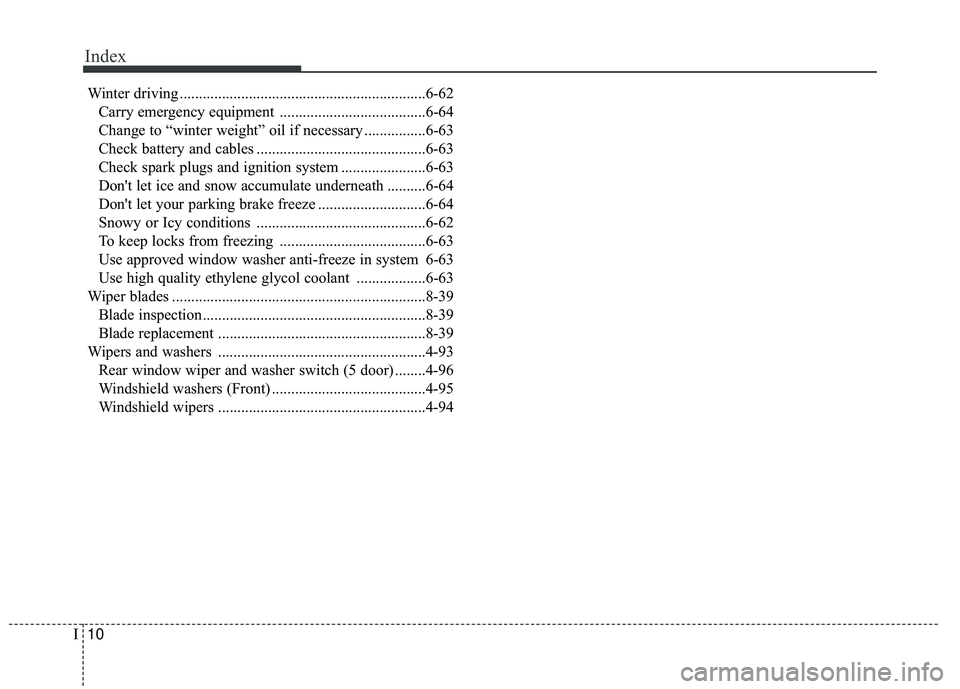
Don't let your parking brake freeze ............................6-64
Snowy or Icy conditions ............................................6-62
To keep locks from freezing ......................................6-63
Use approved window washer anti-freeze in system 6-63
Use high quality ethylene glycol coolant ..................6-63
Wiper blades ..................................................................8-39 Blade inspection ..........................................................8-39
Blade replacement ......................................................8-39
Wipers and washers ......................................................4-93 Rear window wiper and washer switch (5 door) ........4-96
Windshield washers (Front) ........................................4-95
Windshield wipers ......................................................4-94