power steering KIA RIO 2020 User Guide
[x] Cancel search | Manufacturer: KIA, Model Year: 2020, Model line: RIO, Model: KIA RIO 2020Pages: 516, PDF Size: 10.49 MB
Page 313 of 516

Driving your vehicle
46
6
Brake operation
In an emergency situation, the
braking system enters in ready sta-
tus for prompt reaction upon the
driver depressing the brake pedal.
FCA system provides additional braking power for optimum braking
performance when the driver
depresses the brake pedal.
The braking control is automatical- ly deactivated when the driver
sharply depresses the accelerator
pedal, or when the driver abruptly
turns the steering wheel.
The braking control is automatical- ly canceled when risk factors dis-
appear.
FCA system front radar sensor
In order for FCA system to operate
properly, always make sure the sen-
sor or sensor cover is clean and free
of dirt, snow, and debris. Dirt, snow,
or foreign substances on the lens
may adversely affect the sensing
performance of the sensor.
WARNING
FCA system logic operates
within certain parameters, such
as the distance from the vehicle
ahead, the speed of the vehicle
ahead, and the driver's vehicle
speed. Certain conditions such
as inclement weather, road con-
ditions, and systems limitations
may affect the operation of the
FCA system.
WARNING
FCA system braking control
cannot completely stop the
vehicle nor avoid all collisions.
The driver should hold the
responsibility to drive safely
and control the vehicle.
WARNING
Never deliberately drive danger-
ously to activate the system.
CAUTION
The driver should always exer-cise caution when operatingthe vehicle, even though there isno warning message or warningalarm.
OYB056063
SC CAN (ENG) 6.QXP 6/7/2019 9:50 AM Page 46
Page 328 of 516
661
Driving your vehicle
Remember, your vehicle does notrequire extended warm-up. After
the engine has started, allow the
engine to run for 10 to 20 seconds
prior to placing the vehicle in gear.
In very cold weather, however, give
your engine a slightly longer warm-
up period.
Don't “lug” or “over-rev” the engine. Lugging is driving too slowly in a
very high gear resulting in engine
bucking. If this happens, shift to a
lower gear. Over-revving is racing
the engine beyond its safe limit.
This can be avoided by shifting at
the recommended speed. Use your air conditioning sparingly.
The air conditioning system is
operated by engine power so your
fuel economy is reduced when you
use it.
Open windows at high speeds can reduce fuel economy.
Fuel economy is reduced by cross- winds and headwinds. To help off-
set some of this loss, slow down
when driving in these conditions.
Keeping a vehicle in good operating
condition is important both for econ-
omy and safety. Therefore, have an
authorized Kia dealer perform
scheduled inspections and mainte-
nance.
WARNING- Engine off during
motion
Never turn the engine off to
coast down hills or anytime the
vehicle is in motion. The power
steering and power brakes will
not function properly without
the engine running. In addition,
turning off the ignition while
driving could engage the steer-
ing wheel lock resulting in loss
of vehicle steering. Keep the
engine on and downshift to an
appropriate gear for engine
braking effect.
SC CAN (ENG) 6.QXP 6/7/2019 9:51 AM Page 61
Page 381 of 516
739
What to do in an emergency
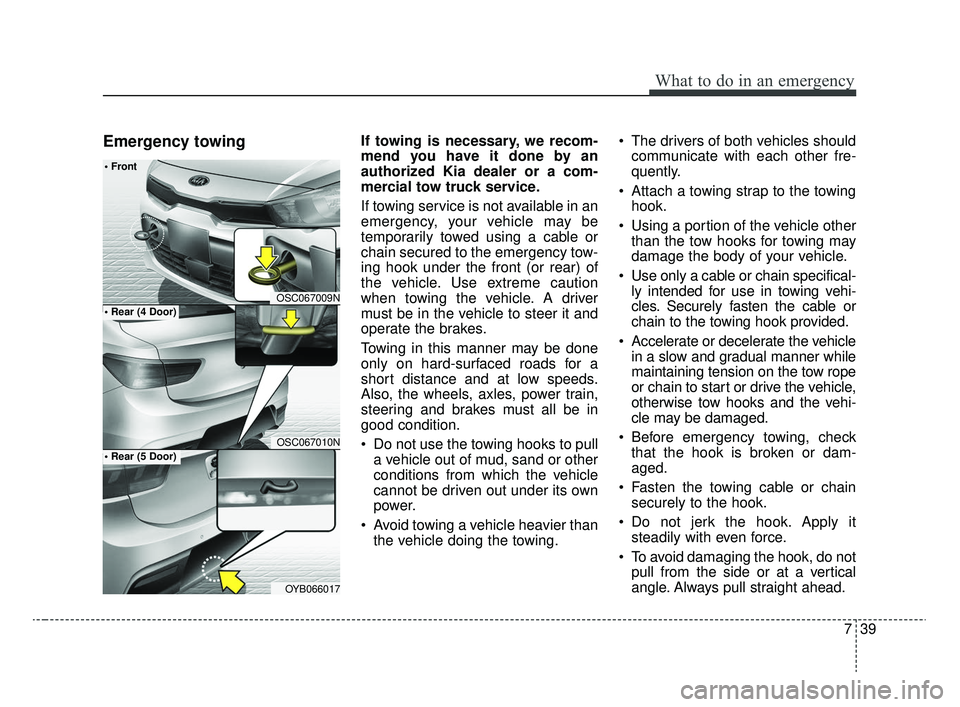
Emergency towingIf towing is necessary, we recom-
mend you have it done by an
authorized Kia dealer or a com-
mercial tow truck service.
If towing service is not available in an
emergency, your vehicle may be
temporarily towed using a cable or
chain secured to the emergency tow-
ing hook under the front (or rear) of
the vehicle. Use extreme caution
when towing the vehicle. A driver
must be in the vehicle to steer it and
operate the brakes.
Towing in this manner may be done
only on hard-surfaced roads for a
short distance and at low speeds.
Also, the wheels, axles, power train,
steering and brakes must all be in
good condition.
Do not use the towing hooks to pulla vehicle out of mud, sand or other
conditions from which the vehicle
cannot be driven out under its own
power.
Avoid towing a vehicle heavier than the vehicle doing the towing. The drivers of both vehicles should
communicate with each other fre-
quently.
Attach a towing strap to the towing hook.
Using a portion of the vehicle other than the tow hooks for towing may
damage the body of your vehicle.
Use only a cable or chain specifical- ly intended for use in towing vehi-
cles. Securely fasten the cable or
chain to the towing hook provided.
Accelerate or decelerate the vehicle in a slow and gradual manner while
maintaining tension on the tow rope
or chain to start or drive the vehicle,
otherwise tow hooks and the vehi-
cle may be damaged.
Before emergency towing, check that the hook is broken or dam-
aged.
Fasten the towing cable or chain securely to the hook.
Do not jerk the hook. Apply it steadily with even force.
To avoid damaging the hook, do not pull from the side or at a vertical
angle. Always pull straight ahead.
OSC067009N
OSC067010N
OYB066017
SC CAN (ENG) 7.qxp 6/7/2019 9:47 AM Page 39
Page 383 of 516
741
What to do in an emergency
Emergency towing precautions
Turn the ignition switch to ACC sothe steering wheel isn’t locked.
Place the transmission shift lever in N (Neutral).
Release the parking brake.
Press the brake pedal with more force than normal since you will
have reduced brake performance.
More steering effort will be required because the power steer-
ing system will be disabled.
If you are driving down a long hill, the brakes may overheat and brake
performance will be reduced. Stop
often and let the brakes cool off.
The vehicle should be towed at a speed of 25 km/h (15 mph) or less
within the distance of 20 km (12
miles).
If the car is being towed with all four
wheels on the ground, it can be
towed only from the front. Be sure
that the transmission is in neutral. Be
sure the steering is unlocked by plac-
ing the ignition switch in the ACC
position. A driver must be in the
towed vehicle to operate the steering
and brakes.CAUTION- Intelligent vari-
able transmission
To avoid serious damage to the intelligent variable trans-mission, limit the vehiclespeed to 10 mph (15 km/h) anddrive less than 1 mile (1.5km/h) when towing.
Before towing, check for an intelligent variable transmis-sion fluid leak under yourvehicle. If the intelligent vari-able transmission fluid is leak-ing, a flatbed equipment ortowing dolly must be used.
SC CAN (ENG) 7.qxp 6/7/2019 9:47 AM Page 41
Page 446 of 516
863
Maintenance
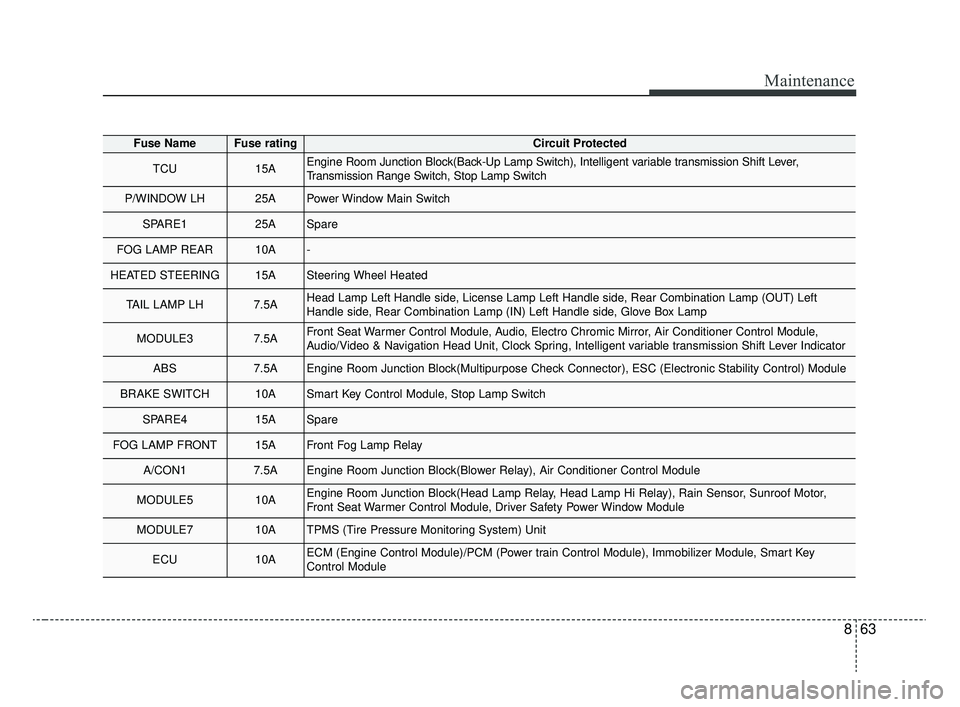
Fuse NameFuse ratingCircuit Protected
TCU15AEngine Room Junction Block(Back-Up Lamp Switch), Intelligent variable transmission Shift Lever,
Transmission Range Switch, Stop Lamp Switch
P/WINDOW LH25APower Window Main Switch
SPARE125ASpare
FOG LAMP REAR10A-
HEATED STEERING15ASteering Wheel Heated
TAIL LAMP LH7.5AHead Lamp Left Handle side, License Lamp Left Handle side, Rear Combination Lamp (OUT) Left
Handle side, Rear Combination Lamp (IN) Left Handle side, Glove Box Lamp
MODULE37.5AFront Seat Warmer Control Module, Audio, Electro Chromic Mirror, Air Conditioner Control Module,
Audio/Video & Navigation Head Unit, Clock Spring, Intelligent variable transmission Shift Lever Indicator
ABS7.5AEngine Room Junction Block(Multipurpose Check Connector), ESC (Electronic Stability Control) Module
BRAKE SWITCH10ASmart Key Control Module, Stop Lamp Switch
SPARE415ASpare
FOG LAMP FRONT15AFront Fog Lamp Relay
A/CON17.5AEngine Room Junction Block(Blower Relay), Air Conditioner Control Module
MODULE510AEngine Room Junction Block(Head Lamp Relay, Head Lamp Hi Relay), Rain Sensor, Sunroof Motor,
Front Seat Warmer Control Module, Driver Safety Power Window Module
MODULE710ATPMS (Tire Pressure Monitoring System) Unit
ECU10AECM (Engine Control Module)/PCM (Power train Control Module), Immobilizer Module, Smart Key
Control Module
SC CAN (ENG) 8.qxp 6/7/2019 9:42 AM Page 63
Page 448 of 516
865
Maintenance
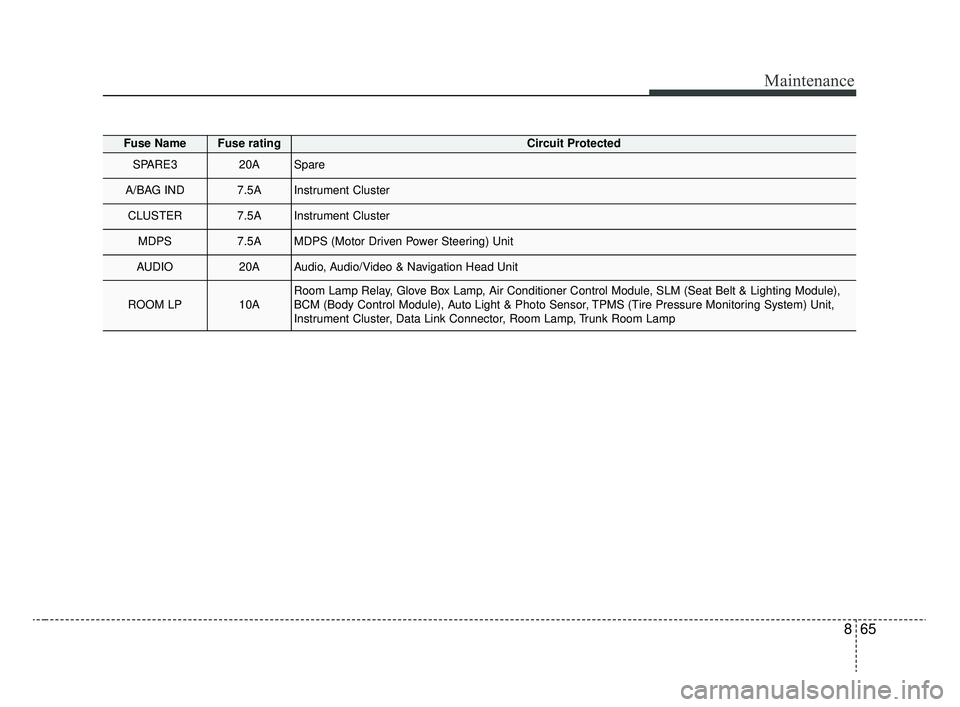
Fuse NameFuse ratingCircuit Protected
SPARE320ASpare
A/BAG IND7.5AInstrument Cluster
CLUSTER7.5AInstrument Cluster
MDPS7.5AMDPS (Motor Driven Power Steering) Unit
AUDIO20AAudio, Audio/Video & Navigation Head Unit
ROOM LP10ARoom Lamp Relay, Glove Box Lamp, Air Conditioner Control Module, SLM (Seat Belt & Lighting Module),
BCM (Body Control Module), Auto Light & Photo Sensor, TPMS (Tire Pressure Monitoring System) Unit,
Instrument Cluster, Data Link Connector, Room Lamp, Trunk Room Lamp
SC CAN (ENG) 8.qxp 6/7/2019 9:42 AM Page 65
Page 450 of 516
867
Maintenance
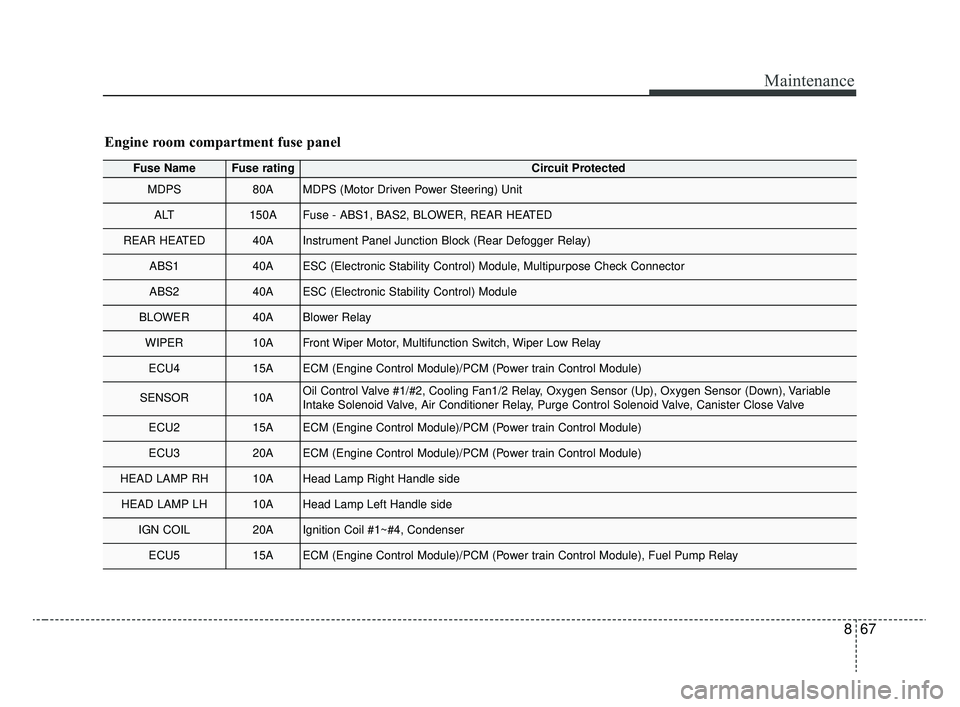
Engine room compartment fuse panel
Fuse NameFuse ratingCircuit Protected
MDPS80AMDPS (Motor Driven Power Steering) Unit
ALT150AFuse - ABS1, BAS2, BLOWER, REAR HEATED
REAR HEATED40AInstrument Panel Junction Block (Rear Defogger Relay)
ABS140AESC (Electronic Stability Control) Module, Multipurpose Check Connector
ABS240AESC (Electronic Stability Control) Module
BLOWER40ABlower Relay
WIPER10AFront Wiper Motor, Multifunction Switch, Wiper Low Relay
ECU415AECM (Engine Control Module)/PCM (Power train Control Module)
SENSOR10AOil Control Valve #1/#2, Cooling Fan1/2 Relay, Oxygen Sensor (Up), Oxygen Sensor (Down), Variable
Intake Solenoid Valve, Air Conditioner Relay, Purge Control Solenoid Valve, Canister Close Valve
ECU215AECM (Engine Control Module)/PCM (Power train Control Module)
ECU320AECM (Engine Control Module)/PCM (Power train Control Module)
HEAD LAMP RH10AHead Lamp Right Handle side
HEAD LAMP LH10AHead Lamp Left Handle side
IGN COIL20AIgnition Coil #1~#4, Condenser
ECU515AECM (Engine Control Module)/PCM (Power train Control Module), Fuel Pump Relay
SC CAN (ENG) 8.qxp 6/7/2019 9:42 AM Page 67
Page 514 of 516
Index
8I
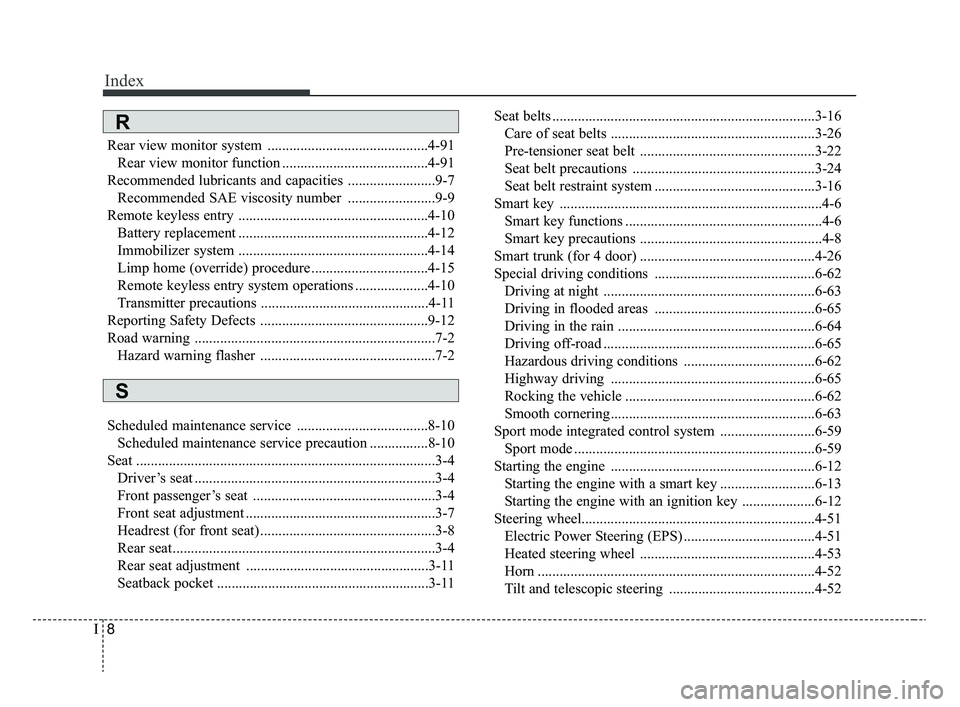
Rear view monitor system ............................................4-91Rear view monitor function ........................................4-91
Recommended lubricants and capacities ........................9-7 Recommended SAE viscosity number ........................9-9
Remote keyless entry ....................................................4-10 Battery replacement ....................................................4-12
Immobilizer system ....................................................4-14
Limp home (override) procedure ................................4-15
Remote keyless entry system operations ....................4-10
Transmitter precautions ..............................................4-11
Reporting Safety Defects ..............................................9-12
Road warning ..................................................................7-2 Hazard warning flasher ................................................7-2
Scheduled maintenance service ....................................8-10 Scheduled maintenance service precaution ................8-10
Seat ........................................................................\
..........3-4 Driver’s seat ..................................................................3-4
Front passenger’s seat ..................................................3-4
Front seat adjustment ....................................................3-7
Headrest (for front seat) ................................................3-8
Rear seat ........................................................................\
3-4
Rear seat adjustment ..................................................3-11
Seatback pocket ..........................................................3-11 Seat belts ........................................................................\
3-16
Care of seat belts ........................................................3-26
Pre-tensioner seat belt ................................................3-22
Seat belt precautions ..................................................3-24
Seat belt restraint system ............................................3-16
Smart key ........................................................................\
4-6 Smart key functions ......................................................4-6
Smart key precautions ..................................................4-8
Smart trunk (for 4 door) ................................................4-26
Special driving conditions ............................................6-62 Driving at night ..........................................................6-63
Driving in flooded areas ............................................6-65
Driving in the rain ......................................................6-64
Driving off-road ..........................................................6-65
Hazardous driving conditions ....................................6-62
Highway driving ........................................................6-65
Rocking the vehicle ....................................................6-62
Smooth cornering ........................................................6-63
Sport mode integrated control system ..........................6-59 Sport mode ..................................................................6-59
Starting the engine ........................................................6-12 Starting the engine with a smart key ..........................6-13
Starting the engine with an ignition key ....................6-12
Steering wheel...........................................................\
.....4-51 Electric Power Steering (EPS) ....................................4-51
Heated steering wheel ................................................4-53
Horn ........................................................................\
....4-52
Tilt and telescopic steering ........................................4-52
R
S
SC CAN (ENG) Index.qxp 12/12/2019 5:06 PM Page 8