ECO mode KIA RIO 2020 Owner's Manual
[x] Cancel search | Manufacturer: KIA, Model Year: 2020, Model line: RIO, Model: KIA RIO 2020Pages: 516, PDF Size: 10.49 MB
Page 250 of 516
Audio system
25
5
(Continued)
• The search and song play order in
the iPod
®device may be different
from the search order in the audio
system.
• If the iPod
®has failed due to an
internal defect, please reset the
iPod
®(consult your iPod®manual).
• Depending on the software ver- sion, the iPod
®may fail to sync
with the system. If the media is
removed or disconnected before
recognition, the previous mode
may not be restored (iPad
®cannot
be charged).
• Cables other than the 1-meter cable provided with iPod
®/iPhone®
products may not be recognized.
• When other music apps are used on your iPod
®, the system sync
function may fail due to malfunc-
tion of the iPod
®application.
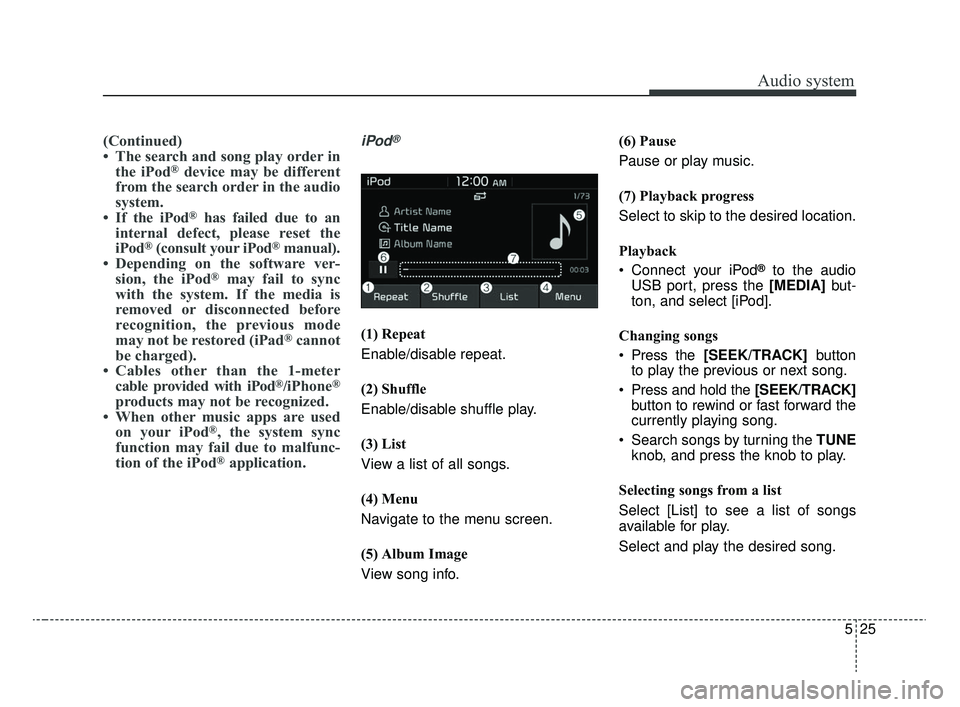
iPod®
(1) Repeat
Enable/disable repeat.
(2) Shuffle
Enable/disable shuffle play.
(3) List
View a list of all songs.
(4) Menu
Navigate to the menu screen.
(5) Album Image
View song info. (6) Pause
Pause or play music.
(7) Playback progress
Select to skip to the desired location.
Playback
Connect your iPod
®to the audio
USB port, press the [MEDIA] but-
ton, and select [iPod].
Changing songs
Press the [SEEK/TRACK] button
to play the previous or next song.
Press and hold the [SEEK/TRACK] button to rewind or fast forward the
currently playing song.
Search songs by turning the TUNE knob, and press the knob to play.
Selecting songs from a list
Select [List] to see a list of songs
available for play.
Select and play the desired song.
SC CAN (ENG) 5(audio).qxp 6/7/2019 9:52 AM Page 25
Page 268 of 516
Driving your vehicle
Before driving . . . . . . . . . . . . . . . . . . . . . . . . . . . . . . 6-4
• Before entering vehicle . . . . . . . . . . . . . . . . . . . . . . . . . 6-4
• Necessary inspections . . . . . . . . . . . . . . . . . . . . . . . . . . 6-4
• Before starting . . . . . . . . . . . . . . . . . . . . . . . . . . . . . . . . 6-4
Key positions . . . . . . . . . . . . . . . . . . . . . . . . . . . . . . . 6-6
• Ignition switch position . . . . . . . . . . . . . . . . . . . . . . . . . 6-6
Engine start/stop button . . . . . . . . . . . . . . . . . . . . . 6-8
• Illuminated engine start/stop button . . . . . . . . . . . . . . 6-8
• Engine start/stop button position. . . . . . . . . . . . . . . . . 6-8
Starting the engine . . . . . . . . . . . . . . . . . . . . . . . . . 6-12
• Starting the engine with an ignition key . . . . . . . . . . 6-12
• Starting the engine with a smart key. . . . . . . . . . . . . 6-13
Manual transmission . . . . . . . . . . . . . . . . . . . . . . . 6-15
• Manual transmission operation . . . . . . . . . . . . . . . . . 6-15
• Good driving practices . . . . . . . . . . . . . . . . . . . . . . . . 6-17
Intelligent Variable Transmission (IVT) . . . . . . . 6-18
• Intelligent Variable Transmission (IVT) operation . 6-18
• Good driving practices . . . . . . . . . . . . . . . . . . . . . . . . 6-25
Brake system . . . . . . . . . . . . . . . . . . . . . . . . . . . . . . 6-27
• Power brakes . . . . . . . . . . . . . . . . . . . . . . . . . . . . . . . . 6-27
• Parking brake . . . . . . . . . . . . . . . . . . . . . . . . . . . . . . . 6-29
• Anti-lock Brake System (ABS). . . . . . . . . . . . . . . . . . 6-32
• Electronic Stability Control (ESC) . . . . . . . . . . . . . . 6-33
• Hill-start Assist Control (HAC) . . . . . . . . . . . . . . . . . 6-37• Vehicle Stability Management (VSM) . . . . . . . . . . . . 6-38
• Good braking practices. . . . . . . . . . . . . . . . . . . . . . . . 6-40
Forward Collision-Avoidance Assist (FCA) system
(Radar type) . . . . . . . . . . . . . . . . . . . . . . . . . . . . . 6-42
• FCA system warning message and system control . 6-44
• Brake operation . . . . . . . . . . . . . . . . . . . . . . . . . . . . . . 6-46
• FCA system front radar sensor . . . . . . . . . . . . . . . . . 6-46
• System malfunction . . . . . . . . . . . . . . . . . . . . . . . . . . . 6-48
• Limitation of the system . . . . . . . . . . . . . . . . . . . . . . . 6-49
Cruise Control system . . . . . . . . . . . . . . . . . . . . . . 6-54
• Cruise control switch . . . . . . . . . . . . . . . . . . . . . . . . . 6-54
• To set cruise control speed . . . . . . . . . . . . . . . . . . . . . 6-55
• To increase cruise control set speed. . . . . . . . . . . . . . 6-56
• To decrease the cruising speed . . . . . . . . . . . . . . . . . . 6-56
• To temporarily accelerate with the cruise
control on . . . . . . . . . . . . . . . . . . . . . . . . . . . . . . . . . . 6-56\
• To cancel cruise control . . . . . . . . . . . . . . . . . . . . . . . 6-57
• To resume cruising speed at more than approximately 30 km/h (20 mph) . . . . . . . . . . . . . . . . . . . . . . . . . . . 6-57
• To turn cruise control off . . . . . . . . . . . . . . . . . . . . . . 6-58
Sport mode integrated control system . . . . . . . . . 6-59
• Sport mode . . . . . . . . . . . . . . . . . . . . . . . . . . . . . . . . . . 6-59\
Economical operation . . . . . . . . . . . . . . . . . . . . . . 6-60
6
SC CAN (ENG) 6.QXP 6/7/2019 9:49 AM Page 1
Page 279 of 516
Driving your vehicle
12
6
Starting the engine with an
ignition key (if equipped)
1. Make sure the parking brake is
applied.
2. Manual Transmission - Depress
the clutch pedal fully and shift the
transmission into Neutral. Keep
the clutch pedal and brake pedal
depressed while turning the igni-
tion switch to the start position.
Intelligent Variable Transmission
- Place the transmission shift lever
in P (Park). Depress the brake
pedal fully.
You can also start the engine when the shift lever is in the N(Neutral) position.
3. Turn the ignition switch to START and hold it there until the engine
starts (a maximum of 10 seconds),
then release the key.
It should be started withoutdepressing the accelerator.
4. Do not wait for the engine to warm up while the vehicle remains sta-
tionary.
Start driving at moderate engine
speeds. (Extreme and/or exces-
sive accelerating and decelerating
should be avoided.)
If the engine stalls while the vehicle
is in motion, do not attempt to move
the shift lever to the P (Park) posi-
tion. If traffic and road conditions per-
mit, you may put the shift lever in the
N (Neutral) position while the vehicle
is still moving and turn the ignition
switch to the START position in an
attempt to restart the engine.
STARTING THE ENGINE
WARNING- Proper footwear
Always wear appropriate shoes
when operating your vehicle.
Unsuitable shoes (high heels, ski
boots, sandals, etc.) may inter-
fere with your ability to use the
brake and accelerator pedals.
CAUTION- Starter
Do not engage the starter for more than 10 seconds. If theengine stalls or fails to start,wait 5 to 10 seconds before re-engaging the starter. Improperuse of the starter may damageit.
SC CAN (ENG) 6.QXP 6/7/2019 9:49 AM Page 12
Page 327 of 516
Driving your vehicle
60
6
Your vehicle's fuel economy depends
mainly on your style of driving, where
you drive and when you drive.
Each of these factors affects how
many miles (kilometers) you can get
from a gallon (liter) of fuel. To operate
your vehicle as economically as pos-
sible, use the following driving sug-
gestions to help save money in both
fuel and repairs:
Drive smoothly. Accelerate at a
moderate rate. Don't make "jack-
rabbit" starts or full-throttle shifts
and maintain a steady cruising
speed. Don't race between stop-
lights. Try to adjust your speed to
the traffic so you don't have to
change speeds unnecessarily.
Avoid heavy traffic whenever pos-
sible. Always maintain a safe dis-
tance from other vehicles so you
can avoid unnecessary braking.
This also reduces brake wear.
Drive at a moderate speed. The faster you drive, the more fuel your
vehicle uses. Driving at a moderate
speed, especially on the highway,
is one of the most effective ways to
reduce fuel consumption. Don't "ride" the brake pedal. This
can increase fuel consumption and
also increase wear on these com-
ponents. In addition, driving with
your foot resting on the brake pedal
may cause the brakes to overheat,
which reduces their effectiveness
and may lead to more serious con-
sequences.
Take care of your tires. Keep them inflated to the recommended pres-
sure. Incorrect inflation, either too
much or too little, results in unnec-
essary tire wear. Check the tire
pressures at least once a month.
Be sure that the wheels are aligned correctly. Improper align-
ment can result from hitting curbs
or driving too fast over irregular
surfaces. Poor alignment causes
faster tire wear and may also result
in other problems as well as
greater fuel consumption. Keep your vehicle in good condi-
tion. For better fuel economy and
reduced maintenance costs, main-
tain your vehicle in accordance
with the maintenance schedule in
section 8. If you drive your vehicle
in severe conditions, more frequent
maintenance is required (see sec-
tion 8 for details).
Keep your vehicle clean. For maxi- mum service, your vehicle should
be kept clean and free of corrosive
materials. It is especially important
that mud, dirt, ice, etc. not be
allowed to accumulate on the
underside of the vehicle. This extra
weight can result in increased fuel
consumption and also contribute to
corrosion.
Travel lightly. Don't carry unneces- sary weight in your vehicle. Weight
reduces fuel economy.
Don't let the engine idle longer than necessary. If you are waiting
(and not in traffic), turn off your
engine and restart only when
you're ready to go.
ECONOMICAL OPERATION
SC CAN (ENG) 6.QXP 6/7/2019 9:51 AM Page 60
Page 394 of 516
811
Maintenance
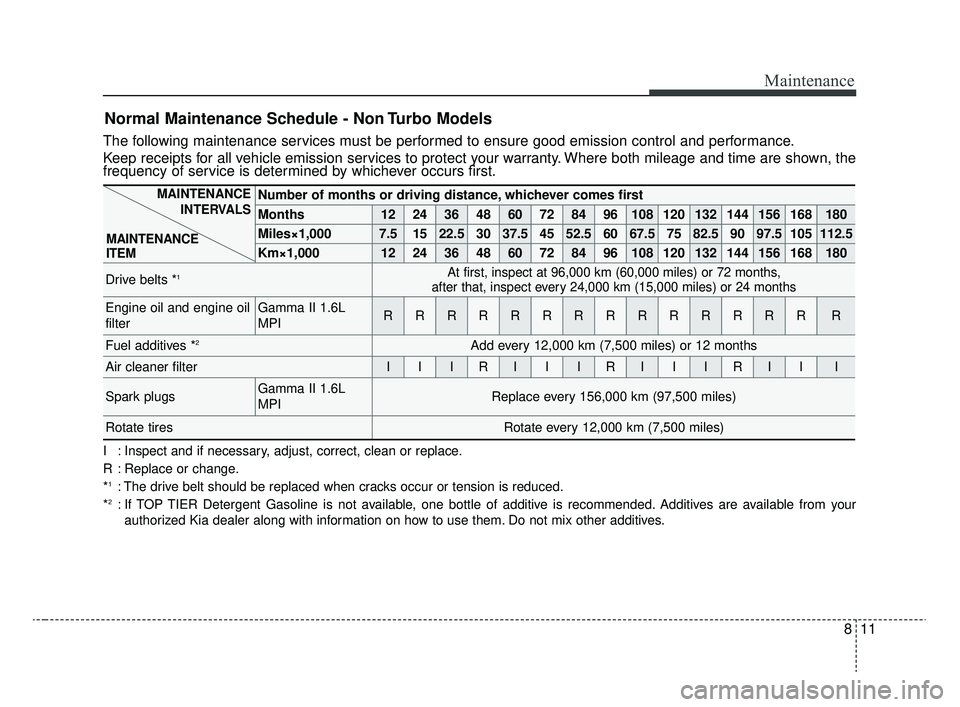
Normal Maintenance Schedule - Non Turbo Models
The following maintenance services must be performed to ensure good emission control and performance.
Keep receipts for all vehicle emission services to protect your warranty. Where both mileage and time are shown, the
frequency of service is determined by whichever occurs first.
Number of months or driving distance, whichever comes first
Months1224364860728496108120132144156168180
Miles×1,0007.51522.530 37.5 45 52.5 60 67.5 75 82.5 90 97.5 105 112.5
Km×1,00012 24 36 48 60 72 84 96 108 120 132 144 156 168 180
Drive belts *1At first, inspect at 96,000 km (60,000 miles) or 72 months,
after that, inspect every 24,000 km (15,000 miles) or 24 months
Engine oil and engine oil
filterGamma II 1.6L
MPIRRRRRRRRRRRRRRR
Fuel additives *2Add every 12,000 km (7,500 miles) or 12 months
Air cleaner filterIIIRIIIRIIIRIII
Spark plugsGamma II 1.6L
MPIReplace every 156,000 km (97,500 miles)
Rotate tiresRotate every 12,000 km (7,500 miles)
I : Inspect and if necessary, adjust, correct, clean or replace.
R : Replace or change.
*
1: The drive belt should be replaced when cracks occur or tension is reduced.
*2: If TOP TIER Detergent Gasoline is not available, one bottle of additive is recommended. Additives are available from your authorized Kia dealer along with information on how to use them. Do not mix other additives.
MAINTENANCE INTERVALS
MAINTENANCE
ITEM
SC CAN (ENG) 8.qxp 6/13/2019 5:09 PM Page 11
Page 396 of 516
813
Maintenance
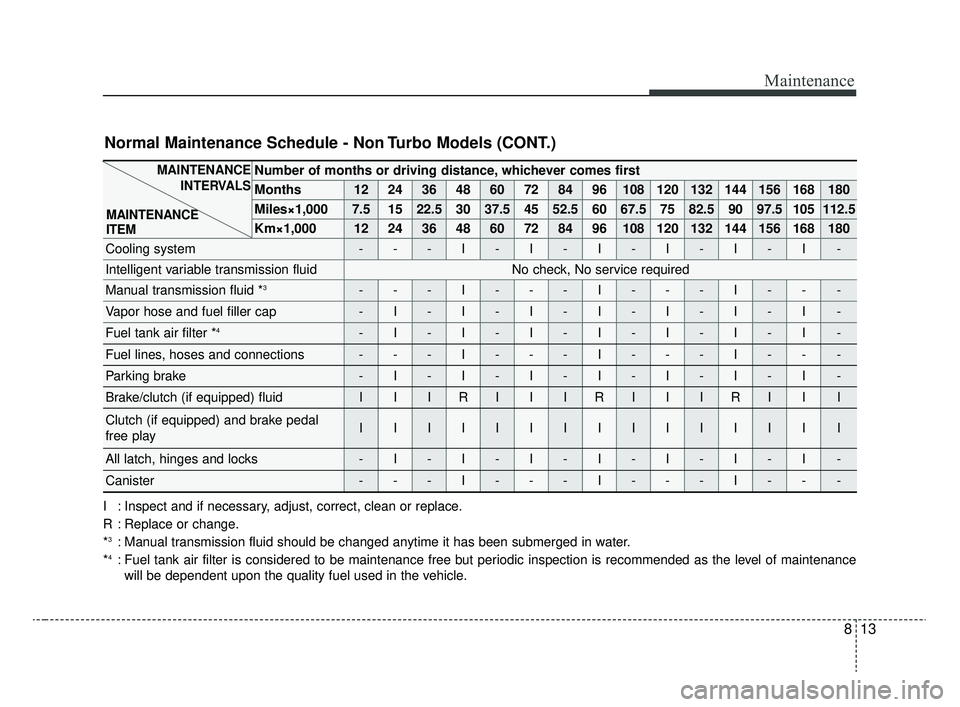
Number of months or driving distance, whichever comes first
Months1224364860728496108120132144156168180
Miles×1,0007.51522.530 37.5 45 52.5 60 67.5 75 82.5 90 97.5 105 112.5
Km×1,00012 24 36 48 60 72 84 96 108 120 132 144 156 168 180
Cooling system---I-I-I-I-I-I-
Intelligent variable transmission fluidNo check, No service required
Manual transmission fluid *3---I---I---I---
Vapor hose and fuel filler cap-I-I-I-I-I-I-I-
Fuel tank air filter *4-I-I-I-I-I-I-I-
Fuel lines, hoses and connections---I---I---I---
Parking brake-I-I-I-I-I-I-I-
Brake/clutch (if equipped) fluidIIIRIIIRIIIRIII
Clutch (if equipped) and brake pedal
free playIIIIIIIIIIIIIII
All latch, hinges and locks-I-I-I-I-I-I-I-
Canister---I---I---I---
Normal Maintenance Schedule - Non Turbo Models (CONT.)
I : Inspect and if necessary, adjust, correct, clean or replace.
R : Replace or change.
*
3: Manual transmission fluid should be changed anytime it has been submerged in water.
*4: Fuel tank air filter is considered to be maintenance free but periodic inspection is recommended as the level of maintenance will be dependent upon the quality fuel used in the vehicle.
MAINTENANCE INTERVALS
MAINTENANCE
ITEM
SC CAN (ENG) 8.qxp 12/12/2019 4:19 PM Page 13
Page 435 of 516
Maintenance
52
8
All season tires
Kia specifies all season tires on
some models to provide good per-
formance for use all year round,
including snowy and icy road condi-
tions. All season tires are identified
by ALL SEASON and/or M+S (Mud
and Snow) on the tire sidewall. Snow
tires have better snow traction than
all season tires and may be more
appropriate in some areas.
Summer tires
Kia specifies summer tires on some
models to provide superior perform-
ance on dry roads. Summer tire per-
formance is substantially reduced in
snow and ice. Summer tires do not
have the tire traction rating M+S
(Mud and Snow) on the tire side wall.
If you plan to operate your vehicle in
snowy or icy conditions, Kia recom-
mends the use of snow tires or all
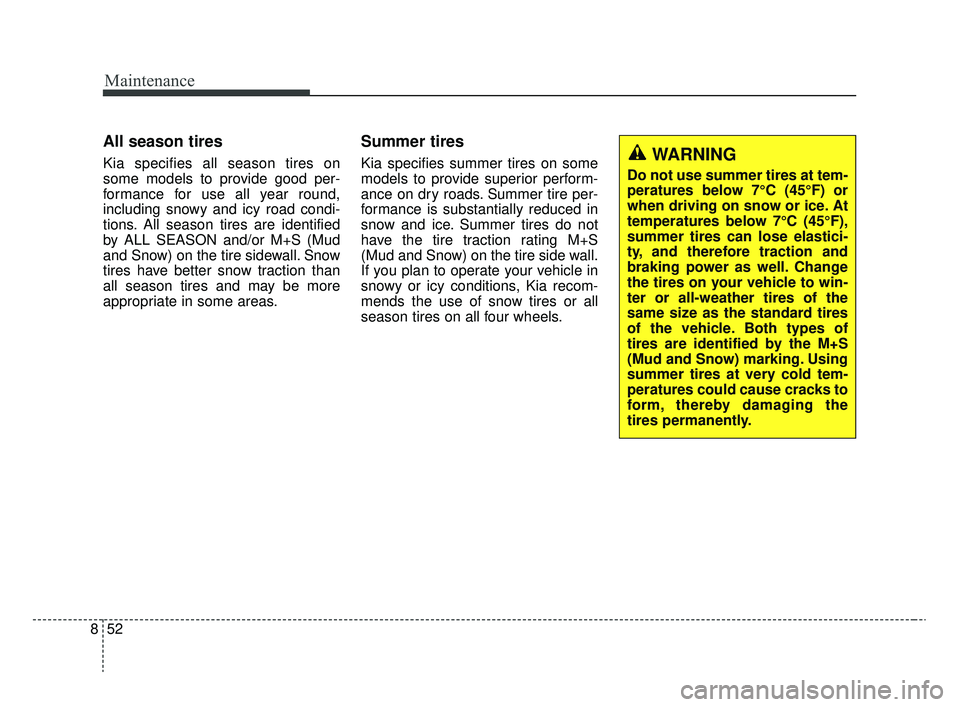
season tires on all four wheels.WARNING
Do not use summer tires at tem-
peratures below 7°C (45°F) or
when driving on snow or ice. At
temperatures below 7°C (45°F),
summer tires can lose elastici-
ty, and therefore traction and
braking power as well. Change
the tires on your vehicle to win-
ter or all-weather tires of the
same size as the standard tires
of the vehicle. Both types of
tires are identified by the M+S
(Mud and Snow) marking. Using
summer tires at very cold tem-
peratures could cause cracks to
form, thereby damaging the
tires permanently.
SC CAN (ENG) 8.qxp 6/7/2019 9:41 AM Page 52
Page 443 of 516
Maintenance
60
8
✽ ✽
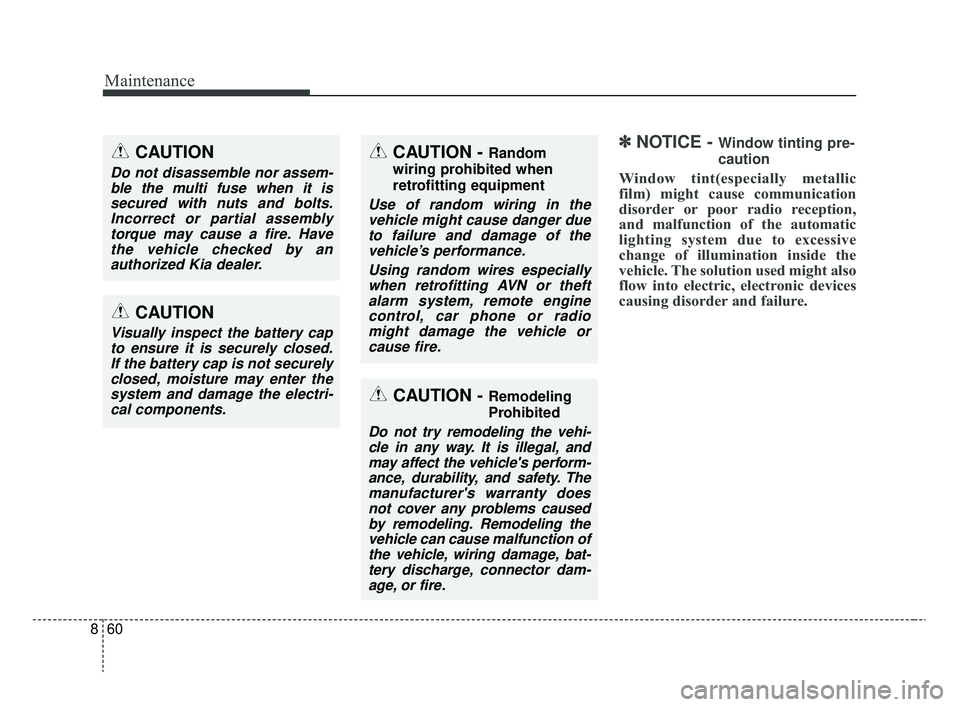
NOTICE - Window tinting pre-
caution
Window tint(especially metallic
film) might cause communication
disorder or poor radio reception,
and malfunction of the automatic
lighting system due to excessive
change of illumination inside the
vehicle. The solution used might also
flow into electric, electronic devices
causing disorder and failure.
CAUTION
Visually inspect the battery cap
to ensure it is securely closed.If the battery cap is not securelyclosed, moisture may enter thesystem and damage the electri-cal components.
CAUTION - Remodeling
Prohibited
Do not try remodeling the vehi-cle in any way. It is illegal, andmay affect the vehicle's perform-ance, durability, and safety. Themanufacturer's warranty doesnot cover any problems causedby remodeling. Remodeling thevehicle can cause malfunction ofthe vehicle, wiring damage, bat-tery discharge, connector dam-age, or fire.
CAUTION
Do not disassemble nor assem-ble the multi fuse when it issecured with nuts and bolts.Incorrect or partial assemblytorque may cause a fire. Havethe vehicle checked by anauthorized Kia dealer.
CAUTION - Random
wiring prohibited when
retrofitting equipment
Use of random wiring in the vehicle might cause danger dueto failure and damage of thevehicle’s performance.
Using random wires especiallywhen retrofitting AVN or theftalarm system, remote enginecontrol, car phone or radiomight damage the vehicle orcause fire.
SC CAN (ENG) 8.qxp 6/7/2019 9:41 AM Page 60
Page 499 of 516
95
Specifications & Consumer information
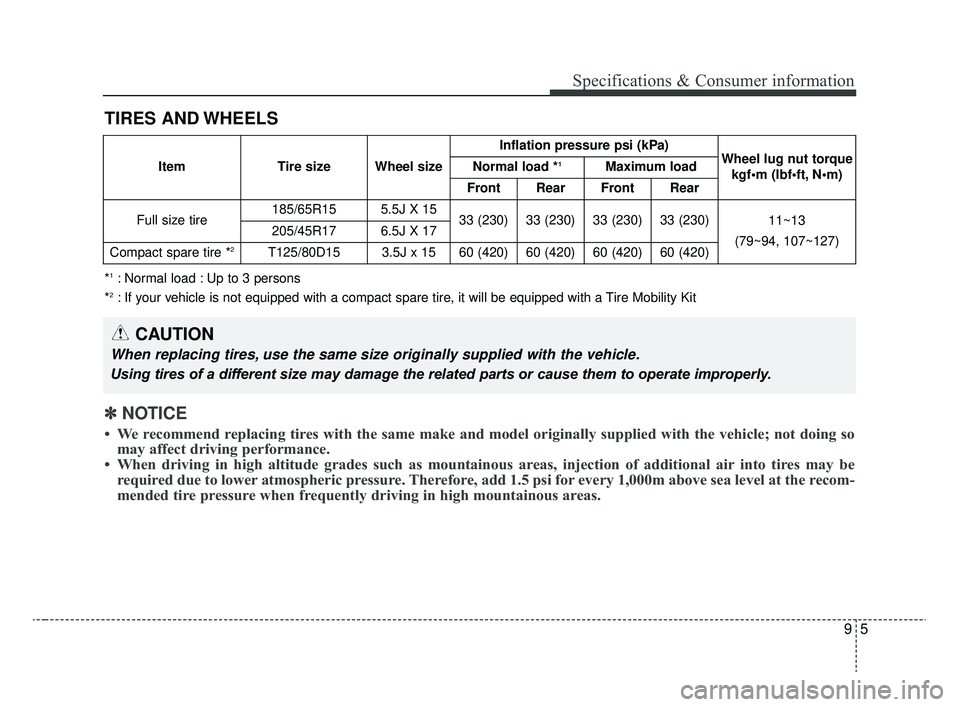
TIRES AND WHEELS
CAUTION
When replacing tires, use the same size originally supplied with the vehicle.
Using tires of a different size may damage the related parts or cause them to operate improp\
erly.
*1: Normal load : Up to 3 persons
*
2: If your vehicle is not equipped with a compact spare tire, it will be equipped with a Tire Mobility Kit Item Tire size Wheel size
Inflation pressure psi (kPa)
Wheel lug nut torque
Normal load *
1Maximum load
Front Rear Front Rear
Full size tire 185/65R15 5.5J X 15
33 (230) 33 (230) 33 (230) 33 (230) 11~13
(79~94, 107~127)
205/45R17 6.5J X 17
Compact spare tire *
2T125/80D15 3.5J x 15 60 (420) 60 (420) 60 (420) 60 (420)
✽ ✽ NOTICE
• We recommend replacing tires with the same make and model originally supplied with the vehicle; no\
t doing so
may affect driving performance.
• When driving in high altitude grades such as mountainous areas, injection of additional air into tires may be required due to lower atmospheric pressure. Therefore, add 1.5 psi for every 1,000m above sea level at the recom-
mended tire pressure when frequently driving in high mountainous areas.
SC CAN (ENG) 9.qxp 12/12/2019 5:07 PM Page 5
Page 514 of 516
Index
8I
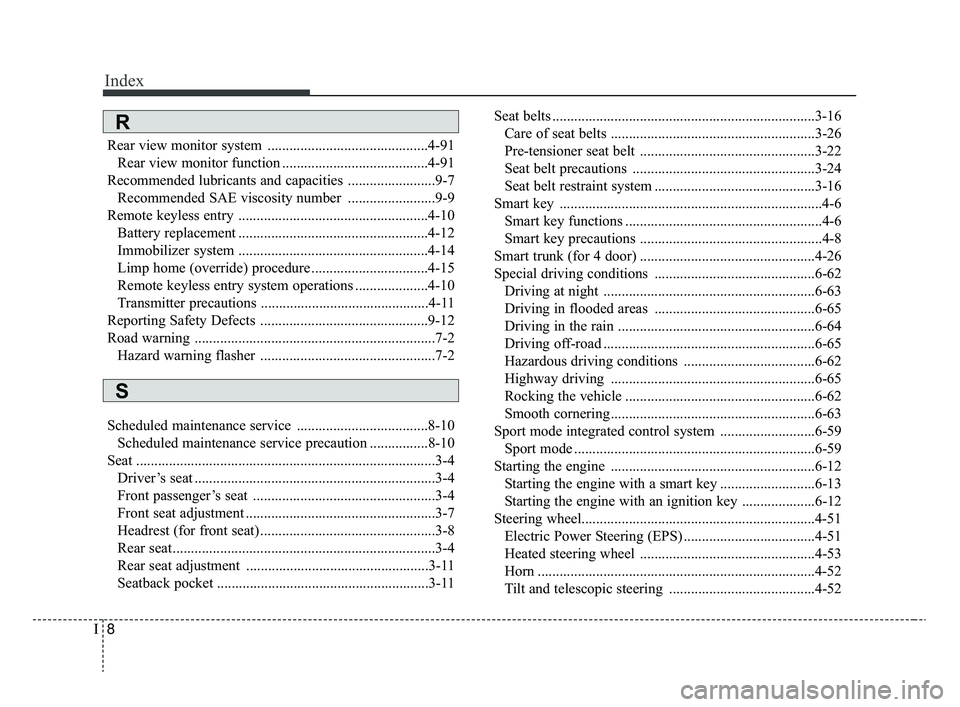
Rear view monitor system ............................................4-91Rear view monitor function ........................................4-91
Recommended lubricants and capacities ........................9-7 Recommended SAE viscosity number ........................9-9
Remote keyless entry ....................................................4-10 Battery replacement ....................................................4-12
Immobilizer system ....................................................4-14
Limp home (override) procedure ................................4-15
Remote keyless entry system operations ....................4-10
Transmitter precautions ..............................................4-11
Reporting Safety Defects ..............................................9-12
Road warning ..................................................................7-2 Hazard warning flasher ................................................7-2
Scheduled maintenance service ....................................8-10 Scheduled maintenance service precaution ................8-10
Seat ........................................................................\
..........3-4 Driver’s seat ..................................................................3-4
Front passenger’s seat ..................................................3-4
Front seat adjustment ....................................................3-7
Headrest (for front seat) ................................................3-8
Rear seat ........................................................................\
3-4
Rear seat adjustment ..................................................3-11
Seatback pocket ..........................................................3-11 Seat belts ........................................................................\
3-16
Care of seat belts ........................................................3-26
Pre-tensioner seat belt ................................................3-22
Seat belt precautions ..................................................3-24
Seat belt restraint system ............................................3-16
Smart key ........................................................................\
4-6 Smart key functions ......................................................4-6
Smart key precautions ..................................................4-8
Smart trunk (for 4 door) ................................................4-26
Special driving conditions ............................................6-62 Driving at night ..........................................................6-63
Driving in flooded areas ............................................6-65
Driving in the rain ......................................................6-64
Driving off-road ..........................................................6-65
Hazardous driving conditions ....................................6-62
Highway driving ........................................................6-65
Rocking the vehicle ....................................................6-62
Smooth cornering ........................................................6-63
Sport mode integrated control system ..........................6-59 Sport mode ..................................................................6-59
Starting the engine ........................................................6-12 Starting the engine with a smart key ..........................6-13
Starting the engine with an ignition key ....................6-12
Steering wheel...........................................................\
.....4-51 Electric Power Steering (EPS) ....................................4-51
Heated steering wheel ................................................4-53
Horn ........................................................................\
....4-52
Tilt and telescopic steering ........................................4-52
R
S
SC CAN (ENG) Index.qxp 12/12/2019 5:06 PM Page 8