cooling KIA RIO 2022 User Guide
[x] Cancel search | Manufacturer: KIA, Model Year: 2022, Model line: RIO, Model: KIA RIO 2022Pages: 528, PDF Size: 11.8 MB
Page 361 of 528
67
What to do in an emergency
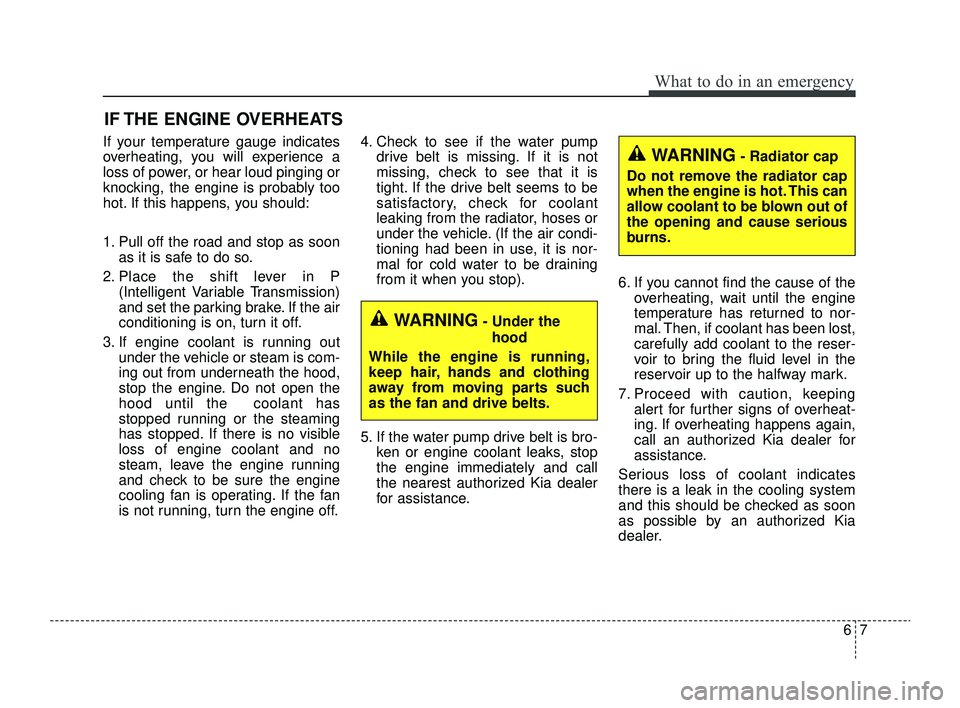
IF THE ENGINE OVERHEATS
If your temperature gauge indicates
overheating, you will experience a
loss of power, or hear loud pinging or
knocking, the engine is probably too
hot. If this happens, you should:
1. Pull off the road and stop as soonas it is safe to do so.
2. Place the shift lever in P (Intelligent Variable Transmission)
and set the parking brake. If the air
conditioning is on, turn it off.
3. If engine coolant is running out under the vehicle or steam is com-
ing out from underneath the hood,
stop the engine. Do not open the
hood until the coolant has
stopped running or the steaming
has stopped. If there is no visible
loss of engine coolant and no
steam, leave the engine running
and check to be sure the engine
cooling fan is operating. If the fan
is not running, turn the engine off. 4. Check to see if the water pump
drive belt is missing. If it is not
missing, check to see that it is
tight. If the drive belt seems to be
satisfactory, check for coolant
leaking from the radiator, hoses or
under the vehicle. (If the air condi-
tioning had been in use, it is nor-
mal for cold water to be draining
from it when you stop).
5. If the water pump drive belt is bro- ken or engine coolant leaks, stop
the engine immediately and call
the nearest authorized Kia dealer
for assistance. 6. If you cannot find the cause of the
overheating, wait until the engine
temperature has returned to nor-
mal. Then, if coolant has been lost,
carefully add coolant to the reser-
voir to bring the fluid level in the
reservoir up to the halfway mark.
7. Proceed with caution, keeping alert for further signs of overheat-
ing. If overheating happens again,
call an authorized Kia dealer for
assistance.
Serious loss of coolant indicates
there is a leak in the cooling system
and this should be checked as soon
as possible by an authorized Kia
dealer.
WARNING- Under the hood
While the engine is running,
keep hair, hands and clothing
away from moving parts such
as the fan and drive belts.
WARNING- Radiator cap
Do not remove the radiator cap
when the engine is hot. This can
allow coolant to be blown out of
the opening and cause serious
burns.
SC PE USA 6.qxp 8/23/2021 6:01 PM Page 7
Page 393 of 528
Maintenance
67
(Continued)
• Wash the undercarriage of yourvehicle regularly during the win-
ter and whenever your vehicle has
been exposed to such salts or
chemicals.
• Do a thorough washing of the undercarriage at the end of the
winter.
• Use professional service techni- cians or governmental inspection
stations to annually inspect for
corrosion.
• Immediately seek an inspection of your vehicle if you become visual-
ly aware of corrosion flaking or
scaling or if you become aware of
a change in vehicle performance,
such as soft or spongy brakes, flu-
ids leaking, impairment of direc-
tional control, suspension noises
or rattling metal straps.
NHTSA further advises that after
a vehicle is 7 years old, it is essen-
tial that you take these indicated
maintenance steps to ensure that
you protect yourself from unsafe
corrosion conditions.Owner maintenance precau-
tions
Improper or incomplete service may
result in problems. This section gives
instructions only for the maintenance
items that are easy to perform.
As explained earlier in this section,
several procedures can be done only
by an authorized Kia dealer with spe-
cial tools.
✽ ✽ NOTICE
Improper owner maintenance dur-
ing the warranty period may affect
warranty coverage. For details, read
the separate Warranty & Consumer
Information manual provided with
the vehicle. If you're unsure about
any servicing or maintenance proce-
dure, have it done by an authorized
Kia dealer.
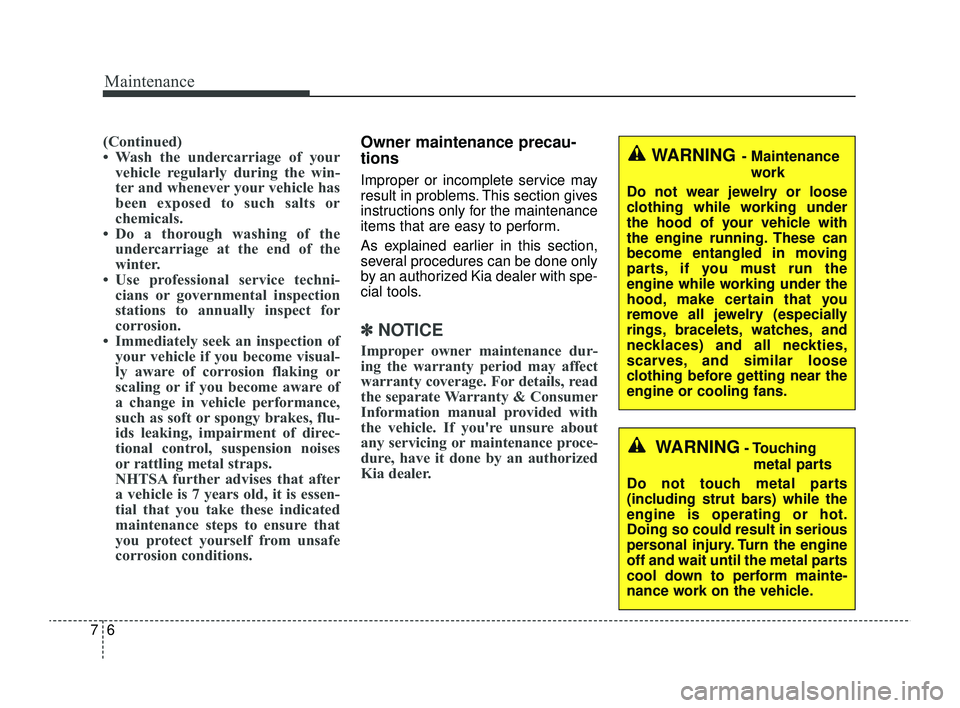
WARNING- Maintenance
work
Do not wear jewelry or loose
clothing while working under
the hood of your vehicle with
the engine running. These can
become entangled in moving
parts, if you must run the
engine while working under the
hood, make certain that you
remove all jewelry (especially
rings, bracelets, watches, and
necklaces) and all neckties,
scarves, and similar loose
clothing before getting near the
engine or cooling fans.
WARNING- Touching metal parts
Do not touch metal parts
(including strut bars) while the
engine is operating or hot.
Doing so could result in serious
personal injury. Turn the engine
off and wait until the metal parts
cool down to perform mainte-
nance work on the vehicle.
SC PE USA 7.qxp 9/9/2021 6:26 PM Page 6
Page 399 of 528
Maintenance
12
7
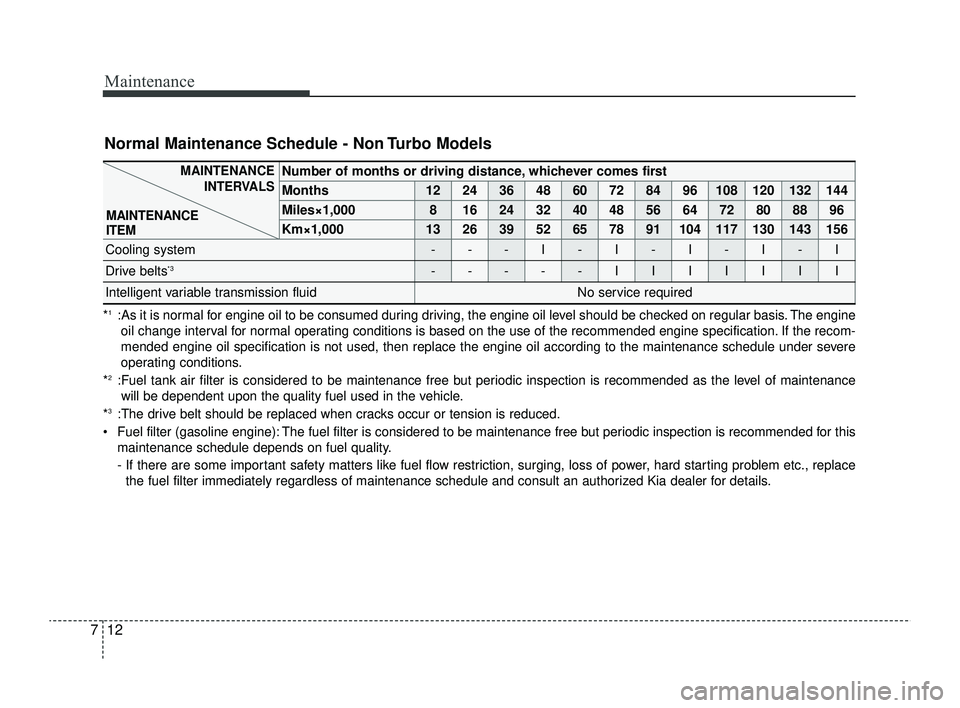
Normal Maintenance Schedule - Non Turbo Models
*1:As it is normal for engine oil to be consumed during driving, the engine oil level should be checked on regular basis. The engi ne
oil change interval for normal operating conditions is based on the use of the recommended engine specifica\
tion. If the recom-
mended engine oil specification is not used, then replace the engine oil\
according to the maintenance schedule under severe
operating conditions.
*
2:Fuel tank air filter is considered to be maintenance free but periodic inspection is recommended as the level of maintenance will be dependent upon the quality fuel used in the vehicle.
*
3:The drive belt should be replaced when cracks occur or tension is reduced.
Fuel filter (gasoline engine): The fuel filter is considered to be maintenance free but periodic inspection is recommended for this maintenance schedule depends on fuel quality.
- If there are some important safety matters like fuel flow restriction, surging, loss of power, hard starting problem etc., re place
the fuel filter immediately regardless of maintenance schedule and consu\
lt an authorized Kia dealer for details.
Number of months or driving distance, whichever comes first
Months1224364860728496108120132144
Miles×1,00081624324048566472808896
Km×1,00013263952657891104117130143156
Cooling system---I-I-I-I-I
Drive belts*3-----IIIIIII
Intelligent variable transmission fluidNo service required
MAINTENANCE INTERVALS
MAINTENANCE
ITEM
SC PE USA 7.qxp 9/9/2021 6:26 PM Page 12
Page 403 of 528
Maintenance
16
7
Vacuum crankcase ventilation
hoses
Inspect the surface of hoses for evi-
dence of heat and/or mechanical
damage. Hard and brittle rubber,
cracking, tears, cuts, abrasions, and
excessive swelling indicate deterio-
ration. Particular attention should be
paid to examine those hose surfaces
nearest to high heat sources, such
as the exhaust manifold.
Inspect the hose routing to assure
that the hoses do not come in con-
tact with any heat source, sharp
edges or moving component which
might cause heat damage or
mechanical wear. Inspect all hose
connections, such as clamps and
couplings, to make sure they are
secure, and that no leaks are pres-
ent. Hoses should be replaced
immediately if there is any evidence
of deterioration or damage.
Air cleaner filter
A Genuine Kia air cleaner filter is rec-
ommended when the filter is replaced.
Spark plugs
Make sure to install new spark plugs
of the correct heat range.
When assembling parts, be sure to
wipe the inside and outside of the
boot bottom of the ignition coil and
the insulator of the spark plug with a
soft cloth to prevent contamination of
the spark plug insulator.
Valve clearance (if equipped)
Inspect excessive valve noise and/or
engine vibration and adjust if neces-
sary. An authorized Kia dealer
should perform the operation.
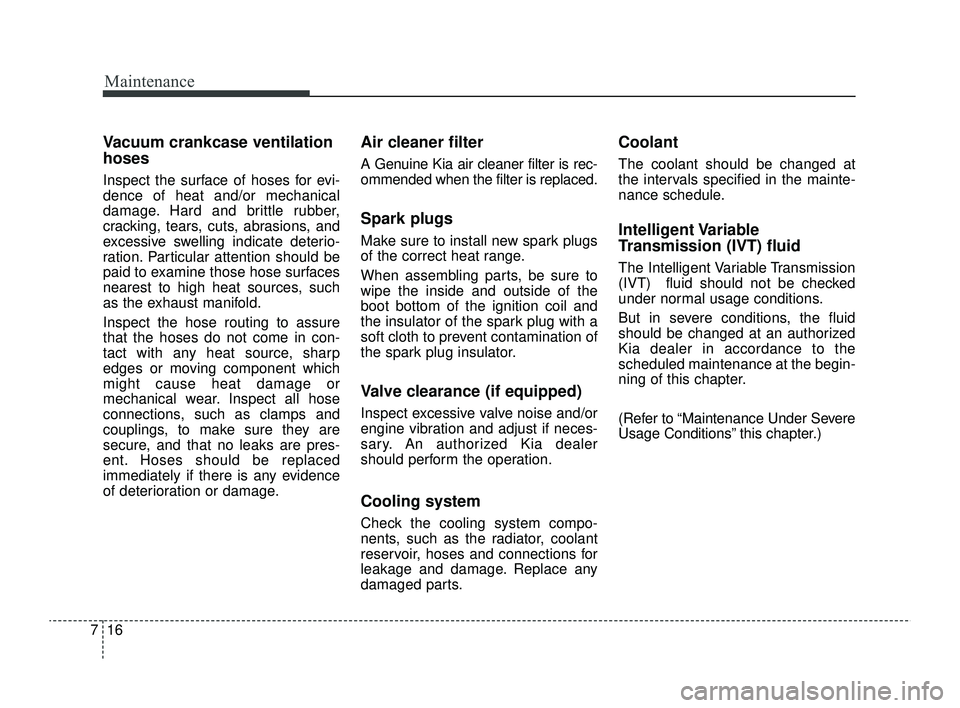
Cooling system
Check the cooling system compo-
nents, such as the radiator, coolant
reservoir, hoses and connections for
leakage and damage. Replace any
damaged parts.
Coolant
The coolant should be changed at
the intervals specified in the mainte-
nance schedule.
Intelligent Variable
Transmission (IVT) fluid
The Intelligent Variable Transmission
(IVT) fluid should not be checked
under normal usage conditions.
But in severe conditions, the fluid
should be changed at an authorized
Kia dealer in accordance to the
scheduled maintenance at the begin-
ning of this chapter.
(Refer to “Maintenance Under Severe
Usage Conditions” this chapter.)
SC PE USA 7.qxp 9/9/2021 6:26 PM Page 16
Page 408 of 528

721
Maintenance
ENGINE OIL
Checking the engine oil level
Engine oil is used for lubricating,
cooling, and operating various
hydraulic components in the engine.
Engine oil consumption while driving
is normal, and it is necessary to
check and refill the engine oil regu-
larly. Also, check and refill the oil
level within the recommended main-
tenance schedule to prevent deterio-
ration of oil performance.
Check the engine oil following the
below procedure.1. Be sure the vehicle is on level
ground.
2. Start the engine and allow it to reach normal operating tempera-
ture.
3. Turn the engine off, remove the oil filler cap and pull the dipstick out.
Wait for 15 minutes for the oil to
return to the oil pan.
4. Wipe the dipstick clean and re- insert it fully. 5. Pull the dipstick out again and
check the level. Check if the oil
level is between the F-L line, and if
it is below the L line, add enough
oil to bring the level to F line.
CAUTION
When you wipe the oil levelgauge, you should wipe it with aclean cloth.
When mixed with debris, it cancause engine damage.
WARNING- Radiator hose
Be very careful not to touch the
radiator hose when checking or
adding the engine oil as it may
be hot enough to burn you.
OSC078048N
■Smartstream G1.6
SC PE USA 7.qxp 9/9/2021 6:26 PM Page 21
Page 411 of 528
Maintenance
24
7
ENGINE COOLANT
The high-pressure cooling system
has a reservoir filled with year round
antifreeze coolant. The reservoir is
filled at the factory.
Check the antifreeze protection and
coolant level at least once a year: at
the beginning of the winter season,
and before traveling to a colder cli-
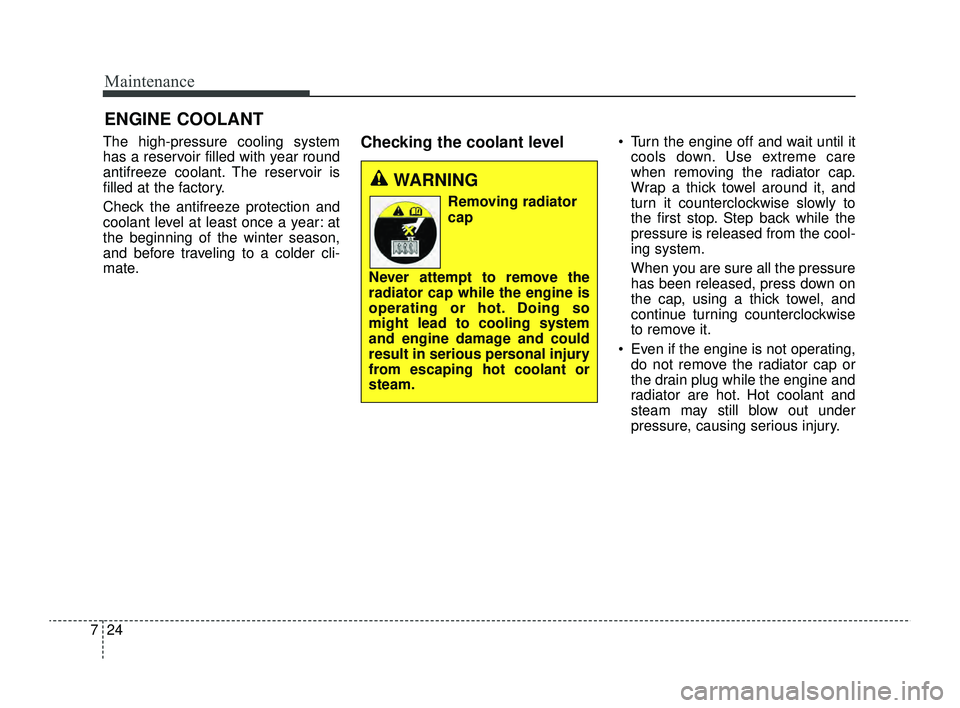
mate.Checking the coolant level Turn the engine off and wait until it
cools down. Use extreme care
when removing the radiator cap.
Wrap a thick towel around it, and
turn it counterclockwise slowly to
the first stop. Step back while the
pressure is released from the cool-
ing system.
When you are sure all the pressure
has been released, press down on
the cap, using a thick towel, and
continue turning counterclockwise
to remove it.
Even if the engine is not operating, do not remove the radiator cap or
the drain plug while the engine and
radiator are hot. Hot coolant and
steam may still blow out under
pressure, causing serious injury.
WARNING
Removing radiator
cap
Never attempt to remove the
radiator cap while the engine is
operating or hot. Doing so
might lead to cooling system
and engine damage and could
result in serious personal injury
from escaping hot coolant or
steam.
SC PE USA 7.qxp 9/9/2021 6:26 PM Page 24
Page 412 of 528
725
Maintenance
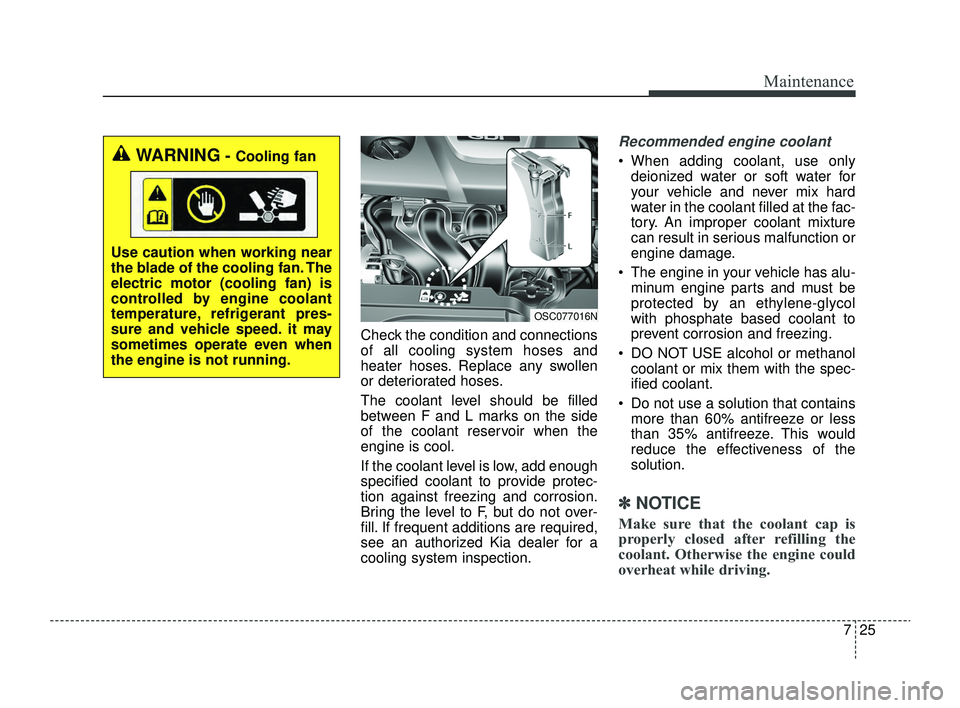
Check the condition and connections
of all cooling system hoses and
heater hoses. Replace any swollen
or deteriorated hoses.
The coolant level should be filled
between F and L marks on the side
of the coolant reservoir when the
engine is cool.
If the coolant level is low, add enough
specified coolant to provide protec-
tion against freezing and corrosion.
Bring the level to F, but do not over-
fill. If frequent additions are required,
see an authorized Kia dealer for a
cooling system inspection.
Recommended engine coolant
When adding coolant, use onlydeionized water or soft water for
your vehicle and never mix hard
water in the coolant filled at the fac-
tory. An improper coolant mixture
can result in serious malfunction or
engine damage.
The engine in your vehicle has alu- minum engine parts and must be
protected by an ethylene-glycol
with phosphate based coolant to
prevent corrosion and freezing.
DO NOT USE alcohol or methanol coolant or mix them with the spec-
ified coolant.
Do not use a solution that contains more than 60% antifreeze or less
than 35% antifreeze. This would
reduce the effectiveness of the
solution.
✽ ✽
NOTICE
Make sure that the coolant cap is
properly closed after refilling the
coolant. Otherwise the engine could
overheat while driving.
OSC077016N
WARNING- Cooling fan
Use caution when working near
the blade of the cooling fan. The
electric motor (cooling fan) is
controlled by engine coolant
temperature, refrigerant pres-
sure and vehicle speed. it may
sometimes operate even when
the engine is not running.
SC PE USA 7.qxp 9/9/2021 6:26 PM Page 25
Page 456 of 528
769
Maintenance
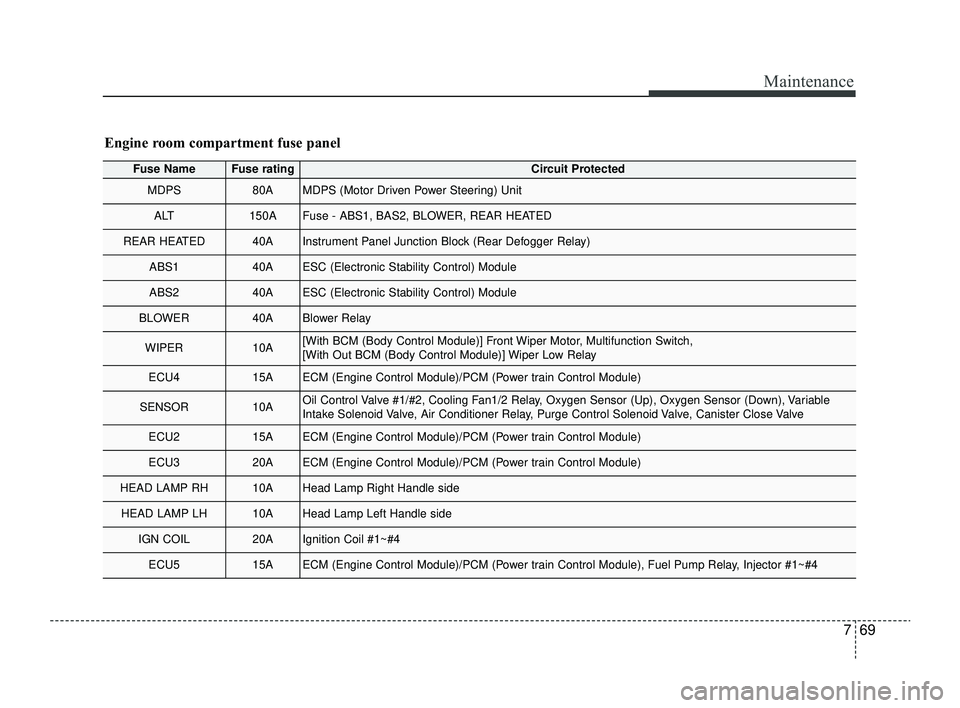
Engine room compartment fuse panel
Fuse NameFuse ratingCircuit Protected
MDPS80AMDPS (Motor Driven Power Steering) Unit
ALT150AFuse - ABS1, BAS2, BLOWER, REAR HEATED
REAR HEATED40AInstrument Panel Junction Block (Rear Defogger Relay)
ABS140AESC (Electronic Stability Control) Module
ABS240AESC (Electronic Stability Control) Module
BLOWER40ABlower Relay
WIPER10A[With BCM (Body Control Module)] Front Wiper Motor, Multifunction Switch,
[With Out BCM (Body Control Module)] Wiper Low Relay
ECU415AECM (Engine Control Module)/PCM (Power train Control Module)
SENSOR10AOil Control Valve #1/#2, Cooling Fan1/2 Relay, Oxygen Sensor (Up), Oxygen Sensor (Down), Variable
Intake Solenoid Valve, Air Conditioner Relay, Purge Control Solenoid Valve, Canister Close Valve
ECU215AECM (Engine Control Module)/PCM (Power train Control Module)
ECU320AECM (Engine Control Module)/PCM (Power train Control Module)
HEAD LAMP RH10AHead Lamp Right Handle side
HEAD LAMP LH10AHead Lamp Left Handle side
IGN COIL20AIgnition Coil #1~#4
ECU515AECM (Engine Control Module)/PCM (Power train Control Module), Fuel Pump Relay, Injector #1~#4
SC PE USA 7.qxp 9/9/2021 6:28 PM Page 69
Page 457 of 528
Maintenance
70
7
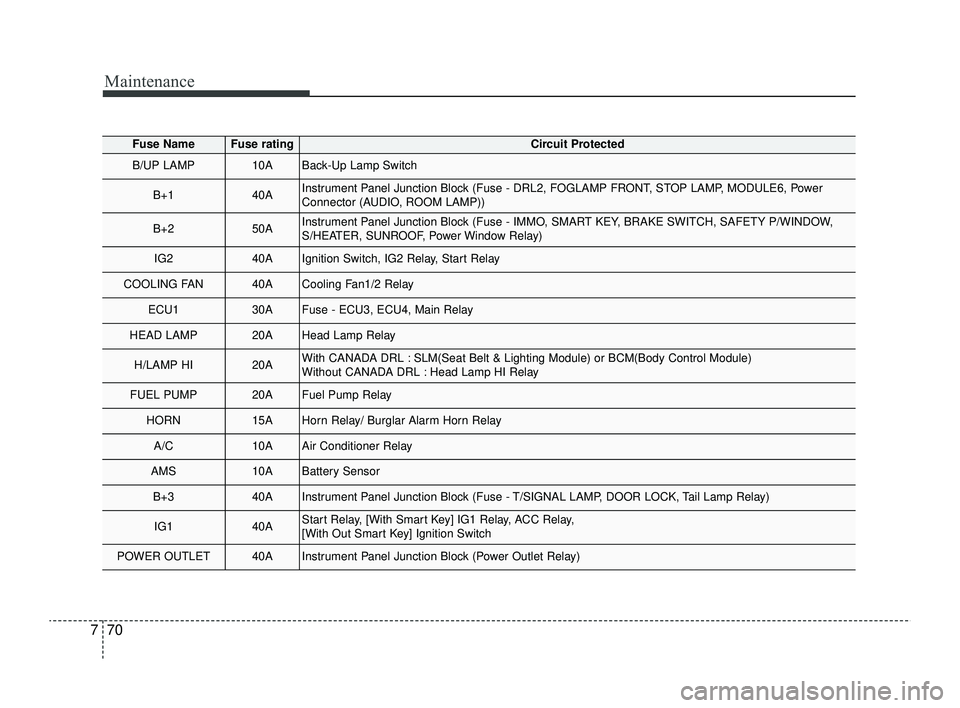
Fuse NameFuse ratingCircuit Protected
B/UP LAMP10ABack-Up Lamp Switch
B+140AInstrument Panel Junction Block (Fuse - DRL2, FOGLAMP FRONT, STOP LAMP, MODULE6, Power
Connector (AUDIO, ROOM LAMP))
B+250AInstrument Panel Junction Block (Fuse - IMMO, SMART KEY, BRAKE SWITCH, SAFETY P/WINDOW,
S/HEATER, SUNROOF, Power Window Relay)
IG240AIgnition Switch, IG2 Relay, Start Relay
COOLING FAN40ACooling Fan1/2 Relay
ECU130AFuse - ECU3, ECU4, Main Relay
HEAD LAMP20AHead Lamp Relay
H/LAMP HI20AWith CANADA DRL : SLM(Seat Belt & Lighting Module) or BCM(Body Control Module)
Without CANADA DRL : Head Lamp HI Relay
FUEL PUMP20AFuel Pump Relay
HORN15AHorn Relay/ Burglar Alarm Horn Relay
A/C10AAir Conditioner Relay
AMS10ABattery Sensor
B+340AInstrument Panel Junction Block (Fuse - T/SIGNAL LAMP, DOOR LOCK, Tail Lamp Relay)
IG140AStart Relay, [With Smart Key] IG1 Relay, ACC Relay,
[With Out Smart Key] Ignition Switch
POWER OUTLET40AInstrument Panel Junction Block (Power Outlet Relay)
SC PE USA 7.qxp 9/9/2021 6:28 PM Page 70
Page 458 of 528
771
Maintenance
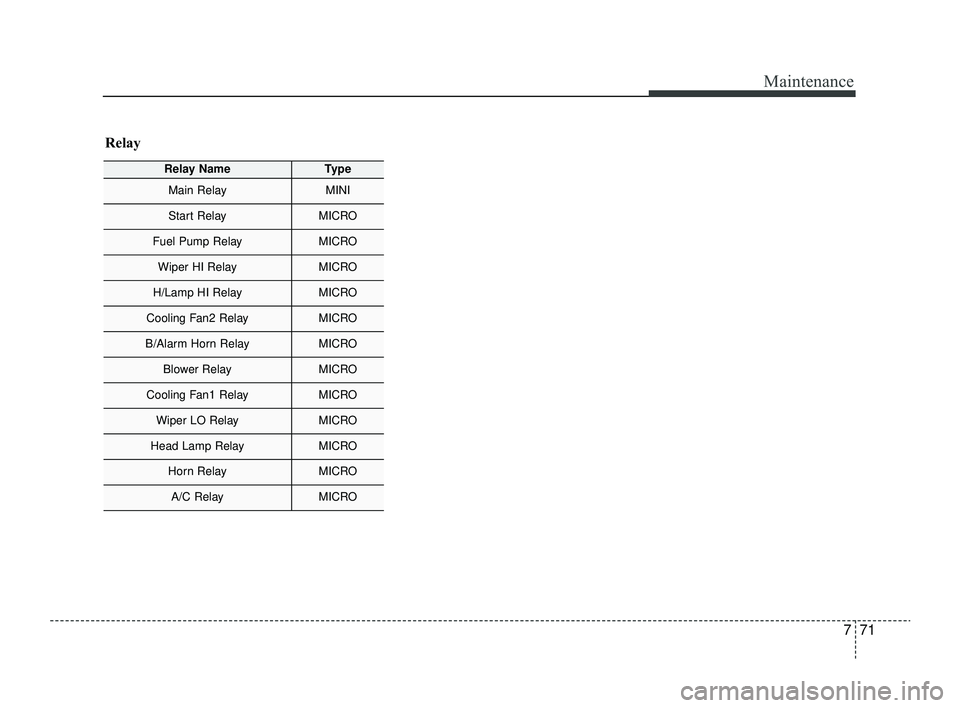
Relay NameType
Main RelayMINI
Start RelayMICRO
Fuel Pump RelayMICRO
Wiper HI RelayMICRO
H/Lamp HI RelayMICRO
Cooling Fan2 RelayMICRO
B/Alarm Horn RelayMICRO
Blower RelayMICRO
Cooling Fan1 RelayMICRO
Wiper LO RelayMICRO
Head Lamp RelayMICRO
Horn RelayMICRO
A/C RelayMICRO
Relay
SC PE USA 7.qxp 9/9/2021 6:28 PM Page 71