ECO mode KIA RIO 2022 Owner's Manual
[x] Cancel search | Manufacturer: KIA, Model Year: 2022, Model line: RIO, Model: KIA RIO 2022Pages: 528, PDF Size: 11.8 MB
Page 254 of 528
Driving your vehicle
20
5
D (Drive)
This is the normal forward driving
position. The transmission will auto-
matically shift, providing the best fuel
economy and power.
For extra power when passing anoth-
er vehicle or climbing grades,
depress the accelerator fully, at which
time the transmission will automati-
cally downshift to the next lower gear.
✽ ✽
NOTICE
Always come to a complete stop
before shifting into D (Drive).
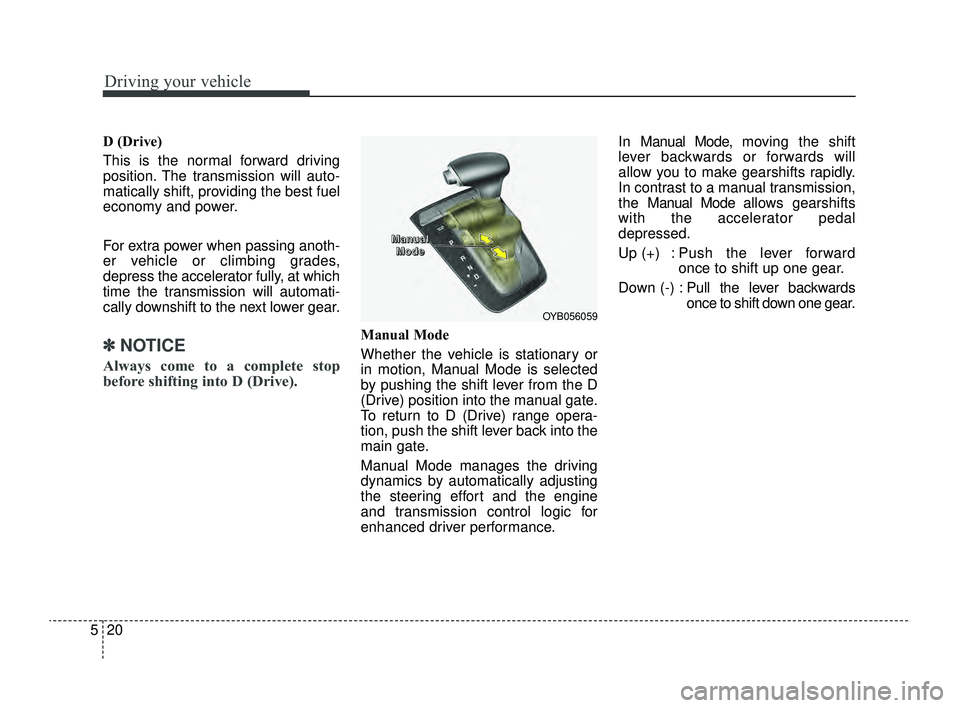
Manual Mode
Whether the vehicle is stationary or
in motion, Manual Mode is selected
by pushing the shift lever from the D
(Drive) position into the manual gate.
To return to D (Drive) range opera-
tion, push the shift lever back into the
main gate.
Manual Mode manages the driving
dynamics by automatically adjusting
the steering effort and the engine
and transmission control logic for
enhanced driver performance. In Manual Mode, mo
ving the shift
lever backwards or forwards will
allow you to make gearshifts rapidly.
In contrast to a manual transmission,
the Man ual Mode allows gearshifts
with the accelerator pedal
depressed.
Up (+) : Push the lever forward once to shift up one gear.
Down (-) : Pull the lever backwards
once to shift down one gear.
OYB056059
M M
M M
a a
a a
n n
n n
u u
u u
a a
a a
l l
l l
M M
M M
o o
o o
d d
d d
e e
e e
SC PE USA 5.QXP 9/9/2021 6:18 PM Page 20
Page 296 of 528
Driving your vehicle
62
5
✽ ✽
NOTICE
• For more details on setting the
functions, refer to "LCD Display
Mode" in chapter 4.
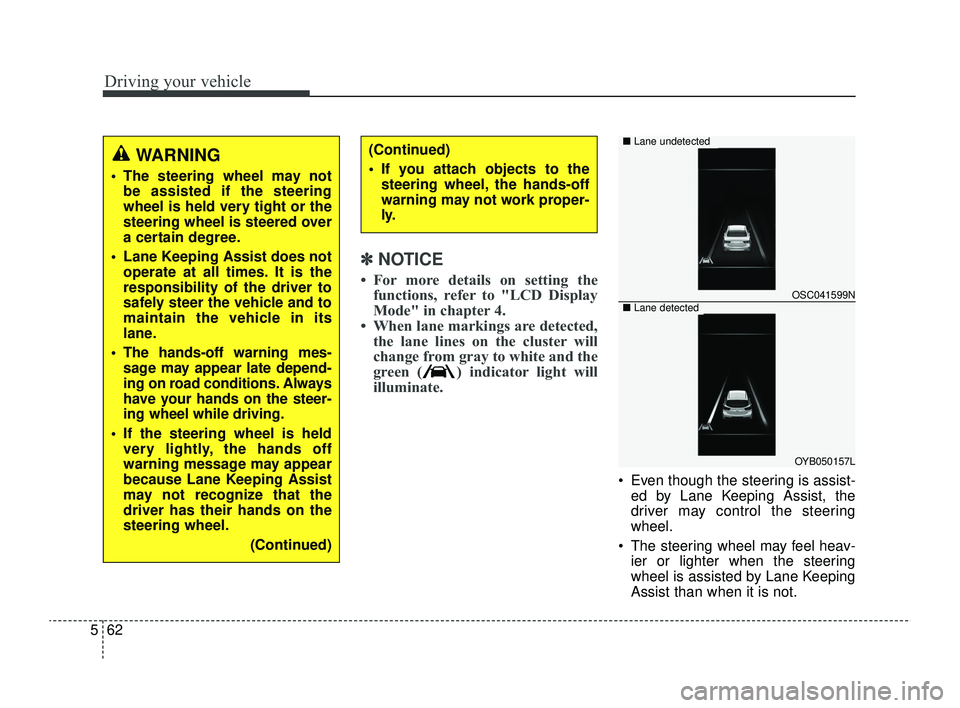
• When lane markings are detected, the lane lines on the cluster will
change from gray to white and the
green ( ) indicator light will
illuminate.
Even though the steering is assist-
ed by Lane Keeping Assist, the
driver may control the steering
wheel.
The steering wheel may feel heav- ier or lighter when the steering
wheel is assisted by Lane Keeping
Assist than when it is not.
WARNING
The steering wheel may notbe assisted if the steering
wheel is held very tight or the
steering wheel is steered over
a certain degree.
Lane Keeping Assist does not operate at all times. It is the
responsibility of the driver to
safely steer the vehicle and to
maintain the vehicle in its
lane.
The hands-off warning mes- sage may appear late depend-
ing on road conditions. Always
have your hands on the steer-
ing wheel while driving.
If the steering wheel is held very lightly, the hands off
warning message may appear
because Lane Keeping Assist
may not recognize that the
driver has their hands on the
steering wheel.
(Continued)
(Continued)
If you attach objects to thesteering wheel, the hands-off
warning may not work proper-
ly.
OSC041599N
OYB050157L
■ Lane undetected
■Lane detected
SC PE USA 5.QXP 9/9/2021 6:19 PM Page 62
Page 337 of 528
5103
Driving your vehicle
Your vehicle's fuel economy depends
mainly on your style of driving, where
you drive and when you drive.
Each of these factors affects how
many miles (kilometers) you can get
from a gallon (liter) of fuel. To operate
your vehicle as economically as pos-
sible, use the following driving sug-
gestions to help save money in both
fuel and repairs:
Drive smoothly. Accelerate at amoderate rate. Don't make "jack-
rabbit" starts or full-throttle shifts
and maintain a steady cruising
speed. Don't race between stop-
lights. Try to adjust your speed to
the traffic so you don't have to
change speeds unnecessarily.
Avoid heavy traffic whenever pos-
sible. Always maintain a safe dis-
tance from other vehicles so you
can avoid unnecessary braking.
This also reduces brake wear.
Drive at a moderate speed. The faster you drive, the more fuel your
vehicle uses. Driving at a moderate
speed, especially on the highway,
is one of the most effective ways to
reduce fuel consumption. Don't "ride" the brake pedal. This
can increase fuel consumption and
also increase wear on these com-
ponents. In addition, driving with
your foot resting on the brake pedal
may cause the brakes to overheat,
which reduces their effectiveness
and may lead to more serious con-
sequences.
Take care of your tires. Keep them inflated to the recommended pres-
sure. Incorrect inflation, either too
much or too little, results in unnec-
essary tire wear. Check the tire
pressures at least once a month.
Be sure that the wheels are aligned correctly. Improper align-
ment can result from hitting curbs
or driving too fast over irregular
surfaces. Poor alignment causes
faster tire wear and may also result
in other problems as well as
greater fuel consumption. Keep your vehicle in good condi-
tion. For better fuel economy and
reduced maintenance costs, main-
tain your vehicle in accordance
with the maintenance schedule in
section 7. If you drive your vehicle
in severe conditions, more frequent
maintenance is required (see sec-
tion 7 for details).
Keep your vehicle clean. For maxi- mum service, your vehicle should
be kept clean and free of corrosive
materials. It is especially important
that mud, dirt, ice, etc. not be
allowed to accumulate on the
underside of the vehicle. This extra
weight can result in increased fuel
consumption and also contribute to
corrosion.
Travel lightly. Don't carry unneces- sary weight in your vehicle. Weight
reduces fuel economy.
Don't let the engine idle longer than necessary. If you are waiting
(and not in traffic), turn off your
engine and restart only when
you're ready to go.
ECONOMICAL OPERATION
SC PE USA 5.QXP 9/9/2021 6:22 PM Page 103
Page 399 of 528
Maintenance
12
7
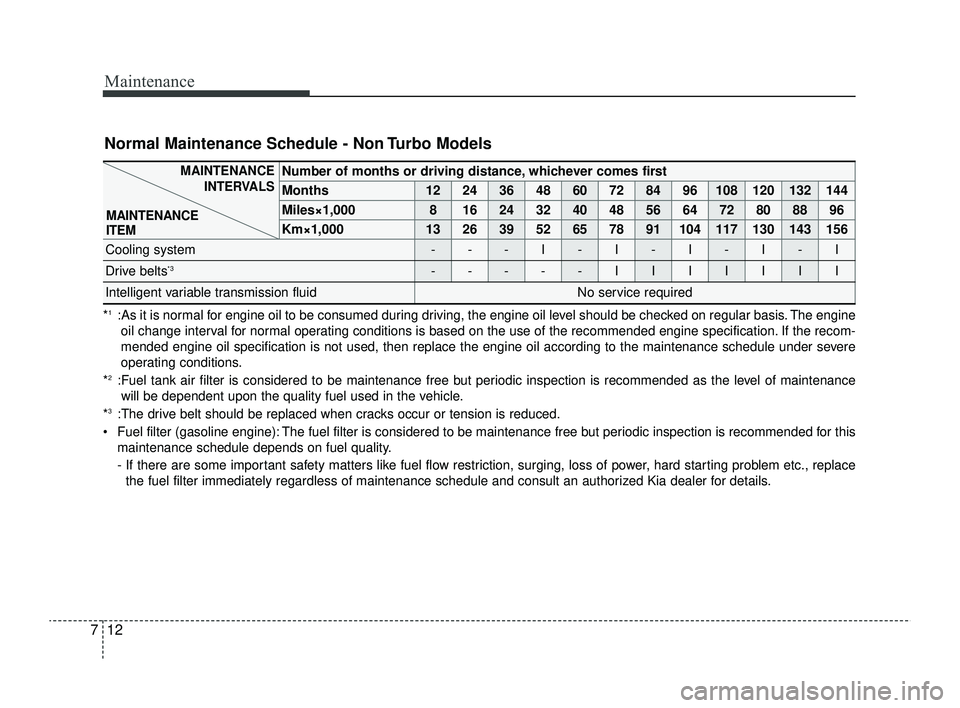
Normal Maintenance Schedule - Non Turbo Models
*1:As it is normal for engine oil to be consumed during driving, the engine oil level should be checked on regular basis. The engi ne
oil change interval for normal operating conditions is based on the use of the recommended engine specifica\
tion. If the recom-
mended engine oil specification is not used, then replace the engine oil\
according to the maintenance schedule under severe
operating conditions.
*
2:Fuel tank air filter is considered to be maintenance free but periodic inspection is recommended as the level of maintenance will be dependent upon the quality fuel used in the vehicle.
*
3:The drive belt should be replaced when cracks occur or tension is reduced.
Fuel filter (gasoline engine): The fuel filter is considered to be maintenance free but periodic inspection is recommended for this maintenance schedule depends on fuel quality.
- If there are some important safety matters like fuel flow restriction, surging, loss of power, hard starting problem etc., re place
the fuel filter immediately regardless of maintenance schedule and consu\
lt an authorized Kia dealer for details.
Number of months or driving distance, whichever comes first
Months1224364860728496108120132144
Miles×1,00081624324048566472808896
Km×1,00013263952657891104117130143156
Cooling system---I-I-I-I-I
Drive belts*3-----IIIIIII
Intelligent variable transmission fluidNo service required
MAINTENANCE INTERVALS
MAINTENANCE
ITEM
SC PE USA 7.qxp 9/9/2021 6:26 PM Page 12
Page 441 of 528
Maintenance
54
7
All season tires
Kia specifies all season tires on
some models to provide good per-
formance for use all year round,
including snowy and icy road condi-
tions. All season tires are identified
by ALL SEASON and/or M+S (Mud
and Snow) on the tire sidewall. Snow
tires have better snow traction than
all season tires and may be more
appropriate in some areas.
Summer tires
Kia specifies summer tires on some
models to provide superior perform-
ance on dry roads. Summer tire per-
formance is substantially reduced in
snow and ice. Summer tires do not
have the tire traction rating M+S
(Mud and Snow) on the tire side wall.
If you plan to operate your vehicle in
snowy or icy conditions, Kia recom-
mends the use of snow tires or all
season tires on all four wheels.
Snow tires
If you equip your car with snow tires,
they should be the same size and
have the same load capacity as the
original tires. Snow tires should be
installed on all four wheels; other-
wise, poor handling may result.
Snow tires should carry 4 psi (28
kPa) more air pressure than the
pressure recommended for the stan-
dard tires on the tire label on the dri-
ver's side of the center pillar, or up to
the maximum pressure shown on the
tire sidewall, whichever is less.
Do not drive faster than 75 mph (120
km/h) when your vehicle is equipped
with snow tires.WARNING
Do not use summer tires at tem-
peratures below 45°F (7°C) or
when driving on snow or ice. At
temperatures below 45°F (7°C),
summer tires can lose elastici-
ty, and therefore traction and
braking power as well. Change
the tires on your vehicle to win-
ter or all-weather tires of the
same size as the standard tires
of the vehicle. Both types of
tires are identified by the M+S
(Mud and Snow) marking. Using
summer tires at very cold tem-
peratures could cause cracks to
form, thereby damaging the
tires permanently.
SC PE USA 7.qxp 9/9/2021 6:27 PM Page 54
Page 449 of 528
Maintenance
62
7
✽ ✽
NOTICE - Window tinting pre-
caution
Window tint(especially metallic
film) might cause communication
disorder or poor radio reception,
and malfunction of the automatic
lighting system due to excessive
change of illumination inside the
vehicle. The solution used might also
flow into electric, electronic devices
causing disorder and failure.
CAUTION
Visually inspect the battery cap
to ensure it is securely closed.If the battery cap is not securelyclosed, moisture may enter thesystem and damage the electri-cal components.
CAUTION - Remodeling
Prohibited
Do not try remodeling the vehi-cle in any way. It is illegal, andmay affect the vehicle's perform-ance, durability, and safety. Themanufacturer's warranty doesnot cover any problems causedby remodeling. Remodeling thevehicle can cause malfunction ofthe vehicle, wiring damage, bat-tery discharge, connector dam-age, or fire.
CAUTION
Do not disassemble nor assem-ble the multi fuse when it issecured with nuts and bolts.Incorrect or partial assemblytorque may cause a fire. Havethe vehicle checked by anauthorized Kia dealer.
CAUTION - Random
wiring prohibited when
retrofitting equipment
Use of random wiring in the vehicle might cause danger dueto failure and damage of thevehicle’s performance.
Using random wires especiallywhen retrofitting AVN or theftalarm system, remote enginecontrol, car phone or radiomight damage the vehicle orcause fire.
SC PE USA 7.qxp 9/9/2021 6:28 PM Page 62
Page 506 of 528
85
Specifications, Consumer information, Reporting safety defects
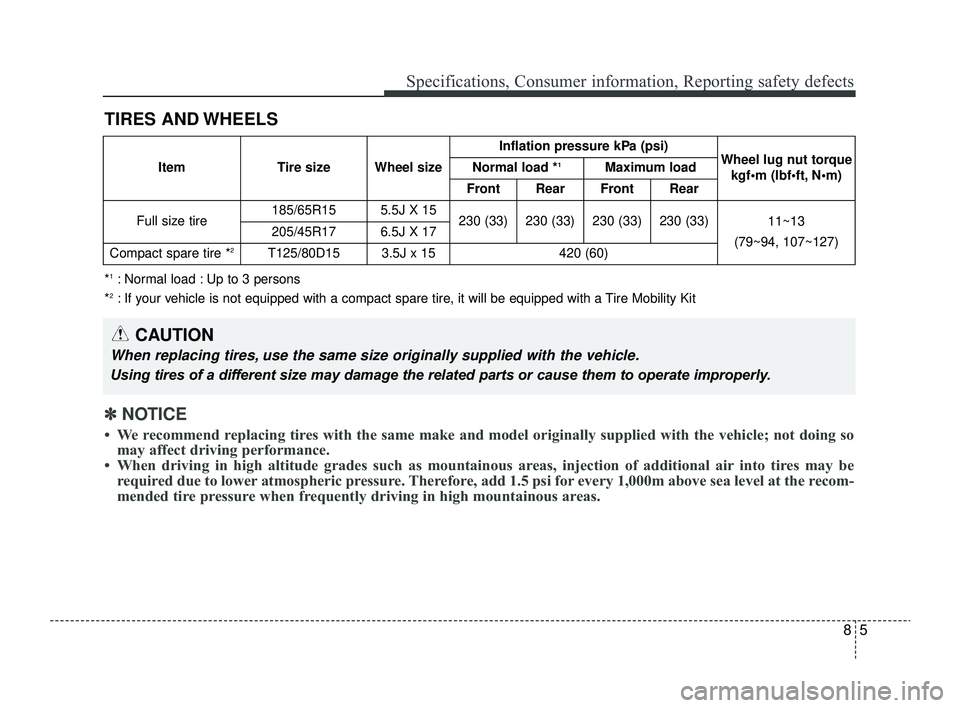
TIRES AND WHEELS
CAUTION
When replacing tires, use the same size originally supplied with the vehicle.
Using tires of a different size may damage the related parts or cause them to operate improp\
erly.
*1: Normal load : Up to 3 persons
*
2: If your vehicle is not equipped with a compact spare tire, it will be equipped with a Tire Mobility Kit Item Tire size Wheel size
Inflation pressure kPa (psi)
Wheel lug nut torque
kgf•m (lbfft, Nm)
Normal load *
1Maximum load
Front Rear Front Rear
Full size tire 185/65R15 5.5J X 15
230 (33) 230 (33) 230 (33) 230 (33) 11~13
(79~94, 107~127)
205/45R17 6.5J X 17
Compact spare tire *
2T125/80D15 3.5J x 15 420 (60)
✽ ✽
NOTICE
• We recommend replacing tires with the same make and model originally supplied with the vehicle; no\
t doing so
may affect driving performance.
• When driving in high altitude grades such as mountainous areas, injection of additional air into tires may be required due to lower atmospheric pressure. Therefore, add 1.5 psi for every 1,000m above sea level at the recom-
mended tire pressure when frequently driving in high mountainous areas.
SC PE USA 8.qxp 8/23/2021 5:30 PM Page 5
Page 522 of 528
Index
6I
Key positions ..................................................................5-7Ignition switch position ................................................5-7
Starting the engine ........................................................5-9
Keys ........................................................................\
........4-4 Battery replacement ......................................................4-8
Immobilizer system ......................................................4-9
Key operations ..............................................................4-4
Record your key number ..............................................4-4
Remote keyless entry system operations ......................4-5
Transmitter precautions ................................................4-7
Lane Following Assist (LFA) ........................................5-89 Detecting sensor ..........................................................5-89
Lane Following Assist malfunction and limitations ..5-93
Lane Following Assist operation ................................5-90
Lane Following Assist settings ..................................5-89
Lane Keeping Assist (LKA) ..........................................5-58 Detecting sensor ..........................................................5-58
Lane Keeping Assist malfunction and limitations ......5-63
Lane Keeping Assist operation ..................................5-60
Lane Keeping Assist settings ......................................5-59
LCD display (For Type B cluster) ................................4-64 Driving Assist mode ..................................................4-65
LCD Display Mode ....................................................4-6\
4 User Settings Mode (For type B cluster) ....................4-66
Warning messages (For type B cluster) ......................4-74
Liftgate (For 5 door) ......................................................4-30 Closing the liftgate ......................................................4-30
Emergency liftgate safety release ..............................4-31
Opening the liftgate ....................................................4-30
Light bulbs ....................................................................7-72\
Back-up lamp bulb replacement (for 4 door) ............7-94
Back-up lamp bulb replacement (for 5 door) ............7-87
Bulb replacement precaution ....................................7-72
Front fog lamp (Bulb type) bulb replacement ..........7-83
Front turn signal lamp bulb replacement (Headlamp Type A) ..................................................7-80
Front turn signal lamp bulb replacement (Headlamp Type B, C) ..............................................7-80
Glove box lamp bulb replacement ..........................7-100
Headlamp (Low/High beam) (Bulb type) bulb replacement (Headlamp Type A) ..............................7-77
Headlamp (Low/High beam) (Bulb type) bulb replacement (Headlamp Type B) ..............................7-78
Headlamp (Low/High beam) (LED type) bulb replacement (Headlamp Type C) ..............................7-84
High mounted stop lamp bulb replacement (for 4 door)................................................................7-97
High mounted stop lamp bulb replacement (for 5 door)................................................................7-92
License plate lamp bulb replacement ........................7-92
Liftgate room lamp bulb replacement (for 5 door) ..7-101
L
K
SC PE USA Index.qxp 8/23/2021 5:25 PM Page 6
Page 525 of 528
I9
Index
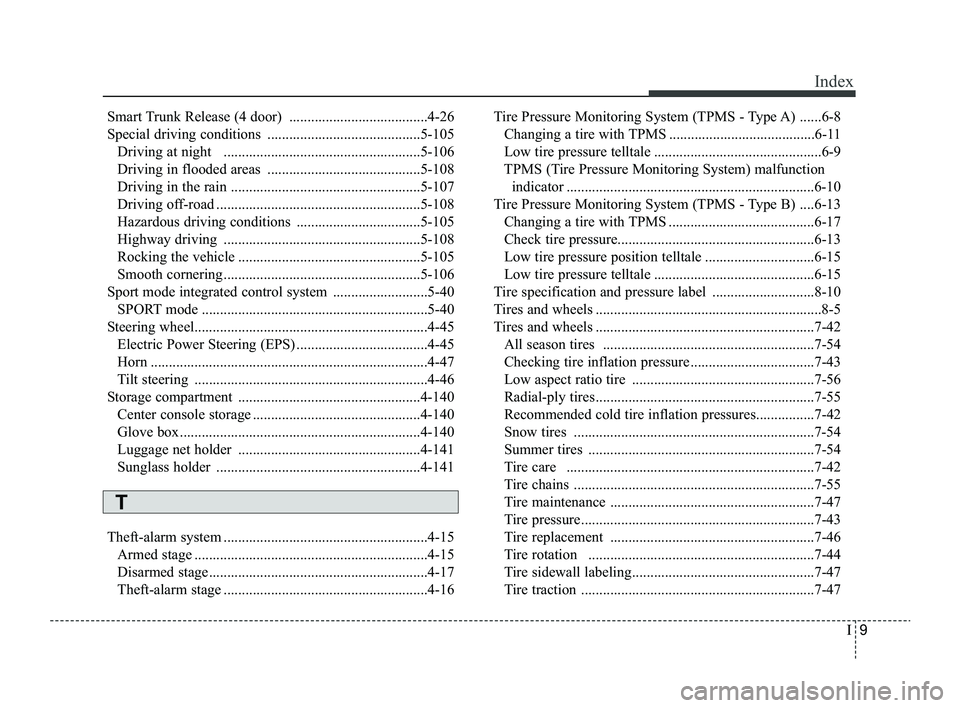
Smart Trunk Release (4 door) ......................................4-26
Special driving conditions ..........................................5-105Driving at night ......................................................5-106
Driving in flooded areas ..........................................5-108
Driving in the rain ....................................................5-107
Driving off-road ........................................................5-108
Hazardous driving conditions ..................................5-105
Highway driving ......................................................5-108
Rocking the vehicle ..................................................5-105
Smooth cornering ......................................................5-106
Sport mode integrated control system ..........................5-40 SPORT mode ..............................................................5-40
Steering wheel...........................................................\
.....4-45 Electric Power Steering (EPS) ....................................4-45
Horn ........................................................................\
....4-47
Tilt steering ................................................................4-46
Storage compartment ..................................................4-140 Center console storage ..............................................4-140
Glove box ..................................................................4-140
Luggage net holder ..................................................4-141
Sunglass holder ........................................................4-141
Theft-alarm system ........................................................4-15 Armed stage ................................................................4-15
Disarmed stage ............................................................4-17
Theft-alarm stage ........................................................4-16 Tire Pressure Monitoring System (TPMS - Type A) ......6-8
Changing a tire with TPMS ........................................6-11
Low tire pressure telltale ..............................................6-9
TPMS (Tire Pressure Monitoring System) malfunction indicator ....................................................................6-10\
Tire Pressure Monitoring System (TPMS - Type B) ....6-13 Changing a tire with TPMS ........................................6-17
Check tire pressure.....................................................\
.6-13
Low tire pressure position telltale ..............................6-15
Low tire pressure telltale ............................................6-15
Tire specification and pressure label ............................8-10
Tires and wheels ..............................................................8-5
Tires and wheels ............................................................7-42 All season tires ..........................................................7-54
Checking tire inflation pressure ..................................7-43
Low aspect ratio tire ..................................................7-56
Radial-ply tires ............................................................7-55
Recommended cold tire inflation pressures................7-42
Snow tires ..................................................................7-54
Summer tires ..............................................................7-54
Tire care ....................................................................7-42\
Tire chains ..................................................................7-55
Tire maintenance ........................................................7-47
Tire pressure................................................................7-43
Tire replacement ........................................................7-46
Tire rotation ..............................................................7-44
Tire sidewall labeling..................................................7-47
Tire traction ................................................................7-47
T
SC PE USA Index.qxp 8/23/2021 5:25 PM Page 9
Page 526 of 528
Index
10I
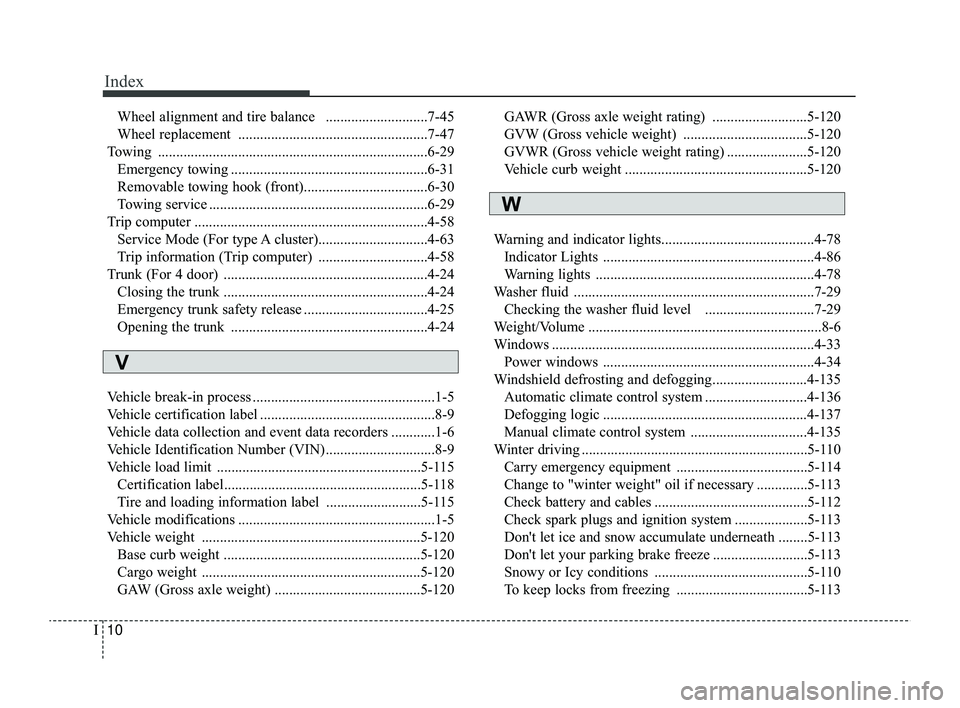
Wheel alignment and tire balance ............................7-45
Wheel replacement ....................................................7-47
Towing ........................................................................\
..6-29 Emergency towing ......................................................6-31
Removable towing hook (front)..................................6-30
Towing service ............................................................6-29
Trip computer ................................................................4-58 Service Mode (For type A cluster)..............................4-63
Trip information (Trip computer) ..............................4-58
Trunk (For 4 door) ........................................................4-24 Closing the trunk ........................................................4-24
Emergency trunk safety release ..................................4-25
Opening the trunk ......................................................4-24
Vehicle break-in process ..................................................1-5
Vehicle certification label ................................................8-9
Vehicle data collection and event data recorders ............1-6
Vehicle Identification Number (VIN)..............................8-9
Vehicle load limit ........................................................5-115 Certification label......................................................5-118
Tire and loading information label ..........................5-115
Vehicle modifications ......................................................1-5
Vehicle weight ............................................................5-120 Base curb weight ......................................................5\
-120
Cargo weight ............................................................5-120
GAW (Gross axle weight) ........................................5-120 GAWR (Gross axle weight rating) ..........................5-120
GVW (Gross vehicle weight) ..................................5-120
GVWR (Gross vehicle weight rating) ......................5-120
Vehicle curb weight ..................................................5-120
Warning and indicator lights..........................................4-78 Indicator Lights ..........................................................4-86
Warning lights ............................................................4-78
Washer fluid ..................................................................7-29 Checking the washer fluid level ..............................7-29
Weight/Volume ................................................................8-6
Windows ........................................................................\
4-33 Power windows ..........................................................4-34
Windshield defrosting and defogging..........................4-135 Automatic climate control system ............................4-136
Defogging logic ........................................................4-137
Manual climate control system ................................4-135
Winter driving ..............................................................5-110 Carry emergency equipment ....................................5-114
Change to "winter weight" oil if necessary ..............5-113
Check battery and cables ..........................................5-112
Check spark plugs and ignition system ....................5-113
Don't let ice and snow accumulate underneath ........5-113
Don't let your parking brake freeze ..........................5-113
Snowy or Icy conditions ..........................................5-110
To keep locks from freezing ....................................5-113
W
V
SC PE USA Index.qxp 8/23/2021 5:25 PM Page 10