air condition KIA RIO 2022 Workshop Manual
[x] Cancel search | Manufacturer: KIA, Model Year: 2022, Model line: RIO, Model: KIA RIO 2022Pages: 528, PDF Size: 11.8 MB
Page 403 of 528
Maintenance
16
7
Vacuum crankcase ventilation
hoses
Inspect the surface of hoses for evi-
dence of heat and/or mechanical
damage. Hard and brittle rubber,
cracking, tears, cuts, abrasions, and
excessive swelling indicate deterio-
ration. Particular attention should be
paid to examine those hose surfaces
nearest to high heat sources, such
as the exhaust manifold.
Inspect the hose routing to assure
that the hoses do not come in con-
tact with any heat source, sharp
edges or moving component which
might cause heat damage or
mechanical wear. Inspect all hose
connections, such as clamps and
couplings, to make sure they are
secure, and that no leaks are pres-
ent. Hoses should be replaced
immediately if there is any evidence
of deterioration or damage.
Air cleaner filter
A Genuine Kia air cleaner filter is rec-
ommended when the filter is replaced.
Spark plugs
Make sure to install new spark plugs
of the correct heat range.
When assembling parts, be sure to
wipe the inside and outside of the
boot bottom of the ignition coil and
the insulator of the spark plug with a
soft cloth to prevent contamination of
the spark plug insulator.
Valve clearance (if equipped)
Inspect excessive valve noise and/or
engine vibration and adjust if neces-
sary. An authorized Kia dealer
should perform the operation.
Cooling system
Check the cooling system compo-
nents, such as the radiator, coolant
reservoir, hoses and connections for
leakage and damage. Replace any
damaged parts.
Coolant
The coolant should be changed at
the intervals specified in the mainte-
nance schedule.
Intelligent Variable
Transmission (IVT) fluid
The Intelligent Variable Transmission
(IVT) fluid should not be checked
under normal usage conditions.
But in severe conditions, the fluid
should be changed at an authorized
Kia dealer in accordance to the
scheduled maintenance at the begin-
ning of this chapter.
(Refer to “Maintenance Under Severe
Usage Conditions” this chapter.)
SC PE USA 7.qxp 9/9/2021 6:26 PM Page 16
Page 406 of 528
719
Maintenance
Brake discs, pads and calipers
Check the pads for excessive wear,
discs for run out and wear, and
calipers for fluid leakage.
Exhaust pipe and muffler
Visually inspect the exhaust pipes,
muffler and hangers for cracks, dete-
rioration, or damage. Start the
engine and listen carefully for any
exhaust gas leakage. Tighten con-
nections or replace parts as neces-
sary.
Suspension mounting bolts
Check the suspension connections
for looseness or damage. Retighten
to the specified torque.
Steering gear box, linkage &
boots/lower arm ball joint
With the vehicle stopped and engine
off, check for excessive free-play in
the steering wheel.
Check the linkage for bends or dam-
age. Check the dust boots and ball
joints for deterioration, cracks, or
damage. Replace any damaged
parts.
Drive shafts and boots
Check the drive shafts, boots and
clamps for cracks, deterioration, or
damage. Replace any damaged
parts and, if necessary, repack the
grease.
Air conditioning refrigerant
Check the air conditioning lines and
connections for leakage and damage.
SC PE USA 7.qxp 9/9/2021 6:26 PM Page 19
Page 414 of 528
727
Maintenance
BRAKE FLUID (IF EQUIPPED)
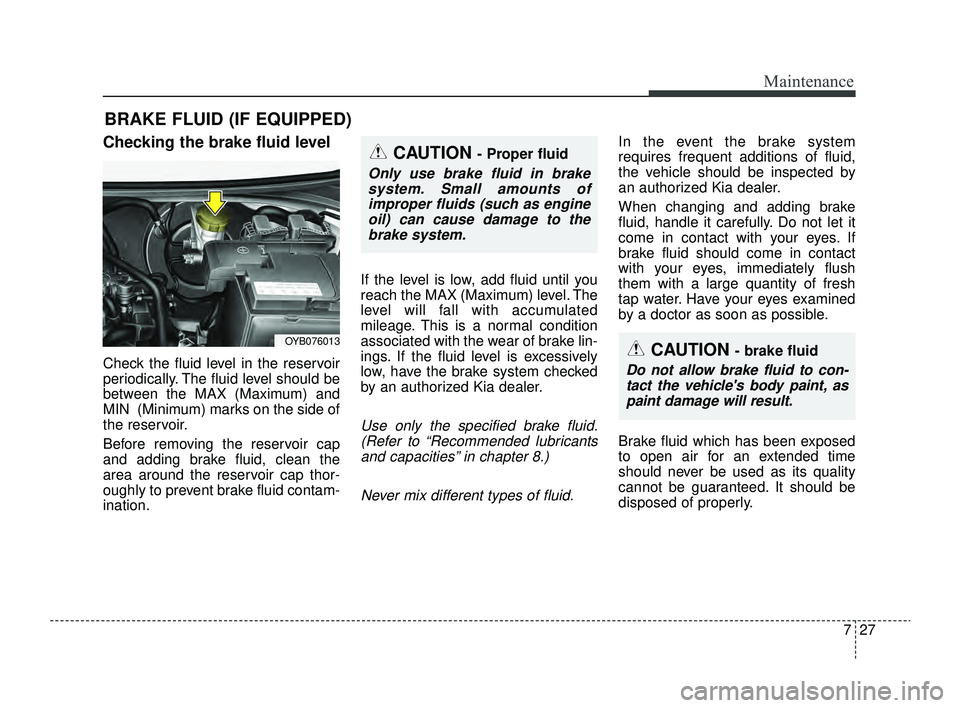
Checking the brake fluid level
Check the fluid level in the reservoir
periodically. The fluid level should be
between the MAX (Maximum) and
MIN (Minimum) marks on the side of
the reservoir.
Before removing the reservoir cap
and adding brake fluid, clean the
area around the reservoir cap thor-
oughly to prevent brake fluid contam-
ination.If the level is low, add fluid until you
reach the MAX (Maximum) level. The
level will fall with accumulated
mileage. This is a normal condition
associated with the wear of brake lin-
ings. If the fluid level is excessively
low, have the brake system checked
by an authorized Kia dealer.
Use only the specified brake fluid.
(Refer to “Recommended lubricantsand capacities” in chapter 8.)
Never mix different types of fluid.
In the event the brake system
requires frequent additions of fluid,
the vehicle should be inspected by
an authorized Kia dealer.
When changing and adding brake
fluid, handle it carefully. Do not let it
come in contact with your eyes. If
brake fluid should come in contact
with your eyes, immediately flush
them with a large quantity of fresh
tap water. Have your eyes examined
by a doctor as soon as possible.
Brake fluid which has been exposed
to open air for an extended time
should never be used as its quality
cannot be guaranteed. It should be
disposed of properly.
OYB076013CAUTION - brake fluid
Do not allow brake fluid to con-tact the vehicle's body paint, aspaint damage will result.
CAUTION - Proper fluid
Only use brake fluid in brakesystem. Small amounts ofimproper fluids (such as engineoil) can cause damage to thebrake system.
SC PE USA 7.qxp 9/9/2021 6:27 PM Page 27
Page 419 of 528
Maintenance
32
7
Replace the filter according to the
Maintenance Schedule.
If the vehicle is operated in extreme-
ly dusty or sandy areas, replace theelement more often than the usualrecommended intervals. (Refer to“Maintenance under severe usageconditions” in this chapter.)
CAUTION - Air filter
maintenance
Do not drive with the air clean- er removed; this will result inexcessive engine wear.
When removing the air cleaner filter, be careful that dust ordirt does not enter the airintake, or damage may result.
Use a Kia genuine part. Use of a non-genuine part coulddamage the air flow sensor.
SC PE USA 7.qxp 9/9/2021 6:27 PM Page 32
Page 431 of 528
Maintenance
44
7
Remove the valve cap from the tire
valve stem. Press the tire gauge firm-
ly onto the valve to get a pressure
measurement. If the cold tire inflation
pressure matches the recommended
pressure on the tire and loading
information label, no further adjust-
ment is necessary. If the pressure is
low, add air until you reach the rec-
ommended amount.
If you overfill the tire, release air by
pushing on the metal stem in the
center of the tire valve. Recheck the
tire pressure with the tire gauge. Be
sure to put the valve caps back on
the valve stems. They help prevent
leaks by keeping out dirt and mois-
ture. Inspect your tires frequently for
proper inflation as well as wear and
damage. Always use a tire pres-
sure gauge.
Tires with too much or too little pressure can cause tires to wear
unevenly, causing poor handling,
loss of vehicle control, and sudden
tire failure leading to accidents,
injuries, and even death. The rec-
ommended cold tire pressure for
your vehicle can be found in this
manual and on the tire label locat-
ed on the driver's side center pillar.
Remember to check the pressure of your spare tire. Kia recommends
that you check the spare every
time you check the pressure of the
other tires on your vehicle.Tire rotation
To equalize tread wear, it is recom-
mended that the tires be rotated
every 8,000 miles (13,000 km) or
sooner if irregular wear develops.
During rotation, check the tires for
correct balance.
When rotating tires, check for uneven
wear and damage. Abnormal wear is
usually caused by incorrect tire pres-
sure, improper wheel alignment, out-
of-balance wheels, severe braking or
severe cornering. Look for bumps or
bulges in the tread or side of the tire.
Replace the tire if you find either of
these conditions. Replace the tire if
fabric or cord is visible. After rotation,
be sure to bring the front and rear tire
pressures to specification and check
lug nut tightness.
Refer to “Tire and wheels” in chapter
8.
SC PE USA 7.qxp 9/9/2021 6:27 PM Page 44
Page 438 of 528
751
Maintenance
Temperature -A, B & C
The temperature grades are A (the
highest), B and C representing the
tire’s resistance to the generation of
heat and its ability to dissipate heat
when tested under controlled condi-
tions on a specified indoor laboratory
test wheel.
Sustained high temperature can
cause the material of the tire to
degenerate and reduce tire life, and
excessive temperature can lead to
sudden tire failure. The grade C cor-
responds to a level of performance
which all passenger car tires must
meet under the Federal Motor
Vehicle Safety Standard No. 109.
Grades B and A represent higher
levels of performance on the labora-
tory test wheel than the minimum
required by law.Tire terminology and definitions
Air Pressure:
The amount of air
inside the tire pressing outward on
the tire. Air pressure is expressed in
kilopascal (kPa) or pounds per
square inch (psi).
Accessory Weight: This means the
combined weight of optional acces-
sories. Some examples of optional
accessories are, intelligent variable
transmission, power seats, and air
conditioning.
Aspect Ratio: The relationship of a
tire's height to its width.
Belt: A rubber coated layer of cords
that is located between the plies and
the tread. Cords may be made from
steel or other reinforcing materials.
Bead: The tire bead contains steel
wires wrapped by steel cords that
hold the tire onto the rim.
Bias Ply Tire: A pneumatic tire in
which the plies are laid at alternate
angles less than 90 degrees to the
centerline of the tread. Cold Tire Pressure:
The amount of
air pressure in a tire, measured in
kilopascals (kPa) or pounds per
square inch (psi) before a tire has
built up heat from driving.
Curb Weight: This means the weight
of a motor vehicle with standard and
optional equipment including the
maximum capacity of fuel, oil and
coolant, but without passengers and
cargo.
DOT Markings: A code molded into
the sidewall of a tire signifying that
the tire is in compliance with the U.S.
Department of Transportation motor
vehicle safety standards. The DOT
code includes the Tire Identification
Number (TIN), an alphanumeric des-
ignator which can also identify the
tire manufacturer, production plant,
brand and date of production.
SC PE USA 7.qxp 9/9/2021 6:27 PM Page 51
Page 441 of 528
Maintenance
54
7
All season tires
Kia specifies all season tires on
some models to provide good per-
formance for use all year round,
including snowy and icy road condi-
tions. All season tires are identified
by ALL SEASON and/or M+S (Mud
and Snow) on the tire sidewall. Snow
tires have better snow traction than
all season tires and may be more
appropriate in some areas.
Summer tires
Kia specifies summer tires on some
models to provide superior perform-
ance on dry roads. Summer tire per-
formance is substantially reduced in
snow and ice. Summer tires do not
have the tire traction rating M+S
(Mud and Snow) on the tire side wall.
If you plan to operate your vehicle in
snowy or icy conditions, Kia recom-
mends the use of snow tires or all
season tires on all four wheels.
Snow tires
If you equip your car with snow tires,
they should be the same size and
have the same load capacity as the
original tires. Snow tires should be
installed on all four wheels; other-
wise, poor handling may result.
Snow tires should carry 4 psi (28
kPa) more air pressure than the
pressure recommended for the stan-
dard tires on the tire label on the dri-
ver's side of the center pillar, or up to
the maximum pressure shown on the
tire sidewall, whichever is less.
Do not drive faster than 75 mph (120
km/h) when your vehicle is equipped
with snow tires.WARNING
Do not use summer tires at tem-
peratures below 45°F (7°C) or
when driving on snow or ice. At
temperatures below 45°F (7°C),
summer tires can lose elastici-
ty, and therefore traction and
braking power as well. Change
the tires on your vehicle to win-
ter or all-weather tires of the
same size as the standard tires
of the vehicle. Both types of
tires are identified by the M+S
(Mud and Snow) marking. Using
summer tires at very cold tem-
peratures could cause cracks to
form, thereby damaging the
tires permanently.
SC PE USA 7.qxp 9/9/2021 6:27 PM Page 54
Page 443 of 528
Maintenance
56
7
Low aspect ratio tire
(if equipped)
Low aspect ratio tires, whose aspect
ratio is lower than 50, are provided
for sporty looks.
Because the low aspect ratio tires
are optimized for handling and brak-
ing, they may be more uncomfortable
to ride in and more noisy when com-
pared with normal tires. It is not easy to recognize the tire
damage with your own eyes. In the
event that the tire is impacted, have
the tire checked or replaced
because the tire damage may
cause air leakage from the tire.
If the tire is damaged by driving on a rough road, off road, pothole,
manhole, or curb stone, the dam-
age will not be covered by the war-
ranty.
You can find out tire information on the tire sidewall.
CAUTION
Because the sidewall of a lowaspect ratio tire is shorter thannormal, the wheel and tire of alow aspect ratio tire is more eas-ily damaged. Therefore, followthe instructions below.
When driving on a rough road or off road, drive cautiouslybecause the tires and wheelsmay become damaged. Andafter driving, inspect the tiresand wheels.
When passing over a pothole, speed bump, manhole, or curbstone, drive slowly so that thetires and wheels are not dam-aged.
If the tire is impacted, we rec- ommend that you inspect thetire condition or contact anauthorized Kia dealer.
To prevent damage to the tire, inspect the tire condition andpressure every 1,900 miles(3,000 km).
SC PE USA 7.qxp 9/9/2021 6:27 PM Page 56
Page 451 of 528
Maintenance
64
7
Fuse NameFuse ratingCircuit Protected
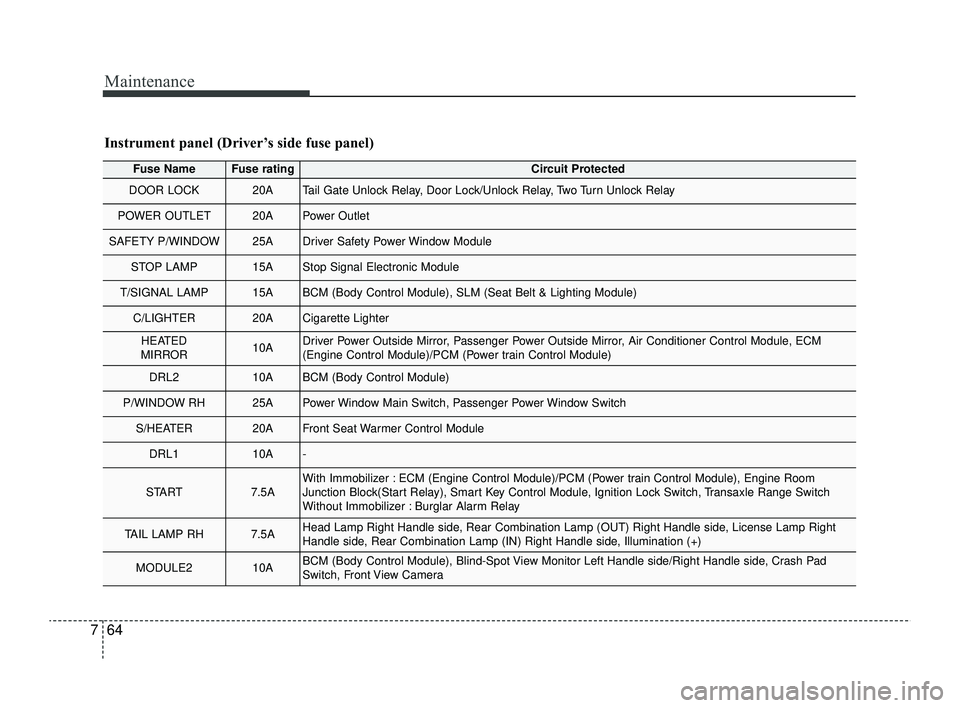
DOOR LOCK20ATail Gate Unlock Relay, Door Lock/Unlock Relay, Two Turn Unlock Relay
POWER OUTLET20APower Outlet
SAFETY P/WINDOW25ADriver Safety Power Window Module
STOP LAMP15AStop Signal Electronic Module
T/SIGNAL LAMP15ABCM (Body Control Module), SLM (Seat Belt & Lighting Module)
C/LIGHTER20ACigarette Lighter
HEATED
MIRROR10ADriver Power Outside Mirror, Passenger Power Outside Mirror, Air Conditioner Control Module, ECM
(Engine Control Module)/PCM (Power train Control Module)
DRL210ABCM (Body Control Module)
P/WINDOW RH25APower Window Main Switch, Passenger Power Window Switch
S/HEATER20AFront Seat Warmer Control Module
DRL110A-
START7.5AWith Immobilizer : ECM (Engine Control Module)/PCM (Power train Control Module), Engine Room
Junction Block(Start Relay), Smart Key Control Module, Ignition Lock Switch, Transaxle Range Switch
Without Immobilizer : Burglar Alarm Relay
TAIL LAMP RH7.5AHead Lamp Right Handle side, Rear Combination Lamp (OUT) Right Handle side, License Lamp Right
Handle side, Rear Combination Lamp (IN) Right Handle side, Illumination (+)
MODULE210ABCM (Body Control Module), Blind-Spot View Monitor Left Handle side/Right Handle side, Crash Pad
Switch, Front View Camera
Instrument panel (Driver’s side fuse panel)
SC PE USA 7.qxp 9/9/2021 6:28 PM Page 64
Page 452 of 528
765
Maintenance
Fuse NameFuse ratingCircuit Protected
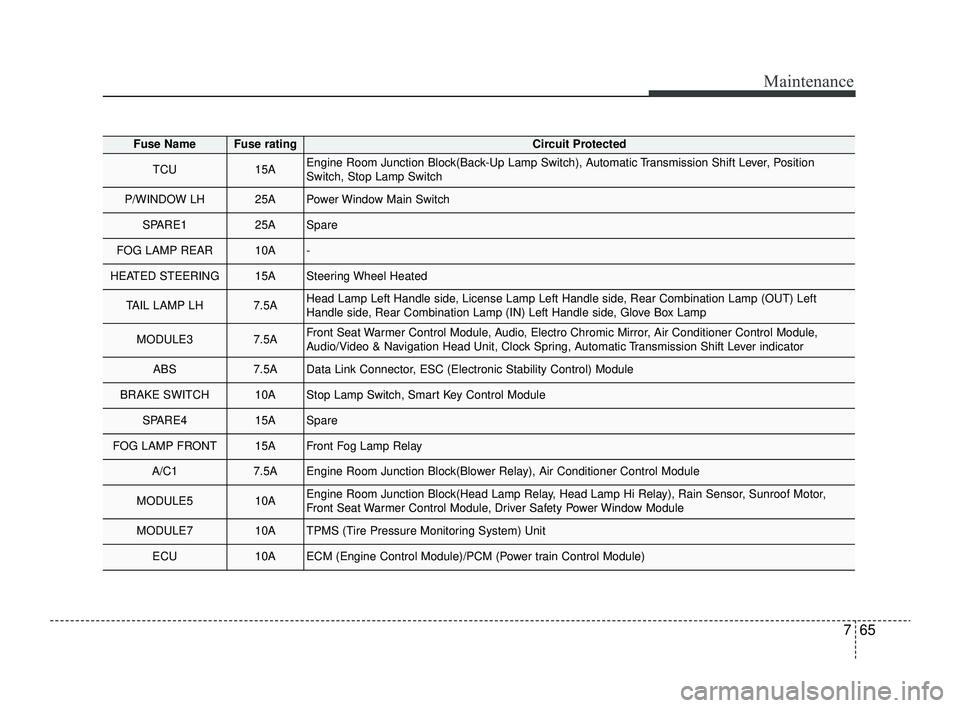
TCU15AEngine Room Junction Block(Back-Up Lamp Switch), Automatic Transmission Shift Lever, Position
Switch, Stop Lamp Switch
P/WINDOW LH25APower Window Main Switch
SPARE125ASpare
FOG LAMP REAR10A-
HEATED STEERING15ASteering Wheel Heated
TAIL LAMP LH7.5AHead Lamp Left Handle side, License Lamp Left Handle side, Rear Combination Lamp (OUT) Left
Handle side, Rear Combination Lamp (IN) Left Handle side, Glove Box Lamp
MODULE37.5AFront Seat Warmer Control Module, Audio, Electro Chromic Mirror, Air Conditioner Control Module,
Audio/Video & Navigation Head Unit, Clock Spring, Automatic Transmission Shift Lever indicator
ABS7.5AData Link Connector, ESC (Electronic Stability Control) Module
BRAKE SWITCH10AStop Lamp Switch, Smart Key Control Module
SPARE415ASpare
FOG LAMP FRONT15AFront Fog Lamp Relay
A/C17.5AEngine Room Junction Block(Blower Relay), Air Conditioner Control Module
MODULE510AEngine Room Junction Block(Head Lamp Relay, Head Lamp Hi Relay), Rain Sensor, Sunroof Motor,
Front Seat Warmer Control Module, Driver Safety Power Window Module
MODULE710ATPMS (Tire Pressure Monitoring System) Unit
ECU10AECM (Engine Control Module)/PCM (Power train Control Module)
SC PE USA 7.qxp 9/9/2021 6:28 PM Page 65