coolant KIA SEDONA 2019 Owner's Manual
[x] Cancel search | Manufacturer: KIA, Model Year: 2019, Model line: SEDONA, Model: KIA SEDONA 2019Pages: 593, PDF Size: 15.93 MB
Page 490 of 593
723
Maintenance
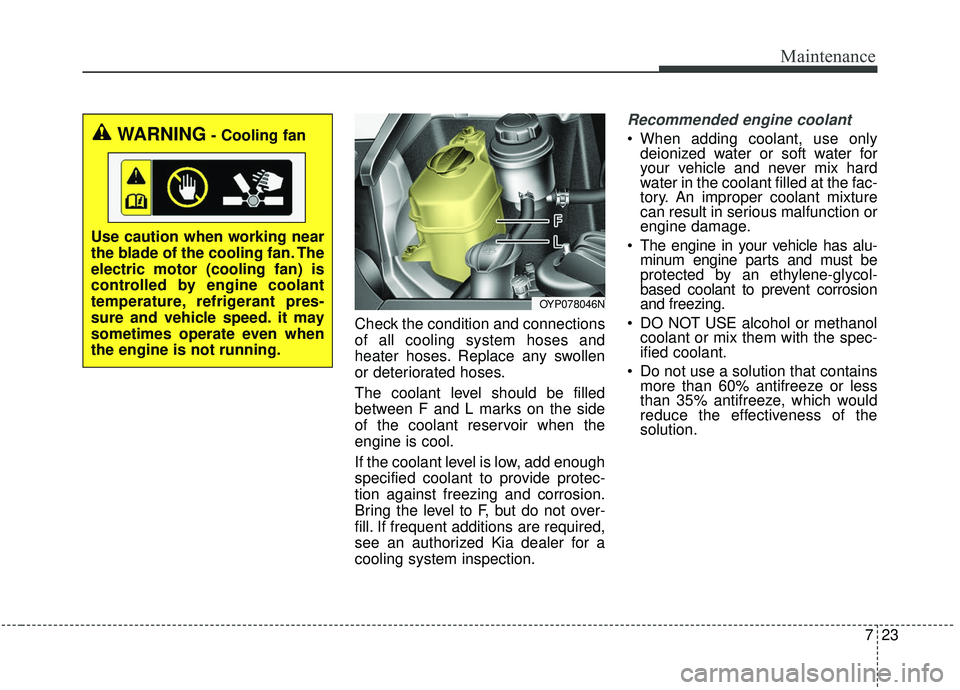
Check the condition and connections
of all cooling system hoses and
heater hoses. Replace any swollen
or deteriorated hoses.
The coolant level should be filled
between F and L marks on the side
of the coolant reservoir when the
engine is cool.
If the coolant level is low, add enough
specified coolant to provide protec-
tion against freezing and corrosion.
Bring the level to F, but do not over-
fill. If frequent additions are required,
see an authorized Kia dealer for a
cooling system inspection.
Recommended engine coolant
When adding coolant, use onlydeionized water or soft water for
your vehicle and never mix hard
water in the coolant filled at the fac-
tory. An improper coolant mixture
can result in serious malfunction or
engine damage.
The engine in your vehicle has alu- minum engine parts and must be
protected by an ethylene-glycol-
based coolant to prevent corrosion
and freezing.
DO NOT USE alcohol or methanol coolant or mix them with the spec-
ified coolant.
Do not use a solution that contains more than 60% antifreeze or less
than 35% antifreeze, which would
reduce the effectiveness of the
solution.
OYP078046N
WARNING- Cooling fan
Use caution when working near
the blade of the cooling fan. The
electric motor (cooling fan) is
controlled by engine coolant
temperature, refrigerant pres-
sure and vehicle speed. it may
sometimes operate even when
the engine is not running.
Page 491 of 593
Maintenance
24
7
For mixture percentage, refer to the
following table.Changing the coolant
Have the coolant changed by an
authorized Kia dealer according to
the Maintenance Schedule at the
beginning of this chapter.
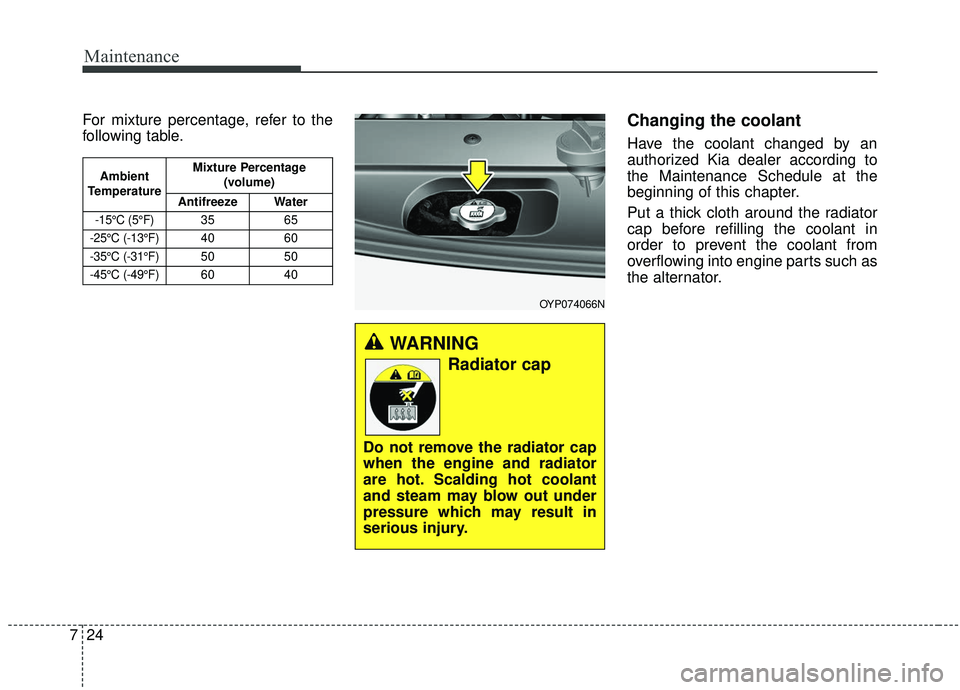
Put a thick cloth around the radiator
cap before refilling the coolant in
order to prevent the coolant from
overflowing into engine parts such as
the alternator.
OYP074066N
Ambient
Temperature Mixture Percentage
(volume)
Antifreeze Water
-15°C (5°F)35 65
-25°C (-13°F)4060
-35°C (-31°F)5050
-45°C (-49°F)6040
WARNING
Radiator cap
Do not remove the radiator cap
when the engine and radiator
are hot. Scalding hot coolant
and steam may blow out under
pressure which may result in
serious injury.
Page 494 of 593
727
Maintenance
WASHER FLUID
Checking the washer fluid
level
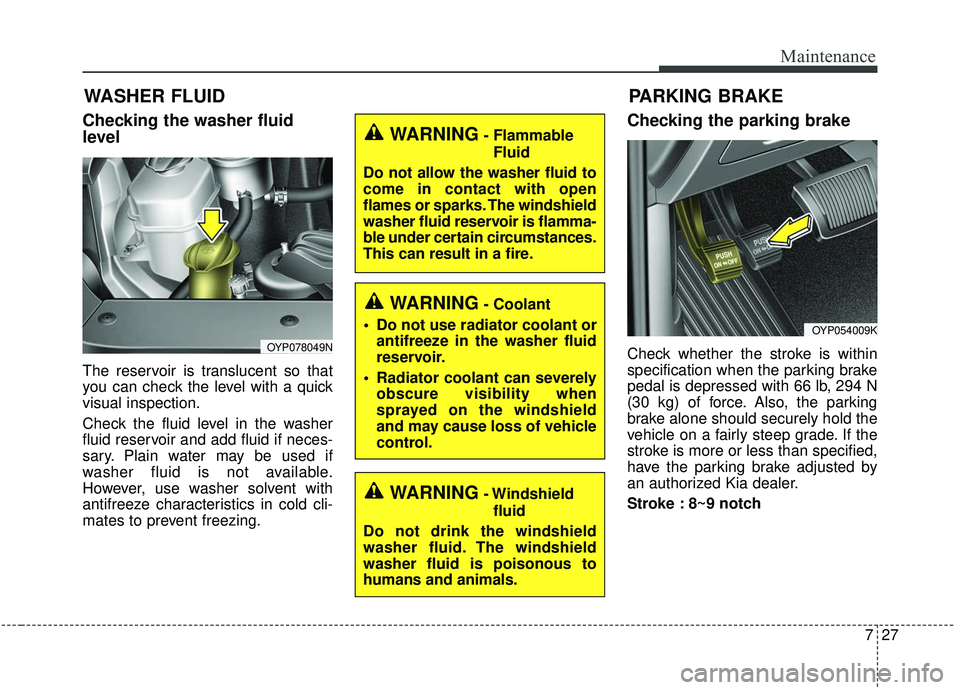
The reservoir is translucent so that
you can check the level with a quick
visual inspection.
Check the fluid level in the washer
fluid reservoir and add fluid if neces-
sary. Plain water may be used if
washer fluid is not available.
However, use washer solvent with
antifreeze characteristics in cold cli-
mates to prevent freezing.
Checking the parking brake
Check whether the stroke is within
specification when the parking brake
pedal is depressed with 66 lb, 294 N
(30 kg) of force. Also, the parking
brake alone should securely hold the
vehicle on a fairly steep grade. If the
stroke is more or less than specified,
have the parking brake adjusted by
an authorized Kia dealer.
Stroke : 8~9 notchOYP078049N
OYP054009K
PARKING BRAKE
WARNING- FlammableFluid
Do not allow the washer fluid to
come in contact with open
flames or sparks. The windshield
washer fluid reservoir is flamma-
ble under certain circumstances.
This can result in a fire.
WARNING- Windshield fluid
Do not drink the windshield
washer fluid. The windshield
washer fluid is poisonous to
humans and animals.
WARNING- Coolant
Do not use radiator coolant or antifreeze in the washer fluid
reservoir.
Radiator coolant can severely obscure visibility when
sprayed on the windshield
and may cause loss of vehicle
control.
Page 516 of 593
749
Maintenance
Cold Tire Pressure:The amount of
air pressure in a tire, measured in
pounds per square inch (psi) or kilo-
pascals (kPa) before a tire has built
up heat from driving.
Curb Weight: This means the weight
of a motor vehicle with standard and
optional equipment including the
maximum capacity of fuel, oil and
coolant, but without passengers and
cargo.
DOT Markings: The DOT code
includes the Tire Identification
Number (TIN), an alphanumeric des-
ignator which can also identify the
tire manufacturer, production plant,
brand and date of production.
GVWR: Gross Vehicle Weight Rating
GAWR FRT: Gross Axle Weight
Rating for the Front Axle.
GAWR RR: Gross Axle Weight
Rating for the Rear axle. Intended Outboard Sidewall:
The
side of an asymmetrical tire, that
must always face outward when
mounted on a vehicle.
Kilopascal (kPa): The metric unit for
air pressure.
Light truck (LT) tire: A tire designat-
ed by its manufacturer as primarily
intended for use on lightweight trucks
or multipurpose passenger vehicles.
Load Index: An assigned number
ranging from 1 to 279 that corre-
sponds to the load carrying capacity
of a tire.
Load ratings: The maximum load
that a tire is rated to carry for a given
inflation pressure.
Maximum Inflation Pressure: The
maximum air pressure to which a
cold tire may be inflated. The maxi-
mum air pressure is molded onto the
sidewall.
Maximum Load Rating: The load
rating for a tire at the maximum per-
missible inflation pressure for that tire. Maximum Loaded Vehicle Weight:
The sum of curb weight; accessory
weight; vehicle capacity weight; and
production options weight.
Normal Occupant Weight:
The
number of occupants a vehicle is
designed to seat multiplied by 150
pounds (68 kg).
Occupant Distribution: Designated
seating positions.
Outward Facing Sidewall: The side
of a asymmetrical tire that has a par-
ticular side that faces outward when
mounted on a vehicle. The outward
facing sidewall bears white lettering
or bears manufacturer, brand, and/or
model name molding that is higher or
deeper than the same moldings on
the inner facing sidewall.
Passenger (P-Metric) Tire: A tire
used on passenger cars and some
light duty trucks and multipurpose
vehicles.
Ply: A layer of rubber-coated parallel
cords.
Page 566 of 593
799
Maintenance
2. Evaporative emission con-trol (including ORVR:
Onboard Refueling Vapor
Recovery) system
The Evaporative Emission Control
System is designed to prevent fuel
vapors from escaping into the atmos-
phere.
(The ORVR system is designed to
allow the vapors from the fuel tank to
be loaded into a canister while refu-
eling at the gas station, preventing
the escape of fuel vapors into the
atmosphere.)
Canister
Fuel vapors generated inside the fuel
tank are absorbed and stored in the
onboard canister. When the engine is
running, the fuel vapors absorbed in
the canister are drawn into the surge
tank through the purge control sole-
noid valve.
Purge Control Solenoid Valve(PCSV)
The purge control solenoid valve is
controlled by the Engine Control
Module (ECM); when the engine
coolant temperature is low during
idling, the PCSV closes so that evap-
orated fuel is not taken into the
engine. After the engine warms up
during ordinary driving, the PCSV
opens to introduce evaporated fuel to
the engine.
3. Exhaust emission control
system
The Exhaust Emission Control System
is a highly effective system which con-
trols exhaust emissions while main-
taining good vehicle performance.
Vehicle modifications
This vehicle should not be modified.
Modification of your vehicle could
affect its performance, safety or dura-
bility and may even violate governmen-
tal safety and emissions regulations.
In addition, damage or performance
problems resulting from any modifi-
cation may not be covered under
warranty.
If you use unauthorized electronic
devices, it may cause the vehicle to
operate abnormally, wire damage,
battery discharge and fire. For your
safety, do not use unauthorized
electronic devices.
Page 574 of 593
68
Specifications & Consumer information
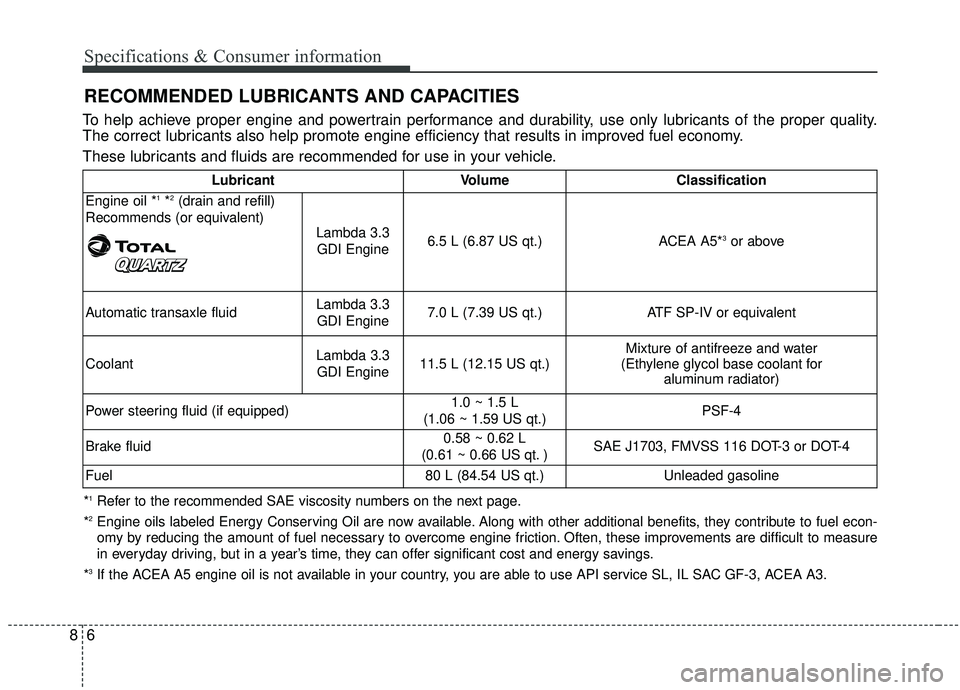
RECOMMENDED LUBRICANTS AND CAPACITIES
To help achieve proper engine and powertrain performance and durability, use only lubricants of the proper quality.
The correct lubricants also help promote engine efficiency that results in improved fuel economy.
These lubricants and fluids are recommended for use in your vehicle.
*1Refer to the recommended SAE viscosity numbers on the next page.
*
2Engine oils labeled Energy Conserving Oil are now available. Along with other additional benefits, they contribute to fuel econ-
omy by reducing the amount of fuel necessary to overcome engine friction. Often, these improvements are difficult to measure
in everyday driving, but in a year’s time, they can offer significant cost and energy savings.
*
3If the ACEA A5 engine oil is not available in your country, you are able to use API service SL, IL SAC GF-3, ACEA A3. Lubricant Volume Classification
Engine oil *
1*2(drain and refill)
Recommends (or equivalent) Lambda 3.3
GDI Engine 6.5 L (6.87 US qt.) ACEA A5*
3or above
Automatic transaxle fluid Lambda 3.3
GDI Engine 7.0 L (7.39 US qt.) ATF SP-IV or equivalent
Coolant Lambda 3.3
GDI Engine 11.5 L (12.15 US qt.) Mixture of antifreeze and water
(Ethylene glycol base coolant for aluminum radiator)
Power steering fluid (if equipped) 1.0 ~ 1.5 L
(1.06 ~ 1.59 US qt.) PSF-4
Brake fluid 0.58 ~ 0.62 L
(0.61 ~ 0.66 US qt. ) SAE J1703, FMVSS 116 DOT-3 or DOT-4
Fuel 80 L (84.54 US qt.) Unleaded gasoline
Page 581 of 593
Index
4I
Child restraint system . . . . . . . . . . . . . . . . . . . . . . . . . . 3-53Placing a passenger seat belt into the auto lock mode . . . . . . . . . . . . . . . . . . . . . . . . . . . . . . . . . . . . \
3-55
Securing a child restraint seat with child seat lower anchor system. . . . . . . . . . . . . . . . . . . . . . . . . . . . . 3-59
Securing a child restraint seat with tether anchor system. . . . . . . . . . . . . . . . . . . . . . . . . . . . . . . . . . . 3-\
58
Using a child restraint system . . . . . . . . . . . . . . . . . 3-54
Child-protector rear door lock . . . . . . . . . . . . . . . . . . . 4-30
Clean air . . . . . . . . . . . . . . . . . . . . . . . . . . . . . . . . . . . 4-\
191
Climate control air filter . . . . . . . . . . . . . . . . . . . . . . . . 7-30 Filter inspection . . . . . . . . . . . . . . . . . . . . . . . . . . . . 7-30
Coat hook . . . . . . . . . . . . . . . . . . . . . . . . . . . . . . . . . . 4-20\
5
Combined instrument, see instrument cluster . . . . . . . 4-89
Conversation mirror . . . . . . . . . . . . . . . . . . . . . . . . . . . 4-84
Cool box . . . . . . . . . . . . . . . . . . . . . . . . . . . . . . . . . . . 4-\
194
Coolant . . . . . . . . . . . . . . . . . . . . . . . . . . . . . . . . . . . . \
. 7-22
Cooling fluid, see engine coolant . . . . . . . . . . . . . . . . . 7-22
Crankcase emission control system . . . . . . . . . . . . . . . 7-98
Cruise control system . . . . . . . . . . . . . . . . . . . . . . . . . . 5-59 To cancel cruise control . . . . . . . . . . . . . . . . . . . . . . 5-61
To decrease the cruising speed . . . . . . . . . . . . . . . . . 5-60
To increase cruise control set speed . . . . . . . . . . . . . 5-60
To resume cruising speed at more than approximately 20mph (30 km/h) . . . . . . . . . . . . . . . . . . . . . . . . . . 5-62
To set cruise control speed . . . . . . . . . . . . . . . . . . . . 5-59
To temporarily accelerate with the cruise control on . 5-61
To turn cruise control off . . . . . . . . . . . . . . . . . . . . . 5-62 Cup holder . . . . . . . . . . . . . . . . . . . . . . . . . . . . . . . . . 4-195
Curtain air bag . . . . . . . . . . . . . . . . . . . . . . . . . . . . . . . 3-80
Dashboard illumination, see instrument panel
illumination . . . . . . . . . . . . . . . . . . . . . . . . . . . . . . . 4-90
Dashboard, see instrument cluster . . . . . . . . . . . . . . . . 4-90
Day/night rearview mirror . . . . . . . . . . . . . . . . . . . . . . 4-74
Defogging (Windshield) . . . . . . . . . . . . . . . . . . . . . . . 4-186
Defroster (Rear window) . . . . . . . . . . . . . . . . . . . . . . 4-151
Defrosting (Windshield) . . . . . . . . . . . . . . . . . . . . . . . 4-186
Digital speedometer . . . . . . . . . . . . . . . . . . . . . . . . . . . 4-99
Dimensions . . . . . . . . . . . . . . . . . . . . . . . . . . . . . . . . . . . 8-\
2
Display illumination, see instrument panel illumination . . . . . . . . . . . . . . . . . . . . . . . . . . . . . . . 4-90
Displays, see instrument cluster . . . . . . . . . . . . . . . . . . 4-89
Distance to empty . . . . . . . . . . . . . . . . . . . . . . . . . . . . 4-102
Door lock button . . . . . . . . . . . . . . . . . . . . . . . . . . . . . . 4-27
Door locks. . . . . . . . . . . . . . . . . . . . . . . . . . . . . . . . . . . 4-\
25 Central door lock switch . . . . . . . . . . . . . . . . . . . . . 4-28
Child-protector rear door lock . . . . . . . . . . . . . . . . . 4-30
Door lock button . . . . . . . . . . . . . . . . . . . . . . . . . . . 4-27
from inside the vehicle . . . . . . . . . . . . . . . . . . . . . . . 4-27
from outside the vehicle . . . . . . . . . . . . . . . . . . . . . . 4-25
Drinks holders, see cup holders . . . . . . . . . . . . . . . . . 4-195
D
Page 582 of 593
I5
Index
Drive mode integrated control system . . . . . . . . . . . . . 5-83Drive mode . . . . . . . . . . . . . . . . . . . . . . . . . . . . . . . . 5-83
Driver Attention Warning (DAW) system . . . . . . . . . . 5-94 Resetting the system. . . . . . . . . . . . . . . . . . . . . . . . . 5-96
System malfunction . . . . . . . . . . . . . . . . . . . . . . . . . 5-96
System setting and activation . . . . . . . . . . . . . . . . . . 5-94
System standby. . . . . . . . . . . . . . . . . . . . . . . . . . . . . 5-96
Driver position memory system . . . . . . . . . . . . . . . . . . 3-11
Driver's and passenger's front air bag . . . . . . . . . . . . . . 3-75
Driving at night . . . . . . . . . . . . . . . . . . . . . . . . . . . . . . 5-107
Driving in flooded areas . . . . . . . . . . . . . . . . . . . . . . . 5-109
Driving in the rain. . . . . . . . . . . . . . . . . . . . . . . . . . . . 5-108
Driving off-road . . . . . . . . . . . . . . . . . . . . . . . . . . . . . 5-109
Driving with a trailer . . . . . . . . . . . . . . . . . . . . . . . . . 5-116
Dynamic Bending Light (DBL) . . . . . . . . . . . . . . . . . 4-143
Economical operation . . . . . . . . . . . . . . . . . . . . . . . . . 5-103
Electric chromic mirror (ECM) with
HomeLink
®system and compass . . . . . . . . . . . . . . 4-76
Electric power steering . . . . . . . . . . . . . . . . . . . . . . . . . 4-70
Electrochromic mirror with HomeLink system . . . . . . 4-73
Electronic Parking Brake (EPB) . . . . . . . . . . . . . . . . . . 5-24
Electronic Stability Control (ESC) . . . . . . . . . . . . . . . . 5-35
Emergency starting . . . . . . . . . . . . . . . . . . . . . . . . . . . . . 6-5 Jump starting . . . . . . . . . . . . . . . . . . . . . . . . . . . . . . . 6-5 Emergency while driving . . . . . . . . . . . . . . . . . . . . . . . . 6-3
Emission control system . . . . . . . . . . . . . . . . . . . . . . . . 7-98
Crankcase emission control system . . . . . . . . . . . . . 7-98
Evaporative emission control (including ORVR:Onboard Refueling Vapor Recovery) system. . . . . 7-99
Exhaust emission control system . . . . . . . . . . . . . . . 7-99
Engine . . . . . . . . . . . . . . . . . . . . . . . . . . . . . . . . . . . . \
. . . 8-2
Engine compartment . . . . . . . . . . . . . . . . . . . . . . . . 2-6, 7-4
Engine coolant . . . . . . . . . . . . . . . . . . . . . . . . . . . . . . . 7-22 Changing the coolant . . . . . . . . . . . . . . . . . . . . . . . . 7-24
Checking the coolant level . . . . . . . . . . . . . . . . . . . . 7-22
Engine coolant temperature gauge . . . . . . . . . . . . . . . . 4-91
Engine number . . . . . . . . . . . . . . . . . . . . . . . . . . . . . . . . 8-9
Engine oil . . . . . . . . . . . . . . . . . . . . . . . . . . . . . . . . . . . 7-\
20 Changing the engine oil and filter . . . . . . . . . . . . . . 7-21
Checking the engine oil level . . . . . . . . . . . . . . . . . . 7-20
Engine overheats . . . . . . . . . . . . . . . . . . . . . . . . . . . . . . . 6-8
Engine start/stop button . . . . . . . . . . . . . . . . . . . . . . . . 5-10 Engine start/stop button position . . . . . . . . . . . . . . . 5-10
Illuminated engine start/stop button. . . . . . . . . . . . . 5-10
Starting the engine with a smart key . . . . . . . . . . . . 5-12
Engine start/stop button illumination . . . . . . . . . . . . . . 5-10
Engine start/stop button position . . . . . . . . . . . . . . . . . 5-10
Engine will not start . . . . . . . . . . . . . . . . . . . . . . . . . . . . 6-4
Evaporative emission control (including ORVR: Onboard Refueling Vapor Recovery) system . . . . . . 7-99
Exhaust emission control system . . . . . . . . . . . . . . . . . 7-99
E
Page 583 of 593
Index
6I
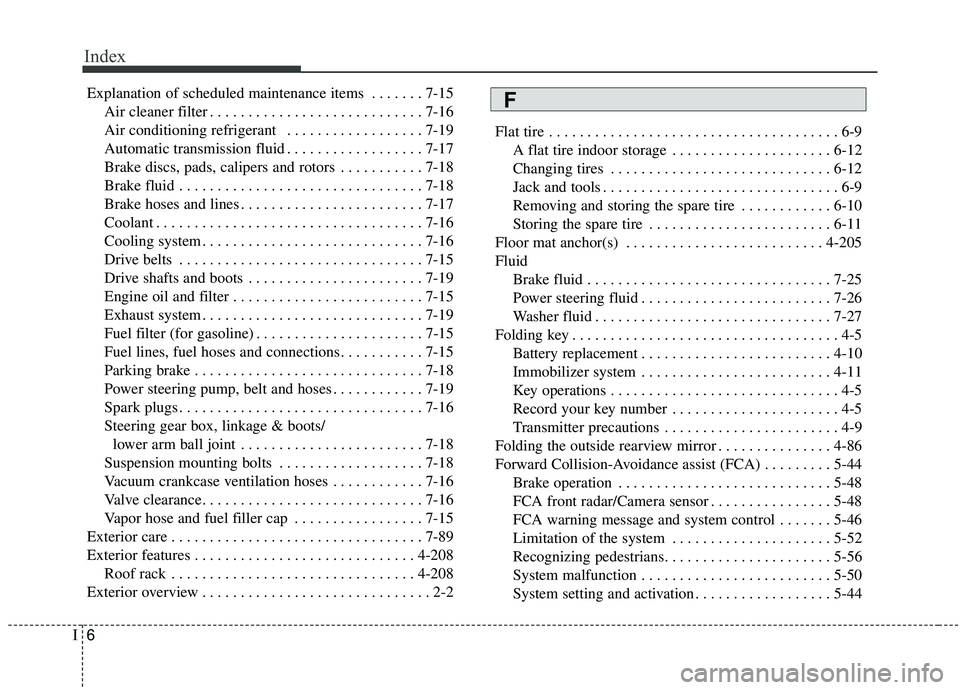
Explanation of scheduled maintenance items . . . . . . . 7-15Air cleaner filter . . . . . . . . . . . . . . . . . . . . . . . . . . . . 7-16
Air conditioning refrigerant . . . . . . . . . . . . . . . . . . 7-19
Automatic transmission fluid . . . . . . . . . . . . . . . . . . 7-17
Brake discs, pads, calipers and rotors . . . . . . . . . . . 7-18
Brake fluid . . . . . . . . . . . . . . . . . . . . . . . . . . . . . . . . 7-18
Brake hoses and lines . . . . . . . . . . . . . . . . . . . . . . . . 7-17
Coolant . . . . . . . . . . . . . . . . . . . . . . . . . . . . . . . . . . . 7-\
16
Cooling system . . . . . . . . . . . . . . . . . . . . . . . . . . . . . 7-16
Drive belts . . . . . . . . . . . . . . . . . . . . . . . . . . . . . . . . 7-15
Drive shafts and boots . . . . . . . . . . . . . . . . . . . . . . . 7-19
Engine oil and filter . . . . . . . . . . . . . . . . . . . . . . . . . 7-15
Exhaust system . . . . . . . . . . . . . . . . . . . . . . . . . . . . . 7-19
Fuel filter (for gasoline) . . . . . . . . . . . . . . . . . . . . . . 7-15
Fuel lines, fuel hoses and connections . . . . . . . . . . . 7-15
Parking brake . . . . . . . . . . . . . . . . . . . . . . . . . . . . . . 7-18
Power steering pump, belt and hoses . . . . . . . . . . . . 7-19
Spark plugs . . . . . . . . . . . . . . . . . . . . . . . . . . . . . . . . 7-16
Steering gear box, linkage & boots/lower arm ball joint . . . . . . . . . . . . . . . . . . . . . . . . 7-18
Suspension mounting bolts . . . . . . . . . . . . . . . . . . . 7-18
Vacuum crankcase ventilation hoses . . . . . . . . . . . . 7-16
Valve clearance. . . . . . . . . . . . . . . . . . . . . . . . . . . . . 7-16
Vapor hose and fuel filler cap . . . . . . . . . . . . . . . . . 7-15
Exterior care . . . . . . . . . . . . . . . . . . . . . . . . . . . . . . . . . 7-89
Exterior features . . . . . . . . . . . . . . . . . . . . . . . . . . . . . 4-208 Roof rack . . . . . . . . . . . . . . . . . . . . . . . . . . . . . . . . 4-208
Exterior overview . . . . . . . . . . . . . . . . . . . . . . . . . . . . . . 2-2 Flat tire . . . . . . . . . . . . . . . . . . . . . . . . . . . . . . . . . . . . \
. . 6-9
A flat tire indoor storage . . . . . . . . . . . . . . . . . . . . . 6-12
Changing tires . . . . . . . . . . . . . . . . . . . . . . . . . . . . . 6-12
Jack and tools . . . . . . . . . . . . . . . . . . . . . . . . . . . . . . . 6-9
Removing and storing the spare tire . . . . . . . . . . . . 6-10
Storing the spare tire . . . . . . . . . . . . . . . . . . . . . . . . 6-11
Floor mat anchor(s) . . . . . . . . . . . . . . . . . . . . . . . . . . 4-205
Fluid Brake fluid . . . . . . . . . . . . . . . . . . . . . . . . . . . . . . . . 7-25
Power steering fluid . . . . . . . . . . . . . . . . . . . . . . . . . 7-26
Washer fluid . . . . . . . . . . . . . . . . . . . . . . . . . . . . . . . 7-27
Folding key . . . . . . . . . . . . . . . . . . . . . . . . . . . . . . . . . . . 4-\
5 Battery replacement . . . . . . . . . . . . . . . . . . . . . . . . . 4-10
Immobilizer system . . . . . . . . . . . . . . . . . . . . . . . . . 4-11
Key operations . . . . . . . . . . . . . . . . . . . . . . . . . . . . . . 4-5
Record your key number . . . . . . . . . . . . . . . . . . . . . . 4-5
Transmitter precautions . . . . . . . . . . . . . . . . . . . . . . . 4-9
Folding the outside rearview mirror . . . . . . . . . . . . . . . 4-86
Forward Collision-Avoidance assist (FCA) . . . . . . . . . 5-44 Brake operation . . . . . . . . . . . . . . . . . . . . . . . . . . . . 5-48
FCA front radar/Camera sensor . . . . . . . . . . . . . . . . 5-48
FCA warning message and system control . . . . . . . 5-46
Limitation of the system . . . . . . . . . . . . . . . . . . . . . 5-52
Recognizing pedestrians. . . . . . . . . . . . . . . . . . . . . . 5-56
System malfunction . . . . . . . . . . . . . . . . . . . . . . . . . 5-50
System setting and activation . . . . . . . . . . . . . . . . . . 5-44F