engine KIA Sorento 2006 1.G Owners Manual
[x] Cancel search | Manufacturer: KIA, Model Year: 2006, Model line: Sorento, Model: KIA Sorento 2006 1.GPages: 312, PDF Size: 5.21 MB
Page 269 of 312
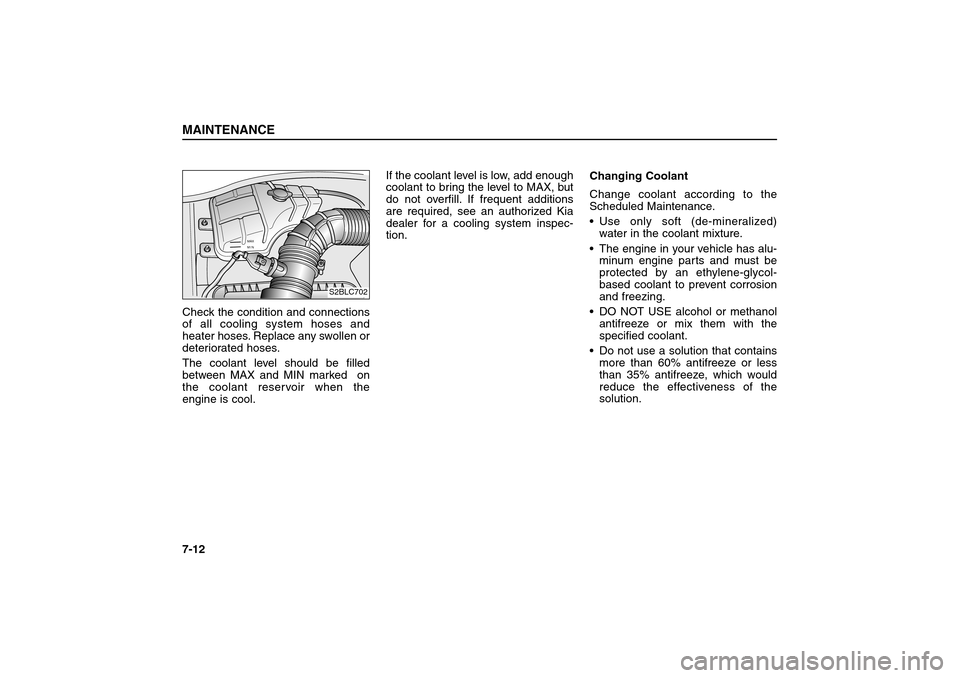
Check the condition and connections
of all cooling system hoses and
heater hoses. Replace any swollen or
deteriorated hoses.
The coolant level should be filled
between MAX and MIN marked on
the coolant reservoir when the
engine is cool.If the coolant level is low, add enough
coolant to bring the level to MAX, but
do not overfill. If frequent additions
are required, see an authorized Kia
dealer for a cooling system inspec-
tion.Changing Coolant
Change coolant according to the
Scheduled Maintenance.
Use only soft (de-mineralized)
water in the coolant mixture.
The engine in your vehicle has alu-
minum engine parts and must be
protected by an ethylene-glycol-
based coolant to prevent corrosion
and freezing.
DO NOT USE alcohol or methanol
antifreeze or mix them with the
specified coolant.
Do not use a solution that contains
more than 60% antifreeze or less
than 35% antifreeze, which would
reduce the effectiveness of the
solution.MAINTENANCE7-12
MAX
MIN
S2BLC702
BL-ENG (CAN)-7.qxd 7/28/05 5:58 PM Page 12
Page 270 of 312
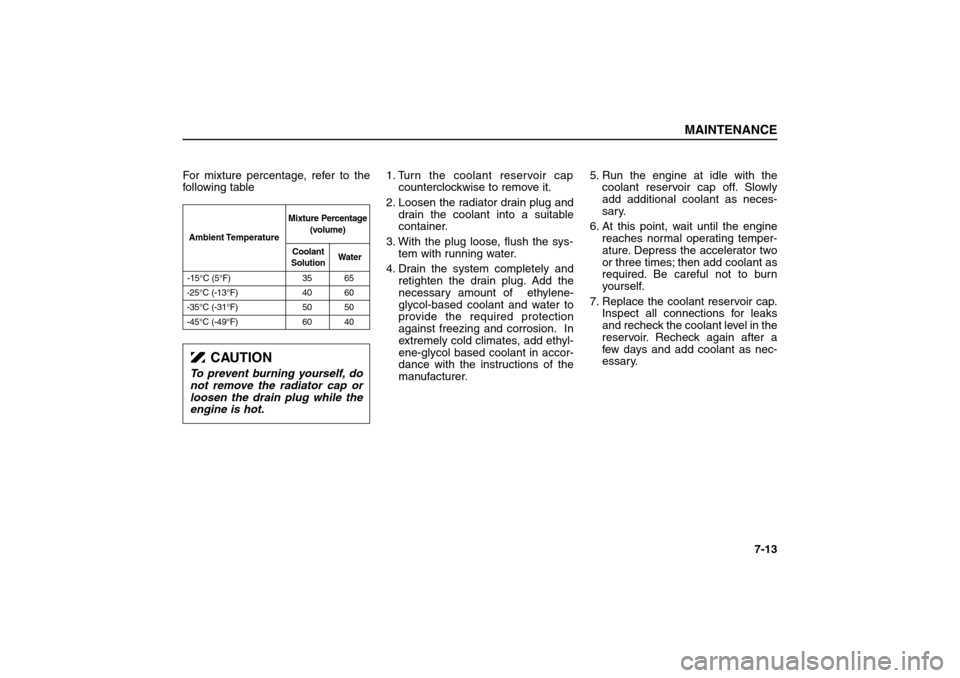
For mixture percentage, refer to the
following table1. Turn the coolant reservoir cap
counterclockwise to remove it.
2. Loosen the radiator drain plug and
drain the coolant into a suitable
container.
3. With the plug loose, flush the sys-
tem with running water.
4. Drain the system completely and
retighten the drain plug. Add the
necessary amount of ethylene-
glycol-based coolant and water to
provide the required protection
against freezing and corrosion. In
extremely cold climates, add ethyl-
ene-glycol based coolant in accor-
dance with the instructions of the
manufacturer.5. Run the engine at idle with the
coolant reservoir cap off. Slowly
add additional coolant as neces-
sary.
6. At this point, wait until the engine
reaches normal operating temper-
ature. Depress the accelerator two
or three times; then add coolant as
required. Be careful not to burn
yourself.
7. Replace the coolant reservoir cap.
Inspect all connections for leaks
and recheck the coolant level in the
reservoir. Recheck again after a
few days and add coolant as nec-
essary.
MAINTENANCE
7-13
-15°C (5°F) 35 65
-25°C (-13°F) 40 60
-35°C (-31°F) 50 50
-45°C (-49°F) 60 40Ambient TemperatureMixture Percentage
(volume)
Coolant
SolutionWater
CAUTION
To prevent burning yourself, do
not remove the radiator cap or
loosen the drain plug while the
engine is hot.
BL-ENG (CAN)-7.qxd 7/28/05 5:58 PM Page 13
Page 272 of 312
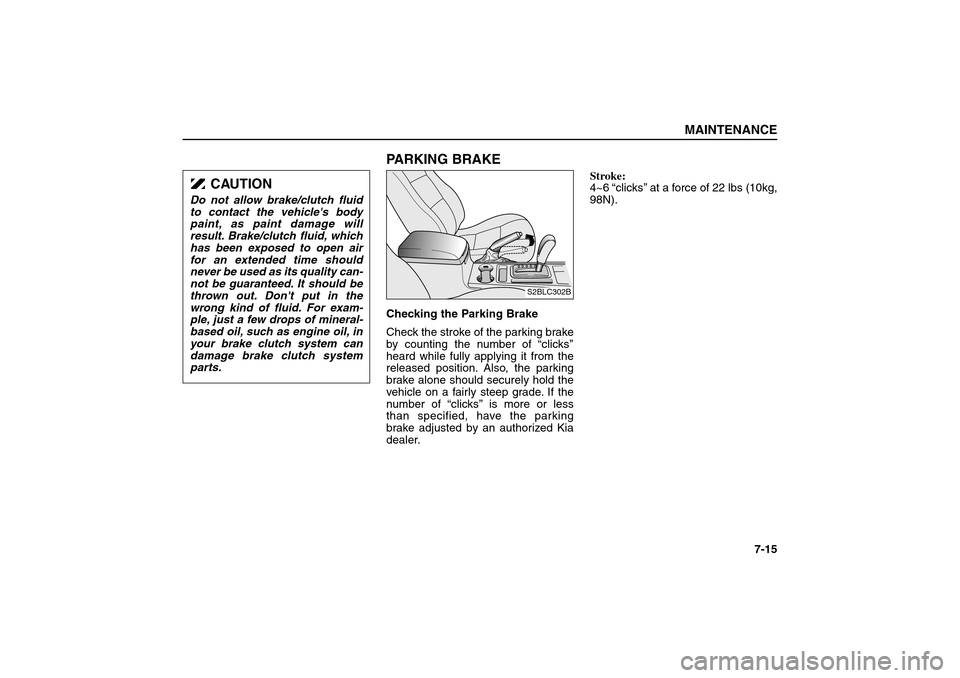
PARKING BRAKEChecking the Parking Brake
Check the stroke of the parking brake
by counting the number of “clicks’’
heard while fully applying it from the
released position. Also, the parking
brake alone should securely hold the
vehicle on a fairly steep grade. If the
number of “clicks’’is more or less
than specified, have the parking
brake adjusted by an authorized Kia
dealer.Stroke:
4~6 “clicks’’at a force of 22 lbs (10kg,
98N).
MAINTENANCE
7-15
S2BLC302B
CAUTION
Do not allow brake/clutch fluid
to contact the vehicle's body
paint, as paint damage will
result. Brake/clutch fluid, which
has been exposed to open air
for an extended time should
never be used as its quality can-
not be guaranteed. It should be
thrown out. Don't put in the
wrong kind of fluid. For exam-
ple, just a few drops of mineral-
based oil, such as engine oil, in
your brake clutch system can
damage brake clutch system
parts.
BL-ENG (CAN)-7.qxd 7/28/05 5:58 PM Page 15
Page 275 of 312
1. Park the vehicle on level ground
and firmly set the parking brake.
2. Allow the engine to idle for about 2
minutes.
3. Depress the brake pedal and move
the shift lever slowly through all
ranges then set it in P (Park).
4. With the engine still idling, pull out
the dipstick, wipe it clean and rein-
sert it fully.
5. Pull out the dipstick again and
check the fluid level.5. Pull out the dipstick again and
check the fluid level.
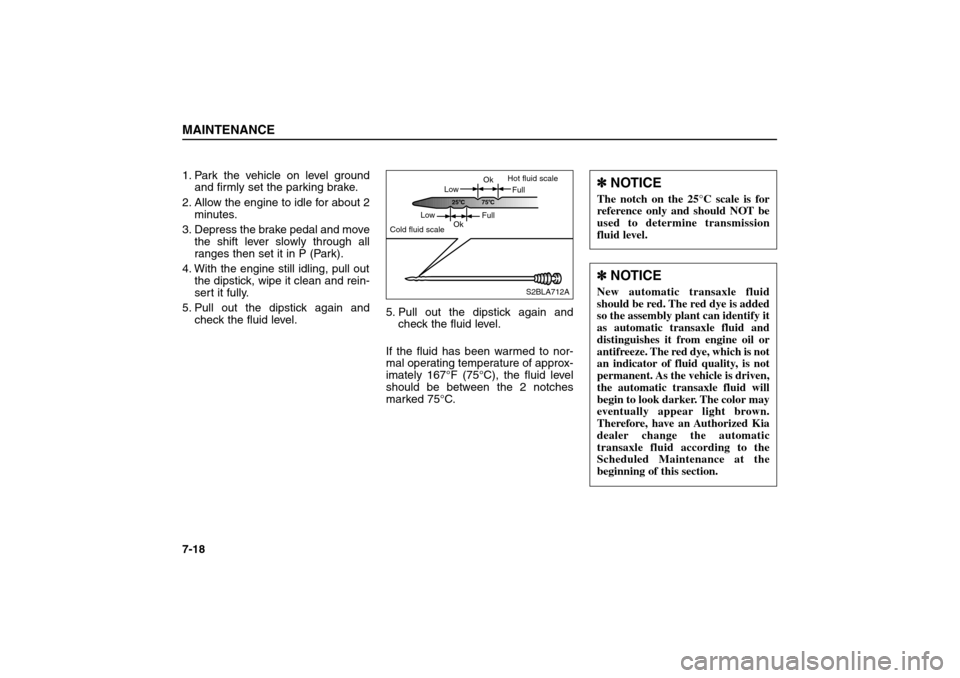
If the fluid has been warmed to nor-
mal operating temperature of approx-
imately 167°F (75°C), the fluid level
should be between the 2 notches
marked 75°C.MAINTENANCE7-18
25 C
75 C
S2BLA712A
LowOk
Ok
Full
Low
Cold fluid scaleHot fluid scale
Full
✽ ✽
NOTICEThe notch on the 25°C scale is for
reference only and should NOT be
used to determine transmission
fluid level.✽ ✽
NOTICENew automatic transaxle fluid
should be red. The red dye is added
so the assembly plant can identify it
as automatic transaxle fluid and
distinguishes it from engine oil or
antifreeze. The red dye, which is not
an indicator of fluid quality, is not
permanent. As the vehicle is driven,
the automatic transaxle fluid will
begin to look darker. The color may
eventually appear light brown.
Therefore, have an Authorized Kia
dealer change the automatic
transaxle fluid according to the
Scheduled Maintenance at the
beginning of this section.
BL-ENG (CAN)-7.qxd 7/28/05 5:58 PM Page 18
Page 276 of 312
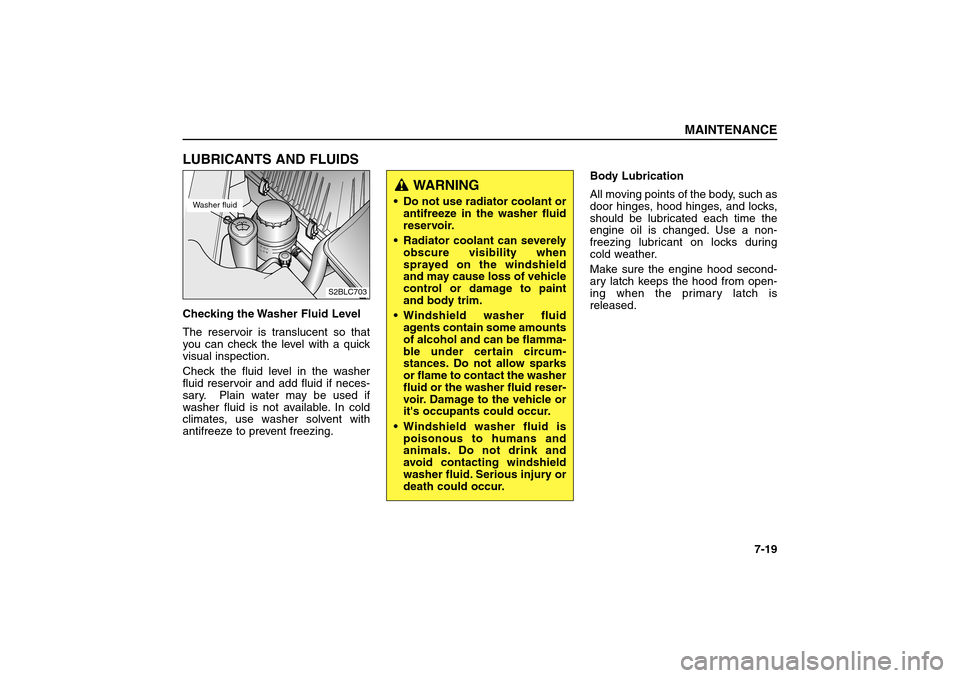
LUBRICANTS AND FLUIDSChecking the Washer Fluid Level
The reservoir is translucent so that
you can check the level with a quick
visual inspection.
Check the fluid level in the washer
fluid reservoir and add fluid if neces-
sary. Plain water may be used if
washer fluid is not available. In cold
climates, use washer solvent with
antifreeze to prevent freezing.Body Lubrication
All moving points of the body, such as
door hinges, hood hinges, and locks,
should be lubricated each time the
engine oil is changed. Use a non-
freezing lubricant on locks during
cold weather.
Make sure the engine hood second-
ary latch keeps the hood from open-
ing when the primary latch is
released.
MAINTENANCE
7-19
HIGHLOW
S2BLC703
Washer fluid
WARNING
Do not use radiator coolant or
antifreeze in the washer fluid
reservoir.
Radiator coolant can severely
obscure visibility when
sprayed on the windshield
and may cause loss of vehicle
control or damage to paint
and body trim.
Windshield washer fluid
agents contain some amounts
of alcohol and can be flamma-
ble under certain circum-
stances. Do not allow sparks
or flame to contact the washer
fluid or the washer fluid reser-
voir. Damage to the vehicle or
it's occupants could occur.
Windshield washer fluid is
poisonous to humans and
animals. Do not drink and
avoid contacting windshield
washer fluid. Serious injury or
death could occur.
BL-ENG (CAN)-7.qxd 7/28/05 5:58 PM Page 19
Page 277 of 312
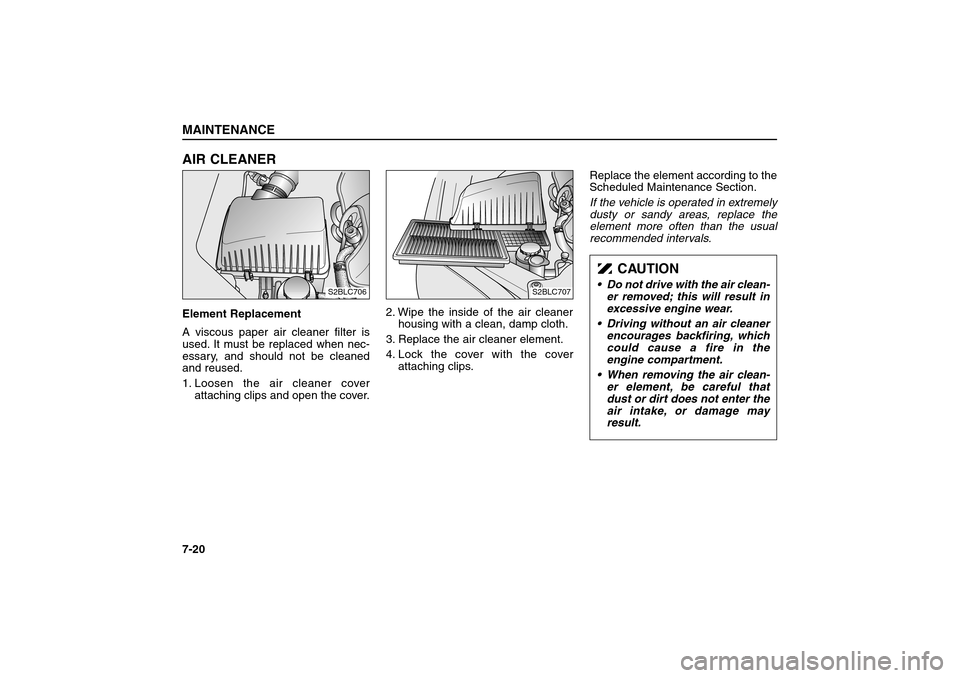
AIR CLEANER Element Replacement
A viscous paper air cleaner filter is
used. It must be replaced when nec-
essary, and should not be cleaned
and reused.
1. Loosen the air cleaner cover
attaching clips and open the cover.2. Wipe the inside of the air cleaner
housing with a clean, damp cloth.
3. Replace the air cleaner element.
4. Lock the cover with the cover
attaching clips.Replace the element according to the
Scheduled Maintenance Section.
If the vehicle is operated in extremely
dusty or sandy areas, replace the
element more often than the usual
recommended intervals.MAINTENANCE7-20
S2BLC706
S2BLC707
CAUTION
• Do not drive with the air clean-
er removed; this will result in
excessive engine wear.
Driving without an air cleaner
encourages backfiring, which
could cause a fire in the
engine compartment.
When removing the air clean-
er element, be careful that
dust or dirt does not enter the
air intake, or damage may
result.
BL-ENG (CAN)-7.qxd 7/28/05 5:58 PM Page 20
Page 280 of 312
BATTERY
MAINTENANCE
7-23
WARNING
- Battery
dangers
Always read the follow-
ing instructions carefully
when handling a battery.
Keep lighted cigarettes
and all other flames or
sparks away from the
battery.
Hydrogen, which is a
highly combustible gas,
is always present in bat-
tery cells and may
explode if ignited.
Keep batteries out of the
reach of children
because batteries con-
tain highly corrosive
SULFURIC ACID. Do not
allow battery acid to
contact your skin, eyes,
clothing or paint finish.
(Continued)
(Continued)
If any electrolyte gets
into your eyes, flush
your eyes with clean
water for at least 15 min-
utes and get immediate
medical attention. If pos-
sible, continue to apply
water with a sponge or
cloth until medical atten-
tion is received.
If electrolyte gets on
your skin, thoroughly
wash the contacted area.
If you feel a pain or a
burning sensation, get
medical attention imme-
diately.
Wear eye protection
when charging or work-
ing near a battery.
Always provide ventila-
tion when working in an
enclosed space.
(Continued)
(Continued)
When lifting a plastic-cased
battery, excessive pressure
on the case may cause battery
acid to leak, resulting in per-
sonal injury. Lift with a battery
carrier or with your hands on
opposite corners.
Never attempt to charge the
battery when the battery
cables are connected.
The electrical ignition system
works with high voltage.
Never touch these compo-
nents with the engine running
or the ignition switched on.
BL-ENG (CAN)-7.qxd 7/28/05 5:58 PM Page 23
Page 282 of 312
MAINTENANCE
7-25
(Continued)
Disconnect the battery charg-
er in the following order.
1. Turn off the battery charger
main switch.
2. Unhook the negative clamp
from the negative battery
terminal.
3. Unhook the positive clamp
from the positive battery
terminal.
✽ ✽
NOTICE Before performing maintenance
or recharging the battery, turn
off all accessories and stop the
engine.
The negative battery cable must
be removed first and installed last
when the battery is disconnected.
WARNING - Recharging Battery
When recharging the battery,
observe the following precau-
tions:
The battery must be removed
from the vehicle and placed in
an area with good ventilation.
Do not allow cigarettes,
sparks, or flame near the bat-
tery.
Watch the battery during
charging, and stop or reduce
the charging rate if the battery
cells begin gassing (boiling)
violently or if the temperature
of the electrolyte of any cell
exceeds 120°F (49°C).
Wear eye protection when
checking the battery during
charging.
(Continued)
BL-ENG (CAN)-7.qxd 7/28/05 5:58 PM Page 25
Page 298 of 312
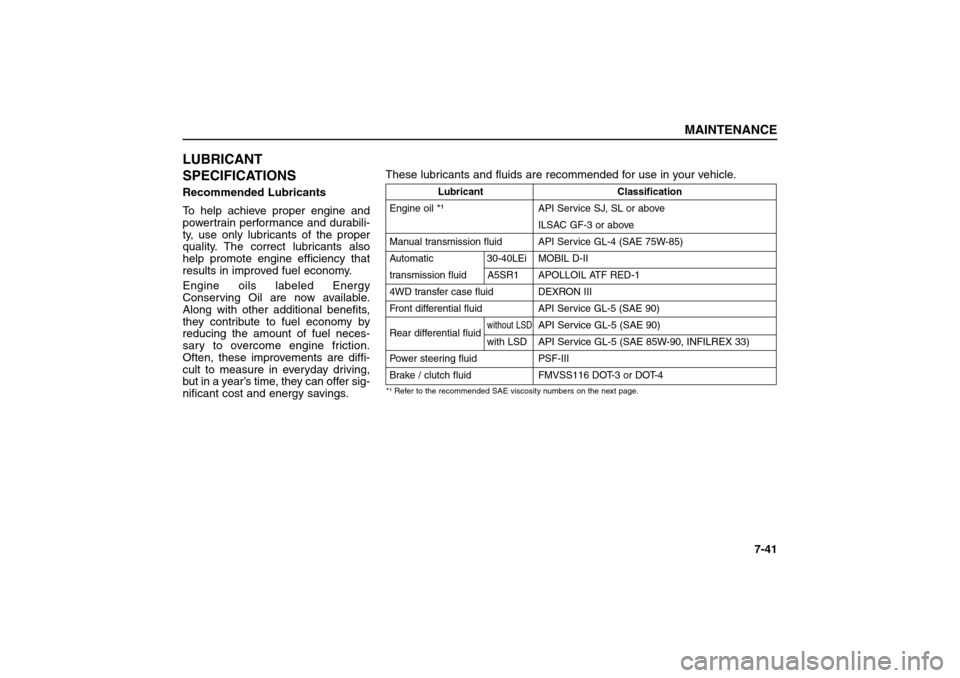
LUBRICANT
SPECIFICATIONSRecommended Lubricants
To help achieve proper engine and
powertrain performance and durabili-
ty, use only lubricants of the proper
quality. The correct lubricants also
help promote engine efficiency that
results in improved fuel economy.
Engine oils labeled Energy
Conserving Oil are now available.
Along with other additional benefits,
they contribute to fuel economy by
reducing the amount of fuel neces-
sary to overcome engine friction.
Often, these improvements are diffi-
cult to measure in everyday driving,
but in a year’s time, they can offer sig-
nificant cost and energy savings.
MAINTENANCE
7-41
*¹ Refer to the recommended SAE viscosity numbers on the next page.These lubricants and fluids are recommended for use in your vehicle.
Lubricant Classification
Engine oil *¹
API Service SJ, SL or above
ILSAC GF-3 or above
Manual transmission fluid API Service GL-4 (SAE 75W-85)
Automatic 30-40LEi MOBIL D-II
transmission fluid A5SR1 APOLLOIL ATF RED-1
4WD transfer case fluid DEXRON III
Front differential fluid API Service GL-5 (SAE 90)
Rear differential fluid
without LSD
API Service GL-5 (SAE 90)
with LSD
API Service GL-5 (SAE 85W-90, INFILREX 33)
Power steering fluid PSF-III
Brake / clutch fluid FMVSS116 DOT-3 or DOT-4
BL-ENG (CAN)-7.qxd 7/28/05 5:58 PM Page 41
Page 299 of 312
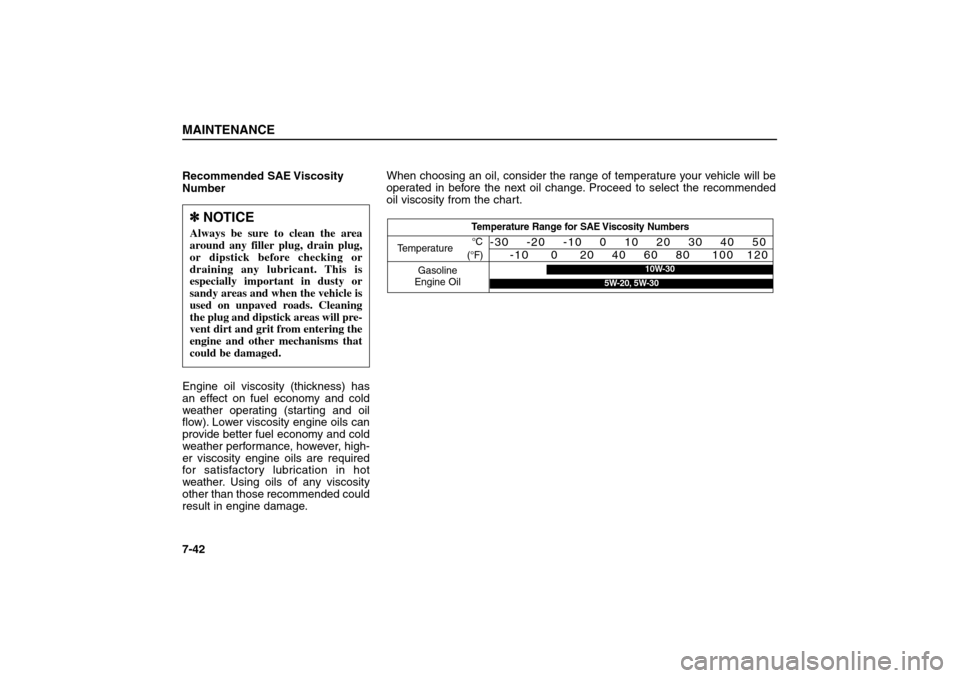
Recommended SAE Viscosity
Number
Engine oil viscosity (thickness) has
an effect on fuel economy and cold
weather operating (starting and oil
flow). Lower viscosity engine oils can
provide better fuel economy and cold
weather performance, however, high-
er viscosity engine oils are required
for satisfactory lubrication in hot
weather. Using oils of any viscosity
other than those recommended could
result in engine damage.MAINTENANCE7-42✽ ✽
NOTICEAlways be sure to clean the area
around any filler plug, drain plug,
or dipstick before checking or
draining any lubricant. This is
especially important in dusty or
sandy areas and when the vehicle is
used on unpaved roads. Cleaning
the plug and dipstick areas will pre-
vent dirt and grit from entering the
engine and other mechanisms that
could be damaged.
When choosing an oil, consider the range of temperature your vehicle will be
operated in before the next oil change. Proceed to select the recommended
oil viscosity from the chart.
Temperature Range for SAE Viscosity Numbers
Temperature
Gasoline
Engine Oil °C
(°F)
-30 -20 -10 0 10 20 30 40 50
-10 0 20 40 60 80 100 120
10W-30
5W-20, 5W-30
BL-ENG (CAN)-7.qxd 7/28/05 5:58 PM Page 42