engine KIA Sorento 2006 1.G Workshop Manual
[x] Cancel search | Manufacturer: KIA, Model Year: 2006, Model line: Sorento, Model: KIA Sorento 2006 1.GPages: 312, PDF Size: 5.21 MB
Page 191 of 312
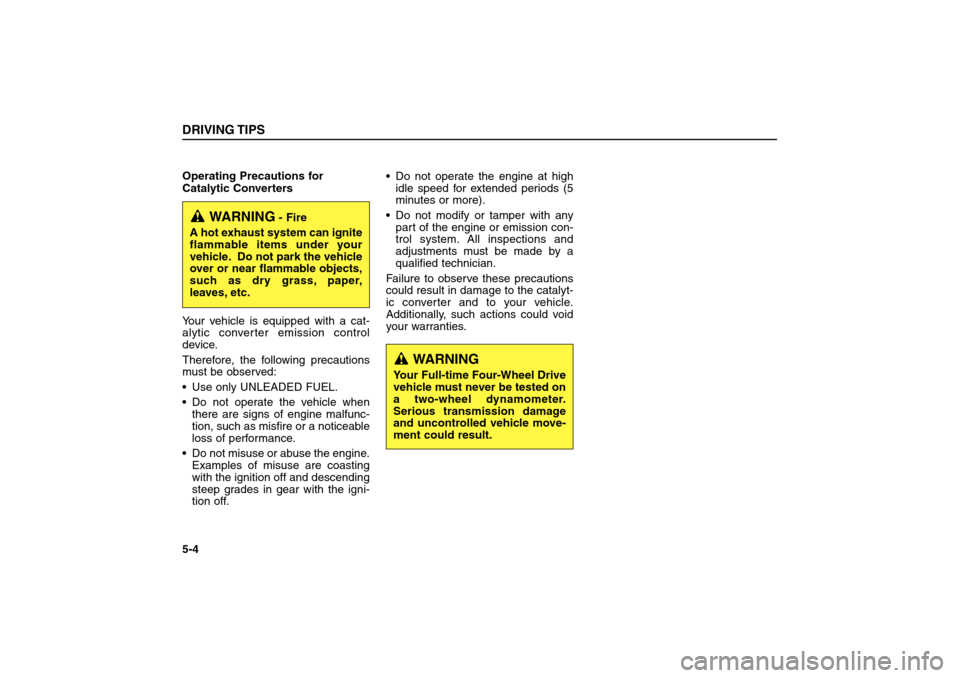
Operating Precautions for
Catalytic Converters
Your vehicle is equipped with a cat-
alytic converter emission control
device.
Therefore, the following precautions
must be observed:
Use only UNLEADED FUEL.
Do not operate the vehicle when
there are signs of engine malfunc-
tion, such as misfire or a noticeable
loss of performance.
Do not misuse or abuse the engine.
Examples of misuse are coasting
with the ignition off and descending
steep grades in gear with the igni-
tion off. Do not operate the engine at high
idle speed for extended periods (5
minutes or more).
Do not modify or tamper with any
part of the engine or emission con-
trol system. All inspections and
adjustments must be made by a
qualified technician.
Failure to observe these precautions
could result in damage to the catalyt-
ic converter and to your vehicle.
Additionally, such actions could void
your warranties.DRIVING TIPS5-4
WARNING
Your Full-time Four-Wheel Drive
vehicle must never be tested on
a two-wheel dynamometer.
Serious transmission damage
and uncontrolled vehicle move-
ment could result.
WARNING
- Fire
A hot exhaust system can ignite
flammable items under your
vehicle. Do not park the vehicle
over or near flammable objects,
such as dry grass, paper,
leaves, etc.
BL-ENG (CAN)-5.qxd 7/28/05 5:56 PM Page 4
Page 192 of 312
TIPS ON DRIVING YOUR
VEHICLEBefore Entering Vehicle:
Be sure that all windows, outside
mirror(s), and outside lights are
clean.
Check the condition of the tires.
Check under the vehicle for any
sign of leaks.
Be sure there are no obstacles
behind you if you intend to back up.
Necessary Inspections
Fluid levels, such as engine oil,
engine coolant, brake/clutch fluid,
and washer fluid should be checked
on a regular basis, with the exact
interval depending on the fluid.
Further details are provided in the
“Maintenance” section.Before Starting
Close and lock all doors.
Position the seat so that all controls
are easily reached.
Adjust the inside and outside
rearview mirrors.
Be sure that all lights work.
Check all gauges.
Check the operation of warning
lights when the ignition switch is
turned to the ON position.
Release the parking brake and
make sure the brake warning light
goes out.
For safe operation, be sure you are
familiar with your vehicle and its
equipment.
DRIVING TIPS
5-5
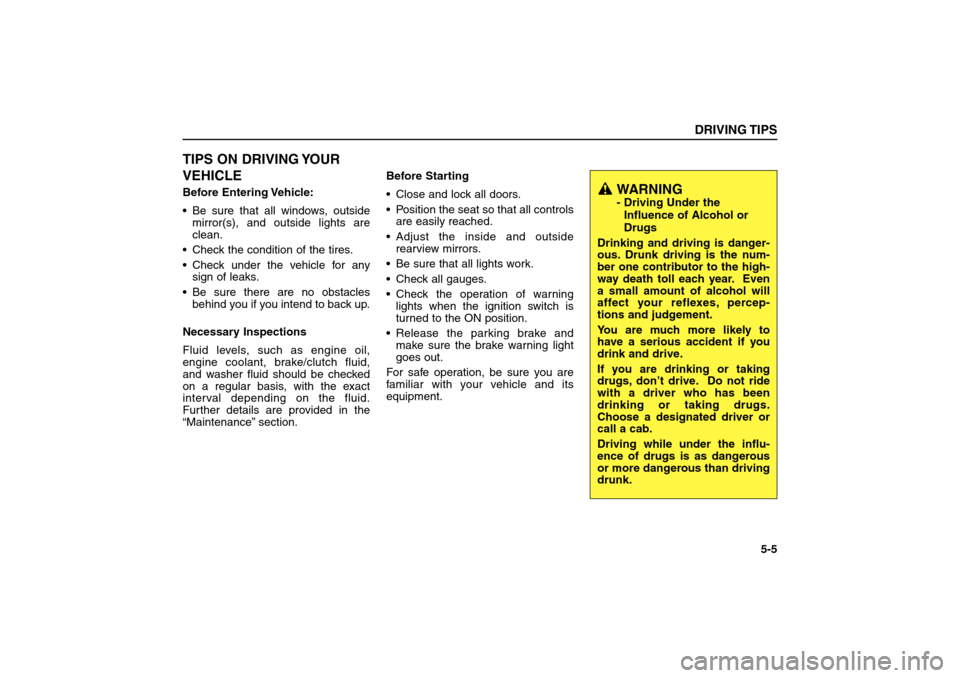
WARNING- Driving Under the
Influence of Alcohol or
Drugs
Drinking and driving is danger-
ous. Drunk driving is the num-
ber one contributor to the high-
way death toll each year. Even
a small amount of alcohol will
affect your reflexes, percep-
tions and judgement.
You are much more likely to
have a serious accident if you
drink and drive.
If you are drinking or taking
drugs, don’t drive. Do not ride
with a driver who has been
drinking or taking drugs.
Choose a designated driver or
call a cab.
Driving while under the influ-
ence of drugs is as dangerous
or more dangerous than driving
drunk.
BL-ENG (CAN)-5.qxd 7/28/05 5:56 PM Page 5
Page 193 of 312
SUGGESTIONS FOR
ECONOMICAL OPERATIONYour vehicle’s fuel economy depends
mainly on your style of driving, where
you drive and when you drive.
Each of these factors affects how
many miles (kilometers) you can get
from a gallon (liter) of fuel. To operate
your vehicle as economically as pos-
sible, use the following driving sug-
gestions to help save money in both
fuel and repairs:
Avoid lengthy warm-up idling. Once
the engine is running smoothly,
begin driving. Remember, engine
warm-up may take a little longer on
cold days.
Save fuel by accelerating slowly
after stopping.
Keep the engine in tune and follow
the recommended periodic mainte-
nance schedule. This will increase
the life of all parts and lower your
operating costs. Do not use the air conditioner
unnecessarily.
Slow down when driving on rough
roads.
For longer tire life and better fuel
economy, always keep the tires
inflated to the recommended pres-
sures.
Maintain a safe distance from other
vehicles to avoid sudden stops.
This will reduce wear on brake lin-
ings and pads. Driving in such a
way will also save fuel because
extra fuel is required to accelerate
back to driving speed.
Do not carry unnecessary weight in
the vehicle.
Do not rest your foot on the brake
pedal while driving. This can cause
needless wear, possible damage to
the brakes, and poor fuel economy. Improper wheel alignment results
in faster tire wear and lower fuel
economy.
Open windows at high speeds can
reduce fuel economy.
Fuel economy is less in crosswinds
and headwinds. To help offset
some of this loss, slow down when
driving in these conditions.
Keeping a vehicle in good operating
condition is important both for econo-
my and safety. Therefore, have an
authorized Kia dealer perform sched-
uled inspections and maintenance.DRIVING TIPS5-6
BL-ENG (CAN)-5.qxd 7/28/05 5:56 PM Page 6
Page 194 of 312
DRIVING TIPS
5-7
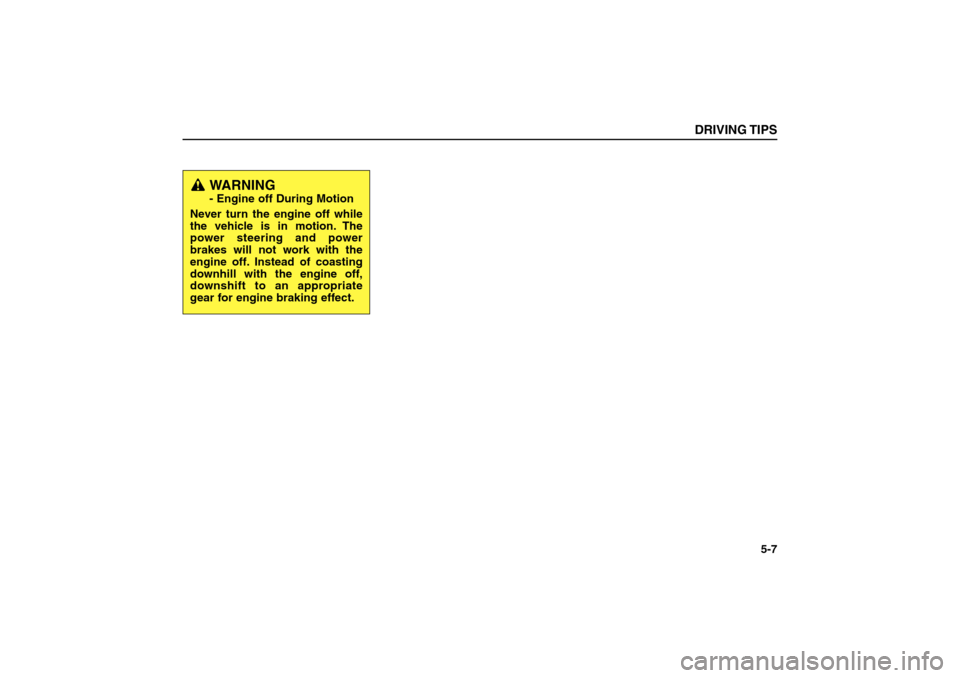
WARNING - Engine off During Motion
Never turn the engine off while
the vehicle is in motion. The
power steering and power
brakes will not work with the
engine off. Instead of coasting
downhill with the engine off,
downshift to an appropriate
gear for engine braking effect.
BL-ENG (CAN)-5.qxd 7/28/05 5:56 PM Page 7
Page 196 of 312
Rocking the Vehicle
If it is necessary to rock the vehicle to
free it from snow, sand, or mud, first
turn the steering wheel right and left
to clear the area around your front
wheels. Then, shift back and forth
between 1 (First) and R (Reverse) in
vehicles equipped with a manual
transmission or R (Reverse) and any
forward gear in vehicles equipped
with an automatic transmission. Do
not race the engine, and spin the
wheels as little as possible. If you are
still stuck after a few tries, have the
vehicle pulled out by a tow vehicle to
avoid engine overheating and possi-
ble damage to the transmission,
transfer case (if equipped), or differ-
ential.Driving at Night
Because night driving presents many
more hazards than driving in the day-
light, here are some important tips to
remember:
Slow down and keep more distance
between you and other vehicles, as
it may be more difficult to see at
night, especially in areas where
there may not be any street lights.
Adjust your mirrors to reduce the
glare from other driver’s headlights.
Keep your headlights clean and
properly aimed. Dirty or improperly
aimed headlights will make it much
more difficult to see at night.
Avoid staring directly at the head-
lights of oncoming vehicles. You
could be temporarily blinded, and it
will take several seconds for your
eyes to readjust to the darkness.
DRIVING TIPS
5-9
✽ ✽
NOTICEProlonged rocking may cause
engine over-heating, transmission
or transfer case (if equipped) dam-
age or failure, and tire damage.
WARNING- Spinning Tires
Do not spin the wheels, espe-
cially at speeds more than 35
mph (56 km/h). Spinning the
wheels at high speeds when the
vehicle is stationary could
cause a tire to overheat,
explode and injure bystanders.
BL-ENG (CAN)-5.qxd 7/28/05 5:56 PM Page 9
Page 197 of 312
Driving in the Rain
Rain and wet roads can make driving
dangerous, especially if you’re not
prepared for the slick pavement. Here
are a few things to consider when
driving in the rain:
A heavy rainfall will make it harder
to see and will increase the dis-
tance needed to stop your vehicle,
so slow down.
Keep your windshield wiping equip-
ment in good shape. Replace your
windshield wiper blades when they
show signs of streaking or missing
areas on the windshield.
If your tires are not in good condi-
tion, making a quick stop on wet
pavement can cause a skid and
possibly lead to an accident. Be
sure your tires are in good shape. Turn on your headlights to make it
easier for others to see you.
Driving too fast through large pud-
dles can affect your brakes. If you
must go through puddles, try to
drive through them slowly.
If you believe your brakes may have
become wet, apply them lightly
while driving until normal braking
operation returns.Winter Driving
We recommend that you carry
emergency equipment, including
tire chains, a window scraper, wind-
shield de-icer, a bag of sand or salt,
flares, a small shovel and jumper
cables.
Make sure you have sufficient eth-
ylene-glycol coolant in the radiator.
Check the battery condition and
cables. Cold temperatures reduce
the capacity of any battery, so it
must be in excellent condition to
provide enough winter starting
power.
Make sure the engine oil viscosity
is suitable for cold weather.
Check the ignition system for loose
connections and damage.DRIVING TIPS5-10
BL-ENG (CAN)-5.qxd 7/28/05 5:56 PM Page 10
Page 198 of 312
Use antifreeze-formulated wind-
shield washer fluid. (Do not use
engine coolant antifreeze.)
Do not use the parking brake if it
might freeze. When parking, shift to
1 (First) or R (Reverse) with a man-
ual transmission or P (Park) with an
automatic transmission, and block
the rear wheels.Snow Tires
If you mount snow tires on your Kia,
make sure they are radial tires of the
same size and load range as the orig-
inal tires. Mount snow tires on all four
wheels to balance your vehicle’s han-
dling in all weather conditions. Keep
in mind that the traction provided by
snow tires on dry roads may not be
as high as your vehicle’s original
equipment tires. You should drive
cautiously even when the roads are
clear. Check with the tire dealer for
maximum speed recommendations.Do not install studded tires without
first checking local, provincial and
municipal regulations for possible
restrictions against their use.
DRIVING TIPS
5-11
WARNING- Snow Tire Size
Snow tires should be equivalent
in size and type to the vehicle’s
standard tires. Otherwise, the
safety and handling of your
vehicle may be adversely affect-
ed.
BL-ENG (CAN)-5.qxd 7/28/05 5:56 PM Page 11
Page 201 of 312
USING FOUR-WHEEL DRIVEDriving on Snow- or Ice-Covered
Roads (“4HI, 4LO” for Part-time
4WD Operation or “AUTO” for
Full-time 4WD Operation)
Use snow tires. See “Tires” in this
section for more information.
Keep an adequate distance
between yourself and other vehi-
cles.
Avoid sudden braking, acceleration
or steering. These actions can
cause your vehicle to lose traction.Driving in Sand or Mud (“4HI,
4LO” for Part-time 4WD Operation
or “AUTO” for Full-time 4WD
Operation)
Avoid sudden braking, acceleration
or steering. These actions can
cause your vehicle to get stuck in
the sand or mud.
Drive at low speeds whenever pos-
sible.
You may need to get out of your
vehicle at times to check road con-
ditions.
If you get stuck in the sand or mud,
try placing stones, wood or other
similar materials under the tires to
get traction, or move forward and
backward repeatedly to get
unstuck.DRIVING TIPS5-14
WARNING
- Traction
Make sure that no one stands in
front of or behind the tires when
materials are placed under the
tires to get more traction. The
tires may cause loose materials
to fly out from under the vehi-
cle, potentially causing serious
bodily injury or death.
✽ ✽
NOTICEProlonged rocking may cause
engine damage, overheating, trans-
mission differential or transfer case
damage or failure and tire damage.
BL-ENG (CAN)-5.qxd 7/28/05 5:56 PM Page 14
Page 203 of 312
Off-Road Driving with Your Four-
Wheel Drive Vehicle
Off-road driving can be great fun. But
it has definite hazards. The greatest
of these is the terrain itself.
“Off-roading” means you’ve left the
paved road system behind. Traffic
lanes are not marked. Curves are not
banked.
There are no carefully engineered
road signs to warn you of dangerous
conditions or to advise you of a safe
speed. You have to assess the envi-
ronment yourself. Surfaces can be
slippery, rough, uphill or downhill.
Off-road driving involves learning
new skills. That’s why it’s important
that you read and understand this
section. You’ll find useful driving infor-
mation and suggestions. These will
help make your off-road driving safer
and more enjoyable.Before you go Off-Roading
There are some things to do before
you leave the paved roads. Be sure to
have all necessary maintenance and
service work done beforehand. Be
sure to read all the information about
your four-wheel drive vehicle in this
manual. Is there enough fuel? Is the
spare tire fully inflated? Are the fluid
levels at the proper levels? What are
the local laws that apply to off-road-
ing where you’ll be driving? If you
don’t know, you should check with
law enforcement people in the area.
Will you be on someone’s private
land? If so, be sure to get the neces-
sary permission.DRIVING TIPS5-16
WARNING
- Rollover
As with other Sports Utility
Vehicles (SUVs), failure to oper-
ate this vehicle correctly may
result in loss of control, an acci-
dent or vehicle rollover.
Specific design characteris-
tics (higher ground clearance,
narrower track, etc.) give this
vehicle a higher center of
gravity than ordinary cars.
A SUV is not designed for cor-
nering at the same speeds as
conventional 2-wheel drive
vehicles.
Avoid sharp turns or abrupt
maneuvers.
In a rollover crash, an unbelt-
ed person is significantly
more likely to die than a per-
son wearing a safety belt.
Make sure everyone in the
vehicle is properly buckled
up.
BL-ENG (CAN)-5.qxd 7/28/05 5:56 PM Page 16
Page 205 of 312
Traveling to Remote Areas
It makes sense to plan your trip,
especially when going to a remote
area. Know the terrain and plan your
route. You are much less likely to
encounter unwanted surprises. Get
accurate maps of trails.
It’s also a good idea to travel with at
least one other vehicle. If something
happens to one of them, the other
can quickly help.Getting Familiar with Off-Road
Driving
It’s necessary for you to practice in an
area that’s safe and close to home
before you begin serious off-road
driving. Off-road driving requires new
and different driving skills.
You need to tune your senses to dif-
ferent kinds of signals. For example,
constantly sweep the terrain with
your eyes looking for unexpected
obstacles. Listen for unusual tire,
gear, or engine sounds. Feel and
respond to the vibrations of the vehi-
cle with your hands, feet, and body
while still carefully controlling your
vehicle. You’ll also need to adjust your
expectations and greatly lower the
number of miles you expect to cover
in an hour or a day.Controlling your vehicle is the key to
successful off-road driving. One of
the best ways to control your vehicle
is to control your speed. Here are
some things to keep in mind when
traveling at higher speeds:
You approach things faster and you
have less time to scan the terrain
for obstacles.
You have less time to react.
You have much more vehicle
bounce when you drive over obsta-
cles, giving you less vehicle control.
You’ll need more distance for brak-
ing, especially since you’re on an
unpaved surface. Such terrain will
always be more “slippery” than a
paved road.DRIVING TIPS5-18
BL-ENG (CAN)-5.qxd 7/28/05 5:56 PM Page 18