brakes KIA Sorento 2006 1.G User Guide
[x] Cancel search | Manufacturer: KIA, Model Year: 2006, Model line: Sorento, Model: KIA Sorento 2006 1.GPages: 312, PDF Size: 5.21 MB
Page 129 of 312
In the Event of Brake Failure
If the service brakes should fail to
operate while the vehicle is in motion,
you can make an emergency stop
with the parking brake. The stopping
distance, however, will be much
greater than normal.
DRIVING YOUR VEHICLE
4-31
WARNING- Parking Brake
Pulling on the parking brake
while the vehicle is moving at
normal speeds can cause a
sudden loss of control of the
vehicle. If you must use the
parking brake to stop the vehi-
cle, use great caution in apply-
ing the brake.
WARNING
- Brakes
Do not drive with your foot
resting on the brake pedal.
This will create abnormally
high brake temperatures,
excessive brake lining and
pad wear, and increased stop-
ping distances.
When descending a long or
steep hill, shift to a lower gear
and avoid continuous applica-
tion of the brakes. Continuous
brake application will cause
the brakes to overheat and
could result in a temporary
loss of braking performance.
(Continued)
(Continued)
Wet brakes may result in the
vehicle not slowing down at
the usual rate and pulling to
one side when the brakes are
applied. Applying the brakes
lightly will indicate whether
they have been affected in
this way. Always test your
brakes in this fashion after
driving through deep water. To
dry the brakes, apply them
lightly while maintaining a
safe forward speed until brake
performance returns to nor-
mal.
BL-ENG (CAN)-4.qxd 7/28/05 5:55 PM Page 31
Page 130 of 312
Disc Brake Wear Indicators
Your vehicle has disc brakes.
When your brake pads are worn and
it’s time for new pads, you will hear a
high-pitched warning sound from
your front brakes. You may hear this
sound come and go or it may occur
whenever you depress the brake
pedal.
Please remember that some driving
conditions or climates may cause a
brake squeal when you first apply (or
lightly apply) the brakes. This is nor-
mal and does not indicate a problem
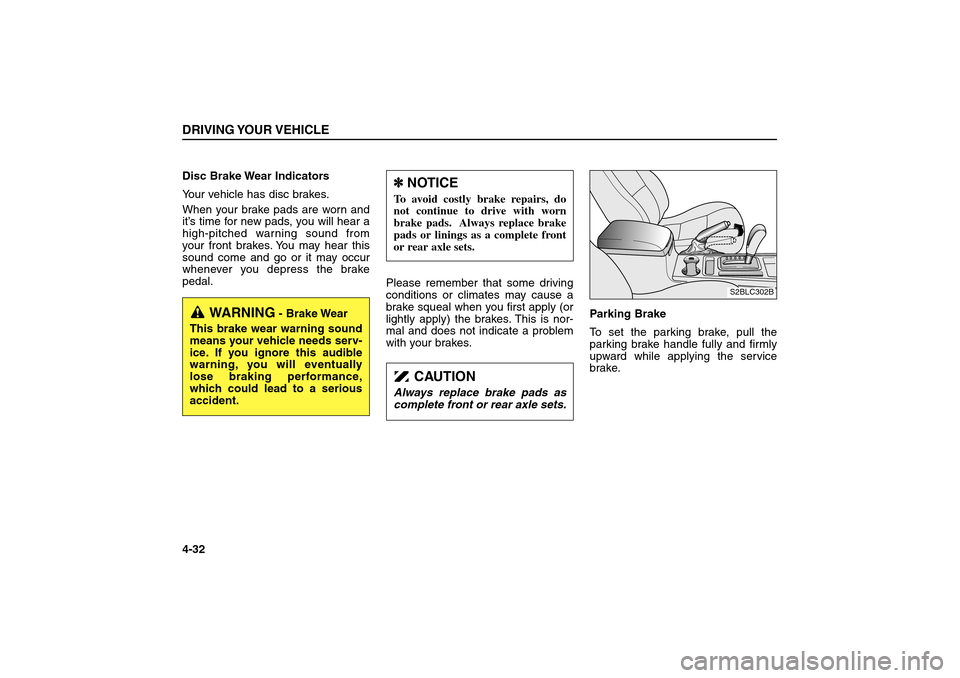
with your brakes.Parking Brake
To set the parking brake, pull the
parking brake handle fully and firmly
upward while applying the service
brake.DRIVING YOUR VEHICLE4-32
S2BLC302B
WARNING
- Brake Wear
This brake wear warning sound
means your vehicle needs serv-
ice. If you ignore this audible
warning, you will eventually
lose braking performance,
which could lead to a serious
accident.
✽ ✽
NOTICETo avoid costly brake repairs, do
not continue to drive with worn
brake pads. Always replace brake
pads or linings as a complete front
or rear axle sets.
CAUTION
Always replace brake pads as
complete front or rear axle sets.
BL-ENG (CAN)-4.qxd 7/28/05 5:55 PM Page 32
Page 132 of 312
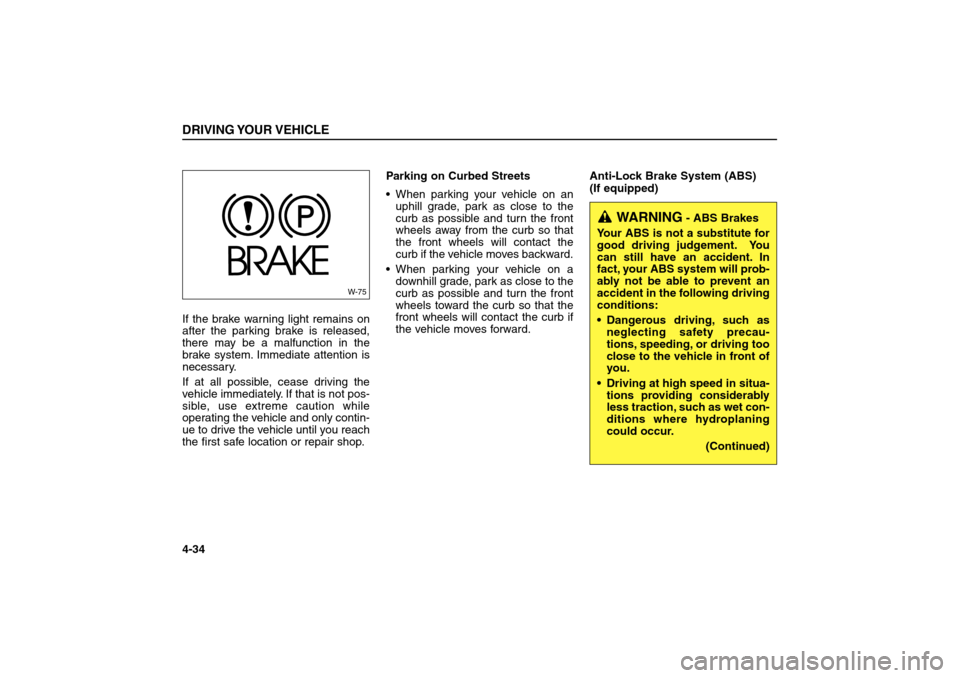
If the brake warning light remains on
after the parking brake is released,
there may be a malfunction in the
brake system. Immediate attention is
necessary.
If at all possible, cease driving the
vehicle immediately. If that is not pos-
sible, use extreme caution while
operating the vehicle and only contin-
ue to drive the vehicle until you reach
the first safe location or repair shop.Parking on Curbed Streets
When parking your vehicle on an
uphill grade, park as close to the
curb as possible and turn the front
wheels away from the curb so that
the front wheels will contact the
curb if the vehicle moves backward.
When parking your vehicle on a
downhill grade, park as close to the
curb as possible and turn the front
wheels toward the curb so that the
front wheels will contact the curb if
the vehicle moves forward.Anti-Lock Brake System (ABS)
(If equipped)DRIVING YOUR VEHICLE4-34
WARNING
- ABS Brakes
Your ABS is not a substitute for
good driving judgement. You
can still have an accident. In
fact, your ABS system will prob-
ably not be able to prevent an
accident in the following driving
conditions:
Dangerous driving, such as
neglecting safety precau-
tions, speeding, or driving too
close to the vehicle in front of
you.
Driving at high speed in situa-
tions providing considerably
less traction, such as wet con-
ditions where hydroplaning
could occur.
(Continued)
W-75
BL-ENG (CAN)-4.qxd 7/28/05 5:55 PM Page 34
Page 133 of 312
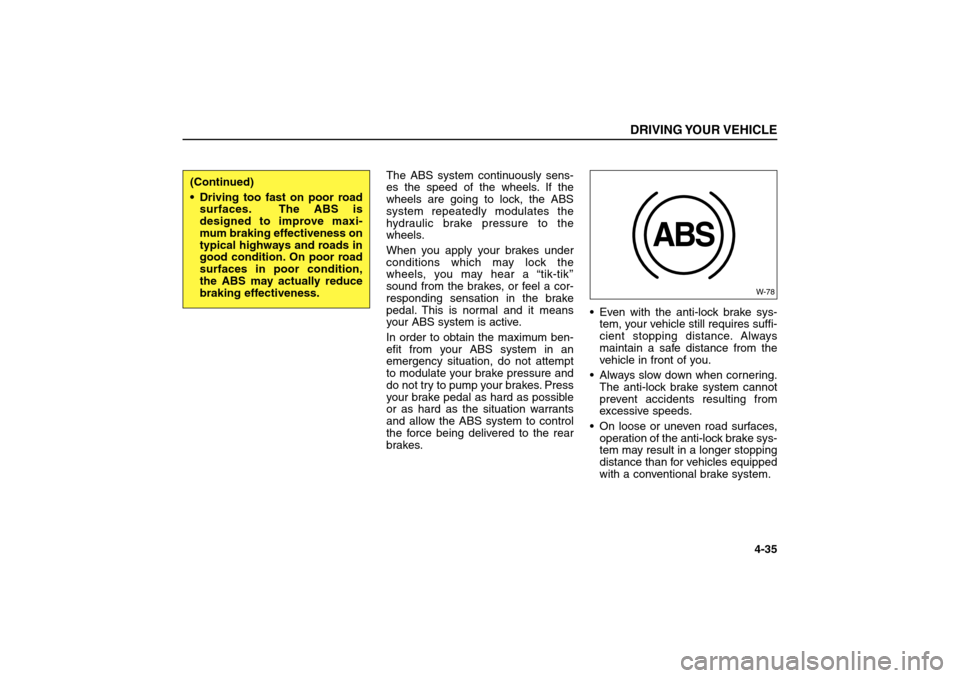
The ABS system continuously sens-
es the speed of the wheels. If the
wheels are going to lock, the ABS
system repeatedly modulates the
hydraulic brake pressure to the
wheels.
When you apply your brakes under
conditions which may lock the
wheels, you may hear a “tik-tik’’
sound from the brakes, or feel a cor-
responding sensation in the brake
pedal. This is normal and it means
your ABS system is active.
In order to obtain the maximum ben-
efit from your ABS system in an
emergency situation, do not attempt
to modulate your brake pressure and
do not try to pump your brakes. Press
your brake pedal as hard as possible
or as hard as the situation warrants
and allow the ABS system to control
the force being delivered to the rear
brakes.Even with the anti-lock brake sys-
tem, your vehicle still requires suffi-
cient stopping distance. Always
maintain a safe distance from the
vehicle in front of you.
Always slow down when cornering.
The anti-lock brake system cannot
prevent accidents resulting from
excessive speeds.
On loose or uneven road surfaces,
operation of the anti-lock brake sys-
tem may result in a longer stopping
distance than for vehicles equipped
with a conventional brake system.
DRIVING YOUR VEHICLE
4-35
ABS
W-78
(Continued)
Driving too fast on poor road
surfaces. The ABS is
designed to improve maxi-
mum braking effectiveness on
typical highways and roads in
good condition. On poor road
surfaces in poor condition,
the ABS may actually reduce
braking effectiveness.
BL-ENG (CAN)-4.qxd 7/28/05 5:55 PM Page 35
Page 134 of 312
DRIVING YOUR VEHICLE4-36
✽ ✽
NOTICEWhen you jump start your vehicle
because of a discharged battery, the
engine may not run as smoothly
and the ABS warning light may
blink at the same time. This hap-
pens because of the low battery
voltage. It does not mean your ABS
is malfunctioning.
Do not pump your brakes!
Have the battery recharged
before driving the vehicle.
✽ ✽
NOTICE If the ABS warning light is on and
stays on, you may have a problem
with the ABS system. In this case,
however, your regular brakes will
work normally.
The ABS warning light will stay
on for 2-3 seconds after the
engine starts. During that time,
the ABS will go through self-diag-
nosis and the light will go off if
everything is normal. If the light
stays on, you may have a problem
with your ABS system. Contact
an authorized Kia dealer as soon
as possible.
✽ ✽
NOTICE When you drive on a road having
poor traction, such as an icy road,
and operate your brakes continu-
ously, the ABS will be active con-
tinuously and the ABS warning
light may illuminate. Pull your
car over to a safe place and stop
the engine.
Restart the engine. If the ABS
warning light is off, then your
ABS system is normal.
Otherwise, you may have a prob-
lem with the ABS. Contact an
authorized Kia dealer as soon as
possible.
BL-ENG (CAN)-4.qxd 7/28/05 5:55 PM Page 36
Page 145 of 312
Parking Brake & Brake
Fluid Warning
Parking brake warning
This light is illuminated when the
parking brake is applied with the igni-
tion switch in the START or ON posi-
tion. The warning light should go off
when the parking brake is released.Low brake fluid level warning
If the warning light remains on, it may
indicate that the brake fluid level in
the reservoir is low.
If the warning light remains on:
1. Drive carefully to the nearest safe
location and stop your vehicle.
2. With the engine stopped, check
the brake fluid level immediately
and add fluid as required. Then
check all brake components for
fluid leaks.
3. Do not drive the vehicle if leaks are
found, the warning light remains on
or the brakes do not operate prop-
erly. Have it towed to any
Authorized Kia Dealer for a brake
system inspection and necessary
repairs.To check bulb operation, check
whether the parking brake and brake
fluid warning light illuminates when
the ignition switch is in the ON posi-
tion
DRIVING YOUR VEHICLE
4-47
WARNING
Driving the vehicle with a warn-
ing light on is dangerous. If the
brake warning light remains on,
have the brakes checked and
repaired immediately by an
Authorized Kia Dealer.
BL-ENG (CAN)-4.qxd 7/28/05 5:55 PM Page 47
Page 193 of 312
SUGGESTIONS FOR
ECONOMICAL OPERATIONYour vehicle’s fuel economy depends
mainly on your style of driving, where
you drive and when you drive.
Each of these factors affects how
many miles (kilometers) you can get
from a gallon (liter) of fuel. To operate
your vehicle as economically as pos-
sible, use the following driving sug-
gestions to help save money in both
fuel and repairs:
Avoid lengthy warm-up idling. Once
the engine is running smoothly,
begin driving. Remember, engine
warm-up may take a little longer on
cold days.
Save fuel by accelerating slowly
after stopping.
Keep the engine in tune and follow
the recommended periodic mainte-
nance schedule. This will increase
the life of all parts and lower your
operating costs. Do not use the air conditioner
unnecessarily.
Slow down when driving on rough
roads.
For longer tire life and better fuel
economy, always keep the tires
inflated to the recommended pres-
sures.
Maintain a safe distance from other
vehicles to avoid sudden stops.
This will reduce wear on brake lin-
ings and pads. Driving in such a
way will also save fuel because
extra fuel is required to accelerate
back to driving speed.
Do not carry unnecessary weight in
the vehicle.
Do not rest your foot on the brake
pedal while driving. This can cause
needless wear, possible damage to
the brakes, and poor fuel economy. Improper wheel alignment results
in faster tire wear and lower fuel
economy.
Open windows at high speeds can
reduce fuel economy.
Fuel economy is less in crosswinds
and headwinds. To help offset
some of this loss, slow down when
driving in these conditions.
Keeping a vehicle in good operating
condition is important both for econo-
my and safety. Therefore, have an
authorized Kia dealer perform sched-
uled inspections and maintenance.DRIVING TIPS5-6
BL-ENG (CAN)-5.qxd 7/28/05 5:56 PM Page 6
Page 194 of 312
DRIVING TIPS
5-7
WARNING - Engine off During Motion
Never turn the engine off while
the vehicle is in motion. The
power steering and power
brakes will not work with the
engine off. Instead of coasting
downhill with the engine off,
downshift to an appropriate
gear for engine braking effect.
BL-ENG (CAN)-5.qxd 7/28/05 5:56 PM Page 7
Page 197 of 312
Driving in the Rain
Rain and wet roads can make driving
dangerous, especially if you’re not
prepared for the slick pavement. Here
are a few things to consider when
driving in the rain:
A heavy rainfall will make it harder
to see and will increase the dis-
tance needed to stop your vehicle,
so slow down.
Keep your windshield wiping equip-
ment in good shape. Replace your
windshield wiper blades when they
show signs of streaking or missing
areas on the windshield.
If your tires are not in good condi-
tion, making a quick stop on wet
pavement can cause a skid and
possibly lead to an accident. Be
sure your tires are in good shape. Turn on your headlights to make it
easier for others to see you.
Driving too fast through large pud-
dles can affect your brakes. If you
must go through puddles, try to
drive through them slowly.
If you believe your brakes may have
become wet, apply them lightly
while driving until normal braking
operation returns.Winter Driving
We recommend that you carry
emergency equipment, including
tire chains, a window scraper, wind-
shield de-icer, a bag of sand or salt,
flares, a small shovel and jumper
cables.
Make sure you have sufficient eth-
ylene-glycol coolant in the radiator.
Check the battery condition and
cables. Cold temperatures reduce
the capacity of any battery, so it
must be in excellent condition to
provide enough winter starting
power.
Make sure the engine oil viscosity
is suitable for cold weather.
Check the ignition system for loose
connections and damage.DRIVING TIPS5-10
BL-ENG (CAN)-5.qxd 7/28/05 5:56 PM Page 10
Page 199 of 312
Driving in Flooded Areas
Avoid driving through flooded areas
unless you are sure the water is no
higher than the bottom of the wheel
hub. Drive through any water slowly.
Allow adequate stopping distance
because brake performance may be
affected.
After driving through water, dry the
brakes by gently applying them sev-
eral times while the vehicle is moving
slowly.Reducing the Risk of a Rollover
This multi-purpose passenger vehicle
is defined as a Sports Utility Vehicle
(SUV). SUV’s have higher ground
clearance and a narrower track to
make them capable of performing in
a wide variety of off-road applica-
tions. Specific design characteristics
give them a higher center of gravity
than ordinary cars. An advantage of
the higher ground clearance is a bet-
ter view of the road, which allows you
to anticipate problems. They are not
designed for cornering at the same
speeds as conventional passenger
drive vehicles, any more than low-rid-
ing sports cars are designed to per-
form satisfactorily in off-road condi-
tions. Due to this risk, driver and pas-
sengers are strongly recommended
to buckle their seatbelts.In a rollover crash, an unbelted per-
son is more likely to die than a person
wearing a seatbelt. There are steps
that a driver can make to reduce the
risk of a rollover. If at all possible,
avoid sharp turns or abrupt maneu-
vers, do not load your roof rack with
heavy cargo, and never modify your
vehicle in any way.DRIVING TIPS5-12
BL-ENG (CAN)-5.qxd 7/28/05 5:56 PM Page 12