emergency towing KIA Sorento 2006 1.G Owner's Manual
[x] Cancel search | Manufacturer: KIA, Model Year: 2006, Model line: Sorento, Model: KIA Sorento 2006 1.GPages: 312, PDF Size: 5.21 MB
Page 233 of 312
6-1
IN CASE OF AN EMERGENCYRoad Warning . . . . . . . . . . . . . . . . . . . . . . . . . . . . . . . . . . . . . 6-2
Overheating . . . . . . . . . . . . . . . . . . . . . . . . . . . . . . . . . . . . . . 6-3
Emergency Starting . . . . . . . . . . . . . . . . . . . . . . . . . . . . . . . . 6-4
Electrical Circuit Protection . . . . . . . . . . . . . . . . . . . . . . . . . . 6-7
Towing . . . . . . . . . . . . . . . . . . . . . . . . . . . . . . . . . . . . . . . . . 6-13
If You Have a Flat Tire . . . . . . . . . . . . . . . . . . . . . . . . . . . . . . 6-19
6
BL-ENG (CAN)-6.qxd 7/28/05 5:57 PM Page 1
Page 236 of 312
EMERGENCY STARTINGJump Starting
Jump starting can be dangerous if
done incorrectly. Therefore, to avoid
harm to yourself or damage to your
vehicle or battery, follow the jump
starting procedures on this page. If in
doubt, we strongly recommend that
you have a competent technician or
towing service jump start your vehi-
cle.Jump starting procedure
1. Make sure the booster battery is
12-volt and that its negative termi-
nal is grounded.
2. If the booster battery is in another
vehicle, do not allow the vehicles to
touch.IN CASE OF AN EMERGENCY6-4✽ ✽
NOTICEUse only a 12-volt jumper system.
You can damage a 12-volt starting
motor, ignition system, and other
electrical parts beyond repair by
use of a 24-volt power supply
(either two 12-volt batteries in
series or a 24-volt motor generator
set).
WARNING
- Battery
Never attempt to check the elec-
trolyte level of the battery as
this may cause the battery to
rupture or explode causing seri-
ous injury.
WARNING
- Battery
• Keep all flames or sparks
away from the battery. The
battery produces hydrogen
gas which may explode if
exposed to flame or sparks.
Do not attempt to jump start
the vehicle if the discharged
battery is frozen or if the elec-
trolyte level is low; the battery
may rupture or explode.
BL-ENG (CAN)-6.qxd 7/28/05 5:57 PM Page 4
Page 245 of 312
TOWING If emergency towing is necessary, we
recommend having it done by an
Authorized Kia Dealer or a commer-
cial tow-truck service. Proper lifting
and towing procedures are neces-
sary to prevent damage to the vehi-
cle. Provincial and local laws applica-
ble to towing vehicles must be fol-
lowed. As a general rule, towed vehi-
cles should be pulled with the driving
wheels off the ground. If excessive
damage or other conditions prevent
towing the vehicle with the driving
wheels of the ground, use wheel dol-
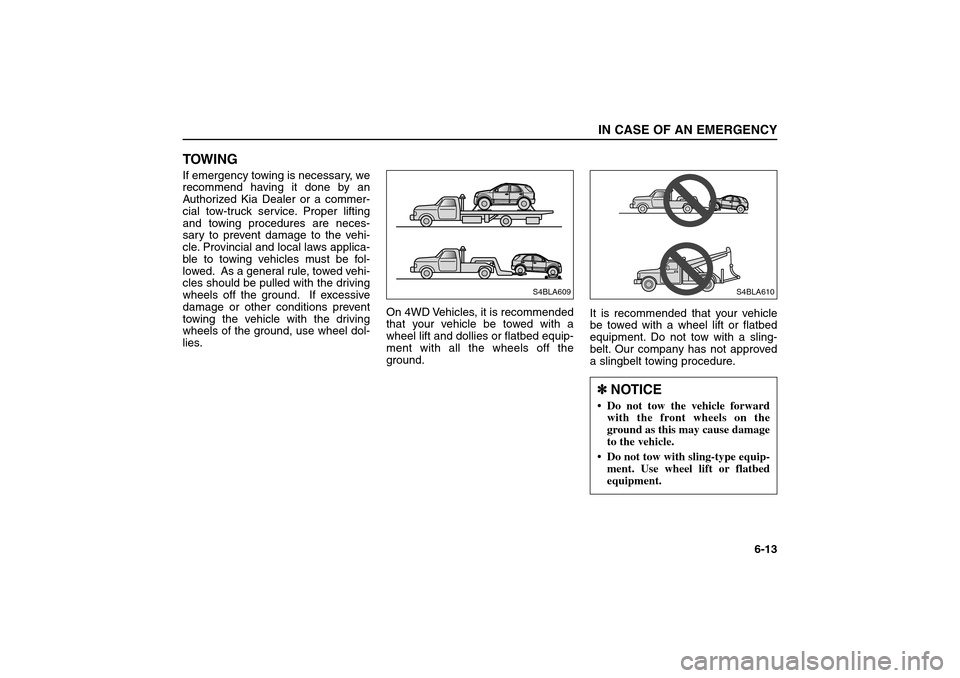
lies.On 4WD Vehicles, it is recommended
that your vehicle be towed with a
wheel lift and dollies or flatbed equip-
ment with all the wheels off the
ground.It is recommended that your vehicle
be towed with a wheel lift or flatbed
equipment. Do not tow with a sling-
belt. Our company has not approved
a slingbelt towing procedure.
IN CASE OF AN EMERGENCY
6-13
S4BLA609
S4BLA610
✽ ✽
NOTICE• Do not tow the vehicle forward
with the front wheels on the
ground as this may cause damage
to the vehicle.
Do not tow with sling-type equip-
ment. Use wheel lift or flatbed
equipment.
BL-ENG (CAN)-6.qxd 7/28/05 5:57 PM Page 13
Page 246 of 312
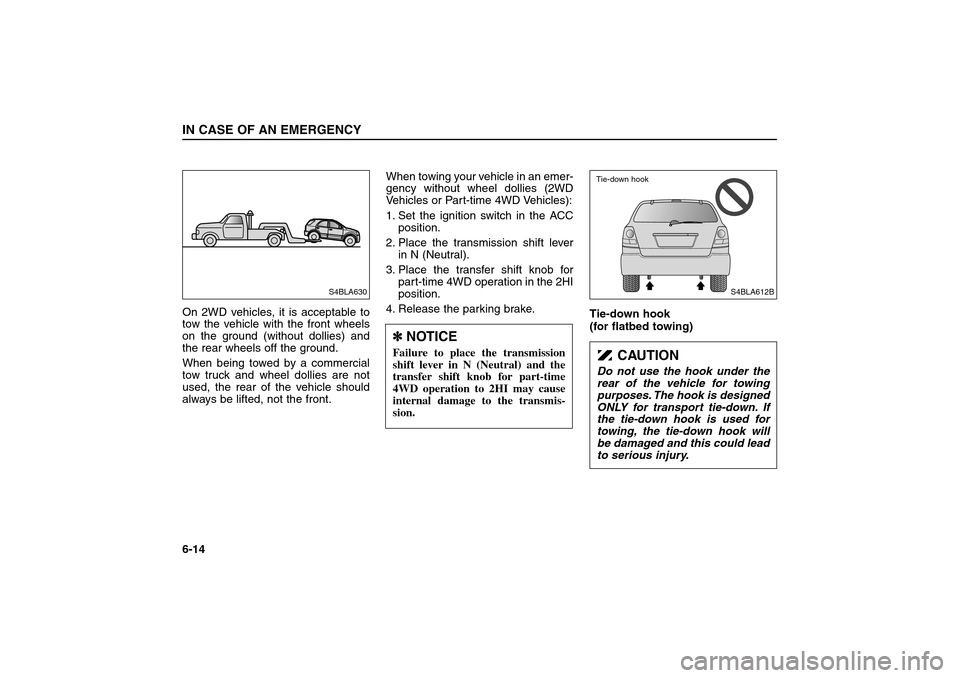
On 2WD vehicles, it is acceptable to
tow the vehicle with the front wheels
on the ground (without dollies) and
the rear wheels off the ground.
When being towed by a commercial
tow truck and wheel dollies are not
used, the rear of the vehicle should
always be lifted, not the front.When towing your vehicle in an emer-
gency without wheel dollies (2WD
Vehicles or Part-time 4WD Vehicles):
1. Set the ignition switch in the ACC
position.
2. Place the transmission shift lever
in N (Neutral).
3. Place the transfer shift knob for
part-time 4WD operation in the 2HI
position.
4. Release the parking brake.
Tie-down hook
(for flatbed towing)IN CASE OF AN EMERGENCY6-14
S4BLA630
S4BLA612B
✽ ✽
NOTICEFailure to place the transmission
shift lever in N (Neutral) and the
transfer shift knob for part-time
4WD operation to 2HI may cause
internal damage to the transmis-
sion.
CAUTION
Do not use the hook under the
rear of the vehicle for towing
purposes. The hook is designed
ONLY for transport tie-down. If
the tie-down hook is used for
towing, the tie-down hook will
be damaged and this could lead
to serious injury.Tie-down hook
BL-ENG (CAN)-6.qxd 7/28/05 5:57 PM Page 14
Page 247 of 312
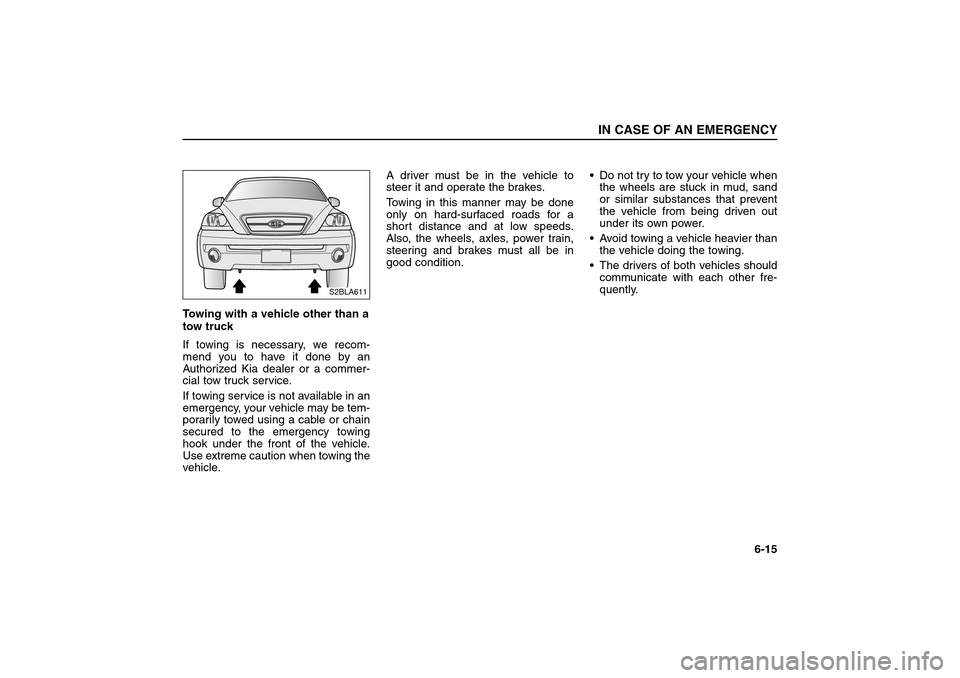
Towing with a vehicle other than a
tow truck
If towing is necessary, we recom-
mend you to have it done by an
Authorized Kia dealer or a commer-
cial tow truck service.
If towing service is not available in an
emergency, your vehicle may be tem-
porarily towed using a cable or chain
secured to the emergency towing
hook under the front of the vehicle.
Use extreme caution when towing the
vehicle.A driver must be in the vehicle to
steer it and operate the brakes.
Towing in this manner may be done
only on hard-surfaced roads for a
short distance and at low speeds.
Also, the wheels, axles, power train,
steering and brakes must all be in
good condition.Do not try to tow your vehicle when
the wheels are stuck in mud, sand
or similar substances that prevent
the vehicle from being driven out
under its own power.
Avoid towing a vehicle heavier than
the vehicle doing the towing.
The drivers of both vehicles should
communicate with each other fre-
quently.
IN CASE OF AN EMERGENCY
6-15
S2BLA611
BL-ENG (CAN)-6.qxd 7/28/05 5:57 PM Page 15
Page 248 of 312
Before emergency towing, check
that the hook is not broken or dam-
aged.
Fasten the towing cable or chain
securely to the hook.
Do not jerk the hook. Apply steady
and even force.
To avoid damaging the hook, do not
pull from the side or at a vertical
angle. Always pull straight ahead.
IN CASE OF AN EMERGENCY6-16
✽ ✽
NOTICE Attach a towing strap to the tow
hook.
Using a portion of the vehicle
other than the tow hooks for tow-
ing may damage the body of your
vehicle.
Use only a cable or chain specifi-
cally intended for use in towing
vehicles. Securely fasten the cable
or chain to the towing hook pro-
vided.
CAUTION
Use extreme caution when tow-
ing the vehicle.
Avoid sudden starts or erratic
driving maneuvers which
would place excessive stress
on the emergency towing
hook and towing cable or
chain. The hook and towing
cable or chain may break and
cause serious injury or dam-
age.
If the towing vehicle can hard-
ly move, do not forcibly con-
tinue the towing. Contact an
Authorized Kia dealer or a
commercial tow truck service
for assistance.
Tow the vehicle as straight
ahead as possible.
Keep away from the vehicle
during towing.
BL-ENG (CAN)-6.qxd 7/28/05 5:57 PM Page 16
Page 249 of 312
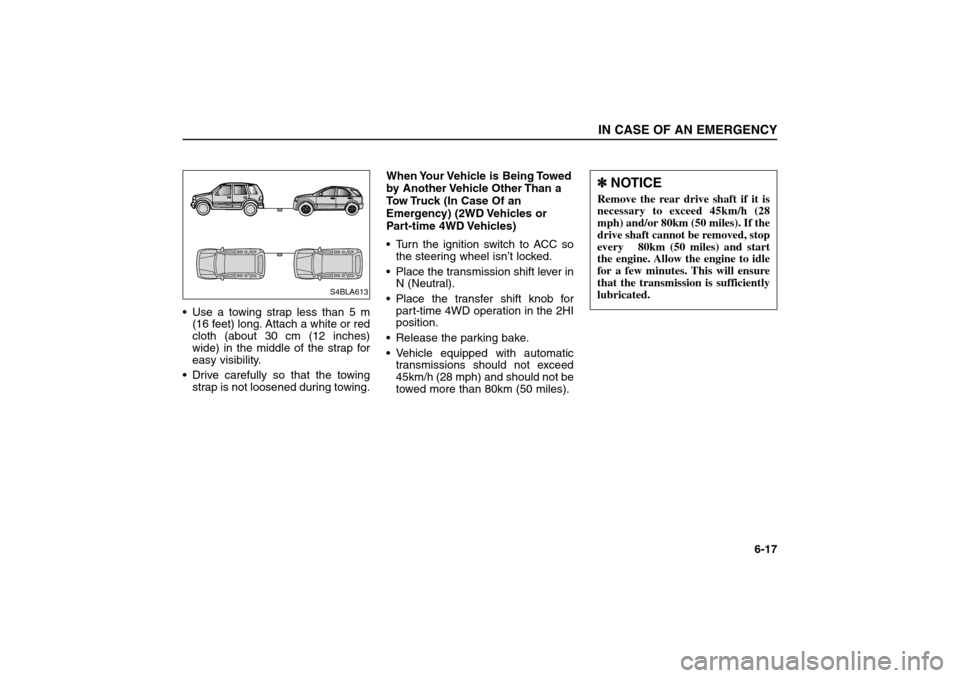
Use a towing strap less than 5 m
(16 feet) long. Attach a white or red
cloth (about 30 cm (12 inches)
wide) in the middle of the strap for
easy visibility.
Drive carefully so that the towing
strap is not loosened during towing.When Your Vehicle is Being Towed
by Another Vehicle Other Than a
Tow Truck (In Case Of an
Emergency) (2WD Vehicles or
Part-time 4WD Vehicles)
Turn the ignition switch to ACC so
the steering wheel isn’t locked.
Place the transmission shift lever in
N (Neutral).
Place the transfer shift knob for
part-time 4WD operation in the 2HI
position.
Release the parking bake.
Vehicle equipped with automatic
transmissions should not exceed
45km/h (28 mph) and should not be
towed more than 80km (50 miles).
IN CASE OF AN EMERGENCY
6-17
S4BLA613
✽ ✽
NOTICERemove the rear drive shaft if it is
necessary to exceed 45km/h (28
mph) and/or 80km (50 miles). If the
drive shaft cannot be removed, stop
every 80km (50 miles) and start
the engine. Allow the engine to idle
for a few minutes. This will ensure
that the transmission is sufficiently
lubricated.
BL-ENG (CAN)-6.qxd 7/28/05 5:57 PM Page 17
Page 250 of 312
Press the brake pedal with more
force than normal since you will
have reduced brake performance.
More steering effort will be required
because the power steering system
will be disabled.
If you are driving down a long hill,
the brakes may overheat and brake
performance will be reduced. Stop
often and let the brakes cool off.Tips for towing a stuck vehicle
The following methods are effective
when your vehicle is stuck in mud,
sand or similar substances that pre-
vent the vehicle from being driven out
under its own power.
Remove the soil and sand, etc.
from the front and the back of the
tires.
Place a stone or wood under the
tires.IN CASE OF AN EMERGENCY6-18✽ ✽
NOTICETo prevent internal damage to the
transmission, never tow your vehi-
cle from the rear (backwards) with
all four tires in contact with the sur-
face.
BL-ENG (CAN)-6.qxd 7/28/05 5:57 PM Page 18
Page 253 of 312
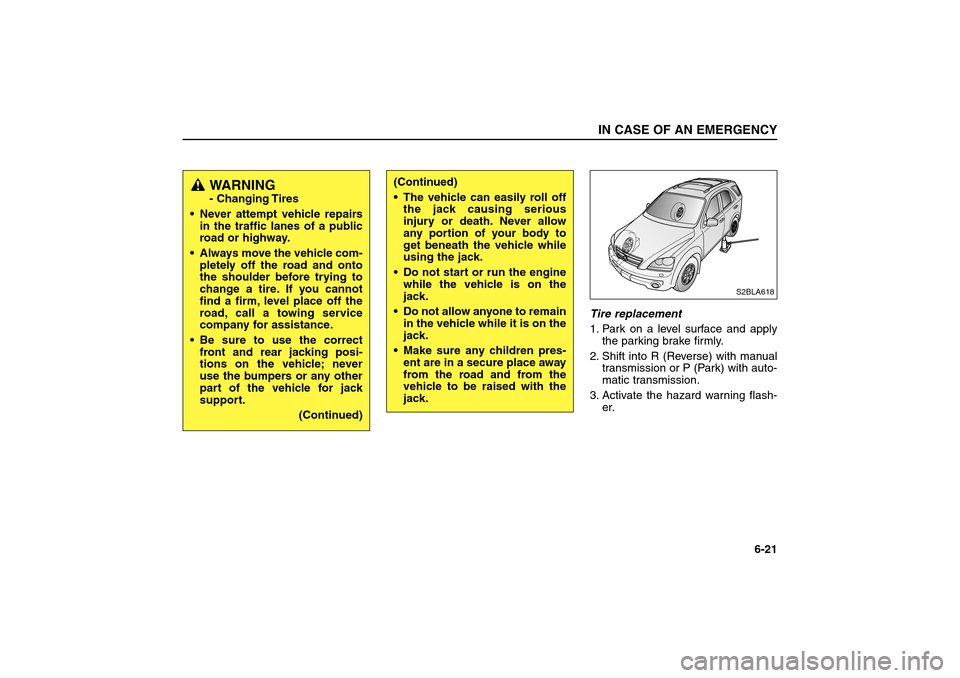
Tire replacement
1. Park on a level surface and apply
the parking brake firmly.
2. Shift into R (Reverse) with manual
transmission or P (Park) with auto-
matic transmission.
3. Activate the hazard warning flash-
er.IN CASE OF AN EMERGENCY
6-21
S2BLA618
WARNING- Changing Tires
Never attempt vehicle repairs
in the traffic lanes of a public
road or highway.
Always move the vehicle com-
pletely off the road and onto
the shoulder before trying to
change a tire. If you cannot
find a firm, level place off the
road, call a towing service
company for assistance.
Be sure to use the correct
front and rear jacking posi-
tions on the vehicle; never
use the bumpers or any other
part of the vehicle for jack
support.
(Continued)
(Continued)
The vehicle can easily roll off
the jack causing serious
injury or death. Never allow
any portion of your body to
get beneath the vehicle while
using the jack.
Do not start or run the engine
while the vehicle is on the
jack.
Do not allow anyone to remain
in the vehicle while it is on the
jack.
Make sure any children pres-
ent are in a secure place away
from the road and from the
vehicle to be raised with the
jack.
BL-ENG (CAN)-6.qxd 7/28/05 5:57 PM Page 21