ESP KIA Sorento 2006 1.G Owner's Guide
[x] Cancel search | Manufacturer: KIA, Model Year: 2006, Model line: Sorento, Model: KIA Sorento 2006 1.GPages: 312, PDF Size: 5.21 MB
Page 186 of 312
WINDSHIELD DEFROSTING
AND DEFOGGING
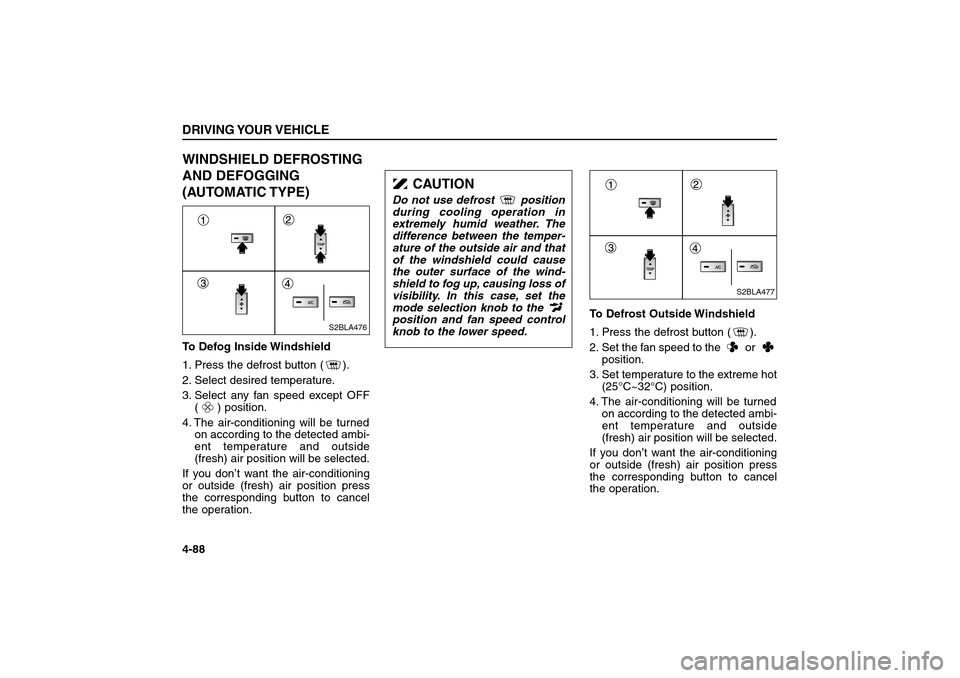
(AUTOMATIC TYPE)To Defog Inside Windshield
1. Press the defrost button ( ).
2. Select desired temperature.
3. Select any fan speed except OFF
( ) position.
4. The air-conditioning will be turned
on according to the detected ambi-
ent temperature and outside
(fresh) air position will be selected.
If you don’t want the air-conditioning
or outside (fresh) air position press
the corresponding button to cancel
the operation.To Defrost Outside Windshield
1. Press the defrost button ( ).
2. Set the fan speed to the or
position.
3. Set temperature to the extreme hot
(25°C~32°C) position.
4. The air-conditioning will be turned
on according to the detected ambi-
ent temperature and outside
(fresh) air position will be selected.
If you don’t want the air-conditioning
or outside (fresh) air position press
the corresponding button to cancel
the operation.DRIVING YOUR VEHICLE4-88
S2BLA476
S2BLA477
CAUTION
Do not use defrost position
during cooling operation in
extremely humid weather. The
difference between the temper-
ature of the outside air and that
of the windshield could cause
the outer surface of the wind-
shield to fog up, causing loss of
visibility. In this case, set the
mode selection knob to the
position and fan speed control
knob to the lower speed.
BL-ENG (CAN)-4.qxd 7/28/05 5:56 PM Page 88
Page 196 of 312
Rocking the Vehicle
If it is necessary to rock the vehicle to
free it from snow, sand, or mud, first
turn the steering wheel right and left
to clear the area around your front
wheels. Then, shift back and forth
between 1 (First) and R (Reverse) in
vehicles equipped with a manual
transmission or R (Reverse) and any
forward gear in vehicles equipped
with an automatic transmission. Do
not race the engine, and spin the
wheels as little as possible. If you are
still stuck after a few tries, have the
vehicle pulled out by a tow vehicle to
avoid engine overheating and possi-
ble damage to the transmission,
transfer case (if equipped), or differ-
ential.Driving at Night
Because night driving presents many
more hazards than driving in the day-
light, here are some important tips to
remember:
Slow down and keep more distance
between you and other vehicles, as
it may be more difficult to see at
night, especially in areas where
there may not be any street lights.
Adjust your mirrors to reduce the
glare from other driver’s headlights.
Keep your headlights clean and
properly aimed. Dirty or improperly
aimed headlights will make it much
more difficult to see at night.
Avoid staring directly at the head-
lights of oncoming vehicles. You
could be temporarily blinded, and it
will take several seconds for your
eyes to readjust to the darkness.
DRIVING TIPS
5-9
✽ ✽
NOTICEProlonged rocking may cause
engine over-heating, transmission
or transfer case (if equipped) dam-
age or failure, and tire damage.
WARNING- Spinning Tires
Do not spin the wheels, espe-
cially at speeds more than 35
mph (56 km/h). Spinning the
wheels at high speeds when the
vehicle is stationary could
cause a tire to overheat,
explode and injure bystanders.
BL-ENG (CAN)-5.qxd 7/28/05 5:56 PM Page 9
Page 197 of 312
Driving in the Rain
Rain and wet roads can make driving
dangerous, especially if you’re not
prepared for the slick pavement. Here
are a few things to consider when
driving in the rain:
A heavy rainfall will make it harder
to see and will increase the dis-
tance needed to stop your vehicle,
so slow down.
Keep your windshield wiping equip-
ment in good shape. Replace your
windshield wiper blades when they
show signs of streaking or missing
areas on the windshield.
If your tires are not in good condi-
tion, making a quick stop on wet
pavement can cause a skid and
possibly lead to an accident. Be
sure your tires are in good shape. Turn on your headlights to make it
easier for others to see you.
Driving too fast through large pud-
dles can affect your brakes. If you
must go through puddles, try to
drive through them slowly.
If you believe your brakes may have
become wet, apply them lightly
while driving until normal braking
operation returns.Winter Driving
We recommend that you carry
emergency equipment, including
tire chains, a window scraper, wind-
shield de-icer, a bag of sand or salt,
flares, a small shovel and jumper
cables.
Make sure you have sufficient eth-
ylene-glycol coolant in the radiator.
Check the battery condition and
cables. Cold temperatures reduce
the capacity of any battery, so it
must be in excellent condition to
provide enough winter starting
power.
Make sure the engine oil viscosity
is suitable for cold weather.
Check the ignition system for loose
connections and damage.DRIVING TIPS5-10
BL-ENG (CAN)-5.qxd 7/28/05 5:56 PM Page 10
Page 202 of 312
Driving on a Hill (“4LO” for Part-
time 4WD Operation or “LOW” for
Full-time 4WD operation)
Use low gear when going uphill or
downhill and avoid sudden braking.
Do not shift gears or use your
clutch when going downhill. Do not
coast downhill in Neutral.Crossing a Ditch (“4LO” for Part-
time 4WD Operation or “LOW” for
Full-time 4WD operation)
Avoid driving through ditches if pos-
sible, especially if there is water in
the ditch. Your vehicle may stall if
the electrical system gets wet. If
you must cross a ditch, shift the
transfer knob to 4LO or LOW.
Avoid driving where the water level
is higher than the bottom of the
wheel hub. If the water level rises
above this mark, your vehicle will
need to be serviced.
Tap lightly on the brake pedal dur-
ing and after driving through water.
This will help keep the brakes dry
and in proper working order.
Do not shift gears while crossing a
ditch.Tight Corner Brake Effect
This is called tight corner brake
effect. Tight corner brake effect is a
unique characteristic of four-wheel
drive vehicles caused by the differ-
ence in tire rotation at the four wheels
and the zero-degree alignment of the
front wheels and suspension.
Sharp turns at low speeds should be
carried out with caution.
DRIVING TIPS
5-15
CAUTION
When turning sharply on a paved
road at low speed while in four-
wheel drive, steering control will be
difficult.
BL-ENG (CAN)-5.qxd 7/28/05 5:56 PM Page 15
Page 205 of 312
Traveling to Remote Areas
It makes sense to plan your trip,
especially when going to a remote
area. Know the terrain and plan your
route. You are much less likely to
encounter unwanted surprises. Get
accurate maps of trails.
It’s also a good idea to travel with at
least one other vehicle. If something
happens to one of them, the other
can quickly help.Getting Familiar with Off-Road
Driving
It’s necessary for you to practice in an
area that’s safe and close to home
before you begin serious off-road
driving. Off-road driving requires new
and different driving skills.
You need to tune your senses to dif-
ferent kinds of signals. For example,
constantly sweep the terrain with
your eyes looking for unexpected
obstacles. Listen for unusual tire,
gear, or engine sounds. Feel and
respond to the vibrations of the vehi-
cle with your hands, feet, and body
while still carefully controlling your
vehicle. You’ll also need to adjust your
expectations and greatly lower the
number of miles you expect to cover
in an hour or a day.Controlling your vehicle is the key to
successful off-road driving. One of
the best ways to control your vehicle
is to control your speed. Here are
some things to keep in mind when
traveling at higher speeds:
You approach things faster and you
have less time to scan the terrain
for obstacles.
You have less time to react.
You have much more vehicle
bounce when you drive over obsta-
cles, giving you less vehicle control.
You’ll need more distance for brak-
ing, especially since you’re on an
unpaved surface. Such terrain will
always be more “slippery” than a
paved road.DRIVING TIPS5-18
BL-ENG (CAN)-5.qxd 7/28/05 5:56 PM Page 18
Page 207 of 312
When you drive over bumps, rocks,
or other obstacles, your wheels can
leave the ground. If this happens,
even with one or two wheels, you
can’t control the vehicle as well or
perhaps at all. Because you will be on
an unpaved surface, it’s especially
important to avoid sudden accelera-
tion, sudden turns, or sudden brak-
ing. Any of these actions could cause
the center of gravity of the vehicle to
shift and destabilize the vehicle, lead-
ing to a collision or rollover accident.
Off-road driving requires a different
kind of alertness from driving on
paved roads and highways. There are
no road signs, posted speed limits or
signal lights. You have to use your
own judgment about what is safe and
what isn’t. Bad judgment in this
uncontrolled environment can be
fatal.Driving on Off-Road Hills
Off-road driving often takes you up,
down, or across a hill. Driving safely
on hills requires excellent judgment
and an understanding of what your
vehicle can and can’t do. There are
some hills that simply should not be
driven.DRIVING TIPS5-20
WARNING- Drinking & Driving
Drinking and driving, or drug
use and driving can be very
dangerous on any road. This
certainly remains true for off-
road driving. At the very time
you need special alertness and
driving skills, your reflexes, per-
ceptions and judgement can be
affected by even a small amount
of alcohol or drugs. You could
have a serious - or even fatal -
accident if you drink or take
drugs and drive or ride with a
driver who has been drinking or
taking drugs.
BL-ENG (CAN)-5.qxd 7/28/05 5:56 PM Page 20
Page 225 of 312
Trailer brakes
If your trailer weighs more than 750
kg (1,650 pounds) loaded, then it
needs its own brakes – and they must
be adequate. Be sure to read and fol-
low the instructions for the trailer
brakes so you’ll be able to install,
adjust and maintain them properly.
Don’t tap into your vehicle’s brake
system.
Do not use a trailer with its own
brakes unless you are absolutely
certain that you have properly set
up the brake system. This is not a
task for amateurs. Use an experi-
enced, competent trailer shop for
this work.Driving with a trailer
Towing a trailer requires a certain
amount of experience. Before setting
out for the open road, you must get to
know your trailer. Acquaint yourself
with the feel of handling and braking
with the added weight of the trailer.
And always keep in mind that the
vehicle you are driving is now a good
deal longer and not nearly so respon-
sive as your vehicle is by itself.
Before you start, check the trailer
hitch and platform, safety chains,
electrical connector(s), lights, tires
and mirror adjustment. If the trailer
has electric brakes, start your vehicle
and trailer moving and then apply the
trailer brake controller by hand to be
sure the brakes are working. This lets
you check your electrical connection
at the same time.
During your trip, check occasionally
to be sure that the load is secure, and
that the lights and any trailer brakes
are still working.Following distance
Stay at least twice as far behind the
vehicle ahead as you would when
driving your vehicle without a trailer.
This can help you avoid situations
that require heavy braking and sud-
den turns.
Passing
You’ll need more passing distance up
ahead when you’re towing a trailer.
And, because you’re a good deal
longer, you’ll need to go much farther
beyond the passed vehicle before
you can return to your lane.DRIVING TIPS5-38
BL-ENG (CAN)-5.qxd 7/28/05 5:56 PM Page 38
Page 259 of 312
MAINTENANCE SERVICESYou should exercise the utmost care
to prevent both damage to your vehi-
cle and injury to yourself whenever
performing any maintenance or
inspection procedures.
Should you have any doubts con-
cerning the inspection or servicing of
your vehicle, we strongly recommend
that you have an authorized Kia
Dealer perform this work.
An authorized Kia dealer has factory-
trained technicians and genuine Kia
parts to service your vehicle properly.
For expert advice and quality service,
see an authorized Kia dealer.
Inadequate, incomplete or insufficient
servicing may result in operational
problems with your vehicle that could
lead to vehicle damage, an accident,
or personal injury.Owner’s Responsibility
You should retain documents that
show proper maintenance has been
performed on your vehicle in accor-
dance with the scheduled mainte-
nance service charts shown on the
following pages. You need this infor-
mation to establish your compliance
with the servicing and maintenance
requirements of your Kia warranties.Detailed warranty information is pro-
vided in your Warranty and
Consumer Information Manual.
Repairs and adjustments required as
a result of improper maintenance or a
lack of required maintenance are not
covered.
We strongly recommend that all vehi-
cle maintenance be performed by an
authorized Kia dealer using genuine
Kia parts.MAINTENANCE7-2
✽ ✽
NOTICEMaintenance Service and Record
Retention are the owner’s responsi-
bility.
BL-ENG (CAN)-7.qxd 7/28/05 5:58 PM Page 2
Page 283 of 312
TIRES AND WHEELSTire Care
For proper maintenance, safety, and
maximum fuel economy, you must
always maintain the recommended
tire inflation pressures and stay with-
in the load limits and weight distribu-
tion recommended for your vehicle.
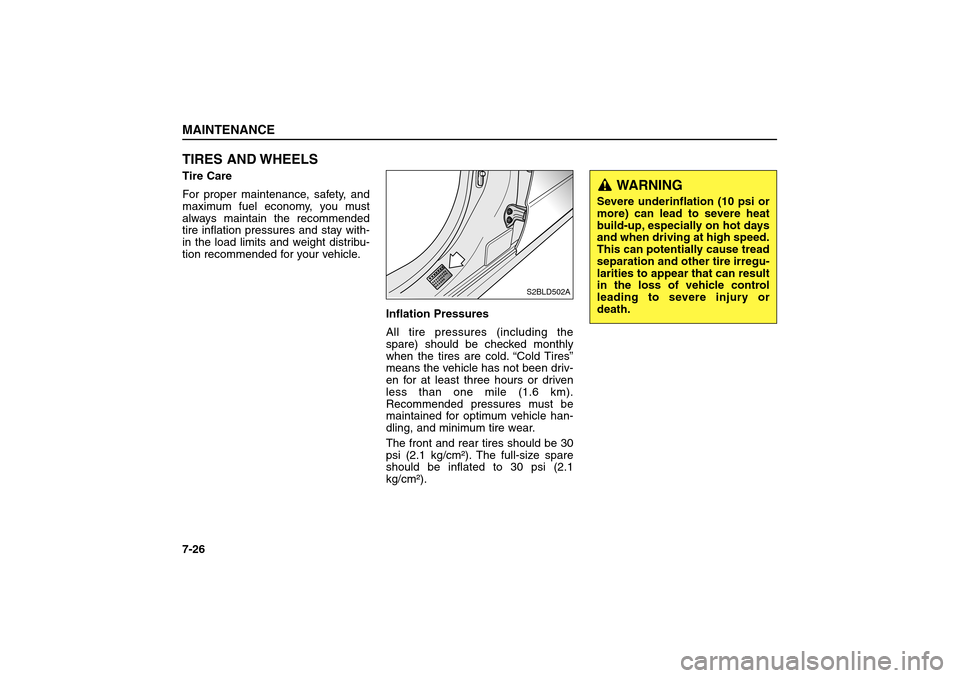
Inflation Pressures
All tire pressures (including the
spare) should be checked monthly
when the tires are cold.“Cold Tires”
means the vehicle has not been driv-
en for at least three hours or driven
less than one mile (1.6 km).
Recommended pressures must be
maintained for optimum vehicle han-
dling, and minimum tire wear.
The front and rear tires should be 30
psi (2.1 kg/cm²). The full-size spare
should be inflated to 30 psi (2.1
kg/cm²).MAINTENANCE7-26
S2BLD502A
WARNING
Severe underinflation (10 psi or
more) can lead to severe heat
build-up, especially on hot days
and when driving at high speed.
This can potentially cause tread
separation and other tire irregu-
larities to appear that can result
in the loss of vehicle control
leading to severe injury or
death.
BL-ENG (CAN)-7.qxd 7/28/05 5:58 PM Page 26
Page 287 of 312
Tire Size Designation
A tire’s sidewall is marked with a tire
size designation. You will need this
information when selecting replace-
ment tires for your car. The following
explains what the letters and num-
bers
in the tire size designation mean.
Example tire size designation:
P245/70R16 106H (these numbers
are provided as an example only;
your tire size designator could vary
depending on your vehicle.)
P– Applicable vehicle type (tires
marked with the prefix “P’’are
intended for use on passenger
cars or light trucks; however, not
all tires have this marking).
245– Tire width in millimeters.
70 – Aspect ratio. The tire’s section
height as a percentage of its
width.
R – Tire construction code (Radial).
16– Rim diameter in inches.106– Load Index, a numerical code
associated with the maximum
load the tire can carry.
H– Speed Rating Symbol. See the
speed rating chart in this section
for additional information.
Wheel Size Designation
Wheels are also marked with impor-
tant information that you need if you
ever have to replace one. The follow-
ing explains what the letters and
numbers in the wheel size designa-
tion mean.
Example wheel size designation:
7.0JJ x 16
7.0– Rim width in inches.
J– Rim contour designation.
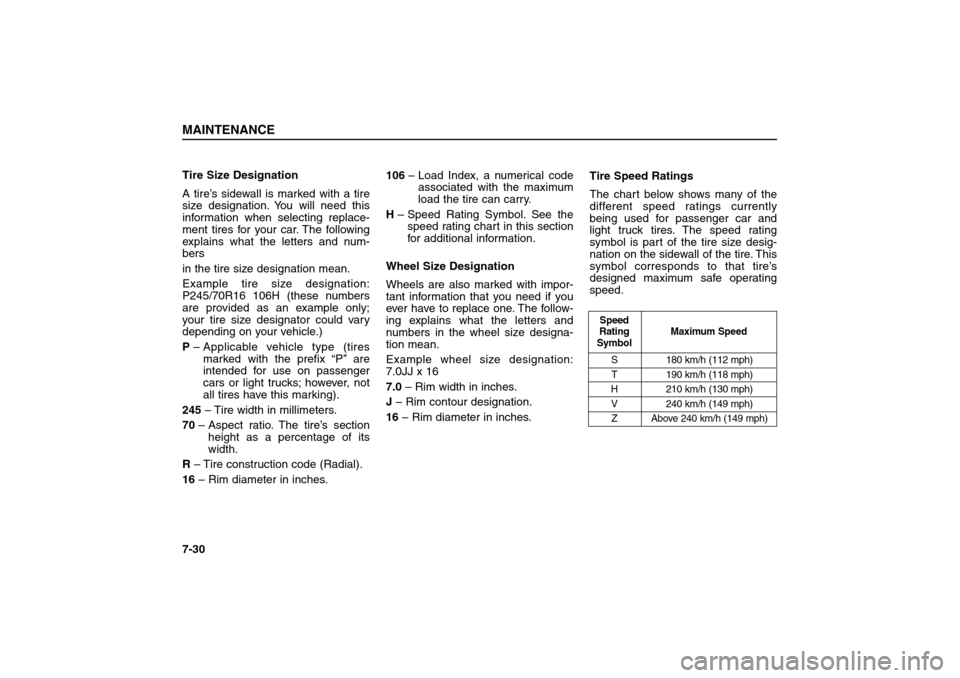
16– Rim diameter in inches.Tire Speed Ratings
The chart below shows many of the
different speed ratings currently
being used for passenger car and
light truck tires. The speed rating
symbol is part of the tire size desig-
nation on the sidewall of the tire. This
symbol corresponds to that tire’s
designed maximum safe operating
speed.MAINTENANCE7-30
S 180 km/h (112 mph)
T 190 km/h (118 mph)
H 210 km/h (130 mph)
V 240 km/h (149 mph)
Z Above 240 km/h (149 mph)
Maximum Speed Speed
Rating
Symbol
BL-ENG (CAN)-7.qxd 7/28/05 5:58 PM Page 30