clutch KIA Sorento 2006 1.G Owner's Manual
[x] Cancel search | Manufacturer: KIA, Model Year: 2006, Model line: Sorento, Model: KIA Sorento 2006 1.GPages: 312, PDF Size: 5.21 MB
Page 100 of 312
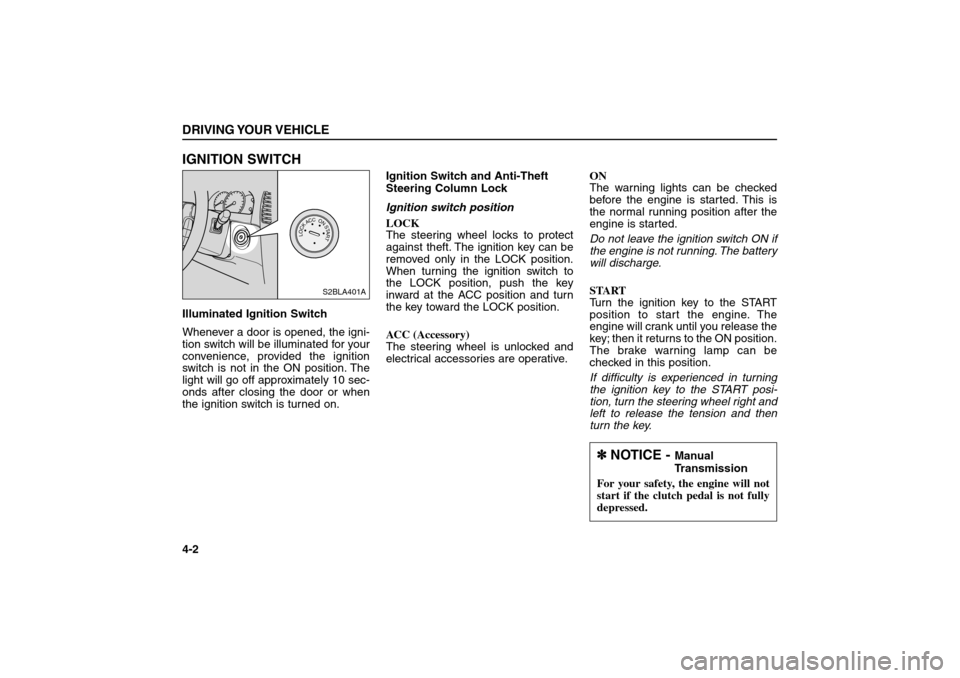
IGNITION SWITCHIlluminated Ignition Switch
Whenever a door is opened, the igni-
tion switch will be illuminated for your
convenience, provided the ignition
switch is not in the ON position. The
light will go off approximately 10 sec-
onds after closing the door or when
the ignition switch is turned on.Ignition Switch and Anti-Theft
Steering Column Lock
Ignition switch position
LOCK
The steering wheel locks to protect
against theft. The ignition key can be
removed only in the LOCK position.
When turning the ignition switch to
the LOCK position, push the key
inward at the ACC position and turn
the key toward the LOCK position.
ACC (Accessory)
The steering wheel is unlocked and
electrical accessories are operative.ON
The warning lights can be checked
before the engine is started. This is
the normal running position after the
engine is started.
Do not leave the ignition switch ON if
the engine is not running. The battery
will discharge.
START
Turn the ignition key to the START
position to start the engine. The
engine will crank until you release the
key; then it returns to the ON position.
The brake warning lamp can be
checked in this position.
If difficulty is experienced in turning
the ignition key to the START posi-
tion, turn the steering wheel right and
left to release the tension and then
turn the key.DRIVING YOUR VEHICLE4-2
PUSH
LOCKACCONSTARTS2BLA401A
✽ ✽
NOTICE -
Manual
Transmission
For your safety, the engine will not
start if the clutch pedal is not fully
depressed.
BL-ENG (CAN)-4.qxd 7/28/05 5:55 PM Page 2
Page 102 of 312
STARTING THE ENGINE1. Make sure the parking brake is
applied.
2.Manual Transmission - Depress
the clutch pedal fully and shift the
transmission into Neutral. Keep the
clutch pedal depressed while turn-
ing the ignition switch to the start
position. The starter will not oper-
ate if the clutch pedal is not fully
depressed.
Automatic Transmission- Place
the transmission shift lever in P
(Park). Depress the brake pedal
fully.
You can also start the engine
when the shift lever is in the N
(Neutral) position.3. Turn the ignition switch to START
and hold it there until the engine
starts (a maximum of 10 seconds),
then release the key.
4. In extremely cold weather – below
0°F (–18°C) – or after the vehicle
has not been operated for several
days, let the engine warm up with-
out depressing the accelerator.
Whether the engine is cold or warm,
it should be started without depress-
ing the accelerator.
If the engine fails to start when
the engine is cold:
The engine is “cold” when the engine
coolant temperature drops below
32°F/0°C. A no-start condition may
be caused by an engine that has
become flooded (has excessive fuel
in the cylinders). If this is the case,
use the starting procedure on the fol-
lowing pages.DRIVING YOUR VEHICLE4-4
✽ ✽
NOTICEIf the engine stalls while you are in
motion, do not attempt to move the
shift lever to the P (Park) position.
If traffic and road conditions per-
mit, you may put the shift lever in
the N (Neutral) position while the
vehicle is still moving and turn the
ignition switch to the START posi-
tion in an attempt to restart the
engine.
BL-ENG (CAN)-4.qxd 7/28/05 5:55 PM Page 4
Page 103 of 312
1. Make sure the parking brake is
applied.
2.Manual Transmission- Depress
the clutch pedal fully and shift the
transmission into Neutral. Keep the
clutch pedal depressed while turn-
ing the ignition switch to the start
position. The starter will not oper-
ate if the clutch pedal is not fully
depressed.
Automatic Transmission -Place
the transmission shift lever in P
(Park) or N (Neutral). Depress the
brake pedal fully.
3. While fully depressing the acceler-
ator, turn the ignition switch to the
START position and hold it (a max-
imum of 10 seconds) to discharge
the excess fuel.
If the engine starts, the engine
speed will increase suddenly;
release the key and the accelera-
tor immediately.4. If the engine has not yet started,
release the accelerator after crank-
ing the engine. Without depressing
the accelerator, crank the engine
until it starts (a maximum of 10
seconds).If the engine fails to start when
the engine is warm:
A no-start condition, characterized by
failure to restart a warmed engine
despite repeated attempts may be
eliminated by using the following pro-
cedure.
1. Make sure the parking brake is
applied.
2.Manual Transmission- Depress
the clutch pedal fully and shift the
transmission into Neutral. Keep the
clutch pedal depressed while turn-
ing the ignition switch to the start
position. The starter will not oper-
ate if the clutch pedal is not fully
depressed.
Automatic Transmission -Place
the transmission shift lever in P
(Park) or N (Neutral). Depress the
brake pedal fully.
DRIVING YOUR VEHICLE
4-5
BL-ENG (CAN)-4.qxd 7/28/05 5:55 PM Page 5
Page 104 of 312
3. While depressing the accelerator
about halfway, turn the ignition
switch to the START position and
hold it (a maximum of 10 seconds).
4. Let the engine idle for about 10
seconds before driving.The starter will not operate if:
Manual transmission - the clutch
pedal is not fully depressed.
Automatic transmission - the shift
lever is NOT in the P (Park) or N
(Neutral) position.
Excessive engine noise may occur if
the engine has not been operated for
an extended period. The noise should
stop after the engine has reached
normal operating temperature. If the
noise does not stop, have the vehicle
inspected by an authorized Kia deal-
er.DRIVING YOUR VEHICLE4-6✽ ✽
NOTICEDo not engage the starter for more
than 10 seconds. If the engine stalls
or fails to start, wait 5 to 10 seconds
before re-engaging the starter.
Improper use of the starter may
damage it.
BL-ENG (CAN)-4.qxd 7/28/05 5:55 PM Page 6
Page 105 of 312
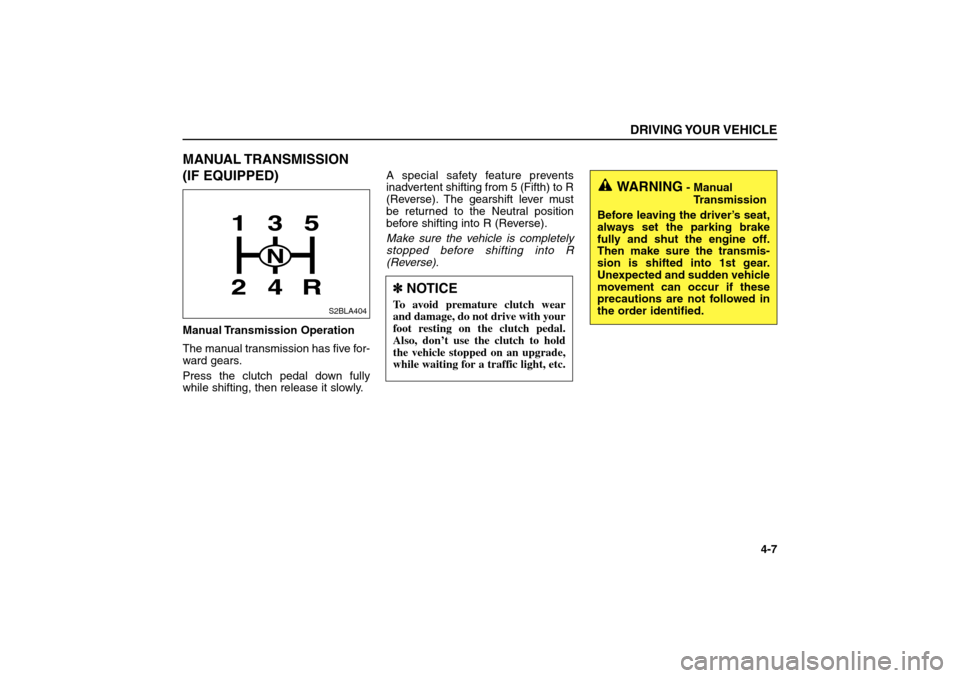
MANUAL TRANSMISSION
(IF EQUIPPED)Manual Transmission Operation
The manual transmission has five for-
ward gears.
Press the clutch pedal down fully
while shifting, then release it slowly.A special safety feature prevents
inadvertent shifting from 5 (Fifth) to R
(Reverse). The gearshift lever must
be returned to the Neutral position
before shifting into R (Reverse).
Make sure the vehicle is completely
stopped before shifting into R
(Reverse).
DRIVING YOUR VEHICLE
4-7
✽ ✽
NOTICETo avoid premature clutch wear
and damage, do not drive with your
foot resting on the clutch pedal.
Also, don’t use the clutch to hold
the vehicle stopped on an upgrade,
while waiting for a traffic light, etc.
N
135
24R
S2BLA404
WARNING
- Manual
Transmission
Before leaving the driver’s seat,
always set the parking brake
fully and shut the engine off.
Then make sure the transmis-
sion is shifted into 1st gear.
Unexpected and sudden vehicle
movement can occur if these
precautions are not followed in
the order identified.
BL-ENG (CAN)-4.qxd 7/28/05 5:55 PM Page 7
Page 121 of 312
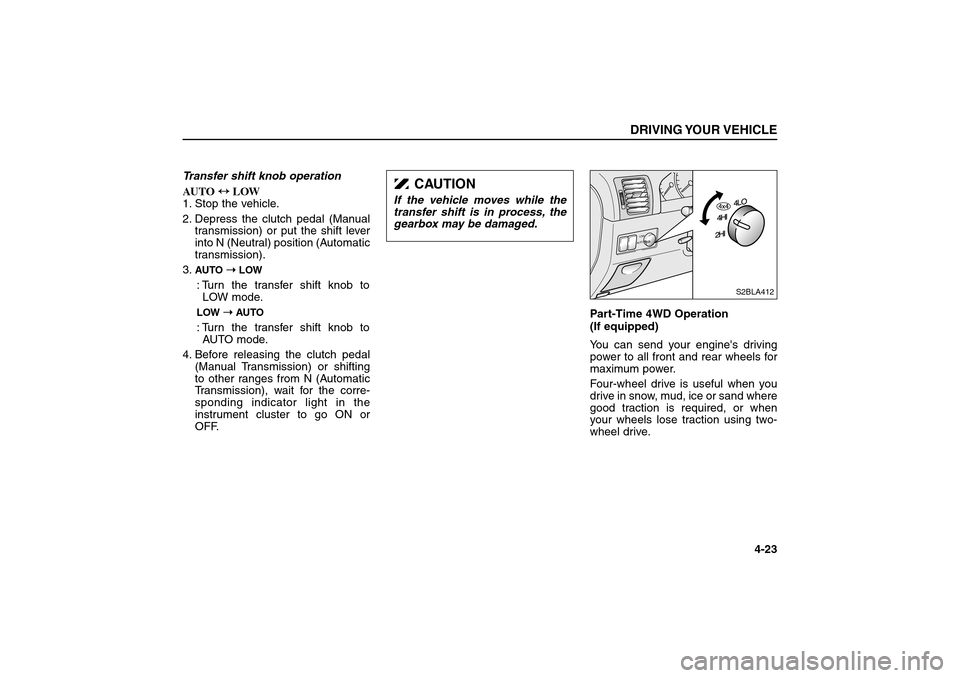
Transfer shift knob operation
AUTO ↔ ↔
LOW
1. Stop the vehicle.
2. Depress the clutch pedal (Manual
transmission) or put the shift lever
into N (Neutral) position (Automatic
transmission).
3.
AUTO ➝ ➝
LOW: Turn the transfer shift knob to
LOW mode.LOW ➝ ➝
AUTO: Turn the transfer shift knob to
AUTO mode.
4. Before releasing the clutch pedal
(Manual Transmission) or shifting
to other ranges from N (Automatic
Transmission), wait for the corre-
sponding indicator light in the
instrument cluster to go ON or
OFF.Part-Time 4WD Operation
(If equipped)
You can send your engine's driving
power to all front and rear wheels for
maximum power.
Four-wheel drive is useful when you
drive in snow, mud, ice or sand where
good traction is required, or when
your wheels lose traction using two-
wheel drive.
DRIVING YOUR VEHICLE
4-23
L
O
WAUTO
S2BLA412
CAUTION
If the vehicle moves while the
transfer shift is in process, the
gearbox may be damaged.
BL-ENG (CAN)-4.qxd 7/28/05 5:55 PM Page 23
Page 123 of 312
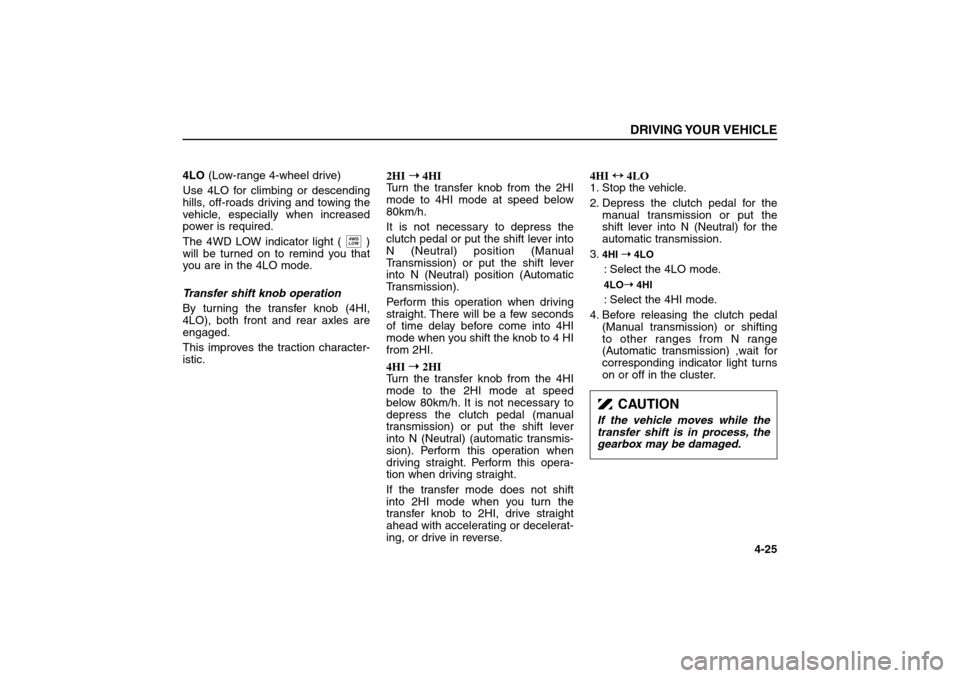
4LO(Low-range 4-wheel drive)
Use 4LO for climbing or descending
hills, off-roads driving and towing the
vehicle, especially when increased
power is required.
The 4WD LOW indicator light ( )
will be turned on to remind you that
you are in the 4LO mode.
Transfer shift knob operation
By turning the transfer knob (4HI,
4LO), both front and rear axles are
engaged.
This improves the traction character-
istic.2HI➝ ➝
4HI
Turn the transfer knob from the 2HI
mode to 4HI mode at speed below
80km/h.
It is not necessary to depress the
clutch pedal or put the shift lever into
N (Neutral) position (Manual
Transmission) or put the shift lever
into N (Neutral) position (Automatic
Transmission).
Perform this operation when driving
straight. There will be a few seconds
of time delay before come into 4HI
mode when you shift the knob to 4 HI
from 2HI.
4HI ➝ ➝
2HI
Turn the transfer knob from the 4HI
mode to the 2HI mode at speed
below 80km/h. It is not necessary to
depress the clutch pedal (manual
transmission) or put the shift lever
into N (Neutral) (automatic transmis-
sion). Perform this operation when
driving straight. Perform this opera-
tion when driving straight.
If the transfer mode does not shift
into 2HI mode when you turn the
transfer knob to 2HI, drive straight
ahead with accelerating or decelerat-
ing, or drive in reverse.4HI ↔ ↔
4LO
1. Stop the vehicle.
2. Depress the clutch pedal for the
manual transmission or put the
shift lever into N (Neutral) for the
automatic transmission.
3.
4HI ➝ ➝
4LO: Select the 4LO mode.4LO➝ ➝
4HI: Select the 4HI mode.
4. Before releasing the clutch pedal
(Manual transmission) or shifting
to other ranges from N range
(Automatic transmission) ,wait for
corresponding indicator light turns
on or off in the cluster.
4WD
LOW
DRIVING YOUR VEHICLE
4-25
CAUTION
If the vehicle moves while the
transfer shift is in process, the
gearbox may be damaged.
BL-ENG (CAN)-4.qxd 7/28/05 5:55 PM Page 25
Page 137 of 312
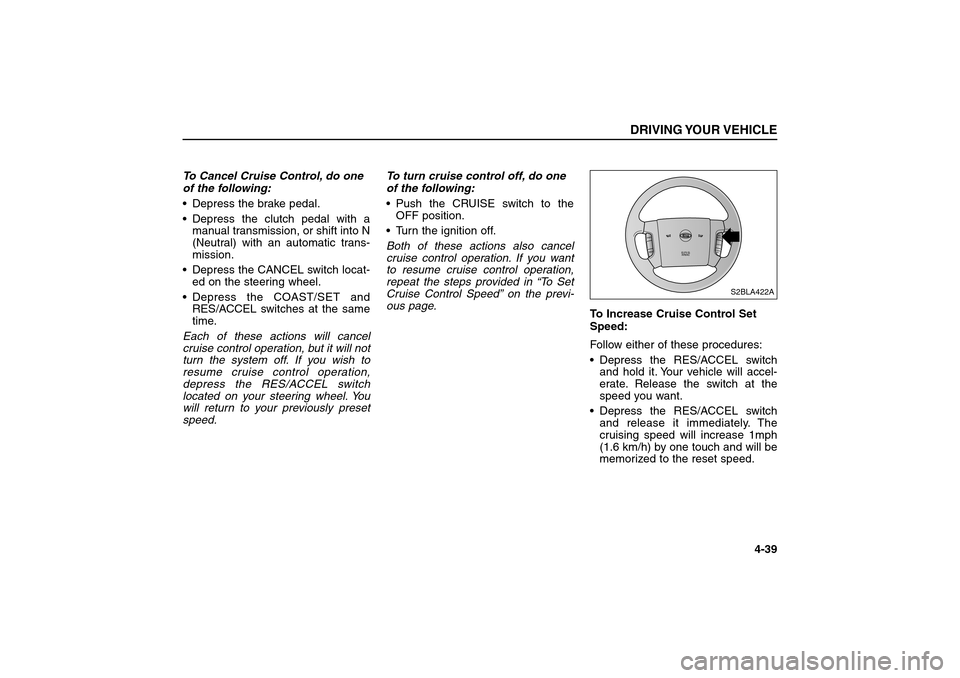
To Cancel Cruise Control, do one
of the following:
Depress the brake pedal.
Depress the clutch pedal with a
manual transmission, or shift into N
(Neutral) with an automatic trans-
mission.
Depress the CANCEL switch locat-
ed on the steering wheel.
Depress the COAST/SET and
RES/ACCEL switches at the same
time.
Each of these actions will cancel
cruise control operation, but it will not
turn the system off. If you wish to
resume cruise control operation,
depress the RES/ACCEL switch
located on your steering wheel. You
will return to your previously preset
speed.To turn cruise control off, do one
of the following:
Push the CRUISE switch to the
OFF position.
Turn the ignition off.
Both of these actions also cancel
cruise control operation. If you want
to resume cruise control operation,
repeat the steps provided in “To Set
Cruise Control Speed” on the previ-
ous page.
To Increase Cruise Control Set
Speed:
Follow either of these procedures:
Depress the RES/ACCEL switch
and hold it. Your vehicle will accel-
erate. Release the switch at the
speed you want.
Depress the RES/ACCEL switch
and release it immediately. The
cruising speed will increase 1mph
(1.6 km/h) by one touch and will be
memorized to the reset speed.
DRIVING YOUR VEHICLE
4-39
SRSAIRBAG
R
E
S
A
C
C
E
LCOAST
SET
P
W
RSEEK
C
A
N
C
E
L
S2BLA422A
BL-ENG (CAN)-4.qxd 7/28/05 5:55 PM Page 39
Page 192 of 312
TIPS ON DRIVING YOUR
VEHICLEBefore Entering Vehicle:
Be sure that all windows, outside
mirror(s), and outside lights are
clean.
Check the condition of the tires.
Check under the vehicle for any
sign of leaks.
Be sure there are no obstacles
behind you if you intend to back up.
Necessary Inspections
Fluid levels, such as engine oil,
engine coolant, brake/clutch fluid,
and washer fluid should be checked
on a regular basis, with the exact
interval depending on the fluid.
Further details are provided in the
“Maintenance” section.Before Starting
Close and lock all doors.
Position the seat so that all controls
are easily reached.
Adjust the inside and outside
rearview mirrors.
Be sure that all lights work.
Check all gauges.
Check the operation of warning
lights when the ignition switch is
turned to the ON position.
Release the parking brake and
make sure the brake warning light
goes out.
For safe operation, be sure you are
familiar with your vehicle and its
equipment.
DRIVING TIPS
5-5
WARNING- Driving Under the
Influence of Alcohol or
Drugs
Drinking and driving is danger-
ous. Drunk driving is the num-
ber one contributor to the high-
way death toll each year. Even
a small amount of alcohol will
affect your reflexes, percep-
tions and judgement.
You are much more likely to
have a serious accident if you
drink and drive.
If you are drinking or taking
drugs, don’t drive. Do not ride
with a driver who has been
drinking or taking drugs.
Choose a designated driver or
call a cab.
Driving while under the influ-
ence of drugs is as dangerous
or more dangerous than driving
drunk.
BL-ENG (CAN)-5.qxd 7/28/05 5:56 PM Page 5
Page 202 of 312
Driving on a Hill (“4LO” for Part-
time 4WD Operation or “LOW” for
Full-time 4WD operation)
Use low gear when going uphill or
downhill and avoid sudden braking.
Do not shift gears or use your
clutch when going downhill. Do not
coast downhill in Neutral.Crossing a Ditch (“4LO” for Part-
time 4WD Operation or “LOW” for
Full-time 4WD operation)
Avoid driving through ditches if pos-
sible, especially if there is water in
the ditch. Your vehicle may stall if
the electrical system gets wet. If
you must cross a ditch, shift the
transfer knob to 4LO or LOW.
Avoid driving where the water level
is higher than the bottom of the
wheel hub. If the water level rises
above this mark, your vehicle will
need to be serviced.
Tap lightly on the brake pedal dur-
ing and after driving through water.
This will help keep the brakes dry
and in proper working order.
Do not shift gears while crossing a
ditch.Tight Corner Brake Effect
This is called tight corner brake
effect. Tight corner brake effect is a
unique characteristic of four-wheel
drive vehicles caused by the differ-
ence in tire rotation at the four wheels
and the zero-degree alignment of the
front wheels and suspension.
Sharp turns at low speeds should be
carried out with caution.
DRIVING TIPS
5-15
CAUTION
When turning sharply on a paved
road at low speed while in four-
wheel drive, steering control will be
difficult.
BL-ENG (CAN)-5.qxd 7/28/05 5:56 PM Page 15