four wheel drive KIA Sorento 2006 1.G Owner's Manual
[x] Cancel search | Manufacturer: KIA, Model Year: 2006, Model line: Sorento, Model: KIA Sorento 2006 1.GPages: 312, PDF Size: 5.21 MB
Page 99 of 312
4-1
DRIVING YOUR VEHICLEIgnition Switch . . . . . . . . . . . . . . . . . . . . . . . . . . . . . . . . . . . . 4-2
Starting the Gasoline Engine . . . . . . . . . . . . . . . . . . . . . . . . 4-4
Manual Transmission . . . . . . . . . . . . . . . . . . . . . . . . . . . . . . . 4-7
Automatic Transmission . . . . . . . . . . . . . . . . . . . . . . . . . . . . 4-9
Four Wheel Drive(4WD) . . . . . . . . . . . . . . . . . . . . . . . . . . . . 4-20
Limited Slip Differential . . . . . . . . . . . . . . . . . . . . . . . . . . . . 4-30
Brake System . . . . . . . . . . . . . . . . . . . . . . . . . . . . . . . . . . . . 4-30
Power Steering . . . . . . . . . . . . . . . . . . . . . . . . . . . . . . . . . . . 4-37
Cruise Control . . . . . . . . . . . . . . . . . . . . . . . . . . . . . . . . . . . 4-38
Instrument Cluster . . . . . . . . . . . . . . . . . . . . . . . . . . . . . . . 4-41
Gauges . . . . . . . . . . . . . . . . . . . . . . . . . . . . . . . . . . . . . . . . . 4-43
Warnings and Indicators . . . . . . . . . . . . . . . . . . . . . . . . . . . 4-45
Multi-Meter . . . . . . . . . . . . . . . . . . . . . . . . . . . . . . . . . . . . . . 4-52
Lighting . . . . . . . . . . . . . . . . . . . . . . . . . . . . . . . . . . . . . . . . 4-58
Wipers and Washers . . . . . . . . . . . . . . . . . . . . . . . . . . . . . . 4-62
Defroster . . . . . . . . . . . . . . . . . . . . . . . . . . . . . . . . . . . . . . . . 4-65
Hazard Warning Flasher . . . . . . . . . . . . . . . . . . . . . . . . . . . . 4-66
Interior Features . . . . . . . . . . . . . . . . . . . . . . . . . . . . . . . . . . 4-67
Manual Climate Control System . . . . . . . . . . . . . . . . . . . . . 4-71
Automatic Climate Control System . . . . . . . . . . . . . . . . . . . 4-79
Windshield Defrosting and Defogging (Manual type) . . . . . 4-86
Windshield Defrosting and Defogging (Automatic type) . . 4-88
4
BL-ENG (CAN)-4.qxd 7/28/05 5:55 PM Page 1
Page 111 of 312
R (Reverse)
Use this position to drive the vehicle
backward.
N (Neutral)
With the gearshift in the N position,
the wheels and transmission are not
locked. The vehicle will roll freely
even if the transfer case is in gear,
unless the parking brake or service
brakes are applied.D (Drive)
This is the normal forward driving
position. The transmission will auto-
matically shift through a four-gear
sequence, providing the best econo-
my and power.
For extra power when passing anoth-
er vehicle or climbing grades,
depress the accelerator fully, at which
time the transmission will automati-
cally downshift to the next lower gear.2 (Second Gear)
Use 2 (Second Gear) for more power
when climbing hills and for increased
braking when going down hills. This
position also helps reduce wheel spin
on slippery surfaces. When the shift
lever is placed in 2 (Second Gear),
the transmission will automatically
shift from first to second gear.
Downshifting from second to first
gear is possible below speeds of 26
miles per hour (43 km/h). Do not
exceed 36 miles per hour (60 km/h)
while in second gear.
L (Low)
Move the shift lever to this position in
hard pulling situations and for climb-
ing steep grades. Do not exceed 22
miles per hour (35 km/h) while in
Low.
DRIVING YOUR VEHICLE
4-13
✽ ✽
NOTICEAlways come to a complete stop
before shifting into or out of R
(Reverse); you may damage the
transmission if you shift into R
while the vehicle is in motion,
except as explained in “Rocking the
Vehicle”, in this manual.
BL-ENG (CAN)-4.qxd 7/28/05 5:55 PM Page 13
Page 118 of 312
FOUR WHEEL DRIVE (4WD)For Safe Four-Wheel Drive Operation
Your vehicle allows you to drive in
on-road and off-road conditions.
However, do not try to drive in deep
standing water, mud, or over steep
hills.
When you are driving up or down
hills drive as close to straight up
and down the hill as possible. Use
extreme caution in going up or
down steep hills, since you may flip
your vehicle over depending on the
grade, terrain and water/mud con-
ditions.You must learn how to corner in a
4WD vehicle as soon as possible.
Do not rely on your experience in
conventional 2WD vehicles in
choosing safe cornering speed. You
must drive more slowly.
Drive off-road carefully because
your vehicle may be damaged by
rocks or roots of trees. Become
familiar with the off-road conditions
you are going to drive before you
start.DRIVING YOUR VEHICLE4-20
WARNING- Four Wheel Drive
Driving across the contour of
steep hills can be extremely
dangerous. This danger can
come from slight changes in the
wheel angle which can destabi-
lize the vehicle or, even if the
vehicle is maintaining stability
under power, it can lose that
stability if the vehicle stops its
forward motion. Your vehicle
may roll over without warning
and without time for you to cor-
rect a mistake that could cause
serious injury or death.
CAUTION
Do not grab inside of the steer-
ing wheel when you are driving
off-road. Your arm may be hurt
by a sudden steering maneuver
or from steering wheel rebound
due to impact with objects on
the ground. This may cause you
to lose steering wheel control.
BL-ENG (CAN)-4.qxd 7/28/05 5:55 PM Page 20
Page 121 of 312
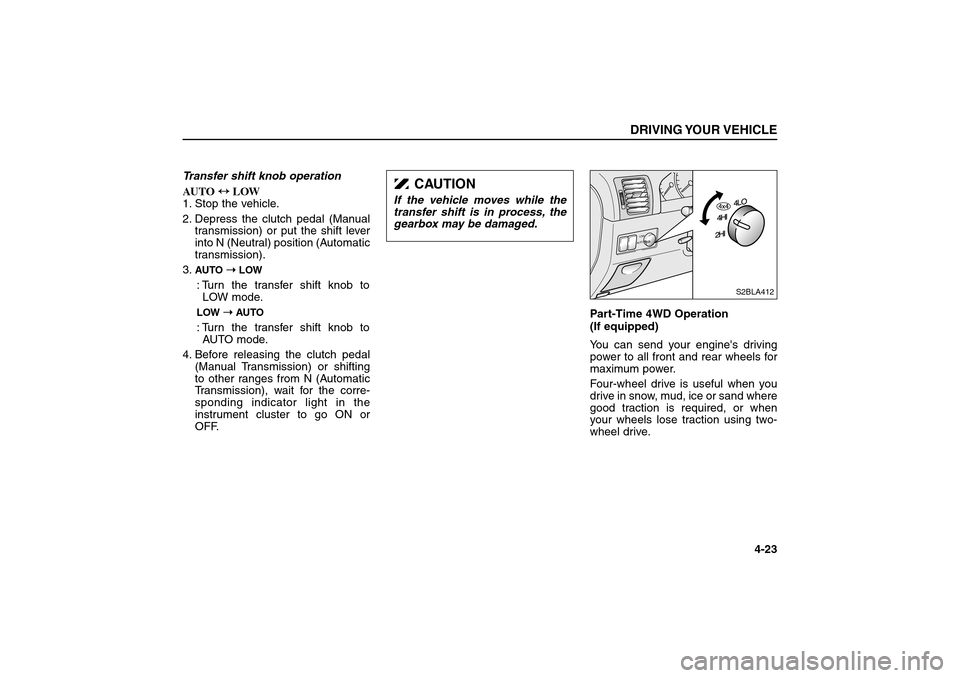
Transfer shift knob operation
AUTO ↔ ↔
LOW
1. Stop the vehicle.
2. Depress the clutch pedal (Manual
transmission) or put the shift lever
into N (Neutral) position (Automatic
transmission).
3.
AUTO ➝ ➝
LOW: Turn the transfer shift knob to
LOW mode.LOW ➝ ➝
AUTO: Turn the transfer shift knob to
AUTO mode.
4. Before releasing the clutch pedal
(Manual Transmission) or shifting
to other ranges from N (Automatic
Transmission), wait for the corre-
sponding indicator light in the
instrument cluster to go ON or
OFF.Part-Time 4WD Operation
(If equipped)
You can send your engine's driving
power to all front and rear wheels for
maximum power.
Four-wheel drive is useful when you
drive in snow, mud, ice or sand where
good traction is required, or when
your wheels lose traction using two-
wheel drive.
DRIVING YOUR VEHICLE
4-23
L
O
WAUTO
S2BLA412
CAUTION
If the vehicle moves while the
transfer shift is in process, the
gearbox may be damaged.
BL-ENG (CAN)-4.qxd 7/28/05 5:55 PM Page 23
Page 122 of 312
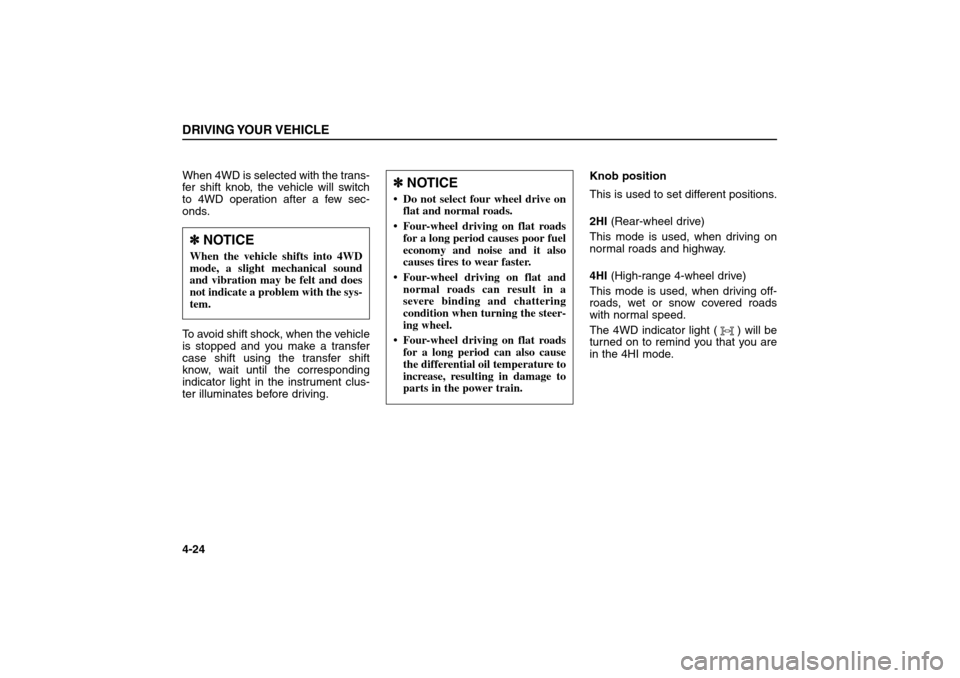
When 4WD is selected with the trans-
fer shift knob, the vehicle will switch
to 4WD operation after a few sec-
onds.
To avoid shift shock, when the vehicle
is stopped and you make a transfer
case shift using the transfer shift
know, wait until the corresponding
indicator light in the instrument clus-
ter illuminates before driving.Knob position
This is used to set different positions.
2HI(Rear-wheel drive)
This mode is used, when driving on
normal roads and highway.
4HI(High-range 4-wheel drive)
This mode is used, when driving off-
roads, wet or snow covered roads
with normal speed.
The 4WD indicator light ( ) will be
turned on to remind you that you are
in the 4HI mode.DRIVING YOUR VEHICLE4-24
✽ ✽
NOTICE Do not select four wheel drive on
flat and normal roads.
Four-wheel driving on flat roads
for a long period causes poor fuel
economy and noise and it also
causes tires to wear faster.
Four-wheel driving on flat and
normal roads can result in a
severe binding and chattering
condition when turning the steer-
ing wheel.
Four-wheel driving on flat roads
for a long period can also cause
the differential oil temperature to
increase, resulting in damage to
parts in the power train.
✽ ✽
NOTICEWhen the vehicle shifts into 4WD
mode, a slight mechanical sound
and vibration may be felt and does
not indicate a problem with the sys-
tem.
BL-ENG (CAN)-4.qxd 7/28/05 5:55 PM Page 24
Page 124 of 312
For Safe Four-Wheel Drive
Operation
Your vehicle allows you to drive in
on-road and off-road conditions.
However, do not try to drive in deep
standing water, mud, or over steep
hills.
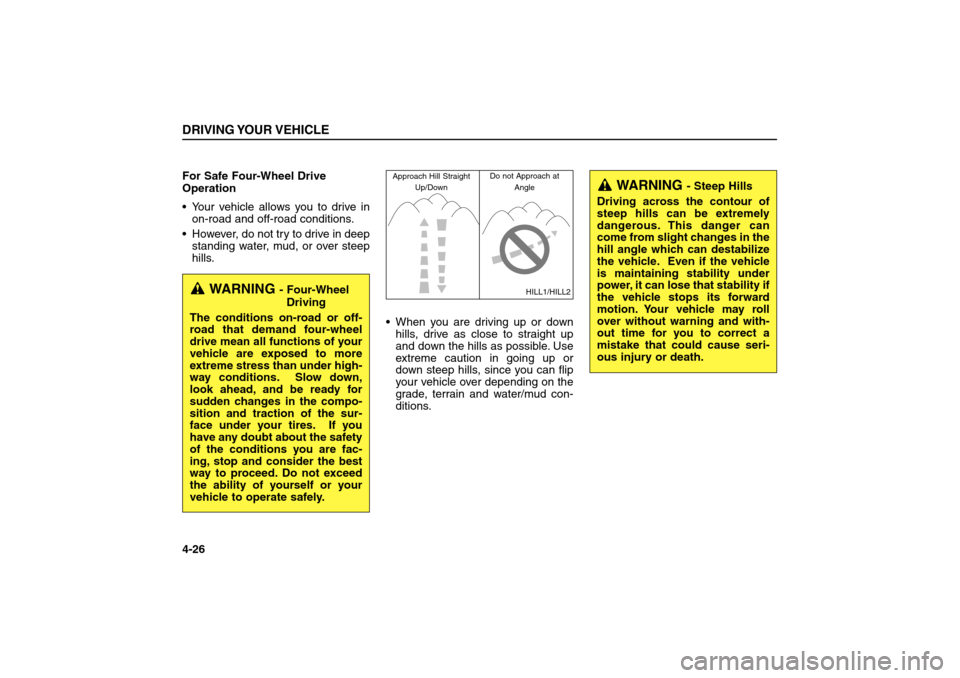
When you are driving up or down
hills, drive as close to straight up
and down the hills as possible. Use
extreme caution in going up or
down steep hills, since you can flip
your vehicle over depending on the
grade, terrain and water/mud con-
ditions.DRIVING YOUR VEHICLE4-26
WARNING
- Four-Wheel
Driving
The conditions on-road or off-
road that demand four-wheel
drive mean all functions of your
vehicle are exposed to more
extreme stress than under high-
way conditions. Slow down,
look ahead, and be ready for
sudden changes in the compo-
sition and traction of the sur-
face under your tires. If you
have any doubt about the safety
of the conditions you are fac-
ing, stop and consider the best
way to proceed. Do not exceed
the ability of yourself or your
vehicle to operate safely.
WARNING
- Steep Hills
Driving across the contour of
steep hills can be extremely
dangerous. This danger can
come from slight changes in the
hill angle which can destabilize
the vehicle. Even if the vehicle
is maintaining stability under
power, it can lose that stability if
the vehicle stops its forward
motion. Your vehicle may roll
over without warning and with-
out time for you to correct a
mistake that could cause seri-
ous injury or death.
HILL1/HILL2 Approach Hill Straight
Up/DownDo not Approach at
Angle
BL-ENG (CAN)-4.qxd 7/28/05 5:55 PM Page 26
Page 126 of 312
Do not drive in water if the level is
higher than the bottom of the wheel
hubs.
Check your brake condition once
you are out of mud or water. Press
the brake pedal several times as
you move slowly until you feel nor-
mal braking forces return.
Shorten your scheduled mainte-
nance interval if you drive off-road in
conditions such as sand, mud or
water (see “Scheduled Maintenance’’
in the Index). Always wash your car
thoroughly.
The full time four wheel drive vehi-
cle cannot be towed by an ordinari-
ly tow truck. Make sure that the
vehicle is towed with its four wheels
raised off the ground.Since the driving torque is always
applied to the 4 wheels the perform-
ance of the 4WD vehicle is greatly
affected by the condition of the tires.
Be sure to equip them with all four
tires with same size and type.DRIVING YOUR VEHICLE4-28
CAUTION
While the full-time 4WD vehicle
is being raised on a jack, never
start the engine or cause the
tires to rotate.
There is the danger that rotating
tires touching the ground could
cause the vehicle to go off the
jack and to jump forward.
If one of the front or rear wheels
begins to spin in mud, snow,
etc. the vehicle can sometimes
be driven out by depressing the
accelerator pedal further; how-
ever avoid running the engine
continuously at high rpm
because doing so could dam-
age the 4WD system.
WARNING
-Driving Through Water
If you are driving too fast in
water, the water spray can get
into the engine compartment
and wet the ignition system,
causing your vehicle to sudden-
ly stop. If this happens and your
vehicle is in a tilted position,
your vehicle may roll over.
WARNING
Your vehicle is equipped with
tires designed to provide for safe
ride and handling capability. Do
not use a size and type of tire
and wheel that is different from
the one that is originally
installed on your vehicle. It can
affect the safety and perform-
ance of your vehicle, which
could lead to handling failure or
rollover and serious injury.
When replacing the tires, be
sure to equip all four tires with
the tire and wheel of the same
size, type, tread, brand and
load-carrying capacity. If you
nevertheless decide to equip
your vehicle with any tire/wheel
combination not recommended
by Kia for off road driving, you
should not use these tires for
highway driving.
BL-ENG (CAN)-4.qxd 7/28/05 5:55 PM Page 28
Page 188 of 312
5-1
DRIVING TIPSFuel Requirements . . . . . . . . . . . . . . . . . . . . . . . . . . . . . . . . . 5-2
Emission Control System . . . . . . . . . . . . . . . . . . . . . . . . . . . 5-3
Tips on Driving Your Vehicle . . . . . . . . . . . . . . . . . . . . . . . . . 5-5
Suggestions for Economical Operation . . . . . . . . . . . . . . . . 5-6
Special Driving Conditions . . . . . . . . . . . . . . . . . . . . . . . . . . 5-8
Using Four-Wheel Drive . . . . . . . . . . . . . . . . . . . . . . . . . . . . 5-14
Weight of the Vehicle - with and without a Trailer . . . . . . . .5-32
Trailer Towing . . . . . . . . . . . . . . . . . . . . . . . . . . . . . . . . . . . . 5-34
Overloading . . . . . . . . . . . . . . . . . . . . . . . . . . . . . . . . . . . . . 5-43
Label Information . . . . . . . . . . . . . . . . . . . . . . . . . . . . . . . . . 5-43
5
BL-ENG (CAN)-5.qxd 7/28/05 5:56 PM Page 1
Page 191 of 312
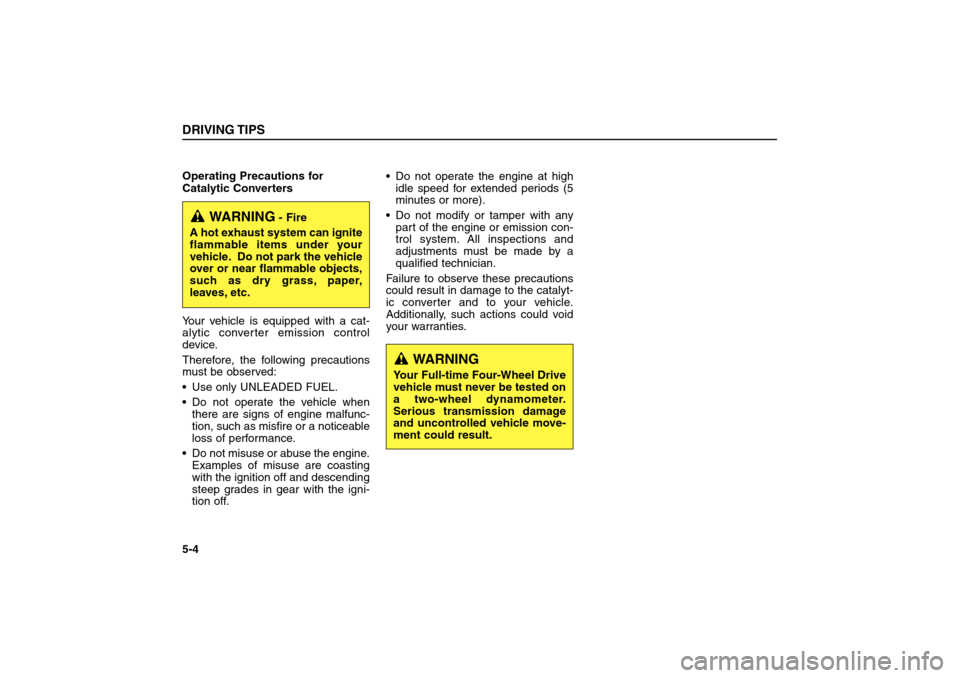
Operating Precautions for
Catalytic Converters
Your vehicle is equipped with a cat-
alytic converter emission control
device.
Therefore, the following precautions
must be observed:
Use only UNLEADED FUEL.
Do not operate the vehicle when
there are signs of engine malfunc-
tion, such as misfire or a noticeable
loss of performance.
Do not misuse or abuse the engine.
Examples of misuse are coasting
with the ignition off and descending
steep grades in gear with the igni-
tion off. Do not operate the engine at high
idle speed for extended periods (5
minutes or more).
Do not modify or tamper with any
part of the engine or emission con-
trol system. All inspections and
adjustments must be made by a
qualified technician.
Failure to observe these precautions
could result in damage to the catalyt-
ic converter and to your vehicle.
Additionally, such actions could void
your warranties.DRIVING TIPS5-4
WARNING
Your Full-time Four-Wheel Drive
vehicle must never be tested on
a two-wheel dynamometer.
Serious transmission damage
and uncontrolled vehicle move-
ment could result.
WARNING
- Fire
A hot exhaust system can ignite
flammable items under your
vehicle. Do not park the vehicle
over or near flammable objects,
such as dry grass, paper,
leaves, etc.
BL-ENG (CAN)-5.qxd 7/28/05 5:56 PM Page 4
Page 195 of 312
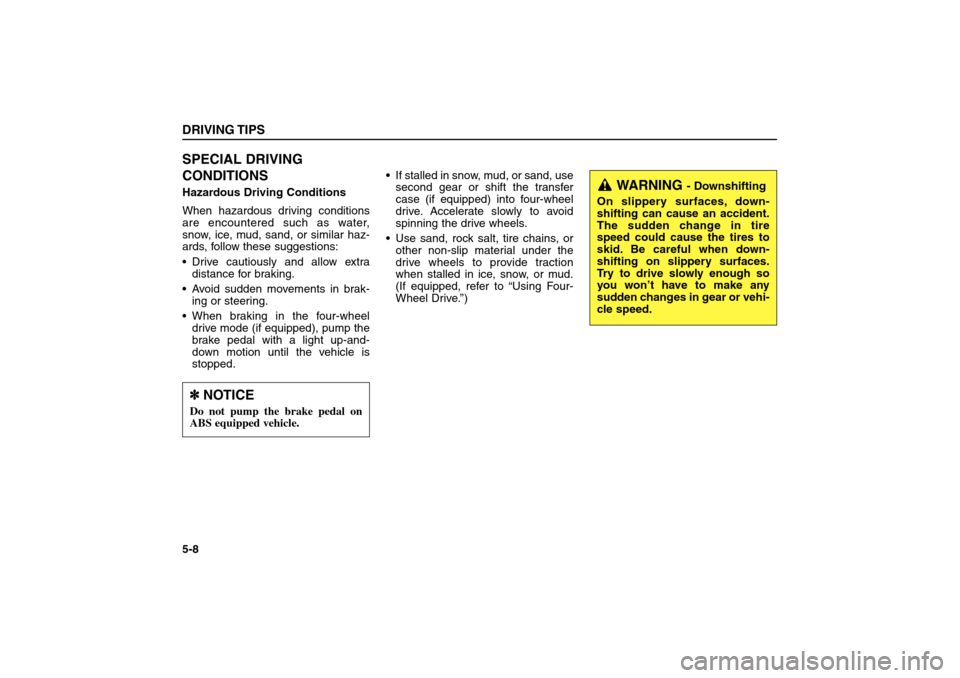
SPECIAL DRIVING
CONDITIONSHazardous Driving Conditions
When hazardous driving conditions
are encountered such as water,
snow, ice, mud, sand, or similar haz-
ards, follow these suggestions:
Drive cautiously and allow extra
distance for braking.
Avoid sudden movements in brak-
ing or steering.
When braking in the four-wheel
drive mode (if equipped), pump the
brake pedal with a light up-and-
down motion until the vehicle is
stopped. If stalled in snow, mud, or sand, use
second gear or shift the transfer
case (if equipped) into four-wheel
drive. Accelerate slowly to avoid
spinning the drive wheels.
Use sand, rock salt, tire chains, or
other non-slip material under the
drive wheels to provide traction
when stalled in ice, snow, or mud.
(If equipped, refer to “Using Four-
Wheel Drive.’’)DRIVING TIPS5-8✽ ✽
NOTICEDo not pump the brake pedal on
ABS equipped vehicle.
WARNING
- Downshifting
On slippery surfaces, down-
shifting can cause an accident.
The sudden change in tire
speed could cause the tires to
skid. Be careful when down-
shifting on slippery surfaces.
Try to drive slowly enough so
you won’t have to make any
sudden changes in gear or vehi-
cle speed.
BL-ENG (CAN)-5.qxd 7/28/05 5:56 PM Page 8