climate control KIA Sorento 2008 1.G User Guide
[x] Cancel search | Manufacturer: KIA, Model Year: 2008, Model line: Sorento, Model: KIA Sorento 2008 1.GPages: 326, PDF Size: 8.63 MB
Page 206 of 326
Driving your vehicle
76 4
Automatic climate control system
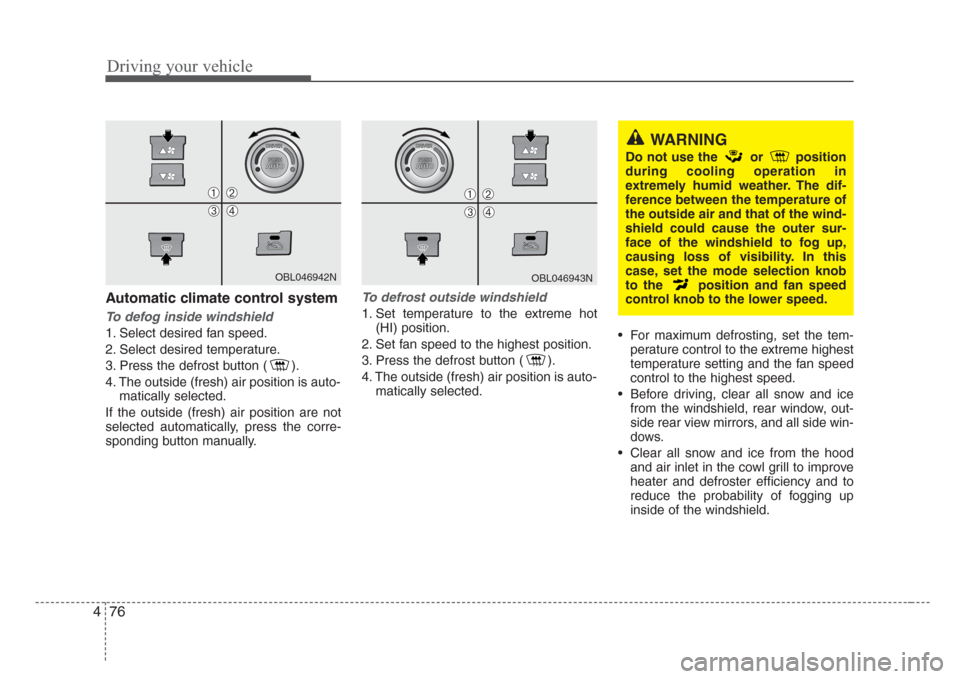
To defog inside windshield
1. Select desired fan speed.
2. Select desired temperature.
3. Press the defrost button ( ).
4. The outside (fresh) air position is auto-
matically selected.
If the outside (fresh) air position are not
selected automatically, press the corre-
sponding button manually.
To defrost outside windshield
1. Set temperature to the extreme hot
(HI) position.
2. Set fan speed to the highest position.
3. Press the defrost button ( ).
4. The outside (fresh) air position is auto-
matically selected.• For maximum defrosting, set the tem-
perature control to the extreme highest
temperature setting and the fan speed
control to the highest speed.
• Before driving, clear all snow and ice
from the windshield, rear window, out-
side rear view mirrors, and all side win-
dows.
• Clear all snow and ice from the hood
and air inlet in the cowl grill to improve
heater and defroster efficiency and to
reduce the probability of fogging up
inside of the windshield.
OBL046942NOBL046943N
➀➁
➂➃
➀➁
➂➃
WARNING
Do not use the or position
during cooling operation in
extremely humid weather. The dif-
ference between the temperature of
the outside air and that of the wind-
shield could cause the outer sur-
face of the windshield to fog up,
causing loss of visibility. In this
case, set the mode selection knob
to the position and fan speed
control knob to the lower speed.
Page 207 of 326
477
Driving your vehicle
Defogging logic
Manual climate control system
To reduce the probability of fogging up
the inside of the windshield, the air intake
control is set to the outside (fresh) air
position automatically if any of following
occur.
• The mode is selected to the or
while the system is activated.
• The ignition switch is turned on while
the mode is selected to the
*,
or .
• The ignition switch is turned off.
• The fan is off.
• The fan begins to be operated.
Press the air intake control button to
select the recirculated air position while
the ignition switch is on.
* : if equippedHow to cancel or return defogging logic
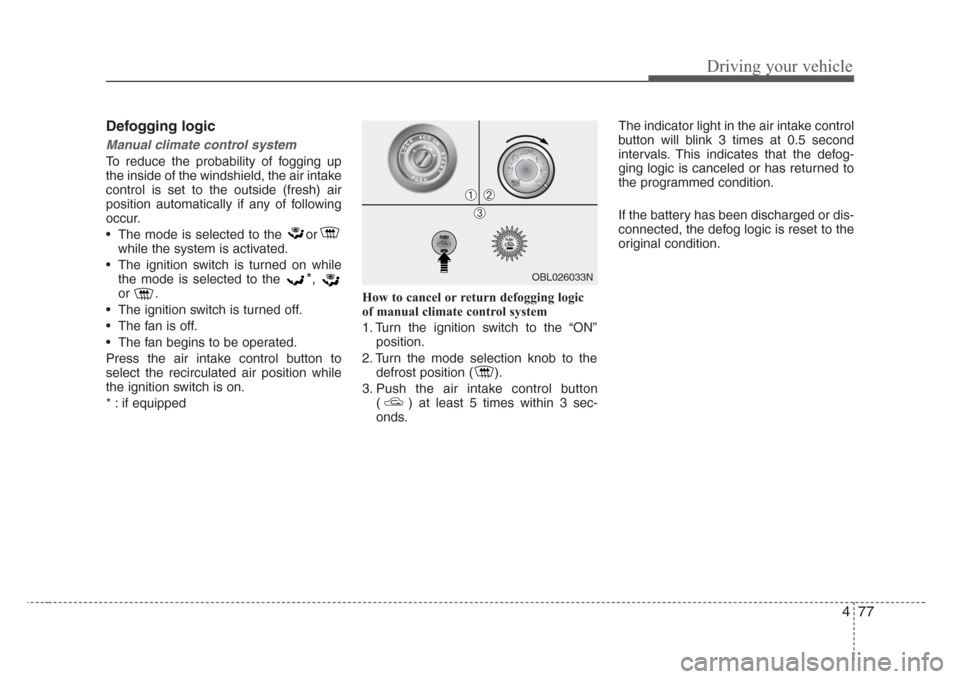
of manual climate control system
1. Turn the ignition switch to the “ON”
position.
2. Turn the mode selection knob to the
defrost position ( ).
3. Push the air intake control button
( ) at least 5 times within 3 sec-
onds.The indicator light in the air intake control
button will blink 3 times at 0.5 second
intervals. This indicates that the defog-
ging logic is canceled or has returned to
the programmed condition.
If the battery has been discharged or dis-
connected, the defog logic is reset to the
original condition.OBL026033N
➀➁
➂
Page 208 of 326
Driving your vehicle
78 4
Automatic climate control system
To reduce the probability of fogging up
inside of the windshield, the air intake
control is set to outside (fresh) air posi-
tion automatically if any of following
occur.
• The ignition switch is turned on while
the mode is selected to the
*,or
.
• The OFF button is pushed.
• The mode is selected to the
*,
or position.
In the or mode, it is impossible to
select the recirculated air position while
the ignition switch is on.
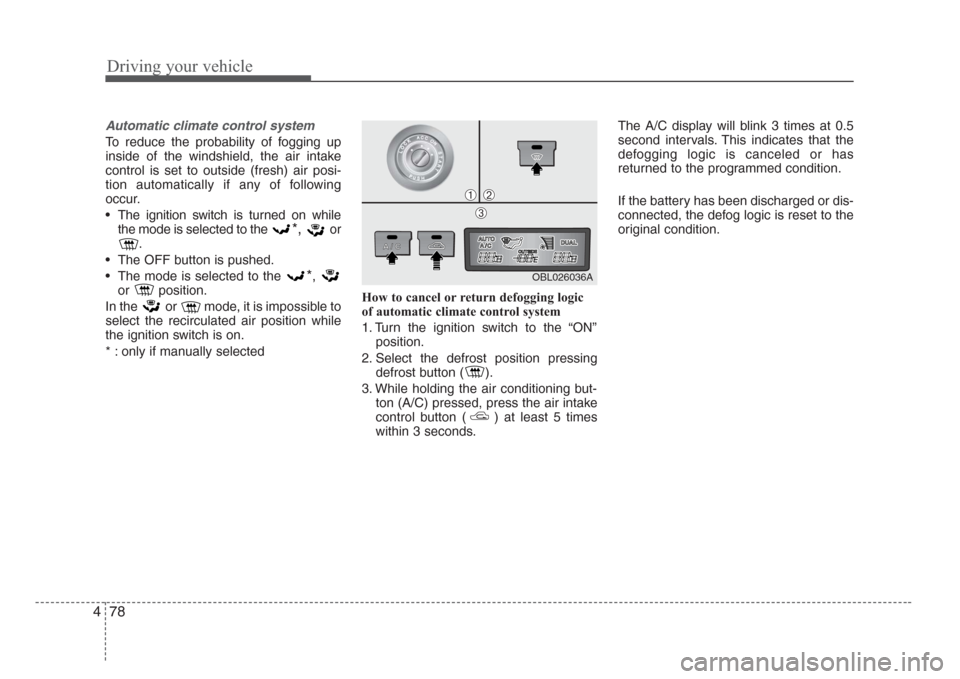
* : only if manually selectedHow to cancel or return defogging logic
of automatic climate control system
1. Turn the ignition switch to the “ON”
position.
2. Select the defrost position pressing
defrost button ( ).
3. While holding the air conditioning but-
ton (A/C) pressed, press the air intake
control button ( ) at least 5 times
within 3 seconds.The A/C display will blink 3 times at 0.5
second intervals. This indicates that the
defogging logic is canceled or has
returned to the programmed condition.
If the battery has been discharged or dis-
connected, the defog logic is reset to the
original condition.OBL026036A
➀➁
➂
Page 275 of 326
7
Maintenance services / 7-2
Maintenance schedule / 7-3
Owner maintenance / 7-7
Engine compartment / 7-10
Engine oil / 7-11
Engine cooling system / 7-12
Brake fluid / 7-14
Power steering / 7-15
Automatic transmission / 7-16
Lubricants and fluids / 7-18
Air cleaner / 7-19
Climate control air filter / 7-20
Wiper blades / 7-20
Battery / 7-22
Tires and wheels / 7-25
Lubricant specifications / 7-37
Exterior care / 7-39
Interior care / 7-42
Maintenance
Page 294 of 326
Maintenance
20 7
CLIMATE CONTROL AIR FILTER (IF EQUIPPED)
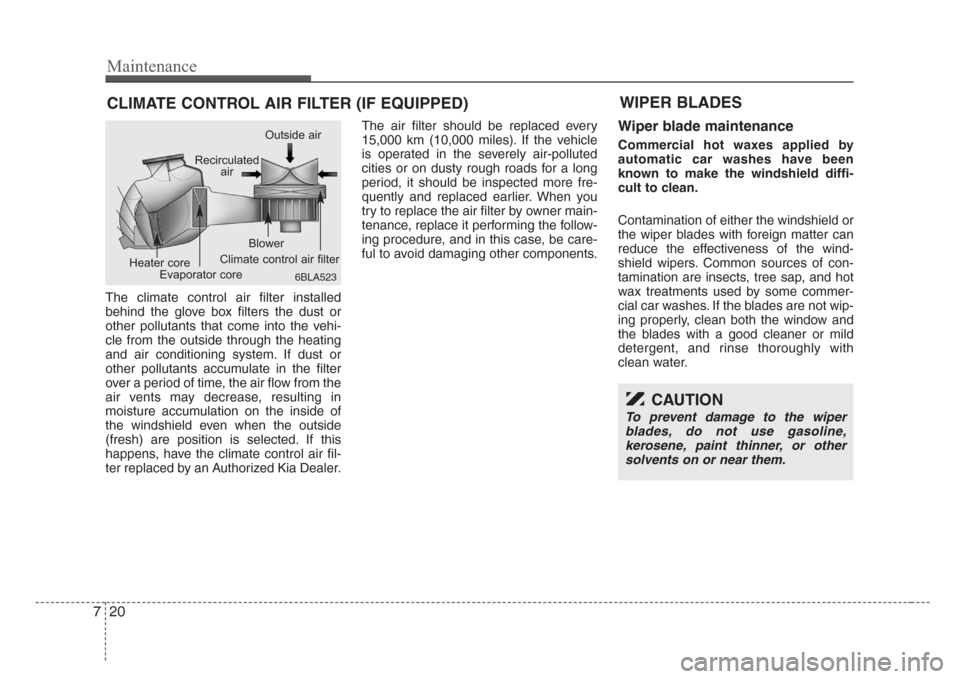
The climate control air filter installed
behind the glove box filters the dust or
other pollutants that come into the vehi-
cle from the outside through the heating
and air conditioning system. If dust or
other pollutants accumulate in the filter
over a period of time, the air flow from the
air vents may decrease, resulting in
moisture accumulation on the inside of
the windshield even when the outside
(fresh) are position is selected. If this
happens, have the climate control air fil-
ter replaced by an Authorized Kia Dealer.The air filter should be replaced every
15,000 km (10,000 miles). If the vehicle
is operated in the severely air-polluted
cities or on dusty rough roads for a long
period, it should be inspected more fre-
quently and replaced earlier. When you
try to replace the air filter by owner main-
tenance, replace it performing the follow-
ing procedure, and in this case, be care-
ful to avoid damaging other components.
Wiper blade maintenance
Commercial hot waxes applied by
automatic car washes have been
known to make the windshield diffi-
cult to clean.
Contamination of either the windshield or
the wiper blades with foreign matter can
reduce the effectiveness of the wind-
shield wipers. Common sources of con-
tamination are insects, tree sap, and hot
wax treatments used by some commer-
cial car washes. If the blades are not wip-
ing properly, clean both the window and
the blades with a good cleaner or mild
detergent, and rinse thoroughly with
clean water.
6BLA523
Outside air
Recirculated
air
Blower
Evaporator core
Heater coreClimate control air filter
WIPER BLADES
CAUTION
To prevent damage to the wiper
blades, do not use gasoline,
kerosene, paint thinner, or other
solvents on or near them.
Page 298 of 326

Maintenance
24 7
Battery recharging
Your vehicle has a maintenance-free,
calcium-based battery.
• If the battery becomes discharged in a
short time (because, for example, the
headlights or interior lights were left on
while the vehicle was not in use),
recharge it by slow charging (trickle)
for 10 hours.
• If the battery gradually discharges
because of high electric load while the
vehicle is being used, recharge it at 20-
30A for two hours.
Items to be reset after the battery has
been discharged or the battery has
been disconnected.
• Clock (See Chapter 3)
• Trip computer (See Chapter 4)
• Compass (See Chapter 4)
• Climate control system (See Chapter 4)
• Audio (See Chapter 3)
WARNING- Recharging
battery
When recharging the battery,
observe the following precautions:
• The battery must be removed
from the vehicle and placed in an
area with good ventilation.
• Do not allow cigarettes,sparks,or
flame near the battery.
• Watch the battery during charg-
ing, and stop or reduce the charg-
ing rate if the battery cells begin
gassing (boiling) violently or if
the temperature of the electrolyte
of any cell exceeds 49°C (120°F).
• Wear eye protection when check-
ing the battery during charging.
•Disconnect the battery charger in
the following order.
1. Turn off the battery charger main
switch.
2. Unhook the negative clamp from
the negative battery terminal.
3. Unhook the positive clamp from
the positive battery terminal.
CAUTION
• Before performing maintenance
or recharging the battery, turn off
all accessories and stop the
engine.
• The negative battery cable must
be removed first and installed last
when the battery is disconnected.
Page 306 of 326
Maintenance
32 7
3. Checking tire life (TIN : Tire
Identification Number)
Any tires that are over 6 years, based
on the manufacturing date, tire
strength and performance, decline
with age naturally (even unused
spare tires). Therefore, the tires
(including the spare tire) should be
replaced by new ones. You can find
the manufacturing date on the tire
sidewall (possibly on the inside of the
wheel), displaying the DOT Code.
The DOT Code is a series of num-
bers on a tire consisting of numbers
and English letters. The manufactur-
ing date is designated by the last four
digits (characters) of the DOT code.
DOT : XXXX XXXX OOOO
The front part of the DOT means a
plant code number, tire size and
tread pattern and the last four num-
bers indicate week and year manu-
factured.
For example:
DOT XXXX XXXX 1606 represents
that the tire was produced in the 16th
week of 2006.
4. Tire ply composition and mate-
rial
The number of layers or plies of rub-
bercoated fabric in the tire. Tire man-
ufacturers also must indicate the
materials in the tire, which include
steel, nylon, polyester, and others.
The letter "R" means radial ply con-
struction; the letter "D" means diago-
nal or bias ply construction; and the
letter "B" means belted-bias ply con-
struction.
5. Maximum permissible inflation
pressure
This number is the greatest amount
of air pressure that should be put in
the tire. Do not exceed the maximum
permissible inflation pressure. Refer
to the Tire and Loading Information
label for recommended inflation
pressure.
WARNING - Tire age
Tires degrade over time, even
when they are not being used.
Regardless of the remaining
tread, it is recommended that
tires generally be replaced after
six (6) years of normal service.
Heat caused by hot climates or
frequent high loading condi-
tions can accelerate the aging
process. Failure to follow this
warning can result in sudden
tire failure, which could lead to a
loss of control and an accident
involving serious injury or
death.
Page 307 of 326
733
Maintenance
6. Maximum load rating
This number indicates the maximum
load in kilograms and pounds that
can be carried by the tire. When
replacing the tires on the vehicle,
always use a tire that has the same
load rating as the factory installed
tire.
7. Uniform tire quality grading
The following information relates to
the tire grading system developed by
the Canadian Motor Vehicle
Standard Safety (CMVSS) for grad-
ing tires by tread wear, traction and
temperature performance.Tread wear
The tread wear grade is a compara-
tive rating based on the wear rate of
the tire when tested under controlled
conditions on a specified govern-
ment test course. For example, a tire
graded 150 would wear one-and-a-
half times as well on the government
course as a tire graded 100.
The relative performance of tires
depends upon the actual conditions
of their use. However, performance
may differ from the norm because of
variations in driving habits, service
practices and differences in road
characteristics and climate.
These grades are molded on the
side-walls of passenger vehicle tires.
The tires available as standard or
optional equipment on Kia vehicles
may vary with respect to grade.Traction - AA, A, B & C
The traction grades, from highest to
lowest, are AA, A, B and C. The
grades represent the tires ability to
stop on wet pavement as measured
under controlled conditions on spec-
ified government test surfaces of
asphalt and concrete. A tire marked
C may have poor traction perform-
ance.
Temperature -A, B & C
The temperature grades are A (the
highest), B and C. The grades repre-
sent the tire’s resistance to the gen-
eration of heat and its ability to dissi-
pate heat when tested under con-
trolled conditions on a specified
indoor laboratory test wheel.
Page 324 of 326
Index
2 9
Air bags - advanced supplemental restraint
system ········································································3-47
Air cleaner ····································································7-19
Antenna ·········································································3-98
Audio remote control···················································3-99
Audio system ······························································3-100
Auto fuel cutoff switch ················································3-74
Automatic climate control system ······························4-66
Automatic transmission ········································4-5,7-16
Battery···········································································7-22
Before driving·································································5-5
Brake fluid ····································································7-14
Brake system ································································4-20
Climate control air filter ·············································7-20
Cruise control system ··················································4-27
Defroster ·······································································4-57
Door locks ·······································································3-7Electrical circuit protection ··········································6-7
Electronic stability control ··········································4-30
Emergency starting························································6-4
Emission control system ················································5-3
Engine compartment ·············································2-3,7-10
Engine cooling system ·················································7-12
Engine oil ······································································7-11
Exterior care·································································7-39
Four wheel drive (4WD)··············································4-10
Fuel filler lid ·································································3-71
Fuel requirements ··························································5-2
Gauges ···········································································4-37
Hazard warning flasher ··············································4-58
Homelink® wireless control system ···························3-78
Hood ··············································································3-69
How to use this manual ·················································1-2
A
B
C
D
E
F
G
H
Page 325 of 326
93
Index
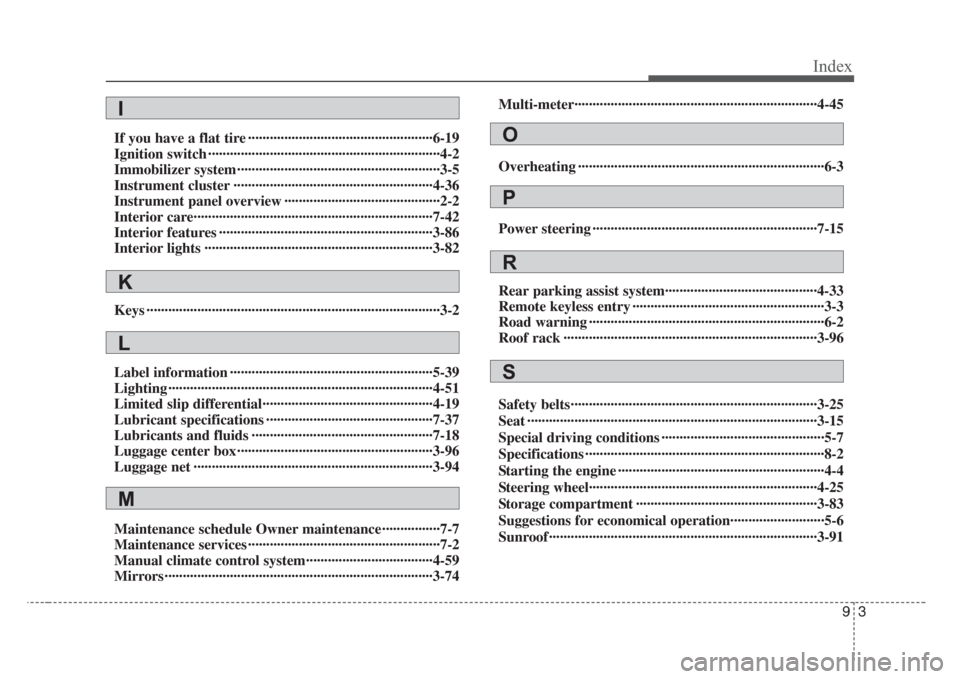
If you have a flat tire ···················································6-19
Ignition switch ································································4-2
Immobilizer system ························································3-5
Instrument cluster ·······················································4-36
Instrument panel overview ···········································2-2
Interior care··································································7-42
Interior features ···························································3-86
Interior lights ·······························································3-82
Keys ·················································································3-2
Label information ························································5-39
Lighting·········································································4-51
Limited slip differential···············································4-19
Lubricant specifications ··············································7-37
Lubricants and fluids ··················································7-18
Luggage center box ······················································3-96
Luggage net ··································································3-94
Maintenance schedule Owner maintenance ················7-7
Maintenance services ·····················································7-2
Manual climate control system···································4-59
Mirrors ··········································································3-74Multi-meter···································································4-45
Overheating····································································6-3
Power steering······························································7-15
Rear parking assist system··········································4-33
Remote keyless entry ·····················································3-3
Road warning·································································6-2
Roof rack ······································································3-96
Safety belts····································································3-25
Seat ················································································3-15
Special driving conditions ·············································5-7
Specifications ··································································8-2
Starting the engine ·························································4-4
Steering wheel·······························································4-25
Storage compartment ··················································3-83
Suggestions for economical operation··························5-6
Sunroof ··········································································3-91
K
L
M
I
O
P
R
S