engine KIA Sorento 2008 1.G Owner's Manual
[x] Cancel search | Manufacturer: KIA, Model Year: 2008, Model line: Sorento, Model: KIA Sorento 2008 1.GPages: 326, PDF Size: 8.63 MB
Page 6 of 326
13
Introduction
VEHICLE HANDLING
INSTRUCTIONS
As with other vehicles of this type, failure
to operate this vehicle correctly may
result in loss of control, an accident or
vehicle rollover. Specific design charac-
teristics (higher ground clearance, track,
etc.) give this vehicle a higher center of
gravity than ordinary cars. They are not
designed for cornering at the same
speeds as conventional 2-wheel drive
vehicles. Avoid sharp turns or abrupt
maneuvers. Again, failure to operate this
vehicle correctly may result in loss of
control, an accident or vehicle rollover.
Be sure to read the “on-pavement’’
and “off-road’’ driving guidelines,
Section 5 in this manual.
VEHICLE BREAK-IN PROCESS
No special break-in period is needed. By
following a few simple precautions for the
first 1,000 km (600 miles) you may add to
the performance, economy and life of
your vehicle.
• Do not race the engine.
• Do not maintain a single speed for long
periods of time, either fast or slow.
Varying engine speed is needed to
properly break-in the engine.
• Avoid hard stops, except in emergen-
cies, to allow the brakes to seat prop-
erly.
• Avoid full-throttle starts.
Page 7 of 326
2
Instrument panel overview / 2-2
Engine compartment / 2-3
Your vehicle at a glance
Page 9 of 326
23
Your vehicle at a glance
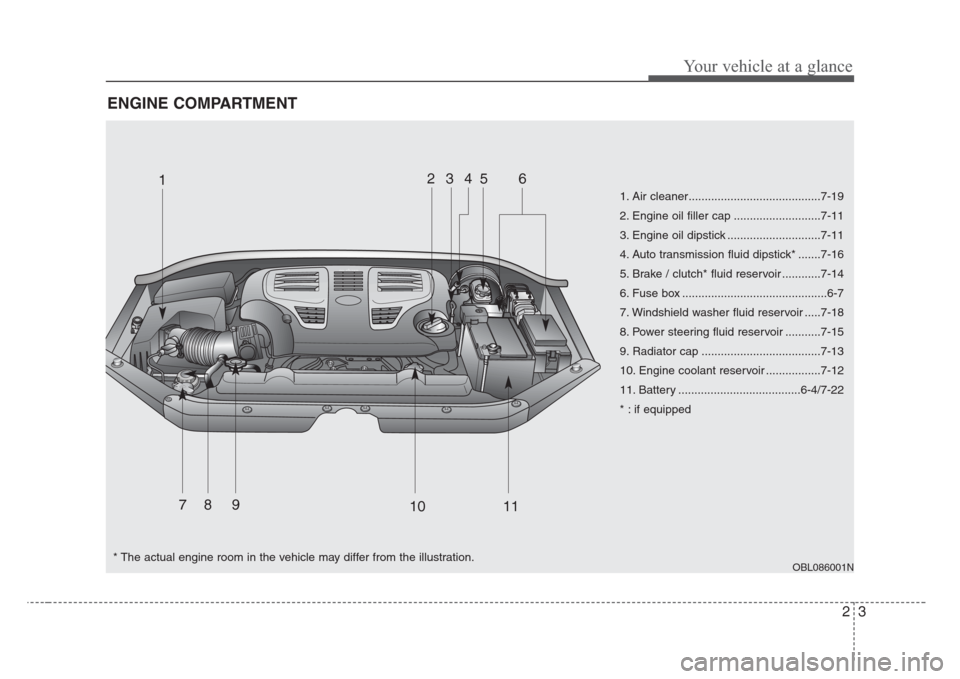
ENGINE COMPARTMENT
OBL086001N
1. Air cleaner.........................................7-19
2. Engine oil filler cap ...........................7-11
3. Engine oil dipstick .............................7-11
4. Auto transmission fluid dipstick* .......7-16
5. Brake / clutch* fluid reservoir ............7-14
6. Fuse box .............................................6-7
7. Windshield washer fluid reservoir .....7-18
8. Power steering fluid reservoir ...........7-15
9. Radiator cap .....................................7-13
10. Engine coolant reservoir .................7-12
11. Battery ......................................6-4/7-22
* : if equipped
1435 62
7
89
1110
* The actual engine room in the vehicle may differ from the illustration.
Page 14 of 326
35
Knowing your vehicle
Your vehicle is equipped with an electron-
ic engine immobilizer system to reduce
the risk of unauthorized vehicle use.
Your immobilizer system is comprised of
a small transponder in the ignition key,
and antenna coil in the key cylinder and
Immobilizer Control Unit (or Smartra
Unit).
With this system, whenever you insert
your ignition key into the ignition switch
and turn it to ON, the antenna coil in the
ignition switch receives a signal from the
transponder in the ignition key and then
sends the signal to the ECU (Engine
Control Unit).
The ECU checks the signal whether the
ignition key is valid.
If the key is determined to be valid, the
engine will start.
If the key is determined to be invalid, the
engine will not start.
To deactivate the immobilizer system:
Insert the ignition key into the key cylin-
der and turn it to the ON position.
To activate the immobilizer system:
Turn the ignition key to the OFF position.
The immobilizer system activates auto-
matically. Without a valid ignition key for
your vehicle, the engine will not start.
✽
NOTICE
When starting the engine, do not use the
key with other immobilizer keys around.
Otherwise the engine may not start or
may stop soon after it starts. Keep each
key separately not to have any malfunc-
tion after you receive your new vehicle.
Limp home (override) procedure
When you turn the ignition key to the ON
position, if the IMMO indicator goes off
after blinking 5 times, your transponder
equipped in the ignition key is out of order.
You cannot start the engine without the
lime home procedure. To start the engine,
you have to input your password by using
the ignition switch.
The following procedure is how to input
your password of “2345” as an example.
1. Turn the ignition key to the ON position.
The IMMO indicator ( ) will blink 5
times and go off indicating the begin-
ning of the limp home procedure.
2. Turn the ignition key to the ACC posi-
tion.
3. To enter the first digit (in this example
“2”), turn the ignition key to the ON and
ACC position twice. Perform the same
procedure for the next digits between 3
seconds and 10 seconds (for example,
for “3”, turn the ignition ON and ACC 3
times).
IMMOBILIZER SYSTEM (IF EQUIPPED)
CAUTION
Do not put metal accessories near
the key or ignition switch.
The engine may not start for the
metal accessories may interrupt the
transponder signal from normally
transmitting.
WARNING
In order to prevent theft of your
vehicle, do not leave spare keys
anywhere in your vehicle. Your
Immobilizer password is a cus-
tomer unique password and should
be kept confidential. Do not leave
this number anywhere in your vehi-
cle.
Page 15 of 326
Knowing your vehicle
6 3
4. If all of the digits have been input suc-
cessfully, you have to start the engine
within 30 seconds. If you attempt to
start the engine after 30 seconds, the
engine will not start and you will have
to input your password again.
After performing the limp home proce-
dure, you have to see an authorized Kia
dealer immediately to inspect and repair
your ignition key or immobilizer system.
✽
NOTICE
If you cannot start your engine in spite
of limp home procedure, have your vehi-
cle towed by an authorized Kia dealer
for inspection and necessary repairs.
✽
NOTICE
The transponder in your ignition key is
an important part of the immobilizer
system. It is designed to give years of
troublefree service, however you should
avoid exposure to moisture, static elec-
tricity and rough handling.
Immobilizer system malfunction could
occur.
✽
NOTICE
Do not change, alter or adjust the immo-
bilizer system because it could cause the
immobilizer system to malfunction and
should only be serviced by an autho-
rized Kia dealer.
Malfunctions caused by improper alter-
ations, adjustments or modifications to
the immobilizer system are not covered
by your vehicle manufacturer warranty.
This device complies with Industry
Canada Standard RSS-210.Operation
is subject to the following two conditions:
1. This device may not cause interfer-
ence, and
2. This device must accept any interfer-
ence, including interference that may
cause undesired operation of the
device.
WARNING
Changes or modifications not
expressly approved by the party
responsible for compliance could
void the user's authority to operate
the equipment.
Page 27 of 326
Knowing your vehicle
18 3
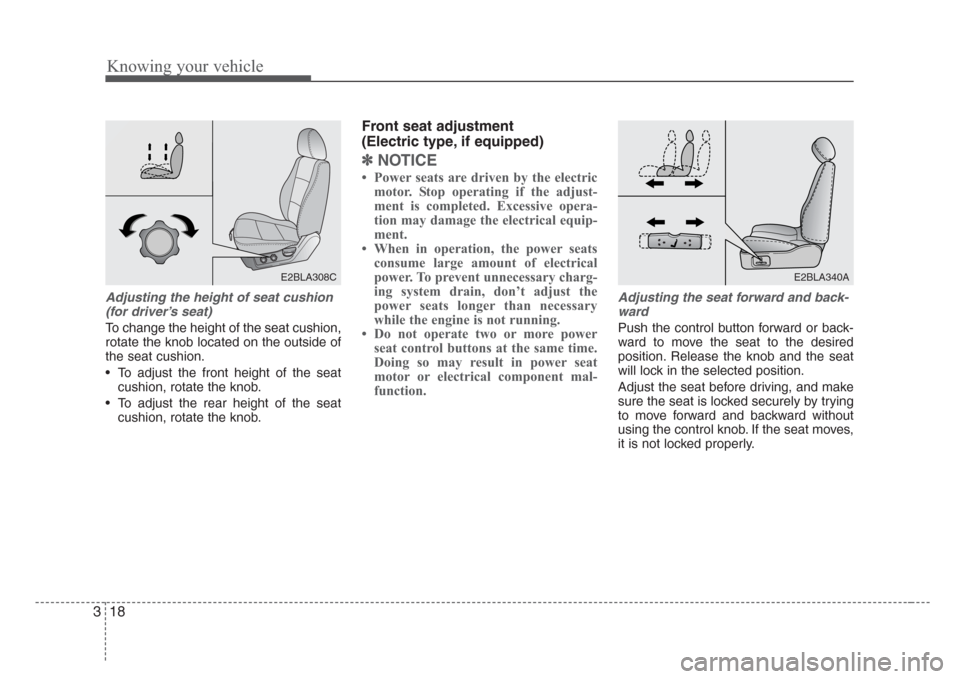
Adjusting the height of seat cushion
(for driver’s seat)
To change the height of the seat cushion,
rotate the knob located on the outside of
the seat cushion.
• To adjust the front height of the seat
cushion, rotate the knob.
• To adjust the rear height of the seat
cushion, rotate the knob.
Front seat adjustment
(Electric type, if equipped)
✽
NOTICE
Power seats are driven by the electric
motor. Stop operating if the adjust-
ment is completed. Excessive opera-
tion may damage the electrical equip-
ment.
When in operation, the power seats
consume large amount of electrical
power. To prevent unnecessary charg-
ing system drain, don’t adjust the
power seats longer than necessary
while the engine is not running.
Do not operate two or more power
seat control buttons at the same time.
Doing so may result in power seat
motor or electrical component mal-
function.
Adjusting the seat forward and back-
ward
Push the control button forward or back-
ward to move the seat to the desired
position. Release the knob and the seat
will lock in the selected position.
Adjust the seat before driving, and make
sure the seat is locked securely by trying
to move forward and backward without
using the control knob. If the seat moves,
it is not locked properly.
E2BLA308CE2BLA340A
Page 33 of 326

Knowing your vehicle
24 3
To unfold the rear seat
1. Lift and push the seatback backward
firmly until it clicks into place.
2. Replace the headrest on the seatback.
3. Push the seat cushion down firmly.
Armrest
The armrest is located in the center of
the rear seat. Pull the armrest down from
the seatback.
CAUTION - Rear floor
Do not remove the floor carpet in
your vehicle. Emission control sys-
tem components in the area of the
rear seats cause high exhaust tem-
peratures under the floor.
WARNING- Cargo
Cargo should always be secured to
prevent it from being thrown about
the vehicle in a collision and caus-
ing injury to the vehicle occupants.
Special care should be taken of
objects placed in the rear seats,
since those may hit the front seat
occupants in a frontal collision.
CAUTION - Cargo loading
Make sure the engine is off, the
transmission is in P and the parking
brake is applied whenever loading
or unloading cargo. Failure to take
these steps may allow the vehicle to
move if shift lever is inadvertently
moved to another position.
E2BLB301F
Page 62 of 326
353
Knowing your vehicle
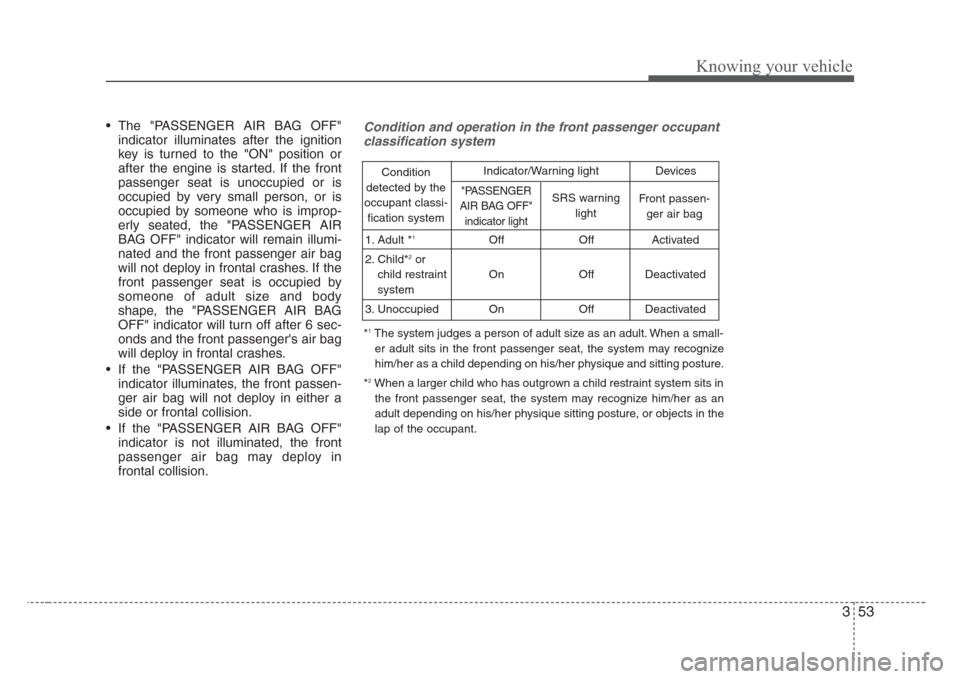
• The "PASSENGER AIR BAG OFF"
indicator illuminates after the ignition
key is turned to the "ON" position or
after the engine is started. If the front
passenger seat is unoccupied or is
occupied by very small person, or is
occupied by someone who is improp-
erly seated, the "PASSENGER AIR
BAG OFF" indicator will remain illumi-
nated and the front passenger air bag
will not deploy in frontal crashes. If the
front passenger seat is occupied by
someone of adult size and body
shape, the "PASSENGER AIR BAG
OFF" indicator will turn off after 6 sec-
onds and the front passenger's air bag
will deploy in frontal crashes.
• If the "PASSENGER AIR BAG OFF"
indicator illuminates, the front passen-
ger air bag will not deploy in either a
side or frontal collision.
• If the "PASSENGER AIR BAG OFF"
indicator is not illuminated, the front
passenger air bag may deploy in
frontal collision.Condition and operation in the front passenger occupant
classification system
*1The system judges a person of adult size as an adult. When a small-
er adult sits in the front passenger seat, the system may recognize
him/her as a child depending on his/her physique and sitting posture.
*
2When a larger child who has outgrown a child restraint system sits in
the front passenger seat, the system may recognize him/her as an
adult depending on his/her physique sitting posture, or objects in the
lap of the occupant.
Condition
detected by the
occupant classi-
fication system
1. Adult *
1
2. Child*2or
child restraint
system
3. Unoccupied Off
On
OnOff
Off
OffActivated
Deactivated
Deactivated
"PASSENGER
AIR BAG OFF"
indicator lightSRS warning
lightFront passen-
ger air bag Indicator/Warning light Devices
Page 75 of 326
Knowing your vehicle
66 3
Air bag warning light
The purpose of air bag warning light in
your instrument panel is to alert you of a
potential problem with your air bag -
Supplemental Restraint System (SRS).
When the ignition switch is turned ON,
the indicator light should blink or illumi-
nate for approximately 6 seconds, then
go off.
Have the system checked if:
• The light does not turn on briefly when
you turn the ignition ON.
• The light stays on after the engine
starts.
• The light comes on while the vehicle is
in motion.
Air bag (Supplemental Restraint
System) service
Your Supplemental Restraint System is
virtually maintenance-free. There are no
parts which you can service.
You must have the system serviced
under the following circumstances:
• If an air bag ever inflates, the air bag
must be replaced. Do not try to remove
or discard the air bag by yourself. This
must be done by an authorized Kia
dealer.
• If the air bag warning indicator light
alerts you to a problem, have the air
bag system checked as soon as possi-
ble. Otherwise, your air bag system
may be ineffective.
WARNING
• Never put child restraint in the
front passenger seat. If the front
passenger air bag inflates, it may
cause severe or fatal injuries.
• When children are seated in the
rear outboard seats in which cur-
tain air bags are equipped, be
sure to put the child restraint sys-
tem as far away from the door
side as possible, and secure the
child restraint system to be
locked in position.
Inflation of curtain air bag could
cause severe injury or death due
to the expansion impact.
AIR
BAG
CAUTION
Do not modify any part of the air
bag system. Modification could
make the air bag system ineffective
or could cause unnecessary
deployment.
Page 79 of 326
Knowing your vehicle
70 3
Closing the hood
1. Before closing the hood, check the fol-
lowing:
• All filler caps in engine compartment
must be correctly installed.
• Gloves, rags or any other com-
bustible material must be removed
from the engine compartment.
2. Lower the hood halfway and push
down to securely lock in place.
Make sure the hood is properly locked
before driving.WARNING - Hood
• Before closing the hood, make
sure that all engine parts and
tools have been removed from
the engine area and that no one’s
hands are near the hood opening.
• Do not leave gloves,rags or any
other combustible material in the
engine compartment. Doing so
may cause a heat-induced fire.