mirror KIA Sorento 2008 1.G User Guide
[x] Cancel search | Manufacturer: KIA, Model Year: 2008, Model line: Sorento, Model: KIA Sorento 2008 1.GPages: 326, PDF Size: 8.63 MB
Page 205 of 326
475
Driving your vehicle
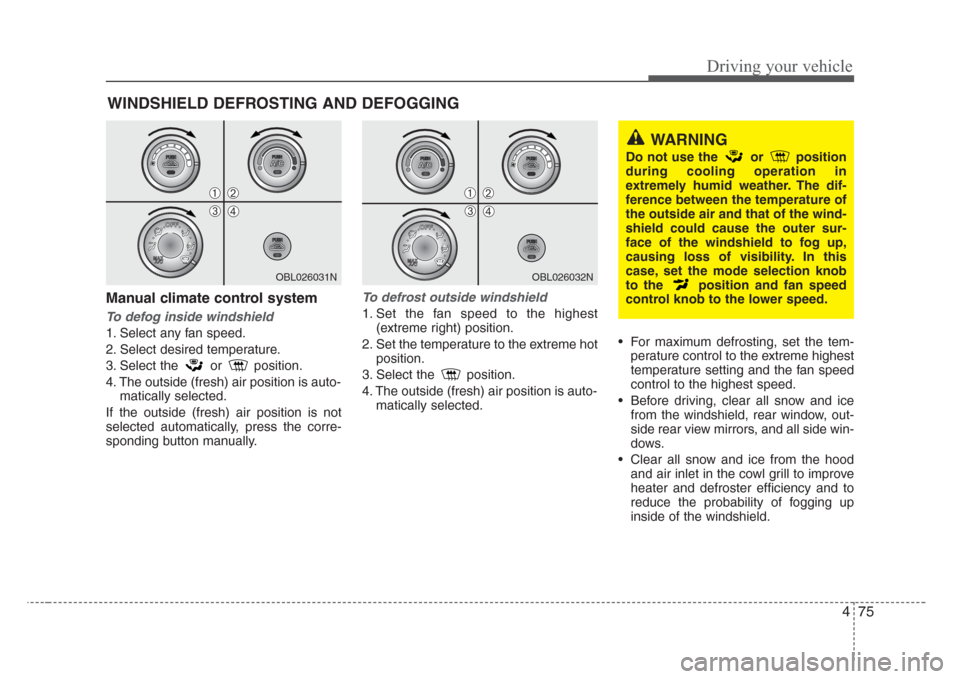
Manual climate control system
To defog inside windshield
1. Select any fan speed.
2. Select desired temperature.
3. Select the or position.
4. The outside (fresh) air position is auto-
matically selected.
If the outside (fresh) air position is not
selected automatically, press the corre-
sponding button manually.
To defrost outside windshield
1. Set the fan speed to the highest
(extreme right) position.
2. Set the temperature to the extreme hot
position.
3. Select the position.
4. The outside (fresh) air position is auto-
matically selected.• For maximum defrosting, set the tem-
perature control to the extreme highest
temperature setting and the fan speed
control to the highest speed.
• Before driving, clear all snow and ice
from the windshield, rear window, out-
side rear view mirrors, and all side win-
dows.
• Clear all snow and ice from the hood
and air inlet in the cowl grill to improve
heater and defroster efficiency and to
reduce the probability of fogging up
inside of the windshield.
WINDSHIELD DEFROSTING AND DEFOGGING
OBL026031NOBL026032N
➀➁
➂➃
➀➁
➂➃
WARNING
Do not use the or position
during cooling operation in
extremely humid weather. The dif-
ference between the temperature of
the outside air and that of the wind-
shield could cause the outer sur-
face of the windshield to fog up,
causing loss of visibility. In this
case, set the mode selection knob
to the position and fan speed
control knob to the lower speed.
Page 206 of 326
Driving your vehicle
76 4
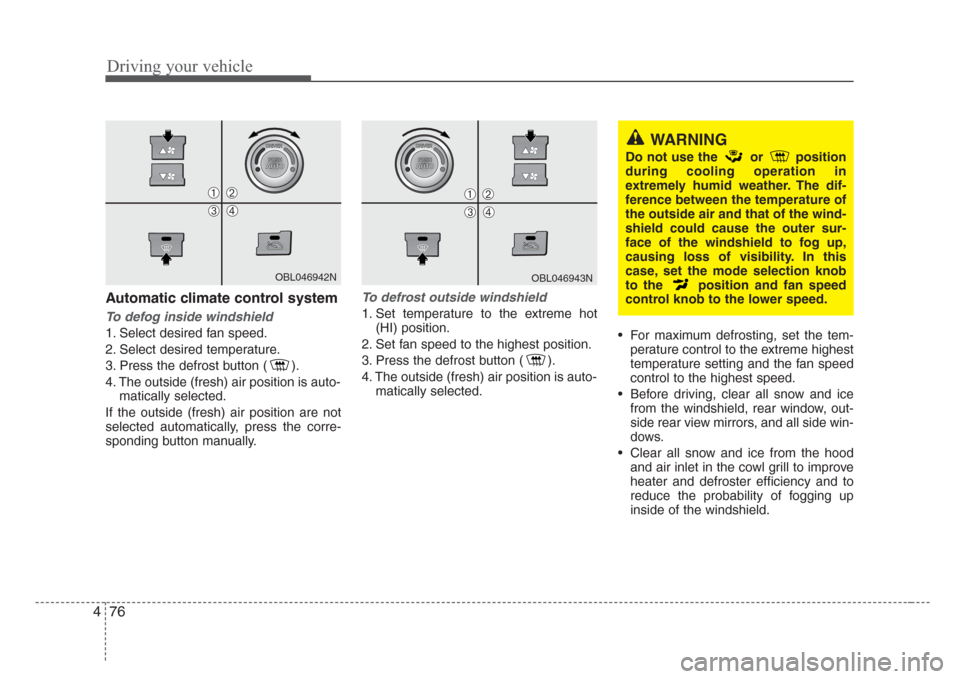
Automatic climate control system
To defog inside windshield
1. Select desired fan speed.
2. Select desired temperature.
3. Press the defrost button ( ).
4. The outside (fresh) air position is auto-
matically selected.
If the outside (fresh) air position are not
selected automatically, press the corre-
sponding button manually.
To defrost outside windshield
1. Set temperature to the extreme hot
(HI) position.
2. Set fan speed to the highest position.
3. Press the defrost button ( ).
4. The outside (fresh) air position is auto-
matically selected.• For maximum defrosting, set the tem-
perature control to the extreme highest
temperature setting and the fan speed
control to the highest speed.
• Before driving, clear all snow and ice
from the windshield, rear window, out-
side rear view mirrors, and all side win-
dows.
• Clear all snow and ice from the hood
and air inlet in the cowl grill to improve
heater and defroster efficiency and to
reduce the probability of fogging up
inside of the windshield.
OBL046942NOBL046943N
➀➁
➂➃
➀➁
➂➃
WARNING
Do not use the or position
during cooling operation in
extremely humid weather. The dif-
ference between the temperature of
the outside air and that of the wind-
shield could cause the outer sur-
face of the windshield to fog up,
causing loss of visibility. In this
case, set the mode selection knob
to the position and fan speed
control knob to the lower speed.
Page 213 of 326
55
Driving tips
BEFORE DRIVING
Before entering vehicle:
• Be sure that all windows, outside mir-
ror(s), and outside lights are clean.
• Check the condition of the tires.
• Check under the vehicle for any sign of
leaks.
• Be sure there are no obstacles behind
you if you intend to back up.
Necessary inspections
Fluid levels, such as engine oil, engine
coolant, brake fluid, and washer fluid
should be checked on a regular basis,
with the exact interval depending on the
fluid. Further details are provided in
Section 7, Maintenance.
Before starting
• Close and lock all doors.
• Position the seat so that all controls are
easily reached.
• Adjust the inside and outside rearview
mirrors.
• Be sure that all lights work.
• Check all gauges.
• Check the operation of warning lights
when the ignition switch is turned to
the ON position.
• Release the parking brake and make
sure the brake warning light goes out.
For safe operation, be sure you are famil-
iar with your vehicle and its equipment.WARNING- Driving under
the influence of alcohol or
drugs
Drinking and driving is dangerous.
Drunk driving is the number one
contributor to the highway death
toll each year. Even a small amount
of alcohol will affect your reflexes,
perceptions and judgement. Driving
while under the influence of drugs
is as dangerous or more dangerous
than driving drunk.
You are much more likely to have a
serious accident if you drink or take
drugs and drive.
If you are drinking or taking drugs,
don’t drive. Do not ride with a driv-
er who has been drinking or taking
drugs. Choose a designated driver
or call a cab.
Page 216 of 326
Driving tips
8 5
Driving at night
Because night driving presents more
hazards than driving in the daylight, here
are some important tips to remember:
• Slow down and keep more distance
between you and other vehicles, as it
may be more difficult to see at night,
especially in areas where there may
not be any street lights.
• Adjust your mirrors to reduce the glare
from other driver's headlights.
• Keep your headlights clean and prop-
erly aimed on vehicles not equipped
with the automatic headlight aiming
feature. Dirty or improperly aimed
headlights will make it much more diffi-
cult to see at night.
• Avoid staring directly at the headlights
of oncoming vehicles. You could be
temporarily blinded, and it will take
several seconds for your eyes to read-
just to the darkness.
Driving in the rain
Rain and wet roads can make driving
dangerous, especially if you’re not pre-
pared for the slick pavement. Here are a
few things to consider when driving in the
rain:
• A heavy rainfall will make it harder to
see and will increase the distance
needed to stop your vehicle, so slow
down.
• Keep your windshield wiping equip-
ment in good shape. Replace your
windshield wiper blades when they
show signs of streaking or missing
areas on the windshield.
• If your tires are not in good condition,
making a quick stop on wet pavement
can cause a skid and possibly lead to
an accident. Be sure your tires are in
good shape.
• Turn on your headlights to make it eas-
ier for others to see you.
• Driving too fast through large puddles
can affect your brakes. If you must go
through puddles, try to drive through
them slowly.
• If you believe you may have gotten
your brakes wet, apply them lightly
while driving until normal braking oper-
ation returns.WARNING- Spinning tires
Do not spin the wheels, especially
at speeds more than 56 km/h (35
mph). Spinning the wheels at high
speeds when the vehicle is station-
ary could cause a tire to overheat,
explode and injure bystanders.
CAUTION
The ESC system (if equipped)
should be turned OFF prior to rock-
ing the vehicle.
Page 240 of 326
Driving tips
32 5
Remember that trailering is different than
just driving your vehicle by itself.
Trailering causes major changes in han-
dling, durability, and fuel economy.
Successful, safe trailering requires cor-
rect equipment, and cautious driving.
This section contains many time-tested,
important trailering tips and safety rules.
Many of these are important for your
safety and that of your passengers.
Please read this section carefully before
you pull a trailer.
Load-pulling components such as the
engine, transmission, wheel assemblies,
and tires are forced to work harder
against the load of the added weight. The
engine is required to operate at relatively
higher speeds and under greater loads.
This additional burden generates extra
heat. The trailer also adds considerably
to wind resistance, increasing the pulling
requirements.If you do decide to pull a trailer
Here are some important points if you
decide to pull a trailer:
• State, provincial, county and municipal
government have varying trailering
laws. Make sure your hitch, mirrors,
lights and wiring arrangements are
legal, not only where you live, but also
where you’ll be driving. A good source
for this information is state or local law
enforcement agencies.
• Consider using a sway control. You can
ask a hitch dealer about sway control.
• After your odometer indicates 800 km
(500 miles) or more, you can tow a
trailer. For the first 800 km (500 miles)
that you tow a trailer, don’t drive over
80 km/h (50 mph) and don’t make
starts at full throttle. This helps your
engine and other parts of your vehicle
“wear” in at the heavier loads.
• Always drive your vehicle at a moder-
ate speed (less than 100 km/h (60
mph)).
• On a long uphill grade, do not exceed
70 km/h (45 mph) or the posted towing
speed limit, whichever is lower.
• The important considerations have to
do with weight:
Weight of the trailer
How heavy can a trailer safely be? It
should never weigh more than the maxi-
mum trailer weight with trailer brakes. But
even that can be too heavy.
It depends on how you plan to use your
trailer. For example, speed, altitude, road
grades, outside temperature and how
much your vehicle is used to pull a trailer
are all important. The ideal trailer weight
can also depend on any special equip-
ment that you have on your vehicle.
Page 242 of 326
Driving tips
34 5
Safety chains
You should always attach chains
between your vehicle and your trailer.
Cross the safety chains under the tongue
of the trailer so that the tongue will not
drop to the road if it becomes separated
from the hitch.
Instructions about safety chains may be
provided by the hitch manufacturer or by
the trailer manufacturer. Follow the man-
ufacturer’s recommendation for attaching
safety chains. Always leave just enough
slack so you can turn with your trailer.
And, never allow safety chains to drag on
the ground.
Trailer brakes
If your trailer weighs more than the max-
imum trailer weight without trailer brakes
loaded, then it needs its own brakes and
they must be adequate. Be sure to read
and follow the instructions for the trailer
brakes so you’ll be able to install, adjust
and maintain them properly.
• Don’t tap into your vehicle's brake sys-
tem.
Driving with a trailer
Towing a trailer requires a certain
amount of experience. Before setting out
for the open road, you must get to know
your trailer. Acquaint yourself with the
feel of handling and braking with the
added weight of the trailer. And always
keep in mind that the vehicle you are
driving is now a good deal longer and not
nearly so responsive as your vehicle is
by itself.
Before you start, check the trailer hitch
and platform, safety chains, electrical
connector(s), lights, tires and mirror
adjustment. If the trailer has electric
brakes, start your vehicle and trailer mov-
ing and then apply the trailer brake con-
troller by hand to be sure the brakes are
working. This lets you check your electri-
cal connection at the same time.
During your trip, check occasionally to be
sure that the load is secure, and that the
lights and any trailer brakes are still work-
ing.
WARNING - Trailer brakes
Do not use a trailer with its own
brakes unless you are absolutely
certain that you have properly set
up the brake system. This is not a
task for amateurs. Use an experi-
enced, competent trailer shop for
this work.
Page 259 of 326
611
In case of an emergency
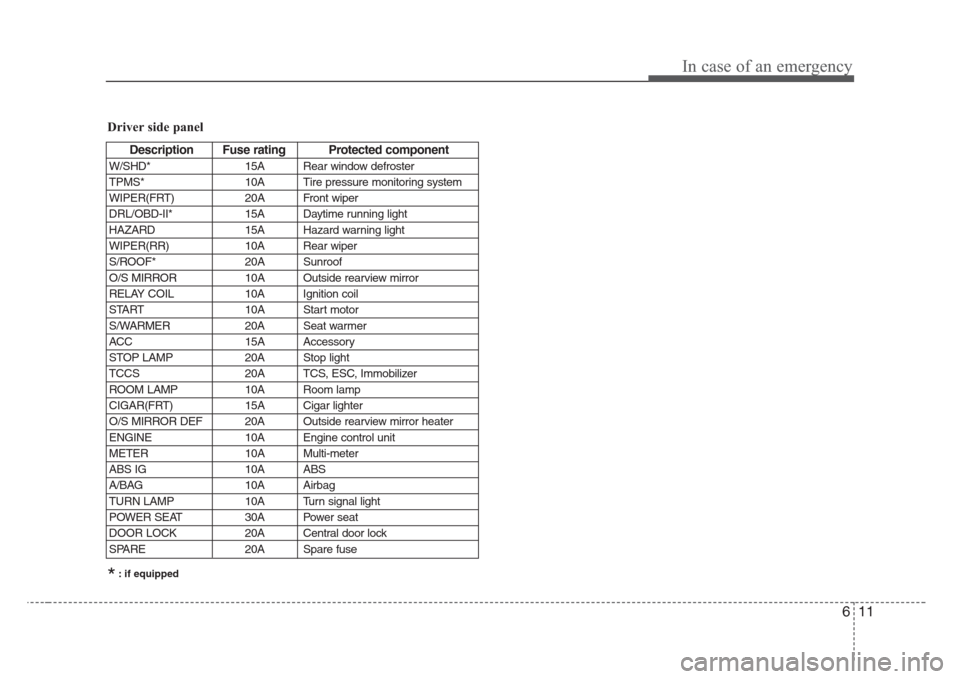
Driver side panel
Description Fuse rating Protected component
W/SHD* 15A Rear window defroster
TPMS* 10A Tire pressure monitoring system
WIPER(FRT) 20A Front wiper
DRL/OBD-II* 15A Daytime running light
HAZARD 15A Hazard warning light
WIPER(RR) 10A Rear wiper
S/ROOF* 20A Sunroof
O/S MIRROR 10A Outside rearview mirror
RELAY COIL 10A Ignition coil
START 10A Start motor
S/WARMER 20A Seat warmer
ACC 15A Accessory
STOP LAMP 20A Stop light
TCCS 20A TCS, ESC, Immobilizer
ROOM LAMP 10A Room lamp
CIGAR(FRT) 15A Cigar lighter
O/S MIRROR DEF 20A Outside rearview mirror heater
ENGINE 10A Engine control unit
METER 10A Multi-meter
ABS IG 10A ABS
A/BAG 10A Airbag
TURN LAMP 10A Turn signal light
POWER SEAT 30A Power seat
DOOR LOCK 20A Central door lock
SPARE 20A Spare fuse
*: if equipped
Page 320 of 326
Specifications
2 8
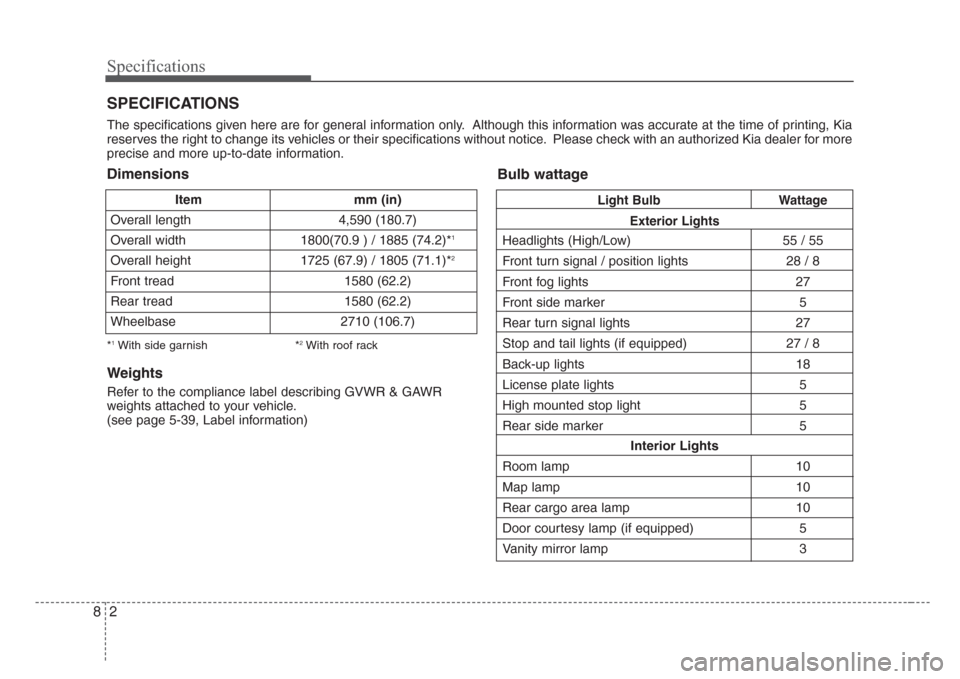
SPECIFICATIONS
The specifications given here are for general information only. Although this information was accurate at the time of printing, Kia
reserves the right to change its vehicles or their specifications without notice. Please check with an authorized Kia dealer for more
precise and more up-to-date information.
Item mm (in)
Overall length 4,590 (180.7)
Overall width 1800(70.9 ) / 1885 (74.2)*
1
Overall height 1725 (67.9) / 1805 (71.1)*2
Front tread 1580 (62.2)
Rear tread 1580 (62.2)
Wheelbase 2710 (106.7)
Dimensions
Bulb wattage
*1With side garnish *2With roof rack
Weights
Refer to the compliance label describing GVWR & GAWR
weights attached to your vehicle.
(see page 5-39, Label information)
Light Bulb Wattage
Exterior Lights
Headlights (High/Low) 55 / 55
Front turn signal / position lights 28 / 8
Front fog lights 27
Front side marker 5
Rear turn signal lights 27
Stop and tail lights (if equipped) 27 / 8
Back-up lights 18
License plate lights 5
High mounted stop light 5
Rear side marker 5
Interior Lights
Room lamp 10
Map lamp 10
Rear cargo area lamp 10
Door courtesy lamp (if equipped) 5
Vanity mirror lamp 3
Page 325 of 326
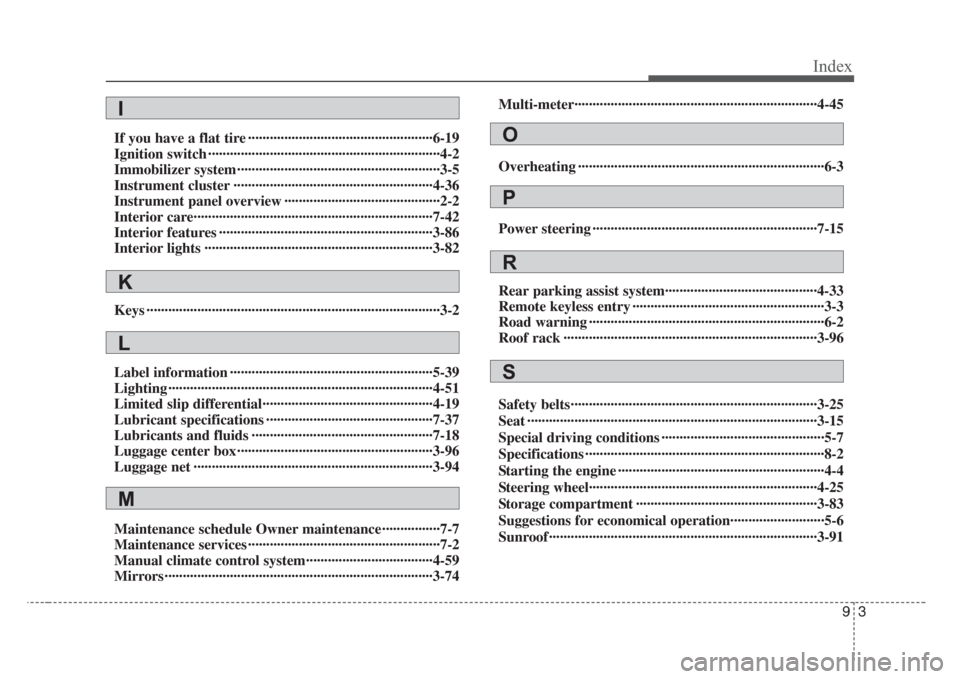
93
Index
If you have a flat tire ···················································6-19
Ignition switch ································································4-2
Immobilizer system ························································3-5
Instrument cluster ·······················································4-36
Instrument panel overview ···········································2-2
Interior care··································································7-42
Interior features ···························································3-86
Interior lights ·······························································3-82
Keys ·················································································3-2
Label information ························································5-39
Lighting·········································································4-51
Limited slip differential···············································4-19
Lubricant specifications ··············································7-37
Lubricants and fluids ··················································7-18
Luggage center box ······················································3-96
Luggage net ··································································3-94
Maintenance schedule Owner maintenance ················7-7
Maintenance services ·····················································7-2
Manual climate control system···································4-59
Mirrors ··········································································3-74Multi-meter···································································4-45
Overheating····································································6-3
Power steering······························································7-15
Rear parking assist system··········································4-33
Remote keyless entry ·····················································3-3
Road warning·································································6-2
Roof rack ······································································3-96
Safety belts····································································3-25
Seat ················································································3-15
Special driving conditions ·············································5-7
Specifications ··································································8-2
Starting the engine ·························································4-4
Steering wheel·······························································4-25
Storage compartment ··················································3-83
Suggestions for economical operation··························5-6
Sunroof ··········································································3-91
K
L
M
I
O
P
R
S