mirror KIA SORENTO 2010 User Guide
[x] Cancel search | Manufacturer: KIA, Model Year: 2010, Model line: SORENTO, Model: KIA SORENTO 2010Pages: 399, PDF Size: 40.44 MB
Page 173 of 399
Features of your vehicle
98
4
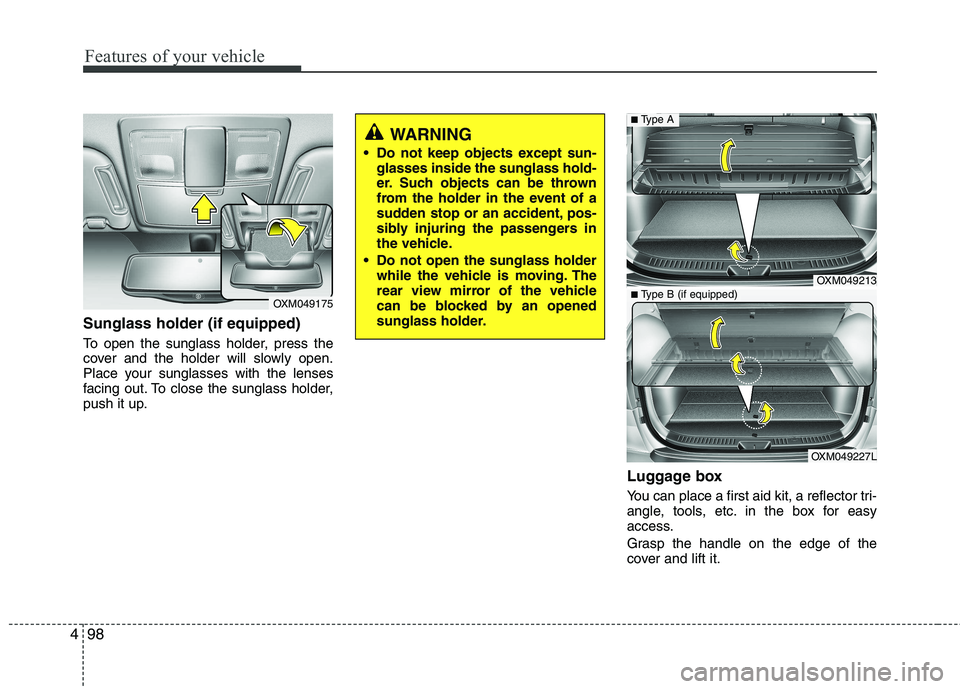
Sunglass holder (if equipped)
To open the sunglass holder, press the
cover and the holder will slowly open.
Place your sunglasses with the lenses
facing out. To close the sunglass holder,
push it up.
Luggage box
You can place a first aid kit, a reflector tri-
angle, tools, etc. in the box for easy
access.
Grasp the handle on the edge of the
cover and lift it.
OXM049175
WARNING
Do not keep objects except sun- glasses inside the sunglass hold-
er. Such objects can be thrown
from the holder in the event of a
sudden stop or an accident, pos-
sibly injuring the passengers in
the vehicle.
Do not open the sunglass holder while the vehicle is moving. The
rear view mirror of the vehicle
can be blocked by an opened
sunglass holder.
OXM049213
OXM049227L
■Type A
■ Type B (if equipped)
Page 176 of 399
4101
Features of your vehicle
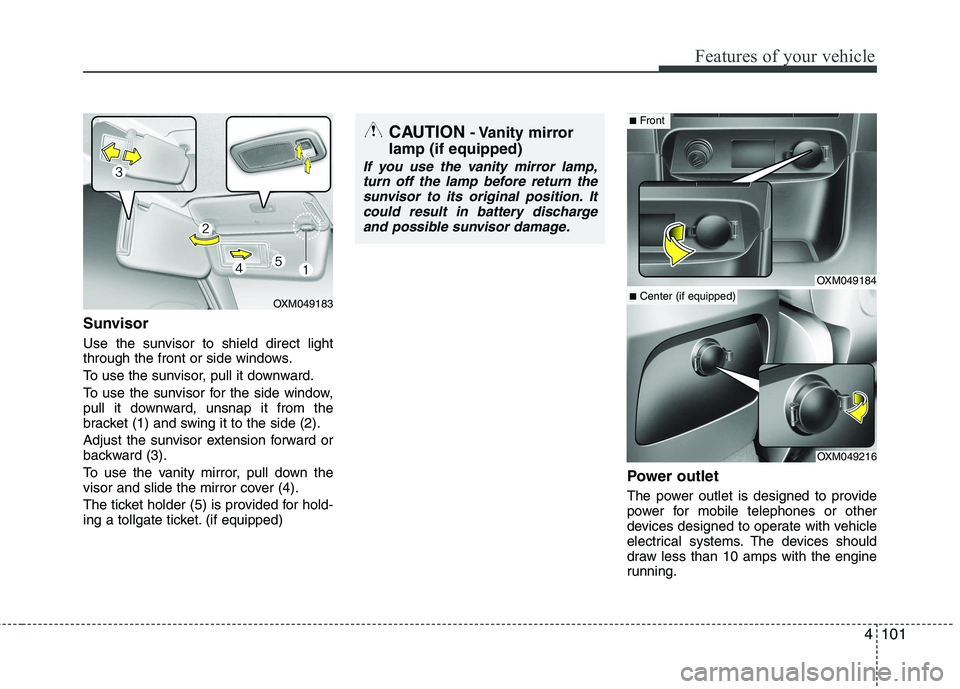
Sunvisor
Use the sunvisor to shield direct light
through the front or side windows.
To use the sunvisor, pull it downward.
To use the sunvisor for the side window,
pull it downward, unsnap it from the
bracket (1) and swing it to the side (2).
Adjust the sunvisor extension forward or
backward (3).
To use the vanity mirror, pull down the
visor and slide the mirror cover (4).
The ticket holder (5) is provided for hold-
ing a tollgate ticket. (if equipped)Power outlet
The power outlet is designed to provide
power for mobile telephones or other
devices designed to operate with vehicle
electrical systems. The devices should
draw less than 10 amps with the engine
running.
OXM049183
CAUTION
- Vanity mirror
lamp (if equipped)
If you use the vanity mirror lamp, turn off the lamp before return the
sunvisor to its original position. Itcould result in battery dischargeand possible sunvisor damage.
OXM049184
OXM049216
■ Front
■Center (if equipped)
Page 215 of 399
53
Driving your vehicle
Before entering vehicle
• Be sure that all windows, outside mir-ror(s), and outside lights are clean.
Check the condition of the tires.
Check under the vehicle for any sign of leaks.
Be sure there are no obstacles behind you if you intend to back up.
Necessary inspections
Fluid levels, such as engine oil, engine
coolant, brake fluid, and washer fluid
should be checked on a regular basis,
with the exact interval depending on the
fluid. Further details are provided in sec-
tion 7, “Maintenance”. Before starting
Close and lock all doors.
Position the seat so that all controls are
easily reached.
Adjust the inside and outside rearview mirrors.
Be sure that all lights work.
Check all gauges.
Check the operation of warning lights when the ignition switch is turned to the ON position.
Release the parking brake and make sure the brake warning light goes out.
For safe operation, be sure you are famil-
iar with your vehicle and its equipment.
BEFORE DRIVING
WARNING
All passengers must be properly
belted whenever the vehicle is mov-
ing. Refer to “Seat belts” in section
3 for more information on their
proper use.
WARNING
Always check the surrounding
areas near your vehicle for people,
especially children, before putting a
vehicle into D (Drive) or R (Reverse).
WARNING - Driving under
the influence of alcohol or drugs
Drinking and driving is dangerous.
Drunk driving is the number one
contributor to the highway death
toll each year. Even a small amount
of alcohol will affect your reflexes,
perceptions and judgment. Drivingwhile under the influence of drugs
is as dangerous or more dangerousthan driving drunk.
You are much more likely to have a
serious accident if you drink or
take drugs and drive.
If you are drinking or taking drugs,
don’t drive. Do not ride with a driv-er who has been drinking or taking
drugs. Choose a designated driveror call a cab.
WARNING
When you intend to park or stop the
vehicle with the engine on, be care-ful not to depress the accelerator
pedal for a long period of time. It
may overheat the engine or exhaust
system and cause fire.
Page 261 of 399
549
Driving your vehicle
Adjust your mirrors to reduce the glarefrom other driver's headlights.
Keep your headlights clean and prop- erly aimed on vehicles not equipped with the automatic headlight aiming
feature. Dirty or improperly aimed
headlights will make it much more diffi-cult to see at night.
Avoid staring directly at the headlights of oncoming vehicles. You could be
temporarily blinded, and it will take
several seconds for your eyes to read-
just to the darkness.
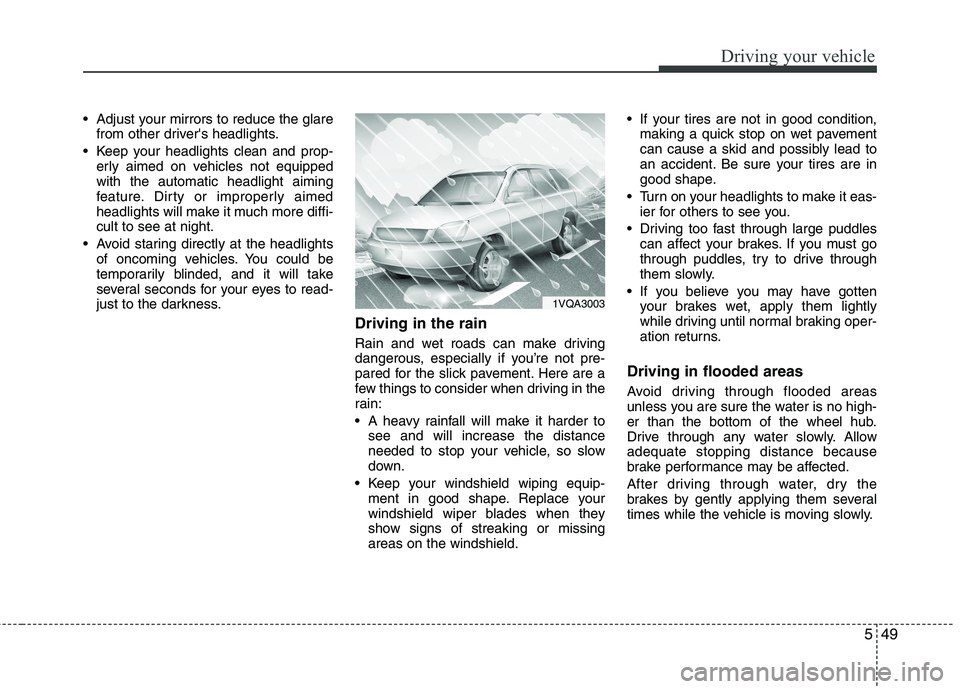
Driving in the rain
Rain and wet roads can make driving
dangerous, especially if you’re not pre-
pared for the slick pavement. Here are a
few things to consider when driving in the
rain:
A heavy rainfall will make it harder tosee and will increase the distance
needed to stop your vehicle, so slow
down.
Keep your windshield wiping equip- ment in good shape. Replace your
windshield wiper blades when they
show signs of streaking or missingareas on the windshield. If your tires are not in good condition,
making a quick stop on wet pavement
can cause a skid and possibly lead to
an accident. Be sure your tires are in
good shape.
Turn on your headlights to make it eas- ier for others to see you.
Driving too fast through large puddles can affect your brakes. If you must go
through puddles, try to drive through
them slowly.
If you believe you may have gotten your brakes wet, apply them lightly
while driving until normal braking oper-
ation returns.
Driving in flooded areas
Avoid driving through flooded areas
unless you are sure the water is no high-
er than the bottom of the wheel hub.
Drive through any water slowly. Allowadequate stopping distance because
brake performance may be affected.
After driving through water, dry the
brakes by gently applying them several
times while the vehicle is moving slowly.
1VQA3003
Page 269 of 399
557
Driving your vehicle
Safety chains
You should always attach chains
between your vehicle and your trailer.
Cross the safety chains under the tongue
of the trailer so that the tongue will not
drop to the road if it becomes separatedfrom the hitch.
Instructions about safety chains may be
provided by the hitch manufacturer or by
the trailer manufacturer. Follow the man-
ufacturer’s recommendation for attaching
safety chains. Always leave just enough
slack so you can turn with your trailer.
And, never allow safety chains drag on
the ground.Trailer brakes
If your trailer is equipped with a braking
system, make sure it conforms to your
country’s regulations and that it is prop-
erly installed and operating correctly.
If your trailer weighs more than the max-
imum trailer weight without trailer brakes
loaded, then it needs its own brakes and
they must be adequate. Be sure to read
and follow the instructions for the trailer
brakes so you’ll be able to install, adjust
and maintain them properly.
Don’t tap into your vehicle's brake sys-
tem. Driving with a trailer
Towing a trailer requires a certain
amount of experience. Before setting out
for the open road, you must get to know
your trailer. Acquaint yourself with the
feel of handling and braking with the
added weight of the trailer. And always
keep in mind that the vehicle you are
driving is now a good deal longer and not
nearly so responsive as your vehicle is
by itself.
Before you start, check the trailer hitch
and platform, safety chains, electrical
connector(s), lights, tires and mirror
adjustment. If the trailer has electric
brakes, start your vehicle and trailer mov-
ing and then apply the trailer brake con-
troller by hand to be sure the brakes are
working. This lets you check your electri-
cal connection at the same time.
During your trip, check occasionally to be
sure that the load is secure, and that the
lights and trailer brakes are still working.
WARNING
- Trailer brakes
Do not use a trailer with its own
brakes unless you are absolutely
certain that you have properly set
up the brake system. This is not a
task for amateurs. Use an experi-
enced, competent trailer shop for
this work.
Page 363 of 399
757
Maintenance
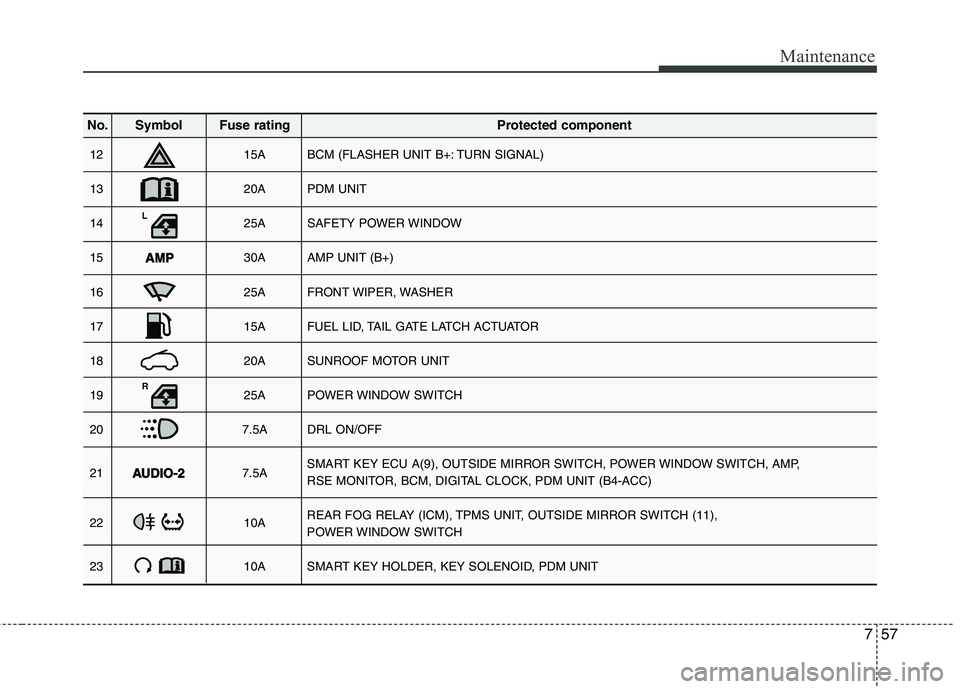
12 15A BCM (FLASHER UNIT B+: TURN SIGNAL)
13 20A PDM UNIT
14 25A SAFETY POWER WINDOW
15 30A AMP UNIT (B+)
16 25A FRONT WIPER, WASHER
17 15A FUEL LID, TAIL GATE LATCH ACTUATOR
18 20A SUNROOF MOTOR UNIT
19 25A POWER WINDOW SWITCH
20 7.5A DRL ON/OFF
21 7.5ASMART KEY ECU A(9), OUTSIDE MIRROR SWITCH, POWER WINDOW SWITCH, AMP,
RSE MONITOR, BCM, DIGITAL CLOCK, PDM UNIT (B4-ACC)
22 10A REAR FOG RELAY (ICM), TPMS UNIT, OUTSIDE MIRROR SWITCH (11),
POWER WINDOW SWITCH
23 10A SMART KEY HOLDER, KEY SOLENOID, PDM UNIT
No. Symbol Fuse rating Protected component
L
R
Page 364 of 399
Maintenance
58
7
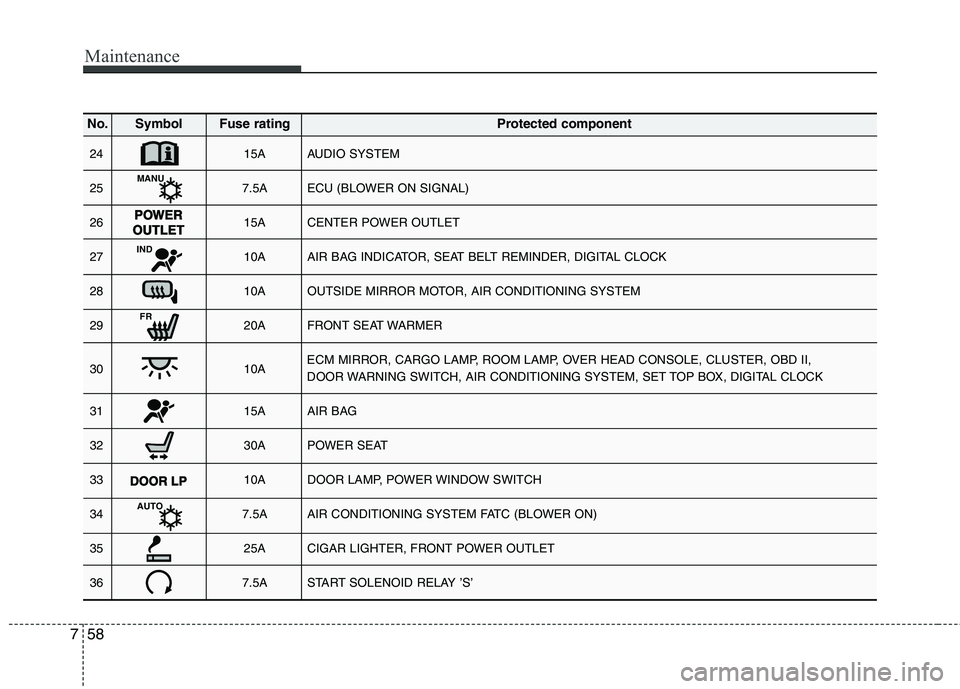
24 15A AUDIO SYSTEM
25 7.5A ECU (BLOWER ON SIGNAL)
26 15A CENTER POWER OUTLET
27 10A AIR BAG INDICATOR, SEAT BELT REMINDER, DIGITAL CLOCK
28 10A OUTSIDE MIRROR MOTOR, AIR CONDITIONING SYSTEM
29 20A FRONT SEAT WARMER
30 10A ECM MIRROR, CARGO LAMP, ROOM LAMP, OVER HEAD CONSOLE, CLUSTER, OBD II,
DOOR WARNING SWITCH, AIR CONDITIONING SYSTEM, SET TOP BOX, DIGITAL CLOCK
31 15A AIR BAG
32 30A POWER SEAT
33 10A DOOR LAMP, POWER WINDOW SWITCH
34 7.5A AIR CONDITIONING SYSTEM FATC (BLOWER ON)
35 25A CIGAR LIGHTER, FRONT POWER OUTLET
36 7.5A START SOLENOID RELAY ’S’
No. Symbol Fuse rating Protected component
MANU
IND
FR
AUTO
Page 366 of 399
Maintenance
60
7
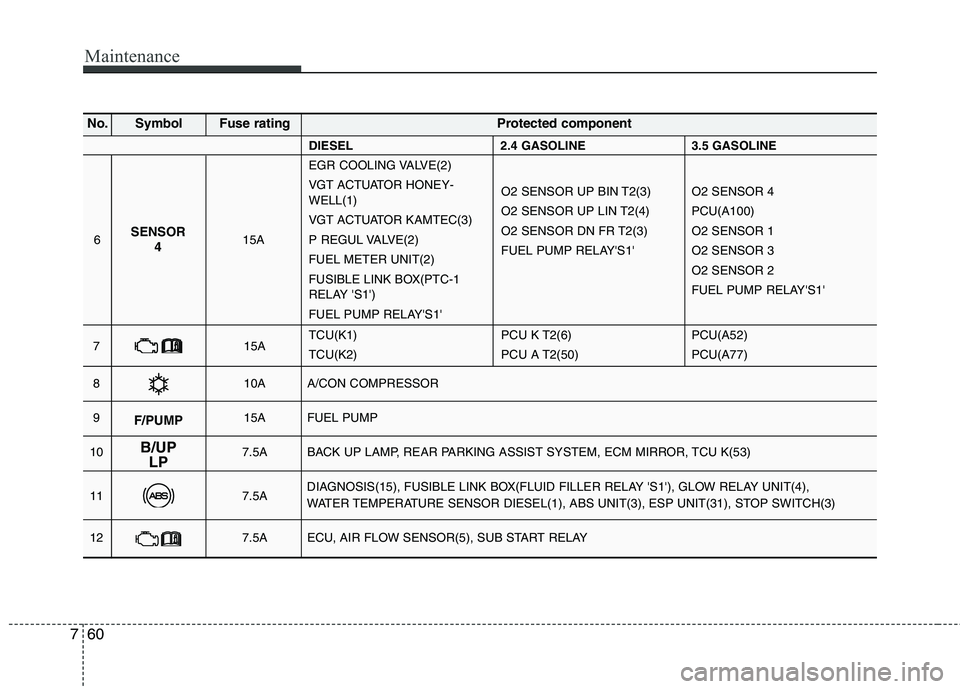
No. Symbol Fuse rating Protected component
8 10A A/CON COMPRESSOR
9 15A FUEL PUMP
10 7.5A BACK UP LAMP, REAR PARKING ASSIST SYSTEM, ECM MIRROR, TCU K(53)
11 7.5A DIAGNOSIS(15), FUSIBLE LINK BOX(FLUID FILLER RELAY 'S1'), GLOW RELAY UNIT(4),
WATER TEMPERATURE SENSOR DIESEL(1), ABS UNIT(3), ESP UNIT(31), STOP SWITCH(3)
12 7.5A ECU, AIR FLOW SENSOR(5), SUB START RELAY
No. Symbol Fuse rating Protected component
15A
6 DIESEL 2.4 GASOLINE 3.5 GASOLINE
EGR COOLING VALVE(2)
VGT ACTUATOR HONEY- WELL(1)
VGT ACTUATOR KAMTEC(3)
P REGUL VALVE(2) FUEL METER UNIT(2)
FUSIBLE LINK BOX(PTC-1
RELAY 'S1')
FUEL PUMP RELAY'S1'O2 SENSOR UP BIN T2(3)
O2 SENSOR UP LIN T2(4)
O2 SENSOR DN FR T2(3)
FUEL PUMP RELAY'S1'
O2 SENSOR 4 PCU(A100) O2 SENSOR 1 O2 SENSOR 3 O2 SENSOR 2
FUEL PUMP RELAY'S1'
7 15A TCU(K1) TCU(K2)PCU K T2(6)
PCU A T2(50)
PCU(A52) PCU(A77)SENSOR4
F/PUMP
B/UP
LP
Page 368 of 399
Maintenance
62
7
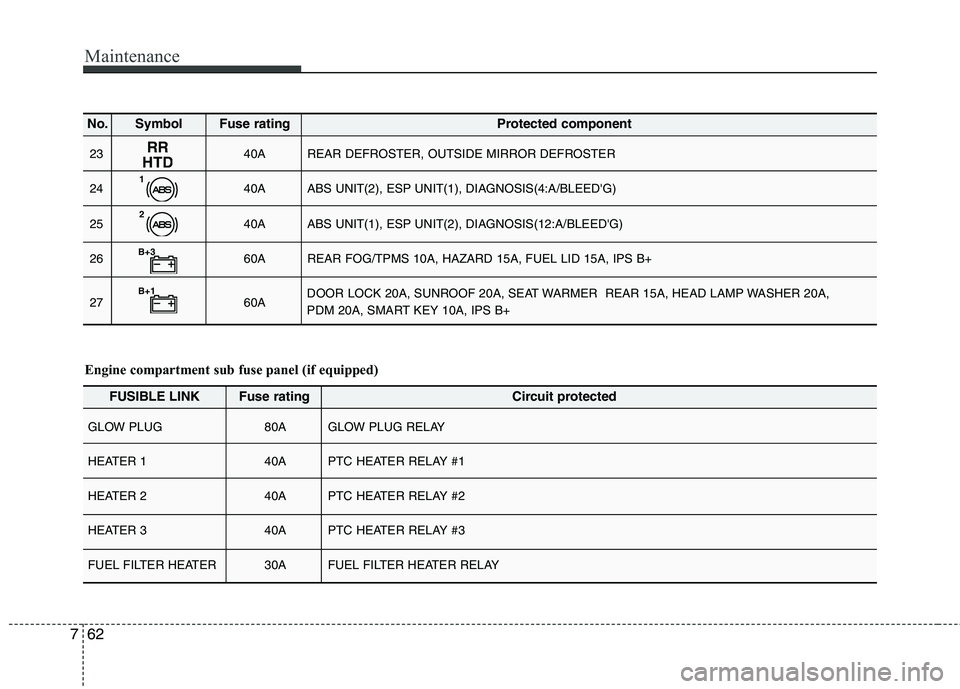
23 40A REAR DEFROSTER, OUTSIDE MIRROR DEFROSTER
24 40A ABS UNIT(2), ESP UNIT(1), DIAGNOSIS(4:A/BLEED'G)
25 40A ABS UNIT(1), ESP UNIT(2), DIAGNOSIS(12:A/BLEED'G)
26 60A REAR FOG/TPMS 10A, HAZARD 15A, FUEL LID 15A, IPS B+
27 60A DOOR LOCK 20A, SUNROOF 20A, SEAT WARMER REAR 15A, HEAD LAMP WASHER 20A,
PDM 20A, SMART KEY 10A, IPS B+
No. Symbol Fuse rating Protected component
GLOW PLUG 80A GLOW PLUG RELAY
HEATER 1 40A PTC HEATER RELAY #1
HEATER 2 40A PTC HEATER RELAY #2
HEATER 3 40A PTC HEATER RELAY #3
FUEL FILTER HEATER 30A FUEL FILTER HEATER RELAY
FUSIBLE LINK Fuse rating Circuit protected
RR
HTD1
2
B+3
B+1
Engine compartment sub fuse panel (if equipped)
Page 377 of 399
771
Maintenance
Interior light bulb replacement
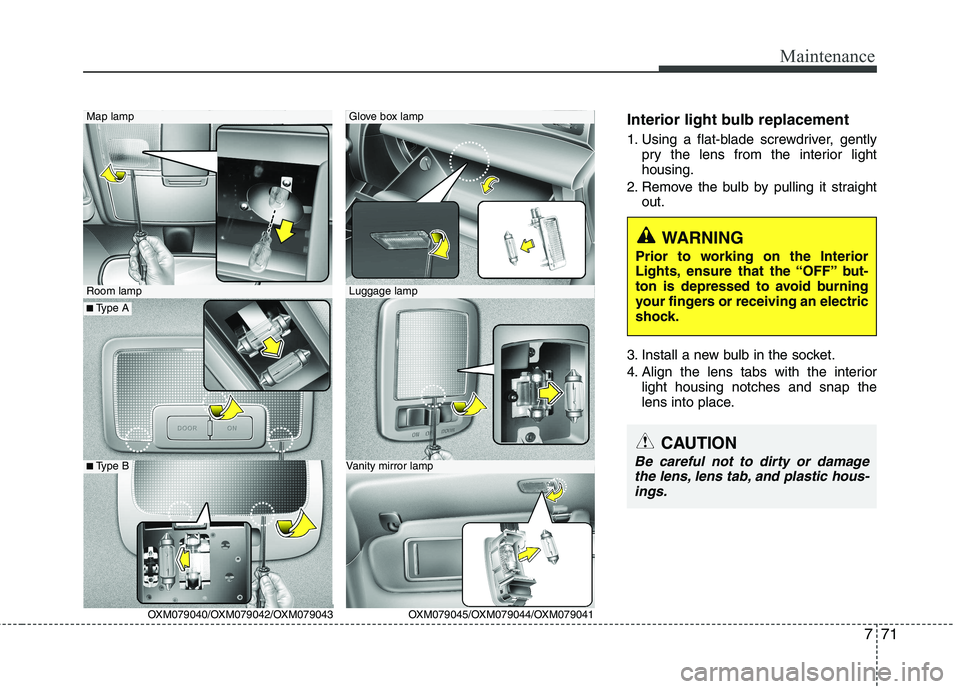
1. Using a flat-blade screwdriver, gentlypry the lens from the interior light housing.
2. Remove the bulb by pulling it straight out.
3. Install a new bulb in the socket.
4. Align the lens tabs with the interior light housing notches and snap the
lens into place.Map lamp
Room lamp
■Type B
■Type A
OXM079040/OXM079042/OXM079043
Glove box lamp
Luggage lamp
Vanity mirror lamp OXM079045/OXM079044/OXM079041
WARNING
Prior to working on the Interior
Lights, ensure that the “OFF” but-
ton is depressed to avoid burning
your fingers or receiving an electric
shock.
CAUTION
Be careful not to dirty or damage the lens, lens tab, and plastic hous-ings.