engine KIA Soul 2016 2.G Owner's Manual
[x] Cancel search | Manufacturer: KIA, Model Year: 2016, Model line: Soul, Model: KIA Soul 2016 2.GPages: 556, PDF Size: 21.35 MB
Page 536 of 556
Maintenance
106
7
Do not operate the engine in con-
fined or closed areas (such as
garages) any more than what is
necessary to move the vehicle in or
out of the area.
When the vehicle is stopped in an open area for more than a short
time with the engine running,
adjust the ventilation system (as
needed) to draw outside air into the
vehicle.
Never sit in a parked or stopped vehicle for any extended time with
the engine running.
When the engine stalls or fails to start, excessive attempts to restart
the engine may cause damage to
the emission control system.Operating precautions for catalyt-
ic converters
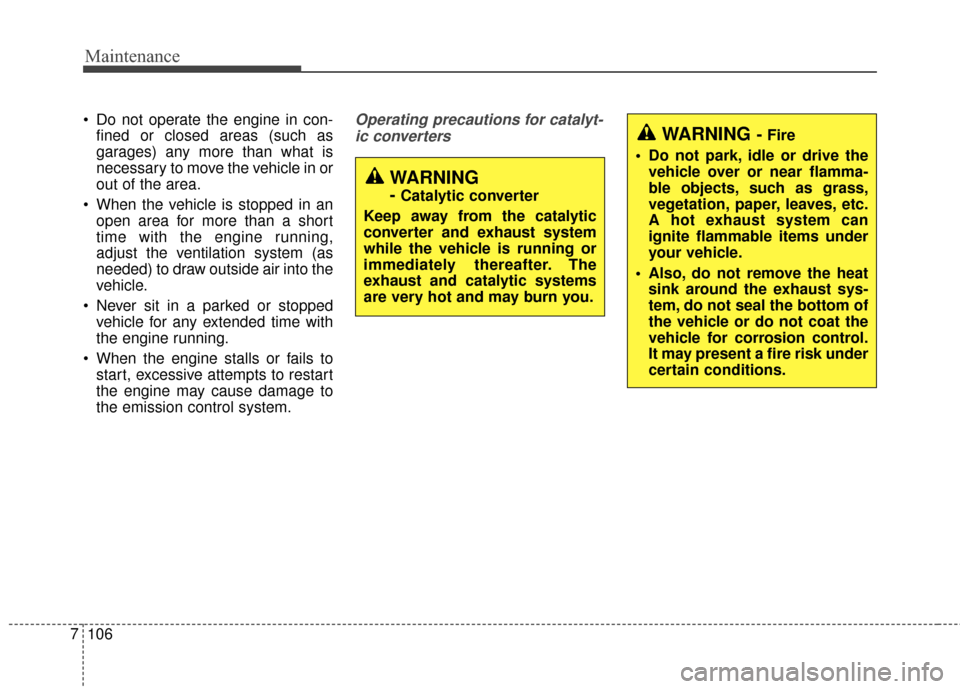
WARNING
- Catalytic converter
Keep away from the catalytic
converter and exhaust system
while the vehicle is running or
immediately thereafter. The
exhaust and catalytic systems
are very hot and may burn you.
WARNING - Fire
Do not park, idle or drive the vehicle over or near flamma-
ble objects, such as grass,
vegetation, paper, leaves, etc.
A hot exhaust system can
ignite flammable items under
your vehicle.
Also, do not remove the heat sink around the exhaust sys-
tem, do not seal the bottom of
the vehicle or do not coat the
vehicle for corrosion control.
It may present a fire risk under
certain conditions.
Page 537 of 556
7107
Maintenance
Your vehicle is equipped with a cat-
alytic converter emission control
device.
Therefore, the following precautions
must be observed:
Use only UNLEADED FUEL forgasoline engines.
Do not operate the vehicle when there are signs of engine malfunc-
tion, such as misfire or a noticeable
loss of performance.
Do not misuse or abuse the engine. Examples of misuse are
coasting with the ignition off and
descending steep grades in gear
with the ignition off.
Do not operate the engine at high idle speed for extended periods (5
minutes or more).
Do not modify or tamper with any part of the engine or emission con-
trol system. All inspections and
adjustments must be made by an
authorized Kia dealer.
Avoid driving with a extremely low fuel level. Running out of fuel could
cause the engine to misfire, dam-
aging the catalytic converter. Failure to observe these precautions
could result in damage to the catalyt-
ic converter and to your vehicle.
Additionally, such actions could void
your warranties.
Page 538 of 556

Specifications & Consumer information
Dimensions . . . . . . . . . . . . . . . . . . . . . . . . . . . . . . . . 8-2
Engine . . . . . . . . . . . . . . . . . . . . . . . . . . . . . . . . . . . . \
8-2
Bulb wattage . . . . . . . . . . . . . . . . . . . . . . . . . . . . . . . 8-3
Tires and wheels . . . . . . . . . . . . . . . . . . . . . . . . . . . . 8-4
Capacity/Weight . . . . . . . . . . . . . . . . . . . . . . . . . . . . 8-5
Air conditioning system . . . . . . . . . . . . . . . . . . . . . . 8-5
Recommended lubricants and capacities . . . . . . . 8-6
• Recommended sae viscosity number . . . . . . . . . . . . . . 8-8
Vehicle identification number (VIN) . . . . . . . . . . . 8-9
Tire specification and pressure label . . . . . . . . . . 8-10
Engine number . . . . . . . . . . . . . . . . . . . . . . . . . . . . 8-10
8
Page 539 of 556
Specifications & Consumer information
28
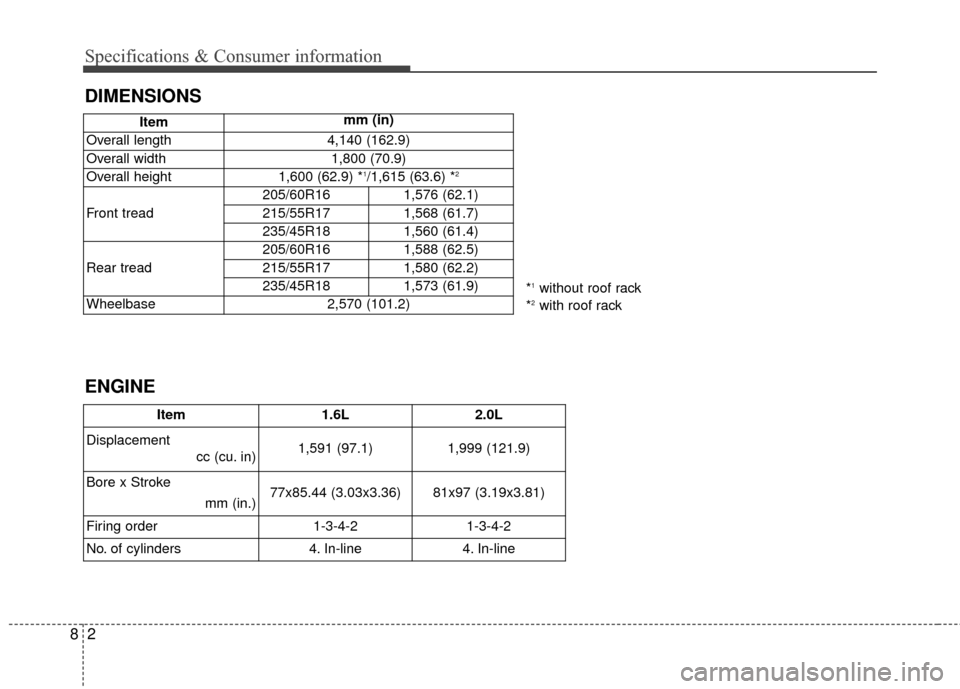
DIMENSIONS
Itemmm (in)
Overall length
4,140 (162.9)
Overall width
1,800 (70.9)
Overall height
1,600 (62.9) *1/1,615 (63.6) *2
Front tread
205/60R161,576 (62.1)
215/55R171,568 (61.7)
235/45R181,560 (61.4)
Rear tread
205/60R161,588 (62.5)
215/55R171,580 (62.2)
235/45R181,573 (61.9)
Wheelbase
2,570 (101.2)
*1without roof rack
*2with roof rack
Item 1.6L 2.0L
Displacement cc (cu. in) 1,591 (97.1) 1,999 (121.9)
Bore x Stroke mm (in.)77x85.44 (3.03x3.36) 81x97 (3.19x3.81)
Firing order 1-3-4-2 1-3-4-2
No. of cylinders 4. In-line4. In-line
ENGINE
Page 542 of 556
85
Specifications & Consumer information
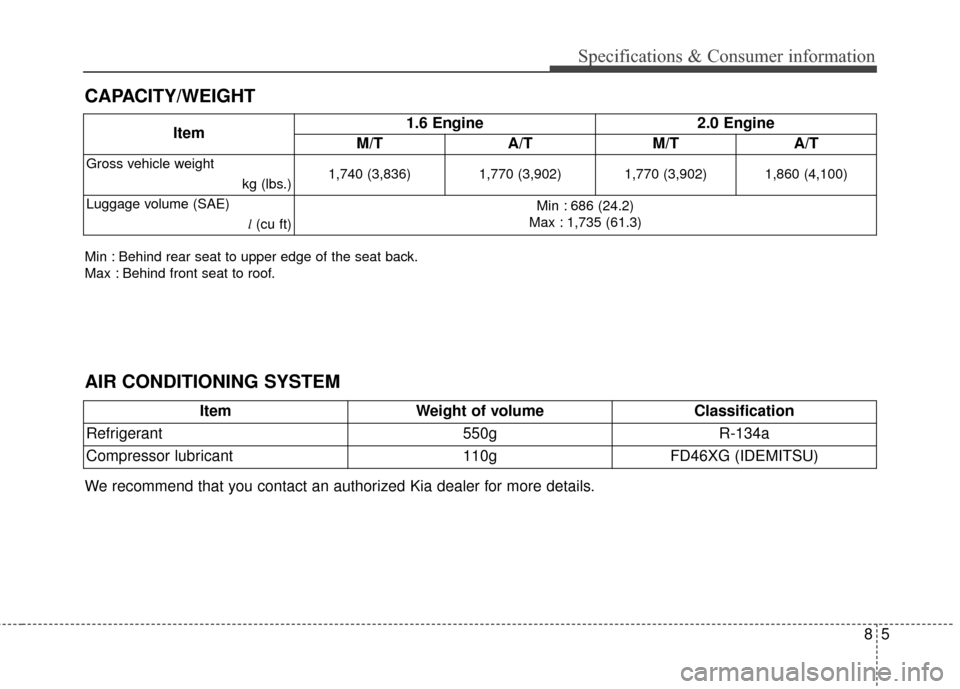
CAPACITY/WEIGHT
Item1.6 Engine 2.0 Engine
M/T A/T M/T A/T
Gross vehicle weight
kg (lbs.)1,740 (3,836) 1,770 (3,902) 1,770 (3,902) 1,860 (4,100)
Luggage volume (SAE) l(cu ft) Min : 686 (24.2)
Max : 1,735 (61.3)
Min : Behind rear seat to upper edge of the seat back.
Max : Behind front seat to roof.
AIR CONDITIONING SYSTEM
ItemWeight of volume Classification
Refrigerant
550g R-134a
Compressor lubricant
110g FD46XG (IDEMITSU)
We recommend that you contact an authorized Kia dealer for more details.
Page 543 of 556
Specifications & Consumer information
68
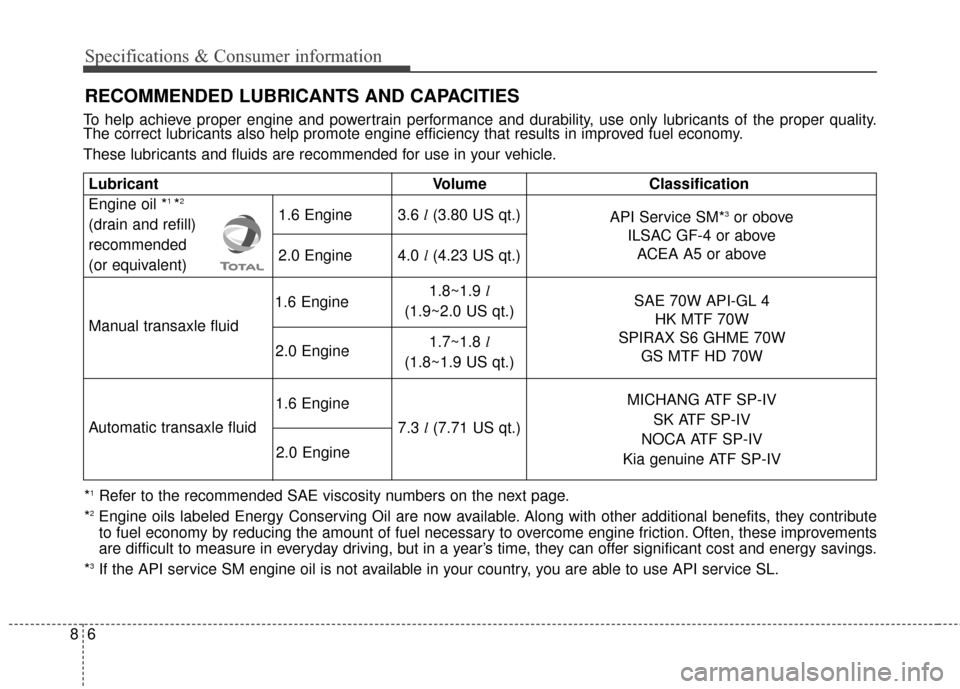
RECOMMENDED LUBRICANTS AND CAPACITIES
To help achieve proper engine and powertrain performance and durability, use only lubricants of the proper quality.
The correct lubricants also help promote engine efficiency that results in improved fuel economy.
These lubricants and fluids are recommended for use in your vehicle.
LubricantVolume Classification
Engine oil *1 *2
1.6 Engine 3.6 l (3.80 US qt.)
(drain and refill)
recommended
2.0 Engine 4.0 l(4.23 US qt.)
(or equivalent)
Manual transaxle fluid
Automatic transaxle fluid
MICHANG ATF SP-IV
SK ATF SP-IV
NOCA ATF SP-IV
Kia genuine ATF SP-IV SAE 70W API-GL 4
HK MTF 70W
SPIRAX S6 GHME 70W GS MTF HD 70W
*
1Refer to the recommended SAE viscosity numbers on the next page.
*2Engine oils labeled Energy Conserving Oil are now available. Along with other additional benefits, they contribute
to fuel economy by reducing the amount of fuel necessary to overcome engine friction. Often, these improvements
are difficult to measure in everyday driving, but in a year’s time, they can offer significant cost and energy savings.
*
3If the API service SM engine oil is not available in your country, you are able to use API service SL. API Service SM*
3or obove
ILSAC GF-4 or above ACEA A5 or above
1.6 Engine
2.0 Engine
2.0 Engine
1.6 Engine
7.3 l(7.71 US qt.)
1.7~1.8
l
(1.8~1.9 US qt.) 1.8~1.9
l
(1.9~2.0 US qt.)
Page 544 of 556
87
Specifications & Consumer information
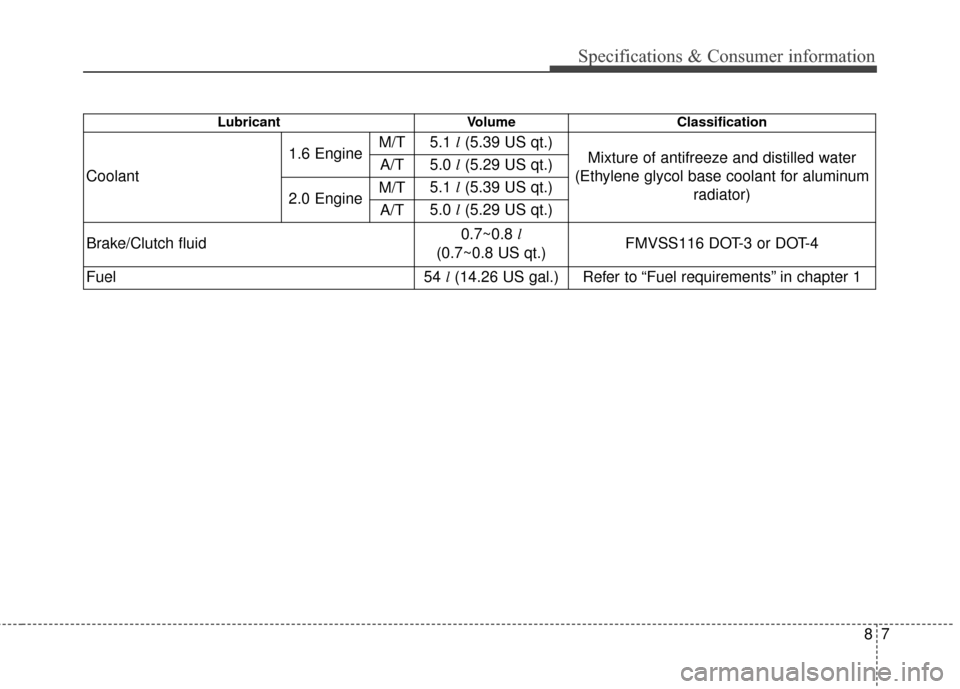
LubricantVolume Classification
Coolant1.6 Engine
M/T
5.1
l(5.39 US qt.)
Mixture of antifreeze and distilled water
(Ethylene glycol base coolant for aluminum radiator)
A/T5.0 l(5.29 US qt.)
2.0 EngineM/T5.1 l(5.39 US qt.)
A/T5.0 l(5.29 US qt.)
Brake/Clutch fluid 0.7~0.8
l
(0.7~0.8 US qt.) FMVSS116 DOT-3 or DOT-4
Fuel 54
l(14.26 US gal.)
Refer to “Fuel requirements” in chapter 1
Page 545 of 556
Specifications & Consumer information
88
Recommended SAE viscosity
number
Always be sure to clean the area
around any filler plug, drain plug, or
dipstick before checking or draining
any lubricant. This is especially
important in dusty or sandy areas
and when the vehicle is used on
unpaved roads. Cleaning the plug
and dipstick areas will prevent dirt
and grit from entering the engine and
other mechanisms that could be
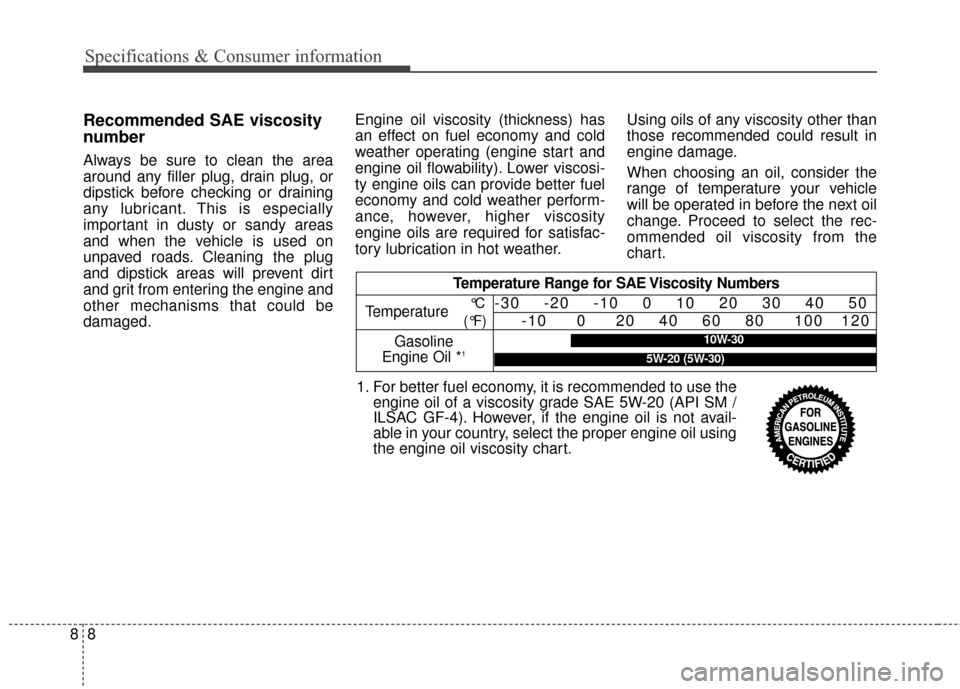
damaged.Engine oil viscosity (thickness) has
an effect on fuel economy and cold
weather operating (engine start and
engine oil flowability). Lower viscosi-
ty engine oils can provide better fuel
economy and cold weather perform-
ance, however, higher viscosity
engine oils are required for satisfac-
tory lubrication in hot weather.
Using oils of any viscosity other than
those recommended could result in
engine damage.
When choosing an oil, consider the
range of temperature your vehicle
will be operated in before the next oil
change. Proceed to select the rec-
ommended oil viscosity from the
chart.
Temperature Range for SAE Viscosity Numbers
Temperature
Gasoline
Engine Oil *
1
°C
(°F)-30 -20 -10 0 10 20 30 40 50 -10 0 20 40 60 80 100 120
1. For better fuel economy, it is recommended to use theengine oil of a viscosity grade SAE 5W-20 (API SM /
ILSAC GF-4). However, if the engine oil is not avail-
able in your country, select the proper engine oil using
the engine oil viscosity chart.
10W-30
5W-20 (5W-30)
Page 547 of 556
Specifications & Consumer information
10
8
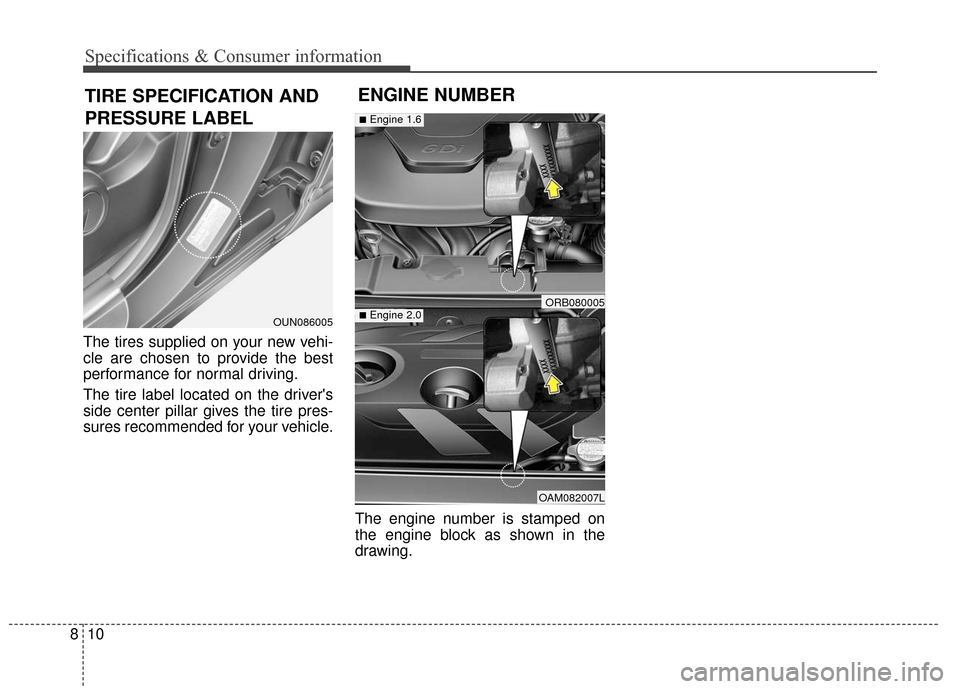
The tires supplied on your new vehi-
cle are chosen to provide the best
performance for normal driving.
The tire label located on the driver's
side center pillar gives the tire pres-
sures recommended for your vehicle.
The engine number is stamped on
the engine block as shown in the
drawing.
ENGINE NUMBER
OUN086005
TIRE SPECIFICATION AND
PRESSURE LABEL
OAM082007L
■Engine 2.0
■Engine 1.6
ORB080005
Page 550 of 556

I3
Index
Electronic stability control (ESC) . . . . . . . . . . . . . . 5-29
Good braking practices . . . . . . . . . . . . . . . . . . . . . . 5-35
Hill-start assist control (HAC) . . . . . . . . . . . . . . . . . 5-34
Parking brake - Hand type . . . . . . . . . . . . . . . . . . . . 5-25
Power brakes . . . . . . . . . . . . . . . . . . . . . . . . . . . . . . 5-23
Vehicle stability management (VSM) . . . . . . . . . . . 5-33
Brake/clutch fluid . . . . . . . . . . . . . . . . . . . . . . . . . . . . . 7-41 Checking the brake/clutch fluid level . . . . . . . . . . . 7-41
Bulb wattage . . . . . . . . . . . . . . . . . . . . . . . . . . . . . . . . . . 8-3
Capacity/Weight . . . . . . . . . . . . . . . . . . . . . . . . . . . . . . . 8-5
Child restraint system . . . . . . . . . . . . . . . . . . . . . . . . . . 3-30 Lower anchor system . . . . . . . . . . . . . . . . . . . . . . . . 3-36
Tether anchor system . . . . . . . . . . . . . . . . . . . . . . . . 3-35
Using a child restraint system . . . . . . . . . . . . . . . . . 3-31
Clean air . . . . . . . . . . . . . . . . . . . . . . . . . . . . . . . . . . . 4-\
131
Climate control air filter . . . . . . . . . . . . . . . . . . . . . . . . 7-47 Filter inspection . . . . . . . . . . . . . . . . . . . . . . . . . . . . 7-47
Filter replacement. . . . . . . . . . . . . . . . . . . . . . . . . . . 7-47
Cruise control system . . . . . . . . . . . . . . . . . . . . . . . . . . 5-37 Cruise control switch . . . . . . . . . . . . . . . . . . . . . . . . 5-38
To cancel cruise control, do one of the following . . 5-40
To decrease the cruising speed . . . . . . . . . . . . . . . . . 5-39
To increase cruise control set speed . . . . . . . . . . . . . 5-39
To resume cruising speed at more thanapproximately 20 mph (30 km/h) . . . . . . . . . . . . . 5-40 To set cruise control speed . . . . . . . . . . . . . . . . . . . . 5-38
To temporarily accelerate with the cruise control on . .
5-39
To turn cruise control off, do one of the following. . 5-41
Defroster . . . . . . . . . . . . . . . . . . . . . . . . . . . . . . . . . . . 4-\
102 Rear window defroster . . . . . . . . . . . . . . . . . . . . . . 4-102
Dimensions . . . . . . . . . . . . . . . . . . . . . . . . . . . . . . . . . . . 8-\
2
Door locks. . . . . . . . . . . . . . . . . . . . . . . . . . . . . . . . . . . 4-\
19 Auto door lock/unlock feature . . . . . . . . . . . . . . . . . 4-22
Child-protector rear door lock . . . . . . . . . . . . . . . . . 4-23
Impact sensing door unlock system . . . . . . . . . . . . . 4-22
Operating door locks from inside the vehicle . . . . . 4-20
Operating door locks from outside the vehicle . . . . 4-19
Speed sensing door lock system . . . . . . . . . . . . . . . 4-22
Economical operation . . . . . . . . . . . . . . . . . . . . . . . . . . 5-56
Emergency starting . . . . . . . . . . . . . . . . . . . . . . . . . . . . . 6-5 Jump starting . . . . . . . . . . . . . . . . . . . . . . . . . . . . . . . 6-5
Push-starting . . . . . . . . . . . . . . . . . . . . . . . . . . . . . . . . 6-7
Emission control system . . . . . . . . . . . . . . . . . . . . . . . 7-104
Engine . . . . . . . . . . . . . . . . . . . . . . . . . . . . . . . . . . . . \
. . . 8-2
Engine compartment. . . . . . . . . . . . . . . . . . . . . . . . . 2-6,7-3
Engine coolant . . . . . . . . . . . . . . . . . . . . . . . . . . . . . . . 7-38 Changing the coolant . . . . . . . . . . . . . . . . . . . . . . . . 7-40
C
D
E