check oil KIA SOUL 2019 User Guide
[x] Cancel search | Manufacturer: KIA, Model Year: 2019, Model line: SOUL, Model: KIA SOUL 2019Pages: 564, PDF Size: 14.2 MB
Page 445 of 564
87
Maintenance
OWNER MAINTENANCE
The following lists are vehicle checks
and inspections that should be per-
formed by the owner or an author-
ized Kia dealer at the frequencies
indicated to help ensure safe,
dependable operation of your vehi-
cle.
Any adverse conditions should be
brought to the attention of your deal-
er as soon as possible.
These Owner Maintenance Checks
are generally not covered by war-
ranties and you may be charged for
labor, parts and lubricants used.Owner maintenance schedule
When you stop for fuel:
Check the engine oil level.
Check the coolant level in thecoolant reservoir.
Check the windshield washer fluid level.
Look for low or under-inflated tires. Check if the front of the radiator
and condenser are clean and not
blocked with leaves, dirt or insects
etc. If any of the above parts are
extremely dirty or you are not sure
of their condition, take your vehicle
to an authorized Kia dealer.
WARNING- Hot coolant
Be careful when checking your
engine coolant level when the
engine is hot. Scalding hot
coolant and steam may blow out
under pressure.
Page 460 of 564
Maintenance
22
8
EXPLANATION OF SCHEDULED MAINTENANCE ITEMS
Engine oil and filter
The engine oil and filter should be
changed at the intervals specified in
the maintenance schedule. If the
vehicle is being driven in severe con-
ditions, more frequent oil and filter
changes are required.
Drive belts
Inspect all drive belts for evidence of
cuts, cracks, excessive wear or oil
saturation and replace if necessary.
Drive belts should be checked peri-
odically for proper tension and
adjusted as necessary.
Fuel filter (for gasoline)
Kia gasoline vehicle is equipped with
a lifetime fuel filter that is integrated
with the fuel tank. Regular mainte-
nance or replacement is generally
not needed. This may vary depend-
ing on fuel quality. If you experience
any of the following: fuel flow restric-
tion, surging, loss of power, or a hard
starting issue, inspection and, if nec-
essary, replacement may be needed.
Have the fuel filter inspected or
replaced by an authorized Kia deal-
er.
Fuel lines, fuel hoses and con-
nections
Check the fuel lines, fuel hoses and
connections for leakage and dam-
age. Have an authorized Kia dealer
replace any damaged or leaking
parts immediately.
Vapor hose and fuel filler cap
The vapor hose and fuel filler cap
should be inspected at those inter-
vals specified in the maintenance
schedule. Make sure that a new
vapor hose or fuel filler cap is cor-
rectly replaced.
Page 465 of 564
827
Maintenance
CHECKING FLUID LEVELS
When checking engine oil, engine
coolant, brake fluid, and washer fluid,
always be sure to clean the area
around any filler plug, drain plug, or
dipstick before checking or draining
any lubricant or fluid. This is espe-
cially important in dusty or sandy
areas and when the vehicle is used
on unpaved roads. Cleaning the plug
and dipstick areas will prevent dirt
and grit from entering the engine and
other mechanisms that could be
damaged.
Page 466 of 564
Maintenance
28
8
ENGINE OIL
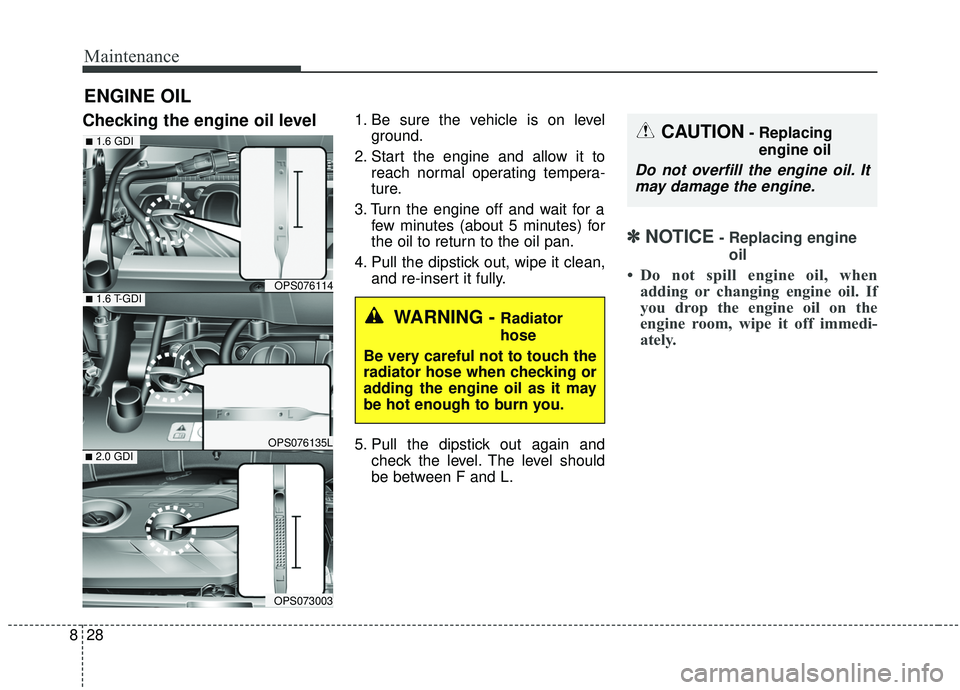
Checking the engine oil level 1. Be sure the vehicle is on level
ground.
2. Start the engine and allow it to reach normal operating tempera-
ture.
3. Turn the engine off and wait for a few minutes (about 5 minutes) for
the oil to return to the oil pan.
4. Pull the dipstick out, wipe it clean, and re-insert it fully.
5. Pull the dipstick out again and check the level. The level should
be between F and L.
✽ ✽NOTICE- Replacing engine
oil
• Do not spill engine oil, when adding or changing engine oil. If
you drop the engine oil on the
engine room, wipe it off immedi-
ately.
WARNING - Radiator
hose
Be very careful not to touch the
radiator hose when checking or
adding the engine oil as it may
be hot enough to burn you.
■1.6 T-GDI
■1.6 GDI
OPS076135L■2.0 GDI
OPS073003
OPS076114
CAUTION- Replacing engine oil
Do not overfill the engine oil. Itmay damage the engine.
Page 471 of 564
833
Maintenance
BRAKE/CLUTCH FLUID
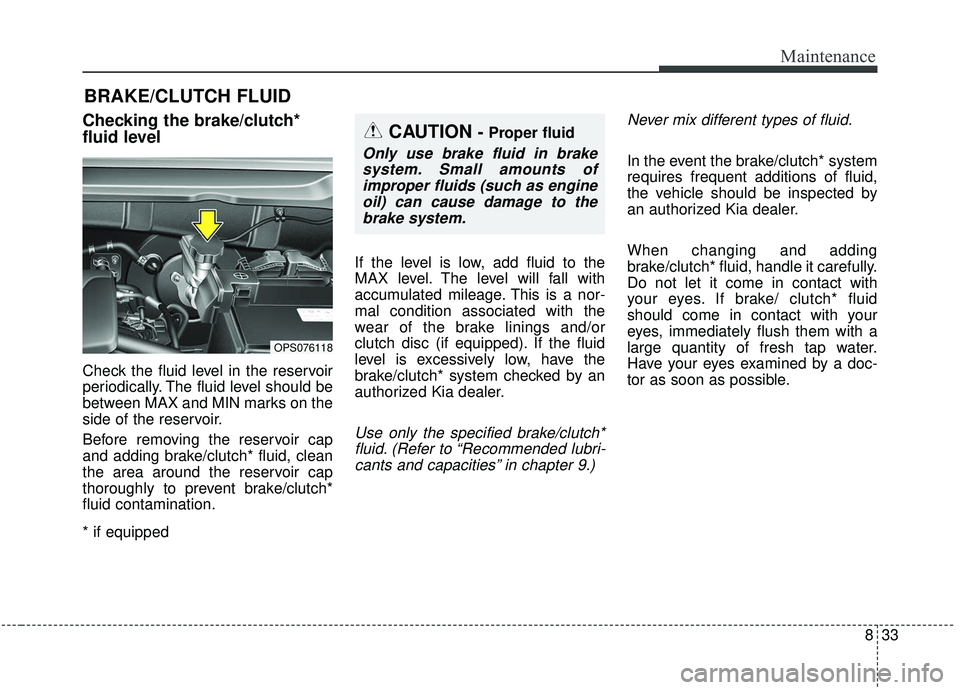
Checking the brake/clutch*
fluid level
Check the fluid level in the reservoir
periodically. The fluid level should be
between MAX and MIN marks on the
side of the reservoir.
Before removing the reservoir cap
and adding brake/clutch* fluid, clean
the area around the reservoir cap
thoroughly to prevent brake/clutch*
fluid contamination.
* if equippedIf the level is low, add fluid to the
MAX level. The level will fall with
accumulated mileage. This is a nor-
mal condition associated with the
wear of the brake linings and/or
clutch disc (if equipped). If the fluid
level is excessively low, have the
brake/clutch* system checked by an
authorized Kia dealer.
Use only the specified brake/clutch*
fluid. (Refer to “Recommended lubri-cants and capacities” in chapter 9.) Never mix different types of fluid.
In the event the brake/clutch* system
requires frequent additions of fluid,
the vehicle should be inspected by
an authorized Kia dealer.
When changing and adding
brake/clutch* fluid, handle it carefully.
Do not let it come in contact with
your eyes. If brake/ clutch* fluid
should come in contact with your
eyes, immediately flush them with a
large quantity of fresh tap water.
Have your eyes examined by a doc-
tor as soon as possible.
OPS076118
CAUTION - Proper fluid
Only use brake fluid in brake
system. Small amounts ofimproper fluids (such as engineoil) can cause damage to thebrake system.
Page 484 of 564
Maintenance
46
8
When recharging the battery,
observe the following precautions:
The battery must be removed from
the vehicle and placed in an area
with good ventilation.
Do not allow cigarettes, sparks, or flame near the battery.
Watch the battery during charging, and stop or reduce the charging
rate if the battery cells begin
gassing (boiling) violently or if the
temperature of the electrolyte of
any cell exceeds 49°C (120°F).
Wear eye protection when check- ing the battery during charging.
Disconnect the battery charger in the following order. 1.Turn off the battery charger main
switch.
2.Unhook the negative clamp from the negative battery terminal.
3.Unhook the positive clamp from the positive battery terminal.
Before performing maintenance or recharging the battery, turn off all
accessories and stop the engine.
The negative battery cable must be removed first and installed last
when the battery is disconnected.Reset items
Items should be reset after the bat-
tery has been discharged or the bat-
tery has been disconnected.
Auto up/down window (See chapter 4)
Sunroof (See chapter 4)
Trip computer (See chapter 4)
Climate control system (See chapter 4)
Clock (See chapter 4)
Audio (See chapter 5)
Page 500 of 564
Maintenance
62
8
FUSES
A vehicle’s electrical system is pro-
tected from electrical overload dam-
age by fuses.
This vehicle has 2 (or 3) fuse panels,
one located in the driver’s side panel
bolster, the other in the engine com-
partment near the battery.
If any of your vehicle’s lights, acces-
sories, or controls do not work, check
the appropriate circuit fuse. If a fuse
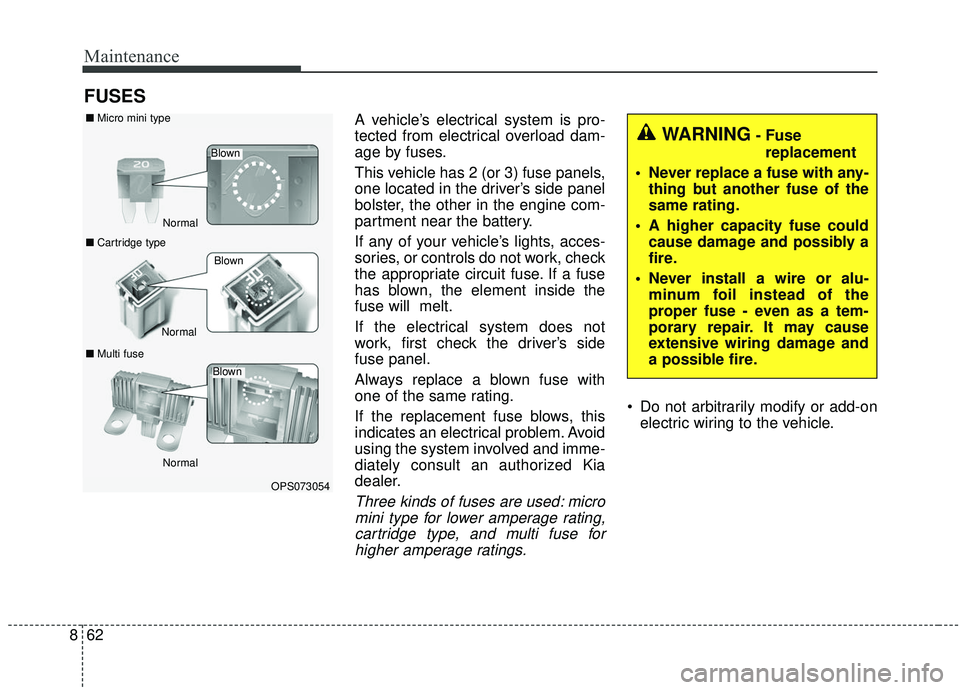
has blown, the element inside the
fuse will melt.
If the electrical system does not
work, first check the driver’s side
fuse panel.
Always replace a blown fuse with
one of the same rating.
If the replacement fuse blows, this
indicates an electrical problem. Avoid
using the system involved and imme-
diately consult an authorized Kia
dealer.
Three kinds of fuses are used: micro
mini type for lower amperage rating,cartridge type, and multi fuse forhigher amperage ratings.
Do not arbitrarily modify or add-on electric wiring to the vehicle.
WARNING- Fuse
replacement
Never replace a fuse with any- thing but another fuse of the
same rating.
A higher capacity fuse could cause damage and possibly a
fire.
Never install a wire or alu- minum foil instead of the
proper fuse - even as a tem-
porary repair. It may cause
extensive wiring damage and
a possible fire.
OPS073054
Normal
Normal
■
Micro mini type
■ Cartridge type
■ Multi fuse
Blown
Blown
Normal
Blown
Page 537 of 564
899
Maintenance
When cleaning lower door panels,rocker panels and frame members,
be sure that drain holes are kept
open so that moisture can escape
and not be trapped inside to accel-
erate corrosion.
Keep your garage dry
Don't park your vehicle in a damp,
poorly ventilated garage. This cre-
ates a favorable environment for cor-
rosion. This is particularly true if you
wash your vehicle in the garage or
drive it into the garage when it is still
wet or covered with snow, ice or
mud. Even a heated garage can con-
tribute to corrosion unless it is well
ventilated so moisture is dispersed. Keep paint and trim in good con-
dition
Scratches or chips in the finish
should be covered with "touch-up"
paint as soon as possible to reduce
the possibility of corrosion. If bare
metal is showing through, the atten-
tion of a qualified body and paint
shop is recommended.
Bird droppings : Bird droppings are
highly corrosive and may damage
painted surfaces in just a few hours.
Always remove bird droppings as
soon as possible.
Don't neglect the interior
Moisture can collect under the floor
mats and carpeting and cause corro-
sion. Check under the mats periodi-
cally to be sure the carpeting is dry.
Use particular care if you carry fertil-
izers, cleaning materials or chemi-
cals in the vehicle.
These should be carried only in prop-
er containers and any spills or leaks
should be cleaned up, flushed with
clean water and thoroughly dried.Interior care
Interior general precautions
Prevent chemicals such as perfume,
cosmetic oil, sun cream, hand clean-
er, and air freshener from contacting
the interior parts because they may
cause damage or discoloration. If
they do contact the interior parts,
wipe them off immediately. If neces-
sary, use a vinyl cleaner, see product
instructions for correct usage.
Page 558 of 564

Index
4I
Defroster . . . . . . . . . . . . . . . . . . . . . . . . . . . . . . . . . . . 4-\
104Rear window defroster . . . . . . . . . . . . . . . . . . . . . . 4-104
Dimensions . . . . . . . . . . . . . . . . . . . . . . . . . . . . . . . . . . 9-20\
Door locks. . . . . . . . . . . . . . . . . . . . . . . . . . . . . . . . . . . 4-\
17 Auto door lock/unlock feature . . . . . . . . . . . . . . . . . 4-20
Child-protector rear door lock . . . . . . . . . . . . . . . . . 4-21
Impact sensing door unlock system . . . . . . . . . . . . . 4-20
Operating door locks from inside the vehicle . . . . . 4-18
Operating door locks from outside the vehicle . . . . 4-17
Speed sensing door lock system . . . . . . . . . . . . . . . 4-20
Drive mode integrated control system . . . . . . . . . . . . . 6-86
Dual Clutch Transmission (DCT). . . . . . . . . . . . . . . . . 6-26 Dual clutch transmission operation . . . . . . . . . . . . . 6-26
Good driving practices . . . . . . . . . . . . . . . . . . . . . . . 6-35
Economical operation . . . . . . . . . . . . . . . . . . . . . . . . . 6-101
Emergency starting . . . . . . . . . . . . . . . . . . . . . . . . . . . . . 7-5 Jump starting . . . . . . . . . . . . . . . . . . . . . . . . . . . . . . . 7-5
Push-starting . . . . . . . . . . . . . . . . . . . . . . . . . . . . . . . . 7-7
Emission control system . . . . . . . . . . . . . . . . . . . . . . . 8-102 Crankcase emission control system . . . . . . . . . . . . 8-102
Evaporative emission control (including ORVR:Onboard Refueling Vapor Recovery) system. . . . 8-102
Exhaust emission control system . . . . . . . . . . . . . . 8-103
Engine . . . . . . . . . . . . . . . . . . . . . . . . . . . . . . . . . . . . \
. . . 9-3
Engine compartment . . . . . . . . . . . . . . . . . . . . . . . . . . . . 2-6 Engine compartment . . . . . . . . . . . . . . . . . . . . . . . . . . . . 8-3
Engine coolant . . . . . . . . . . . . . . . . . . . . . . . . . . . . . . . 8-30
Changing the coolant . . . . . . . . . . . . . . . . . . . . . . . . 8-32
Checking the coolant level . . . . . . . . . . . . . . . . . . . . 8-30
Engine number . . . . . . . . . . . . . . . . . . . . . . . . . . . . . . . 9-11
Engine oil . . . . . . . . . . . . . . . . . . . . . . . . . . . . . . . . . . . 8-\
28 Changing the engine oil and filter . . . . . . . . . . . . . . 8-29
Checking the engine oil level . . . . . . . . . . . . . . . . . . 8-28
Engine start/stop button . . . . . . . . . . . . . . . . . . . . . . . . . 6-9 Engine start/stop button position . . . . . . . . . . . . . . . . 6-9
Illuminated engine start/stop button. . . . . . . . . . . . . . 6-9
Starting the engine with a smart key . . . . . . . . . . . . 6-11
Explanation of scheduled maintenance items . . . . . . . 8-22
Exterior features . . . . . . . . . . . . . . . . . . . . . . . . . . . . . 4-150 Mounting bracket for roof carrier . . . . . . . . . . . . . 4-151
Roof rack . . . . . . . . . . . . . . . . . . . . . . . . . . . . . . . . 4-150
Exterior overview . . . . . . . . . . . . . . . . . . . . . . . . . . . . . . 2-2
Fuel filler lid . . . . . . . . . . . . . . . . . . . . . . . . . . . . . . . . . 4-33 Closing the fuel filler lid . . . . . . . . . . . . . . . . . . . . . 4-33
Opening the fuel filler lid. . . . . . . . . . . . . . . . . . . . . 4-33
Fuel requirements . . . . . . . . . . . . . . . . . . . . . . . . . . . . . . 1-3 Do not use methanol . . . . . . . . . . . . . . . . . . . . . . . . . 1-5
Fuel Additives . . . . . . . . . . . . . . . . . . . . . . . . . . . . . . 1-6
Gasoline containing alcohol and methanol . . . . . . . . 1-3
F
E
Page 564 of 564
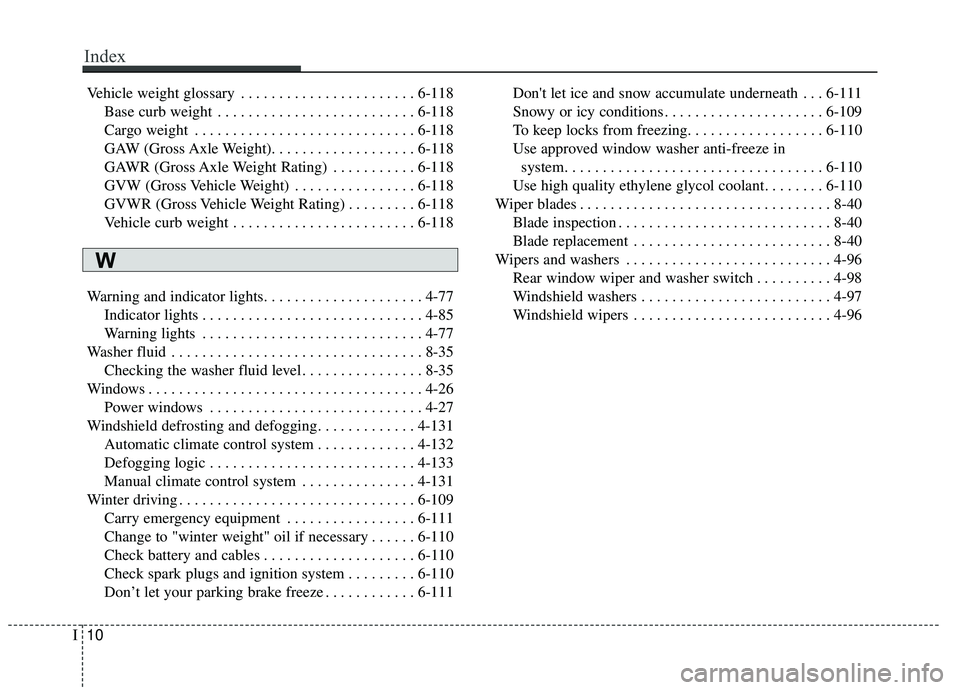
Vehicle weight glossary . . . . . . . . . . . . . . . . . . . . . . . 6-118Base curb weight . . . . . . . . . . . . . . . . . . . . . . . . . . 6-118
Cargo weight . . . . . . . . . . . . . . . . . . . . . . . . . . . . . 6-118
GAW (Gross Axle Weight). . . . . . . . . . . . . . . . . . . 6-118
GAWR (Gross Axle Weight Rating) . . . . . . . . . . . 6-118
GVW (Gross Vehicle Weight) . . . . . . . . . . . . . . . . 6-118
GVWR (Gross Vehicle Weight Rating) . . . . . . . . . 6-118
Vehicle curb weight . . . . . . . . . . . . . . . . . . . . . . . . 6-118
Warning and indicator lights. . . . . . . . . . . . . . . . . . . . . 4-77 Indicator lights . . . . . . . . . . . . . . . . . . . . . . . . . . . . . 4-85
Warning lights . . . . . . . . . . . . . . . . . . . . . . . . . . . . . 4-77
Washer fluid . . . . . . . . . . . . . . . . . . . . . . . . . . . . . . . . . 8-35 Checking the washer fluid level . . . . . . . . . . . . . . . . 8-35
Windows . . . . . . . . . . . . . . . . . . . . . . . . . . . . . . . . . . . . \
4-26 Power windows . . . . . . . . . . . . . . . . . . . . . . . . . . . . 4-27
Windshield defrosting and defogging. . . . . . . . . . . . . 4-131 Automatic climate control system . . . . . . . . . . . . . 4-132
Defogging logic . . . . . . . . . . . . . . . . . . . . . . . . . . . 4-133
Manual climate control system . . . . . . . . . . . . . . . 4-131
Winter driving . . . . . . . . . . . . . . . . . . . . . . . . . . . . . . . 6-109 Carry emergency equipment . . . . . . . . . . . . . . . . . 6-111
Change to "winter weight" oil if necessary . . . . . . 6-110
Check battery and cables . . . . . . . . . . . . . . . . . . . . 6-110
Check spark plugs and ignition system . . . . . . . . . 6-110
Don’t let your parking brake freeze . . . . . . . . . . . . 6-111 Don't let ice and snow accumulate underneath . . . 6-111
Snowy or icy conditions . . . . . . . . . . . . . . . . . . . . . 6-109
To keep locks from freezing. . . . . . . . . . . . . . . . . . 6-110
Use approved window washer anti-freeze in
system. . . . . . . . . . . . . . . . . . . . . . . . . . . . . . . . . . 6-11\
0
Use high quality ethylene glycol coolant. . . . . . . . 6-110
Wiper blades . . . . . . . . . . . . . . . . . . . . . . . . . . . . . . . . . 8-40 Blade inspection . . . . . . . . . . . . . . . . . . . . . . . . . . . . 8-40
Blade replacement . . . . . . . . . . . . . . . . . . . . . . . . . . 8-40
Wipers and washers . . . . . . . . . . . . . . . . . . . . . . . . . . . 4-96 Rear window wiper and washer switch . . . . . . . . . . 4-98
Windshield washers . . . . . . . . . . . . . . . . . . . . . . . . . 4-97
Windshield wipers . . . . . . . . . . . . . . . . . . . . . . . . . . 4-96
W
I10
Index