spark KIA SOUL 2019 User Guide
[x] Cancel search | Manufacturer: KIA, Model Year: 2019, Model line: SOUL, Model: KIA SOUL 2019Pages: 564, PDF Size: 14.2 MB
Page 473 of 564
835
Maintenance
WASHER FLUID
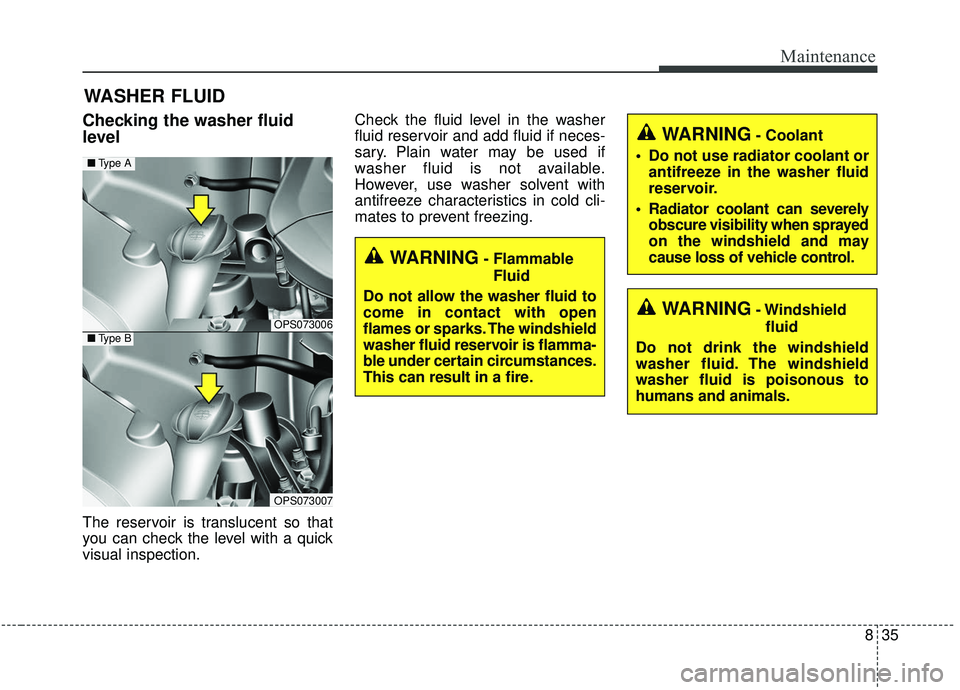
Checking the washer fluid
level
The reservoir is translucent so that
you can check the level with a quick
visual inspection.Check the fluid level in the washer
fluid reservoir and add fluid if neces-
sary. Plain water may be used if
washer fluid is not available.
However, use washer solvent with
antifreeze characteristics in cold cli-
mates to prevent freezing.
OPS073006
OPS073007
■
Type A
■Type B
WARNING- Flammable
Fluid
Do not allow the washer fluid to
come in contact with open
flames or sparks. The windshield
washer fluid reservoir is flamma-
ble under certain circumstances.
This can result in a fire.
WARNING- Coolant
Do not use radiator coolant or antifreeze in the washer fluid
reservoir.
Radiator coolant can severely obscure visibility when sprayed
on the windshield and may
cause loss of vehicle control.
WARNING- Windshield
fluid
Do not drink the windshield
washer fluid. The windshield
washer fluid is poisonous to
humans and animals.
Page 482 of 564
Maintenance
44
8
BATTERY
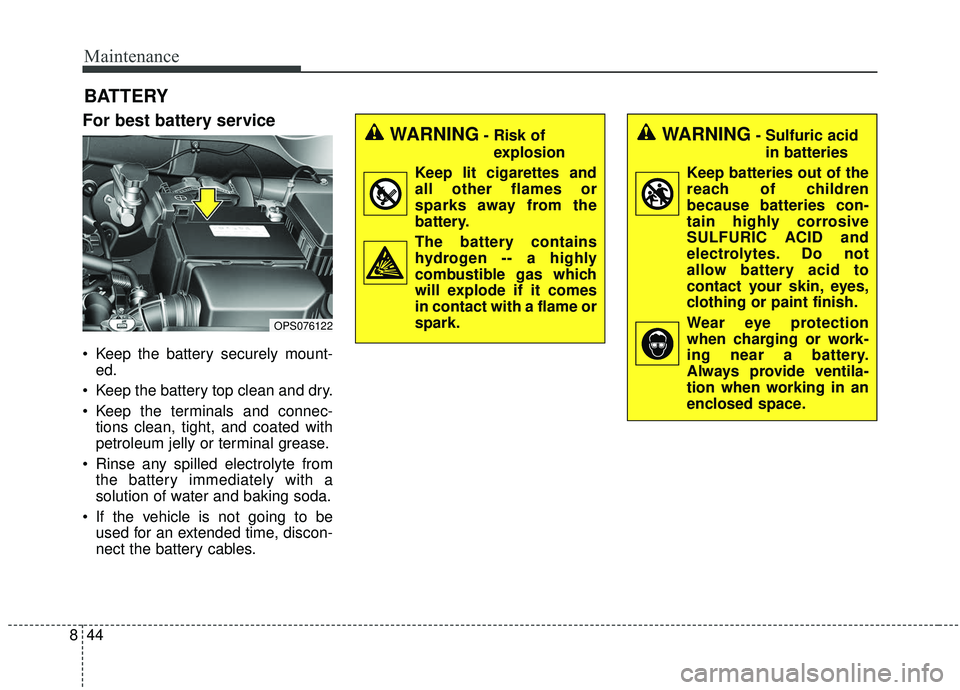
For best battery service
Keep the battery securely mount-
ed.
Keep the battery top clean and dry.
Keep the terminals and connec- tions clean, tight, and coated with
petroleum jelly or terminal grease.
Rinse any spilled electrolyte from the battery immediately with a
solution of water and baking soda.
If the vehicle is not going to be used for an extended time, discon-
nect the battery cables.
OPS076122
WARNING- Risk of
explosion
Keep lit cigarettes and
all other flames or
sparks away from the
battery.
The battery contains hydrogen -- a highly
combustible gas which
will explode if it comes
in contact with a flame or
spark.WARNING- Sulfuric acid
in batteries
Keep batteries out of the reach of children
because batteries con-
tain highly corrosive
SULFURIC ACID and
electrolytes. Do not
allow battery acid to
contact your skin, eyes,
clothing or paint finish.
Wear eye protection when charging or work-
ing near a battery.
Always provide ventila-
tion when working in an
enclosed space.
Page 484 of 564
Maintenance
46
8
When recharging the battery,
observe the following precautions:
The battery must be removed from
the vehicle and placed in an area
with good ventilation.
Do not allow cigarettes, sparks, or flame near the battery.
Watch the battery during charging, and stop or reduce the charging
rate if the battery cells begin
gassing (boiling) violently or if the
temperature of the electrolyte of
any cell exceeds 49°C (120°F).
Wear eye protection when check- ing the battery during charging.
Disconnect the battery charger in the following order. 1.Turn off the battery charger main
switch.
2.Unhook the negative clamp from the negative battery terminal.
3.Unhook the positive clamp from the positive battery terminal.
Before performing maintenance or recharging the battery, turn off all
accessories and stop the engine.
The negative battery cable must be removed first and installed last
when the battery is disconnected.Reset items
Items should be reset after the bat-
tery has been discharged or the bat-
tery has been disconnected.
Auto up/down window (See chapter 4)
Sunroof (See chapter 4)
Trip computer (See chapter 4)
Climate control system (See chapter 4)
Clock (See chapter 4)
Audio (See chapter 5)
Page 564 of 564
Vehicle weight glossary . . . . . . . . . . . . . . . . . . . . . . . 6-118Base curb weight . . . . . . . . . . . . . . . . . . . . . . . . . . 6-118
Cargo weight . . . . . . . . . . . . . . . . . . . . . . . . . . . . . 6-118
GAW (Gross Axle Weight). . . . . . . . . . . . . . . . . . . 6-118
GAWR (Gross Axle Weight Rating) . . . . . . . . . . . 6-118
GVW (Gross Vehicle Weight) . . . . . . . . . . . . . . . . 6-118
GVWR (Gross Vehicle Weight Rating) . . . . . . . . . 6-118
Vehicle curb weight . . . . . . . . . . . . . . . . . . . . . . . . 6-118
Warning and indicator lights. . . . . . . . . . . . . . . . . . . . . 4-77 Indicator lights . . . . . . . . . . . . . . . . . . . . . . . . . . . . . 4-85
Warning lights . . . . . . . . . . . . . . . . . . . . . . . . . . . . . 4-77
Washer fluid . . . . . . . . . . . . . . . . . . . . . . . . . . . . . . . . . 8-35 Checking the washer fluid level . . . . . . . . . . . . . . . . 8-35
Windows . . . . . . . . . . . . . . . . . . . . . . . . . . . . . . . . . . . . \
4-26 Power windows . . . . . . . . . . . . . . . . . . . . . . . . . . . . 4-27
Windshield defrosting and defogging. . . . . . . . . . . . . 4-131 Automatic climate control system . . . . . . . . . . . . . 4-132
Defogging logic . . . . . . . . . . . . . . . . . . . . . . . . . . . 4-133
Manual climate control system . . . . . . . . . . . . . . . 4-131
Winter driving . . . . . . . . . . . . . . . . . . . . . . . . . . . . . . . 6-109 Carry emergency equipment . . . . . . . . . . . . . . . . . 6-111
Change to "winter weight" oil if necessary . . . . . . 6-110
Check battery and cables . . . . . . . . . . . . . . . . . . . . 6-110
Check spark plugs and ignition system . . . . . . . . . 6-110
Don’t let your parking brake freeze . . . . . . . . . . . . 6-111 Don't let ice and snow accumulate underneath . . . 6-111
Snowy or icy conditions . . . . . . . . . . . . . . . . . . . . . 6-109
To keep locks from freezing. . . . . . . . . . . . . . . . . . 6-110
Use approved window washer anti-freeze in
system. . . . . . . . . . . . . . . . . . . . . . . . . . . . . . . . . . 6-11\
0
Use high quality ethylene glycol coolant. . . . . . . . 6-110
Wiper blades . . . . . . . . . . . . . . . . . . . . . . . . . . . . . . . . . 8-40 Blade inspection . . . . . . . . . . . . . . . . . . . . . . . . . . . . 8-40
Blade replacement . . . . . . . . . . . . . . . . . . . . . . . . . . 8-40
Wipers and washers . . . . . . . . . . . . . . . . . . . . . . . . . . . 4-96 Rear window wiper and washer switch . . . . . . . . . . 4-98
Windshield washers . . . . . . . . . . . . . . . . . . . . . . . . . 4-97
Windshield wipers . . . . . . . . . . . . . . . . . . . . . . . . . . 4-96
W
I10
Index