charge KIA Soul EV 2017 2.G Service Manual
[x] Cancel search | Manufacturer: KIA, Model Year: 2017, Model line: Soul EV, Model: KIA Soul EV 2017 2.GPages: 470, PDF Size: 16.76 MB
Page 324 of 470
75
Maintenance
OWNER MAINTENANCE
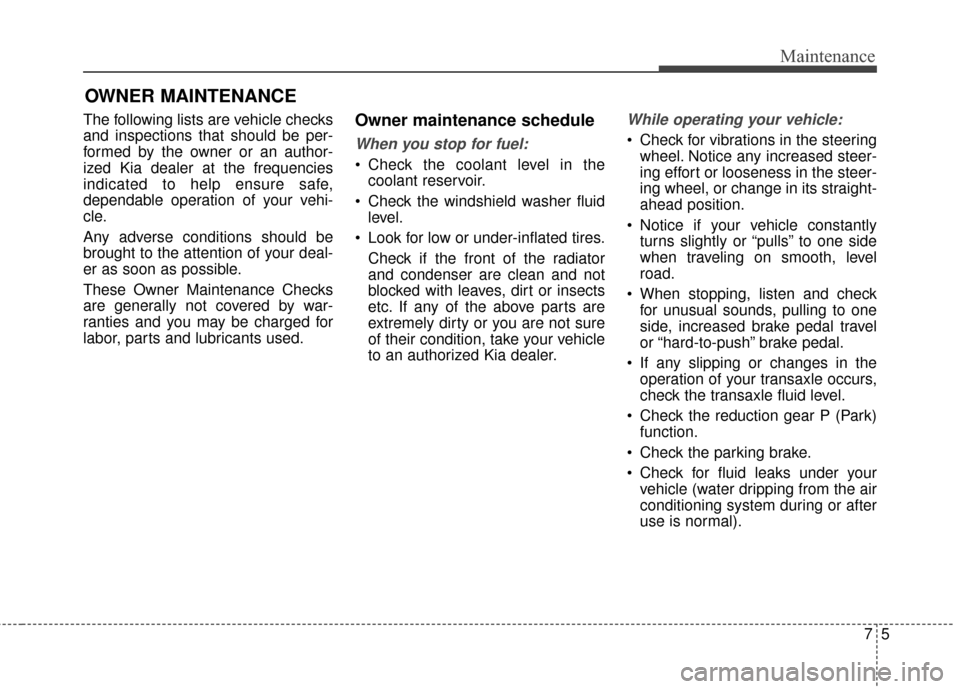
The following lists are vehicle checks
and inspections that should be per-
formed by the owner or an author-
ized Kia dealer at the frequencies
indicated to help ensure safe,
dependable operation of your vehi-
cle.
Any adverse conditions should be
brought to the attention of your deal-
er as soon as possible.
These Owner Maintenance Checks
are generally not covered by war-
ranties and you may be charged for
labor, parts and lubricants used.Owner maintenance schedule
When you stop for fuel:
Check the coolant level in thecoolant reservoir.
Check the windshield washer fluid level.
Look for low or under-inflated tires. Check if the front of the radiator
and condenser are clean and not
blocked with leaves, dirt or insects
etc. If any of the above parts are
extremely dirty or you are not sure
of their condition, take your vehicle
to an authorized Kia dealer.
While operating your vehicle:
Check for vibrations in the steeringwheel. Notice any increased steer-
ing effort or looseness in the steer-
ing wheel, or change in its straight-
ahead position.
Notice if your vehicle constantly turns slightly or “pulls” to one side
when traveling on smooth, level
road.
When stopping, listen and check for unusual sounds, pulling to one
side, increased brake pedal travel
or “hard-to-push” brake pedal.
If any slipping or changes in the operation of your transaxle occurs,
check the transaxle fluid level.
Check the reduction gear P (Park) function.
Check the parking brake.
Check for fluid leaks under your vehicle (water dripping from the air
conditioning system during or after
use is normal).
Page 350 of 470
731
Maintenance
BATTERY
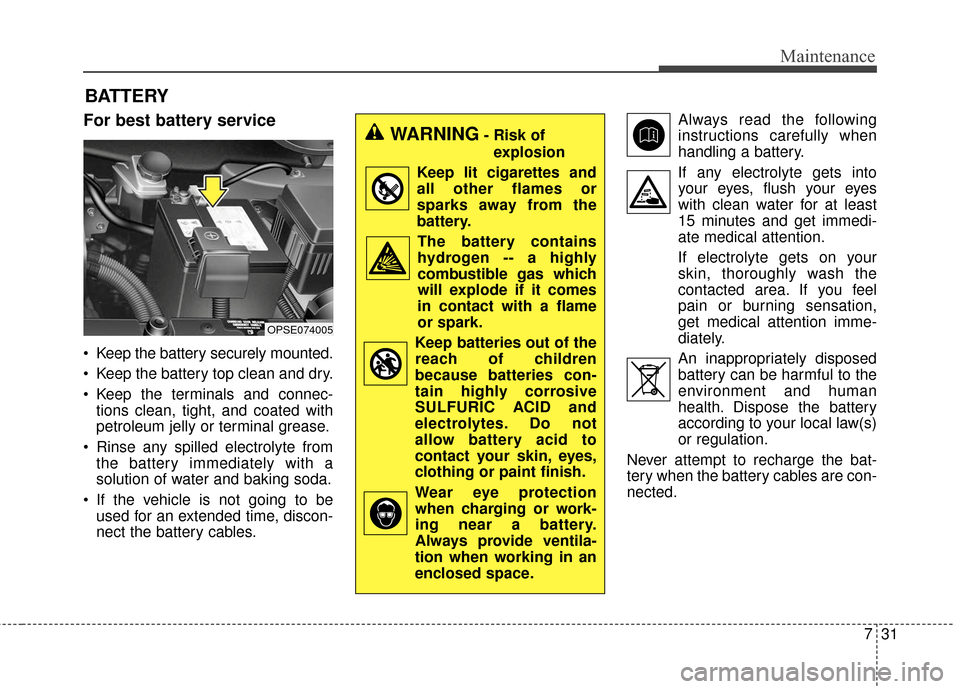
For best battery service
Keep the battery securely mounted.
Keep the battery top clean and dry.
Keep the terminals and connec-tions clean, tight, and coated with
petroleum jelly or terminal grease.
Rinse any spilled electrolyte from the battery immediately with a
solution of water and baking soda.
If the vehicle is not going to be used for an extended time, discon-
nect the battery cables. Always read the following
instructions carefully when
handling a battery.
If any electrolyte gets into your eyes, flush your eyes
with clean water for at least
15 minutes and get immedi-
ate medical attention.
If electrolyte gets on your
skin, thoroughly wash the
contacted area. If you feel
pain or burning sensation,
get medical attention imme-
diately.
An inappropriately disposed battery can be harmful to the
environment and human
health. Dispose the battery
according to your local law(s)
or regulation.
Never attempt to recharge the bat-
tery when the battery cables are con-
nected.
OPSE074005
WARNING- Risk of explosion
Keep lit cigarettes and all other flames or
sparks away from the
battery.
The battery containshydrogen -- a highly
combustible gas which
will explode if it comes
in contact with a flame
or spark.
Keep batteries out of the reach of children
because batteries con-
tain highly corrosive
SULFURIC ACID and
electrolytes. Do not
allow battery acid to
contact your skin, eyes,
clothing or paint finish.
Wear eye protection when charging or work-
ing near a battery.
Always provide ventila-
tion when working in an
enclosed space.
Page 351 of 470
Maintenance
32
7
✽ ✽
NOTICE
If you connect unauthorized elec-
tronic devices to the battery, the bat-
tery may be discharged. Never use
unauthorized devices.
Battery recharging
Your vehicle has a maintenance-free,
calcium-based battery.
If the battery becomes discharged
in a short time (because, for exam-
ple, the headlights or interior lights
were left on while the vehicle was
not in use), recharge it by slow
charging (trickle) for 10 hours.
If the battery gradually discharges because of high electric load while
the vehicle is being used, recharge
it at 20-30A for two hours. When recharging the battery,
observe the following precautions:
The battery must be removed from
the vehicle and placed in an area
with good ventilation.
Do not allow cigarettes, sparks, or flame near the battery.
Watch the battery during charging, and stop or reduce the charging
rate if the battery cells begin
gassing (boiling) violently or if the
temperature of the electrolyte of
any cell exceeds 49°C (120°F).
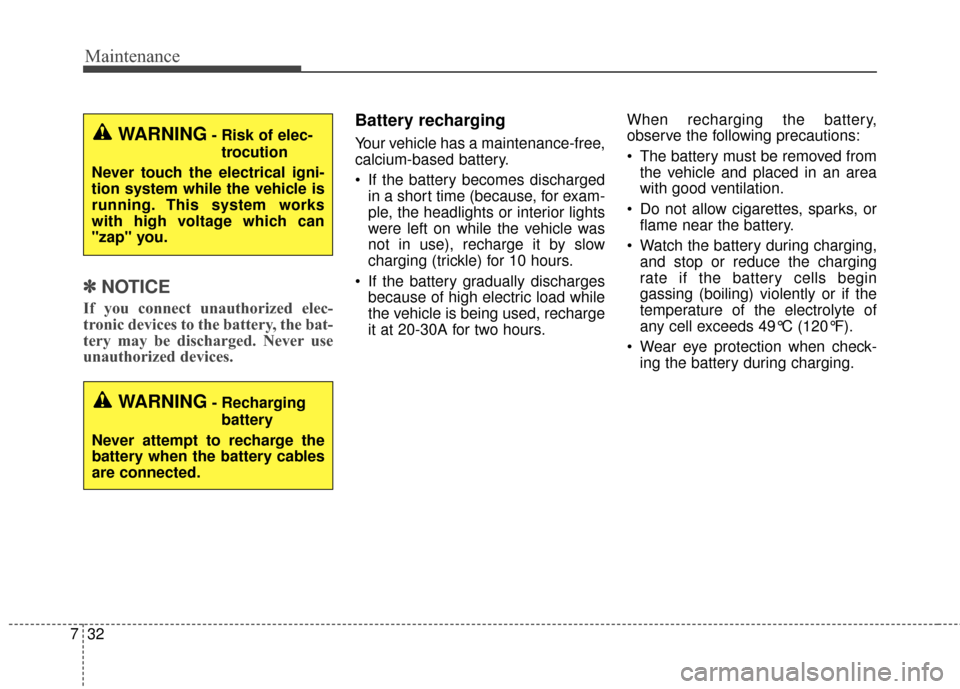
Wear eye protection when check- ing the battery during charging.WARNING- Risk of elec-
trocution
Never touch the electrical igni-
tion system while the vehicle is
running. This system works
with high voltage which can
"zap" you.
WARNING- Recharging battery
Never attempt to recharge the
battery when the battery cables
are connected.
Page 352 of 470
733
Maintenance
Disconnect the battery charger inthe following order:
1. Turn off the battery charger main switch.
2. Unhook the negative clamp from the negative battery terminal.
3. Unhook the positive clamp from the positive battery terminal.
Before performing maintenance or recharging the battery, turn off all
accessories and stop the vehicle.
The negative battery cable must be removed first and installed last
when the battery is disconnected.Reset items
Items should be reset after the bat-
tery has been discharged or the bat-
tery has been disconnected.
Auto up/down window (See chapter 4)
Trip computer (See chapter 4)
Climate control system (See chapter 4)
Audio (See chapter 4)
Page 369 of 470
Maintenance
50
7
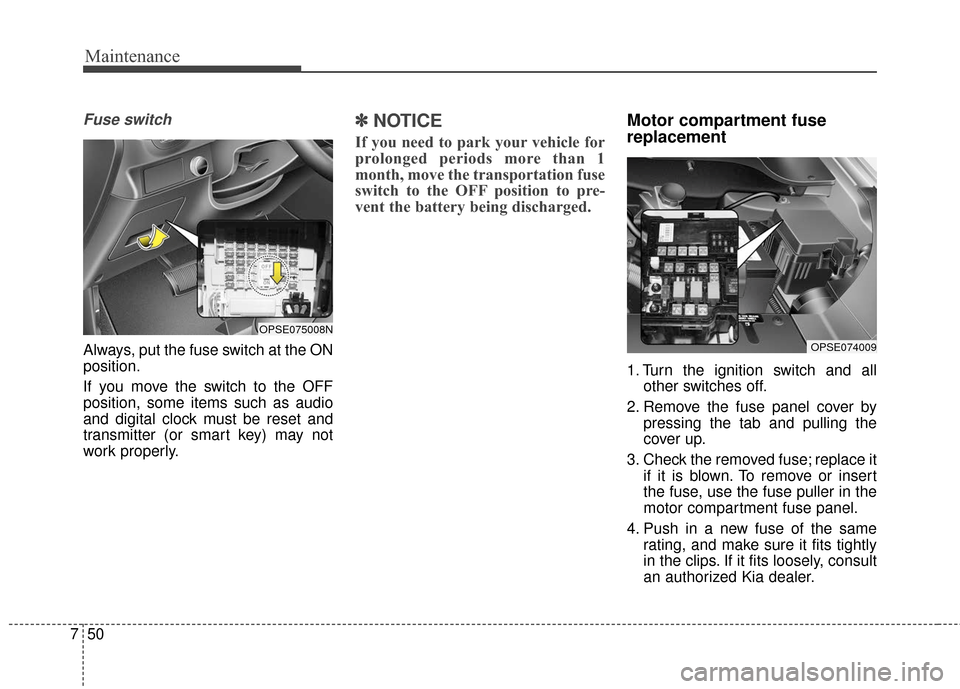
Fuse switch
Always, put the fuse switch at the ON
position.
If you move the switch to the OFF
position, some items such as audio
and digital clock must be reset and
transmitter (or smart key) may not
work properly.
✽ ✽
NOTICE
If you need to park your vehicle for
prolonged periods more than 1
month, move the transportation fuse
switch to the OFF position to pre-
vent the battery being discharged.
Motor compartment fuse
replacement
1. Turn the ignition switch and all
other switches off.
2. Remove the fuse panel cover by pressing the tab and pulling the
cover up.
3. Check the removed fuse; replace it if it is blown. To remove or insert
the fuse, use the fuse puller in the
motor compartment fuse panel.
4. Push in a new fuse of the same rating, and make sure it fits tightly
in the clips. If it fits loosely, consult
an authorized Kia dealer.
OPSE074009
OPSE075008N
Page 375 of 470
Maintenance
56
7
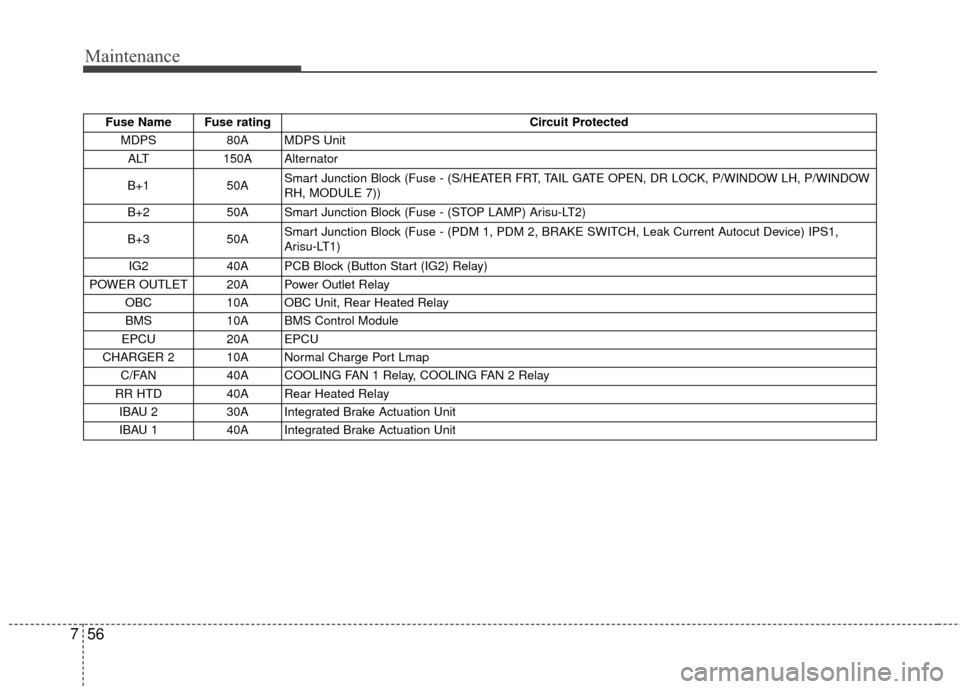
Fuse Name Fuse rating Circuit Protected
MDPS 80A MDPS Unit
ALT 150A Alternator
B+1 50A Smart Junction Block (Fuse - (S/HEATER FRT, TAIL GATE OPEN, DR LOCK, P/WINDOW LH, P/WINDOW
RH, MODULE 7))
B+2 50A Smart Junction Block (Fuse - (STOP LAMP) Arisu-LT2)
B+3 50A Smart Junction Block (Fuse - (PDM 1, PDM 2, BRAKE SWITCH, Leak Current Autocut Device) IPS1,
Arisu-LT1)
IG2 40A PCB Block (Button Start (IG2) Relay)
POWER OUTLET 20A Power Outlet Relay OBC 10A OBC Unit, Rear Heated Relay
BMS 10A BMS Control Module
EPCU 20A EPCU
CHARGER 2 10A Normal Charge Port Lmap C/FAN 40A COOLING FAN 1 Relay, COOLING FAN 2 Relay
RR HTD 40A Rear Heated Relay IBAU 2 30A Integrated Brake Actuation Unit
IBAU 1 40A Integrated Brake Actuation Unit
Page 376 of 470
757
Maintenance
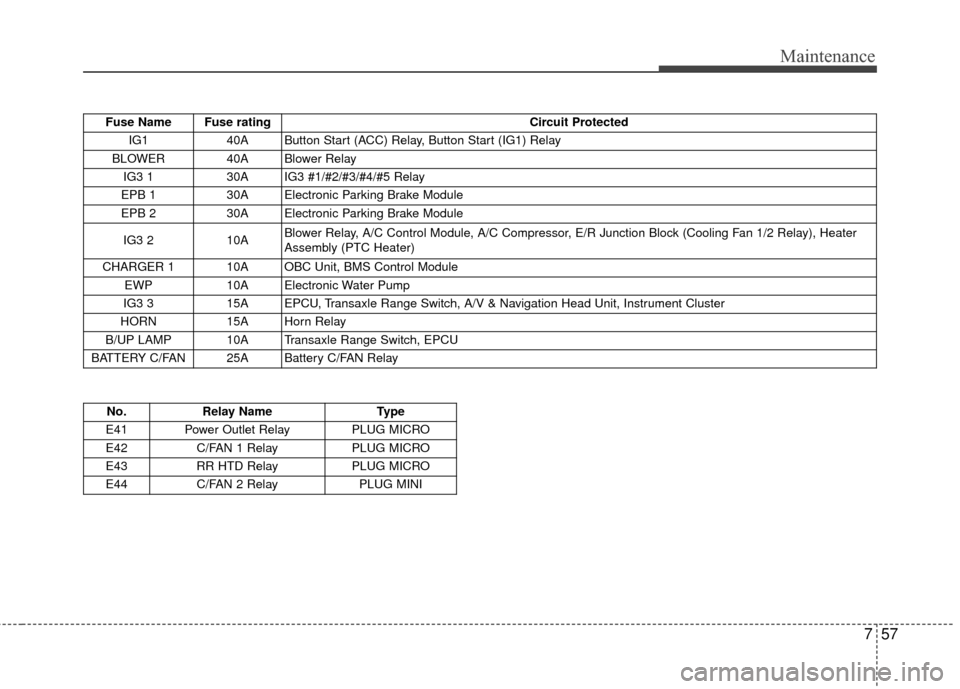
Fuse Name Fuse ratingCircuit Protected
IG1 40A Button Start (ACC) Relay, Button Start (IG1) Relay
BLOWER 40A Blower Relay IG3 1 30A IG3 #1/#2/#3/#4/#5 Relay
EPB 1 30A Electronic Parking Brake Module
EPB 2 30A Electronic Parking Brake Module
IG3 2 10A Blower Relay, A/C Control Module, A/C Compressor, E/R Junction Block (Cooling Fan 1/2 Relay), Heater
Assembly (PTC Heater)
CHARGER 1 10A OBC Unit, BMS Control Module EWP 10A Electronic Water Pump
IG3 3 15A EPCU, Transaxle Range Switch, A/V & Navigation Head Unit, Instrument Cluster
HORN 15A Horn Relay
B/UP LAMP 10A Transaxle Range Switch, EPCU
BATTERY C/FAN 25A Battery C/FAN Relay
No. Relay Name Type
E41 Power Outlet Relay PLUG MICRO
E42 C/FAN 1 Relay PLUG MICRO
E43 RR HTD Relay PLUG MICRO
E44 C/FAN 2 Relay PLUG MINI
Page 396 of 470
Specifications & Consumer information
28
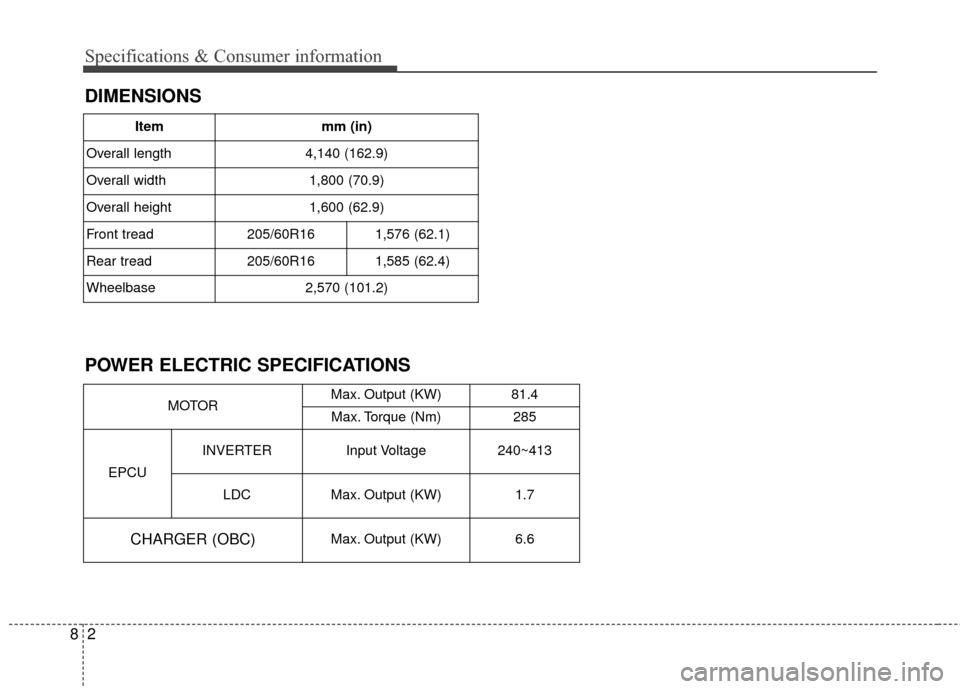
DIMENSIONS
POWER ELECTRIC SPECIFICATIONS
Itemmm (in)
Overall length
4,140 (162.9)
Overall width
1,800 (70.9)
Overall height
1,600 (62.9)
Front tread
205/60R161,576 (62.1)
Rear tread
205/60R161,585 (62.4)
Wheelbase
2,570 (101.2)
MOTOR Max. Output (KW) 81.4
Max. Torque (Nm) 285
EPCU INVERTER
Input Voltage 240~413
LDC Max. Output (KW) 1.7
CHARGER (OBC)Max. Output (KW)6.6
Page 411 of 470
Electric Vehicle Guide
❈This is an electric vehicle guide to assist drivers with
understanding their vehicle.
Refer to the following content for electric vehicle details
and precautions
Review of Electric Vehicle ........................................................2
Main Components of Electric Vehicle.......................................4
High voltage battery .................................................................5
EV Mode ........................................................................\
..........7
■ Available Range .................................................................7■ Near by stations .................................................................8■ Energy Information. ............................................................8■ ECO Driving .......................................................................9\
■ Setting Charging Times .....................................................9■ Setting Climate Times ......................................................11■ EV Setting ........................................................................\
11
Charge Types for Electric Vehicle...........................................13
Charge Indicator Lamp for Electric Vehicle ............................15
Reserved Charging ................................................................16
Reserved Climate Control. .....................................................18
Precautions for Charging Electric Vehicle ..............................19
Charging Electric Vehicle (Normal Charge) ...........................22
■ How to Connect Normal Charger .....................................22■ Unlock Charging Door in Emergency ...............................25■ Emergency Release of the Charging connector
lock system .......................................................................2\
6
■ Checking Charging Status................................................26■ How to Disconnect Normal Charger ................................27
Charging Electric Vehicle (Quick Charge) ..............................28
■ How to Connect Quick Charger .......................................28■ Unlock Charging Door in Emergency ...............................31■ Checking Charging Status................................................31■ How to Disconnect Quick Charger ...................................32
Charging Electric Vehicle (Trickle Charge) .............................34
■ How to Connect Portable Charging Cable .......................34■ Unlock Charging Door in Emergency ...............................38■ Emergency Release of the Charging connector
lock system .......................................................................3\
9
■ Checking Charging Status................................................39■ Charging Status Indicator Lamp for Portable Charging
Cable ........................................................................\
........40
■ How to Disconnect Portable Charging Cable ..................41■ Precautions for Portable Charging Cable .........................43
Driving Electric Vehicle ...........................................................44
■ How to Start the Vehicle ...................................................44■ How to Stop the Vehicle ...................................................45■ Pedestrian Warning System .............................................46■ Active ECO system ..........................................................46■ Range ........................................................................\
.......47■ Tips for Improving Distance to Empty ..............................48■ Motor Operation Gauge....................................................48■ State of charge (SOC) gauge for high voltage battery.....49■ Warning Message on LCD Display (related to charge)....50■ Warning Lamp and Indicator Lamp
(related to electric vehicle) ...............................................53
Safety Precautions for Electric Vehicle...................................56
■ Service Plug .....................................................................59
Environmental Friendliness Mark ...........................................59
Page 412 of 470
2
An electric vehicle is driven using a
battery and an electric motor. While
general vehicles use an internal
combustion engine and gasoline as
fuel, electric vehicles use electrical
energy that is stored inside the high
voltage battery. As a result, electric
vehicles are eco-friendly in that they
do not require fuel and do not emit
exhaust gases.1. It is driven using the electrical ener-
gy that is stored inside the high
voltage battery. This method pre-
vents air pollution since fuel, like
gasoline, is not required, negating
the emission of exhaust gases.
2. A high performance motor is used in the vehicle as well. Compared
to standard, internal combustion
engine vehicles, engine noise and
vibrations are much more minimal
when driving.
3. When decelerating or driving down- hill, regenerative braking is utilized
to charge the high voltage battery.
This minimizes energy loss and
increases the distance to empty.
4. When the battery charge is not sufficient, normal charge, quick
charge and trickle charge are
available. (Refer to “Charge Types
for Electric Vehicle” for details.)
REVIEW OF ELECTRIC VEHICLE
Review of Electric Vehicle Characteristics of Electric
Vehicles
What does regenerative braking
do?
It uses an electric motor when
decelerating and braking and
transforms kinetic energy to elec-
trical energy in order to charge the
high voltage battery. (Torque is
applied in the opposite direction
when decelerating to generate
braking force and electric energy.)
Note