belt KIA SPECTRA5 2007 Service Manual
[x] Cancel search | Manufacturer: KIA, Model Year: 2007, Model line: SPECTRA5, Model: KIA SPECTRA5 2007Pages: 312, PDF Size: 3.42 MB
Page 77 of 312

Knowing your vehicle66
3
1
2
3
4
5
6
7
8
910
Air bag non-inflation conditions In certain collisions, the vehicle
safety belts are sufficient to protect
the vehicle occupants and the air
bags may not deploy. In some
cases, deploying air bags in low-
speed collisions can cause a sec-
ondary impact to the occupants
(light abrasions, cuts, burns, etc.),
or loss of vehicle control.
Frontal air bags are not designed
to inflate in rear collisions, because
occupants are moved backward by
the force of the impact. In this
case, the air bags do not provide
proper protection.
Front air bags may not inflate in
side impact collision, because
occupants move to the direction of
the collision, and thus in side
impacts, frontal air bag deployment
does not provide occupant protec-
tion.
However, side or curtain air bags
may inflate depending on the inten-
sity, vehicle speed and angles of
impact.
1GHA2273
1LDA2061
1JBA3516
Page 80 of 312

369
1
2
3
4
5
6
7
8
910
Knowing your vehicle
In order to help provide protection
in a severe collision, the air bags
must inflate rapidly. The speed of
air bag inflation is a consequence
of the extremely short time in which
a collision occurs and the need to
get the air bag between the occu-
pant and the vehicle structures
before the occupant impacts those
structures. This speed of inflation
reduces the risk of serious or life-
threatening injuries in a severe col-
lision and is thus a necessary part
of air bag design.
However, air bag inflation can also
cause injuries which normally can
include facial abrasions, bruises
and broken bones, and sometimes
more serious injuries because the
inflation speed also causes the air
bags to expand with a great deal of
force.
There are even circumstances under which contact with the
steering wheel air bag can cause
fatal injuries, especially if the
occupant is positioned exces-
sively close to the steering
wheel.
Noise and smokeWhen the air bags inflate, they make
a loud noise and they leave smoke
and powder in the air inside of the
vehicle. This is normal and is a result
of the ignition of the air bag inflator.
After the air bag inflates, you may
feel substantial discomfort in breath-
ing due to the contact of your chest
to both the safety belt and the air
bag, as well as from breathing the
smoke and powder. We strongly
urge you to open your doors
and/or windows as soon as possi-
ble after impact in order to reduce
discomfort and prevent prolonged
exposure to the smoke and pow-
der.
Though smoke and powder are non-
toxic, it may cause irritation to the
skin (eyes, nose and throat etc).
Wash and rinse with the cold water
immediately and consult the doctor if
the symptom persists.
WARNING
To avoid severe personal injury or death caused by
deploying air bags in a colli-
sion, the driver should sit as
far back from the steering
wheel air bag as possible (at
least 10 inches (250 mm)
away). The front passenger
should always move their seat
as far back as possible and sit
back in their seat.
Air bag inflates instantly in an event of collision, passengers
may be injured by the air bag
expansion force if they are not
in proper position.
Air bag inflation may cause injuries which normally
include facial or bodily abra-
sions, injuries by the broken
glasses or burns by the explo-
sives.
Page 150 of 312

Driving your vehicle18
4
1
2
3
4
5
6
7
8
910
Power steeringPower Steering uses energy from the
engine to assist you in steering the
vehicle. If the engine is off or if the
power steering system becomes
inoperative, the vehicle may still be
steered, but it will require increased
steering effort.
Should you notice any change in the
effort required to steer during normal
vehicle operation, have the power
steering checked by an Authorized
Kia Dealer.
✽ ✽
NOTICEIf the vehicle is parked for extended
periods outside in cold weather
(below -10 °C/14 °F), the power
steering may require increased
effort when the engine is first start-
ed. This is caused by increased fluid
viscosity due to the cold weather and
does not indicate a malfunction.
When this happens, increase the
engine RPM by depressing accelera-
tor until the RPM reaches 1,500 rpm
then release or let the engine idle for
two or three minutes to warm up the
fluid.
STEERING WHEEL
CAUTION
Never hold the steering wheel
against a stop (extreme rightor left turn) for more than 5seconds with the engine run-ning. Holding the steeringwheel for more than 5 sec-onds in either position maycause damage to the powersteering pump.
If the power steering drive belt
breaks or if the power steeringpump malfunctions, the steer-ing effort will greatly increase.
Page 164 of 312

Driving your vehicle32
4
1
2
3
4
5
6
7
8
910
Engine oil pressure
warning This warning light indicates the
engine oil pressure is low.
If the warning light illuminates while
driving:
1. Drive safely to the side of the road
and stop.
2. With the engine off, check the engine oil level. If the level is low,
add oil as required.
If the warning light remains on after
adding oil or if oil is not available, call
an Authorized Kia Dealer.
Charging system
warning This warning light indicates a mal-
function of either the generator or
electrical charging system.
If the warning light comes on while
the vehicle is in motion:
1. Drive to the nearest safe location.
2. With the engine off, check the gen- erator drive belt for looseness or
breakage.
3. If the belt is adjusted properly, a problem exists somewhere in the
electrical charging system. Have
an Authorized Kia Dealer correct
the problem as soon as possible.
Safety belt warning If the driver's lap/shoulder belt is not
fastened when the ignition switch is
turned ON, the safety belt warning
light and chime will activate for about
6 seconds. And if the lap/shoulder
belt is fastened when the ignition
switch is turned ON, the safety belt
warning light will blink for about 6
seconds.
If the lap/shoulder belt is unfastened
while the lap/shoulder belt is fas-
tened with the ignition switch ON, the
safety belt warning light will blink for
about 6 seconds and if the vehicle
speed exceeds 10km/h the safety
belt warning light and chime will acti-
vate until it is fastened.
CAUTION
If the engine is not stoppedimmediately, severe damagecould result.
Page 203 of 312
Driving tips12
5Driving in flooded areas Avoid driving through flooded areas
unless you are sure the water is no
higher than the bottom of the wheel
hub. Drive through any water slowly.
Allow adequate stopping distance
because brake performance may be
affected.
After driving through water, dry the
brakes by gently applying them sev-
eral times while the vehicle is moving
slowly.
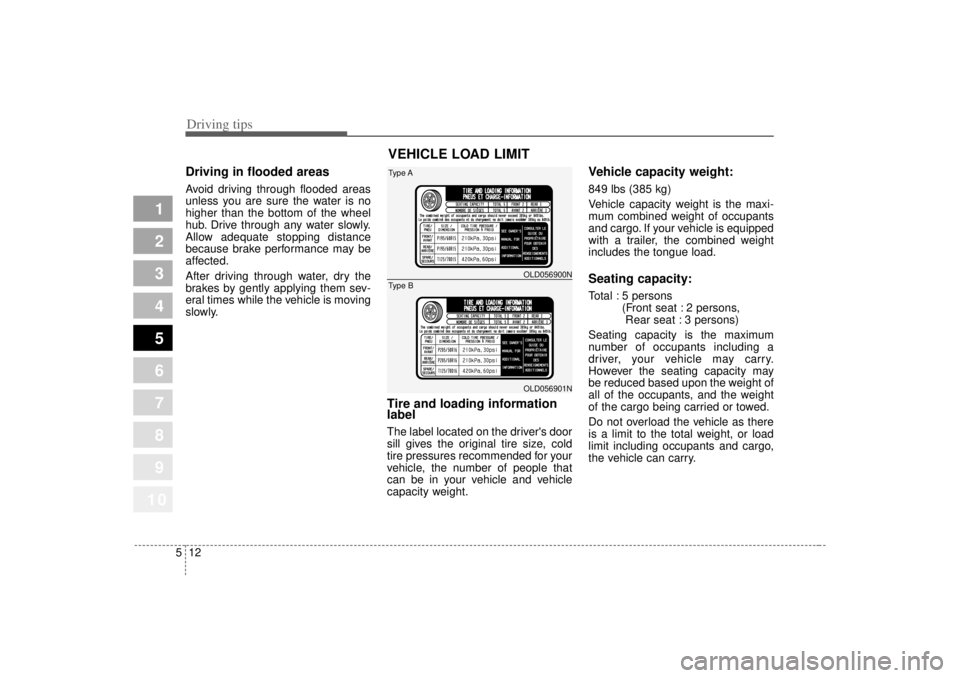
Tire and loading information
labelThe label located on the driver's door
sill gives the original tire size, cold
tire pressures recommended for your
vehicle, the number of people that
can be in your vehicle and vehicle
capacity weight.
Vehicle capacity weight:849 lbs (385 kg)
Vehicle capacity weight is the maxi-
mum combined weight of occupants
and cargo. If your vehicle is equipped
with a trailer, the combined weight
includes the tongue load.Seating capacity:Total : 5 persons
(Front seat : 2 persons, Rear seat : 3 persons)
Seating capacity is the maximum
number of occupants including a
driver, your vehicle may carry.
However the seating capacity may
be reduced based upon the weight of
all of the occupants, and the weight
of the cargo being carried or towed.
Do not overload the vehicle as there
is a limit to the total weight, or load
limit including occupants and cargo,
the vehicle can carry.
1
2
3
4
5
6
7
8
910
VEHICLE LOAD LIMIT
OLD056900NOLD056901N
Type AType B
Page 252 of 312

75
Maintenance
1
2
3
4
5
6
7
8
910
NORMAL MAINTENANCE SCHEDULE (CONT.)
DESCRIPTION
7.5 15 22.5 30 37.5 45 52.5 60 67.5 75 82.5 90 97.5 105 112.5 120 127.5 135 142.5 15012 24 36 48 60 72 84 96 108 120 132 144 156 168 180 192 204 216 228 240 6 121824303642485460667278849096102108114120IIIIIIIIIIIIIIIIII II
At first, replace at 60,000 miles (96,000 km) or 60 months
After that, replace every 25,000 miles (40,000 km) or 24 months IRIR
IIII
IIIII
IIIIIIRIII IIIII
IIIIIIIIII IIIII
IIIIIIIIII
GENERAL ITEMS
DRIVE BELT
(ALTERNATOR, P/STR'G, A/CON, W/PUMP)
COOLANT
TIMING BELT
TENSIONER/IDLER-TIMING BELT
MANUAL TRANSAXLE OIL
AUTOMATIC TRANSAXLE FLUID
BRAKE FLUID
BRAKE HOSES AND LINES
REAR BRAKE DRUMS/LININGS, PARKING BRAKE
BRAKE PADS, CALIPERS AND ROTORS MILES X 1000
KILOMETERS X 1000
MONTHS
No.1
2
3
4
5
6
7
8
9
10R : Replace I : Inspect and, after Inspection, clean, adjust, repair or replace if neces\
sary.
Page 253 of 312
R : ReplaceI : Inspect and, after inspection, clean, adjust, repair or replace if neces\
sary
DESCRIPTION
7.5 15 22.5 30 37.5 45 52")
Maintenance67
1
2
3
4
5
6
7
8
910
NORMAL MAINTENANCE SCHEDULE (CONT.)R : ReplaceI : Inspect and, after inspection, clean, adjust, repair or replace if neces\
sary
DESCRIPTION
7.5 15 22.5 30 37.5 45 52.5 60 67.5 75 82.5 90 97.5 105 112.5 120 127.5 135 142.5 150
12 24 36 48 60 72 84 96 108 120 132 144 156 168 180 192 204 216 228 240 6 121824303642485460667278849096102108114120
IIIIIIIIII
IIIIIIIIII
IIIIIIIIII
IIIIIIIIII
IIIIIIIIII
IIIIIIIIII
Replace every 12 months or 10,000 miles (15,000 km)
GENERAL ITEMS
EXHAUST PIPE AND MUFFLER
SUSPENSION MOUNTING BOLTS
STEERING GEAR BOX, LINKAGE & BOOTS
/LOWER ARM BALL JOINT, UPPER ARM BALL
JOINT
POWER STEERING PUMP, BELT AND HOSES
DRIVE SHAFTS AND BOOTS
AIR CONDITIONING REFRIGERANT
CLIMATE CONTROL AIR FILTER
(FOR EVAPORATOR AND BLOWER UNIT) MILES X 1000
KILOMETERS X 1000
MONTHS
No.11
12
13
14
15
16
17
Page 254 of 312

77
Maintenance
1
2
3
4
5
6
7
8
910
MAINTENANCE UNDER SEVERE USAGE CONDITIONSSEVERE DRIVING CONDITIONS
A - Repeatedly driving short distance of less than 5miles (8km) in nor-mal temperature or less than 10miles (16km) in freezing temperature
B - Extensive engine idling or low speed driving for long distances
C - Driving on rough, dusty, muddy, unpaved, graveled or salt- spread roads
D - Driving in areas using salt or other corrosive materials or in very cold weather E - Driving in sandy areas
F - Driving in heavy traffic area over 90°F (32°C)
G - Driving on uphill, downhill, or mountain road
H - Towing a Trailer, or using a camper, or roof rack
I - Driving as a patrol car, taxi, other commercial use or vehicle towing
J - Driving over 100 MPH (170 Km/h)
K - Frequently driving in stop-and-go conditionsENGINE OIL AND FILTER
AIR CLEANER FILTER
SPARK PLUGS
BRAKE PADS, CALIPERS AND ROTORS
REAR BRAKE DRUMS/LININGS, PARKING BRAKE
STEERING GEAR BOX, LINKAGE & BOOTS/
LOWER ARM BALL JOINT, UPPER ARM BALL JOINT
DRIVE SHAFTS AND BOOTS
TIMING BELT/IDLER/TENSIONER
MANUAL TRANSAXLE OIL
AUTOMATIC TRANSAXLE FLUID
CLIMATE CONTROL AIR FILTER
(FOR EVAPORATOR AND BLOWER UNIT)R
R
R
I
I
I
I
R
R
R
R EVERY 3,000 MILES (5,000 KM) OR 3 MONTHS
MORE FREQUENTLY
MORE FREQUENTLY
MORE FREQUENTLY
MORE FREQUENTLY
MORE FREQUENTLY
EVERY 7,500 MILES (12,000 KM) OR 6 MONTHS
EVERY 60,000 MILES (96,000 KM) OR 48 MONTHS
EVERY 60,000 MILES (96,000 KM)
EVERY 30,000 MILES (48,000 KM)
MORE FREQUENTLY
A, B, C, D, E, F, G, H, I, KC, E
B, H
C, D, G, H
C, D, G, H
C, D, E, F, G, H, I
C, D, E, F, G, H
B, C, D, E, F, G
A, C, D, E, F, G, H, I, J
A, C, E, F, G, H, I
C, E
MAINTENANCE ITEM
MAINTENANCE
OPERATION MAINTENANCE
INTERVALS DRIVING
CONDITION
The following items must be serviced more frequently on cars normally used under severe driving conditions. Refer
to the chart below for the appropriate maintenance intervals.
R : Replace I : Inspect and, after inspection, clean, adjust, repair or replace if neces\
sary
Page 256 of 312
79
Maintenance
1
2
3
4
5
6
7
8
910
At least monthly: Check coolant level in the enginecoolant reservoir.
Check the operation of all exterior lights, including the stoplights, turn
signals and hazard warning flash-
ers.
Check the inflation pressures of all tires including the spare.
At least twice a year
(i.e., every Spring and Fall) : Check radiator, heater and air con- ditioning hoses for leaks or da-
mage.
Check windshield washer spray and wiper operation. Clean wiper
blades with clean cloth dampened
with washer fluid.
Check headlight alignment.
Check muffler, exhaust pipes, shields and clamps.
Check the lap/shoulder belts for wear and function.
Check for worn tires and loose wheel lug nuts.
At least once a year : Clean body and door drain holes.
Lubricate door hinges and checks,and hood hinges.
Lubricate door and hood locks and latches.
Lubricate door rubber weather- strips.
Check the air conditioning system.
Check the power steering fluid level.
Inspect and lubricate automatic transaxle linkage and controls.
Clean battery and terminals.
Check the brake fluid level.
Page 285 of 312

Maintenance38
7
1
2
3
4
5
6
7
8
910
4. Tire ply composition and mate-
rialThe number of layers or plies of rub-
ber-coated fabric in the tire. Tire
manufacturers also must indicate the
materials in the tire, which include
steel, nylon, polyester, and others.
The letter "R" means radial ply con-
struction; the letter "D" means diago-
nal or bias ply construction; and the
letter "B" means belted-bias ply con-
struction.
5. Maximum permissible inflationpressureThis number is the greatest amount
of air pressure that should be put in
the tire. Do not exceed the maximum
permissible inflation pressure. Refer
to the Tire and Loading Information
label for recommended inflation
pressure.6. Maximum load ratingThis number indicates the maximum
load in kilograms and pounds that
can be carried by the tire. When
replacing the tires on the vehicle,
always use a tire that has the same
load rating as the factory installed
tire.7. Uniform tire quality grading The following information relates to
the tire grading system developed by
the National Highway Traffic Safety
Administration (NHTSA) for grading
tires by tread wear, traction and tem-
perature performance. Tread wear
The tread wear grade is a compara-
tive rating based on the wear rate of
the tire when tested under controlled
conditions on a specified govern-
ment test course. For example, a tire
graded 150 would wear one-and-a-
half times as well on the government
course as a tire graded 100.
The relative performance of tires
depends upon the actual conditions
of their use. However, performance
may differ from the norm because of
variations in driving habits, service
practices and differences in road
characteristics and climate.
These grades are molded on the
side-walls of passenger vehicle tires.
The tires available as standard or
optional equipment on your vehicles
may vary with respect to grade.
WARNING -
Tire age
A tire more than 6 years old may
sustain separation of cord lay-
ers inside the tire. Tire failure to
separation of cord, can cause
accidents resulting in severe
injuries or death.
Make sure to check the manu-
facturing date of the tire and
replace it within 6 years of that
date.