four wheel drive KIA Sportage 2005 JE_ / 2.G Owner's Manual
[x] Cancel search | Manufacturer: KIA, Model Year: 2005, Model line: Sportage, Model: KIA Sportage 2005 JE_ / 2.GPages: 354, PDF Size: 2.78 MB
Page 124 of 354
1
2
3
4
5
6
7
8
9
Ignition switch / 4-2
Starting the engine / 4-4
Manual transaxle / 4-5
Automatic transaxle / 4-6
Four wheel drive (4WD) / 4-12
Brake system / 4-18
Steering wheel / 4-25
Cruise control / 4-28
Traction control system / 4-33
Electronic stability program / 4-36
Instrument cluster / 4-39
Gauges / 4-40
Warnings and indicators / 4-46
Tires pressure monitoring system (TPMS) / 4-54
Compass / 4-56
Lighting / 4-59
Wipers and washers / 4-63
Defroster / 4-66
Driving your vehicle
KM CAN (ENG) 4.qxd 9/13/2004 4:48 PM Page 1
Page 135 of 354
Driving your vehicle12 4
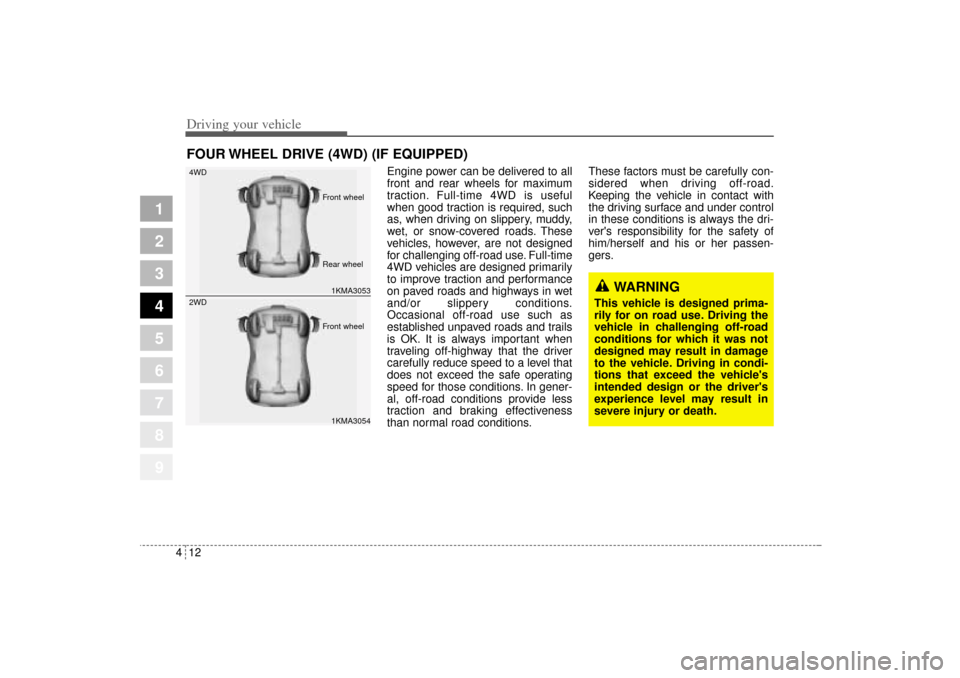
Engine power can be delivered to all
front and rear wheels for maximum
traction. Full-time 4WD is useful
when good traction is required, such
as, when driving on slippery, muddy,
wet, or snow-covered roads. These
vehicles, however, are not designed
for challenging off-road use. Full-time
4WD vehicles are designed primarily
to improve traction and performance
on paved roads and highways in wet
and/or slippery conditions.
Occasional off-road use such as
established unpaved roads and trails
is OK. It is always important when
traveling off-highway that the driver
carefully reduce speed to a level that
does not exceed the safe operating
speed for those conditions. In gener-
al, off-road conditions provide less
traction and braking effectiveness
than normal road conditions.These factors must be carefully con-
sidered when driving off-road.
Keeping the vehicle in contact with
the driving surface and under control
in these conditions is always the dri-
ver's responsibility for the safety of
him/herself and his or her passen-
gers.
FOUR WHEEL DRIVE (4WD) (IF EQUIPPED)
1
2
3
4
5
6
7
8
9
WARNING
This vehicle is designed prima-
rily for on road use. Driving the
vehicle in challenging off-road
conditions for which it was not
designed may result in damage
to the vehicle. Driving in condi-
tions that exceed the vehicle's
intended design or the driver's
experience level may result in
severe injury or death.
1KMA3053 4WD1KMA3054
2WDFront wheel
Front wheel Rear wheel
KM CAN (ENG) 4.qxd 9/13/2004 4:48 PM Page 12
Page 136 of 354
413
Driving your vehicle
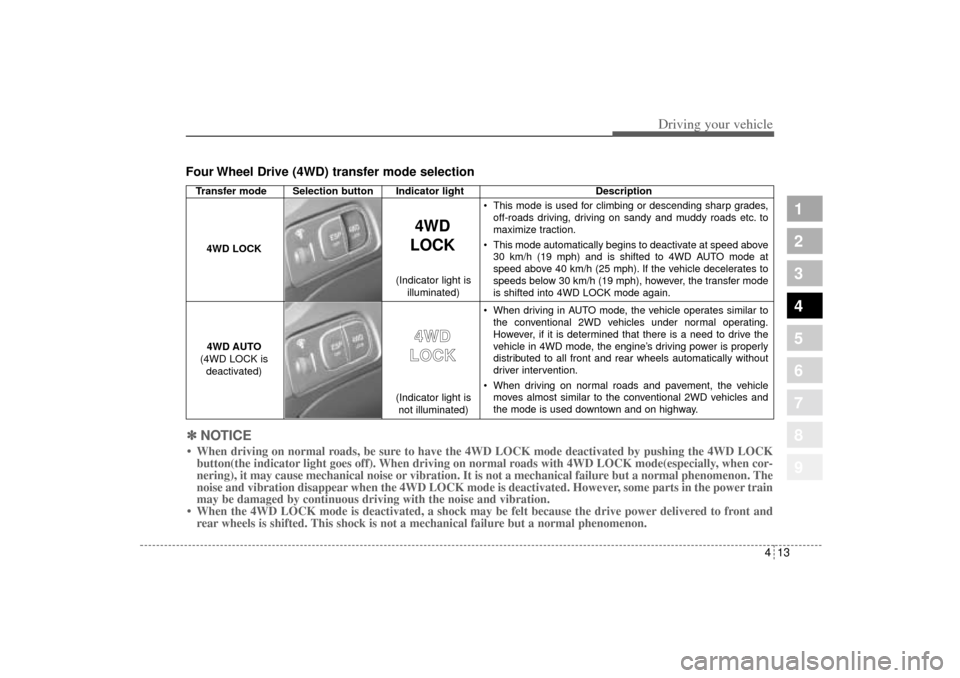
Four Wheel Drive (4WD) transfer mode selection
1
2
3
4
5
6
7
8
9
Transfer mode Selection button Indicator light Description
This mode is used for climbing or descending sharp grades,
off-roads driving, driving on sandy and muddy roads etc. to
maximize traction.
This mode automatically begins to deactivate at speed above
30 km/h (19 mph) and is shifted to 4WD AUTO mode at
speed above 40 km/h (25 mph). If the vehicle decelerates to
speeds below 30 km/h (19 mph), however, the transfer mode
is shifted into 4WD LOCK mode again.
When driving in AUTO mode, the vehicle operates similar to
the conventional 2WD vehicles under normal operating.
However, if it is determined that there is a need to drive the
vehicle in 4WD mode, the engine’s driving power is properly
distributed to all front and rear wheels automatically without
driver intervention.
When driving on normal roads and pavement, the vehicle
moves almost similar to the conventional 2WD vehicles and
the mode is used downtown and on highway.
4WD
LOCK
4WD LOCK
4WD AUTO
(4WD LOCK is
deactivated)
4 4W
WD
D
L LO
OC
CK
K
(Indicator light is
not illuminated) (Indicator light is
illuminated)
✽ ✽
NOTICE• When driving on normal roads, be sure to have the 4WD LOCK mode deactivated by pushing the 4WD LOCK
button(the indicator light goes off). When driving on normal roads with 4WD LOCK mode(especially, when cor-
nering), it may cause mechanical noise or vibration. It is not a mechanical failure but a normal phenomenon. The
noise and vibration disappear when the 4WD LOCK mode is deactivated. However, some parts in the power train
may be damaged by continuous driving with the noise and vibration.
• When the 4WD LOCK mode is deactivated, a shock may be felt because the drive power delivered to front and
rear wheels is shifted. This shock is not a mechanical failure but a normal phenomenon.
KM CAN (ENG) 4.qxd 9/13/2004 4:48 PM Page 13
Page 137 of 354
Driving your vehicle14 4
1
2
3
4
5
6
7
8
9
For safe four-wheel drive oper-
ation Do not try to drive in deep standing
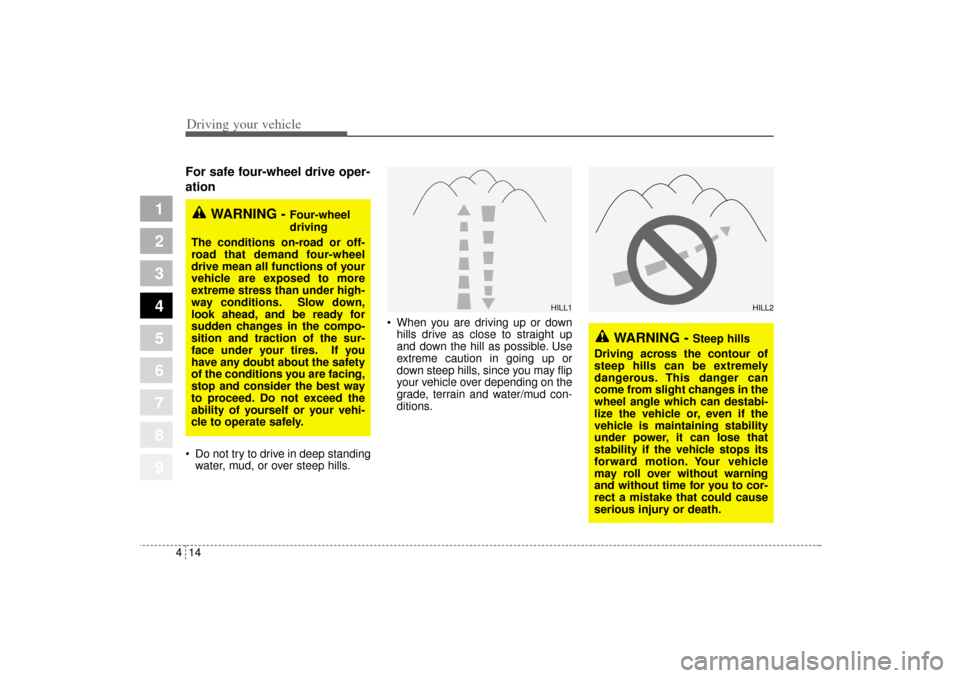
water, mud, or over steep hills. When you are driving up or down
hills drive as close to straight up
and down the hill as possible. Use
extreme caution in going up or
down steep hills, since you may flip
your vehicle over depending on the
grade, terrain and water/mud con-
ditions.
WARNING -
Steep hills
Driving across the contour of
steep hills can be extremely
dangerous. This danger can
come from slight changes in the
wheel angle which can destabi-
lize the vehicle or, even if the
vehicle is maintaining stability
under power, it can lose that
stability if the vehicle stops its
forward motion. Your vehicle
may roll over without warning
and without time for you to cor-
rect a mistake that could cause
serious injury or death.
WARNING -
Four-wheel
driving
The conditions on-road or off-
road that demand four-wheel
drive mean all functions of your
vehicle are exposed to more
extreme stress than under high-
way conditions. Slow down,
look ahead, and be ready for
sudden changes in the compo-
sition and traction of the sur-
face under your tires. If you
have any doubt about the safety
of the conditions you are facing,
stop and consider the best way
to proceed. Do not exceed the
ability of yourself or your vehi-
cle to operate safely.
HILL1
HILL2
KM CAN (ENG) 4.qxd 9/13/2004 4:48 PM Page 14
Page 139 of 354
Driving your vehicle16 4
1
2
3
4
5
6
7
8
9
If you need to drive in water, stop
your vehicle, set your transfer to
“4WD LOCK” and drive at less than
8 km/h (5 mph).
✽ ✽
NOTICE• Do not drive in water if the level is
higher than the bottom of the vehi-
cle.
• Check your brake condition once
you are out of mud or water. Press
the brake pedal several times as
you move slowly until you feel nor-
mal braking forces return.
• Shorten your scheduled mainte-
nance interval if you drive in off-
road conditions such as sand,
mud or water (see “Maintenance
Services” in the Index). Always
wash you car thoroughly.
• Since the driving torque is always
applied to the 4 wheels the per-
formance of the 4WD vehicle is
greatly affected by the condition of
the tires. Be sure to equip them
with all four tires with same size
and type.
• The full time four wheel drive
vehicle cannot be towed by an
ordinary tow truck. Make sure
that the vehicle is towed with its
four wheels raised off the ground.
WARNING
While the full-time 4WD vehicle
is being raised on a jack, never
start the engine or cause the
tires to rotate.
There is the danger that rotating
tires touching the ground could
cause the vehicle to go off the
jack and to jump forward.
CAUTION
If one of the front or rear wheels
begins to spin in mud, snow,
etc. the vehicle can sometimes
be driven out by depressing the
accelerator pedal further; how-
ever avoid running the engine
continuously at high rpm
because doing so could dam-
age the 4WD system.
WARNING
If you are driving in heavy wind,
the vehicle's higher center of
gravity decreases your steering
control capacity and requires
you to drive more slowly.
WARNING -
Driving
through water
If you are driving too fast in
water, the water spray can get
into the engine compartment
and wet the ignition system,
causing your vehicle to sudden-
ly stall. If this happens and your
vehicle is in a tilted position,
your vehicle may roll over.
KM CAN (ENG) 4.qxd 9/13/2004 4:48 PM Page 16
Page 218 of 354
1
2
3
4
5
6
7
8
91
2
3
4
5
6
7
8
9
Fuel requirements / 5-2
Emission control system / 5-3
Before driving / 5-5
Suggestions for economical operation / 5-6
Special driving conditions / 5-7
Using four-wheel drive / 5-14
Weight of the vehicle
- With and without a trailer / 5-32
Trailer towing / 5-34
Overloading / 5-41
Vehicle load limit / 5-42
Label information / 5-52
Driving tips
KM CAN (ENG) 5.qxd 9/13/2004 4:48 PM Page 1
Page 227 of 354
Driving tips10 5Snow tires If you mount snow tires on your Kia,
make sure they are radial tires of the
same size and load range as the
original tires. Mount snow tires on all
four wheels to balance your vehicle’s
handling in all weather conditions.
Keep in mind that the traction provid-
ed by snow tires on dry roads may
not be as high as your vehicle's orig-
inal equipment tires. You should drive
cautiously even when the roads are
clear. Check with the tire dealer for
maximum speed recommendations.Do not install studded tires without
first checking local, state and munic-
ipal regulations for possible restric-
tions against their use.
Driving in flooded areas Avoid driving through flooded areas
unless you are sure the water is no
higher than the bottom of the wheel
hub. Drive through any water slowly.
Allow adequate stopping distance
because brake performance may be
affected.
After driving through water, dry the
brakes by gently applying them sev-
eral times while the vehicle is moving
slowly.
Reducing the risk of a rolloverThis multi-purpose passenger vehi-
cle is defined as a Sports Utility
Vehicle (SUV). SUV’s have higher
ground clearance and a narrower
track to make them capable of per-
forming in a wide variety of off-road
applications. Specific design charac-
teristics give them a higher center of
gravity than ordinary cars. An advan-
tage of the higher ground clearance
is a better view of the road, which
allows you to anticipate problems.
They are not designed for cornering
at the same speeds as conventional
passenger drive vehicles, any more
than low-slung sports cars are
designed to perform satisfactorily in
off-road conditions. Due to this risk,
driver and passengers are strongly
recommended to buckle their seat-
belts. In a rollover crash, an unbelt-
ed person is more likely to die than a
person wearing a seatbelt. There
are steps that a driver can make to
reduce the risk of a rollover. If at all
possible, avoid sharp turns or abrupt
maneuvers, do not load your roof
rack with heavy cargo, and never
modify your vehicle in any way.
1
2
3
4
5
6
7
8
9
WARNING
- Snow tire
size
Snow tires should be equivalent
in size and type to the vehicle's
standard tires. Otherwise, the
safety and handling of your
vehicle may be adversely affect-
ed.
KM CAN (ENG) 5.qxd 9/13/2004 4:48 PM Page 10
Page 229 of 354
Driving tips12 5
1
2
3
4
5
6
7
8
9
USING FOUR-WHEEL DRIVEDriving on snow- or Ice-cov-
ered roads (“4WD LOCK” for
full-time 4WD operation) Use snow tires. See “Tires” in this
section for more information.
Keep an adequate distance
between yourself and other vehi-
cles.
Avoid sudden braking, acceleration
or steering. These actions can
cause your vehicle to lose traction.
Driving in sand or mud (“4WD
LOCK” for full-time 4WD opera-
tion) Avoid sudden braking, acceleration
or steering. These actions can
cause your vehicle to get stuck in
the sand or mud.
Drive at low speeds whenever pos-
sible.
You may need to get out of your
vehicle at times to check road con-
ditions.
If you get stuck in the sand or mud,
try placing stones, wood or other
similar materials under the tires to
get traction, or move forward and
backward repeatedly to get
unstuck.
✽ ✽
NOTICEProlonged rocking may cause engine
damage, overheating, transaxle dif-
ferential or transfer case damage or
failure and tire damage.
WARNING
- Traction
Make sure that no one stands in
front of or behind the tires when
materials are placed under the
tires to get more traction. The
tires may cause loose materials
to fly out from under the vehicle,
potentially causing serious bod-
ily injury or death.
KM CAN (ENG) 5.qxd 9/13/2004 4:48 PM Page 12
Page 230 of 354
513
Driving tips
1
2
3
4
5
6
7
8
9
Driving on a hill (“4WD LOCK”
for full-time 4WD operation) Use low gear when going uphill or
downhill and avoid sudden braking.
Do not shift gears or use your
clutch when going downhill. Do not
coast downhill in Neutral.
Crossing a ditch (“4WD LOCK”
for full-time 4WD operation) Avoid driving through ditches if
possible, especially if there is
water in the ditch. Your vehicle may
stall if the electrical system gets
wet. If you must cross a ditch,
select 4WD LOCK mode.
Avoid driving where the water level
is higher than the bottom of the
wheel hub. If the water level rises
above this mark, your vehicle will
need to be serviced.
Tap lightly on the brake pedal dur-
ing and after driving through water.
This will help keep the brakes dry
and in proper working order.
Do not shift gears while crossing a
ditch.
Tight corner brake effectThis is called tight corner brake
effect. Tight corner brake effect is a
unique characteristic of four-wheel
drive vehicles caused by the differ-
ence in tire rotation at the four
wheels and the zero-degree align-
ment of the front wheels and sus-
pension.
Sharp turns at low speeds should be
carried out with caution.
CAUTION
When turning sharply on a
paved road at low speed while
in four-wheel drive, steering
control will be difficult.
KM CAN (ENG) 5.qxd 9/13/2004 4:48 PM Page 13
Page 231 of 354
Driving tips14 5
1
2
3
4
5
6
7
8
9
Off-road driving with your
four-wheel drive vehicleOff-road driving can be great fun. But
it has definite hazards. The greatest
of these is the terrain itself.
“Off-roading” means you’ve left the
paved road system behind. Traffic
lanes are not marked. Curves are not
banked.
There are no carefully engineered
road signs to warn you of dangerous
conditions or to advise you of a safe
speed. You have to assess the envi-
ronment yourself. Surfaces can be
slippery, rough, uphill or downhill.
Off-road driving involves learning
new skills. That’s why it’s important
that you read and understand this
section. You’ll find useful driving
information and suggestions. These
will help make your off-road driving
safer and more enjoyable.
Before you go off-roadingThere are some things to do before
you leave the paved roads. Be sure
to have all necessary maintenance
and service work done beforehand.
Be sure to read all the information
about your four-wheel drive vehicle
in this manual. Is there enough fuel?
Is the spare tire fully inflated? Are the
fluid levels at the proper levels? What
are the local laws that apply to off-
roading where you’ll be driving? If
you don’t know, you should check
with law enforcement people in the
area. Will you be on someone’s pri-
vate land? If so, be sure to get the
necessary permission.
Loading your vehicle for off-road
drivingThere are some important items to
remember about how to properly
load your vehicle.
The heaviest things should be in
the cargo area and forward of your
rear axle. Place heavier items as
far forward as you can.
Be sure the load is properly
secured, so driving over off-road
terrain doesn’t shift your load or
throw items toward the driver or
passengers.
KM CAN (ENG) 5.qxd 9/13/2004 4:48 PM Page 14