overheating KIA Sportage 2005 JE_ / 2.G Owner's Manual
[x] Cancel search | Manufacturer: KIA, Model Year: 2005, Model line: Sportage, Model: KIA Sportage 2005 JE_ / 2.GPages: 354, PDF Size: 2.78 MB
Page 35 of 354
Knowing your vehicle24 3
1
2
3
4
5
6
7
8
9
✽ ✽
NOTICE• The seat warmer will not operate
if ambient temperature is above
37±3 °C (98.5±5.5 °F).
• If the seat warmer doesn't work
when the ambient temperature is
below 28±3.5 °C (82.5±5.5 °F),
have the system checked by an
authorized dealer.
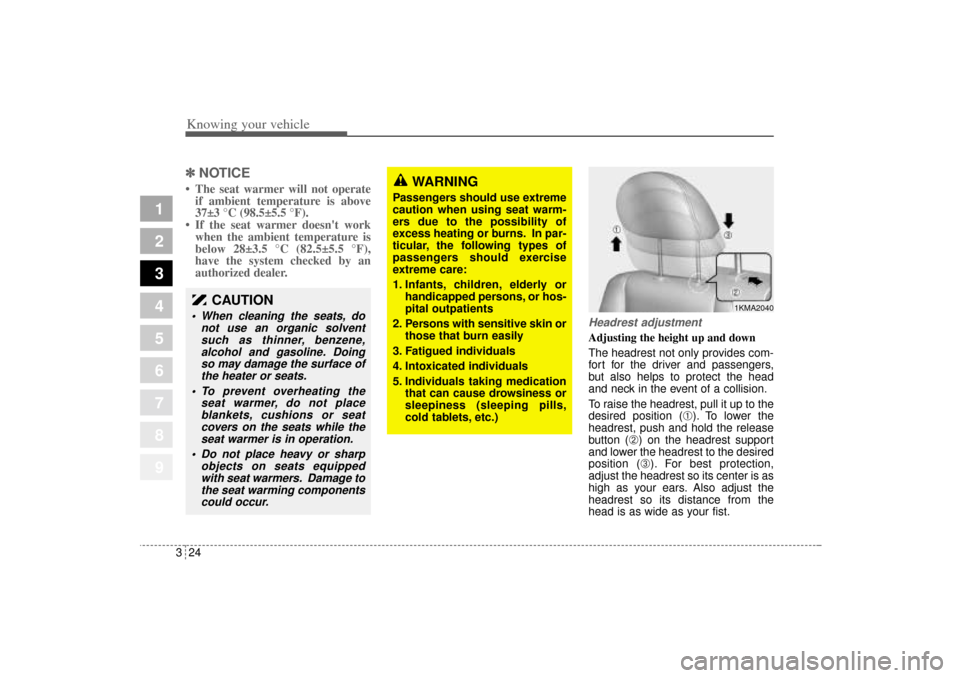
Headrest adjustmentAdjusting the height up and down
The headrest not only provides com-
fort for the driver and passengers,
but also helps to protect the head
and neck in the event of a collision.
To raise the headrest, pull it up to the
desired position (
➀). To lower the
headrest, push and hold the release
button (
➁) on the headrest support
and lower the headrest to the desired
position (➂). For best protection,
adjust the headrest so its center is as
high as your ears. Also adjust the
headrest so its distance from the
head is as wide as your fist.
WARNING
Passengers should use extreme
caution when using seat warm-
ers due to the possibility of
excess heating or burns. In par-
ticular, the following types of
passengers should exercise
extreme care:
1. Infants, children, elderly or
handicapped persons, or hos-
pital outpatients
2. Persons with sensitive skin or
those that burn easily
3. Fatigued individuals
4. Intoxicated individuals
5. Individuals taking medication
that can cause drowsiness or
sleepiness (sleeping pills,
cold tablets, etc.)
1KMA2040
CAUTION
When cleaning the seats, do
not use an organic solvent
such as thinner, benzene,
alcohol and gasoline. Doing
so may damage the surface of
the heater or seats.
To prevent overheating the
seat warmer, do not place
blankets, cushions or seat
covers on the seats while the
seat warmer is in operation.
Do not place heavy or sharp
objects on seats equipped
with seat warmers. Damage to
the seat warming components
could occur.
KM CAN (ENG) 3 (~57).qxd 9/13/2004 4:49 PM Page 24
Page 108 of 354
397
1
2
3
4
5
6
7
8
9
Knowing your vehicle
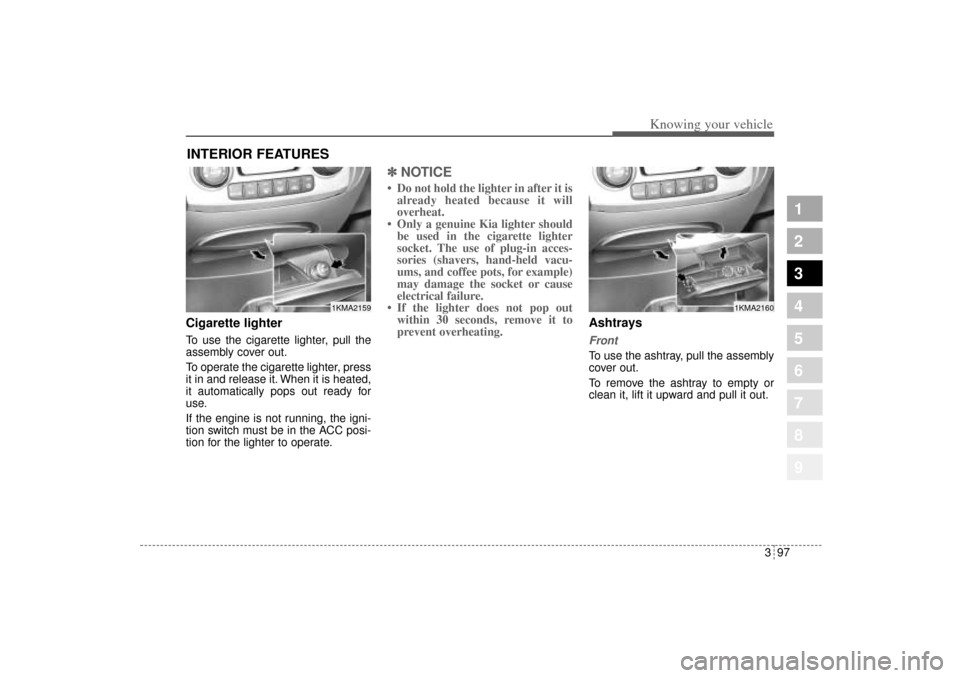
Cigarette lighterTo use the cigarette lighter, pull the
assembly cover out.
To operate the cigarette lighter, press
it in and release it. When it is heated,
it automatically pops out ready for
use.
If the engine is not running, the igni-
tion switch must be in the ACC posi-
tion for the lighter to operate.
✽ ✽
NOTICE• Do not hold the lighter in after it is
already heated because it will
overheat.
• Only a genuine Kia lighter should
be used in the cigarette lighter
socket. The use of plug-in acces-
sories (shavers, hand-held vacu-
ums, and coffee pots, for example)
may damage the socket or cause
electrical failure.
• If the lighter does not pop out
within 30 seconds, remove it to
prevent overheating.
Ashtrays Front To use the ashtray, pull the assembly
cover out.
To remove the ashtray to empty or
clean it, lift it upward and pull it out.
INTERIOR FEATURES
1KMA2159
1KMA2160
KM CAN (ENG) 3 (~112).qxd 9/13/2004 4:51 PM Page 97
Page 164 of 354
441
Driving your vehicle
1
2
3
4
5
6
7
8
9
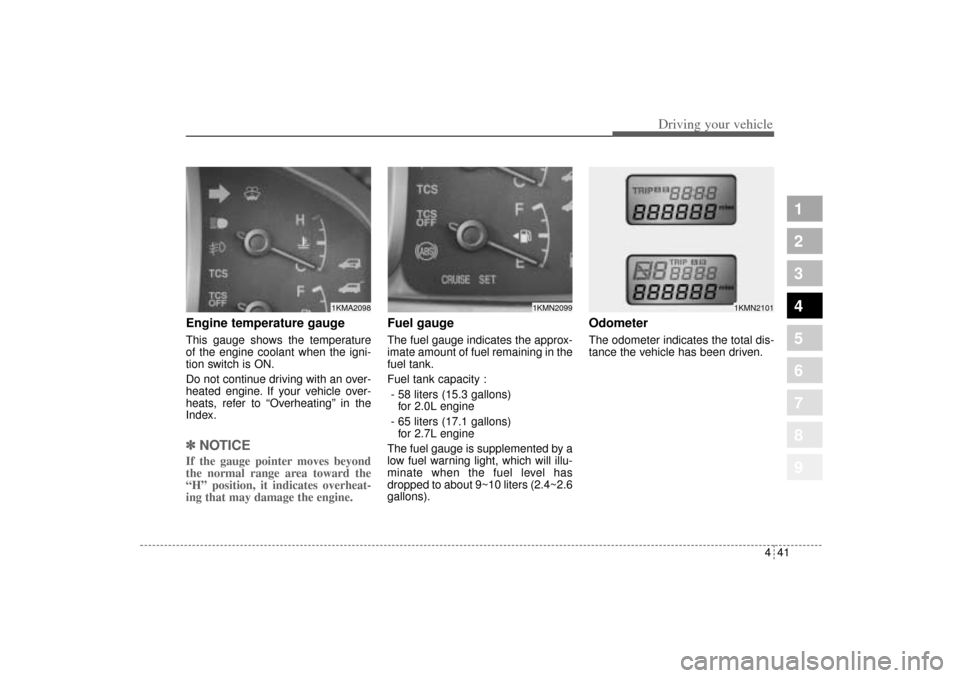
Engine temperature gauge This gauge shows the temperature
of the engine coolant when the igni-
tion switch is ON.
Do not continue driving with an over-
heated engine. If your vehicle over-
heats, refer to “Overheating” in the
Index.✽ ✽
NOTICEIf the gauge pointer moves beyond
the normal range area toward the
“H” position, it indicates overheat-
ing that may damage the engine.
Fuel gaugeThe fuel gauge indicates the approx-
imate amount of fuel remaining in the
fuel tank.
Fuel tank capacity :
- 58 liters (15.3 gallons)
for 2.0L engine
- 65 liters (17.1 gallons)
for 2.7L engine
The fuel gauge is supplemented by a
low fuel warning light, which will illu-
minate when the fuel level has
dropped to about 9~10 liters (2.4~2.6
gallons).
OdometerThe odometer indicates the total dis-
tance the vehicle has been driven.
1KMN2099
1KMN2101
1KMA2098
KM CAN (ENG) 4.qxd 9/13/2004 4:48 PM Page 41
Page 198 of 354
475
Driving your vehicle
1
2
3
4
5
6
7
8
9
When maximum cooling is desired,
set the temperature control to the
extreme left position, set the air
intake control to the recirculated air
position, then set the fan speed
control to the highest speed.✽ ✽
NOTICE• When using the air conditioning
system, monitor the temperature
gauge closely while driving up
hills or in heavy traffic when out-
side temperatures are high. Air
conditioning system operation
may cause engine overheating.
Continue to use the blower fan but
turn the air conditioning system
off if the temperature gauge indi-
cates engine overheating.
• When opening the windows in
humid weather air conditioning
may create water droplets inside
the vehicle. Since excessive water
droplets may cause damage to
electrical equipment, air condi-
tioning should only be run with
the windows closed.
Air conditioning system oper-
ation tips If the vehicle has been parked in
direct sunlight during hot weather,
open the windows for a short time
to let the hot air inside the vehicle
escape.
To help reduce moisture inside of
windows on rainy humid days,
decrease the humidity inside the
vehicle by operating the air condi-
tioning system.
During air conditioning system
operation, you may occasionally
notice a slight change in engine
speed at idle as the air condition-
ing compressor cycles on. This is
a normal system operation charac-
teristics.
Use the air conditioning system
every month if only for a few min-
utes to ensure maximum system
performance.
When using the air conditioning
system, you may notice clear water
dripping (or even pudding) on the
ground under the passenger side
of the vehicle. This is a normal sys-
tem operation characteristics. The air conditioning system
includes a function that automati-
cally turns the air conditioning
compressor off if engine coolant
temperature approaches an over
heating level. The air conditioning
compressor operation will resume
once engine coolant temperature
returns to the normal range. Also,
the air conditioning compressor is
automatically turned off for a few
seconds when the accelerator is
fully depressed (wide open throt-
tle).
When operating the air condition-
ing system use the outside (fresh)
air position.
Operating the air conditioning sys-
tem in the recirculated air position
does provide maximum cooling,
however, continual operation in this
mode may cause the air inside the
vehicle to become stale.
KM CAN (ENG) 4.qxd 9/13/2004 4:49 PM Page 75
Page 210 of 354
487
Driving your vehicle
1
2
3
4
5
6
7
8
9
Air conditioning All Kia Air Conditioning Systems are
filled with environmentally friendly
R-134a refrigerant which is not dam-
aging to the ozone layer.
1. Start the engine. Push the air con-
ditioning button.
2. Set the mode to the position.
3. Set the air intake control to the
outside air or recirculated air posi-
tion.
4. Set the temperature control to the
desired position.
5. Set the fan speed control to the
desired speed.
6. Adjust the fan speed control and
temperature control to maintain
maximum comfort. If warmer air is desired at floor
level for bi-level operation, set the
mode to the position and
adjust the temperature control to
maintain maximum comfort.
When maximum cooling is
desired, set the temperature con-
trol to the minimum Lo (17°C/62°F)
and set the air intake to the recir-
culated air position, then set the
fan speed control to the highest
speed.
✽ ✽
NOTICEWhen using the air conditioning sys-
tem, monitor the temperature gauge
closely while driving up hills or in
heavy traffic when outside tempera-
tures are high. Air conditioning sys-
tem operation may cause engine
overheating. Continue to use the
blower fan but turn the air condi-
tioning system off if the temperature
gauge indicates engine overheating.
KM CAN (ENG) 4.qxd 9/13/2004 4:49 PM Page 87
Page 229 of 354
Driving tips12 5
1
2
3
4
5
6
7
8
9
USING FOUR-WHEEL DRIVEDriving on snow- or Ice-cov-
ered roads (“4WD LOCK” for
full-time 4WD operation) Use snow tires. See “Tires” in this
section for more information.
Keep an adequate distance
between yourself and other vehi-
cles.
Avoid sudden braking, acceleration
or steering. These actions can
cause your vehicle to lose traction.
Driving in sand or mud (“4WD
LOCK” for full-time 4WD opera-
tion) Avoid sudden braking, acceleration
or steering. These actions can
cause your vehicle to get stuck in
the sand or mud.
Drive at low speeds whenever pos-
sible.
You may need to get out of your
vehicle at times to check road con-
ditions.
If you get stuck in the sand or mud,
try placing stones, wood or other
similar materials under the tires to
get traction, or move forward and
backward repeatedly to get
unstuck.
✽ ✽
NOTICEProlonged rocking may cause engine
damage, overheating, transaxle dif-
ferential or transfer case damage or
failure and tire damage.
WARNING
- Traction
Make sure that no one stands in
front of or behind the tires when
materials are placed under the
tires to get more traction. The
tires may cause loose materials
to fly out from under the vehicle,
potentially causing serious bod-
ily injury or death.
KM CAN (ENG) 5.qxd 9/13/2004 4:48 PM Page 12
Page 250 of 354
533
Driving tips
1
2
3
4
5
6
7
8
9
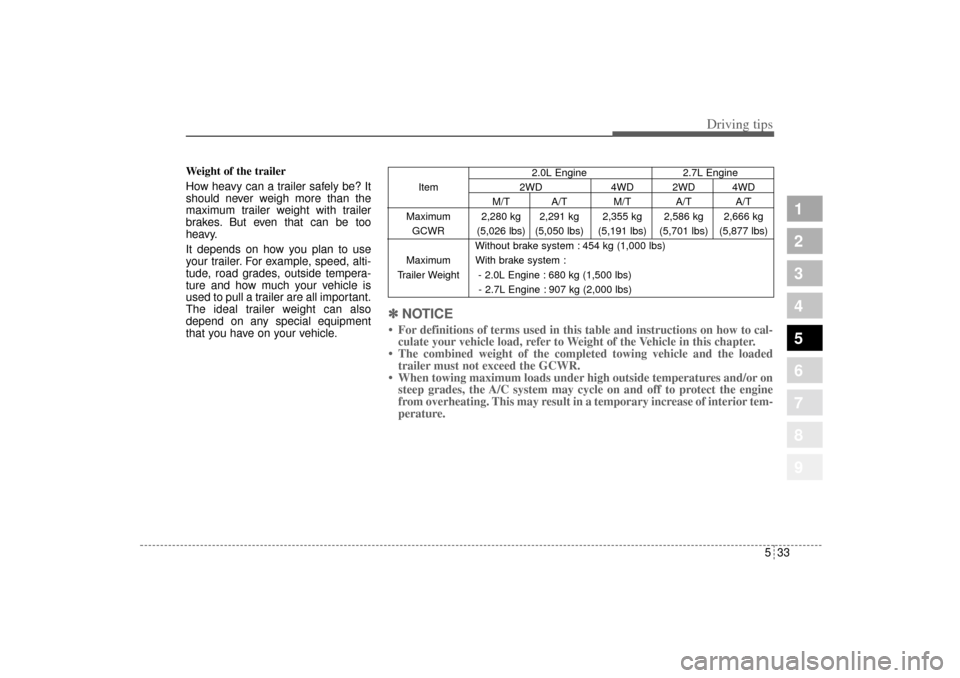
Weight of the trailer
How heavy can a trailer safely be? It
should never weigh more than the
maximum trailer weight with trailer
brakes. But even that can be too
heavy.
It depends on how you plan to use
your trailer. For example, speed, alti-
tude, road grades, outside tempera-
ture and how much your vehicle is
used to pull a trailer are all important.
The ideal trailer weight can also
depend on any special equipment
that you have on your vehicle.
✽ ✽
NOTICE• For definitions of terms used in this table and instructions on how to cal-
culate your vehicle load, refer to Weight of the Vehicle in this chapter.
• The combined weight of the completed towing vehicle and the loaded
trailer must not exceed the GCWR.
• When towing maximum loads under high outside temperatures and/or on
steep grades, the A/C system may cycle on and off to protect the engine
from overheating. This may result in a temporary increase of interior tem-
perature.
2.0L Engine 2.7L Engine
Item 2WD 4WD 2WD 4WD
M/T A/T M/T A/T A/T
Maximum 2,280 kg 2,291 kg 2,355 kg 2,586 kg 2,666 kg
GCWR (5,026 lbs) (5,050 lbs) (5,191 lbs) (5,701 lbs) (5,877 lbs)
Without brake system : 454 kg (1,000 lbs)
Maximum With brake system :
Trailer Weight - 2.0L Engine : 680 kg (1,500 lbs)
- 2.7L Engine : 907 kg (2,000 lbs)
KM CAN (ENG) 5.qxd 9/13/2004 4:48 PM Page 33
Page 256 of 354
539
Driving tips
1
2
3
4
5
6
7
8
9
Maintenance when trailer tow-
ing Your vehicle will need service more
often when you regularly pull a trail-
er. Important items to pay particular
attention to include engine oil, auto-
matic transaxle fluid, axle lubricant
and cooling system fluid. Brake con-
dition is another important item to
frequently check. Each item is cov-
ered in this manual, and the Index
will help you find them quickly. If
you’re trailering, it’s a good idea to
review these sections before you
start your trip.
Don’t forget to also maintain your
trailer and hitch. Follow the mainte-
nance schedule that accompanied
your trailer and check it periodically.
Preferably, conduct the check at the
start of each day’s driving. Most
importantly, all hitch nuts and bolts
should be tight.
✽ ✽
NOTICE• Due to higher load during trailer
usage, overheating might occur in
hot days or during uphill driving.
If the coolant gauge indicates
over-heating, switch off the A/C
and stop the vehicle in a safe area
to cool down the engine.
• When towing check transaxle
fluid more frequently.
• If your vehicle is not equipped
with the air conditioner, you
should install a condenser fan to
improve engine performance
when towing a trailer.
OVERLOADING
CAUTION
The gross axle weight rating
(GAWR) and the gross vehicle
weight rating (GVWR) for your
vehicle are on the manufactur-
er's label attached to the dri-
ver's door. Exceeding these rat-
ings can cause an accident or
vehicle damage. You can calcu-
late the weight of your load by
weighing the items (or people)
before putting them in the vehi-
cle. Be careful not to overload
your vehicle.
KM CAN (ENG) 5.qxd 9/13/2004 4:48 PM Page 39
Page 269 of 354
1
2
3
4
5
6
7
8
9
Road warning / 6-2
Overheating / 6-3
Emergency starting / 6-4
Electrical circuit protection / 6-7
Towing / 6-14
If you have a flat tire / 6-19
In case of an emergency
KM CAN (ENG) 6.qxd 9/13/2004 4:47 PM Page 1
Page 271 of 354
63
In case of an emergency
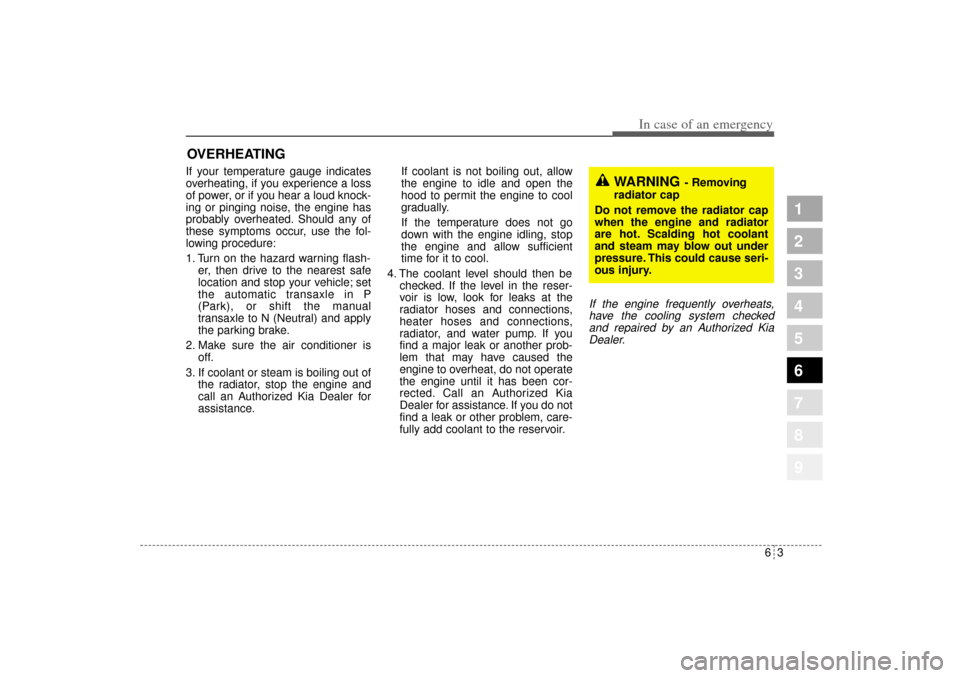
OVERHEATING If your temperature gauge indicates
overheating, if you experience a loss
of power, or if you hear a loud knock-
ing or pinging noise, the engine has
probably overheated. Should any of
these symptoms occur, use the fol-
lowing procedure:
1. Turn on the hazard warning flash-
er, then drive to the nearest safe
location and stop your vehicle; set
the automatic transaxle in P
(Park), or shift the manual
transaxle to N (Neutral) and apply
the parking brake.
2. Make sure the air conditioner is
off.
3. If coolant or steam is boiling out of
the radiator, stop the engine and
call an Authorized Kia Dealer for
assistance.If coolant is not boiling out, allow
the engine to idle and open the
hood to permit the engine to cool
gradually.
If the temperature does not go
down with the engine idling, stop
the engine and allow sufficient
time for it to cool.
4. The coolant level should then be
checked. If the level in the reser-
voir is low, look for leaks at the
radiator hoses and connections,
heater hoses and connections,
radiator, and water pump. If you
find a major leak or another prob-
lem that may have caused the
engine to overheat, do not operate
the engine until it has been cor-
rected. Call an Authorized Kia
Dealer for assistance. If you do not
find a leak or other problem, care-
fully add coolant to the reservoir.
If the engine frequently overheats,
have the cooling system checked
and repaired by an Authorized Kia
Dealer.
1
2
3
4
5
6
7
8
9
WARNING
- Removing
radiator cap
Do not remove the radiator cap
when the engine and radiator
are hot. Scalding hot coolant
and steam may blow out under
pressure. This could cause seri-
ous injury.
KM CAN (ENG) 6.qxd 9/13/2004 4:47 PM Page 3