flat KIA Sportage 2017 QL / 4.G Manual PDF
[x] Cancel search | Manufacturer: KIA, Model Year: 2017, Model line: Sportage, Model: KIA Sportage 2017 QL / 4.GPages: 595, PDF Size: 16.22 MB
Page 527 of 595
859
Maintenance
All season tires
Kia specifies all season tires on
some models to provide good per-
formance for use all year round,
including snowy and icy road condi-
tions. All season tires are identified
by ALL SEASON and/or M+S (Mud
and Snow) on the tire sidewall. Snow
tires have better snow traction than
all season tires and may be more
appropriate in some areas.
Summer tires
Kia specifies summer tires on some
models to provide superior perform-
ance on dry roads. Summer tire per-
formance is substantially reduced in
snow and ice. Summer tires do not
have the tire traction rating M+S
(Mud and Snow) on the tire side wall.
If you plan to operate your vehicle in
snowy or icy conditions, Kia recom-
mends the use of snow tires or all
season tires on all four wheels.
Snow tires
If you equip your car with snow tires,
they should be the same size and
have the same load capacity as the
original tires. Snow tires should be
installed on all four wheels; other-
wise, poor handling may result.
Snow tires should carry 28 kPa
(4 psi) more air pressure than the
pressure recommended for the stan-
dard tires on the tire label on the dri-
ver's side of the center pillar, or up to
the maximum pressure shown on the
tire sidewall, whichever is less.
Do not drive faster than 120 km/h
(75 mph) when your vehicle is
equipped with snow tires.
Radial-ply tires
Radial-ply tires provide improved
tread life, road hazard resistance and
smoother high speed ride. The radi-
al-ply tires used on this vehicle are
of belted construction and are select-
ed to complement the ride and han-
dling characteristics of your vehicle.
Radial-ply tires have the same load
carrying capacity as bias-ply or bias
belted tires of the same size and use
the same recommended inflation
pressure. Mixing of radial-ply tires
with bias-ply or bias belted tires is
not recommended. Any combina-
tions of radial-ply and bias-ply or bias
belted tires when used on the same
vehicle will seriously deteriorate
vehicle handling. The best rule to fol-
low is: identical radial-ply tires should
always be used as a set of four.
Page 558 of 595
Maintenance
90
8
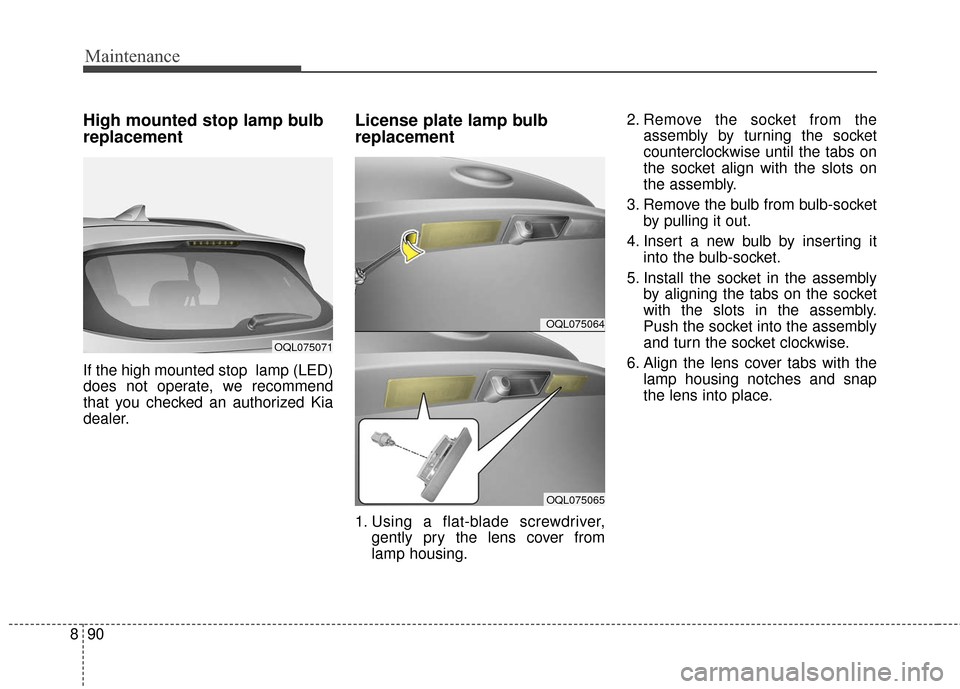
High mounted stop lamp bulb
replacement
If the high mounted stop lamp (LED)
does not operate, we recommend
that you checked an authorized Kia
dealer.
License plate lamp bulb
replacement
1. Using a flat-blade screwdriver,
gently pry the lens cover from
lamp housing. 2. Remove the socket from the
assembly by turning the socket
counterclockwise until the tabs on
the socket align with the slots on
the assembly.
3. Remove the bulb from bulb-socket by pulling it out.
4. Insert a new bulb by inserting it into the bulb-socket.
5. Install the socket in the assembly by aligning the tabs on the socket
with the slots in the assembly.
Push the socket into the assembly
and turn the socket clockwise.
6. Align the lens cover tabs with the lamp housing notches and snap
the lens into place.
OQL075071
OQL075064
OQL075065
Page 560 of 595
Maintenance
92
8
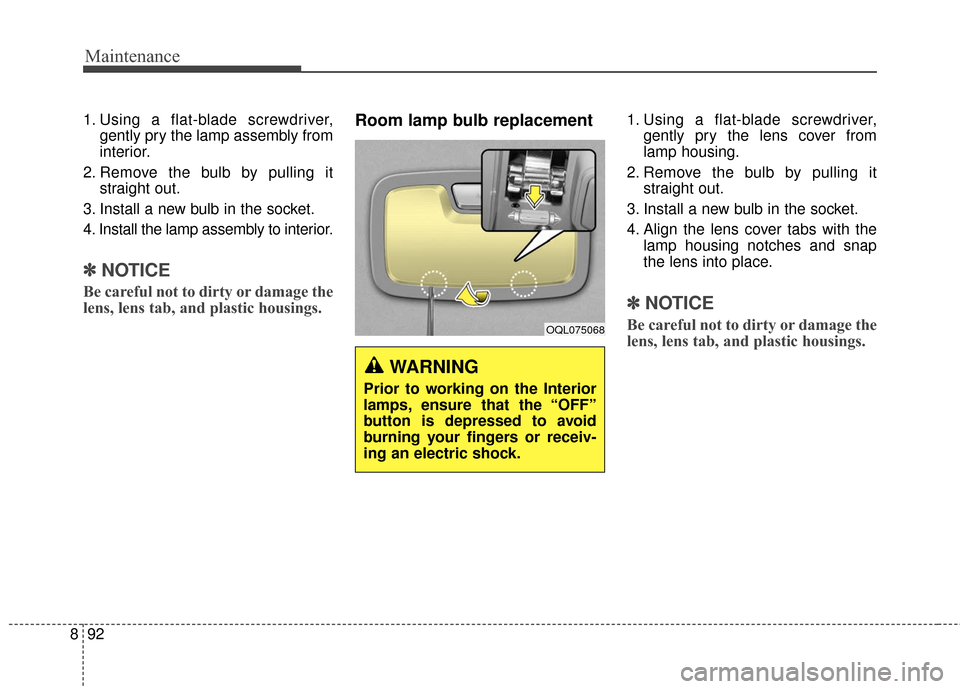
1. Using a flat-blade screwdriver,
gently pry the lamp assembly from
interior.
2. Remove the bulb by pulling it straight out.
3. Install a new bulb in the socket.
4. Install the lamp assembly to interior.
✽ ✽ NOTICE
Be careful not to dirty or damage the
lens, lens tab, and plastic housings.
Room lamp bulb replacement 1. Using a flat-blade screwdriver,
gently pry the lens cover from
lamp housing.
2. Remove the bulb by pulling it straight out.
3. Install a new bulb in the socket.
4. Align the lens cover tabs with the lamp housing notches and snap
the lens into place.
✽ ✽NOTICE
Be careful not to dirty or damage the
lens, lens tab, and plastic housings.
WARNING
Prior to working on the Interior
lamps, ensure that the “OFF”
button is depressed to avoid
burning your fingers or receiv-
ing an electric shock.
OQL075068
Page 561 of 595
893
Maintenance
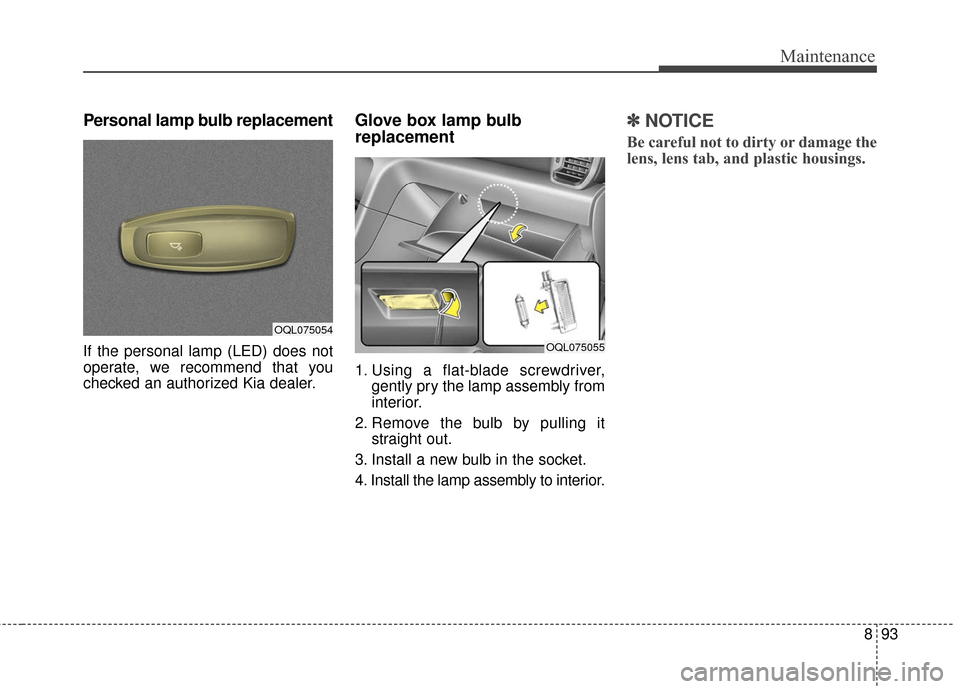
Personal lamp bulb replacement
If the personal lamp (LED) does not
operate, we recommend that you
checked an authorized Kia dealer.
Glove box lamp bulb
replacement
1. Using a flat-blade screwdriver,gently pry the lamp assembly from
interior.
2. Remove the bulb by pulling it straight out.
3. Install a new bulb in the socket.
4. Install the lamp assembly to interior.
✽ ✽ NOTICE
Be careful not to dirty or damage the
lens, lens tab, and plastic housings.
OQL075054
OQL075055
Page 562 of 595
Maintenance
94
8
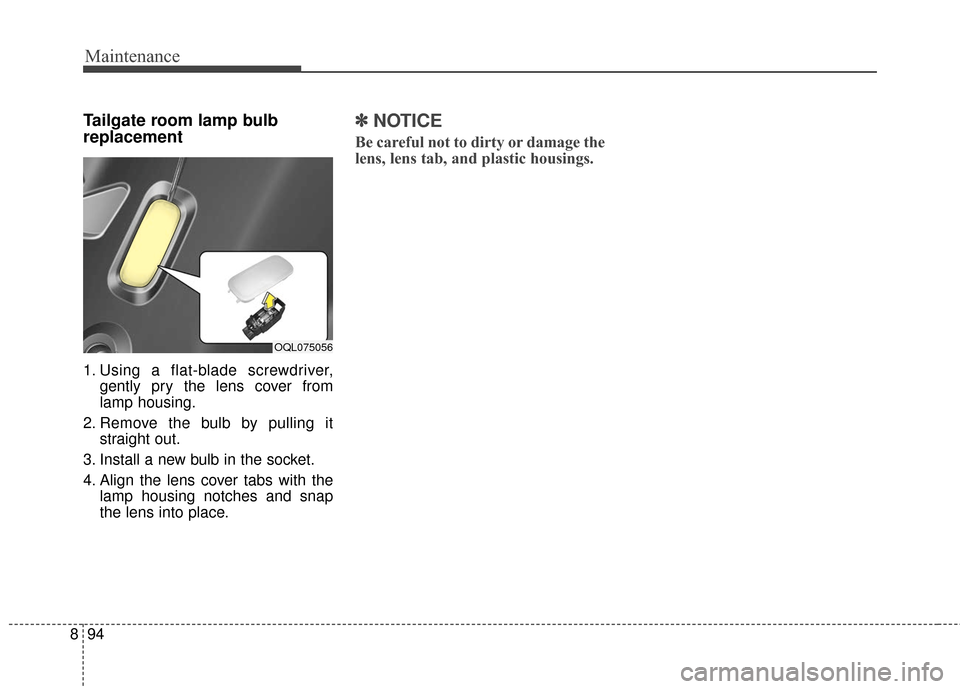
Tailgate room lamp bulb
replacement
1. Using a flat-blade screwdriver,
gently pry the lens cover from
lamp housing.
2. Remove the bulb by pulling it straight out.
3. Install a new bulb in the socket.
4. Align the lens cover tabs with the lamp housing notches and snap
the lens into place.
✽ ✽NOTICE
Be careful not to dirty or damage the
lens, lens tab, and plastic housings.
OQL075056
Page 578 of 595
49
Specifications & Consumer information
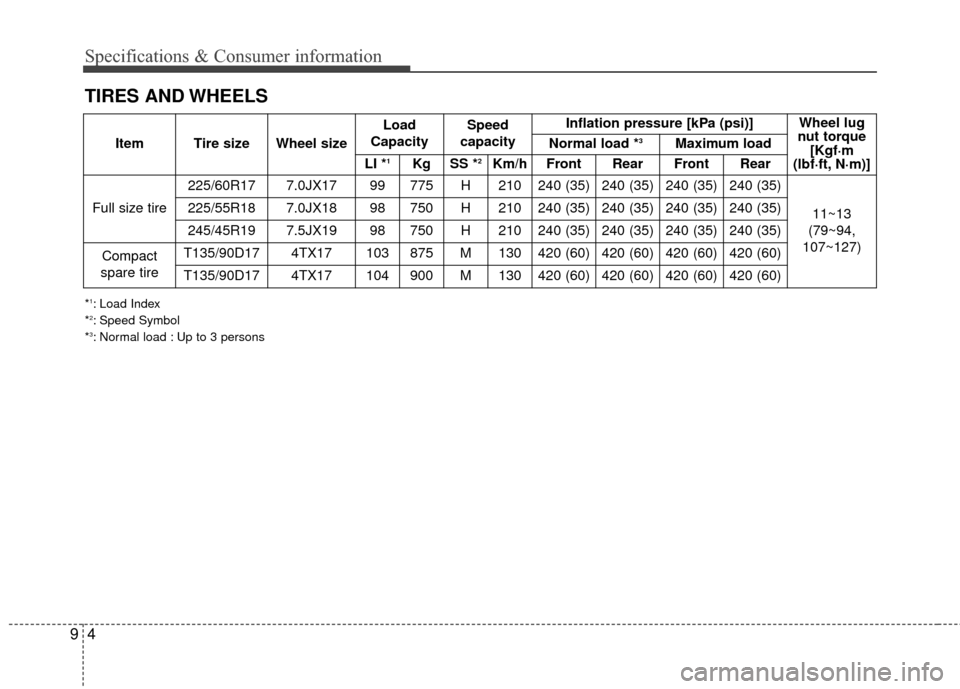
TIRES AND WHEELS
*1: Load Index
*2: Speed Symbol
*3: Normal load : Up to 3 persons
ItemTire sizeWheel size
Load
CapacitySpeed
capacityInflation pressure [kPa (psi)]Wheel lug
nut torque [Kgf·m
(lbf·ft, N·m)]
Normal load *3Maximum load
LI *1KgSS *2Km/hFront RearFront Rear
Full size tire
225/60R177.0JX1799775H210240 (35)240 (35)240 (35)240 (35)
11~13
(79~94,
107~127)225/55R187.0JX1898750H210240 (35)240 (35)240 (35)240 (35)
245/45R197.5JX1998750H210240 (35)240 (35)240 (35)240 (35)
Compact
spare tireT135/90D174TX17103875M130420 (60)420 (60)420 (60)420 (60)
T135/90D174TX17104900M130420 (60)420 (60)420 (60)420 (60)
Page 579 of 595
95
Specifications & Consumer information
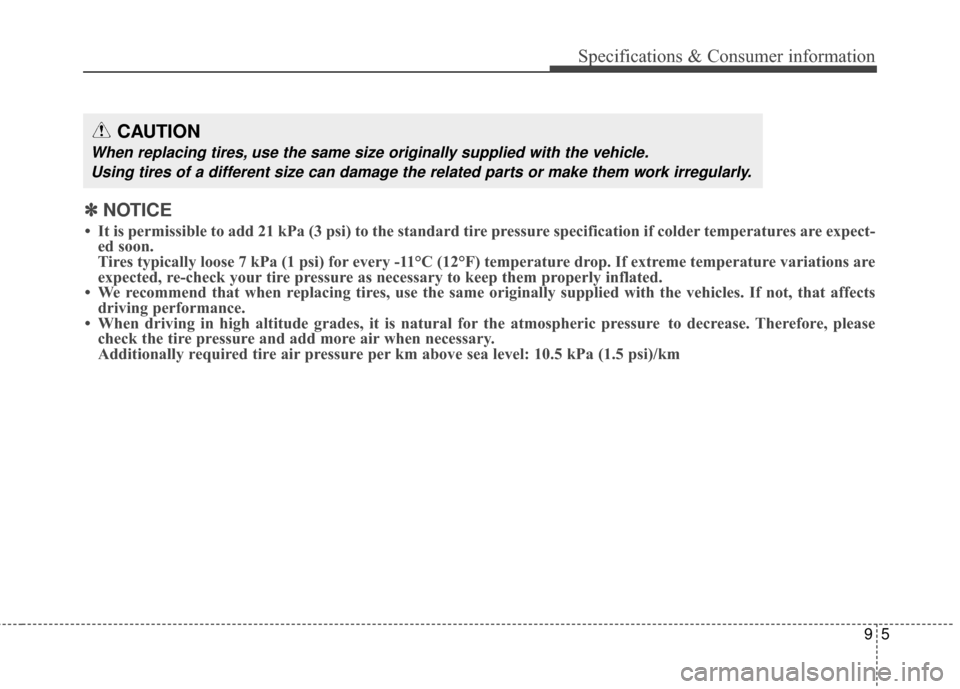
CAUTION
When replacing tires, use the same size originally supplied with the vehicle.Using tires of a different size can damage the related parts or make them work irregularly.
✽ ✽ NOTICE
• It is permissible to add 21 kPa (3 psi) to the standard tire pressure specification if colder temperatures are expect-
ed soon.
Tires typically loose 7 kPa (1 psi) for every -11°C (12°F) temperature drop. If extreme temperature variations are
expected, re-check your tire pressure as necessary to keep them properly inflated.
• We recommend that when replacing tires, use the same originally supplied with the vehicles. If not, that aff\
ects driving performance.
• When driving in high altitude grades, it is natural for the atmospheric pressure to decrease. Therefore, please check the tire pressure and add more air when necessary.
Additionally required tire air pressure per km above sea level: 10.5 kPa (1.5 psi)/km
Page 580 of 595
69
Specifications & Consumer information
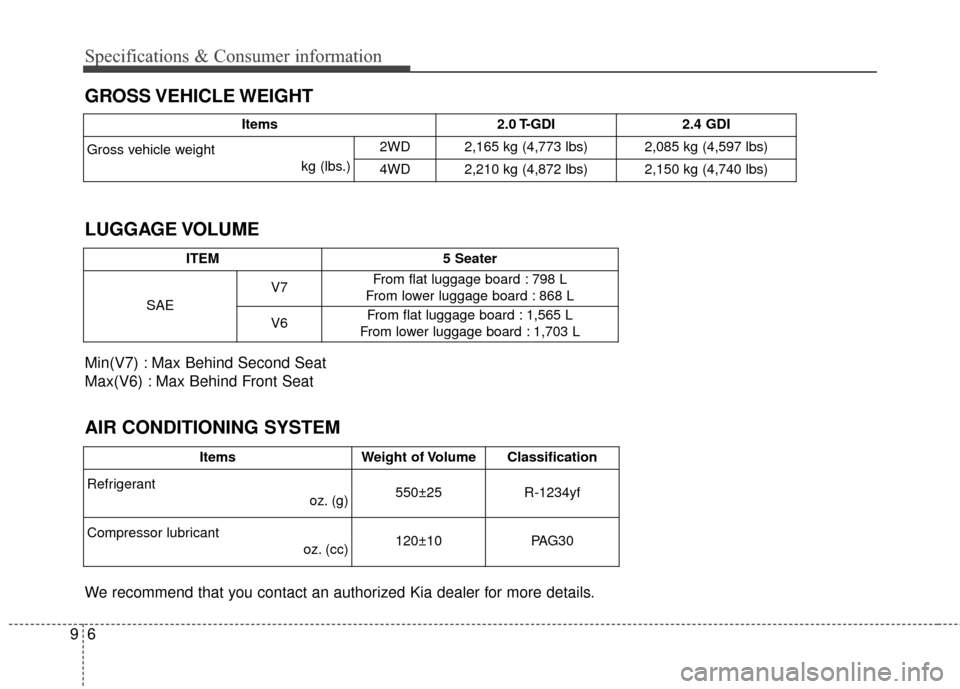
GROSS VEHICLE WEIGHT
AIR CONDITIONING SYSTEM LUGGAGE VOLUME
We recommend that you contact an authorized Kia dealer for more details. Min(V7) : Max Behind Second Seat
Max(V6) : Max Behind Front Seat
Items2.0 T-GDI2.4 GDI
Gross vehicle weightkg (lbs.)2WD2,165 kg (4,773 lbs)2,085 kg (4,597 lbs)
4WD2,210 kg (4,872 lbs)2,150 kg (4,740 lbs)
ITEM5 Seater
SAE
V7From flat luggage board : 798 L
From lower luggage board : 868 L
V6From flat luggage board : 1,565 L
From lower luggage board : 1,703 L
ItemsWeight of VolumeClassification
Refrigerant oz. (g)550±25R-1234yf
Compressor lubricantoz. (cc) 120±10PAG30
Page 587 of 595
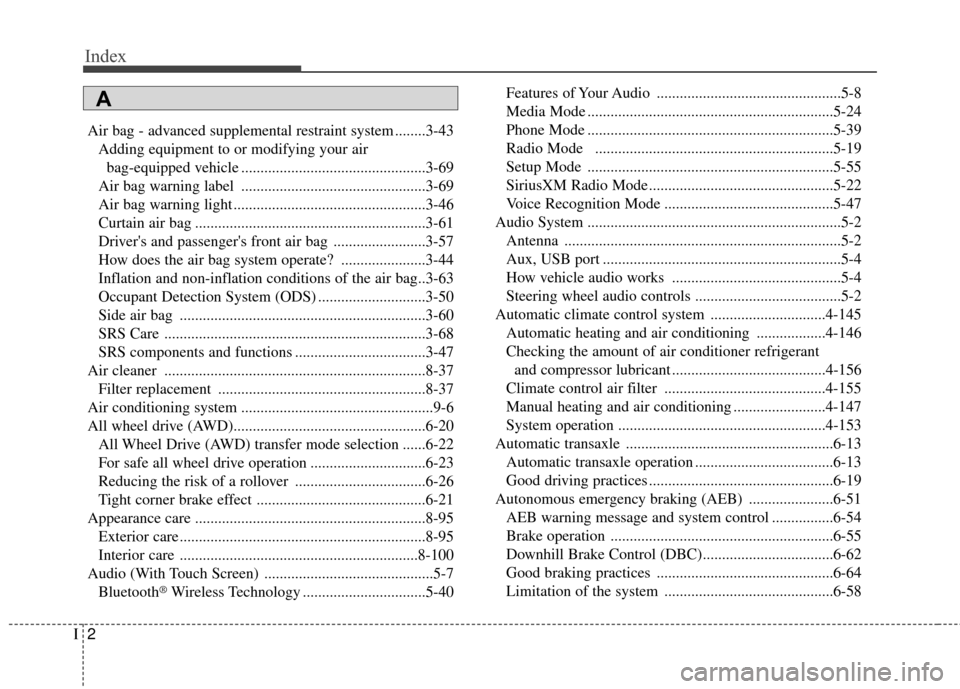
Index
2I
Air bag - advanced supplemental restraint system ........3-43Adding equipment to or modifying your airbag-equipped vehicle ................................................3-69
Air bag warning label ................................................3-69
Air bag warning light ..................................................3-46
Curtain air bag ............................................................3-61
Driver's and passenger's front air bag ........................3-57
How does the air bag system operate? ......................3-44
Inflation and non-inflation conditions of the air bag..3-63
Occupant Detection System (ODS) ............................3-50
Side air bag ................................................................3-60
SRS Care ....................................................................3-68\
SRS components and functions ..................................3-47
Air cleaner ....................................................................8-37\
Filter replacement ......................................................8-37
Air conditioning system ..................................................9-6
All wheel drive (AWD)..................................................6-20 All Wheel Drive (AWD) transfer mode selection ......6-22
For safe all wheel drive operation ..............................6-23
Reducing the risk of a rollover ..................................6-26
Tight corner brake effect ............................................6-21
Appearance care ............................................................8-95 Exterior care ................................................................8-95
Interior care ..............................................................8-100
Audio (With Touch Screen) ............................................5-7 Bluetooth
®Wireless Technology ................................5-40 Features of Your Audio ................................................5-8
Media Mode ................................................................5-24
Phone Mode ................................................................5-39
Radio Mode ..............................................................5-19
Setup Mode ................................................................5-55
SiriusXM Radio Mode ................................................5-22
Voice Recognition Mode ............................................5-47
Audio System ..................................................................5-2 Antenna ........................................................................\
5-2
Aux, USB port ..............................................................5-4
How vehicle audio works ............................................5-4
Steering wheel audio controls ......................................5-2
Automatic climate control system ..............................4-145 Automatic heating and air conditioning ..................4-146
Checking the amount of air conditioner refrigerant and compressor lubricant ........................................4-156
Climate control air filter ..........................................4-155
Manual heating and air conditioning ........................4-147
System operation ......................................................4-153
Automatic transaxle ......................................................6-13 Automatic transaxle operation ....................................6-13
Good driving practices ................................................6-19
Autonomous emergency braking (AEB) ......................6-51 AEB warning message and system control ................6-54
Brake operation ..........................................................6-55
Downhill Brake Control (DBC)..................................6-62
Good braking practices ..............................................6-64
Limitation of the system ............................................6-58
A
Page 590 of 595
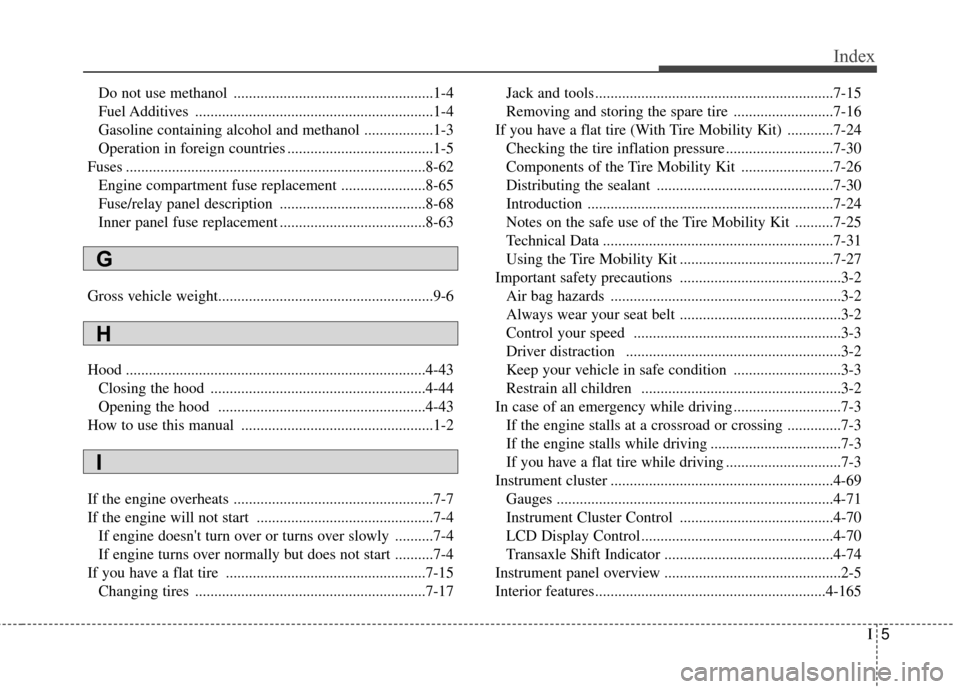
I5
Index
Do not use methanol ....................................................1-4
Fuel Additives ..............................................................1-4
Gasoline containing alcohol and methanol ..................1-3
Operation in foreign countries ......................................1-5
Fuses ........................................................................\
......8-62 Engine compartment fuse replacement ......................8-65
Fuse/relay panel description ......................................8-68
Inner panel fuse replacement ......................................8-63
Gross vehicle weight........................................................9-6\
Hood ........................................................................\
......4-43 Closing the hood ........................................................4-44
Opening the hood ......................................................4-43
How to use this manual ..................................................1-2
If the engine overheats ....................................................7-7
If the engine will not start ..............................................7-4 If engine doesn't turn over or turns over slowly ..........7-4
If engine turns over normally but does not start ..........7-4
If you have a flat tire ....................................................7-15 Changing tires ............................................................7-17 Jack and tools ..............................................................7-15
Removing and storing the spare tire ..........................7-16
If you have a flat tire (With Tire Mobility Kit) ............7-24 Checking the tire inflation pressure ............................7-30
Components of the Tire Mobility Kit ........................7-26
Distributing the sealant ..............................................7-30
Introduction ................................................................7-24
Notes on the safe use of the Tire Mobility Kit ..........7-25
Technical Data ............................................................7-31
Using the Tire Mobility Kit ........................................7-27
Important safety precautions ..........................................3-2 Air bag hazards ............................................................3-2
Always wear your seat belt ..........................................3-2
Control your speed ......................................................3-3
Driver distraction ........................................................3-2
Keep your vehicle in safe condition ............................3-3
Restrain all children ....................................................3-2
In case of an emergency while driving ............................7-3 If the engine stalls at a crossroad or crossing ..............7-3
If the engine stalls while driving ..................................7-3
If you have a flat tire while driving ..............................7-3
Instrument cluster ..........................................................4-69 Gauges ........................................................................\
4-71
Instrument Cluster Control ........................................4-70
LCD Display Control ..................................................4-70
Transaxle Shift Indicator ............................................4-74
Instrument panel overview ..............................................2-5
Interior features............................................................4-165
G
H
I