Head lights KIA SPORTAGE 2019 User Guide
[x] Cancel search | Manufacturer: KIA, Model Year: 2019, Model line: SPORTAGE, Model: KIA SPORTAGE 2019Pages: 607, PDF Size: 16.97 MB
Page 219 of 607
Features of your vehicle
132
4
WELCOME SYSTEM (IF EQUIPPED)
Headlight (Headlamp) escort
function
The headlights (and/or taillights)
remain on for approximately 5 min-
utes after the ignition key is removed
or turned to the ACC or LOCK posi-
tion. However, if the driver’s door is
opened and closed, the headlights
are turned off after 15 seconds.
The headlights can be turned off by
pressing the lock button on the trans-
mitter or smart key twice or turning
off the light switch from the headlight
or Auto light position.
Interior light
When the interior light switch is in the
DOOR position and all doors (and
trunk) are locked and closed, the
room lamp will come on for 30 sec-
onds if any of the below is performed.
Without smart key system
- When the door unlock button ispressed on the transmitter.
With the smart key system - When the door unlock button ispressed on the smart key.
- When the button of the outside door handle is pressed.
At this time, if you press the door lock
button, the lamps will turn off imme-
diately.
Pocket lamp (if equipped)
When all doors are locked and
closed, the pocket lamp will come on
for 15 seconds if any of the below is
performed.
With the smart key system - When the door unlock button ispressed on the smart key.
- When the button of the outside door handle is pressed.
At this time, if you press the door lock
button, the lamps will turn off imme-
diately.
Page 411 of 607
683
Driving your vehicle
Conditions that cause missed
warnings and false warnings:
The lane is not visible due to snow,rain, debris, puddles or other envi-
ronmental conditions.
The brightness outside changes suddenly such as when
entering/exiting a tunnel.
The headlights are off at night or the vehicle is in a tunnel.
The color of the lane marking from the road is difficult to distinguish.
Driving on a steep grade or a curve.
Light such as street lights, sunlight or oncoming vehicle lights reflect
off of water on the road.
The lens or windshield is obscured by debris.
The sensor cannot detect the lane because of fog, heavy rain or
heavy snow.
The rear view mirror housing has overheated from exposure to direct
sunlight.
The lane is very wide or narrow. The lane line is damaged or indis-
tinct.
The windshield is fogged up by humidity.
Objects in the median or along the side of the road cast shadows over
the lane markings
The sensor cannot distinguish the lane from the road due to the
dust/dirt.
There are other markings similar to lane lines.
There are lane boundaries instead of markings.
The vehicle ahead is very close, obscuring the view of the lane
markings, or the vehicle ahead is
driving over the lane markings.
The vehicle vibrates heavily due to poor road conditions.
The lanes are merging, expanding, or otherwise overlapping
Something reflective is placed on the dashboard. Driving with the sun in front of you.
Driving in areas under construc-
tion.
Lanes are marked by more than two sets of lines.
The windshield is fogged by humid air in the vehicle.
This device complies with Part 15
of the FCC rules.
Operation is subject to the following
two conditions:
1. This device may not cause harm- ful interference, and
2. This device must accept any inter- ference received, including inter-
ference that may cause undesired
operation.
Page 417 of 607
689
Driving your vehicle
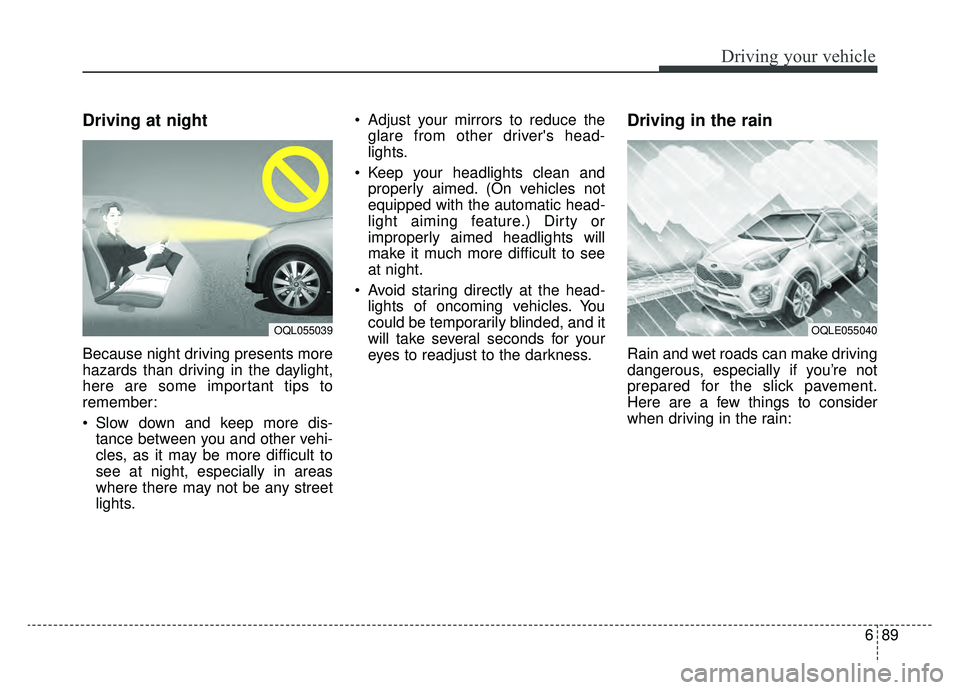
Driving at night
Because night driving presents more
hazards than driving in the daylight,
here are some important tips to
remember:
Slow down and keep more dis-tance between you and other vehi-
cles, as it may be more difficult to
see at night, especially in areas
where there may not be any street
lights. Adjust your mirrors to reduce the
glare from other driver's head-
lights.
Keep your headlights clean and properly aimed. (On vehicles not
equipped with the automatic head-
light aiming feature.) Dirty or
improperly aimed headlights will
make it much more difficult to see
at night.
Avoid staring directly at the head- lights of oncoming vehicles. You
could be temporarily blinded, and it
will take several seconds for your
eyes to readjust to the darkness.
Driving in the rain
Rain and wet roads can make driving
dangerous, especially if you’re not
prepared for the slick pavement.
Here are a few things to consider
when driving in the rain:
OQL055039OQLE055040
Page 418 of 607
Driving your vehicle
90
6
A heavy rainfall will make it harder
to see and will increase the dis-
tance needed to stop your vehicle,
so slow down.
Keep your windshield wiping equipment in good shape. Replace
your windshield wiper blades when
they show signs of streaking or
missing areas on the windshield.
If your tires are not in good condi- tion, making a quick stop on wet
pavement can cause a skid and
possibly lead to an accident. Be
sure your tires are in good shape.
Turn on your headlights to make it easier for others to see you.
Driving too fast through large pud- dles can affect your brakes. If you
must go through puddles, try to
drive through them slowly.
If you believe you may have gotten your brakes wet, apply them lightly
while driving until normal braking
operation returns.Driving in flooded areas
Avoid driving through flooded areas
unless you are sure the water is no
higher than the bottom of the wheel
hub. Drive through any water slowly.
Allow adequate stopping distance
because brake performance may be
affected.
After driving through water, dry the
brakes by gently applying them sev-
eral times while the vehicle is moving
slowly.
Driving off-road
Drive carefully off-road because your
vehicle may be damaged by rocks or
roots of trees. Become familiar with
the off-road conditions where you
are going to drive before you begin
driving.
Highway driving
Tires
Adjust the tire inflation pressures to
specification. Low tire inflation pres-
sures will result in overheating and
possible failure of the tires.
Avoid using worn or damaged tires
which may result in reduced traction
or tire failure.
Never exceed the maximum tire
inflation pressure shown on the tires.
WARNING- Under/over
inflated tires
Always check the tires for proper
inflation before driving.
Underinflated or overinflated
tires can cause poor handling,
loss of vehicle control, and sud-
den tire failure leading to acci-
dents, injuries, and even death.
For proper tire pressures, refer to
“Tires and wheels” in chapter 9.
Page 426 of 607
Driving your vehicle
98
6
Driving with a trailer
Towing a trailer requires a certain
amount of experience. Before setting
out for the open road, you must get
to know your trailer. Acquaint your-
self with the feel of handling and
braking with the added weight of the
trailer. And always keep in mind that
the vehicle you are driving is now a
good deal longer and not nearly so
responsive as your vehicle is by
itself.
Before you start, check the trailer
hitch and platform, safety chains,
electrical connector(s), lights, tires
and mirror adjustment. If the trailer
has electric brakes, start your vehicle
and trailer moving and then apply the
trailer brake controller by hand to be
sure the brakes are working. This lets
you check your electrical connection
at the same time.
During your trip, check occasionally
to be sure that the load is secure,
and that the lights and any trailer
brakes are still working.
Following distance
Stay at least twice as far behind the
vehicle ahead as you would when
driving your vehicle without a trailer.
This can help you avoid situations
that require heavy braking and sud-
den turns.
Passing
You’ll need more passing distance
up ahead when you’re towing a trail-
er. And, because of the increased
vehicle length, you’ll need to go
much farther beyond the passed
vehicle before you can return to your
lane. Due to the added load to the
engine when going uphill the vehicle
may also take longer to pass than it
would on flat ground.
Backing up
Hold the bottom of the steering
wheel with one hand. Then, to move
the trailer to the left, just move your
hand to the left. To move the trailer to
the right, move your hand to the
right. Always back up slowly and, if
possible, have someone guide you.
Making turns
When you’re turning with a trailer,
make wider turns than normal. Do
this so your trailer won’t strike soft
shoulders, curbs, road signs, trees,
or other objects near the edge of the
road. Avoid jerky or sudden maneu-
vers. Signal well in advance before
turning or lane changes.
Page 480 of 607
87
Maintenance
At least monthly:
Check the coolant level in theengine coolant reservoir.
Check the operation of all exterior lights, including the stoplights, turn
signals and hazard warning flash-
ers.
Check the inflation pressures of all tires including the spare.
At least twice a year
(i.e., every Spring and Fall) :
Check the radiator, heater and air conditioning hoses for leaks or
damage.
Check the windshield washer spray and wiper operation. Clean
the wiper blades with clean cloth
dampened with washer fluid.
Check the headlight alignment.
Check the muffler, exhaust pipes, shields and clamps.
Check the lap/shoulder belts for wear and function.
Check for worn tires and loose wheel lug nuts.
At least once a year :
Clean the body and door drainholes.
Lubricate the door hinges and check the hood hinges.
Lubricate the door and hood locks and latches.
Lubricate the door rubber weather- strips.
Check the air conditioning system.
Inspect and lubricate automatic transaxle linkage and controls.
Clean the battery and terminals.
Check the brake fluid level.
Page 550 of 607
877
Maintenance
LIGHT BULBS
Bulb replacement precaution
Please keep extra bulbs on hand
with appropriate wattage ratings in
case of emergencies.
Refer to “Bulb Wattage” in chapter 9.
When changing lamps, first turn off
the engine at a safe place, firmly
apply the parking brake and detach
the battery’s negative (-) terminal.
Use only bulbs of the specifiedwattage.✽ ✽ NOTICE
• If the light bulb or lamp connector
is removed while the lamp is still
on, the fuse box's electronic sys-
tem may log it as a malfunction.
Therefore, a lamp malfunction
incident may be recorded as a
Diagnostic Trouble Code (DTC) in
the fuse box.
• It is normal for an operating lamp to flicker momentarily. This is due
to a stabilization function of the
vehicle’s electronic control device.
If the lamp lights up normally
after momentarily blinking, then
it is functioning as normal.
However, if the lamp continues to
flicker several times or turns off
completely, there may be an error
in the vehicle’s electronic control
device. Please have the vehicle
checked by an authorized Kia
dealer immediately.
WARNING- Working on
the lights
Prior to working on the light,
firmly apply the parking brake,
ensure that the ignition switch
is turned to the LOCK position
and turn off the lights to avoid
sudden movement of the vehi-
cle and burning your fingers or
receiving an electric shock.
CAUTION -Light replace-
ment
Be sure to replace the burned- out bulb with one of the samewattage rating. Otherwise, itmay cause damage to the fuseor electric wiring system.
CAUTION -Headlamp
Lens
To prevent damage, do notclean the headlamp lens withchemical solvents or strongdetergents.
Page 551 of 607
Maintenance
78
8
If you don’t have the necessary tools,
the correct bulbs and the expertise,
consult an authorized Kia dealer. In
many cases, it is difficult to replace
vehicle light bulbs because other
parts of the vehicle must be removed
before you can get to the bulb. This is
especially true if you have to remove
the headlamp assembly to get to the
bulb(s).
Removing/installing the headlamp
assembly can result in damage to
the vehicle.
If non-genuine parts or substandard
bulbs are used, it may lead to blow-
ing a fuse or other wiring damages.
Do not install extra lamps or LEDs to
the vehicle. If additional lights are
installed, it may lead to lamp mal-
functions and flickering. Additionally,
the fuse box and other writing may
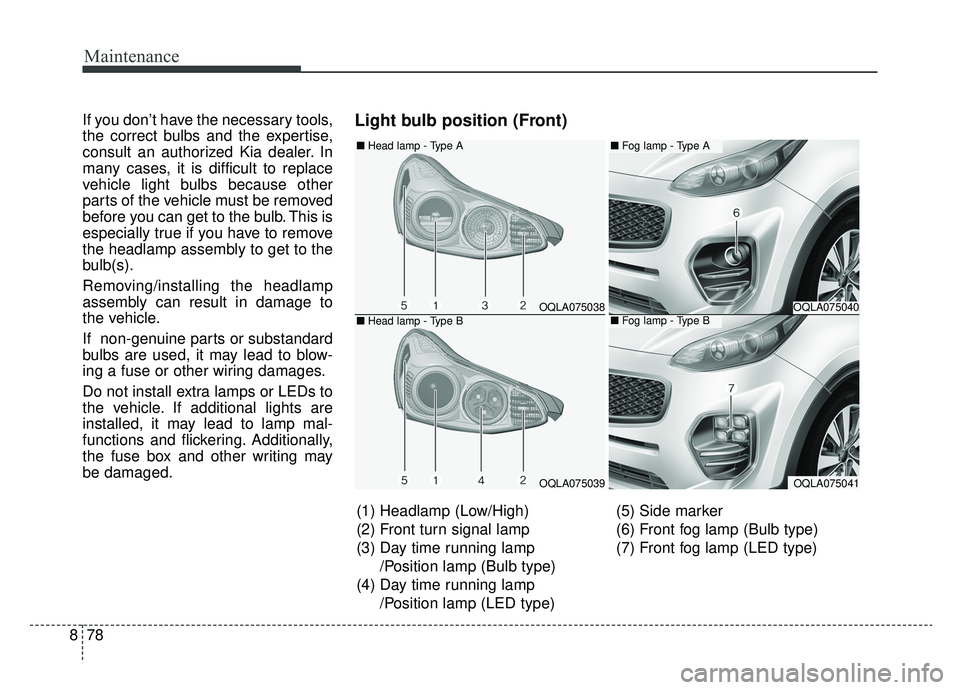
be damaged.Light bulb position (Front)
OQLA075038
OQLA075039
■ Head lamp - Type A
■Head lamp - Type BOQLA075040
OQLA075041
■Fog lamp - Type A
■Fog lamp - Type B
(1) Headlamp (Low/High)
(2) Front turn signal lamp
(3) Day time running lamp
/Position lamp (Bulb type)
(4) Day time running lamp /Position lamp (LED type) (5) Side marker
(6) Front fog lamp (Bulb type)
(7) Front fog lamp (LED type)
Page 599 of 607
 bulbreplacement ............................................................\
....8-83
Front seat adjustment (manual) ......................................")
I7
Index
Front fog lamp (Bulb and LED type) bulbreplacement ............................................................\
....8-83
Front seat adjustment (manual) ......................................3-7
Front seat adjustment (power) ........................................3-9
Front turn signal lamp bulb replacement ......................8-82
Fuel Economy ................................................................4-83
Fuel filler lid ..................................................................4-45
Fuel Gauge ....................................................................4-71\
Fuel requirements ............................................................1-2
Fuses ........................................................................\
......8-59 Inner panel fuse replacement ......................................8-60
Engine compartment fuse replacement ......................8-62
Fuse/relay panel description ......................................8-65
Gauges ........................................................................\
..4-70
Glove box ....................................................................4-16\
1
Glove box lamp bulb replacement ................................8-90
Gross vehicle weight........................................................9-6\
Hazard warning flasher ....................................................7-2
Hazardous driving conditions ........................................6-86
Headlamp (HID type) bulb replacement ......................8-80
Headlamp (High/Low beam) bulb replacement ............8-81
Headlight (Headlamp) escort function ........................4-132 Headlight position........................................................4-119
Headrest (rear) ..............................................................3-14
Headrest(front) ..............................................................3-11
Heated steering wheel....................................................4-56
High - beam operation ................................................4-120
High mounted stop lamp bulb replacement ..................8-87
Highway driving ............................................................6-89
Hill-start assist control (HAC) ......................................6-49
Hood ........................................................................\
......4-43
Horn ........................................................................\
......4-57
How to use this manual ..................................................1-2
Ignition switch illumination ............................................6-6
Ignition switch position ..................................................6-6
Immobilizer system (folding key) ..................................4-9
Indicator Lights............................................................4-103
Inflation conditions (Air bags) ......................................3-64
Inside rearview mirror ..................................................4-58
Instrument cluster ..........................................................4-68
Instrument Cluster Control ........................................4-69
LCD Display Control ..................................................4-69
Gauges ........................................................................\
4-70
LCD Display ..............................................................4-74
LCD Modes ................................................................4-74
Service Mode ..............................................................4-75
User settings mode ......................................................4-77
H
G
I
Page 606 of 607

Index
14I
Transaxle shift indicator ................................................4-73
Trip A/B ........................................................................\
4-85
Trip computer ................................................................4-83
Trip interruption ............................................................9-13
Trip modes ....................................................................4-83\
Turn By Turn Mode ......................................................4-87
Turn signals..................................................................4-123
USB charger ................................................................4-168
User settings mode ........................................................4-77
Using the Tire Mobility Kit ..........................................7-27
Vanity mirror lamp ......................................................4-131
Vanity mirror lamp bulb replacement ............................8-88
Vehicle break-in process ..................................................1-5
Vehicle certification label ..............................................9-10
Vehicle data collection and event data recorders ............1-6
Vehicle handling instructions ..........................................1-5
Vehicle identification number (VIN) ............................9-10
Vehicle load limit ........................................................6-104Tire and loading information label ..........................6-104
Certification label......................................................6-108
Vehicle stability management (VSM) ..........................6-48
Vehicle weight ............................................................6-109 Warning and Indicator lights ........................................4-96
Warning lights ................................................................4-96
Warning Messages ........................................................4-88
Washer fluid ..................................................................8-33
Checking the washer fluid level..................................8-33
Welcome system ..........................................................4-132 Headlight (Headlamp) escort function......................4-132
Wheel alignment and tire balance ................................8-47
Wheel replacement ........................................................8-49
Windows ........................................................................\
4-38 Power window lock button ........................................4-41
Windshield defrosting and defogging..........................4-156
Windshield washers ....................................................4-126
Windshield wipers ......................................................4-125
Winter driving ................................................................6-92 Snow tires....................................................................6-92\
Tire chains ..................................................................6-93
Wiper blades ..................................................................8-38 Blade inspection ..........................................................8-38
Blade replacement ......................................................8-39
Wipers and washers ....................................................4-125 Windshield wipers ....................................................4-125
Windshield washers ..................................................4-126
Rear window wiper and washer................................4-127
Wireless smart phone charging system ......................4-169
U
V
W