fuel KIA STINGER 2019 Repair Manual
[x] Cancel search | Manufacturer: KIA, Model Year: 2019, Model line: STINGER, Model: KIA STINGER 2019Pages: 555, PDF Size: 13.49 MB
Page 534 of 555
7103
Maintenance
Your vehicle is equipped with a cat-
alytic converter emission control
device.
Therefore, the following precautions
must be observed:
Use only UNLEADED FUEL forgasoline engines.
Do not operate the vehicle when there are signs of engine malfunc-
tion, such as misfire or a noticeable
loss of performance.
Do not misuse or abuse the engine. Examples of misuse are
coasting with the ignition off and
descending steep grades in gear
with the ignition off.
Do not operate the engine at high idle speed for extended periods (5
minutes or more).
Do not modify or tamper with any part of the engine or emission con-
trol system. All inspections and
adjustments must be made by an
authorized Kia dealer.
Avoid driving with an extremely low fuel level. Running out of fuel could
cause the engine to misfire, dam-
aging the catalytic converter. Failure to observe these precautions
could result in damage to the catalyt-
ic converter and to your vehicle.
Additionally, such actions could void
your warranties.
Page 541 of 555
87
Specifications & Consumer information
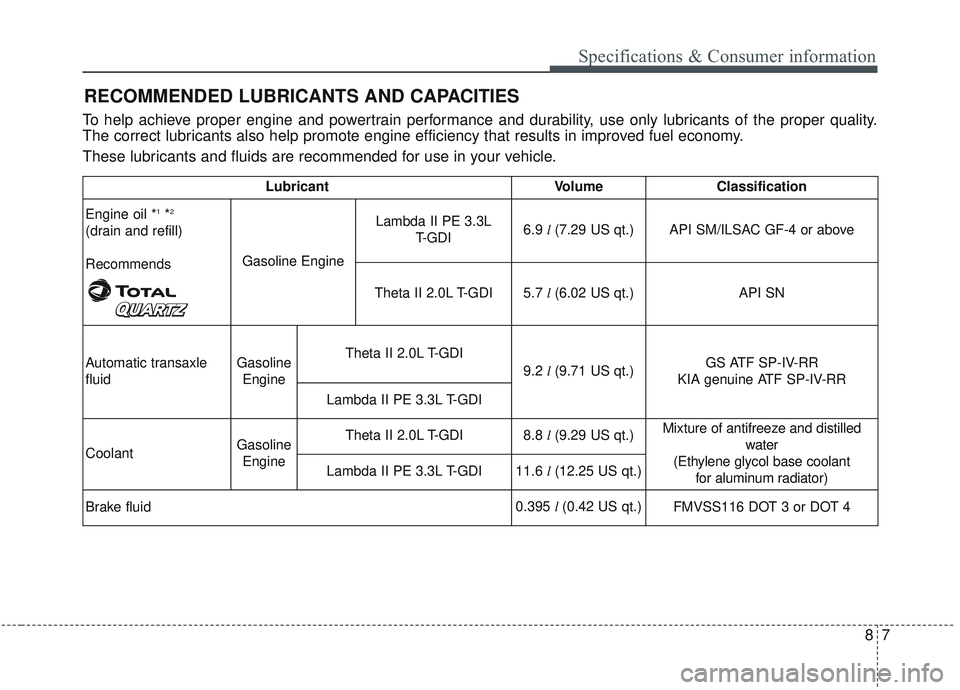
RECOMMENDED LUBRICANTS AND CAPACITIES
To help achieve proper engine and powertrain performance and durability, use only lubricants of the proper quality.
The correct lubricants also help promote engine efficiency that results in improved fuel economy.
These lubricants and fluids are recommended for use in your vehicle.
Lubricant VolumeClassification
Engine oil *1*2
(drain and refill)
Recommends
Gasoline Engine
Lambda II PE 3.3L T-GDI6.9 l (7.29 US qt.)API SM/ILSAC GF-4 or above
Theta II 2.0L T-GDI5.7 l (6.02 US qt.)API SN
Automatic transaxle
fluidGasoline
Engine Theta II 2.0L T-GDI
9.2 l (9.71 US qt.)GS ATF SP-IV-RR
KIA genuine ATF SP-IV-RR
Lambda II PE 3.3L T-GDI
CoolantGasoline EngineTheta II 2.0L T-GDI8.8 l (9.29 US qt.)Mixture of antifreeze and distilled
water
(Ethylene glycol base coolant for aluminum radiator)
Lambda II PE 3.3L T-GDI11.6 l (12.25 US qt.)
Brake fluid0.395 l (0.42 US qt.)FMVSS116 DOT 3 or DOT 4
Page 542 of 555
88
Specifications & Consumer information
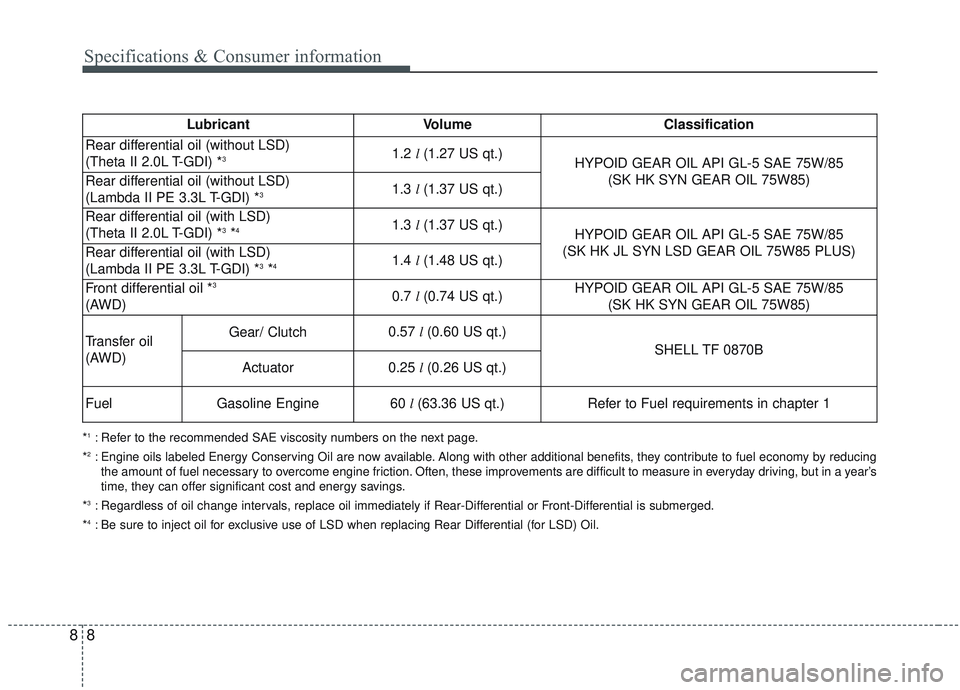
Lubricant VolumeClassification
Rear differential oil (without LSD)
(Theta II 2.0L T-GDI) *31.2 l (1.27 US qt.)HYPOID GEAR OIL API GL-5 SAE 75W/85
(SK HK SYN GEAR OIL 75W85)
Rear differential oil (without LSD)
(Lambda II PE 3.3L T-GDI) *31.3 l (1.37 US qt.)
Rear differential oil (with LSD)
(Theta II 2.0L T-GDI) *3*41.3 l (1.37 US qt.)HYPOID GEAR OIL API GL-5 SAE 75W/85
(SK HK JL SYN LSD GEAR OIL 75W85 PLUS)
Rear differential oil (with LSD)
(Lambda II PE 3.3L T-GDI) *3*41.4 l (1.48 US qt.)
Front differential oil *3
(AWD)0.7 l (0.74 US qt.)HYPOID GEAR OIL API GL-5 SAE 75W/85
(SK HK SYN GEAR OIL 75W85)
Transfer oil
(AWD)Gear/ Clutch0.57 l (0.60 US qt.)
SHELL TF 0870B
Actuator0.25 l (0.26 US qt.)
FuelGasoline Engine60 l (63.36 US qt.)Refer to Fuel requirements in chapter 1
*1: Refer to the recommended SAE viscosity numbers on the next page.
*2: Engine oils labeled Energy Conserving Oil are now available. Along with other additional benefits, they contribute to fuel economy by reducing the amount of fuel necessary to overcome engine friction. Often, these improvements are difficult to measure in everyday driving, but in a year’s
time, they can offer significant cost and energy savings.
*
3: Regardless of oil change intervals, replace oil immediately if Rear-Differential or Front-Differential is submerged.
*4: Be sure to inject oil for exclusive use of LSD when replacing Rear Differential (for LSD) Oil.
Page 543 of 555
89
Specifications & Consumer information
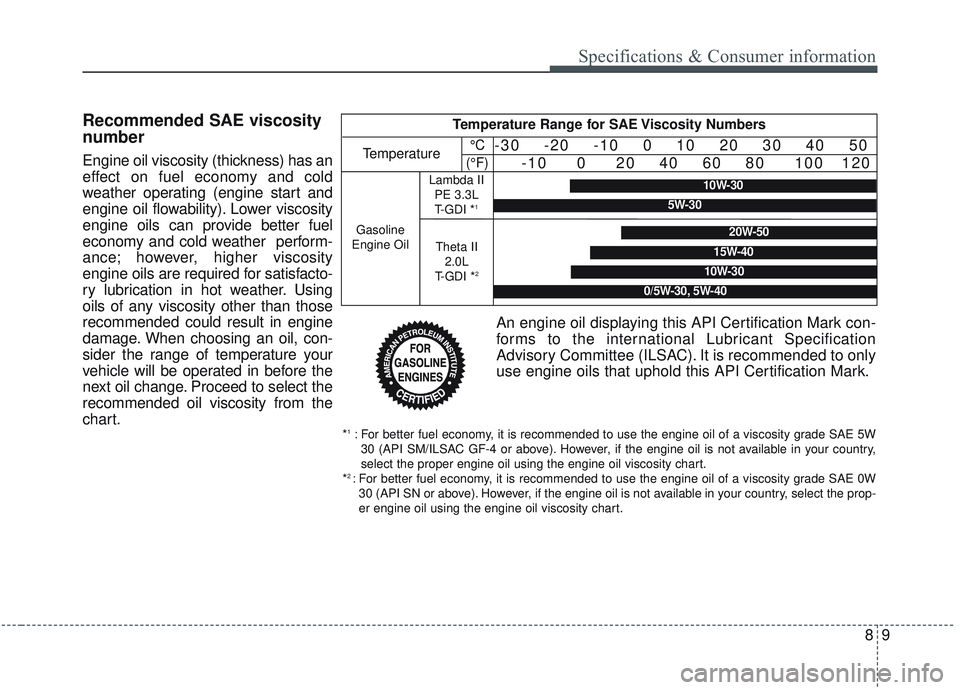
Recommended SAE viscosity
number
Engine oil viscosity (thickness) has an
effect on fuel economy and cold
weather operating (engine start and
engine oil flowability). Lower viscosity
engine oils can provide better fuel
economy and cold weather perform-
ance; however, higher viscosity
engine oils are required for satisfacto-
ry lubrication in hot weather. Using
oils of any viscosity other than those
recommended could result in engine
damage. When choosing an oil, con-
sider the range of temperature your
vehicle will be operated in before the
next oil change. Proceed to select the
recommended oil viscosity from the
chart.
An engine oil displaying this API Certification Mark con-
forms to the international Lubricant Specification
Advisory Committee (ILSAC). It is recommended to only
use engine oils that uphold this API Certification Mark.
Temperature Range for SAE Viscosity Numbers
Temperature°C
(°F)-30 -20 -10 0 10 20 30 40 50 -10 0 20 40 60 80 100 120
Gasoline
Engine Oil
Lambda II PE 3.3L T-GDI *
1
Theta II 2.0L
T-GDI *
2
20W-50
10W-30
15W-40
0/5W-30, 5W-40
*1: For better fuel economy, it is recommended to use the engine oil of a viscosity grade SAE 5W 30 (API SM/ILSAC GF-4 or above). However, if the engine oil is not available in your country,
select the proper engine oil using the engine oil viscosity chart.
*
2 : For better fuel economy, it is recommended to use the engine oil of a viscosity grade SAE 0W 30 (API SN or above). However, if the engine oil is not available in your country, select the prop-
er engine oil using the engine oil viscosity chart.
10W-30
5W-30
Page 549 of 555
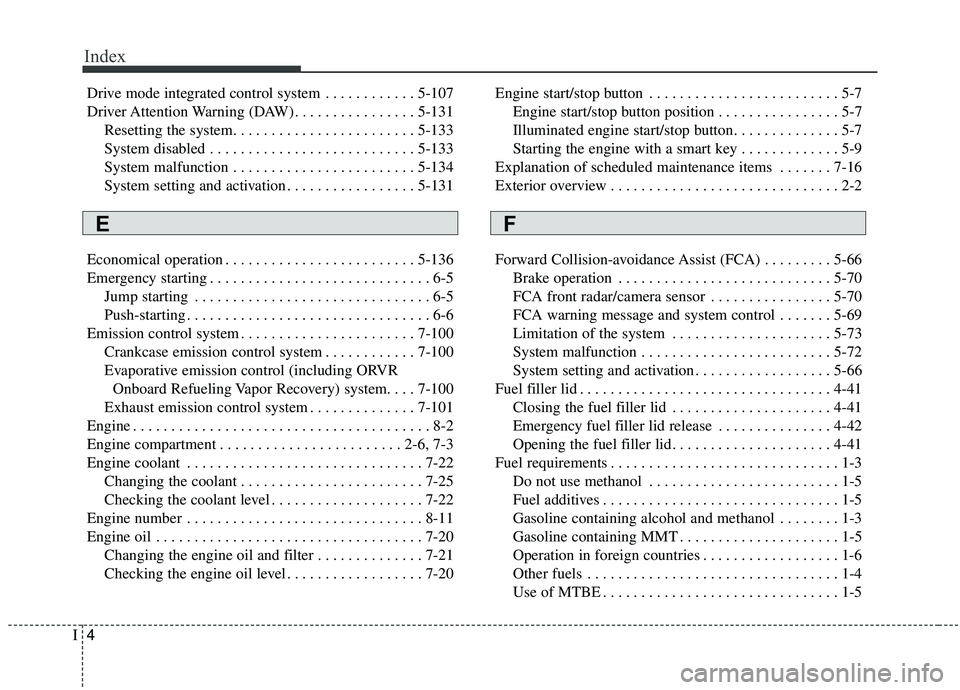
Index
4I
Drive mode integrated control system . . . . . . . . . . . . 5-107
Driver Attention Warning (DAW). . . . . . . . . . . . . . . . 5-131Resetting the system. . . . . . . . . . . . . . . . . . . . . . . . 5-133
System disabled . . . . . . . . . . . . . . . . . . . . . . . . . . . 5-133
System malfunction . . . . . . . . . . . . . . . . . . . . . . . . 5-134
System setting and activation . . . . . . . . . . . . . . . . . 5-131
Economical operation . . . . . . . . . . . . . . . . . . . . . . . . . 5-136
Emergency starting . . . . . . . . . . . . . . . . . . . . . . . . . . . . . 6-5 Jump starting . . . . . . . . . . . . . . . . . . . . . . . . . . . . . . . 6-5
Push-starting . . . . . . . . . . . . . . . . . . . . . . . . . . . . . . . . 6-6
Emission control system . . . . . . . . . . . . . . . . . . . . . . . 7-100 Crankcase emission control system . . . . . . . . . . . . 7-100
Evaporative emission control (including ORVR Onboard Refueling Vapor Recovery) system. . . . 7-100
Exhaust emission control system . . . . . . . . . . . . . . 7-101
Engine . . . . . . . . . . . . . . . . . . . . . . . . . . . . . . . . . . . . \
. . . 8-2
Engine compartment . . . . . . . . . . . . . . . . . . . . . . . . 2-6, 7-3
Engine coolant . . . . . . . . . . . . . . . . . . . . . . . . . . . . . . . 7-22 Changing the coolant . . . . . . . . . . . . . . . . . . . . . . . . 7-25
Checking the coolant level . . . . . . . . . . . . . . . . . . . . 7-22
Engine number . . . . . . . . . . . . . . . . . . . . . . . . . . . . . . . 8-11
Engine oil . . . . . . . . . . . . . . . . . . . . . . . . . . . . . . . . . . . 7-\
20 Changing the engine oil and filter . . . . . . . . . . . . . . 7-21
Checking the engine oil level . . . . . . . . . . . . . . . . . . 7-20 Engine start/stop button . . . . . . . . . . . . . . . . . . . . . . . . . 5-7
Engine start/stop button position . . . . . . . . . . . . . . . . 5-7
Illuminated engine start/stop button. . . . . . . . . . . . . . 5-7
Starting the engine with a smart key . . . . . . . . . . . . . 5-9
Explanation of scheduled maintenance items . . . . . . . 7-16
Exterior overview . . . . . . . . . . . . . . . . . . . . . . . . . . . . . . 2-2
Forward Collision-avoidance Assist (FCA) . . . . . . . . . 5-66 Brake operation . . . . . . . . . . . . . . . . . . . . . . . . . . . . 5-70
FCA front radar/camera sensor . . . . . . . . . . . . . . . . 5-70
FCA warning message and system control . . . . . . . 5-69
Limitation of the system . . . . . . . . . . . . . . . . . . . . . 5-73
System malfunction . . . . . . . . . . . . . . . . . . . . . . . . . 5-72
System setting and activation . . . . . . . . . . . . . . . . . . 5-66
Fuel filler lid . . . . . . . . . . . . . . . . . . . . . . . . . . . . . . . . . 4-41 Closing the fuel filler lid . . . . . . . . . . . . . . . . . . . . . 4-41
Emergency fuel filler lid release . . . . . . . . . . . . . . . 4-42
Opening the fuel filler lid. . . . . . . . . . . . . . . . . . . . . 4-41
Fuel requirements . . . . . . . . . . . . . . . . . . . . . . . . . . . . . . 1-3 Do not use methanol . . . . . . . . . . . . . . . . . . . . . . . . . 1-5
Fuel additives . . . . . . . . . . . . . . . . . . . . . . . . . . . . . . . 1-5
Gasoline containing alcohol and methanol . . . . . . . . 1-3
Gasoline containing MMT . . . . . . . . . . . . . . . . . . . . . 1-5
Operation in foreign countries . . . . . . . . . . . . . . . . . . 1-6
Other fuels . . . . . . . . . . . . . . . . . . . . . . . . . . . . . . . . . 1-4
Use of MTBE . . . . . . . . . . . . . . . . . . . . . . . . . . . . . . . 1-5
EF