weight KIA VENGA 2013 Owner's Guide
[x] Cancel search | Manufacturer: KIA, Model Year: 2013, Model line: VENGA, Model: KIA VENGA 2013Pages: 751, PDF Size: 27.49 MB
Page 623 of 751
This section will guide you in the proper
loading of your vehicle and/or trailer, to
keep your loaded vehicle weight within its
design rating capability, with or without a
trailer. Properly loading your vehicle will
provide maximum return of the vehicle
design performance. Before loading your
vehicle, familiarize yourself with the fol-
lowing terms for determining your vehi-
cle's weight ratings, with or without a
trailer, from the vehicle's specifications
and the certification label: Base curb weight
This is the weight of the vehicle including a full tank of fuel and all standard equip-
ment. It does not include passengers,
cargo, or optional equipment.
Vehicle curb weight
This is the weight of your new vehicle
when you picked it up from your dealer
plus any aftermarket equipment.Cargo weight
This figure includes all weight added to
the Base Curb Weight, including cargoand optional equipment.
GAW (Gross axle weight)
This is the total weight placed on each
axle (front and rear) - including vehicle
curb weight and all payload.
GAWR (Gross axle weight rating)
This is the maximum allowable weight
that can be carried by a single axle (front
or rear). These numbers are shown on
the certification label.
The total load on each axle must never
exceed its GAWR.
GVW (Gross vehicle weight)
This is the Base Curb Weight plus actual
Cargo Weight plus passengers.
GVWR (Gross vehicle weight rating)
This is the maximum allowable weight of
the fully loaded vehicle (including all
options, equipment, passengers and
cargo). The GVWR is shown on the cer-
tification label located on the driver’s (or
front passenger’s) door sill. Overloading
VEHICLE WEIGHTWARNING -
Vehicle weight
The gross axle weight rating
(GAWR) and the gross vehicle
weight rating (GVWR) for your vehi-
cle are on the certification label
attached to the driver's (or front
passenger’s) door. Exceeding theseratings can cause an accident or
vehicle damage. You can calculate
the weight of your load by weighing
the items (and people) before put-
ting them in the vehicle. Be careful
not to overload your vehicle.
560
Driving your vehicle
YN RHD 5.QXP 3/31/2012 4:08 PM Page 60
Page 642 of 751
619
What to do in an emergency
Notes on the safe use of the Tyre Mobility Kit
Park your car at the side of theroad so that you can work with the
Tyre Mobility Kit away from moving
traffic. Place your warning triangle
in a prominent place to make pass-
ing vehicles aware of your location.
To be sure your vehicle won't move, even when you're on fairly
level ground, always set your park-
ing brake.
Only use the Tyre Mobility Kit for sealing/inflation passenger car
tyres. Do not use on motorcycles,
bicycles or any other type of tyres.
Do not remove any foreign objects- such as nails or screws -that have
penetrated the tyre.
Before using the Tyre Mobility Kit, read the precautionary advice
printed on the sealant bottle!
Provided the car is outdoors, leave the engine running. Otherwise
operating the compressor may
eventually drain the car battery. Never leave the Tyre Mobility Kit
unattended whilst it is being used.
Do not leave the compressor run- ning for more than 10 min. at a time
or it may overheat.
Do not use the Tyre Mobility Kit if the ambient temperature is below -30°C (-22°F).
Do not use the sealing compound after its expiration date which can
be found on the label of the bottle.
Keep away from children. Technical Data
System voltage: DC 12 V
Working voltage: DC 10 - 15 V
Amperage rating: max. 15 A
Suitable for use at temperatures:
-30 ~ +70°C (-22 ~ +158°F)
Max. working pressure: 6 bar (87 psi)
Size
Compressor: 170 x 150 x 60 mm (6.7 x 5.9 x 2.4 in.)
Sealant bottle: 85 x 77 ø mm (3.3 x 3.0 ø in.)
Compressor weight: 0.8 kg (1.8 lbs)
Sealant volume: 200 ml (12.2 cu. in.)
❈ Sealing compound and spare
parts can be obtained and
replaced at an authorised vehicle
or tyre dealer. Empty sealing com-
pound bottles may be disposed of
at home. Liquid residue from thesealing compound should be dis-
posed of by your vehicle or tyredealer or in accordance with local
waste disposal regulations.
YN RHD 6.QXP 3/31/2012 4:10 PM Page 19
Page 694 of 751
Maintenance
42
7
TYRES AND WHEELS
Tyre care
For proper maintenance, safety, and
maximum fuel economy, you must
always maintain recommended tyre
inflation pressures and stay within
the load limits and weight distribution
recommended for your vehicle. Recommended cold tyre inflation pressures All tyre pressures (including the
spare) should be checked when the
tyres are cold. “Cold Tyres” means
the vehicle has not been driven for at
least three hours or driven less than1.6 km (one mile).
Recommended pressures must be
maintained for the best ride, top vehi-
cle handling, and minimum tyre
wear.
For recommended inflation pressure,
refer to “Tyre and wheels” in section8. All specifications (sizes and pres-
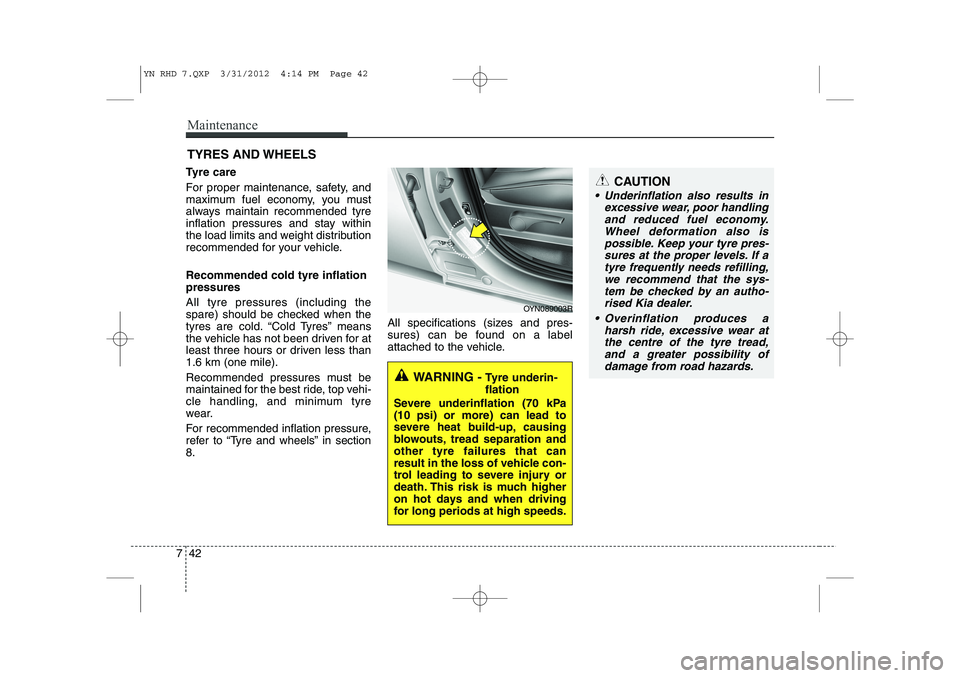
sures) can be found on a label
attached to the vehicle.
WARNING -
Tyre underin- flation
Severe underinflation (70 kPa(10 psi) or more) can lead to
severe heat build-up, causing
blowouts, tread separation andother tyre failures that can
result in the loss of vehicle con-
trol leading to severe injury or
death. This risk is much higher
on hot days and when driving
for long periods at high speeds.
OYN089003R
CAUTION
Underinflation also results in excessive wear, poor handlingand reduced fuel economy. Wheel deformation also ispossible. Keep your tyre pres-sures at the proper levels. If a tyre frequently needs refilling,we recommend that the sys-tem be checked by an autho- rised Kia dealer.
Overinflation produces a harsh ride, excessive wear atthe centre of the tyre tread,and a greater possibility of damage from road hazards.
YN RHD 7.QXP 3/31/2012 4:14 PM Page 42
Page 697 of 751
745
Maintenance
Disc brake pads should be inspectedfor wear whenever tyres are rotated.
✽✽ NOTICE
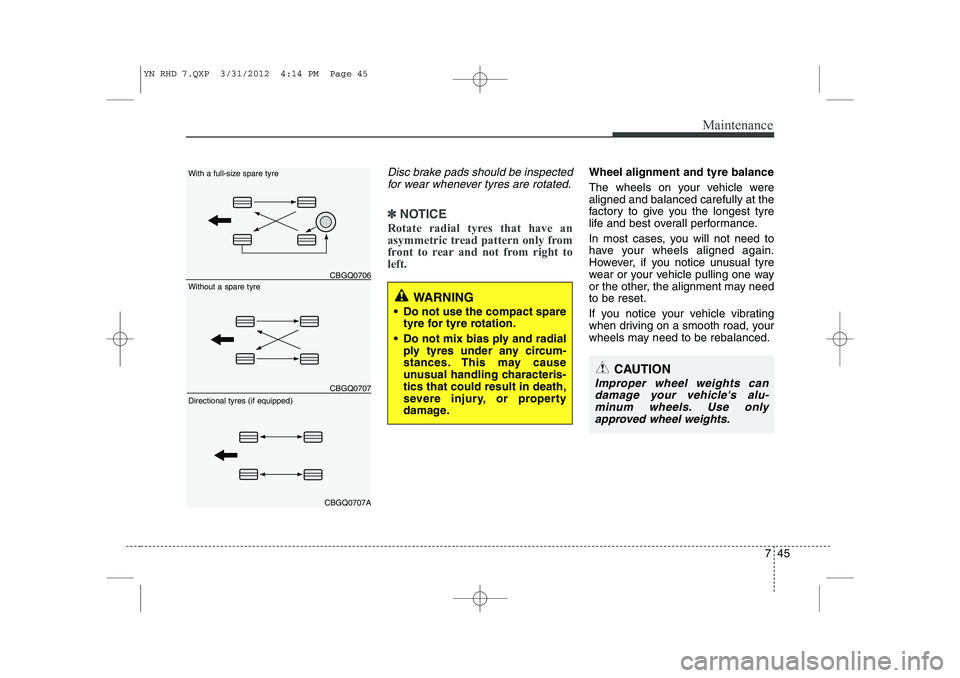
Rotate radial tyres that have an
asymmetric tread pattern only from
front to rear and not from right toleft.
Wheel alignment and tyre balance
The wheels on your vehicle were aligned and balanced carefully at the
factory to give you the longest tyre
life and best overall performance.
In most cases, you will not need to
have your wheels aligned again.
However, if you notice unusual tyre
wear or your vehicle pulling one way
or the other, the alignment may needto be reset.
If you notice your vehicle vibrating
when driving on a smooth road, your
wheels may need to be rebalanced.
WARNING
Do not use the compact spare tyre for tyre rotation.
Do not mix bias ply and radial ply tyres under any circum-
stances. This may cause
unusual handling characteris-tics that could result in death,
severe injury, or property
damage.
CAUTION
Improper wheel weights can
damage your vehicle's alu-minum wheels. Use onlyapproved wheel weights.
CBGQ0706
CBGQ0707
CBGQ0707A
Without a spare tyre
With a full-size spare tyre Directional tyres (if equipped)
YN RHD 7.QXP 3/31/2012 4:14 PM Page 45
Page 751 of 751
I9
Index
Tyres and wheels
Checking tyre inflation pressure . . . . . . . . . . . . . . . . 7-43
Compact spare tyre replacement . . . . . . . . . . . . . . . . 7-47
Recommended cold tyre inflation pressures . . . . . . . 7-42
Tyre care . . . . . . . . . . . . . . . . . . . . . . . . . . . . . . . . . . . 7-42
Tyre maintenance . . . . . . . . . . . . . . . . . . . . . . . . . . . . 7-47
Tyre replacement . . . . . . . . . . . . . . . . . . . . . . . . . . . . 7-46
Tyre rotation . . . . . . . . . . . . . . . . . . . . . . . . . . . . . . . . 7-44
Tyre sidewall labeling . . . . . . . . . . . . . . . . . . . . . . . . 7-48
Tyre traction . . . . . . . . . . . . . . . . . . . . . . . . . . . . . . . . 7-47
Wheel alignment and tyre balance . . . . . . . . . . . . . . . 7-45
Wheel replacement . . . . . . . . . . . . . . . . . . . . . . . . . . . 7-47
TMK, see tyremobilitykit . . . . . . . . . . . . . . . . . . . . . . . 6-15
Towing . . . . . . . . . . . . . . . . . . . . . . . . . . . . . . . . . . . . . 6-25
TPMS . . . . . . . . . . . . . . . . . . . . . . . . . . . . . . . . . . . . . . 6-20
Trailer towing . . . . . . . . . . . . . . . . . . . . . . . . . . . . . . . . 5-52
Transaxle Automatic transaxle . . . . . . . . . . . . . . . . . . . . . . . . . . 5-19
Manual transaxle . . . . . . . . . . . . . . . . . . . . . . . . . . . . 5-16
tyre4-44
Using the tyre mobility kit . . . . . . . . . . . . . . . . . . . . . . 6-15 Vehicle break-in process . . . . . . . . . . . . . . . . . . . . . . . . . 1-5
Vehicle identification number (VIN) . . . . . . . . . . . . . . . 8-7
Vehicle stability management . . . . . . . . . . . . . . . . . . . . 5-29
Vehicle weight . . . . . . . . . . . . . . . . . . . . . . . . . . . . . . . 5-60
Warning and indicators . . . . . . . . . . . . . . . . . . . . . . . . . 4-47
Washer fluid . . . . . . . . . . . . . . . . . . . . . . . . . . . . . . . . . 7-31
Wheel alignment and tyre balance . . . . . . . . . . . . . . . . 7-45
Wheel replacement . . . . . . . . . . . . . . . . . . . . . . . . . . . . 7-47
Windows
Auto up/down window . . . . . . . . . . . . . . . . . . . . . . . . 4-21
Manual window . . . . . . . . . . . . . . . . . . . . . . . . . . . . . 4-23
Power window lock button. . . . . . . . . . . . . . . . . . . . . 4-22
Winter driving Snow tyres . . . . . . . . . . . . . . . . . . . . . . . . . . . . . . . . . 5-48
Tyre chains . . . . . . . . . . . . . . . . . . . . . . . . . . . . . . . . . 5-49
Wiper blades . . . . . . . . . . . . . . . . . . . . . . . . . . . . . . . . . 7-36
Wipers and washers . . . . . . . . . . . . . . . . . . . . . . . . . . . 4-67
U
V
W
YN RHD INDEX.QXP 1/15/2013 12:59 PM Page 9