tires KIA VENGA 2015 User Guide
[x] Cancel search | Manufacturer: KIA, Model Year: 2015, Model line: VENGA, Model: KIA VENGA 2015Pages: 480, PDF Size: 23.15 MB
Page 366 of 480
What to do in an emergency
28
6
✽✽
NOTICE
If the TPMS, Low Tire Pressure and
Position indicators do not illuminate
for 3 seconds when the ignition switch
is turned to the ON position or engine
is running, or if they remain illumi-
nated after coming on for approxi-
mately 3 seconds, we recommend that
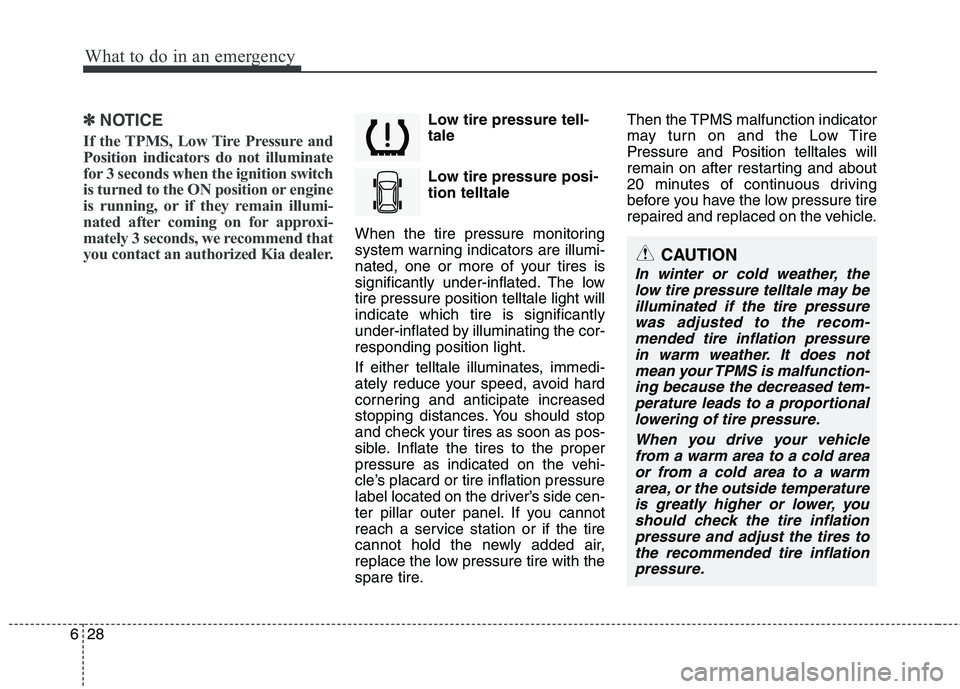
you contact an authorized Kia dealer.Low tire pressure tell- tale
Low tire pressure posi- tion telltale
When the tire pressure monitoring
system warning indicators are illumi-
nated, one or more of your tires is
significantly under-inflated. The lowtire pressure position telltale light willindicate which tire is significantly
under-inflated by illuminating the cor-responding position light.
If either telltale illuminates, immedi-
ately reduce your speed, avoid hard
cornering and anticipate increased
stopping distances. You should stop
and check your tires as soon as pos-
sible. Inflate the tires to the proper
pressure as indicated on the vehi-
cle’s placard or tire inflation pressure
label located on the driver’s side cen-
ter pillar outer panel. If you cannot
reach a service station or if the tire
cannot hold the newly added air,
replace the low pressure tire with the
spare tire. Then the TPMS malfunction indicator
may turn on and the Low Tire
Pressure and Position telltales will
remain on after restarting and about
20 minutes of continuous driving
before you have the low pressure tire
repaired and replaced on the vehicle.
CAUTION
In winter or cold weather, the
low tire pressure telltale may beilluminated if the tire pressurewas adjusted to the recom- mended tire inflation pressurein warm weather. It does notmean your TPMS is malfunction- ing because the decreased tem-perature leads to a proportionallowering of tire pressure.
When you drive your vehiclefrom a warm area to a cold area or from a cold area to a warmarea, or the outside temperatureis greatly higher or lower, you should check the tire inflationpressure and adjust the tires tothe recommended tire inflation pressure.
Page 367 of 480
629
What to do in an emergency
TPMS (Tire Pressure Monitoring System)malfunction indicator
The low tire pressure telltale will illu-
minate after it blinks for approximate-
ly one minute when there is a prob-
lem with the Tire Pressure Monitoring
System. If the system is able to cor-
rectly detect an underinflation warn-
ing at the same time as system fail-ure then it will illuminate both the
TPMS malfunction and low tire pres-
sure position telltales e.g. if Front Left
sensor fails, the TPMS malfunction
indicator illuminates, but if the FrontRight, Rear Left, or Rear Right tire is
under-inflated, the low tire pressure
position telltales may illuminatetogether with the TPMS malfunction
indicator.
We recommend that the system be
checked by an authorized Kia dealer.
WARNING - Low pressure
damage
Significantly low tire pressure
makes the vehicle unstable and
can contribute to loss of vehicle
control and increased brakingdistances.
Continued driving on low pres- sure tires can cause the tires to
overheat and fail.CAUTION
The TPMS malfunction indica- tor may be illuminated if thevehicle is moving around elec- tric power supply cables orradios transmitter such as atpolice stations, government and public offices, broadcast-ing stations, military installa-tions, airports, or transmitting towers, etc. This can interferewith normal operation of theTire Pressure Monitoring System (TPMS).
The TPMS malfunction indica- tor may be illuminated if snowchains are used or some sep-arate electronic devices such as notebook computer, mobilecharger, remote starter or nav-igation etc., are used in the vehicle. This can interfere withnormal operation of the TirePressure Monitoring System(TPMS).
Page 368 of 480
What to do in an emergency
30
6
Changing a tire with TPMS
If you have a flat tire, the Low Tire
Pressure and Position telltales will
come on. We recommend that the
system be checked by an authorized
Kia dealer. Each wheel is equipped with a tire pressure sensor mounted inside the
tire behind the valve stem. You must
use TPMS specific wheels. It is rec-
ommended that you have your tires
serviced by an authorized Kia dealer. Even if you replace the low pressure
tire with the spare tire, the Low Tire
Pressure and Position telltales will
remain on until the low pressure tire
is repaired and placed on the vehicle.
After you replace the low pressure
tire with the spare tire, the TPMS
malfunction indicator may illuminate
after a few minutes because theTPMS sensor is not mounted on thespare wheel.
Once the low pressure tire is reinflat- ed to the recommended pressure
and installed on the vehicle or theTPMS sensor mounted on the
replaced spare wheel is initiated by
recommended authorized Kia dealer,
the TPMS malfunction indicator and
the low tire pressure and position
telltales will extinguish within a few
minutes of driving.
If the indicators are not extinguished
after a few minutes of driving, werecommend that the system be
checked by an authorized Kia dealer.CAUTION
If a original mounted tire is
replaced with the spare tire, theTPMS sensor on the replaced spare wheel should be initiatedand the TPMS sensor on theoriginal mounted wheel shouldbe deactivated. If the TPMS sen- sor on the original mountedwheel located in the spare tirecarrier still activates, the tire pressure monitoring systemmay not operate properly. Werecommend that the system be serviced by an authorized Kiadealer.
CAUTION
We recommend that you use a puncture-repairing agentapproved by Kia to repair and/or inflate a low pressure tire. Thetire sealant not approved by Kiamay damage the tire pressure sensor.
The sealant on the tire pressuresensor and wheel shall be elem-inated when you replace the tirewith a new one.
Page 370 of 480
What to do in an emergency
32
6
TIRE PRESSURE MONITORING SYSTEM (TPMS) (TYPE B) (IF EQUIPPED)
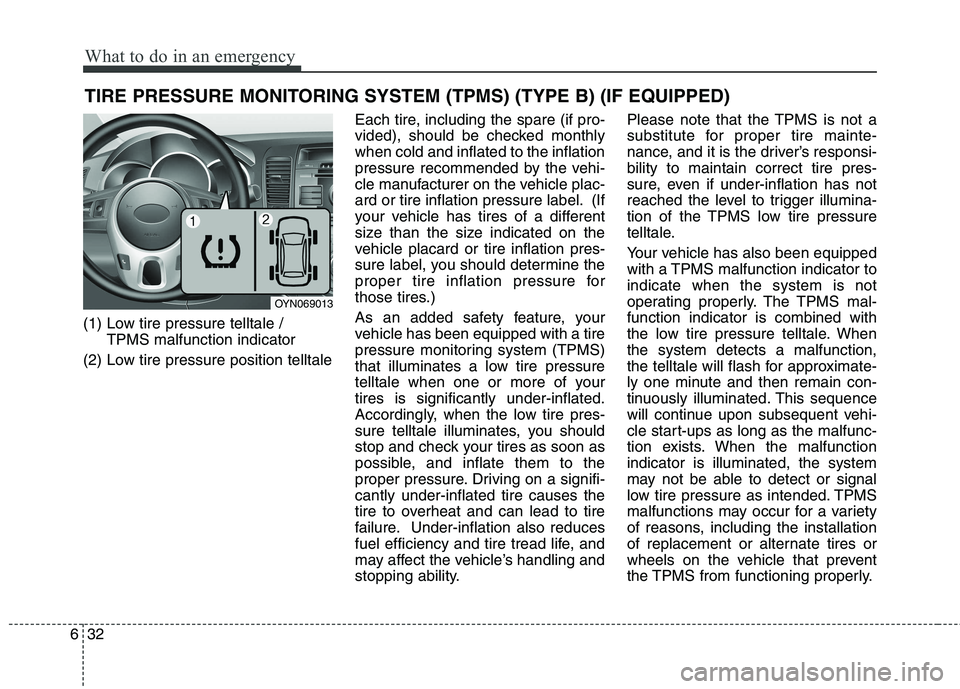
(1) Low tire pressure telltale / TPMS malfunction indicator
(2) Low tire pressure position telltale Each tire, including the spare (if pro-
vided), should be checked monthlywhen cold and inflated to the inflation
pressure recommended by the vehi-
cle manufacturer on the vehicle plac-
ard or tire inflation pressure label. (If
your vehicle has tires of a different
size than the size indicated on the
vehicle placard or tire inflation pres-
sure label, you should determine the
proper tire inflation pressure for
those tires.)
As an added safety feature, your
vehicle has been equipped with a tire
pressure monitoring system (TPMS)
that illuminates a low tire pressure
telltale when one or more of yourtires is significantly under-inflated.
Accordingly, when the low tire pres-
sure telltale illuminates, you should
stop and check your tires as soon as
possible, and inflate them to the
proper pressure. Driving on a signifi-cantly under-inflated tire causes the
tire to overheat and can lead to tire
failure. Under-inflation also reduces
fuel efficiency and tire tread life, and
may affect the vehicle’s handling and
stopping ability.Please note that the TPMS is not a
substitute for proper tire mainte-
nance, and it is the driver’s responsi-bility to maintain correct tire pres-
sure, even if under-inflation has not
reached the level to trigger illumina-
tion of the TPMS low tire pressure
telltale.
Your vehicle has also been equipped
with a TPMS malfunction indicator toindicate when the system is not
operating properly. The TPMS mal-function indicator is combined with
the low tire pressure telltale. Whenthe system detects a malfunction,
the telltale will flash for approximate-
ly one minute and then remain con-
tinuously illuminated. This sequence
will continue upon subsequent vehi-
cle start-ups as long as the malfunc-
tion exists. When the malfunctionindicator is illuminated, the system
may not be able to detect or signal
low tire pressure as intended. TPMS
malfunctions may occur for a variety
of reasons, including the installation
of replacement or alternate tires or
wheels on the vehicle that prevent
the TPMS from functioning properly.
OYN069013
Page 371 of 480
633
What to do in an emergency
Always check the TPMS malfunction telltale after replacing one or more
tires or wheels on your vehicle toensure that the replacement or alter-
nate tires and wheels allow the TPMS
to continue to function properly.
✽✽NOTICE
If any of the below happens, we rec-
ommend that the system be checked
by an authorized Kia dealer.
1.The low tire pressure telltale/ TPMS malfunction indicator do
not illuminate for 3 seconds when
the ignition switch is turned to the
ON position or engine is running.
2. The TPMS malfunction indicator remains illuminated after blinking
for approximately 1 minute.
3. The Low tire pressure position telltale remains illuminated.
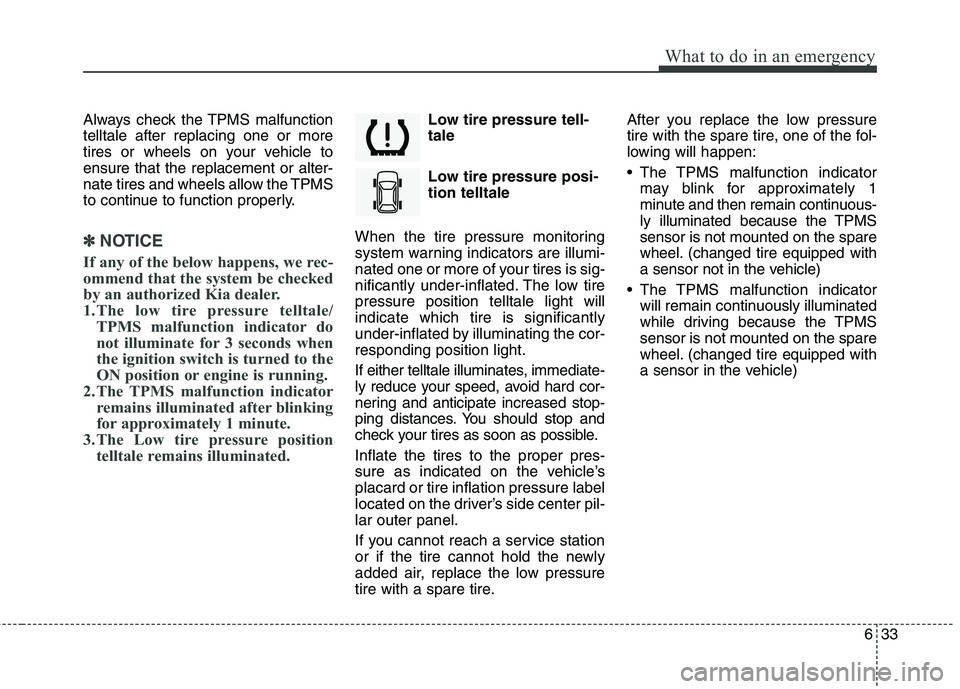
Low tire pressure tell- tale
Low tire pressure posi- tion telltale
When the tire pressure monitoring
system warning indicators are illumi-
nated one or more of your tires is sig-
nificantly under-inflated. The low tirepressure position telltale light willindicate which tire is significantly
under-inflated by illuminating the cor-responding position light.
If either telltale illuminates, immediate-
ly reduce your speed, avoid hard cor-
nering and anticipate increased stop-
ping distances. You should stop and
check your tires as soon as possible. Inflate the tires to the proper pres-
sure as indicated on the vehicle’splacard or tire inflation pressure label
located on the driver’s side center pil-lar outer panel.
If you cannot reach a service station
or if the tire cannot hold the newly
added air, replace the low pressure
tire with a spare tire. After you replace the low pressure
tire with the spare tire, one of the fol-
lowing will happen:
The TPMS malfunction indicator
may blink for approximately 1
minute and then remain continuous-
ly illuminated because the TPMSsensor is not mounted on the spare
wheel. (changed tire equipped with
a sensor not in the vehicle)
The TPMS malfunction indicator will remain continuously illuminated
while driving because the TPMSsensor is not mounted on the spare
wheel. (changed tire equipped with
a sensor in the vehicle)
Page 372 of 480
What to do in an emergency
34
6
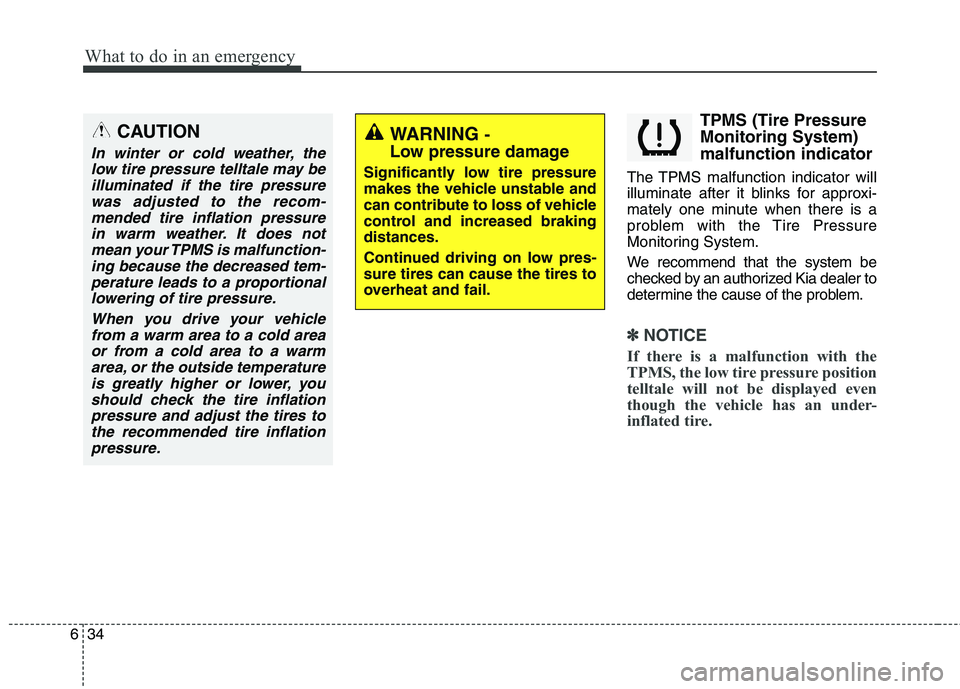
TPMS (Tire Pressure Monitoring System)malfunction indicator
The TPMS malfunction indicator will
illuminate after it blinks for approxi-
mately one minute when there is a
problem with the Tire Pressure
Monitoring System.
We recommend that the system be
checked by an authorized Kia dealer to
determine the cause of the problem.
✽✽ NOTICE
If there is a malfunction with the
TPMS, the low tire pressure position
telltale will not be displayed even
though the vehicle has an under-
inflated tire.
CAUTION
In winter or cold weather, the low tire pressure telltale may beilluminated if the tire pressure was adjusted to the recom-mended tire inflation pressurein warm weather. It does not mean your TPMS is malfunction-ing because the decreased tem-perature leads to a proportional lowering of tire pressure.
When you drive your vehiclefrom a warm area to a cold areaor from a cold area to a warmarea, or the outside temperature is greatly higher or lower, youshould check the tire inflationpressure and adjust the tires tothe recommended tire inflation pressure.
WARNING -
Low pressure damage
Significantly low tire pressure
makes the vehicle unstable and
can contribute to loss of vehicle
control and increased brakingdistances.
Continued driving on low pres- sure tires can cause the tires to
overheat and fail.
Page 373 of 480
635
What to do in an emergency
Changing a tire with TPMS
If you have a flat tire, the low Tire
Pressure and Position telltales will
come on. We recommend that the
system be checked by an authorized
Kia dealer. Each wheel is equipped with a tire pressure sensor mounted inside the
tire behind the valve stem. You must
use TPMS specific wheels. It is rec-
ommended that you have your tires
serviced by an authorized Kia dealer.If you drive the vehicle for about 10
minutes at speeds above 25 km/h
after replaceing the low pressure tire
with the spare tire, one of the follow-ing will happen:
The TPMS malfunction indicator
may blink for approximately 1
minute and then remain continuous-
ly illuminated because the TPMSsensor is not mounted on the spare
wheel. (changed tire equipped with
a sensor not in the vehicle)
The TPMS malfunction indicator will remain continuously illuminated
while driving because the TPMSsensor is not mounted on the spare
wheel. (changed tire equipped with
a sensor in the vehicle) You may not be able identify a low
tire by simply looking at it. Alwaysuse a good quality tire pressuregauge to measure the tire's inflation
pressure. Please note that a tire that
is hot (from being driven) will have ahigher pressure measurement than atire that is cold (from sitting station-
ary for at least 3 hours and driven
less than 1 mile (1.6 km) during that
3 hour period).
Allow the tire to cool before measur-
ing the inflation pressure. Always be
sure the tire is cold before inflating to
the recommended pressure.
A cold tire means the vehicle has
been sitting for 3 hours and driven forless than 1 mile (1.6 km) in that 3
hour period.
CAUTION
We recommend that you use the
sealant approved by Kia.
The sealant on the tire pressuresensor and wheel shall be elim-inated when you replace the tire with a new one.
CAUTION
We recommend that you use thesealant approved by Kia if yourvehicle is equipped with a TirePressure Monitoring System. The liquid sealant can damagethe tire pressure sensors.
Page 474 of 480
I3
Index
Care
Exterior care . . . . . . . . . . . . . . . . . . . . . . . . . . . . . . . . 7-73
Interior care . . . . . . . . . . . . . . . . . . . . . . . . . . . . . . . . 7-78
Tire care . . . . . . . . . . . . . . . . . . . . . . . . . . . . . . . . . . . 7-42
Catalytic converters . . . . . . . . . . . . . . . . . . . . . . . . . . . 7-81
Center console storage . . . . . . . . . . . . . . . . . . . . . . . . . 4-92
Central door lock switch. . . . . . . . . . . . . . . . . . . . . . . . 4-14
Certification label . . . . . . . . . . . . . . . . . . . . . . . . . . . . . . 8-8
Chains Tire chains . . . . . . . . . . . . . . . . . . . . . . . . . . . . . . . . . 5-50
Changing tires . . . . . . . . . . . . . . . . . . . . . . . . . . . . . . . . . 6-8
Checking tire inflation pressure . . . . . . . . . . . . . . . . . . 7-43
Child restraint system . . . . . . . . . . . . . . . . . . . . . . . . . . 3-26 ISOFIX system . . . . . . . . . . . . . . . . . . . . . . . . . . . . . . 3-32
Recommended child restraint system. . . . . . . . . . . . . 3-36
Tether anchor system . . . . . . . . . . . . . . . . . . . . . . . . . 3-31
Child-protector rear door lock . . . . . . . . . . . . . . . . . . . 4-16
Cigarette lighter . . . . . . . . . . . . . . . . . . . . . . . . . . . . . . 4-95
Climate control (automatic) . . . . . . . . . . . . . . . . . . . . . 4-82
Climate control (manual) . . . . . . . . . . . . . . . . . . . . . . . 4-73
Climate control air filter . . . . . . . . . . . . . . . . . . . . . 4-80,88
Climate control air filter (replacement) . . . . . . . . . . . . 7-34
Clock (Digital) . . . . . . . . . . . . . . . . . . . . . . . . . . . . . . . 4-94
Clothes hanger . . . . . . . . . . . . . . . . . . . . . . . . . . . . . . . 4-99
Combined instrument, see instrument cluster . . . . . . . 4-40
Compact spare tire . . . . . . . . . . . . . . . . . . . . . . . . . . . . 6-13 Compact spare tire replacement . . . . . . . . . . . . . . . . . . 7-47
Components of the tire mobility kit . . . . . . . . . . 6-17, 6-22
Coolant . . . . . . . . . . . . . . . . . . . . . . . . . . . . . . . . . . . . . 7-25
Cool box . . . . . . . . . . . . . . . . . . . . . . . . . . . . . . . . . . . . 4-93
Cooling fluid, see engine coolant . . . . . . . . . . . . . . . . . 7-25
Crankcase emission control system . . . . . . . . . . . . . . . 7-79
Cruise control system . . . . . . . . . . . . . . . . . . . . . . . . . . 5-36
Cup holder . . . . . . . . . . . . . . . . . . . . . . . . . . . . . . . . . . 4-96
Curtain air bag . . . . . . . . . . . . . . . . . . . . . . . . . . . . . . . 3-51
Dashboard illumination, see instrument panel illumination. . 4-42
Dashboard, see instrument cluster . . . . . . . . . . . . . . . . 4-40
Declaration of conformity . . . . . . . . . . . . . . . . . . . . . . 8-10
Defogging (Windshield) . . . . . . . . . . . . . . . . . . . . . . . . 4-90
Defroster (Rear window) . . . . . . . . . . . . . . . . . . . . . . . 4-72
Defrosting (Windshield) . . . . . . . . . . . . . . . . . . . . . . . . 4-90
Diesel particulate filter . . . . . . . . . . . . . . . . . . . . . . . . . 7-82
Digital clock . . . . . . . . . . . . . . . . . . . . . . . . . . . . . . . . . 4-94
Dimensions . . . . . . . . . . . . . . . . . . . . . . . . . . . . . . . . . . . 8-2
Display illumination, see instrument panel illumination . . 4-42
Displays, see instrument cluster . . . . . . . . . . . . . . . . . . 4-40
Door locks. . . . . . . . . . . . . . . . . . . . . . . . . . . . . . . . . . . 4-13
Central door lock switch . . . . . . . . . . . . . . . . . . . . . . 4-14
Child-protector rear door lock . . . . . . . . . . . . . . . . . . 4-16
DPF . . . . . . . . . . . . . . . . . . . . . . . . . . . . . . . . . . . . . . . . 7-82
D
Page 475 of 480
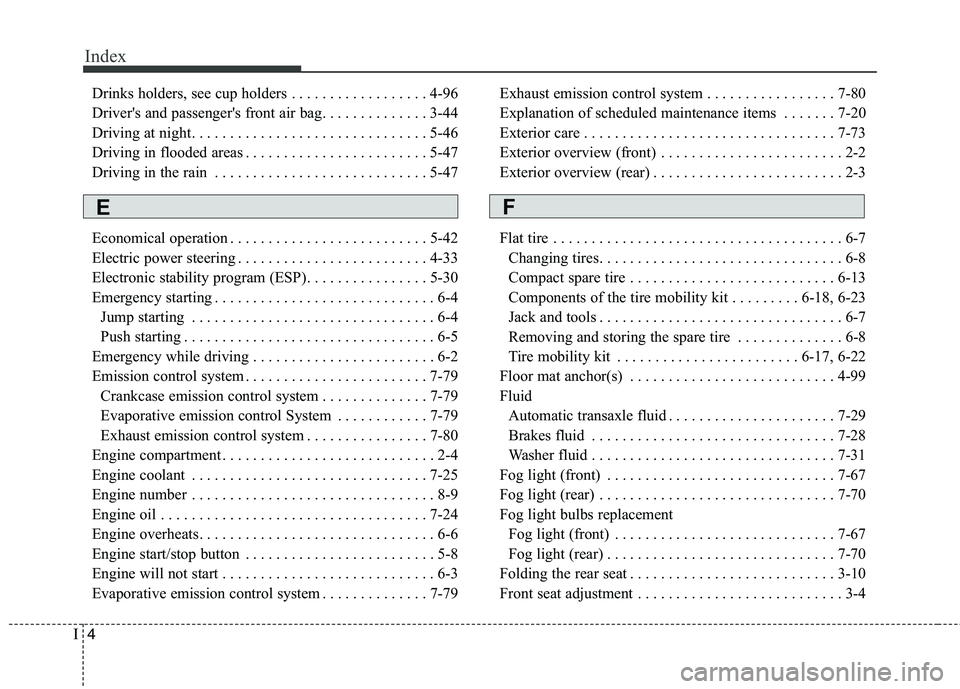
Index
4
I
Drinks holders, see cup holders . . . . . . . . . . . . . . . . . . 4-96
Driver's and passenger's front air bag. . . . . . . . . . . . . . 3-44
Driving at night. . . . . . . . . . . . . . . . . . . . . . . . . . . . . . . 5-46
Driving in flooded areas . . . . . . . . . . . . . . . . . . . . . . . . 5-47
Driving in the rain . . . . . . . . . . . . . . . . . . . . . . . . . . . . 5-47
Economical operation . . . . . . . . . . . . . . . . . . . . . . . . . . 5-42
Electric power steering . . . . . . . . . . . . . . . . . . . . . . . . . 4-33
Electronic stability program (ESP). . . . . . . . . . . . . . . . 5-30
Emergency starting . . . . . . . . . . . . . . . . . . . . . . . . . . . . . 6-4
Jump starting . . . . . . . . . . . . . . . . . . . . . . . . . . . . . . . . 6-4
Push starting . . . . . . . . . . . . . . . . . . . . . . . . . . . . . . . . . 6-5
Emergency while driving . . . . . . . . . . . . . . . . . . . . . . . . 6-2
Emission control system . . . . . . . . . . . . . . . . . . . . . . . . 7-79 Crankcase emission control system . . . . . . . . . . . . . . 7-79
Evaporative emission control System . . . . . . . . . . . . 7-79
Exhaust emission control system . . . . . . . . . . . . . . . . 7-80
Engine compartment . . . . . . . . . . . . . . . . . . . . . . . . . . . . 2-4
Engine coolant . . . . . . . . . . . . . . . . . . . . . . . . . . . . . . . 7-25
Engine number . . . . . . . . . . . . . . . . . . . . . . . . . . . . . . . . 8-9
Engine oil . . . . . . . . . . . . . . . . . . . . . . . . . . . . . . . . . . . 7-24
Engine overheats. . . . . . . . . . . . . . . . . . . . . . . . . . . . . . . 6-6
Engine start/stop button . . . . . . . . . . . . . . . . . . . . . . . . . 5-8
Engine will not start . . . . . . . . . . . . . . . . . . . . . . . . . . . . 6-3
Evaporative emission control system . . . . . . . . . . . . . . 7-79 Exhaust emission control system . . . . . . . . . . . . . . . . . 7-80
Explanation of scheduled maintenance items . . . . . . . 7-20
Exterior care . . . . . . . . . . . . . . . . . . . . . . . . . . . . . . . . . 7-73
Exterior overview (front) . . . . . . . . . . . . . . . . . . . . . . . . 2-2
Exterior overview (rear) . . . . . . . . . . . . . . . . . . . . . . . . . 2-3
Flat tire . . . . . . . . . . . . . . . . . . . . . . . . . . . . . . . . . . . . . . 6-7
Changing tires. . . . . . . . . . . . . . . . . . . . . . . . . . . . . . . . 6-8
Compact spare tire . . . . . . . . . . . . . . . . . . . . . . . . . . . 6-13
Components of the tire mobility kit . . . . . . . . . 6-18, 6-23
Jack and tools . . . . . . . . . . . . . . . . . . . . . . . . . . . . . . . . 6-7
Removing and storing the spare tire . . . . . . . . . . . . . . 6-8
Tire mobility kit . . . . . . . . . . . . . . . . . . . . . . . . 6-17, 6-22
Floor mat anchor(s) . . . . . . . . . . . . . . . . . . . . . . . . . . . 4-99
Fluid Automatic transaxle fluid . . . . . . . . . . . . . . . . . . . . . . 7-29
Brakes fluid . . . . . . . . . . . . . . . . . . . . . . . . . . . . . . . . 7-28
Washer fluid . . . . . . . . . . . . . . . . . . . . . . . . . . . . . . . . 7-31
Fog light (front) . . . . . . . . . . . . . . . . . . . . . . . . . . . . . . 7-67
Fog light (rear) . . . . . . . . . . . . . . . . . . . . . . . . . . . . . . . 7-70
Fog light bulbs replacement Fog light (front) . . . . . . . . . . . . . . . . . . . . . . . . . . . . . 7-67
Fog light (rear) . . . . . . . . . . . . . . . . . . . . . . . . . . . . . . 7-70
Folding the rear seat . . . . . . . . . . . . . . . . . . . . . . . . . . . 3-10
Front seat adjustment . . . . . . . . . . . . . . . . . . . . . . . . . . . 3-4
EF
Page 479 of 480
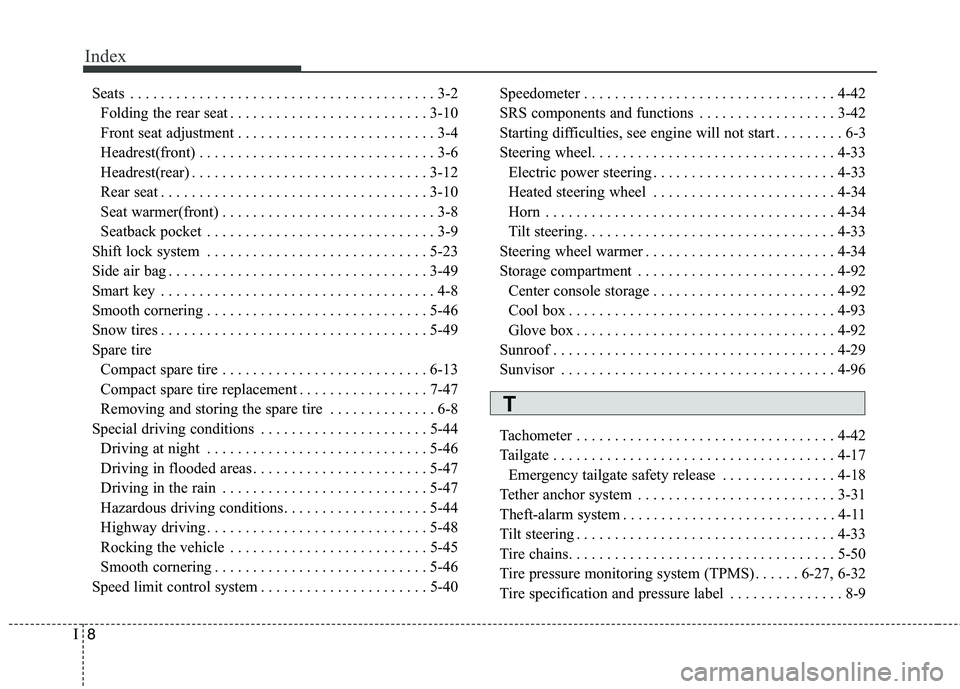
Index
8
I
Seats . . . . . . . . . . . . . . . . . . . . . . . . . . . . . . . . . . . . . . . . 3-2
Folding the rear seat . . . . . . . . . . . . . . . . . . . . . . . . . . 3-10
Front seat adjustment . . . . . . . . . . . . . . . . . . . . . . . . . . 3-4
Headrest(front) . . . . . . . . . . . . . . . . . . . . . . . . . . . . . . . 3-6
Headrest(rear) . . . . . . . . . . . . . . . . . . . . . . . . . . . . . . . 3-12
Rear seat . . . . . . . . . . . . . . . . . . . . . . . . . . . . . . . . . . . 3-10
Seat warmer(front) . . . . . . . . . . . . . . . . . . . . . . . . . . . . 3-8
Seatback pocket . . . . . . . . . . . . . . . . . . . . . . . . . . . . . . 3-9
Shift lock system . . . . . . . . . . . . . . . . . . . . . . . . . . . . . 5-23
Side air bag . . . . . . . . . . . . . . . . . . . . . . . . . . . . . . . . . . 3-49
Smart key . . . . . . . . . . . . . . . . . . . . . . . . . . . . . . . . . . . . 4-8
Smooth cornering . . . . . . . . . . . . . . . . . . . . . . . . . . . . . 5-46
Snow tires . . . . . . . . . . . . . . . . . . . . . . . . . . . . . . . . . . . 5-49
Spare tire
Compact spare tire . . . . . . . . . . . . . . . . . . . . . . . . . . . 6-13
Compact spare tire replacement . . . . . . . . . . . . . . . . . 7-47
Removing and storing the spare tire . . . . . . . . . . . . . . 6-8
Special driving conditions . . . . . . . . . . . . . . . . . . . . . . 5-44 Driving at night . . . . . . . . . . . . . . . . . . . . . . . . . . . . . 5-46
Driving in flooded areas . . . . . . . . . . . . . . . . . . . . . . . 5-47
Driving in the rain . . . . . . . . . . . . . . . . . . . . . . . . . . . 5-47
Hazardous driving conditions. . . . . . . . . . . . . . . . . . . 5-44
Highway driving . . . . . . . . . . . . . . . . . . . . . . . . . . . . . 5-48
Rocking the vehicle . . . . . . . . . . . . . . . . . . . . . . . . . . 5-45
Smooth cornering . . . . . . . . . . . . . . . . . . . . . . . . . . . . 5-46
Speed limit control system . . . . . . . . . . . . . . . . . . . . . . 5-40 Speedometer . . . . . . . . . . . . . . . . . . . . . . . . . . . . . . . . . 4-42
SRS components and functions . . . . . . . . . . . . . . . . . . 3-42
Starting difficulties, see engine will not start . . . . . . . . . 6-3
Steering wheel. . . . . . . . . . . . . . . . . . . . . . . . . . . . . . . . 4-33
Electric power steering . . . . . . . . . . . . . . . . . . . . . . . . 4-33
Heated steering wheel . . . . . . . . . . . . . . . . . . . . . . . . 4-34
Horn . . . . . . . . . . . . . . . . . . . . . . . . . . . . . . . . . . . . . . 4-34
Tilt steering . . . . . . . . . . . . . . . . . . . . . . . . . . . . . . . . . 4-33
Steering wheel warmer . . . . . . . . . . . . . . . . . . . . . . . . . 4-34
Storage compartment . . . . . . . . . . . . . . . . . . . . . . . . . . 4-92 Center console storage . . . . . . . . . . . . . . . . . . . . . . . . 4-92
Cool box . . . . . . . . . . . . . . . . . . . . . . . . . . . . . . . . . . . 4-93
Glove box . . . . . . . . . . . . . . . . . . . . . . . . . . . . . . . . . . 4-92
Sunroof . . . . . . . . . . . . . . . . . . . . . . . . . . . . . . . . . . . . . 4-29
Sunvisor . . . . . . . . . . . . . . . . . . . . . . . . . . . . . . . . . . . . 4-96
Tachometer . . . . . . . . . . . . . . . . . . . . . . . . . . . . . . . . . . 4-42
Tailgate . . . . . . . . . . . . . . . . . . . . . . . . . . . . . . . . . . . . . 4-17 Emergency tailgate safety release . . . . . . . . . . . . . . . 4-18
Tether anchor system . . . . . . . . . . . . . . . . . . . . . . . . . . 3-31
Theft-alarm system . . . . . . . . . . . . . . . . . . . . . . . . . . . . 4-11
Tilt steering . . . . . . . . . . . . . . . . . . . . . . . . . . . . . . . . . . 4-33
Tire chains. . . . . . . . . . . . . . . . . . . . . . . . . . . . . . . . . . . 5-50
Tire pressure monitoring system (TPMS) . . . . . . 6-27, 6-32
Tire specification and pressure label . . . . . . . . . . . . . . . 8-9
T