warning KIA VENGA 2015 User Guide
[x] Cancel search | Manufacturer: KIA, Model Year: 2015, Model line: VENGA, Model: KIA VENGA 2015Pages: 480, PDF Size: 23.15 MB
Page 55 of 480
55
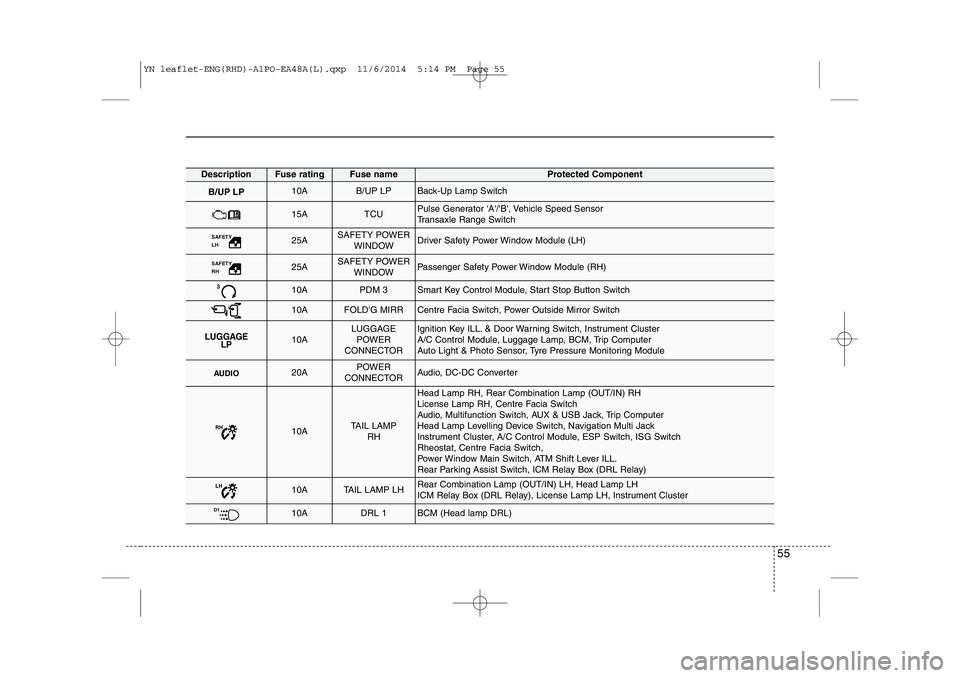
DescriptionFuse ratingFuse nameProtected Component
B/UP LP10AB/UP LPBack-Up Lamp Switch
15ATCUPulse Generator 'A'/'B', Vehicle Speed Sensor
Transaxle Range Switch
SAFETY LH 25ASAFETY POWERWINDOWDriver Safety Power Window Module (LH)
SAFETY RH 25ASAFETY POWERWINDOWPassenger Safety Power Window Module (RH)
310APDM 3Smart Key Control Module, Start Stop Button Switch
10AFOLD'G MIRRCentre Facia Switch, Power Outside Mirror Switch
LUGGAGE LP10ALUGGAGE
POWER
CONNECTORIgnition Key ILL. & Door Warning Switch, Instrument Cluster
A/C Control Module, Luggage Lamp, BCM, Trip Computer
Auto Light & Photo Sensor, Tyre Pressure Monitoring Module
AUDIO20APOWER
CONNECTORAudio, DC-DC Converter
RH10ATAIL LAMP RH
Head Lamp RH, Rear Combination Lamp (OUT/IN) RH
License Lamp RH, Centre Facia Switch
Audio, Multifunction Switch, AUX & USB Jack, Trip Computer
Head Lamp Levelling Device Switch, Navigation Multi Jack
Instrument Cluster, A/C Control Module, ESP Switch, ISG Switch
Rheostat, Centre Facia Switch,
Power Window Main Switch, ATM Shift Lever ILL.
Rear Parking Assist Switch, ICM Relay Box (DRL Relay)
LH10ATAIL LAMP LHRear Combination Lamp (OUT/IN) LH, Head Lamp LH
ICM Relay Box (DRL Relay), License Lamp LH, Instrument Cluster
D110ADRL 1BCM (Head lamp DRL)
YN leaflet-ENG(RHD)-A1PO-EA48A(L).qxp 11/6/2014 5:14 PM Page 55
Page 73 of 480
Introduction
2
1
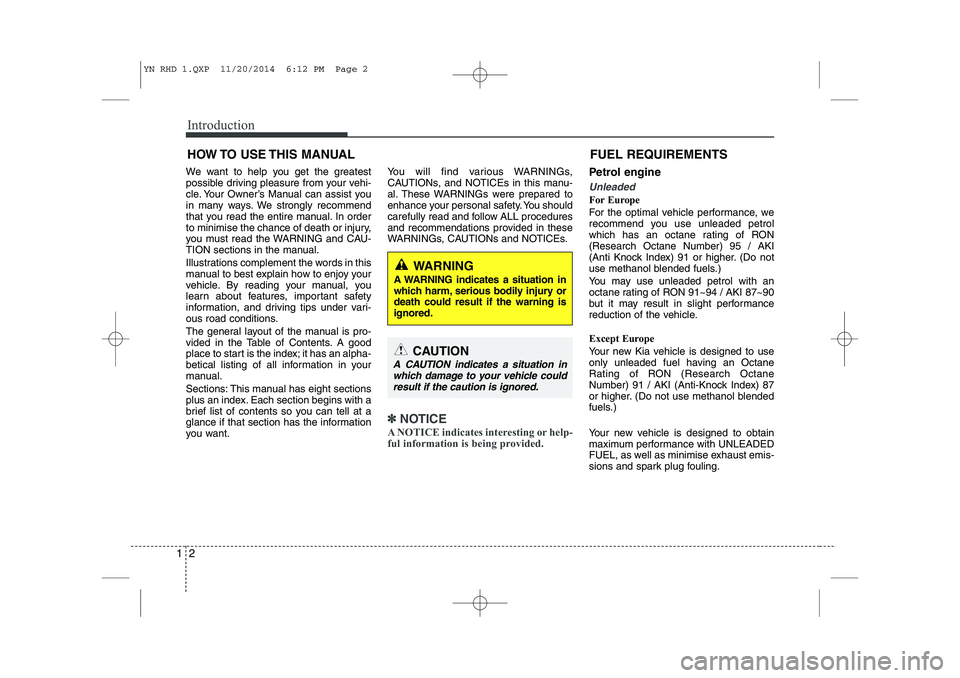
We want to help you get the greatest
possible driving pleasure from your vehi-
cle. Your Owner’s Manual can assist you
in many ways. We strongly recommend
that you read the entire manual. In order
to minimise the chance of death or injury,
you must read the WARNING and CAU-
TION sections in the manual.
Illustrations complement the words in this
manual to best explain how to enjoy your
vehicle. By reading your manual, you
learn about features, important safety
information, and driving tips under vari-
ous road conditions.
The general layout of the manual is pro-
vided in the Table of Contents. A good
place to start is the index; it has an alpha-
betical listing of all information in your
manual.
Sections: This manual has eight sections
plus an index. Each section begins with a
brief list of contents so you can tell at a
glance if that section has the information
you want. You will find various WARNINGs,
CAUTIONs, and NOTICEs in this manu-
al. These WARNINGs were prepared to
enhance your personal safety. You should
carefully read and follow ALL procedures
and recommendations provided in these
WARNINGs, CAUTIONs and NOTICEs.
✽✽
NOTICE
A NOTICE indicates interesting or help-
ful information is being provided.
Petrol engine
Unleaded
For Europe
For the optimal vehicle performance, we
recommend you use unleaded petrol
which has an octane rating of RON(Research Octane Number) 95 / AKI
(Anti Knock Index) 91 or higher. (Do not
use methanol blended fuels.)
You may use unleaded petrol with an
octane rating of RON 91~94 / AKI 87~90
but it may result in slight performance
reduction of the vehicle.
Except Europe
Your new Kia vehicle is designed to use
only unleaded fuel having an Octane
Rating of RON (Research Octane
Number) 91 / AKI (Anti-Knock Index) 87
or higher. (Do not use methanol blended
fuels.)
Your new vehicle is designed to obtain
maximum performance with UNLEADED
FUEL, as well as minimise exhaust emis-
sions and spark plug fouling.
HOW TO USE THIS MANUAL
WARNING
A WARNING indicates a situation in
which harm, serious bodily injury ordeath could result if the warning isignored.
CAUTION
A CAUTION indicates a situation in which damage to your vehicle could
result if the caution is ignored.
FUEL REQUIREMENTS
YN RHD 1.QXP 11/20/2014 6:12 PM Page 2
Page 74 of 480
13
Introduction
Leaded (if equipped)
For some countries, your vehicle is
designed to use leaded petrol. When you
are going to use leaded petrol, we rec-
ommend that you ask to an authorised
Kia dealer. Octane Rating of leaded petrol is same
with unleaded one.
Petrol containing alcohol andmethanol
Gasohol, a mixture of petrol and ethanol
(also known as grain alcohol), and petrolor gasohol containing methanol (also
known as wood alcohol) are being mar-
keted along with or instead of leaded orunleaded petrol. Do not use gasohol containing more than 10% ethanol, and do not use petrol or
gasohol containing any methanol. Either
of these fuels may cause drivability prob-lems and damage to the fuel system,engine control system and emission con-trol system.
Discontinue using gasohol of any kind if
drivability problems occur.
Vehicle damage or drivability problems
may not be covered by the manufacturer’s
warranty if they result from the use of: 1. Gasohol containing more than 10%
ethanol.
2. Petrol or gasohol containing methanol.
3. Leaded fuel or leaded gasohol.Other fuels
Using fuels such as
- Silicone (Si) contained fuel,
- MMT (Manganese, Mn) contained fuel,
- Ferrocene (Fe) contained fuel, and
- Other metalic additives contained fuels,
may cause vehicle and engine damage
or cause plugging, misfiring, poor accel-
eration, engine stalling, catalyst melting,
abnormal corrosion, life cycle reduction,etc.
Also, the Malfunction Indicator Lamp
(MIL) may illuminate.
✽✽
NOTICE
Damage to the fuel system or perform-
ance problem caused by the use of these
fuels may not be covered by your New
Vehicle Limited Warranty.
WARNING
• Do not "top off" after the nozzle automatically shuts off when refuelling.
Always check that the fuel cap is installed securely to prevent fuel
spillage in the event of an acci-dent.
CAUTION
NEVER USE LEADED FUEL. The
use of leaded fuel is detrimental to
the catalytic converter and willdamage the engine control sys-tem’s oxygen sensor and affect emission control.
Never add any fuel system cleaningagents to the fuel tank other thanwhat has been specified. (We rec-ommend that you consult an
authorised Kia.)
CAUTION
Never use gasohol which contains methanol. Discontinue use of anygasohol product which impairs dri-
vability.
YN RHD 1.QXP 11/20/2014 6:12 PM Page 3
Page 82 of 480
25
Your vehicle at a glance
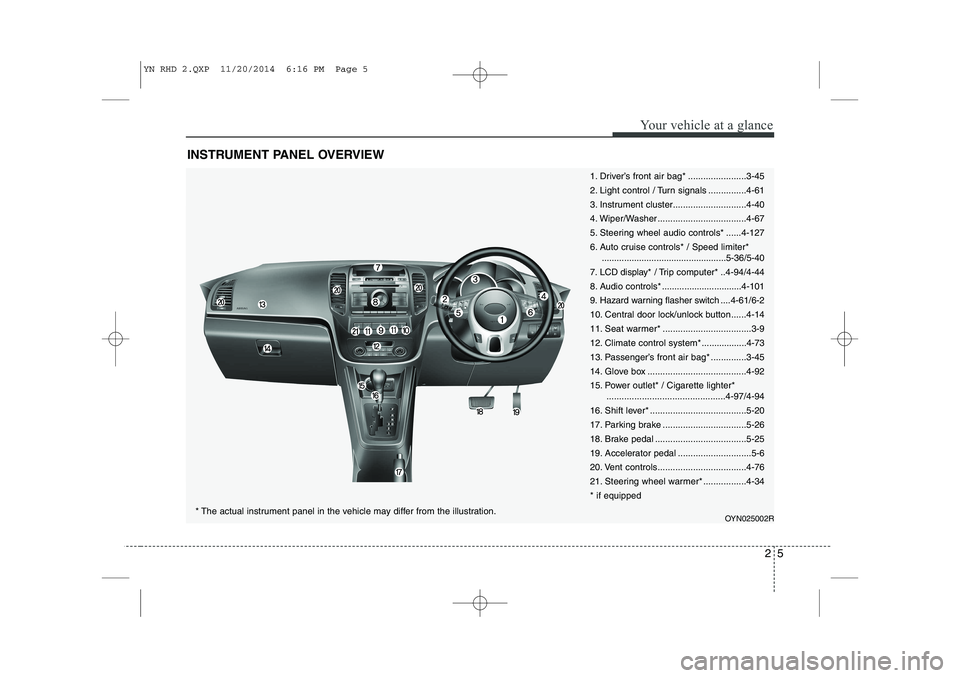
INSTRUMENT PANEL OVERVIEW
1. Driver’s front air bag* .......................3-45
2. Light control / Turn signals ...............4-61
3. Instrument cluster.............................4-40
4. Wiper/Washer ...................................4-67
5. Steering wheel audio controls* ......4-127
6. Auto cruise controls* / Speed limiter*..................................................5-36/5-40
7. LCD display* / Trip computer* ..4-94/4-44
8. Audio controls * ................................4-101
9. Hazard warning flasher switch ....4-61/6-2
10. Central door lock/unlock button......4-14
11. Seat warmer* ...................................3-9
12. Climate control system*..................4-73
13. Passenger’s front air bag* ..............3-45
14. Glove box .......................................4-92
15. Power outlet* / Cigarette lighter* ...............................................4-97/4-94
16. Shift lever* ......................................5-20
17. Parking brake .................................5-26
18. Brake pedal ....................................5-25
19. Accelerator pedal .............................5-6
20. Vent controls...................................4-7621.
Steering wheel warmer* .................4-34
* if equipped
OYN025002R
* The actual instrument panel in the vehicle may differ from the illustration.
YN RHD 2.QXP 11/20/2014 6:16 PM Page 5
Page 86 of 480
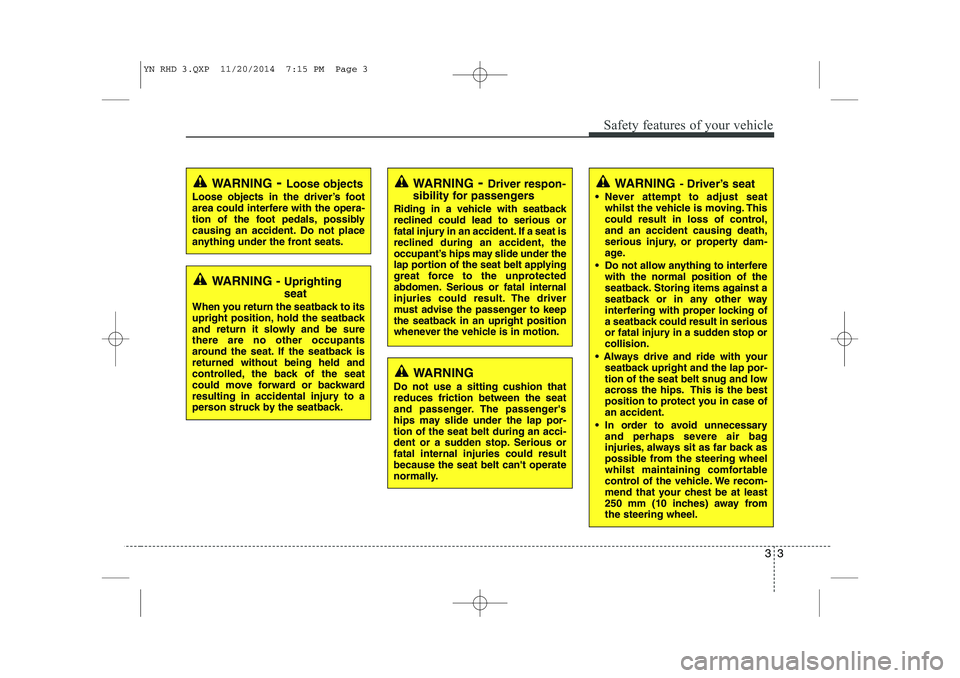
WARNING- Driver’s seat
Never attempt to adjust seat whilst the vehicle is moving. This
could result in loss of control,and an accident causing death,
serious injury, or property dam-
age.
Do not allow anything to interfere with the normal position of the
seatback. Storing items against a
seatback or in any other way
interfering with proper locking of
a seatback could result in serious
or fatal injury in a sudden stop orcollision.
Always drive and ride with your seatback upright and the lap por-
tion of the seat belt snug and low
across the hips. This is the best
position to protect you in case ofan accident.
In order to avoid unnecessary and perhaps severe air bag
injuries, always sit as far back as
possible from the steering wheel
whilst maintaining comfortable
control of the vehicle. We recom-
mend that your chest be at least
250 mm (10 inches) away fromthe steering wheel.
WARNING - Uprighting seat
When you return the seatback to its
upright position, hold the seatback
and return it slowly and be surethere are no other occupants
around the seat. If the seatback isreturned without being held and
controlled, the back of the seat
could move forward or backward
resulting in accidental injury to a
person struck by the seatback.
WARNING - Driver respon-
sibility for passengers
Riding in a vehicle with seatback
reclined could lead to serious or
fatal injury in an accident. If a seat is
reclined during an accident, the
occupant’s hips may slide under the
lap portion of the seat belt applying
great force to the unprotected
abdomen. Serious or fatal internal
injuries could result. The driver
must advise the passenger to keep
the seatback in an upright position
whenever the vehicle is in motion.WARNING - Loose objects
Loose objects in the driver’s foot
area could interfere with the opera-
tion of the foot pedals, possibly
causing an accident. Do not place
anything under the front seats.
33
Safety features of your vehicle
WARNING
Do not use a sitting cushion that reduces friction between the seat
and passenger. The passenger's
hips may slide under the lap por-tion of the seat belt during an acci-
dent or a sudden stop. Serious orfatal internal injuries could resultbecause the seat belt can't operate
normally.
YN RHD 3.QXP 11/20/2014 7:15 PM Page 3
Page 87 of 480
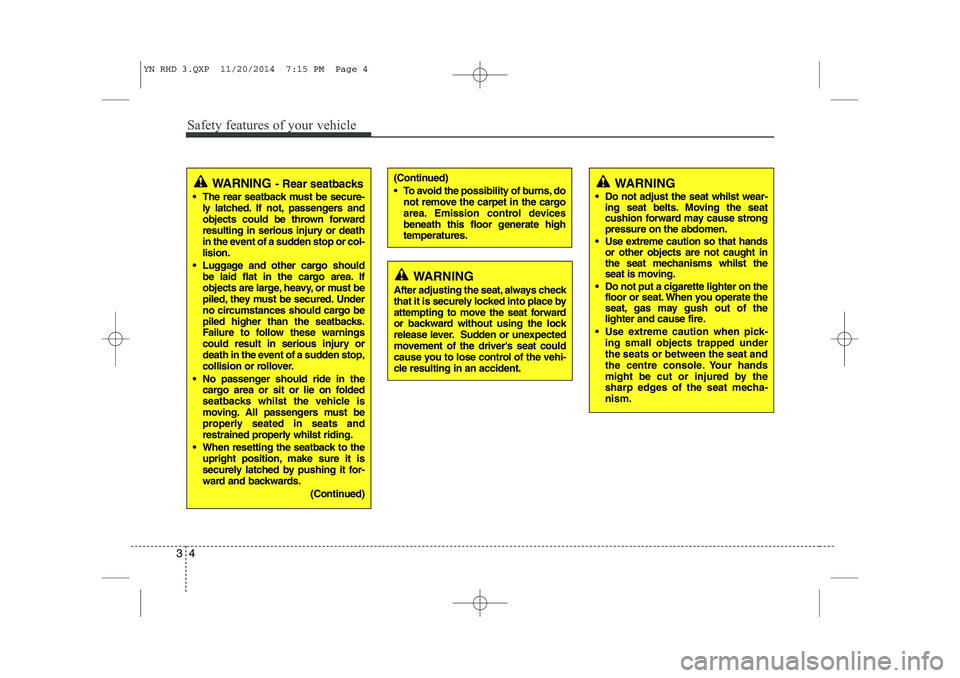
Safety features of your vehicle
4
3
(Continued)
To avoid the possibility of burns, do
not remove the carpet in the cargo
area. Emission control devices
beneath this floor generate hightemperatures.WARNING - Rear seatbacks
The rear seatback must be secure- ly latched. If not, passengers and
objects could be thrown forward
resulting in serious injury or death
in the event of a sudden stop or col-lision.
Luggage and other cargo should be laid flat in the cargo area. If
objects are large, heavy, or must be
piled, they must be secured. Under
no circumstances should cargo be
piled higher than the seatbacks.
Failure to follow these warnings
could result in serious injury or
death in the event of a sudden stop,
collision or rollover.
No passenger should ride in the cargo area or sit or lie on folded
seatbacks whilst the vehicle is
moving. All passengers must be
properly seated in seats and
restrained properly whilst riding.
When resetting the seatback to the upright position, make sure it is
securely latched by pushing it for-
ward and backwards.
(Continued)
WARNING
After adjusting the seat, always check
that it is securely locked into place by
attempting to move the seat forward
or backward without using the lock
release lever. Sudden or unexpected
movement of the driver's seat could
cause you to lose control of the vehi-
cle resulting in an accident.
WARNING
Do not adjust the seat whilst wear- ing seat belts. Moving the seat
cushion forward may cause strongpressure on the abdomen.
Use extreme caution so that hands or other objects are not caught in
the seat mechanisms whilst the
seat is moving.
Do not put a cigarette lighter on the floor or seat. When you operate the
seat, gas may gush out of the
lighter and cause fire.
Use extreme caution when pick- ing small objects trapped under the seats or between the seat and
the centre console. Your hands
might be cut or injured by the
sharp edges of the seat mecha-nism.
YN RHD 3.QXP 11/20/2014 7:15 PM Page 4
Page 89 of 480
Safety features of your vehicle
6
3
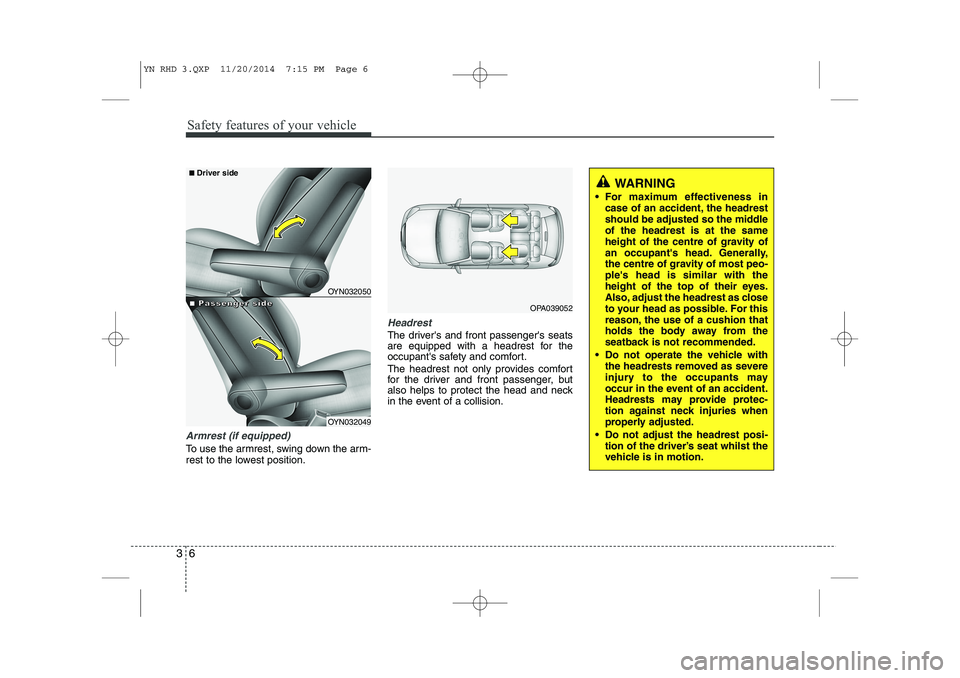
Armrest (if equipped)
To use the armrest, swing down the arm-
rest to the lowest position.
Headrest
The driver's and front passenger's seats
are equipped with a headrest for the
occupant's safety and comfort.
The headrest not only provides comfort
for the driver and front passenger, but
also helps to protect the head and neck
in the event of a collision.
WARNING
For maximum effectiveness in case of an accident, the headrest
should be adjusted so the middleof the headrest is at the same
height of the centre of gravity of
an occupant's head. Generally,
the centre of gravity of most peo-ple's head is similar with the
height of the top of their eyes.
Also, adjust the headrest as close
to your head as possible. For this
reason, the use of a cushion that
holds the body away from the
seatback is not recommended.
Do not operate the vehicle with the headrests removed as severe
injury to the occupants may
occur in the event of an accident.
Headrests may provide protec-
tion against neck injuries when
properly adjusted.
Do not adjust the headrest posi- tion of the driver’s seat whilst the
vehicle is in motion.
OPA039052
OYN032050
OYN032049
■
■
Driver side
■■■■PPPPaaaasssssssseeeennnnggggeeeerrrr ssssiiiiddddeeee
YN RHD 3.QXP 11/20/2014 7:15 PM Page 6
Page 91 of 480
Safety features of your vehicle
8
3
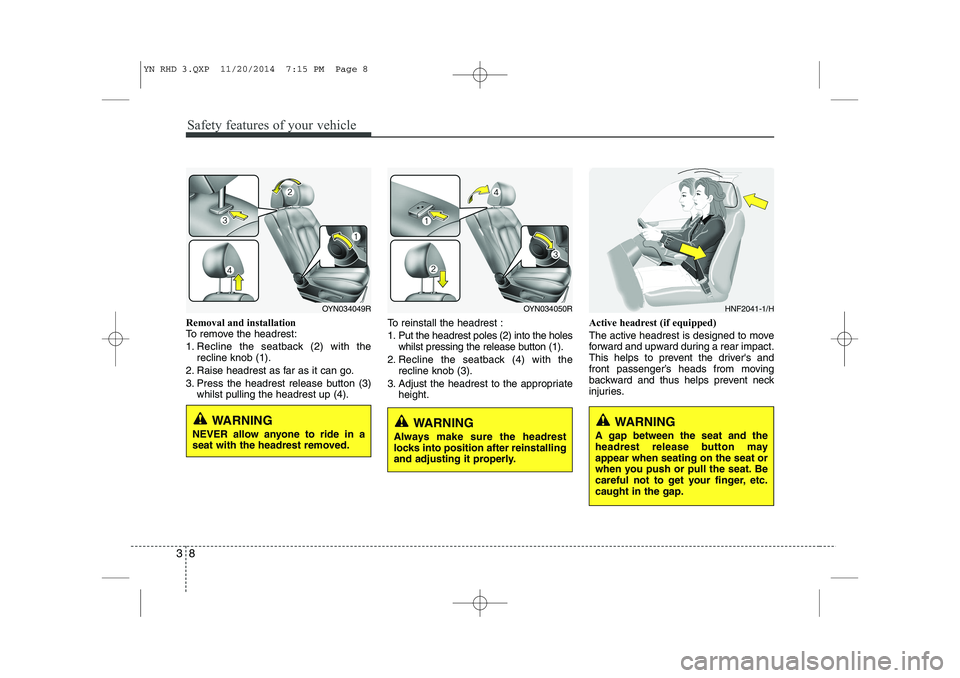
Removal and installation
To remove the headrest:
1. Recline the seatback (2) with the
recline knob (1).
2. Raise headrest as far as it can go.
3. Press the headrest release button (3) whilst pulling the headrest up (4). To reinstall the headrest :
1. Put the headrest poles (2) into the holes
whilst pressing the release button (1).
2. Recline the seatback (4) with the recline knob (3).
3. Adjust the headrest to the appropriate height. Active headrest (if equipped)
The active headrest is designed to move
forward and upward during a rear impact.
This helps to prevent the driver's and
front passenger’s heads from moving
backward and thus helps prevent neck
injuries.
HNF2041-1/H
WARNING
A gap between the seat and the
headrest release button mayappear when seating on the seat or
when you push or pull the seat. Be
careful not to get your finger, etc.caught in the gap.WARNING
Always make sure the headrest
locks into position after reinstalling
and adjusting it properly.
OYN034050R
WARNING
NEVER allow anyone to ride in a
seat with the headrest removed.
OYN034049R
YN RHD 3.QXP 11/20/2014 7:15 PM Page 8
Page 92 of 480
39
Safety features of your vehicle
Seat warmer (if equipped)
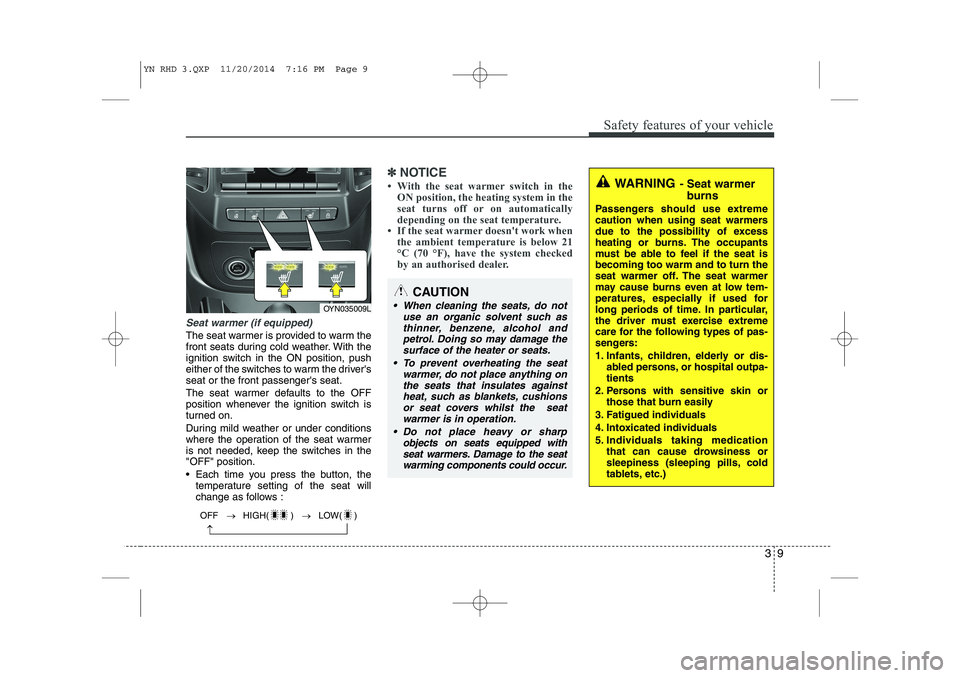
The seat warmer is provided to warm the
front seats during cold weather. With the
ignition switch in the ON position, push
either of the switches to warm the driver'sseat or the front passenger's seat.
The seat warmer defaults to the OFF
position whenever the ignition switch is
turned on.
During mild weather or under conditions
where the operation of the seat warmer
is not needed, keep the switches in the"OFF" position.
Each time you press the button, thetemperature setting of the seat will
change as follows :
✽✽ NOTICE
With the seat warmer switch in the ON position, the heating system in the
seat turns off or on automatically
depending on the seat temperature.
If the seat warmer doesn't work when
the ambient temperature is below 21
°C (70 °F), have the system checked
by an authorised dealer.WARNING - Seat warmer
burns
Passengers should use extreme
caution when using seat warmers
due to the possibility of excess
heating or burns. The occupants
must be able to feel if the seat isbecoming too warm and to turn the
seat warmer off. The seat warmer
may cause burns even at low tem-
peratures, especially if used for
long periods of time. In particular,
the driver must exercise extreme
care for the following types of pas-
sengers:
1. Infants, children, elderly or dis- abled persons, or hospital outpa- tients
2. Persons with sensitive skin or those that burn easily
3. Fatigued individuals
4. Intoxicated individuals
5. Individuals taking medication that can cause drowsiness or
sleepiness (sleeping pills, cold
tablets, etc.)
OYN035009L
CAUTION
When cleaning the seats, do not
use an organic solvent such asthinner, benzene, alcohol andpetrol. Doing so may damage the surface of the heater or seats.
To prevent overheating the seat warmer, do not place anything onthe seats that insulates against heat, such as blankets, cushions
or seat covers whilst the seatwarmer is in operation.
Do not place heavy or sharp objects on seats equipped withseat warmers. Damage to the seat
warming components could occur.
OFF HIGH( ) LOW( )
YN RHD 3.QXP 11/20/2014 7:16 PM Page 9
Page 93 of 480
Safety features of your vehicle
10
3
Seatback pocket (if equipped)Rear seat adjustment
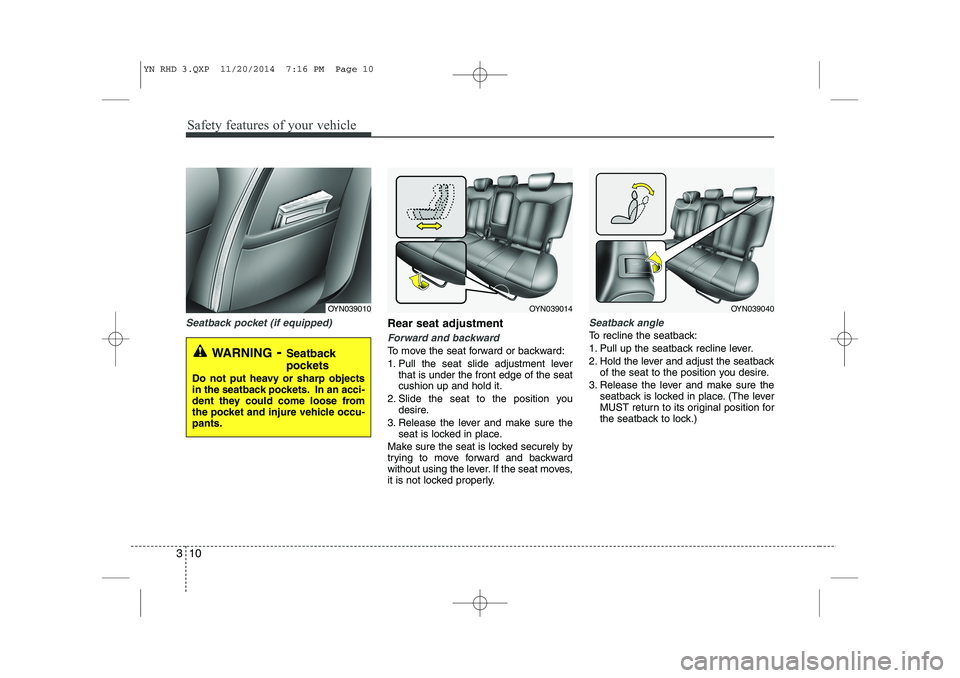
Forward and backward
To move the seat forward or backward:
1. Pull the seat slide adjustment lever
that is under the front edge of the seat cushion up and hold it.
2. Slide the seat to the position you desire.
3. Release the lever and make sure the seat is locked in place.
Make sure the seat is locked securely by
trying to move forward and backward
without using the lever. If the seat moves,
it is not locked properly.
Seatback angle
To recline the seatback:
1. Pull up the seatback recline lever.
2. Hold the lever and adjust the seatback of the seat to the position you desire.
3. Release the lever and make sure the seatback is locked in place. (The lever
MUST return to its original position for
the seatback to lock.)
OYN039040OYN039014
WARNING - Seatback
pockets
Do not put heavy or sharp objects
in the seatback pockets. In an acci-
dent they could come loose from
the pocket and injure vehicle occu-pants.
OYN039010
YN RHD 3.QXP 11/20/2014 7:16 PM Page 10