check engine light KIA VENGA 2015 Owner's Guide
[x] Cancel search | Manufacturer: KIA, Model Year: 2015, Model line: VENGA, Model: KIA VENGA 2015Pages: 480, PDF Size: 23.15 MB
Page 341 of 480
63
What to do in an emergency
2. When the vehicle is stopped, turn onyour emergency hazard flashers, set
the parking brake and put the transaxle
in P (automatic transaxle) or reverse
(manual transaxle).
3. Have all passengers get out of the vehicle. Be sure they all get out on the
side of the vehicle that is away from
traffic.
4. When changing a flat tire, follow the instruction provided later in this sec-tion.
If engine stalls while driving
1. Reduce your speed gradually, keeping a straight line. Move cautiously off the
road to a safe place.
2. Turn on your emergency flashers.
3. Try to start the engine again. If your vehicle will not start, we recommend
that you contact an authorized Kia
dealer. If engine doesn't turn over or
turns over slowly
1. If your vehicle has an automatic
transaxle, be sure the shift lever is in N
(Neutral) or P (Park) and the emer-
gency brake is set.
2. Check the battery connections to be sure they are clean and tight.
3. Turn on the interior light. If the light dims or goes out when you operate the
starter, the battery is discharged.
4. Check the starter connections to be sure they are securely tightened.
5. Do not push or pull the vehicle to start it. See instructions for "Jump starting". If engine turns over normally but
does not start
1. Check the fuel level.
2. With the ignition switch in the LOCK
position, check all connectors at the
ignition coils and spark plugs.
Reconnect any that may be discon-
nected or loose.
3. Check the fuel line in the engine com- partment.
4. If the engine still does not start, we recommend that you call an author-
ized Kia dealer.
IF THE ENGINE WILL NOT START
WARNING
If the engine will not start, do not
push or pull the vehicle to start it.This could result in a collision or
cause other damage. In addition,
push or pull starting may cause the
catalytic converter to be over-
loaded and create a fire hazard.
Page 366 of 480
What to do in an emergency
28
6
✽✽
NOTICE
If the TPMS, Low Tire Pressure and
Position indicators do not illuminate
for 3 seconds when the ignition switch
is turned to the ON position or engine
is running, or if they remain illumi-
nated after coming on for approxi-
mately 3 seconds, we recommend that
you contact an authorized Kia dealer.Low tire pressure tell- tale
Low tire pressure posi- tion telltale
When the tire pressure monitoring
system warning indicators are illumi-
nated, one or more of your tires is
significantly under-inflated. The lowtire pressure position telltale light willindicate which tire is significantly
under-inflated by illuminating the cor-responding position light.
If either telltale illuminates, immedi-
ately reduce your speed, avoid hard
cornering and anticipate increased
stopping distances. You should stop
and check your tires as soon as pos-
sible. Inflate the tires to the proper
pressure as indicated on the vehi-
cle’s placard or tire inflation pressure
label located on the driver’s side cen-
ter pillar outer panel. If you cannot
reach a service station or if the tire
cannot hold the newly added air,
replace the low pressure tire with the
spare tire. Then the TPMS malfunction indicator
may turn on and the Low Tire
Pressure and Position telltales will
remain on after restarting and about
20 minutes of continuous driving
before you have the low pressure tire
repaired and replaced on the vehicle.
CAUTION
In winter or cold weather, the
low tire pressure telltale may beilluminated if the tire pressurewas adjusted to the recom- mended tire inflation pressurein warm weather. It does notmean your TPMS is malfunction- ing because the decreased tem-perature leads to a proportionallowering of tire pressure.
When you drive your vehiclefrom a warm area to a cold area or from a cold area to a warmarea, or the outside temperatureis greatly higher or lower, you should check the tire inflationpressure and adjust the tires tothe recommended tire inflation pressure.
Page 371 of 480
633
What to do in an emergency
Always check the TPMS malfunction telltale after replacing one or more
tires or wheels on your vehicle toensure that the replacement or alter-
nate tires and wheels allow the TPMS
to continue to function properly.
✽✽NOTICE
If any of the below happens, we rec-
ommend that the system be checked
by an authorized Kia dealer.
1.The low tire pressure telltale/ TPMS malfunction indicator do
not illuminate for 3 seconds when
the ignition switch is turned to the
ON position or engine is running.
2. The TPMS malfunction indicator remains illuminated after blinking
for approximately 1 minute.
3. The Low tire pressure position telltale remains illuminated.
Low tire pressure tell- tale
Low tire pressure posi- tion telltale
When the tire pressure monitoring
system warning indicators are illumi-
nated one or more of your tires is sig-
nificantly under-inflated. The low tirepressure position telltale light willindicate which tire is significantly
under-inflated by illuminating the cor-responding position light.
If either telltale illuminates, immediate-
ly reduce your speed, avoid hard cor-
nering and anticipate increased stop-
ping distances. You should stop and
check your tires as soon as possible. Inflate the tires to the proper pres-
sure as indicated on the vehicle’splacard or tire inflation pressure label
located on the driver’s side center pil-lar outer panel.
If you cannot reach a service station
or if the tire cannot hold the newly
added air, replace the low pressure
tire with a spare tire. After you replace the low pressure
tire with the spare tire, one of the fol-
lowing will happen:
The TPMS malfunction indicator
may blink for approximately 1
minute and then remain continuous-
ly illuminated because the TPMSsensor is not mounted on the spare
wheel. (changed tire equipped with
a sensor not in the vehicle)
The TPMS malfunction indicator will remain continuously illuminated
while driving because the TPMSsensor is not mounted on the spare
wheel. (changed tire equipped with
a sensor in the vehicle)
Page 384 of 480
75
Maintenance
OWNER MAINTENANCE
The following lists are vehicle checks and
inspections that should be performed atthe frequencies indicated to help ensure
safe, dependable operation of your vehi-
cle. If you have any question, we recom-
mend that you consult an authorised Kia
dealer.
These Owner Maintenance Checks are
generally not covered by warranties and
you may be charged for labour, parts and
lubricants used. Owner maintenance schedule
When you stop for fuel:
• Check the engine oil level.
Check the coolant level in coolant
reservoir.
Check the windscreen washer fluid level.
Look for low or under-inflated tyres.
Whilst operating your vehicle:
Note any changes in the sound of the exhaust or any smell of exhaust fumes
in the vehicle.
Check for vibrations in the steering wheel. Notice any increased steering
effort or looseness in the steering
wheel, or change in its straight-aheadposition.
Notice if your vehicle constantly turns slightly or “pulls” to one side when trav-
elling on smooth, level road.
When stopping, listen and check for unusual sounds, pulling to one side,
increased brake pedal travel or “hard-
to-push” brake pedal.
If any slipping or changes in the oper- ation of your transaxle occurs, check
the transaxle fluid level.
Check automatic transaxle P (Park) function.
Check the parking brake.
Check for fluid leaks under your vehicle (water dripping from the air condition-
ing system during or after use is nor-mal).
WARNING
Be careful when checking your
engine coolant level when the
engine is hot. Scalding hot coolant
and steam may blow out under
pressure. This could cause burns
or other serious injury.
YN RHD 7.QXP 11/20/2014 6:43 PM Page 5
Page 385 of 480
Maintenance
6
7
At least monthly:
Check the coolant level in the engine
coolant reservoir.
Check the operation of all exterior lights, including the stoplights, turn sig-
nals and hazard warning flashers.
Check the inflation pressures of all tyres including the spare.
At least twice a year
(i.e., every Spring and Fall):
Check the radiator, heater and air con- ditioning hoses for leaks or damage.
Check the windscreen washer spray and wiper operation. Clean wiper
blades with clean cloth dampened with
washer fluid.
Check the headlight alignment.
Check the muffler, exhaust pipes, shields and clamps.
Check the lap/shoulder belts for wear and function.
Check for worn tyres and loose wheel lug nuts.
At least once a year:
Clean the body and door drain holes.
Lubricate the door hinges and checks,and bonnet hinges.
Lubricate the door and bonnet locks and latches.
Lubricate the door rubber weather- strips.
Check the air conditioning system.
Inspect and lubricate automatic transaxle linkage and controls.
Clean the battery and terminals.
Check the brake/clutch fluid level.
YN RHD 7.QXP 11/20/2014 6:43 PM Page 6
Page 411 of 480
Maintenance
32
7
FUEL FILTER (FOR DIESEL)
Draining water from the fuel filter
The fuel filter for diesel engine plays an
important role of separating water from
fuel and accumulating the water in itsbottom.
If water accumulates in the fuel filter, the
warning light comes on when the ignition
switch is in the ON position. If this warning light illuminates,
we recommend that you con-
tact an authorised Kia dealer.
Extracting air from the fuel filter
If you drove until you have no fuel left or
if you replaced the fuel filter, be sure to
extract air in the fuel system as it makes
you difficult to start the engine.
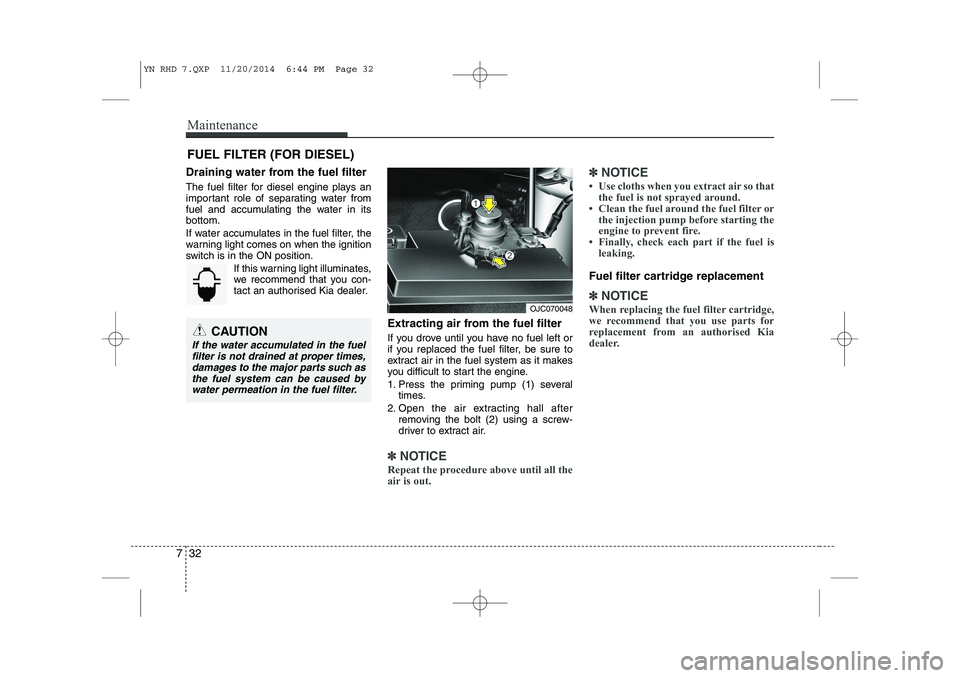
1. Press the priming pump (1) severaltimes.
2. Open the air extracting hall after removing the bolt (2) using a screw-
driver to extract air.
✽✽ NOTICE
Repeat the procedure above until all the
air is out. ✽
✽
NOTICE
Use cloths when you extract air so that the fuel is not sprayed around.
Clean the fuel around the fuel filter or
the injection pump before starting the
engine to prevent fire.
Finally, check each part if the fuel is leaking.
Fuel filter cartridge replacement
✽✽ NOTICE
When replacing the fuel filter cartridge,
we recommend that you use parts for
replacement from an authorised Kia
dealer.
CAUTION
If the water accumulated in the fuel filter is not drained at proper times, damages to the major parts such as
the fuel system can be caused bywater permeation in the fuel filter.
OJC070048
YN RHD 7.QXP 11/20/2014 6:44 PM Page 32
Page 431 of 480
Maintenance
52
7
FUSES
A vehicle’s electrical system is protected
from electrical overload damage by
fuses. This vehicle has 2 (or 3) fuse panels, one
located in the driver’s side panel bolster,
the other in the engine compartment
near the battery.
If any of your vehicle’s lights, acces-
sories, or controls do not work, check the
appropriate circuit fuse. If the fuse is dis-
connected, every electrical system pro-
tected by the fuse will not operate.
Therefore, you must change the fuse. If
the electrical system does not work, first
check the driver’s side fuse panel.
Always replace a blown fuse with one of
the same rating.
Before replacing a blown fuse, disconnect
the negative battery cable.
If the replacement fuse blows, this indi-
cates an electrical problem. Avoid using
the system involved and we recommend
that you consult an authorised Kia deal-
er.
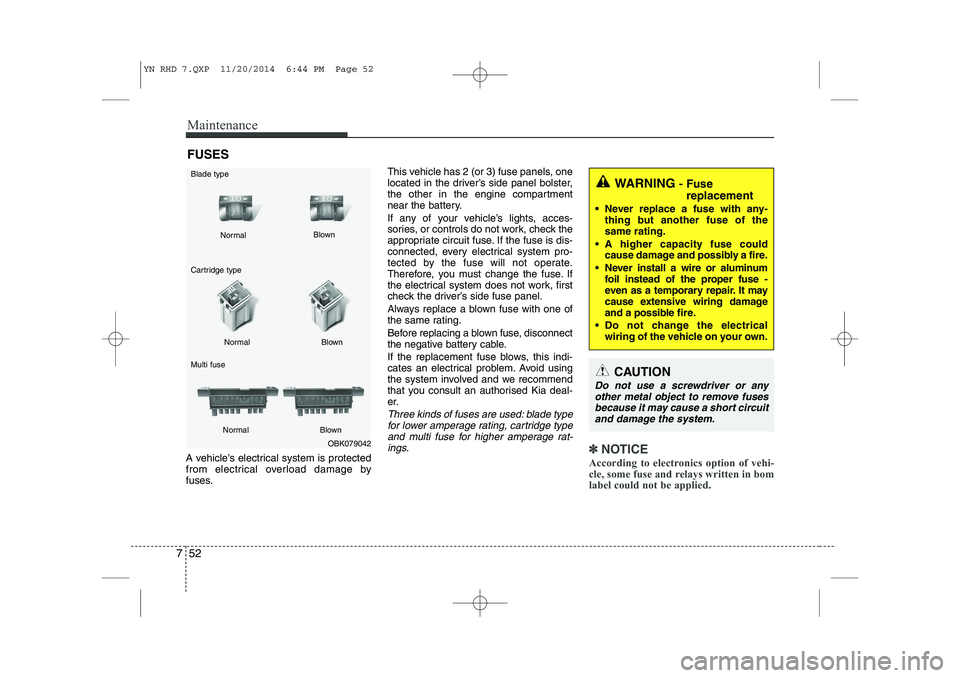
Three kinds of fuses are used: blade type
for lower amperage rating, cartridge typeand multi fuse for higher amperage rat-
ings.
✽✽ NOTICE
According to electronics option of vehi-
cle, some fuse and relays written in bom
label could not be applied.OBK079042
Normal
Normal
Cartridge type Multi fuse Blown
Blown
Normal Blown
CAUTION
Do not use a screwdriver or any other metal object to remove fusesbecause it may cause a short circuit and damage the system.
Blade typeWARNING - Fuse
replacement
Never replace a fuse with any- thing but another fuse of the same rating.
A higher capacity fuse could cause damage and possibly a fire.
Never install a wire or aluminum foil instead of the proper fuse -
even as a temporary repair. It may
cause extensive wiring damage
and a possible fire.
Do not change the electrical
wiring of the vehicle on your own.
YN RHD 7.QXP 11/20/2014 6:44 PM Page 52
Page 432 of 480
753
Maintenance
✽✽NOTICE
The actual fuse/relay panel label may
differ from equipped items.
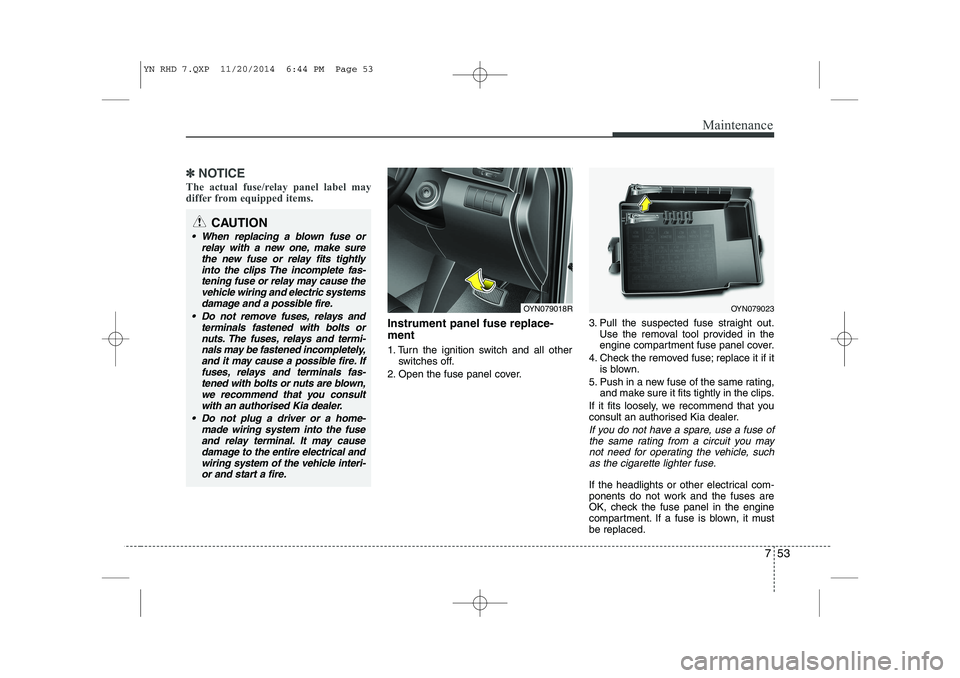
Instrument panel fuse replace- ment
1. Turn the ignition switch and all other switches off.
2. Open the fuse panel cover. 3. Pull the suspected fuse straight out.
Use the removal tool provided in the
engine compartment fuse panel cover.
4. Check the removed fuse; replace it if it is blown.
5. Push in a new fuse of the same rating, and make sure it fits tightly in the clips.
If it fits loosely, we recommend that you
consult an authorised Kia dealer.
If you do not have a spare, use a fuse of the same rating from a circuit you may
not need for operating the vehicle, suchas the cigarette lighter fuse.
If the headlights or other electrical com-
ponents do not work and the fuses are
OK, check the fuse panel in the engine
compartment. If a fuse is blown, it mustbe replaced.
OYN079023OYN079018R
CAUTION
When replacing a blown fuse or
relay with a new one, make surethe new fuse or relay fits tightly into the clips The incomplete fas-tening fuse or relay may cause the
vehicle wiring and electric systems damage and a possible fire.
Do not remove fuses, relays and terminals fastened with bolts or
nuts. The fuses, relays and termi-nals may be fastened incompletely, and it may cause a possible fire. Iffuses, relays and terminals fas-
tened with bolts or nuts are blown, we recommend that you consultwith an authorised Kia dealer.
Do not plug a driver or a home- made wiring system into the fuse
and relay terminal. It may cause damage to the entire electrical andwiring system of the vehicle interi-or and start a fire.
YN RHD 7.QXP 11/20/2014 6:44 PM Page 53
Page 461 of 480
Maintenance
82
7
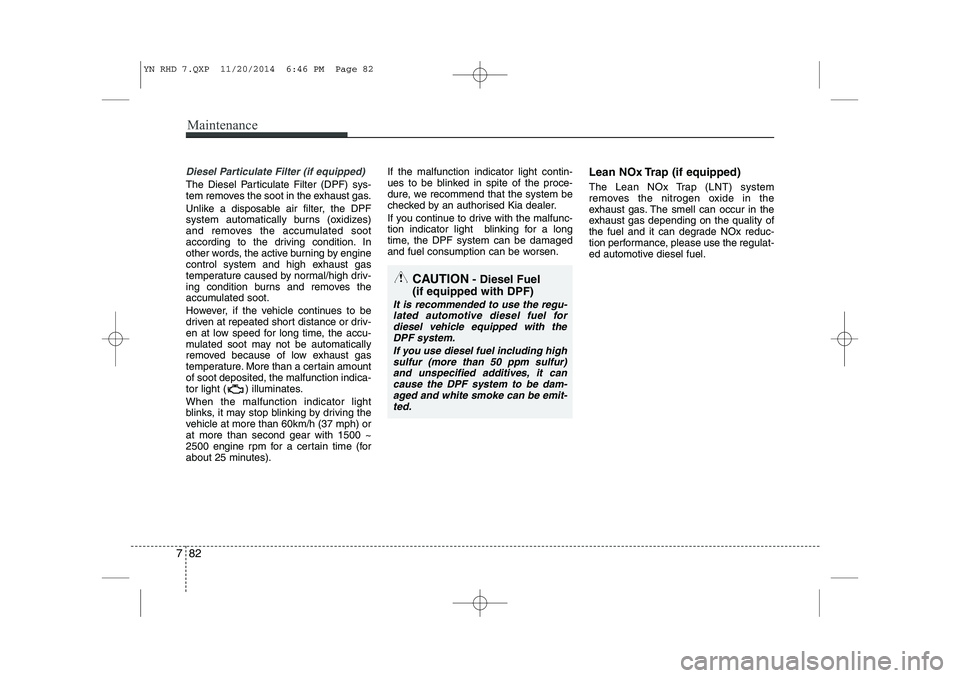
Diesel Particulate Filter (if equipped)
The Diesel Particulate Filter (DPF) sys-
tem removes the soot in the exhaust gas.
Unlike a disposable air filter, the DPF
system automatically burns (oxidizes)
and removes the accumulated soot
according to the driving condition. In
other words, the active burning by engine
control system and high exhaust gas
temperature caused by normal/high driv-
ing condition burns and removes the
accumulated soot.
However, if the vehicle continues to be
driven at repeated short distance or driv-
en at low speed for long time, the accu-
mulated soot may not be automatically
removed because of low exhaust gas
temperature. More than a certain amountof soot deposited, the malfunction indica-
tor light ( ) illuminates. When the malfunction indicator light
blinks, it may stop blinking by driving the
vehicle at more than 60km/h (37 mph) orat more than second gear with 1500 ~
2500 engine rpm for a certain time (for
about 25 minutes). If the malfunction indicator light contin-
ues to be blinked in spite of the proce-
dure, we recommend that the system be
checked by an authorised Kia dealer.
If you continue to drive with the malfunc-
tion indicator light blinking for a long
time, the DPF system can be damaged
and fuel consumption can be worsen.
Lean NOx Trap (if equipped)
The Lean NOx Trap (LNT) system
removes the nitrogen oxide in the
exhaust gas. The smell can occur in the
exhaust gas depending on the quality of
the fuel and it can degrade NOx reduc-
tion performance, please use the regulat-
ed automotive diesel fuel.
CAUTION
- Diesel Fuel
(if equipped with DPF)
It is recommended to use the regu- lated automotive diesel fuel for
diesel vehicle equipped with the DPF system.
If you use diesel fuel including highsulfur (more than 50 ppm sulfur) and unspecified additives, it can
cause the DPF system to be dam- aged and white smoke can be emit-ted.
YN RHD 7.QXP 11/20/2014 6:46 PM Page 82
Page 474 of 480
I3
Index
Care
Exterior care . . . . . . . . . . . . . . . . . . . . . . . . . . . . . . . . 7-73
Interior care . . . . . . . . . . . . . . . . . . . . . . . . . . . . . . . . 7-78
Tire care . . . . . . . . . . . . . . . . . . . . . . . . . . . . . . . . . . . 7-42
Catalytic converters . . . . . . . . . . . . . . . . . . . . . . . . . . . 7-81
Center console storage . . . . . . . . . . . . . . . . . . . . . . . . . 4-92
Central door lock switch. . . . . . . . . . . . . . . . . . . . . . . . 4-14
Certification label . . . . . . . . . . . . . . . . . . . . . . . . . . . . . . 8-8
Chains Tire chains . . . . . . . . . . . . . . . . . . . . . . . . . . . . . . . . . 5-50
Changing tires . . . . . . . . . . . . . . . . . . . . . . . . . . . . . . . . . 6-8
Checking tire inflation pressure . . . . . . . . . . . . . . . . . . 7-43
Child restraint system . . . . . . . . . . . . . . . . . . . . . . . . . . 3-26 ISOFIX system . . . . . . . . . . . . . . . . . . . . . . . . . . . . . . 3-32
Recommended child restraint system. . . . . . . . . . . . . 3-36
Tether anchor system . . . . . . . . . . . . . . . . . . . . . . . . . 3-31
Child-protector rear door lock . . . . . . . . . . . . . . . . . . . 4-16
Cigarette lighter . . . . . . . . . . . . . . . . . . . . . . . . . . . . . . 4-95
Climate control (automatic) . . . . . . . . . . . . . . . . . . . . . 4-82
Climate control (manual) . . . . . . . . . . . . . . . . . . . . . . . 4-73
Climate control air filter . . . . . . . . . . . . . . . . . . . . . 4-80,88
Climate control air filter (replacement) . . . . . . . . . . . . 7-34
Clock (Digital) . . . . . . . . . . . . . . . . . . . . . . . . . . . . . . . 4-94
Clothes hanger . . . . . . . . . . . . . . . . . . . . . . . . . . . . . . . 4-99
Combined instrument, see instrument cluster . . . . . . . 4-40
Compact spare tire . . . . . . . . . . . . . . . . . . . . . . . . . . . . 6-13 Compact spare tire replacement . . . . . . . . . . . . . . . . . . 7-47
Components of the tire mobility kit . . . . . . . . . . 6-17, 6-22
Coolant . . . . . . . . . . . . . . . . . . . . . . . . . . . . . . . . . . . . . 7-25
Cool box . . . . . . . . . . . . . . . . . . . . . . . . . . . . . . . . . . . . 4-93
Cooling fluid, see engine coolant . . . . . . . . . . . . . . . . . 7-25
Crankcase emission control system . . . . . . . . . . . . . . . 7-79
Cruise control system . . . . . . . . . . . . . . . . . . . . . . . . . . 5-36
Cup holder . . . . . . . . . . . . . . . . . . . . . . . . . . . . . . . . . . 4-96
Curtain air bag . . . . . . . . . . . . . . . . . . . . . . . . . . . . . . . 3-51
Dashboard illumination, see instrument panel illumination. . 4-42
Dashboard, see instrument cluster . . . . . . . . . . . . . . . . 4-40
Declaration of conformity . . . . . . . . . . . . . . . . . . . . . . 8-10
Defogging (Windshield) . . . . . . . . . . . . . . . . . . . . . . . . 4-90
Defroster (Rear window) . . . . . . . . . . . . . . . . . . . . . . . 4-72
Defrosting (Windshield) . . . . . . . . . . . . . . . . . . . . . . . . 4-90
Diesel particulate filter . . . . . . . . . . . . . . . . . . . . . . . . . 7-82
Digital clock . . . . . . . . . . . . . . . . . . . . . . . . . . . . . . . . . 4-94
Dimensions . . . . . . . . . . . . . . . . . . . . . . . . . . . . . . . . . . . 8-2
Display illumination, see instrument panel illumination . . 4-42
Displays, see instrument cluster . . . . . . . . . . . . . . . . . . 4-40
Door locks. . . . . . . . . . . . . . . . . . . . . . . . . . . . . . . . . . . 4-13
Central door lock switch . . . . . . . . . . . . . . . . . . . . . . 4-14
Child-protector rear door lock . . . . . . . . . . . . . . . . . . 4-16
DPF . . . . . . . . . . . . . . . . . . . . . . . . . . . . . . . . . . . . . . . . 7-82
D