turn signal KIA VENGA 2015 Owners Manual
[x] Cancel search | Manufacturer: KIA, Model Year: 2015, Model line: VENGA, Model: KIA VENGA 2015Pages: 480, PDF Size: 23.15 MB
Page 4 of 480
4
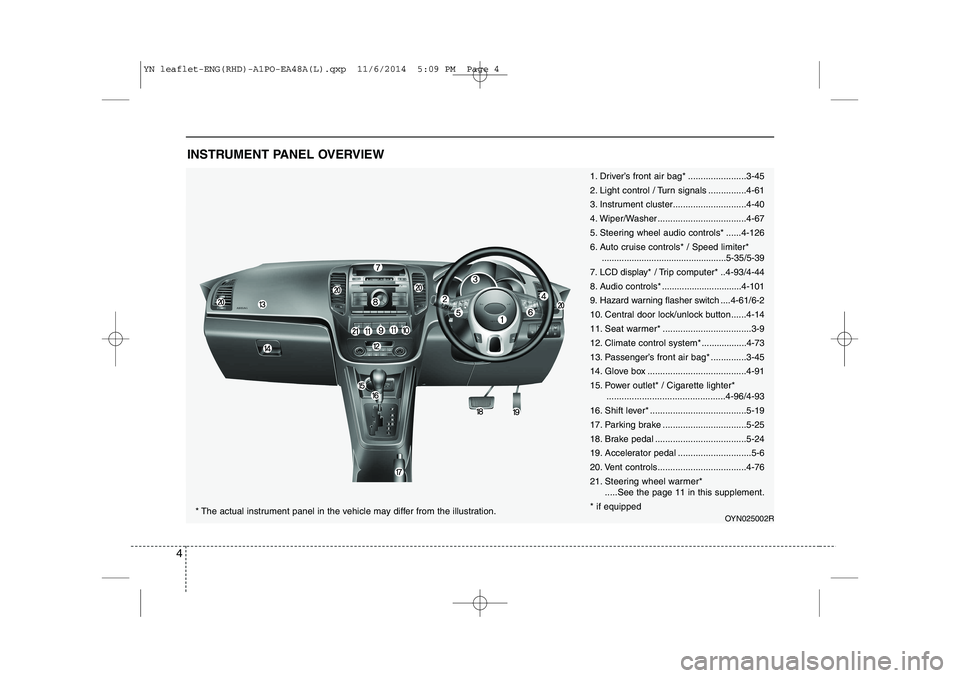
INSTRUMENT PANEL OVERVIEW
1. Driver’s front air bag* .......................3-45
2. Light control / Turn signals ...............4-61
3. Instrument cluster.............................4-40
4. Wiper/Washer ...................................4-67
5. Steering wheel audio controls* ......4-126
6. Auto cruise controls* / Speed limiter*..................................................5-35/5-39
7. LCD display* / Trip computer* ..4-93/4-44
8. Audio controls * ................................4-101
9. Hazard warning flasher switch ....4-61/6-2
10. Central door lock/unlock button......4-14
11. Seat warmer* ...................................3-9
12. Climate control system*..................4-73
13. Passenger’s front air bag* ..............3-45
14. Glove box .......................................4-91
15. Power outlet* / Cigarette lighter* ...............................................4-96/4-93
16. Shift lever* ......................................5-19
17. Parking brake .................................5-25
18. Brake pedal ....................................5-24
19. Accelerator pedal .............................5-6
20. Vent controls...................................4-7621.
Steering wheel warmer*
.....See the page 11 in this supplement.
* if equipped
OYN025002R* The actual instrument panel in the vehicle may differ from the illustration.
YN leaflet-ENG(RHD)-A1PO-EA48A(L).qxp 11/6/2014 5:09 PM Page 4
Page 12 of 480

12
❖❖Please see this page instead of page 4-40 in owner's manual.
INSTRUMENT CLUSTER
OYN045042L/OYN045043L* The actual cluster in the vehicle may differ from the illustration.
■
Diesel Engine
Type A
Type B
1. Tachometer
2. Turn signal indicators
3. Speedometer
4. Warning and indicator lights
5. Automatic transaxle shift position indicator* or Manual transaxle shift indicator*
6. Odometer/Tripmeter*
7. Fuel gauge* if equipped
YN leaflet-ENG(RHD)-A1PO-EA48A(L).qxp 11/6/2014 5:10 PM Page 12
Page 13 of 480
13
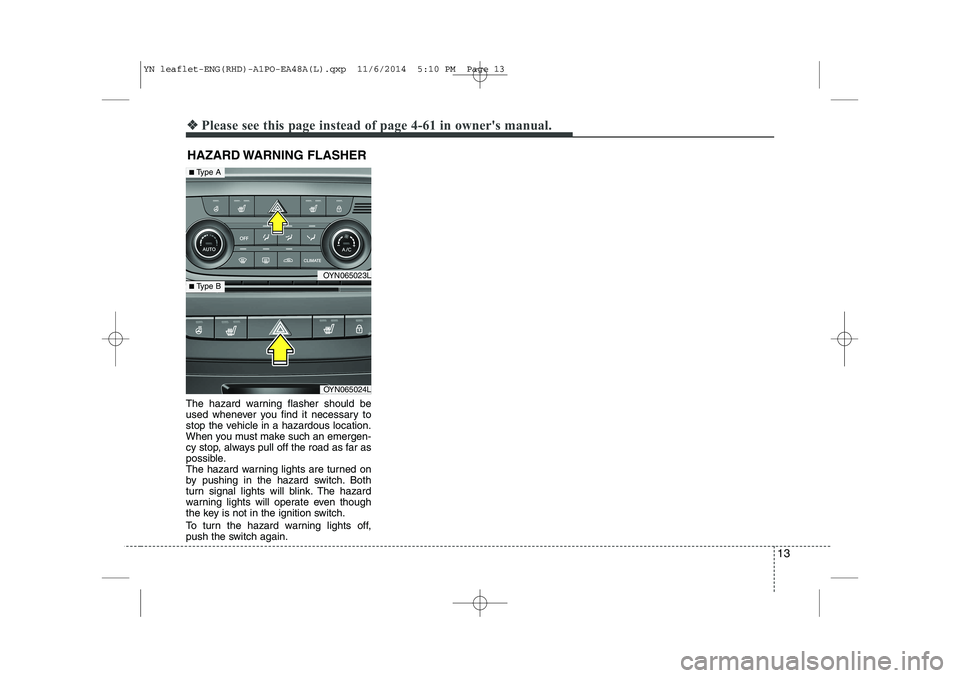
❖❖Please see this page instead of page 4-61 in owner's manual.
The hazard warning flasher should be
used whenever you find it necessary to
stop the vehicle in a hazardous location.
When you must make such an emergen-
cy stop, always pull off the road as far as
possible.
The hazard warning lights are turned on
by pushing in the hazard switch. Both
turn signal lights will blink. The hazard
warning lights will operate even though
the key is not in the ignition switch.
To turn the hazard warning lights off,
push the switch again.HAZARD WARNING FLASHER
OYN065023L
OYN065024L
■
Type A
■ Type B
YN leaflet-ENG(RHD)-A1PO-EA48A(L).qxp 11/6/2014 5:10 PM Page 13
Page 31 of 480
31
❖❖Please see this page instead of page 6-2 in owner's manual.
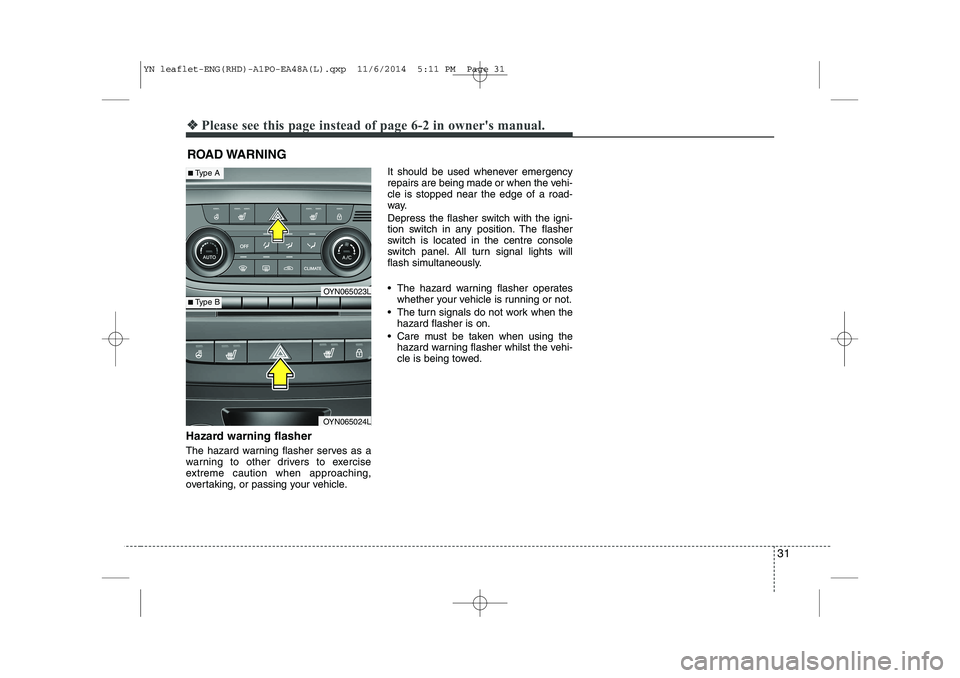
Hazard warning flasher
The hazard warning flasher serves as a
warning to other drivers to exercise
extreme caution when approaching,
overtaking, or passing your vehicle. It should be used whenever emergency
repairs are being made or when the vehi-cle is stopped near the edge of a road-
way.
Depress the flasher switch with the igni-
tion switch in any position. The flasher
switch is located in the centre console
switch panel. All turn signal lights will
flash simultaneously.
The hazard warning flasher operates
whether your vehicle is running or not.
The turn signals do not work when the hazard flasher is on.
Care must be taken when using the hazard warning flasher whilst the vehi-
cle is being towed.
ROAD WARNING
OYN065023L
■
Type A
OYN065024L
■Type B
YN leaflet-ENG(RHD)-A1PO-EA48A(L).qxp 11/6/2014 5:11 PM Page 31
Page 53 of 480
53
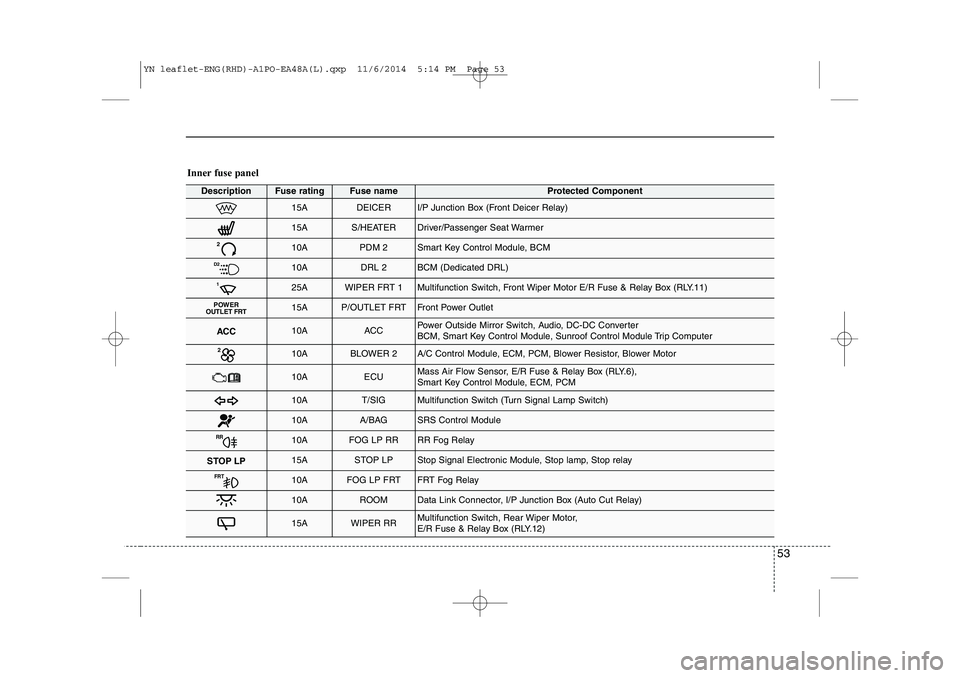
Inner fuse panel
DescriptionFuse ratingFuse nameProtected Component
15ADEICERI/P Junction Box (Front Deicer Relay)
15AS/HEATERDriver/Passenger Seat Warmer
210APDM 2Smart Key Control Module, BCM
D210ADRL 2BCM (Dedicated DRL)
125AWIPER FRT 1Multifunction Switch, Front Wiper Motor E/R Fuse & Relay Box (RLY.11)
POWER
OUTLET FRT15AP/OUTLET FRTFront Power Outlet
ACC10AACCPower Outside Mirror Switch, Audio, DC-DC Converter
BCM, Smart Key Control Module, Sunroof Control Module Trip Computer
210ABLOWER 2A/C Control Module, ECM, PCM, Blower Resistor, Blower Motor
10AECUMass Air Flow Sensor, E/R Fuse & Relay Box (RLY.6),
Smart Key Control Module, ECM, PCM
10AT/SIGMultifunction Switch (Turn Signal Lamp Switch)
10AA/BAGSRS Control Module
RR10AFOG LP RRRR Fog Relay
STOP LP15ASTOP LPStop Signal Electronic Module, Stop lamp, Stop relay
FRT10AFOG LP FRTFRT Fog Relay
10AROOMData Link Connector, I/P Junction Box (Auto Cut Relay)
15AWIPER RRMultifunction Switch, Rear Wiper Motor,
E/R Fuse & Relay Box (RLY.12)
YN leaflet-ENG(RHD)-A1PO-EA48A(L).qxp 11/6/2014 5:14 PM Page 53
Page 60 of 480
60
❖❖Please see this page instead of page 7-63 in owner's manual.
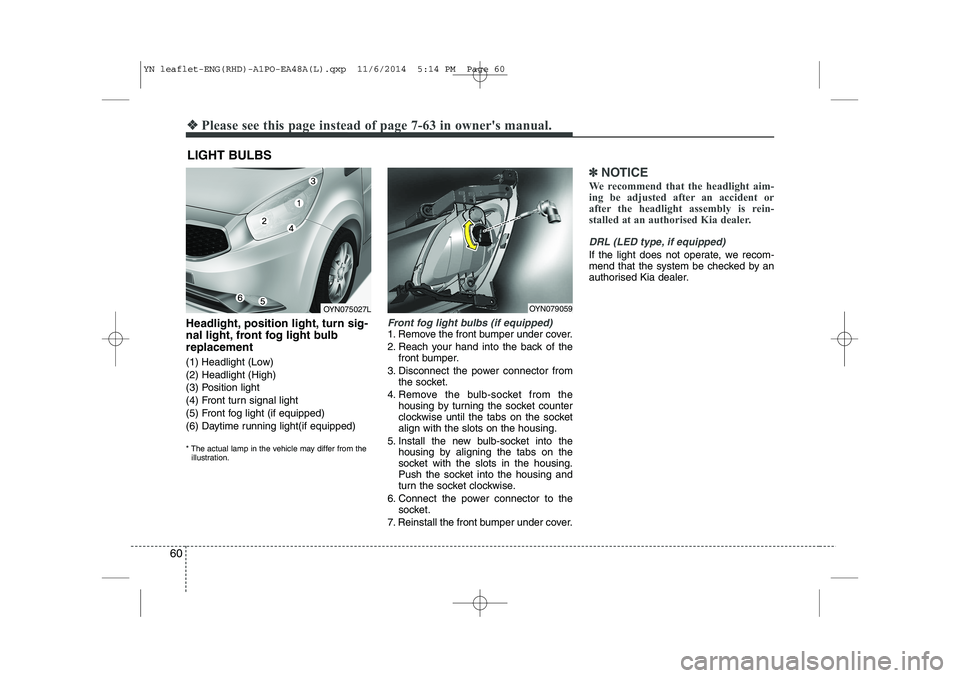
Headlight, position light, turn sig-
nal light, front fog light bulbreplacement
(1) Headlight (Low) (2) Headlight (High)
(3) Position light
(4) Front turn signal light
(5) Front fog light (if equipped)
(6) Daytime running light(if equipped)
* The actual lamp in the vehicle may differ from the
illustration.Front fog light bulbs (if equipped)1. Remove the front bumper under cover.
2. Reach your hand into the back of the
front bumper.
3. Disconnect the power connector from the socket.
4. Remove the bulb-socket from the housing by turning the socket counter
clockwise until the tabs on the socketalign with the slots on the housing.
5. Install the new bulb-socket into the housing by aligning the tabs on the
socket with the slots in the housing.
Push the socket into the housing and
turn the socket clockwise.
6. Connect the power connector to the socket.
7. Reinstall the front bumper under cover.
✽✽ NOTICE
We recommend that the headlight aim-
ing be adjusted after an accident or
after the headlight assembly is rein-
stalled at an authorised Kia dealer.
DRL (LED type, if equipped)
If the light does not operate, we recom-
mend that the system be checked by an
authorised Kia dealer.
LIGHT BULBS
OYN075027LOYN079059
YN leaflet-ENG(RHD)-A1PO-EA48A(L).qxp 11/6/2014 5:14 PM Page 60
Page 64 of 480
64
❖❖Please see this page instead of page 8-2 in owner's manual.
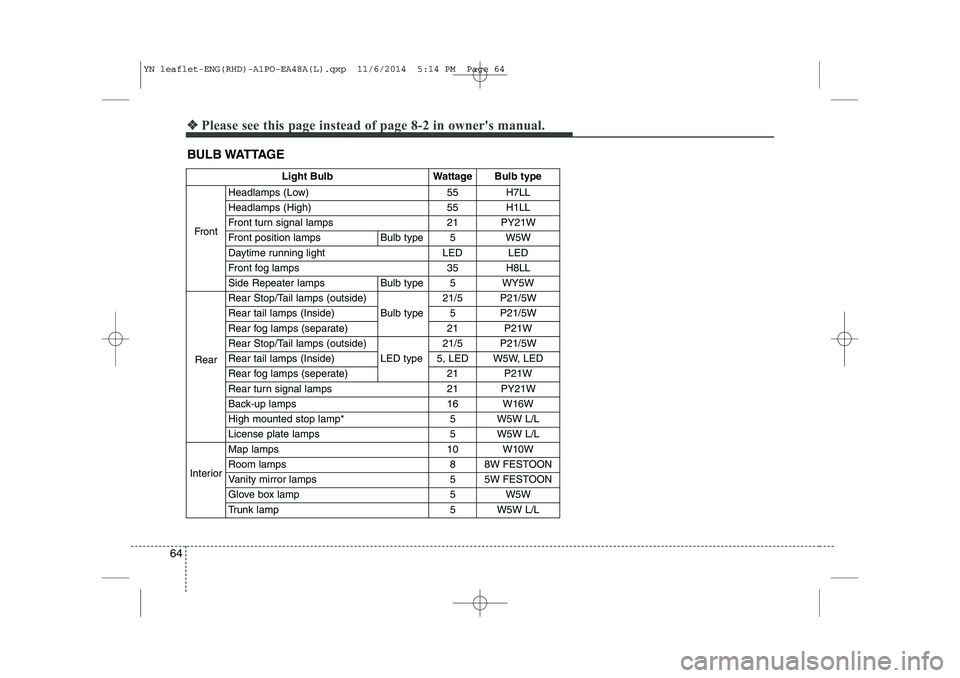
BULB WATTAGE
Light BulbWattageBulb type
Front
Headlamps (Low) 55H7LL
Headlamps (High) 55H1LL
Front turn signal lamps 21PY21W
Front position lamps Bulb type5W5W
Daytime running lightLEDLED
Front fog lamps 35H8LL
Side Repeater lamps Bulb type5WY5W
Rear
Rear Stop/Tail lamps (outside)
Bulb type
21/5P21/5W
Rear tail lamps (Inside)5P21/5W
Rear fog lamps (separate)21P21W
Rear Stop/Tail lamps (outside)
LED type
21/5P21/5W
Rear tail lamps (Inside)5, LEDW5W, LED
Rear fog lamps (seperate) 21P21W
Rear turn signal lamps21PY21W
Back-up lamps16W16W
High mounted stop lamp* 5W5W L/L
License plate lamps5W5W L/L
Interior
Map lamps 10W10W
Room lamps88W FESTOON
Vanity mirror lamps55W FESTOON
Glove box lamp5W5W
Trunk lamp 5W5W L/L
YN leaflet-ENG(RHD)-A1PO-EA48A(L).qxp 11/6/2014 5:14 PM Page 64
Page 82 of 480
25
Your vehicle at a glance
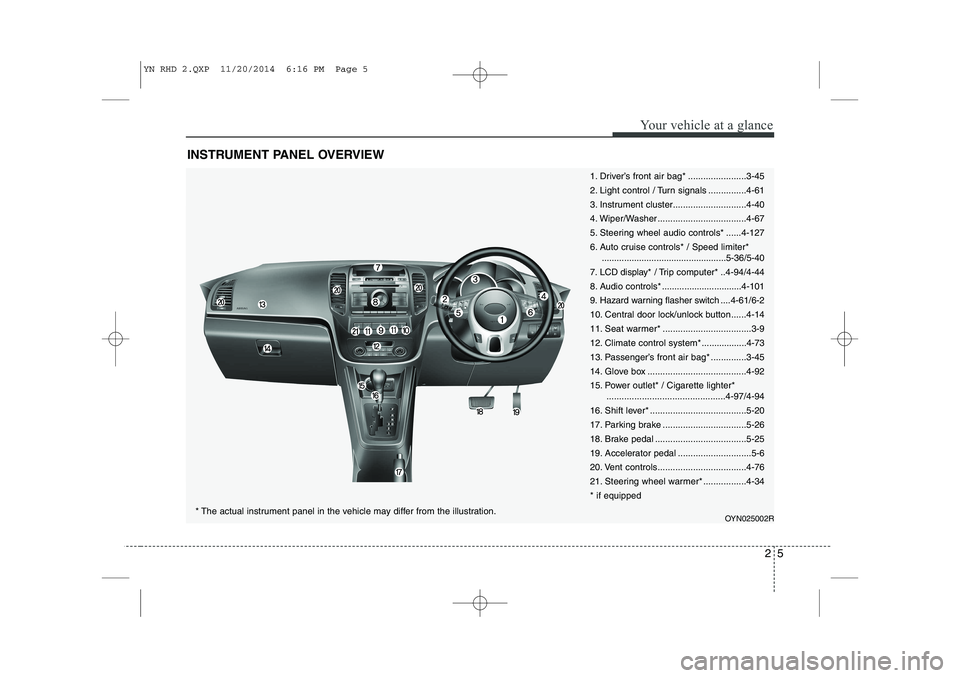
INSTRUMENT PANEL OVERVIEW
1. Driver’s front air bag* .......................3-45
2. Light control / Turn signals ...............4-61
3. Instrument cluster.............................4-40
4. Wiper/Washer ...................................4-67
5. Steering wheel audio controls* ......4-127
6. Auto cruise controls* / Speed limiter*..................................................5-36/5-40
7. LCD display* / Trip computer* ..4-94/4-44
8. Audio controls * ................................4-101
9. Hazard warning flasher switch ....4-61/6-2
10. Central door lock/unlock button......4-14
11. Seat warmer* ...................................3-9
12. Climate control system*..................4-73
13. Passenger’s front air bag* ..............3-45
14. Glove box .......................................4-92
15. Power outlet* / Cigarette lighter* ...............................................4-97/4-94
16. Shift lever* ......................................5-20
17. Parking brake .................................5-26
18. Brake pedal ....................................5-25
19. Accelerator pedal .............................5-6
20. Vent controls...................................4-7621.
Steering wheel warmer* .................4-34
* if equipped
OYN025002R
* The actual instrument panel in the vehicle may differ from the illustration.
YN RHD 2.QXP 11/20/2014 6:16 PM Page 5
Page 122 of 480
339
Safety features of your vehicle
How does the air bag system operate
Air bags are activated (able to inflate ifnecessary) only when the ignition
switch is turned to the ON or STARTposition.
Air bags inflate instantly in the event of serious frontal or side collision (if
equipped with side air bag or curtainair bag) in order to help protect the
occupants from serious physical injury.
There is no single speed at which the air bags will inflate.
Generally, air bags are designed to
inflate based upon the severity of a col-
lision and its direction. These two fac-
tors determine whether the sensors
produce an electronic deployment/inflation signal.
Air bag deployment depends on a number of factors including vehiclespeed, angles of impact and the densi-
ty and stiffness of the vehicles or
objects which your vehicle hits in the
collision. The determining, factors are
not limited to those mentioned above.
The front air bags will completely inflate and deflate in an instant. It is virtually impossible for you to see
the air bags inflate during an accident.
It is much more likely that you will sim-ply see the deflated air bags hanging
out of their storage compartments afterthe collision.
In order to help provide protection in a severe collision, the air bags must
inflate rapidly. The speed of air bag
inflation is a consequence of extremely
short time in which a collision occursand the need to get the air bag
between the occupant and the vehicle
structures before the occupant impacts
those structures. This speed of inflation
reduces the risk of serious or life-
threatening injuries in a severe collision
and is thus a necessary part of air bagdesign.
However, air bag inflation can also
cause injuries which can include facial
abrasions, bruises and broken bonesbecause the inflation speed also caus-
es the air bags to expand with a great
deal of force.
There are even circumstances under which contact with the steer-
ing wheel air bag can cause fatal
injuries, especially if the occupant
is positioned excessively close tothe steering wheel.
WARNING
To avoid severe personal injury or death caused by deploying air
bags in a collision, the driver
should sit as far back from the
steering wheel air bag as possible
(at least 250 mm (10 inches)
away). The front passenger should
always move their seat as far
back as possible and sit back intheir seat.
Air bag inflates instantly in an event of a collision, passengers
may be injured by the air bag
expansion force if they are not in
a proper position.
Air bag inflation may cause injuries including facial or bodily
abrasions, injuries from broken
glasses or burns.
YN RHD 3.QXP 11/20/2014 7:17 PM Page 39
Page 183 of 480
Features of your vehicle
40
4
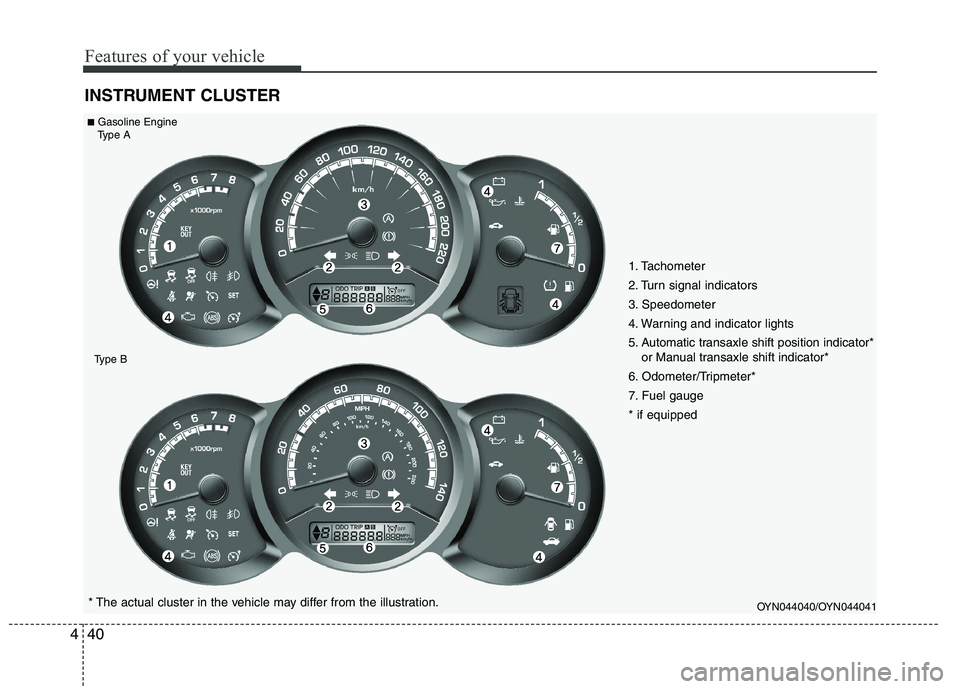
INSTRUMENT CLUSTER
OYN044040/OYN044041* The actual cluster in the vehicle may differ from the illustration.
■
Gasoline Engine
Type A
Type B
1. Tachometer
2. Turn signal indicators
3. Speedometer
4. Warning and indicator lights
5. Automatic transaxle shift position indicator* or Manual transaxle shift indicator*
6. Odometer/Tripmeter*
7. Fuel gauge* if equipped