seats KIA VENGA 2016 User Guide
[x] Cancel search | Manufacturer: KIA, Model Year: 2016, Model line: VENGA, Model: KIA VENGA 2016Pages: 404, PDF Size: 21.96 MB
Page 39 of 404
325
Safety features of your vehicle
Do not lie down
To reduce the chance of injuries in the
event of an accident and to achieve max-
imum effectiveness of the restraint sys-tem, all passengers should be sitting upand the front and rear seats should be in
an upright position when the car is mov-
ing. A seat belt cannot provide proper
protection if the person is lying down inthe rear seat or if the front and rear seatsare in a reclined position.Care of seat belts
Seat belt systems should never be disas-
sembled or modified. In addition, care
should be taken to assure that seat belts
and belt hardware are not damaged by
seat hinges, doors or other abuse.
Periodic inspection
All seat belts should be inspected peri-
odically for wear or damage of any kind.
Any damaged parts should be replaced
as soon as possible.
Keep belts clean and dry
Seat belts should be kept clean and dry.
If belts become dirty, they can be
cleaned by using a mild soap solution
and warm water. Bleach, dye, strong
detergents or abrasives should not be
used because they may damage and
weaken the fabric.
When to replace seat belts
The entire in-use seat belt assembly or
assemblies should be replaced if the
vehicle has been involved in an accident.
This should be done even if no damage is
visible. Additional questions concerning
seat belt operation we recommend that
you consult an authorized Kia dealer.
WARNING
When you return the rear seat- back to its upright position after
the rear seatback has been folded
down, be careful not to damage
the seat belt webbing or buckle.
Be sure that the webbing or buck-
le does not get caught or pinched
in the rear seat. A seat belt with
damaged webbing or buckle
could possibly fail during a colli-
sion or sudden stop, resulting in
serious injury. If the webbing or
buckles are damaged, get them
replaced immediately.
Seatbelts can become hot in a vehicle that has been closed up
in sunny weather. They could
burn infants and children.
WARNING
Riding with a reclined seatback
increases your chance of serious or
fatal injuries in the event of a colli-
sion or sudden stop. The protection
of your restraint system (seat belts
and air bags) is greatly reduced by
reclining your seat. Seat belts must
be snug against your hips and
chest to work properly. The more
the seatback is reclined, the greater
the chance that an occupant's hipswill slide under the lap belt causingserious internal injuries or the
occupant's neck could strike the
shoulder belt. Drivers and passen-
gers should always sit well back in
their seats, properly belted, andwith the seat backs upright.
YN ENG 3.QXP 28.11.2016 16:04 Page 25
Page 40 of 404
Safety features of your vehicle
26
3
Children riding in the car should sit in the
rear seat and must always be properly
restrained to minimize the risk of injury inan accident, sudden stop or sudden
maneuver. According to accident statis-
tics, children are safer when properly
restrained in the rear seats than in the
front seat. Larger children not in a child
restraint should use one of the seat belts
provided.
You should be aware of the specific
requirements in your country. Child and/or
infant safety seats must be properly
placed and installed in the rear seat. You
must use a commercially available child
restraint system that meets the re quire-
ments of the Safety Standards of your
country.
Child restraint systems are designed to
be secured in vehicle seats by lap belts
or the lap belt portion of a lap/shoulder
belt, or by a tether anchor and/or ISOFIXanchors (if equipped). Children could be injured or killed in a
crash if their restraints are not properly
secured. For small children and babies, a
child seat or infant seat must be used. Before buying a particular child restraint
system, make sure it fits your car seat
and seat belts, and fits your child. Follow
all the instructions provided by the man-
ufacturer when installing the child
restraint system.
CHILD RESTRAINT SYSTEM
WARNING
A child restraint system must be placed in the rear seat. Never
install a child or infant seat on the
front passenger's seat. Should anaccident occur and cause the
passenger-side air bag to deploy,
it could severely injure or kill an
infant or child seated in an infant
or child seat. Thus only use a
child restraint in the rear seat of
your vehicle.
A seat belt or child restraint sys- tem can become very hot if it is
left in a closed vehicle on a sunny
day, even if the outside tempera-
ture does not feel hot. Be sure to
check the seat cover and buckles
before placing a child there.
(Continued)
(Continued)
When the child restraint systemis not in use, store it in the lug-
gage area or fasten it with a seat
belt so that it will not be thrown
forward in the case of a suddenstop or an accident.
Children may be seriously injured or killed by an inflating air bag.
All children, even those too large
for child restraints, must ride inthe rear seat.
YN ENG 3.QXP 28.11.2016 16:04 Page 26
Page 42 of 404
Safety features of your vehicle
28
3
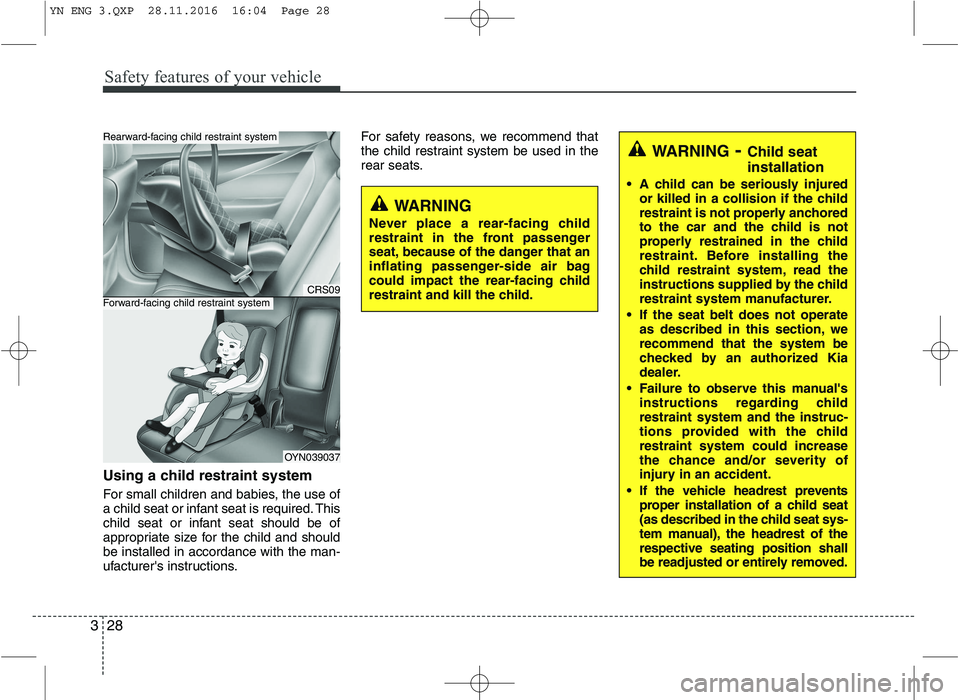
Using a child restraint system
For small children and babies, the use of
a child seat or infant seat is required. This
child seat or infant seat should be of
appropriate size for the child and shouldbe installed in accordance with the man-
ufacturer's instructions. For safety reasons, we recommend that
the child restraint system be used in the
rear seats.
WARNING
- Child seat installation
A child can be seriously injured or killed in a collision if the child
restraint is not properly anchored
to the car and the child is not
properly restrained in the child
restraint. Before installing the
child restraint system, read the
instructions supplied by the child
restraint system manufacturer.
If the seat belt does not operate as described in this section, werecommend that the system be
checked by an authorized Kia
dealer.
Failure to observe this manual's instructions regarding childrestraint system and the instruc-
tions provided with the childrestraint system could increase
the chance and/or severity of
injury in an accident.
If the vehicle headrest prevents proper installation of a child seat
(as described in the child seat sys-
tem manual), the headrest of therespective seating position shall
be readjusted or entirely removed.
WARNING
Never place a rear-facing child
restraint in the front passenger
seat, because of the danger that an
inflating passenger-side air bag
could impact the rear-facing child
restraint and kill the child.
CRS09
OYN039037
Forward-facing child restraint system
Rearward-facing child restraint system
YN ENG 3.QXP 28.11.2016 16:04 Page 28
Page 43 of 404
329
Safety features of your vehicle
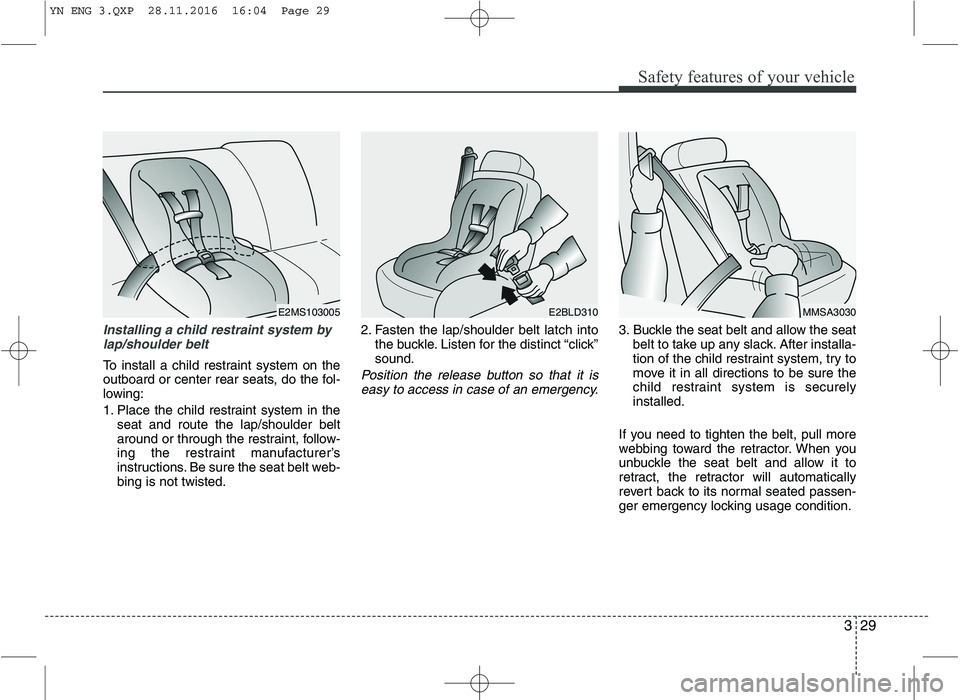
Installing a child restraint system bylap/shoulder belt
To install a child restraint system on the
outboard or center rear seats, do the fol-
lowing:
1. Place the child restraint system in the seat and route the lap/shoulder belt
around or through the restraint, follow-
ing the restraint manufacturer’s
instructions. Be sure the seat belt web-bing is not twisted. 2. Fasten the lap/shoulder belt latch into
the buckle. Listen for the distinct “click”sound.Position the release button so that it is
easy to access in case of an emergency.
3. Buckle the seat belt and allow the seat belt to take up any slack. After installa-
tion of the child restraint system, try to
move it in all directions to be sure the
child restraint system is securelyinstalled.
If you need to tighten the belt, pull more
webbing toward the retractor. When you
unbuckle the seat belt and allow it to
retract, the retractor will automatically
revert back to its normal seated passen-
ger emergency locking usage condition.
E2MS103005MMSA3030E2BLD310
YN ENG 3.QXP 28.11.2016 16:04 Page 29
Page 44 of 404
Safety features of your vehicle
30
3
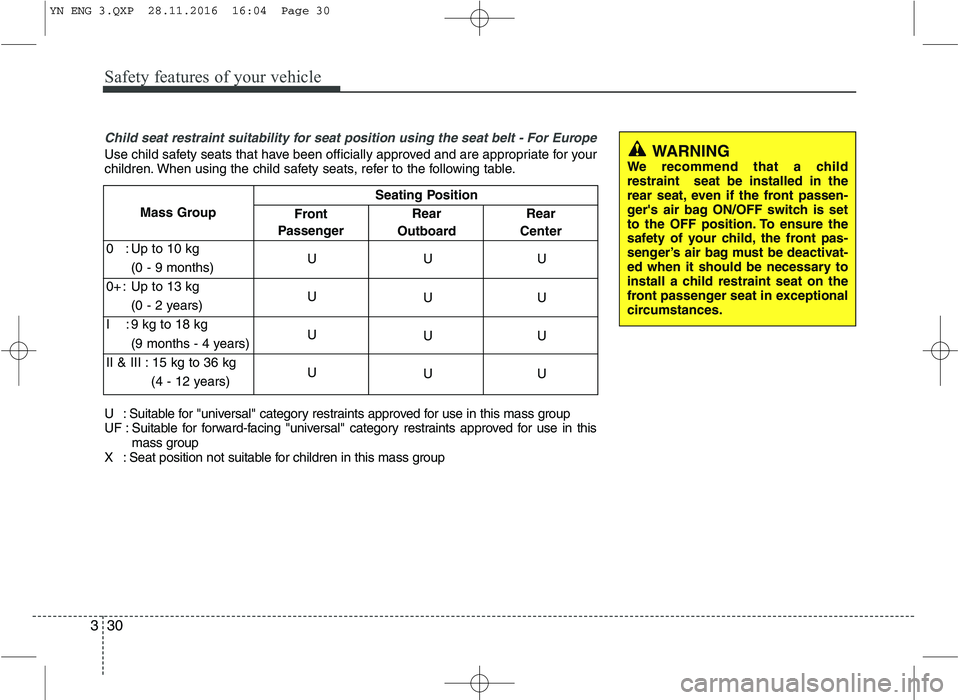
Child seat restraint suitability for seat position using the seat belt - For Europe
Use child safety seats that have been officially approved and are appropriate for your
children. When using the child safety seats, refer to the following table.WARNING
We recommend that a child restraint seat be installed in the
rear seat, even if the front passen-
ger's air bag ON/OFF switch is set
to the OFF position. To ensure the
safety of your child, the front pas-
senger’s air bag must be deactivat-
ed when it should be necessary to
install a child restraint seat on the
front passenger seat in exceptional
circumstances.
Front
Passenger Rear
Outboard Rear
Center
Seating Position
U : Suitable for "universal" category restraints approved for use in this mass group
UF : Suitable for forward-facing "universal" category restraints approved for use in this mass group
X : Seat position not suitable for children in this mass group Mass Group
0 : Up to 10 kg UUU
(0 - 9 months)
0+ : Up to 13 kg UUU
(0 - 2 years)
I : 9 kg to 18 kg UUU
(9 months - 4 years)
II & III : 15 kg to 36 kg UUU
(4 - 12 years)
YN ENG 3.QXP 28.11.2016 16:04 Page 30
Page 45 of 404
331
Safety features of your vehicle
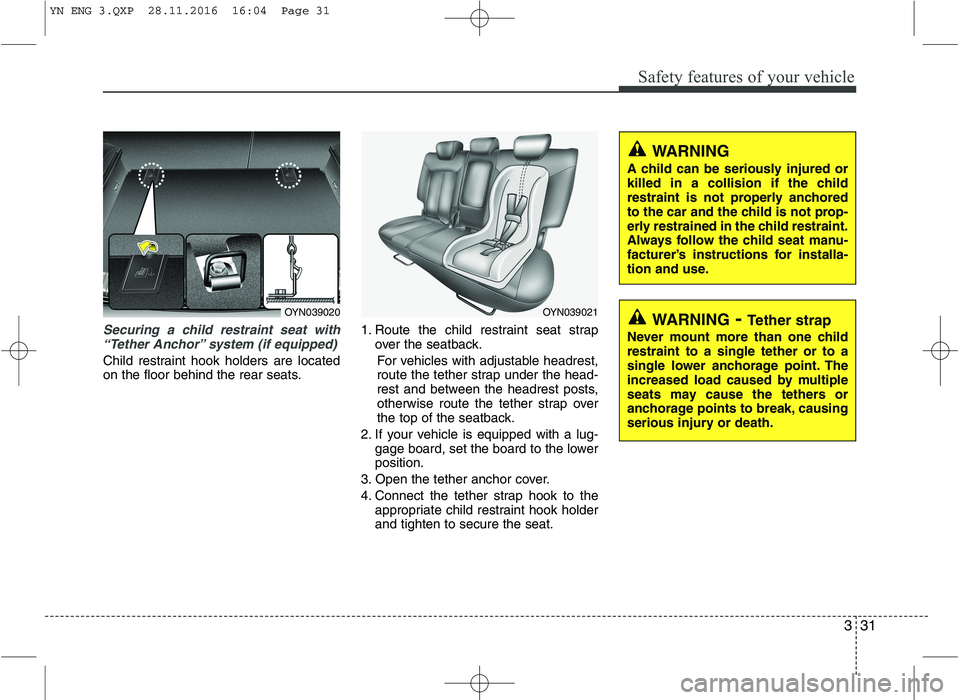
Securing a child restraint seat with“Tether Anchor” system (if equipped)
Child restraint hook holders are located
on the floor behind the rear seats. 1. Route the child restraint seat strap
over the seatback.
For vehicles with adjustable headrest,
route the tether strap under the head-
rest and between the headrest posts,
otherwise route the tether strap over
the top of the seatback.
2. If your vehicle is equipped with a lug- gage board, set the board to the lowerposition.
3. Open the tether anchor cover.
4. Connect the tether strap hook to the appropriate child restraint hook holder and tighten to secure the seat.
WARNING - Tether strap
Never mount more than one child restraint to a single tether or to a
single lower anchorage point. The
increased load caused by multiple
seats may cause the tethers or
anchorage points to break, causing
serious injury or death.
WARNING
A child can be seriously injured or
killed in a collision if the child
restraint is not properly anchored
to the car and the child is not prop-
erly restrained in the child restraint.
Always follow the child seat manu-
facturer’s instructions for installa-
tion and use.
OYN039021OYN039020
YN ENG 3.QXP 28.11.2016 16:04 Page 31
Page 46 of 404
Safety features of your vehicle
32
3
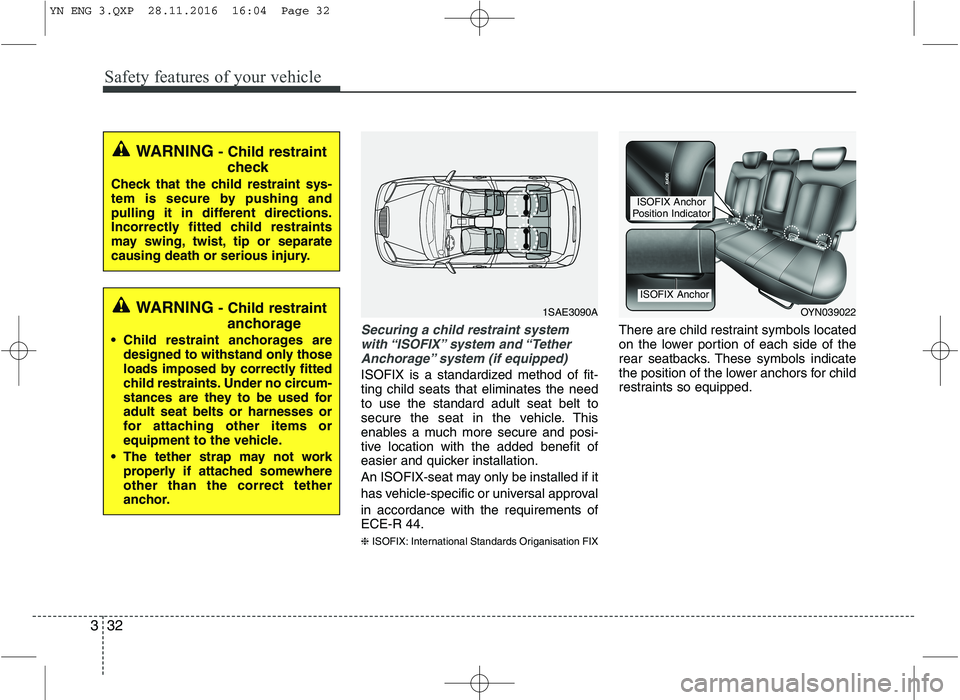
Securing a child restraint system
with “ISOFIX” system and “TetherAnchorage” system (if equipped)
ISOFIX is a standardized method of fit- ting child seats that eliminates the needto use the standard adult seat belt to
secure the seat in the vehicle. This
enables a much more secure and posi-
tive location with the added benefit of
easier and quicker installation.
An ISOFIX-seat may only be installed if it
has vehicle-specific or universal approval in accordance with the requirements of ECE-R 44. ❈ ISOFIX: International Standards Origanisation FIX There are child restraint symbols located
on the lower portion of each side of the
rear seatbacks. These symbols indicate
the position of the lower anchors for child
restraints so equipped.
WARNING
- Child restraint
check
Check that the child restraint sys-
tem is secure by pushing and
pulling it in different directions.
Incorrectly fitted child restraints
may swing, twist, tip or separate
causing death or serious injury.
WARNING - Child restraint
anchorage
Child restraint anchorages are designed to withstand only those
loads imposed by correctly fitted
child restraints. Under no circum-
stances are they to be used foradult seat belts or harnesses or
for attaching other items or
equipment to the vehicle.
The tether strap may not work properly if attached somewhereother than the correct tether
anchor.1SAE3090AOYN039022
ISOFIX Anchor
ISOFIX Anchor
Position Indicator
YN ENG 3.QXP 28.11.2016 16:04 Page 32
Page 47 of 404
333
Safety features of your vehicle
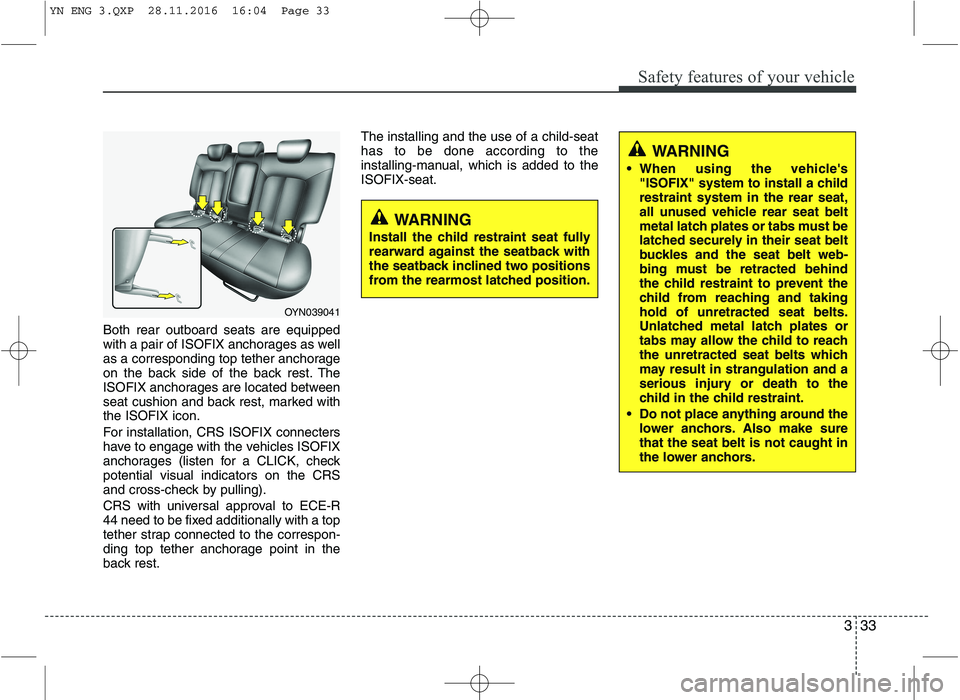
Both rear outboard seats are equipped
with a pair of ISOFIX anchorages as well
as a corresponding top tether anchorage
on the back side of the back rest. The
ISOFIX anchorages are located between
seat cushion and back rest, marked withthe ISOFIX icon.
For installation, CRS ISOFIX connecters
have to engage with the vehicles ISOFIX
anchorages (listen for a CLICK, checkpotential visual indicators on the CRS
and cross-check by pulling).
CRS with universal approval to ECE-R
44 need to be fixed additionally with a top
tether strap connected to the correspon-
ding top tether anchorage point in the
back rest.The installing and the use of a child-seathas to be done according to the
installing-manual, which is added to theISOFIX-seat.
OYN039041
WARNING
Install the child restraint seat fully
rearward against the seatback with
the seatback inclined two positions
from the rearmost latched position.
WARNING
When using the vehicle's "ISOFIX" system to install a child restraint system in the rear seat,
all unused vehicle rear seat belt
metal latch plates or tabs must be
latched securely in their seat belt
buckles and the seat belt web-
bing must be retracted behind
the child restraint to prevent the
child from reaching and takinghold of unretracted seat belts.
Unlatched metal latch plates or
tabs may allow the child to reach
the unretracted seat belts which
may result in strangulation and a
serious injury or death to the
child in the child restraint.
Do not place anything around the lower anchors. Also make surethat the seat belt is not caught in
the lower anchors.
YN ENG 3.QXP 28.11.2016 16:04 Page 33
Page 54 of 404
Safety features of your vehicle
40
3
Do not install a child restraint on the
front passenger’s seat
Never place a rear-facing child restraint
in the front passenger’s seat. If the air
bag deploys, it would impact the rear-fac-
ing child restraint, causing serious or
fatal injury.
In addition, do not place front-facing child
restraints in the front passenger’s seat
either. If the front passenger air bag
inflates, it would cause serious or fatal
injuries to the child.
If your vehicle is equipped with the pas-
senger’s front air bag ON/OFF switch,
you can activate or deactivate the front
passenger’s air bag when necessary.
For more details, please refer to 3-47
page. Air bag warning and indicator
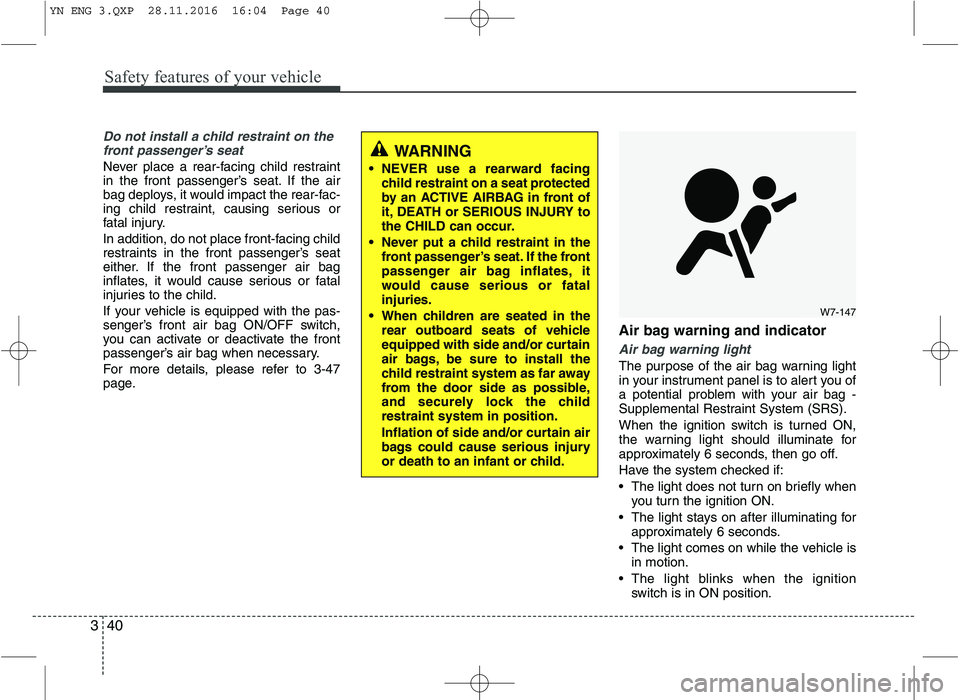
Air bag warning light
The purpose of the air bag warning light
in your instrument panel is to alert you of
a potential problem with your air bag -
Supplemental Restraint System (SRS).
When the ignition switch is turned ON,
the warning light should illuminate for
approximately 6 seconds, then go off.
Have the system checked if:
The light does not turn on briefly when
you turn the ignition ON.
The light stays on after illuminating for approximately 6 seconds.
The light comes on while the vehicle is in motion.
The light blinks when the ignition switch is in ON position.
WARNING
NEVER use a rearward facing child restraint on a seat protected
by an ACTIVE AIRBAG in front of
it, DEATH or SERIOUS INJURY to
the CHILD can occur.
Never put a child restraint in the front passenger’s seat. If the front
passenger air bag inflates, it
would cause serious or fatalinjuries.
When children are seated in the rear outboard seats of vehicle
equipped with side and/or curtain
air bags, be sure to install the
child restraint system as far away
from the door side as possible,
and securely lock the childrestraint system in position.
Inflation of side and/or curtain air
bags could cause serious injury
or death to an infant or child.
W7-147
YN ENG 3.QXP 28.11.2016 16:04 Page 40
Page 59 of 404
345
Safety features of your vehicle
The indications of the system's presence
are the letters "AIR BAG" embossed on
the air bag pad cover in the steeringwheel and the passenger's side front
panel pad above the glove box. The SRS consists of air bags installed
under the pad covers in the center of the
steering wheel and the passenger's side
front panel above the glove box.
The purpose of the SRS is to provide the
vehicle's driver and/or the front passen-ger with additional protection than that
offered by the seat belt system alone incase of a frontal impact of sufficient
severity.(Continued)
Move your seat as far back aspractical from the front air bags,
while still maintaining control of
the vehicle.
You and your passengers should never sit or lean unnecessarily
close to the air bags. Improperly
positioned drivers and passen-
gers can be severely injured by
inflating air bags.
Never lean against the door or center console – always sit in anupright position.
Do not allow a passenger to ride in the front seat when the pas-
senger’s front air bag OFF indica-
tor is illuminated, because the air
bag will not deploy in the event of
a moderate or severe frontalcrash.
(Continued)WARNING
Always use seat belts and child
restraints – every trip, every time,
everyone! Air bags inflate with con-
siderable force and in the blink of an
eye. Seat belts help keep occupants
in proper position to obtain maxi-
mum benefit from the air bag. Even
with air bags, improperly and unbelt-
ed occupants can be severely
injured when the air bag inflates.
Always follow the precautions about
seat belts, air bags and occupant
safety contained in this manual.
To reduce the chance of serious or fatal injuries and receive the maxi-
mum safety benefit from yourrestraint system:
Never place a child in any child or booster seat in the front seat.
ABC – Always Buckle Children in the back seat. It is the safest
place for children of any age to
ride.
Front and side air bags can injure occupants improperly positioned
in the front seats.
(Continued)
YN ENG 3.QXP 28.11.2016 16:05 Page 45