steering wheel Lancia Musa 2009 Owner handbook (in English)
[x] Cancel search | Manufacturer: LANCIA, Model Year: 2009, Model line: Musa, Model: Lancia Musa 2009Pages: 218, PDF Size: 3.7 MB
Page 109 of 218

108
STARTING
AND
DRIVING
WARNING
LIGHTS AND
MESSAGES
IN AN
EMERGENCY
MAINTENANCE
AND CARE
TECHNICALSPECIFICATIONS
INDEX
DASHBOARD
AND CONTROLS
SAFETY
DEVICES
FRONT AIRBAGS
The car is supplied with front airbags
for both the driver and passenger, and
window bags (head protection sys-
tem). On driver’s request, it can be
supplied with front side airbags.
The front airbags (for driver and pas-
senger) have been designed to protect
the passengers sitting on the front
seats in the event of head-on crashes
of medium-high severity, by placing
the bag between the person and the
steering wheel or dashboard.
Non-deployment of the airbags dur-
ing other types of collisions (side col-
lisions, rear shunts, roll-overs, etc.)
does not necessarily indicate a system
malfunction.
An electronic control unit causes the
bag to inflate in the event of a frontal
crash. The bag inflates instanta-
neously placing itself between the
front passenger’s body and the struc-
tures which could cause injury. It de-
flates immediately afterwards.
Driver and passenger front airbags are
not a replacement of, but comple-
mentary to the seat belts, which you
are always recommended to wear, as
specified by law in Europe and most
non-European countries.
In the event of a collision, a person
not wearing the seat belt may bethrown forward and come into con-
tact with the bag before it has fully
opened. The protection offered by the
bag is reduced in such a case.
Front airbags may not be activated in
the following situations:
❒during collisions against highly de-
formable objects that do not affect
the car front surface (e.g. bumper
collision against guard rail, heaps
of gravel, etc.);
❒jamming of the car underneath
other vehicles or protective barri-
ers (e.g. underneath a truck or a
guard rail); in this case, the bags
would offer no additional protec-
tion with respect to the seat belt
and their deployment is unneces-
sary. In these cases non-deploy-
ment of the airbag does not neces-
sarily indicate a system malfunc-
tion.
The front airbags on the driver’s and
passenger’s sides are designed and cal-
ibrated to protect the front seat pas-
sengers who wear the safety belts. The
volume of front airbags at max. infla-
tion fills most of the space between
the steering wheel and the driver and
between the dashboard and the pas-
senger.FRONT AIRBAG ON DRIVER’S
SIDE fig. 17
It consists of an instant-inflating bag
contained in a special recess in the
centre of the steering wheel.
fig. 17L0C0416m
095-112 MUSA 1ed GB 10-07-2008 9:37 Pagina 108
Page 110 of 218
109
STARTING
AND
DRIVING
WARNING
LIGHTS AND
MESSAGES
IN AN
EMERGENCY
MAINTENANCE
AND CARE
TECHNICALSPECIFICATIONS
INDEX
DASHBOARD
AND CONTROLS
SAFETY
DEVICES
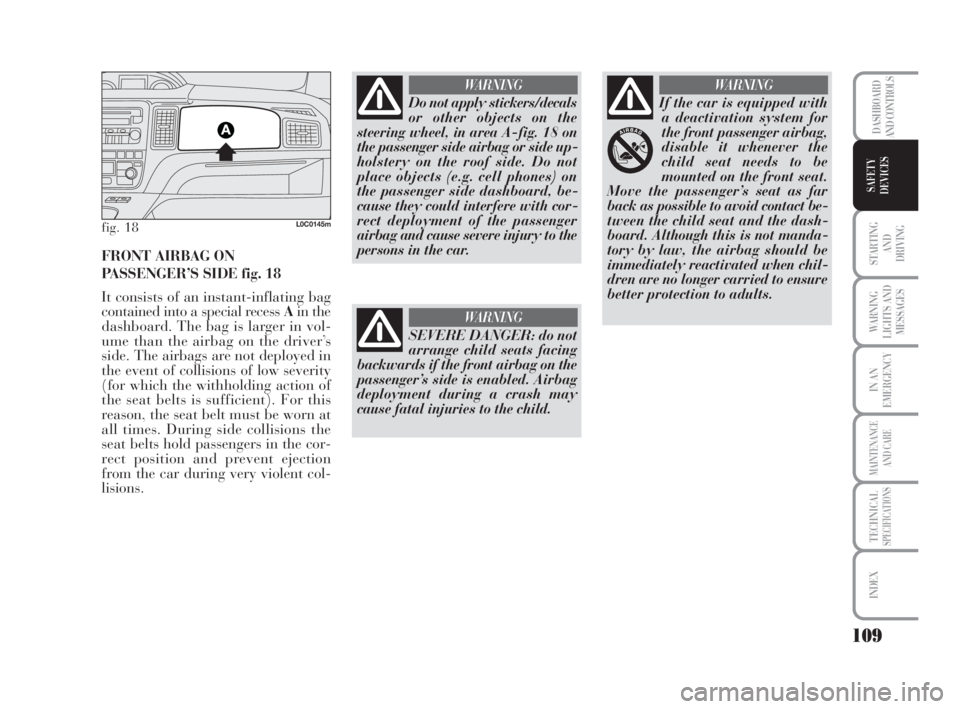
fig. 18L0C0145m
FRONT AIRBAG ON
PASSENGER’S SIDE fig. 18
It consists of an instant-inflating bag
contained into a special recess Ain the
dashboard. The bag is larger in vol-
ume than the airbag on the driver’s
side. The airbags are not deployed in
the event of collisions of low severity
(for which the withholding action of
the seat belts is sufficient). For this
reason, the seat belt must be worn at
all times. During side collisions the
seat belts hold passengers in the cor-
rect position and prevent ejection
from the car during very violent col-
lisions.
Do not apply stickers/decals
or other objects on the
steering wheel, in area A-fig. 18 on
the passenger side airbag or side up-
holstery on the roof side. Do not
place objects (e.g. cell phones) on
the passenger side dashboard, be-
cause they could interfere with cor-
rect deployment of the passenger
airbag and cause severe injury to the
persons in the car.
WARNING
SEVERE DANGER: do not
arrange child seats facing
backwards if the front airbag on the
passenger’s side is enabled. Airbag
deployment during a crash may
cause fatal injuries to the child.
WARNING
If the car is equipped with
a deactivation system for
the front passenger airbag,
disable it whenever the
child seat needs to be
mounted on the front seat.
Move the passenger’s seat as far
back as possible to avoid contact be-
tween the child seat and the dash-
board. Although this is not manda-
tory by law, the airbag should be
immediately reactivated when chil-
dren are no longer carried to ensure
better protection to adults.
WARNING
095-112 MUSA 1ed GB 10-07-2008 9:37 Pagina 109
Page 113 of 218
112
STARTING
AND
DRIVING
WARNING
LIGHTS AND
MESSAGES
IN AN
EMERGENCY
MAINTENANCE
AND CARE
TECHNICALSPECIFICATIONS
INDEX
DASHBOARD
AND CONTROLS
SAFETY
DEVICES
Always drive keeping your
hands on the steering wheel
so that the airbag can inflate with-
out obstacles if it is deployed. Do
not drive with your body bent for-
ward. Keep your back straight
against the backrest. If the car is
stolen or an attempt is made to steal
it, or if the car has been subjected to
illegal attacks or flooding, have the
airbag system checked by a Lancia
Dealership.
WARNING
Do not travel carrying ob-
jects on your lap or opposite
the chest and keeping a pipe, pen-
cils, etc. between your lips in order
to avoid serious injuries due to de-
ployment of the airbag after a colli-
sion.
WARNING
The front airbag is de-
ployed in the event of colli-
sions having a more severe nature
than those required to activate the
pretensioners. For collisions in the
range between the two activation
thresholds, pretensioner activation
is normal.
WARNING
Turning the ignition key to
MAR, the warning light “
(airbag on passenger’s side enabled)
goes on and flashes for a few sec-
onds, thus reminding the passenger
that the airbag on his/her side will
deploy in the event of a collision. Af-
ter this time, the light goes off.
WARNING
Do not wash the car seats
with water or pressurised
steam (both by hand or at automatic
washing stations).
WARNING
The airbag does not replace
the safety belts, it increases
their effectiveness. Furthermore,
since front airbags are not deployed
after low speed collisions, side colli-
sions, rear-end shunts or roll-overs,
the passengers are only protected by
the seat belts which must be fas-
tened at all times.
WARNING
Do not hook rigid objects to
cloth hangers and to the
support handles.
WARNING
If the ignition key is in
place and in the MAR posi-
tion, the airbags are deployed even
with the engine off in the event of a
car crash against another moving
vehicle. For this reason, children
must never sit on the front seat, even
if the car is not moving. On the other
hand, whenever the key is positioned
on STOP, the safety devices (airbags
or pretensioners) do not deploy af-
ter a collision. In this case non-de-
ployment of these devices does not
indicate a system malfunction.
WARNING
095-112 MUSA 1ed GB 10-07-2008 9:37 Pagina 112
Page 129 of 218
128
IN AN
EMERGENCY
MAINTENANCE
AND CARE
TECHNICALSPECIFICATIONS
INDEX
DASHBOARD
AND CONTROLS
SAFETY
DEVICES
STARTING
AND
DRIVING
WARNING
LIGHTS AND
MESSAGES
LOW ENGINE OIL
PRESSURE (red)
EXHAUSTED OIL (red)
(Multijet versions with DPF)
Low engine oil pressure
When the ignition key is moved to
MAR, the warning light turns on and
should go out as soon as the engine is
started.
The display will show the dedicated
message.
v
Exhausted oil
The warning light turns on and
flashes along with the message on the
display when the system detects that
the engine oil is exhausted.
After the first indication, at each en-
gine start-up, the warning light
vcontinues to flash for about 60 sec-
onds and then every 2 hours until the
oil is changed.
If the warning light vturns on when the car is
travelling (on certain versions to-
gether with the message on the dis-
play) stop the engine immediately
and contact Lancia Dealership.
WARNING
If the warning light vflashes, promptly contact
Lancia Dealership in order to have
the oil changed and the warning
light on the instrument panel turned
off.
WARNING
“DUALDRIVE”
ELECTRIC POWER
STEERING FAILURE
(red)
When the ignition key is moved to
MAR, the warning light turns on and
should go off after a few seconds.
If the warning light stays on, the elec-
tric steering system provides no assis-
tance and the effort on the steering
wheel is increased, although steering
is still possible. In this case, go to a
Lancia Dealership.
The display will show the dedicated
message.
g
INCOMPLETE DOOR
LOCKING (red)
On certain versions the
warning light turns on when
one or more doors or the tailgate are
not properly closed.
The display will show the dedicated
message.
A buzzer is triggered when doors/tail-
gate are open and the car is moving.
´
SEAT BELTS NOT
FASTENED (red)
(where provided)
The warning light on the dis-
play lights up when the car is moving
and the driver’s seat belt is not cor-
rectly fastened. The warning light
flashes, and a buzzer is triggered, if
the driver’s seat belt is not correctly
fastened. The buzzer of the S.B.R.
(Seat Belt Reminder) system can be
disabled by the Lancia Dealership
only. The system can be enabled from
the “setup” menu.
<
125-134 MUSA 1ed GB 10-07-2008 9:38 Pagina 128
Page 139 of 218
138
WARNING
LIGHTS AND
MESSAGES
MAINTENANCE
AND CARE
TECHNICALSPECIFICATIONS
INDEX
DASHBOARD
AND CONTROLS
SAFETY
DEVICES
STARTING
AND
DRIVING
IN AN
EMERGENCY
Indicate that the car is sta-
tionary according to the laws
in force: emergency lights, refracting
warning triangle, etc. Passengers
should leave the car, particularly if it
is very loaded and wait for the wheel
to be changed away from on-coming
traffic. In case of steep slopes or
rough slopes, place wedges or other
materials suitable to stop the vehicle
under the wheels.
WARNINGQUICK TYRE
REPAIR KIT FIX
& GO automatic
(if provided for)
The quick tyre repair kit Fix & Go
automaticfig. 3is placed in the boot.
The kit includes:
❒cylinderAcontaining sealing liq-
uid and fitted with:
– filling pipe B;
– adhesive label Cbearing the
words “max. 80 km/h”, to be at-
tached in a position easily visi-
ble to the driver (on the dash-
board) after tyre repair;
❒informative leaflet fig. 4, used to
ensure the correct use of the quick
tyre repair kit and then given to
the personnel who will handle the
treated tyre; BUMP STARTING
Never jump start the engine by push-
ing, towing or driving downhill. This
could cause a flow of fuel into the cat-
alytic converter and damage it beyond
repair.
IMPORTANT Remember that the
brake booster and the power steering
system are not operating until the en-
gine is started, a greater effort will
therefore be required to press the
brake pedal or turn the steering
wheel.
135-164 MUSA 1ed GB 10-07-2008 9:38 Pagina 138
Page 144 of 218

143
WARNING
LIGHTS AND
MESSAGES
MAINTENANCE
AND CARE
TECHNICALSPECIFICATIONS
INDEX
DASHBOARD
AND CONTROLS
SAFETY
DEVICES
STARTING
AND
DRIVING
IN AN
EMERGENCY
The small spare wheel is
specific for your car. Do not
use it on cars of different models. Do
not use spare wheels of different
models on your car. The small spare
wheel must only be used in an emer-
gency. Never use it for more than
strictly necessary and never exceed
80 km/h. On the small spare wheel
there is an orange label, summariz-
ing the main warnings regarding
small spare wheel usage restrictions.
Never remove or cover the label.
Never apply any hub cap on the
small spare wheel. The label con-
tains the following indications in
four languages: Warning! For tem-
porary use only! 80 km/h max! Re-
place the standard wheel as soon as
possible. Do not cover this instruc-
tion.
WARNING
The driving characteristics
of the car are different
when the small spare wheel is in-
stalled. Avoid violent accelerations
and braking, sharp steering and fast
bending. The overall duration of the
small spare wheel is of about 3000
km, after which the relevant tyre
must be replaced with another one
of the same type. Never install a tra-
ditional tyre on a rim designed to be
used as a small spare wheel. Repair
and refit the standard wheel as soon
as possible. Using two or more small
spare wheels at the same time is for-
bidden. Do not apply grease to the
bolt threading before assembly: they
might come unscrewed.
WARNING
The jack may only be used
to replace wheels on the car
which it equips or other cars of the
same model. Never use the jack for
other purposes, such as lifting other
car models. Never use the jack to
carry out repairs under the car. In-
correct positioning of the jack may
cause the car to fall. Do not use the
jack for loads higher than those
shown on the label. Never install
snow chains on the small spare
wheel; if a front tyre (driving wheel)
is punctured and you need to use
snow chains, use a standard wheel
from the rear axle and install the
small spare wheel on the rear axle.
This way, with two normal front dri-
ving wheels, you can install the snow
chains on them, thus resolving the
emergency.
WARNING
135-164 MUSA 1ed GB 10-07-2008 9:38 Pagina 143
Page 165 of 218
164
WARNING
LIGHTS AND
MESSAGES
MAINTENANCE
AND CARE
TECHNICALSPECIFICATIONS
INDEX
DASHBOARD
AND CONTROLS
SAFETY
DEVICES
STARTING
AND
DRIVING
IN AN
EMERGENCY
fig. 44L0D0251m
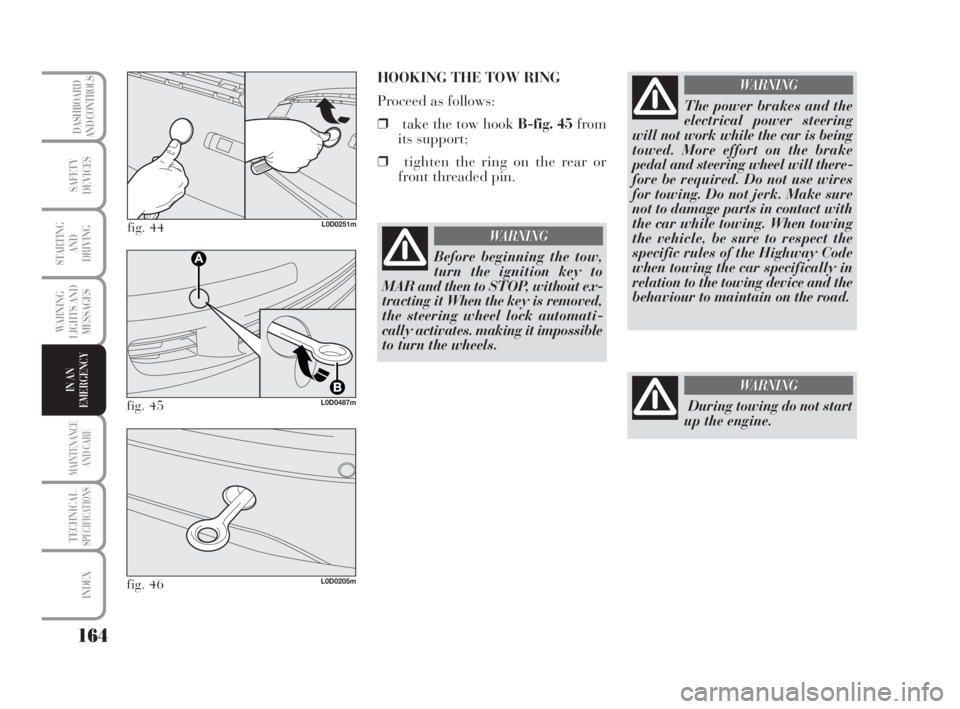
HOOKING THE TOW RING
Proceed as follows:
❒take the tow hook B-fig. 45from
its support;
❒tighten the ring on the rear or
front threaded pin.
fig. 45L0D0487m
fig. 46L0D0205m
The power brakes and the
electrical power steering
will not work while the car is being
towed. More effort on the brake
pedal and steering wheel will there-
fore be required. Do not use wires
for towing. Do not jerk. Make sure
not to damage parts in contact with
the car while towing. When towing
the vehicle, be sure to respect the
specific rules of the Highway Code
when towing the car specifically in
relation to the towing device and the
behaviour to maintain on the road.
WARNING
Before beginning the tow,
turn the ignition key to
MAR and then to STOP, without ex-
tracting it When the key is removed,
the steering wheel lock automati-
cally activates. making it impossible
to turn the wheels.
WARNING
During towing do not start
up the engine.
WARNING
135-164 MUSA 1ed GB 10-07-2008 9:38 Pagina 164
Page 180 of 218
179
WARNING
LIGHTS AND
MESSAGES
TECHNICALSPECIFICATIONS
INDEX
DASHBOARD
AND CONTROLS
SAFETY
DEVICES
STARTING
AND
DRIVING
IN AN
EMERGENCY
MAINTENANCE
AND CARE
IMPORTANT If the charge level re-
mains for a long time under 50%, the
battery is damaged by sulphation, re-
ducing its capacity and starting atti-
tude.
The battery will also be more at risk
of freezing (e.g. already at –10°C).
Refer to the paragraph “Car inactiv-
ity” in “Starting and driving” if the
car is left parked for a long time.
If after buying the car, you want to in-
stall electric accessories which require
permanent electric supply (alarm,
etc.) contact the Lancia Dealership
whose qualified personnel, in addition
to suggesting the most suitable devices
beloning to the Lancia Lineaccessori
line, will evaluate the overall electric
absorption, checking whether the car’s
electric system is capable of with-
standing the load required, or whether
it should be integrated with a more
powerful battery.
Since these devices continue absorb-
ing energy even when the ignition key
is off, they gradually run down the
battery.WHEELS
AND TYRES
Check the pressure of each type, in-
cluding the spare, approximately once
every two weeks and before starting a
long journey: this check must be per-
formed with the tyre rested and cold.
It is normal for the pressure to in-
crease when the car is used; for the
correct tyre inflation pressure, see
“Wheels” in “Technical specifica-
tions” section.
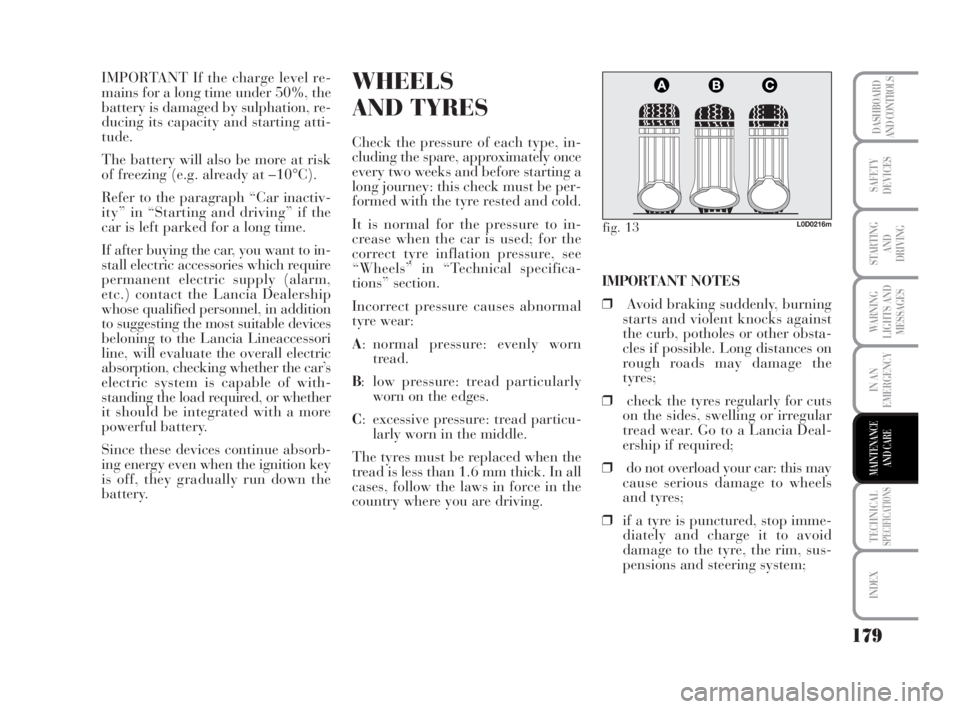
Incorrect pressure causes abnormal
tyre wear:
A: normal pressure: evenly worn
tread.
B: low pressure: tread particularly
worn on the edges.
C: excessive pressure: tread particu-
larly worn in the middle.
The tyres must be replaced when the
tread is less than 1.6 mm thick. In all
cases, follow the laws in force in the
country where you are driving.IMPORTANT NOTES
❒Avoid braking suddenly, burning
starts and violent knocks against
the curb, potholes or other obsta-
cles if possible. Long distances on
rough roads may damage the
tyres;
❒check the tyres regularly for cuts
on the sides, swelling or irregular
tread wear. Go to a Lancia Deal-
ership if required;
❒do not overload your car: this may
cause serious damage to wheels
and tyres;
❒if a tyre is punctured, stop imme-
diately and charge it to avoid
damage to the tyre, the rim, sus-
pensions and steering system;
fig. 13L0D0216m
165-186 MUSA 1ed GB 10-07-2008 9:39 Pagina 179
Page 187 of 218

186
WARNING
LIGHTS AND
MESSAGES
TECHNICALSPECIFICATIONS
INDEX
DASHBOARD
AND CONTROLS
SAFETY
DEVICES
STARTING
AND
DRIVING
IN AN
EMERGENCY
MAINTENANCE
AND CARE
Do not keep aerosol cans in
the car: risk of explosion.
Aerosol cans must not be exposed to
a temperature exceeding 50°C.
When the vehicle is exposed to sun-
light, the internal temperature can
greatly exceed this value.
WARNINGSTEERING WHEEL/GEAR
LEVER COVERED
IN REAL LEATHER
These components must be cleaned
with mild soap and water only. Never
use spirit and/or alcohol based prod-
ucts.
Before using specific products for the
cleaning of the interiors, ensure
through careful reading that the in-
structions on the label of the product
do not contain alcohol and/or alcohol-
based substances.
If, during cleaning of the windscreen,
window cleaner accidentally drips
onto the leather of the steering wheel
/ gear lever knob, wipe away imme-
diately and then wash the area with
mild soap and water.
IMPORTANT Be careful when in-
stalling a steering wheel lock device,
where applicable, to prevent damag-
ing the leather upholstery by rubbing.
165-186 MUSA 1ed GB 10-07-2008 9:39 Pagina 186
Page 188 of 218

187
WARNING
LIGHTS AND
MESSAGES
INDEX
DASHBOARD
AND CONTROLS
SAFETY
DEVICES
STARTING
AND
DRIVING
IN AN
EMERGENCY
MAINTENANCE
AND CARE
TECHNICALSPECIFICATIONS
TECHNICAL SPECIFICATIONS
IDENTIFICATION DATA .................................. 188
ENGINE CODES -
BODYWORK VERSIONS .................................. 190
ENGINE........................................................... 191
FUEL FEED/IGNITION ................................... 192
TRANSMISSION............................................... 192
BRAKES........................................................... 193
SUSPENSIONS................................................. 193
STEERING....................................................... 193
WHEELS.......................................................... 194
DIMENSIONS................................................... 198
PERFORMANCE.............................................. 199
WEIGHTS........................................................ 200
CAPACITIES .................................................... 201
FLUIDS AND LUBRICANTS ............................ 202
FUEL CONSUMPTION .................................... 204
CO
2EMISSIONS............................................... 205
187-205 MUSA 1ed GB 10-07-2008 9:40 Pagina 187