engine overheat Lancia Voyager 2012 Owner handbook (in English)
[x] Cancel search | Manufacturer: LANCIA, Model Year: 2012, Model line: Voyager, Model: Lancia Voyager 2012Pages: 344, PDF Size: 3.95 MB
Page 175 of 344

The light also will turn on when the
parking brake is applied with the ig-
nition switch in the ON/RUN posi-
tion.
NOTE:
This light shows only that the
parking brake is applied. It does
not show the degree of brake ap-
plication.
19. Seat Belt Reminder LightWhen the ignition switch is first
turned to ON/RUN, this light
will turn on for four to eight
seconds as a bulb check. During the
bulb check, if the driver or front pas-
senger's seat belt is unbuckled, a
chime will sound. After the bulb
check or when driving, if the driver's
seat belt remains unbuckled, the Seat
Belt Reminder Light will illuminate
and the chime will sound. Refer to
“Occupant Restraints” in “Things To
Know Before Starting Your Vehicle”
for further information. 20. Temperature Gauge
The temperature gauge shows engine
coolant temperature. Any reading
within the normal range indicates
that the engine cooling system is
op-
erating satisfactorily.
The gauge pointer will likely indicate
a higher temperature when driving in
hot weather, up mountain grades, or
when towing a trailer. It should not be
allowed to exceed the upper limits of
the normal operating range.
CAUTION!
Driving with a hot engine cooling
system could damage your vehicle.
If the temperature gauge reads “H”
pull over and stop the vehicle. Idle
the vehicle with the air conditioner
turned off until the pointer drops
back into the normal range. If the
pointer remains on the “H” and you
hear continuous chimes, turn the en-
gine off immediately and call an au-
thorized dealership for service.
WARNING!
A hot engine cooling system is dan-
gerous. You or others could be badly
burned by steam or boiling coolant.
You may want to call an authorized
dealership for service if your vehicle
overheats. If you decide to look un-
der the hood yourself, see “Main-
taining Your Vehicle”. Follow the
warnings under the Cooling System
Pressure Cap paragraph.
21. Rear Fog Light Indicator This indicator will illuminate
when the rear fog lights are
on. (Refer to “Lights” in “Un-
derstanding The Features Of
Your Vehicle” for further informa-
tion).
169
Page 183 of 344

Door AjarThis light will turn on to
indicate that one or more
doors may be ajar.
Oil Pressure Warning Light This light indicates low engine
oil pressure. The light should
turn on momentarily when the engine
is started. If the light turns on while
driving, stop the vehicle and shut off
the engine as soon as possible. A
chime will sound when this light turns
on.
Do not operate the vehicle until the
cause is corrected. This light does not
show how much oil is in the engine.
The engine oil level must be checked
under the hood.
Charging System Light This light shows the status of
the electrical charging system.
The light should come on when the
ignition switch is first turned ON and
remain on briefly as a bulb check. If
the light stays on or comes on while
driving, turn off some of the vehicle's
non-essential electrical devices or in-
crease engine speed (if at idle). If the charging system light remains on, it
means that the vehicle is experiencing
a problem with the charging system.
Obtain SERVICE IMMEDIATELY.
See an authorized dealer.
If jump starting is required, refer to
“Jump Starting Procedures” in “What
To Do In Emergencies”.
Electronic Throttle Control
(ETC) Light This light informs you of a
problem with the Electronic
Throttle Control (ETC)
system. The light will come
on when the ignition is first turned ON
and remain on briefly as a bulb check.
If the light does not come on during
starting, have the system checked by
an authorized dealer.
If a problem is detected, the light will
come on while the engine is running.
Cycle the ignition key when the ve-
hicle has completely stopped and the
shift lever is placed in the PARK posi-
tion. The light should turn off.
If the light remains lit with the engine
running, your vehicle will usually be
drivable. However, see an authorized dealer for service as soon as possible.
If the light is flashing when the engine
is running, immediate service is re-
quired. You may experience reduced
performance, an elevated/rough idle
or engine stall and your vehicle may
require towing.
Engine Temperature Warning
Light This light warns of an over-
heated engine condition. As
temperatures rise and the
gauge approaches H,this indicator
will illuminate and a single chime will
sound after reaching a set threshold.
Further overheating will cause the
temperature gauge to pass H,a con-
tinuous chime will occur until the en-
gine is allowed to cool.
If the light turns on while driving,
safely pull over and stop the vehicle. If
the A/C system is on, turn it off. Also,
shift the transmission into NEUTRAL
and idle the vehicle. If the tempera-
ture reading does not return to nor-
mal, turn the engine off immediately
and call for service. Refer to “If Your
Engine Overheats” in “What To Do In
Emergencies” for more information.
177
Page 272 of 344
Cooling System
To reduce potential for engine and
transmission overheating, take the
following actions:
City Driving
When stopped for short periods of
time, shift the transmission into NEU-
TRAL but do not increase engine idle
speed.
Highway Driving
Reduce speed.
Air Conditioning
Turn off temporarily.
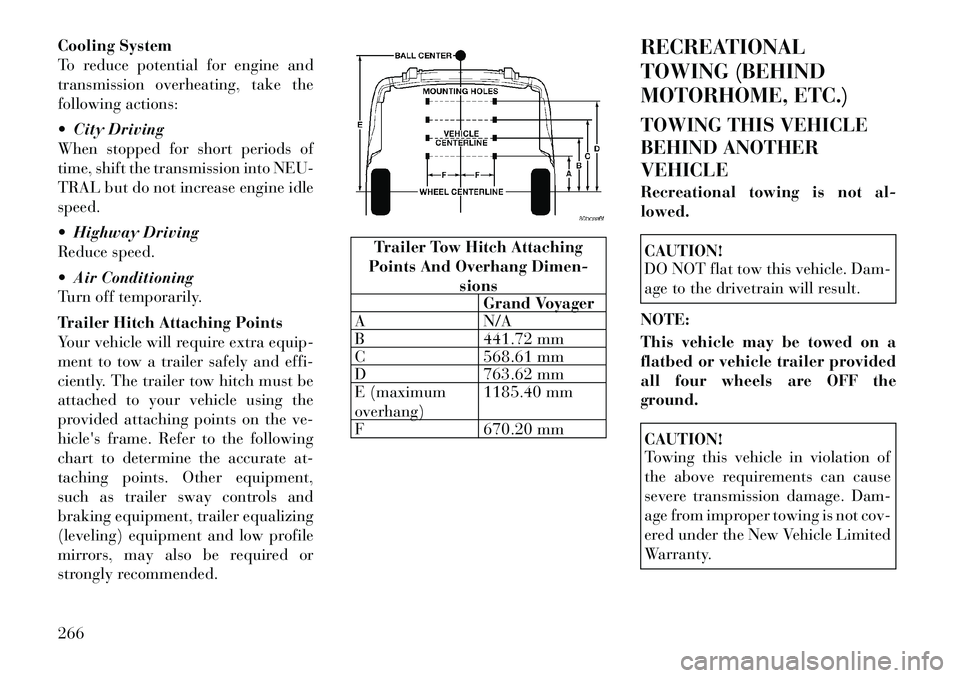
Trailer Hitch Attaching Points
Your vehicle will require extra equip-
ment to tow a trailer safely and effi-
ciently. The trailer tow hitch must be
attached to your vehicle using the
provided attaching points on the ve-
hicle's frame. Refer to the following
chart to determine the accurate at-
taching points. Other equipment,
such as trailer sway controls and
braking equipment, trailer equalizing
(leveling) equipment and low profile
mirrors, may also be required or
strongly recommended.
Trailer Tow Hitch Attaching
Points And Overhang Dimen-
sionsGrand Voyager
A N/A
B 441.72 mm
C 568.61 mm
D 763.62 mm
E (maximum
overhang) 1185.40 mm
F 670.20 mm RECREATIONAL
TOWING (BEHIND
MOTORHOME, ETC.)
TOWING THIS VEHICLE
BEHIND ANOTHER
VEHICLE
Recreational towing is not al-
lowed.
CAUTION!
DO NOT flat tow this vehicle. Dam-
age to the drivetrain will result.
NOTE:
This vehicle may be towed on a
flatbed or vehicle trailer provided
all four wheels are OFF the
ground.CAUTION!
Towing this vehicle in violation of
the above requirements can cause
severe transmission damage. Dam-
age from improper towing is not cov-
ered under the New Vehicle Limited
Warranty.
266
Page 273 of 344

6
WHAT TO DO IN EMERGENCIES
HAZARD WARNING FLASHERS . . . . . . . . . . . . 268
IF YOUR ENGINE OVERHEATS . . . . . . . . . . . . . 268
JACKING AND TIRE CHANGING . . . . . . . . . . . . 269 JACK LOCATION . . . . . . . . . . . . . . . . . . . . . . 269
SPARE TIRE REMOVAL . . . . . . . . . . . . . . . . . 269
TO ACCESS SPARE TIRE WINCH DRIVENUT . . . . . . . . . . . . . . . . . . . . . . . . . . . . . . . . 270
SPARE TIRE TOOLS . . . . . . . . . . . . . . . . . . . 271
SPARE TIRE REMOVAL INSTRUCTIONS . . . 271
PREPARATIONS FOR JACKING . . . . . . . . . . . 272
JACKING INSTRUCTIONS . . . . . . . . . . . . . . . 272
SECURING THE SPARE TIRE . . . . . . . . . . . . 275
ROAD TIRE INSTALLATION . . . . . . . . . . . . . 276
JUMP-STARTING PROCEDURE . . . . . . . . . . . . . 277 PREPARATIONS FOR JUMP-START . . . . . . . 278
JUMP-STARTING PROCEDURE . . . . . . . . . . . 278
FREEING A STUCK VEHICLE . . . . . . . . . . . . . . 279
SHIFT LEVER OVERRIDE . . . . . . . . . . . . . . . . . 280
TOWING A DISABLED VEHICLE . . . . . . . . . . . 281 WITHOUT THE IGNITION KEY . . . . . . . . . . . 282
267
Page 274 of 344

HAZARD WARNING
FLASHERS
The Hazard Warning flasher switch is
located in the lower center area of the
instrument panel.Press the switch to turn on the
Hazard Warning flasher. When
the switch is activated, all di-
rectional turn signals will flash on and
off to warn oncoming traffic of an
emergency. Press the switch a second
time to turn off the Hazard Warning
flashers.
This is an emergency warning system
and it should not be used when the
vehicle is in motion. Use it when your
vehicle is disabled and it is creating a
safety hazard for other motorists.
When you must leave the vehicle to
seek assistance, the Hazard Warning
flashers will continue to operate even
though the ignition is placed in the
OFF position.
NOTE:
With extended use the Hazard
Warning flashers may wear down
your battery. IF YOUR ENGINE
OVERHEATS
In any of the following situations, you
can reduce the potential for overheat-
ing by taking the appropriate action.
On the highways — slow down.
In city traffic — while stopped,
place the transmission in NEU-
TRAL, but do not increase engine
idle speed.
NOTE:
There are steps that you can take to
slow down an impending overheat
condition:
If your air conditioner (A/C) is on, turn it off. The A/C system
adds heat to the engine cooling
system and turning the A/C off
can help remove this heat.
You can also turn the tempera- ture control to maximum heat,
the mode control to floor and the
blower control to high. This al-
lows the heater core to act as a
supplement to the radiator and
aids in removing heat from the
engine cooling system.
CAUTION!
Driving with a hot cooling system
could damage your vehicle. If tem-
perature gauge reads “H”, pull over
and stop the vehicle. Idle the vehicle
with the air conditioner turned off
until the pointer drops back into the
normal range. If the pointer remains
on the “H”, turn the engine off im-
mediately, and call for service.WARNING!
You or others can be badly burned
by hot engine coolant (antifreeze) or
steam from your radiator. If you see
or hear steam coming from under
the hood, do not open the hood until
the radiator has had time to cool.
Never try to open a cooling system
pressure cap when the radiator or
coolant bottle is hot.
268
Page 285 of 344
the discharged vehicle’s engine) away
from the battery and the fuel injection
system.WARNING!
Do not connect the cable to the nega-
tive post(-)of the discharged bat-
tery. The resulting electrical spark
could cause the battery to explode
and could result in personal injury.
5. Start the engine in the vehicle that
has the booster battery, let the engine
idle a few minutes, and then start the
engine in the vehicle with the dis-
charged battery. Once the engine is
started, remove the jumper cables in
the reverse sequence:
6. Disconnect the negative (-)jumper
cable from the negative (-)post of the
vehicle with the discharged battery.
7. Disconnect the negative end (-)of
the jumper cable from the negative (-)
post of the booster battery. 8. Disconnect the opposite end of the
positive
(+)jumper cable from the
positive (+)post of the booster bat-
tery.
9. Disconnect the positive (+)end of
the jumper cable from the positive (+)
post of the discharged vehicle.
If frequent jump-starting is required
to start your vehicle you should have
the battery and charging system in-
spected at your authorized dealer.
CAUTION!
Accessories that can be plugged into
the vehicle power outlets draw
power from the vehicle’s battery,
even when not in use (i.e., cellular
phones, etc.). Eventually, if plugged
in long enough, the vehicle’s battery
will discharge sufficiently to degrade
battery life and/or prevent the en-
gine from starting. FREEING A STUCK
VEHICLE
If your vehicle becomes stuck in mud,
sand or snow, it can often be moved by
a rocking motion. Turn your steering
wheel right and left to clear the area
around the front wheels. Then move
the shift lever back and forth between
DRIVE and REVERSE. Using mini-
mal accelerator pedal pressure to
maintain the rocking motion, without
spinning the wheels, is most effective.
CAUTION!
Racing the engine or spinning the
wheels may lead to transmission
overheating and failure. Allow the
engine to idle with the shift lever in
NEUTRAL for at least one minute
after every five rocking-motion
cycles. This will minimize overheat-
ing and reduce the risk of transmis-
sion failure during prolonged efforts
to free a stuck vehicle.
279
Page 286 of 344
NOTE:
To improve the vehicle’s traction
when starting off in deep snow,
sand or gravel, it may be desirable
to switch the Electronic Stability
Program (ESP) to “Partial Off”
mode. Refer to “Electronic Brake
Control System” in “Starting and
Operating” for further informa-
tion.CAUTION!
When “rocking” a stuck vehicleby moving between DRIVE and
REVERSE, do not spin the wheels
faster than 24 km/h, or drivetrain
damage may result.
Revving the engine or spinning
the wheels too fast may lead to
transmission overheating and
failure. It can also damage the
tires. Do not spin the wheels above
48 km/h while in gear (no trans-
mission shifting occurring).
WARNING!
Fast spinning tires can be danger-
ous. Forces generated by excessive
wheel speeds may cause damage, or
even failure, of the axle and tires. A
tire could explode and injure some-
one. Do not spin your vehicle's
wheels faster than 48 km/h or for
longer than 30 seconds continuously
without stopping when you are stuck
and do not let anyone near a spin-
ning wheel, no matter what the
speed.
SHIFT LEVER
OVERRIDE
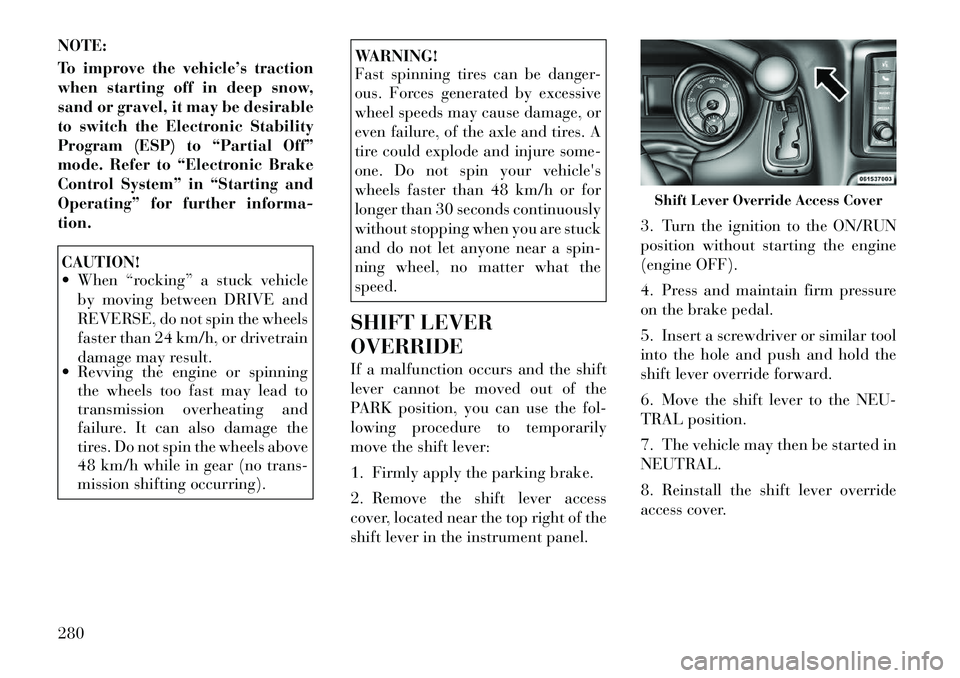
If a malfunction occurs and the shift
lever cannot be moved out of the
PARK position, you can use the fol-
lowing procedure to temporarily
move the shift lever:
1. Firmly apply the parking brake.
2. Remove the shift lever access
cover, located near the top right of the
shift lever in the instrument panel. 3. Turn the ignition to the ON/RUN
position without starting the engine
(engine OFF).
4. Press and maintain firm pressure
on the brake pedal.
5. Insert a screwdriver or similar tool
into the hole and push and hold the
shift lever override forward.
6. Move the shift lever to the NEU-
TRAL position.
7. The vehicle may then be started in
NEUTRAL.
8. Reinstall the shift lever override
access cover.
Shift Lever Override Access Cover
280
Page 296 of 344

INTERVENTION
REGENERATION
STRATEGY – 2.8L DIESEL
ENGINE
This vehicle is equipped with a state-
of-the-art engine and exhaust system
containing a diesel particulate filter.
The engine and exhaust after-
treatment system work together to
meet the Emission standards. The
system manages engine combustion to
allow the exhaust system’s catalyst to
trap and burn Particulate Matter
(PM) pollutants with no input or in-
teraction on your part.
Refer to “Electronic Vehicle Informa-
tion Center (EVIC)” in “Understand-
ing Your Instrument Panel” for fur-
ther information.
EXHAUST SYSTEM
The best protection against carbon
monoxide entry into the vehicle body
is a properly maintained engine ex-
haust system.Whenever a change is noticed in the
sound of the exhaust system, when
exhaust fumes can be detected inside
the vehicle, or when the underside or
rear of the vehicle is damaged, have a
competent mechanic inspect the com-
plete exhaust system and adjacent
body areas for broken, damaged, de-
teriorated, or mispositioned parts.
Open seams or loose connections
could permit exhaust fumes to seep
into the passenger compartment. In
addition, have the exhaust system in-
spected each time the vehicle is raised
for lubrication or oil change. Replace
as required.
WARNING!
Exhaust gases can injure or kill.
They contain carbon monoxide
(CO) which is colorless and odorless.
Breathing it can make you uncon-
scious and can eventually poison
you. To avoid breathing CO, refer to
“Safety Tips/Exhaust Gas” in
“Things To Know Before Starting
Your Vehicle” for further informa-
tion.
CAUTION!
The catalytic converter requires the
use of unleaded fuel only. Leaded
gasoline will destroy the effective-
ness of the catalyst as an emissions
control device and may seriously re-
duce engine performance and cause
serious damage to the engine.
Under normal operating conditions,
the catalytic converter will not require
maintenance. However, it is impor-
tant to keep the engine properly tuned
to assure proper catalyst operation
and prevent possible catalyst damage.CAUTION!
Damage to the catalytic converter
can result if your vehicle is not kept
in proper operating condition. In the
event of engine malfunction, par-
ticularly involving engine misfire or
other apparent loss of performance,
have your vehicle serviced promptly.
Continued operation of your vehicle
with a severe malfunction could
cause the converter to overheat, re-
sulting in possible damage to the
converter and the vehicle.
290
Page 303 of 344

NOTE:
Mixing engine coolant (antifreeze)
types will decrease the life of the
engine coolant (antifreeze) and
will require more frequent coolant
changes.
Cooling System Pressure Cap
The cap must be fully tightened to
prevent the loss of engine coolant (an-
tifreeze), and to ensure that engine
coolant (antifreeze) will return to the
radiator from the coolant recovery
bottle.
The cap should be inspected and
cleaned if there is any accumulation
of foreign material on the sealing sur-
faces.
WARNING!
The warning words “DO NOTOPEN HOT” on the cooling sys-
tem pressure cap are a safety pre-
caution. Never add engine coolant
(antifreeze) when the engine is
overheated. Do not loosen or re-
move the cap to cool an over-
heated engine. Heat causes pres-
sure to build up in the cooling
system. To prevent scalding or in-
jury, do not remove the pressure
cap while the system is hot or un-
der pressure.
Do not use a pressure cap other
than the one specified for your
vehicle. Personal injury or engine
damage may result.
Disposal Of Used Coolant
Used ethylene glycol-based engine
coolant (antifreeze) is a regulated
substance requiring proper disposal.
Check with your local authorities to
determine the disposal rules for your
community. To prevent ingestion by
animals or children, do not store eth-
ylene glycol-based engine coolant
(antifreeze) in open containers or al- low it to remain in puddles on the
ground. If ingested by a child or pet,
seek emergency assistance immedi-
ately. Clean up any ground spills im-
mediately.
Coolant Level
The coolant bottle provides a quick
visual method for determining that
the coolant level is adequate. With the
engine cold, the level of the engine
coolant (antifreeze) in the coolant re-
covery bottle should be between the
ranges indicated on the bottle.
The radiator normally remains com-
pletely full, so there is no need to
remove the radiator cap unless check-
ing for engine coolant (antifreeze)
freeze point or replacing the engine
coolant (antifreeze). Advise your ser-
vice attendant of this. As long as the
engine operating temperature is satis-
factory, the coolant bottle only needs
to be checked once a month.
When additional engine coolant (an-
tifreeze) is needed to maintain the
proper level, it should be added to the
coolant bottle. Do not overfill.
297
Page 334 of 344
DisposalAntifreeze (Engine
Coolant) . . . . . . . . . . . . . . 297
Engine Oil . . . . . . . . . . . . . 289
Domelight . . . . . . . . . . . . . . . 120
Door Locks . . . . . . . . . . . . . . . 22
Door Locks, Automatic . . . . . . 23
Driving On Slippery Surfaces . . . . . 236
Through Flowing, Rising, or
Shallow Standing Water . . . 236
Driving to Achieve Maximum
Fuel Economy . . . . . . . . . . . . 178
Electric Remote Mirrors . . . . . . 76
Electrical Power Outlets . . . . . 141
Electronic Brake Control
System . . . . . . . . . . . . . . . . . 241 Brake Assist System . . . . . . 242
Electronic Speed Control
(Cruise Control) . . . . . . . . . . 128
Electronic Stability Control
(ESC) . . . . . . . . . . . . . . . . . . 242
Electronic Vehicle Information
Center (EVIC) . . . . . . . . 135,172
Emergency, In Case of Hazard Warning Flasher . . . 268
Jacking . . . . . . . . . . . . 269,272
Jump Starting . . . . . . . . . . 277 Overheating . . . . . . . . . . . . 268
Engine . . . . . . . . . . . . . . . . . 286 Air Cleaner . . . . . . . . . . . . 289
Break-In Recommendations . . 62
Checking Oil Level . . . . . . . 288
Compartment . . . . . . . . . . . 285
Compartment
Identification . . . . . . . . . . . 285
Coolant (Antifreeze) . . . . . . 312
Cooling . . . . . . . . . . . . . . . 295
Exhaust Gas Caution . . . . 33,63
Fails to Start . . . . . . . . . . . 227
Flooded, Starting . . . . . . . . 227
Fuel Requirements . . . . . . . 311
Oil . . . . . . . . . . . . 288,311,312
Oil Change Interval . . . . . . 288
Oil Disposal . . . . . . . . . . . . 289
Oil Filler Cap . . . . . . . . . . . 286
Oil Filter Disposal . . . . . . . 289
Oil Selection . . . . . . . . 288,311
Oil Synthetic . . . . . . . . . . . 289
Overheating . . . . . . . . . . . . 268
Starting . . . . . . . . . . . . . . . 225
Temperature Gauge . . . . . . 169
Enhanced Accident Response
Feature . . . . . . . . . . . . . . . . . . 50
Entry System, Illuminated . . . . 18
Event Data Recorder . . . . . . . . 52
Exhaust Gas Caution . . 33,63,290 Exhaust System . . . . . . . . 63,290
Exterior Folding Mirrors . . . . . . 76
Exterior Lights . . . . . . . . . . . . 65
Fabric Care . . . . . . . . . . . . . . 302
Filler Location Fuel . . . . . . . . 167
Filters
Air Cleaner . . . . . . . . . . . . 289
Air Conditioning . . . . . 220,293
Engine Oil . . . . . . . . . . 289,312
Engine Oil Disposal . . . . . . 289
Flash-To-Pass . . . . . . . . . . . . 123
Flashers Hazard Warning . . . . . . . . . 268
Turn Signal . . . . . . . 65,164,309
Flooded Engine Starting . . . . . 227
Floor Console . . . . . . . . . . . . 148
Fluid Capacities . . . . . . . . . . . 311
Fluid Leaks . . . . . . . . . . . . . . 65
Fluid Level Checks Automatic Transaxle . . . . . . 300
Brake . . . . . . . . . . . . . 299,313
Power Steering . . . . . . 238,313
Fluid, Brake . . . . . . . . . . . . . 313
Fluids . . . . . . . . . . . . . . . . . . 312
Fluids, Lubricants and
Genuine Parts . . . . . . . . . . . . 312
Fog Light Service . . . . . . . . . . 310
Fog Lights . . . . . . . . 122,164,310
328