child lock Lancia Voyager 2014 Owner handbook (in English)
[x] Cancel search | Manufacturer: LANCIA, Model Year: 2014, Model line: Voyager, Model: Lancia Voyager 2014Pages: 364, PDF Size: 3.49 MB
Page 17 of 364
SLIDING SIDE DOOR......................29
POWER SLIDING SIDE DOOR (for versions/ markets, where provided) .................29
SLIDING SIDE DOOR CHILD PROTECTION LOCK ................................31
LIFTGATE ...............................33
POWER LIFTGATE (for versions/markets, where available) .............................33
OCCUPANT RESTRAINTS ...................35
LAP/SHOULDER BELTS ..................36
SEAT BELTS IN PASSENGER SEATING POSITIONS ............................40
AUTOMATIC LOCKING RETRACTOR MODE (ALR) .................................40
ENERGY MANAGEMENT FEATURE ..........41
SEAT BELT PRETENSIONERS .............41
SUPPLEMENTAL ACTIVE HEAD RESTRAINTS (AHR) — (for versions/markets where
provided) ..............................42
ACTIVE HOOD SYSTEM ..................43
ENHANCED SEAT BELT USE REMINDER SYSTEM (BeltAlert®) ....................45
SEAT BELTS AND PREGNANT WOMEN ......46
SUPPLEMENTAL RESTRAINT SYSTEM (SRS) — AIR BAGS .............................46
AIR BAG SYSTEM COMPONENTS ...........47
ADVANCED FRONT AIR BAG FEATURES .....47
AIR BAG DEPLOYMENT SENSORS AND CONTROLS ............................50
11
Page 20 of 364
REMOVING KEY FOB
FROM IGNITION
Place the shift lever in PARK. Turn
the Key Fob to the OFF position and
then remove the Key Fob.
NOTE: Power window switches
will also remain active for up to 10
minutes after the ignition switch
has been turned to OFF, depending
upon the accessory delay setting.
Opening either front door will can-
cel this feature.
WARNING!
Before exiting a vehicle, alwaysapply the parking brake, shift the
transmission into PARK, and
push ignition button to place ig-
nition in OFF position. When
leaving the vehicle, always lock
your vehicle.
Never leave children alone in a vehicle, or with access to an un-
locked vehicle.
(Continued)
WARNING!(Continued)
Allowing children to be in a ve-hicle unattended is dangerous for
a number of reasons. A child or
others could be seriously or fa-
tally injured. Children should be
warned not to touch the parking
brake, brake pedal or the shift
lever.
Do not leave the Key Fob in or near the vehicle, or in a location
accessible to children, and do not
leave the ignition of a vehicle
equipped with Keyless Enter-N-
Go™ in the ACC or ON/RUN
mode. A child could operate
power windows, other controls, or
move the vehicle.
Do not leave children or animals inside parked vehicles in hot
weather. Interior heat build-up
may cause serious injury or
death.
CAUTION!
An unlocked car is an invitation to
thieves. Always remove the Key
Fob from the ignition and lock all
doors when leaving the vehicle un-
attended.
KEY-IN-IGNITION
REMINDER
Opening the driver's door when the
Key Fob is in the ignition and the
ignition switch position is OFF or
ACC, a chime will sound to remind
you to remove the key.
NOTE: The Key-In-Ignition re-
minder only sounds when the Key
Fob is placed in the OFF or ACC
ignition position.
If your vehicle is equipped with Key-
less Enter-N-Go™, opening the driv-
er’s door when the vehicle’s ignition
switch is placed in ACC or ON/RUN
(engine stopped) will cause the re-
minder chime to sound. Refer to
“Starting Procedures” in “Starting
And Operating” for further informa-
tion.
14
Page 29 of 364
WARNING!
For personal security and safetyin the event of a collision, lock the
vehicle doors as you drive as well
as when you park and leave the
vehicle.
When leaving the vehicle, always remove the Key Fob from the ig-
nition and lock your vehicle.
Never leave children alone in a vehicle, or with access to an un-
locked vehicle. Allowing children
to be in a vehicle unattended is
dangerous for a number of rea-
sons. A child or others could be
seriously or fatally injured. Chil-
dren should be warned not to
touch the parking brake, brake
pedal or the shift lever.
(Continued)
WARNING!(Continued)
Do not leave the Key Fob in or
near the vehicle, or in a location
accessible to children, and do not
leave the ignition of a vehicle
equipped with Keyless Enter-N-
Go™ in the ACC or ON/RUN
mode. A child could operate
power windows, other controls, or
move the vehicle.
POWER DOOR LOCKS (for
versions/markets, where
provided)
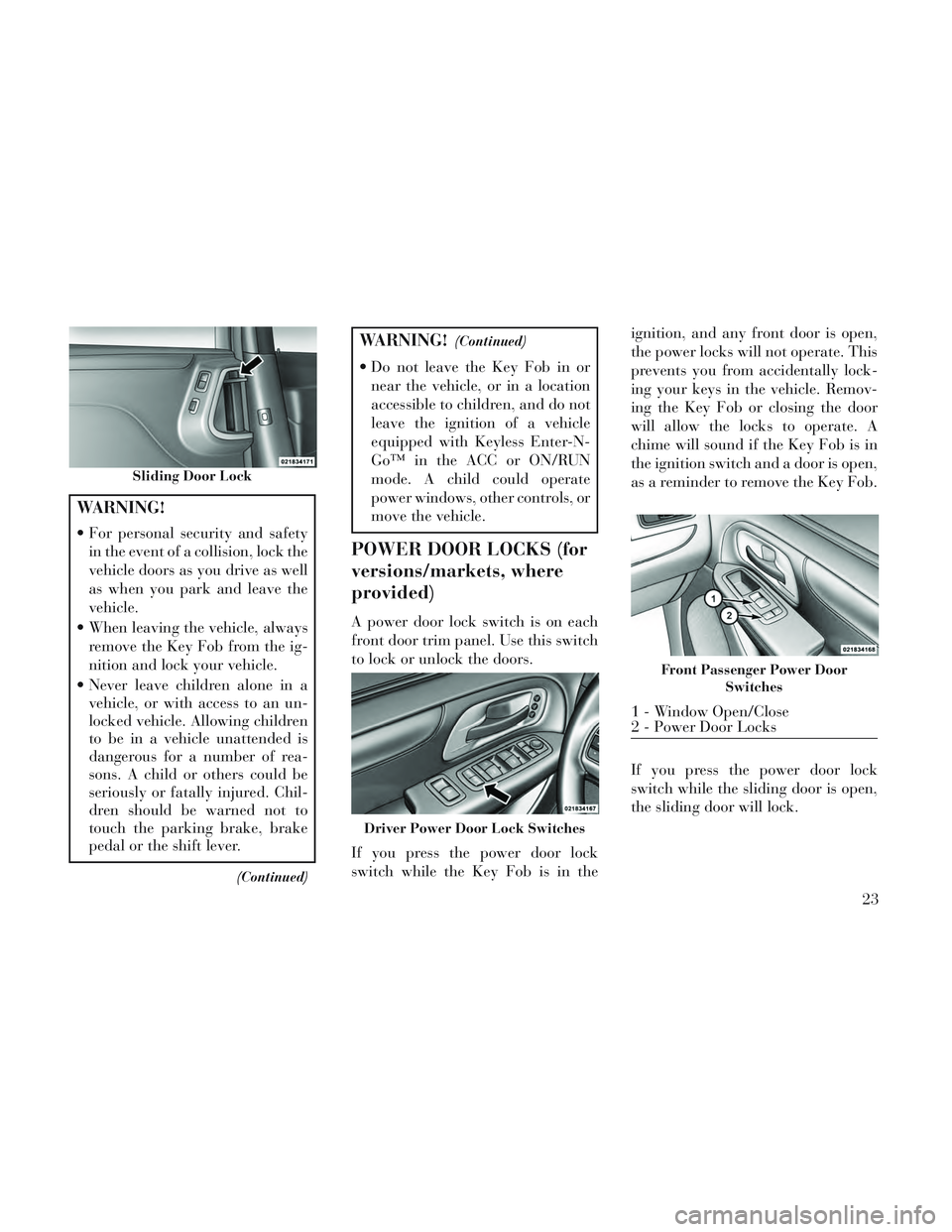
A power door lock switch is on each
front door trim panel. Use this switch
to lock or unlock the doors.
If you press the power door lock
switch while the Key Fob is in the ignition, and any front door is open,
the power locks will not operate. This
prevents you from accidentally lock-
ing your keys in the vehicle. Remov-
ing the Key Fob or closing the door
will allow the locks to operate. A
chime will sound if the Key Fob is in
the ignition switch and a door is open,
as a reminder to remove the Key Fob.
If you press the power door lock
switch while the sliding door is open,
the sliding door will lock.
Sliding Door Lock
Driver Power Door Lock Switches
Front Passenger Power Door
Switches
1 - Window Open/Close
2 - Power Door Locks
23
Page 37 of 364
power sliding door must be
opened or closed manually.
WARNING!
You, or others, could be injured if
caught in the path of the sliding
door. Make sure the door path is
clear before closing the door.
Power Sliding Side Door Open
Flash
The left and right exterior hazard
lights will flash for 12 seconds when
either sliding door is opened. This will
alert other drivers in the area that
passenger(s) could be entering or ex-
iting the vehicle.
The Sliding Side Door Open Flash can
be enabled or disabled by performing
the following procedure:
1. Place the Key Fob in the ignition
switch.
2. Cycle the ignition switch from ON/
RUN to OFF five times ending in the
ON/RUN position (do not start the
engine). 3. Within 10 seconds of the final
cycle, press the HAZARD switch ON.
4. A single chime will sound to sig-
nify that you have successfully com-
pleted the programming.
You can turn the feature back on by
repeating the previous procedure.
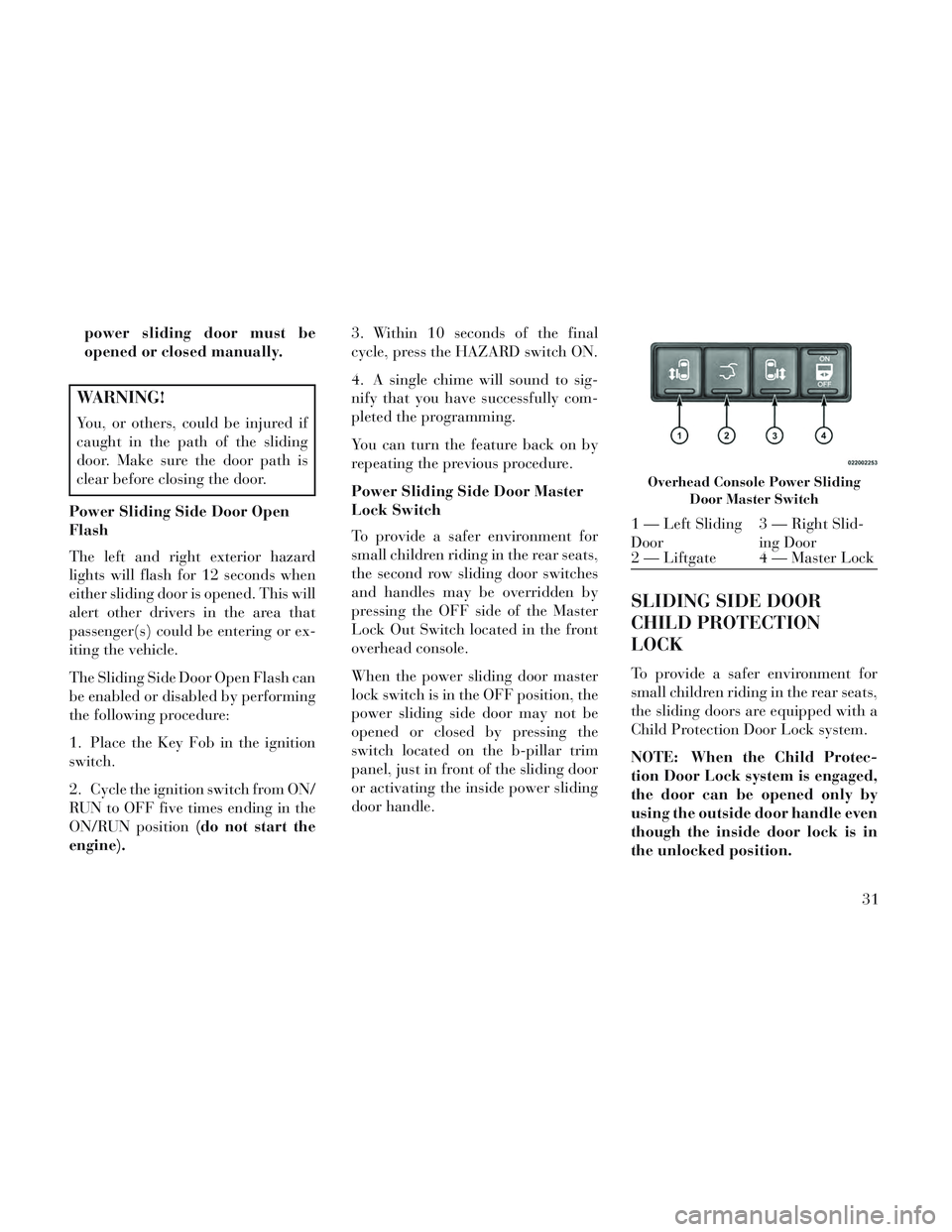
Power Sliding Side Door Master
Lock Switch
To provide a safer environment for
small children riding in the rear seats,
the second row sliding door switches
and handles may be overridden by
pressing the OFF side of the Master
Lock Out Switch located in the front
overhead console.
When the power sliding door master
lock switch is in the OFF position, the
power sliding side door may not be
opened or closed by pressing the
switch located on the b-pillar trim
panel, just in front of the sliding door
or activating the inside power sliding
door handle.
SLIDING SIDE DOOR
CHILD PROTECTION
LOCK
To provide a safer environment for
small children riding in the rear seats,
the sliding doors are equipped with a
Child Protection Door Lock system.
NOTE: When the Child Protec-
tion Door Lock system is engaged,
the door can be opened only by
using the outside door handle even
though the inside door lock is in
the unlocked position.
Overhead Console Power Sliding
Door Master Switch
1 — Left Sliding
Door 3 — Right Slid-
ing Door
2 — Liftgate 4 — Master Lock
31
Page 38 of 364
NOTE:
After engaging the Child Protec-tion Door Lock, always test the
door from the inside to make
certain it is in the desired posi-
tion.
When the Child Protection Door Lock system is engaged, (even if
the inside door lock is in the
unlocked position) the door can
be opened only by using the out-
side door handle, the RKE
transmitter, the switches on the
overhead console or the switches
located on the trim panel just in
front of the power sliding door.
The power sliding side door will operate from the switches lo-
cated on the trim panel just in
front of the power sliding door,
regardless of the Child Protec-
tion Door Lock lever position. To
avoid unintentional operation of
the power sliding door from the
rear seats, press the "OFF” Mas-
ter Lock Out Switch located in
the front overhead console, next
to the driver.WARNING!
Avoid trapping anyone in the ve-
hicle in a collision. Remember that
the sliding doors can only be
opened from the outside door
handle or the switches located on
the b-pillar trim panel just in front
of the power sliding door when the
Child Protection Door Locks are
engaged.
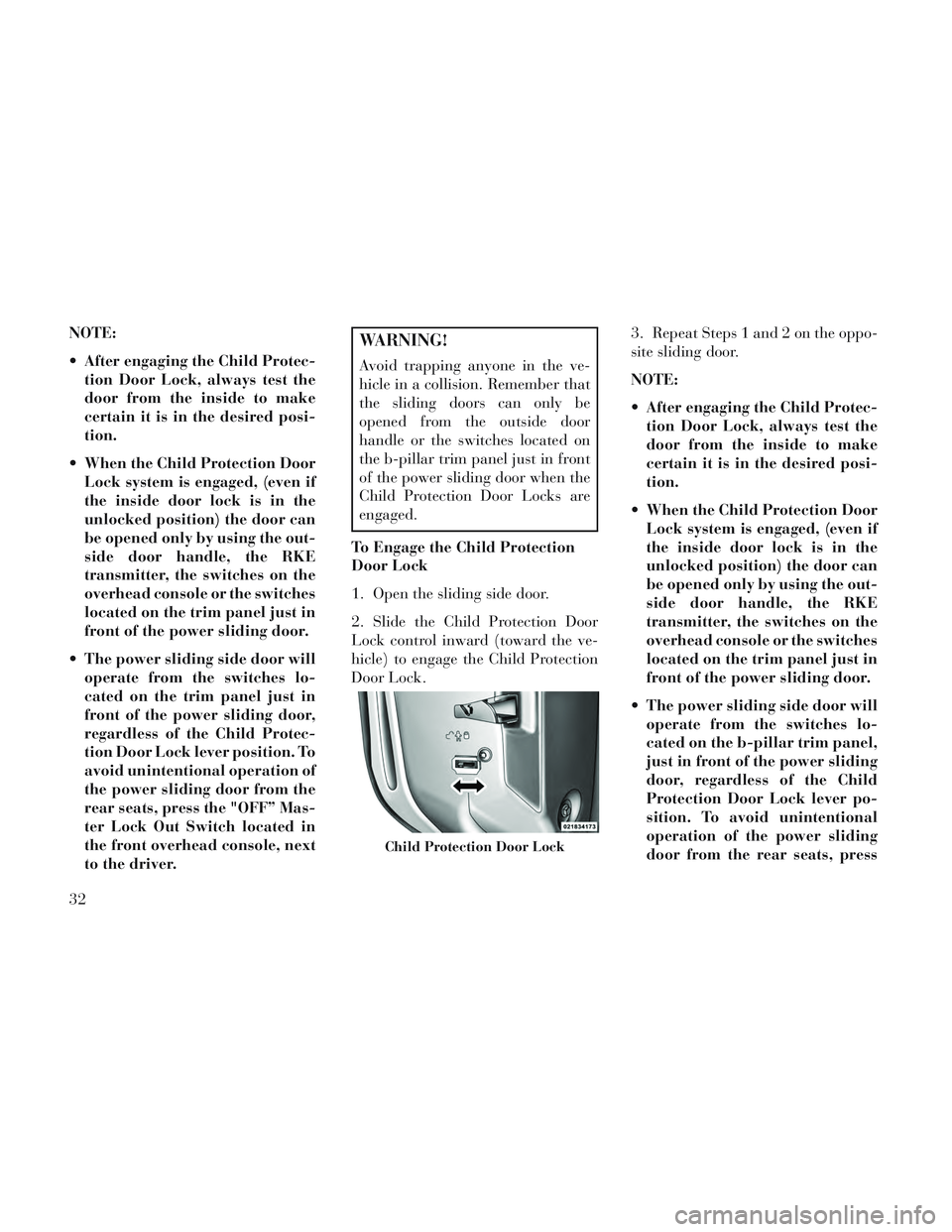
To Engage the Child Protection
Door Lock
1. Open the sliding side door.
2. Slide the Child Protection Door
Lock control inward (toward the ve-
hicle) to engage the Child Protection
Door Lock. 3. Repeat Steps 1 and 2 on the oppo-
site sliding door.
NOTE:
After engaging the Child Protec-
tion Door Lock, always test the
door from the inside to make
certain it is in the desired posi-
tion.
When the Child Protection Door Lock system is engaged, (even if
the inside door lock is in the
unlocked position) the door can
be opened only by using the out-
side door handle, the RKE
transmitter, the switches on the
overhead console or the switches
located on the trim panel just in
front of the power sliding door.
The power sliding side door will operate from the switches lo-
cated on the b-pillar trim panel,
just in front of the power sliding
door, regardless of the Child
Protection Door Lock lever po-
sition. To avoid unintentional
operation of the power sliding
door from the rear seats, press
Child Protection Door Lock
32
Page 39 of 364
the “OFF” Master Lock Out
Switch located in the front over-
head console, next to the driver.
WARNING!
Avoid trapping anyone in the ve-
hicle in a collision. Remember that
the sliding doors can only be
opened from the outside door
handle or the switches located on
the b-pillar trim panel just in front
of the power sliding door when the
Child Protection Door Locks are
engaged.
To Disengage the Child Protection
Door Lock
1. Open the sliding side door.
2. Slide the Child Protection Door
Lock control outward (away from the
vehicle) to disengage the Child Pro-
tection Door Lock.
3. Repeat Steps 1 and 2 on the oppo-
site sliding door (for versions/
markets, where provided). NOTE:
After setting the Child Protec-
tion Door Lock system, always
test the door from the inside to
make certain it is in the desired
position.
The power sliding side door switches will not open the power
sliding doors if the vehicle is in
gear or the vehicle speed is
above 0 km/h.
The power sliding door will op- erate from the outside door
handle, the RKE transmitter, the
switches on the overhead con-
sole, or the switches located on
the b-pillar trim panel just in
front of the power sliding door
when the shift lever is in PARK,
regardless of the child lock lever
position.
LIFTGATE
On vehicles equipped with power
locks, the liftgate can be unlocked
using the Remote Keyless Entry (RKE) transmitter button, or by acti-
vating the power door lock switches
located on the front doors.
To open the liftgate, press the liftgate
release handle located on the under-
side of the license plate bar and pull
the liftgate open with one fluid mo-
tion.
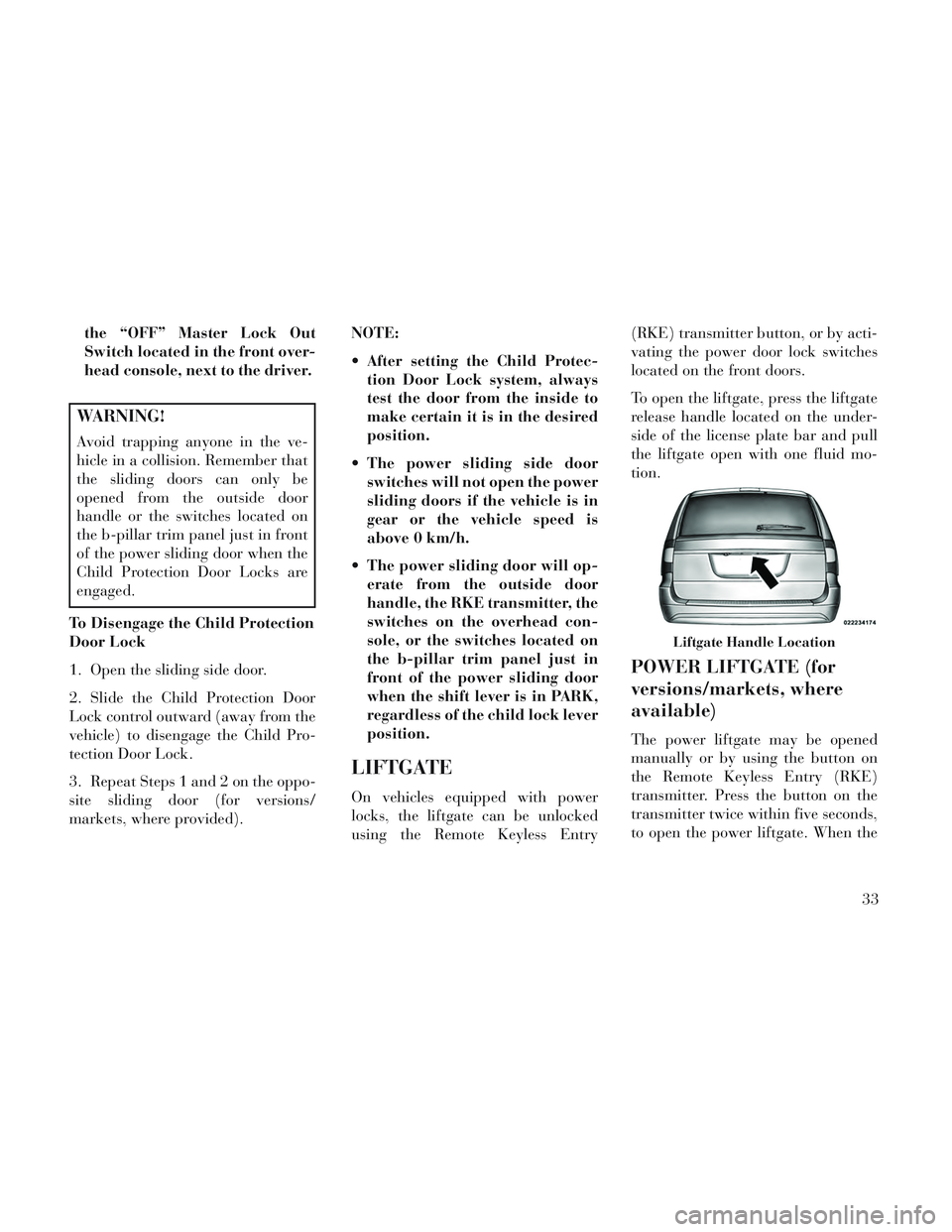
POWER LIFTGATE (for
versions/markets, where
available)
The power liftgate may be opened
manually or by using the button on
the Remote Keyless Entry (RKE)
transmitter. Press the button on the
transmitter twice within five seconds,
to open the power liftgate. When the
Liftgate Handle Location
33
Page 42 of 364
desired length to restrain a child seat
or secure a large item in a seat
If you will be carrying children too
small for adult-sized seat belts, the
seat belts or the ISOFIX feature also
can be used to hold infant and child
restraint systems. For more informa-
tion on ISOFIX, see ISOFIX — Child
Seat Anchorage System.
WARNING!
Never place a rear facing infantseat in front of an air bag. A de-
ploying Passenger Advanced
Front Air Bag can cause death or
serious injury to a child 12 years
or younger, including a child in a
rearward facing infant seat.
Only use a rearward-facing child restraint in a vehicle with a rear
seat.
NOTE: The Advanced Front Air
Bags have a multistage inflator de-
sign. This allows the air bag to
have different rates of inflation
based on several factors, including
the severity and type of collision. Please pay close attention to the infor-
mation in this section. It tells you how
to use your restraint system properly,
to keep you and your passengers as
safe as possible.
Buckle up even though you are an
excellent driver, even on short trips.
Someone on the road may be a poor
driver and cause a collision that in-
cludes you. This can happen far away
from home or on your own street.
Research has shown that seat belts
save lives, and they can reduce the
seriousness of injuries in a collision.
Some of the worst injuries happen
when people are thrown from the ve-
hicle. Seat belts reduce the possibility
of ejection and the risk of injury
caused by striking the inside of the
vehicle. Everyone in a motor vehicle
should be belted at all times.
LAP/SHOULDER BELTS
All seating positions in your vehicle
are equipped with combination lap/
shoulder belts.
The belt webbing in the retractor is
designed to lock during very suddenstops or collisions. This feature allows
the shoulder part of the belt to move
freely with you under normal condi-
tions. However, in a collision the belt
will lock and reduce the risk of you
striking the inside of the vehicle or
being thrown out.
The driver is responsible for respect-
ing, and ensuring that all the other
occupants of the car also respect, the
local laws in force in relation to the
use of the seat belts. Always fasten the
seat belts before starting.
WARNING!
It is dangerous to ride in a cargo
area, inside or outside of a ve-
hicle. In a collision, people riding
in these areas are more likely to
be seriously injured or killed.
Do not allow people to ride in any area of your vehicle that is not
equipped with seats and seat
belts.
Be sure everyone in your vehicle is in a seat and using a seat belt
properly.
(Continued)
36
Page 46 of 364
SEAT BELTS IN
PASSENGER SEATING
POSITIONS
The seat belts in the passenger seating
positions are equipped with Auto-
matic Locking Retractors (ALR)which are used to secure a child re-
straint system. For additional infor-
mation, refer to “Installing Child Re-
straints Using The Vehicle Seat Belt”
under the “Child Restraints” section.
The chart below defines the type of
feature for each seating position.
Driver
Center Passenger
First Row N/AN/AALR (for versions/markets, where
provided)
Second Row ALRN/A ALR
Third Row ALRCINCH ALR
N/A — Not Applicable
ALR —
Automatic Locking Retractor
If the passenger seating position is
equipped with an ALR and is being
used for normal usage:
Only pull the belt webbing out far
enough to comfortably wrap around
the occupant's mid-section so as to not
activate the ALR. If the ALR is acti-
vated, you will hear a ratcheting sound
as the belt retracts. Allow the webbing
to retract completely in this case and
then carefully pull out only the amount
of webbing necessary to comfortably wrap around the occupant's mid-
section. Slide the latch plate into the
buckle until you hear a "click."
AUTOMATIC LOCKING
RETRACTOR MODE (ALR)
In this mode, the shoulder belt is auto-
matically pre-locked. The belt will still
retract to remove any slack in the
shoulder belt. The Automatic Locking
Mode is available on all passenger-
seating positions with a combination
lap/shoulder belt. Use the Automatic
Locking Mode anytime a child safety
seat is installed in a seating position
that has a belt with this feature. Chil-
dren 12 years old and under should
always be properly restrained in the
rear seat.
How To Engage The Automatic
Locking Mode
1. Buckle the combination lap and
shoulder belt.
2. Grasp the shoulder portion and
pull downward until the entire belt is
extracted.
40
Page 47 of 364
3. Allow the belt to retract. As the
belt retracts, you will hear a clicking
sound. This indicates the safety belt is
now in the Automatic Locking Mode.
How To Disengage The Automatic
Locking Mode
Unbuckle the combination lap/
shoulder belt and allow it to retract
completely to disengage the Auto-
matic Locking Mode and activate the
vehicle sensitive (emergency) locking
mode.
WARNING!
The belt and retractor assemblymust be replaced if the seat belt
assembly Automatic Locking Re-
tractor (ALR) feature or any
other seat belt function is not
working properly when checked
according to the procedures in the
Service Manual.
Failure to replace the belt and retractor assembly could increase
the risk of injury in collisions.
ENERGY MANAGEMENT
FEATURE
This vehicle has a safety belt system
with an energy management feature
in the front seating positions to help
further reduce the risk of injury in the
event of a head-on collision. This
safety belt system has a retractor as-
sembly that is designed to release
webbing in a controlled manner. This
feature is designed to help reduce the
belt force acting on the occupant’s
chest.
WARNING!
The belt and retractor assemblymust be replaced if the seat belt
assembly Automatic Locking Re-
tractor (ALR) feature or any
other seat belt function is not
working properly when checked
according to the procedures in the
Service Manual.
Failure to replace the belt and retractor assembly could increase
the risk of injury in collisions.
SEAT BELT
PRETENSIONERS
The seat belts for both front seating
positions are equipped with preten-
sioning devices that are designed to
remove slack from the seat belt in the
event of a collision. These devices may
improve the performance of the seat
belt by assuring that the belt is tight
about the occupant early in a colli-
sion. Pretensioners work for all size
occupants, including those in child
restraints.
NOTE: These devices are not a
substitute for proper seat belt
placement by the occupant. The
seat belt still must be worn snugly
and positioned properly.
The pretensioners are triggered by the
Occupant Restraint Controller
(ORC). Like the air bags, the preten-
sioners are single use items. A de-
ployed pretensioner or a deployed air
bag must be replaced immediately.
41
Page 56 of 364
Occupants, including children who
are up against or very close to SAB or
SABIC air bags can be seriously in-
jured or killed. Occupants, especially
children, should not lean on or sleep
against the door, side windows, or
area where the SAB or SABIC air bags
inflate, even if they are in an infant or
child restraint. Always sit upright as
possible with your back against the
seat back, use the seat belts properly,
and use the appropriate sized child
restraint, infant restraint or booster
seat recommended for the size and
weight of the child.
WARNING!
Your vehicle is equipped withSABIC air bags, do not have any
accessory items installed which
will alter the roof, including add-
ing a sunroof to your vehicle. Do
not add roof racks that require
permanent attachments (bolts or
screws) for installation on the ve-
hicle roof. Do not drill into the
roof of the vehicle for any reason.
(Continued)
WARNING!(Continued)
Your vehicle is equipped with leftand right Supplemental Side Air
Bag Inflatable Curtain (SABIC),
do not stack luggage or other
cargo up high enough to block the
location of the SABIC. The area
where the SABIC is located
should remain free from any ob-
structions.
Do not use accessory seat covers or place objects between you and
the side air bags; the performance
could be adversely affected
and/or objects could be pushed
into you, causing serious injury.
Knee Impact Bolsters
The Knee Impact Bolsters help pro-
tect the knees of the driver and the
front passenger, and position front oc-
cupants for the best interaction with
the Advanced Front Air Bags.
Along with seat belts and pretension-
ers, Advanced Front Air Bags work
with the knee bolsters to provide im-
proved protection for the driver and front passenger. Side air bags also
work with seat belts to improve occu-
pant protection.
AIR BAG DEPLOYMENT
SENSORS AND CONTROLS
Occupant Restraint Controller
(ORC)
The ORC is part of a regulated safety
system required for this vehicle.
The ORC determines if deployment of
the front and/or side air bags in a
frontal or side collision is required.
Based on the impact sensor's signals,
a central electronic ORC deploys the
Advanced Front Air Bags, SABIC air
bags, Supplemental Seat-Mounted
Side Air Bags, and front seat belt pre-
tensioners, as required, depending on
several factors, including the severity
and type of impact.
Advanced Front Air Bags are designed
to provide additional protection by
supplementing the seat belts in cer-
tain frontal collisions depending on
several factors, including the severity
and type of collision. Advanced Front
50