coolant level Lancia Voyager 2014 Owner handbook (in English)
[x] Cancel search | Manufacturer: LANCIA, Model Year: 2014, Model line: Voyager, Model: Lancia Voyager 2014Pages: 364, PDF Size: 3.49 MB
Page 230 of 364
CAUTION!
Interior air enters the Rear Auto-
matic Temperature Control System
through an intake grille, located in
the right side trim panel behind the
third row seats. The rear outlets are
located in the right side trim panel
of the 3rd Row seat. Do not block or
place objects directly in front of the
inlet grille or heater outlets. The
electrical system could overload
causing damage to the blower mo-
tor.
Rear Temperature Control
To change the temperature in the rear
of the vehicle, rotate the temperature
knob counterclockwise to lower the
temperature, and clockwise to in-
crease the temperature. The rear tem-
perature settings are displayed in the
front ATC panel.
When rear controls are locked by the
front system, the Rear Temperature
Lock symbol on the temperature
knob is illuminated and any rear over-
head adjustments are ignored. Rear Mode Control
Auto Mode
The rear system automatically main-
tains the correct mode and comfort
level desired by the rear seat occu-
pants.
Headliner Mode
Air comes from the outlets in
the headliner. Each of these
outlets can be individually adjusted to
direct the flow of air. Moving the air
vanes of the outlets to one side will
shut off the airflow.
Bi-Level Mode
Air comes from both the head-
liner outlets and the floor out-
lets.
NOTE: In many temperature po-
sitions, the Bi-Level mode is de-
signed to provide cooler air out of
the headliner outlets and warmer
air from the floor outlets.
Floor Mode Air comes from the floor out-
lets. Recirculation Control
When outside air contains
smoke, odors, or high hu-
midity, or if rapid cooling is
desired, you may wish to
recirculate interior air by pressing the
Recirculation control button. Recir-
culation mode should only be used
temporarily. The recirculation LED
will illuminate when this button is
selected. Push the button a second
time to turn off the Recirculation
mode LED and allow outside air into
the vehicle.
NOTE: In cold weather, use of the
Recirculation mode may lead to
excessive window fogging. The Re-
circulation mode is not allowed in
Defrost mode to improve window
clearing operation. Recirculation
will be disabled automatically if
this mode is selected.
SUMMER OPERATION
The engine cooling system in air con-
ditioned vehicles must be protected
with a high-quality antifreeze coolant
to provide proper corrosion protection
224
Page 323 of 364
Adding Coolant
Your vehicle has been built with an
improved engine coolant (antifreeze)
that allows extended maintenance in-
tervals. This engine coolant (anti-
freeze) can be used up to ten years or
240 000 km before replacement. To
prevent reducing this extended main-
tenance period, it is important that
you use the same engine coolant (an-
tifreeze) throughout the life of your
vehicle.
Use only high purity water such as
distilled or deionized water when
mixing the water/engine coolant (an-
tifreeze) solution. The use of lower
quality water will reduce the amount
of corrosion protection in the engine
cooling system.
Please note that it is the owner's re-
sponsibility to maintain the proper
level of protection against freezing ac-
cording to the temperatures occurring
in the area where the vehicle is oper-
ated.
NOTE: Mixing engine coolant
(antifreeze) types will decrease thelife of the engine coolant (anti-
freeze) and will require more fre-
quent coolant changes.
Cooling System Pressure Cap
The cap must be fully tightened to
prevent loss of coolant, and to ensure
that coolant will return to the radiator
from the coolant recovery bottle.
The cap should be inspected and
cleaned if there is any accumulation of
foreign material on the sealing surfaces.
WARNING!
The warning words “DO NOT
OPEN HOT” on the cooling sys-
tem pressure cap are a safety pre-
caution. Never add engine cool-
ant (antifreeze) when the engine
is overheated. Do not loosen or
remove the cap to cool an over-
heated engine. Heat causes pres-
sure to build up in the cooling
system. To prevent scalding or in-
jury, do not remove the pressure
cap while the system is hot or
under pressure.
(Continued)
WARNING!(Continued)
Do not use a pressure cap otherthan the one specified for your
vehicle. Personal injury or engine
damage may result.
Disposal Of Used Engine Coolant
Used ethylene glycol-based engine
coolant (antifreeze) is a regulated
substance requiring proper disposal.
Check with your local authorities to
determine the disposal rules for your
community. To prevent ingestion by
animals or children, do not store eth-
ylene glycol-based engine coolant
(antifreeze) in open containers or al-
low it to remain in puddles on the
ground. If ingested by a child or pet,
seek emergency assistance immedi-
ately. Clean up any ground spills im-
mediately.
Coolant Level
The coolant bottle provides a quick
visual method for determining that
the coolant level is adequate. With the
engine cold, the level of the engine
317
Page 324 of 364
coolant (antifreeze) in the coolant re-
covery bottle should be between the
ranges indicated on the bottle.
The radiator normally remains com-
pletely full, so there is no need to
remove the radiator cap unless check-
ing for engine coolant (antifreeze)
freeze point or replacing the engine
coolant (antifreeze). Advise your ser-
vice attendant of this. As long as the
engine operating temperature is satis-
factory, the coolant bottle only needs
to be checked once a month.
When additional engine coolant (an-
tifreeze) is needed to maintain the
proper level, it should be added to the
coolant bottle. Do not overfill.
Points To Remember
NOTE: When the vehicle is
stopped after a few kilometers of
operation, you may observe vapor
coming from the front of the engine
compartment. This is normally a
result of moisture from rain, snow,
or high humidity accumulating on
the radiator and being vaporizedwhen the thermostat opens, allow-
ing hot engine coolant (antifreeze)
to enter the radiator.
If an examination of your engine com-
partment shows no evidence of radia-
tor or hose leaks, the vehicle may be
safely driven. The vapor will soon dis-
sipate.
Do not overfill the coolant recovery
bottle.
Check the engine coolant (anti- freeze) freeze point in the radiator
and in the coolant recovery bottle.
If engine coolant (antifreeze) needs
to be added, contents of the coolant
recovery bottle must also be pro-
tected against freezing.
If frequent engine coolant (anti- freeze) additions are required, or if
the level in the coolant recovery
bottle does not drop when the en-
gine cools, the cooling system
should be pressure tested for leaks.
Maintain engine coolant (anti- freeze) concentration at 50% en-
gine coolant (antifreeze) (mini-
mum) and distilled water for proper corrosion protection of your
engine, which contains aluminum
components.
Make sure that the radiator and coolant recovery bottle overflow
hoses are not kinked or obstructed.
Keep the front of the radiator clean. If your vehicle is equipped with air
conditioning, also keep the front of
the condenser clean.
Do not change the thermostat for Summer or Winter operation. If re-
placement is ever necessary, install
ONLY the correct type thermostat.
Other designs may result in unsat-
isfactory coolant performance,
poor gas mileage, and increased
emissions.
BRAKES
In order to assure brake system per-
formance, all brake system compo-
nents should be inspected periodi-
cally. Refer to the “Maintenance
Schedule” for the proper maintenance
intervals.
318
Page 339 of 364

The PRY location is best closestto the studs while dislodging
them separately.
3. Twist the socket and remove it
from the lamp assembly.
4. Pull the bulb to remove it from the
socket.
5. Replace the bulb, reinstall the
socket, and reattach the lamp assem-
bly.CENTER HIGH-MOUNTED
STOP LAMP (CHMSL)
The CHMSL uses LED lights are not
serviceable. The CHMSL must be re-
placed as an assembly, see your au-
thorized dealer.
LICENSE LAMP
There are two license plate lamps, and
they are located under the tailgate
lamp bar and above the license plate. 1. Remove the two lens assembly
mounting screws.
2. Remove the bulb from the socket.
Replace the bulb and reattach the lens
assembly.
FLUID CAPACITIES
Metric
Fuel (Approximate) 76 Liters
Engine Oil with Filter
3.6L Engine 5.6 Liters
2.8L Diesel Engine 6.6 Liters
Cooling System *
3.6L Engine 12.6 Liters
2.8L Diesel Engine 13.8 Liters
* Includes heater and coolant recovery bottle filled to MAX level. Add 2.8 Liters for versions/markets, where provided
with a rear heater.
333
Page 347 of 364

Thousands Of Kilometers 24 48 72 96 120 144 168 192Months 12 24 36 48 60 72 84 96
Check operation of lighting system (headlamps, direction indi-
cators, hazard warning lights, luggage compartment, passen-
ger compartment, glove compartment, instrument panel warn-
ing lights, etc.).
Check operation of windshield washer system and adjust jets if
necessary.
Check windshield/rear window wiper blade position/wear.
Check cleanliness of hood and tailgate locks and cleanliness
and lubrication of linkages.
Visually inspect condition of: exterior bodywork, underbody
protection, pipes and hoses (exhaust - fuel system - brakes),
rubber elements (boots, sleeves, bushes, etc.).
Check conditions and wear of front disc brake pads.
Check conditions and wear of rear disc brake pads.
Check and, if necessary, top up fluid levels (brakes, windshield
washer, battery, engine coolant, etc.).
Visually inspect the condition of accessory drive belt/s.
Check exhaust gas emissions.
Check engine management system operation (via diagnostic
socket).
Adjust parking brake shoes as necessary.
Change the automatic transmission fluid and filter. (*)
Replace spark plugs. (***)
Replace air filter cartridge.
341
Page 348 of 364
Thousands Of Kilometers 24 48 72 96 120 144 168 192Months 12 24 36 48 60 72 84 96
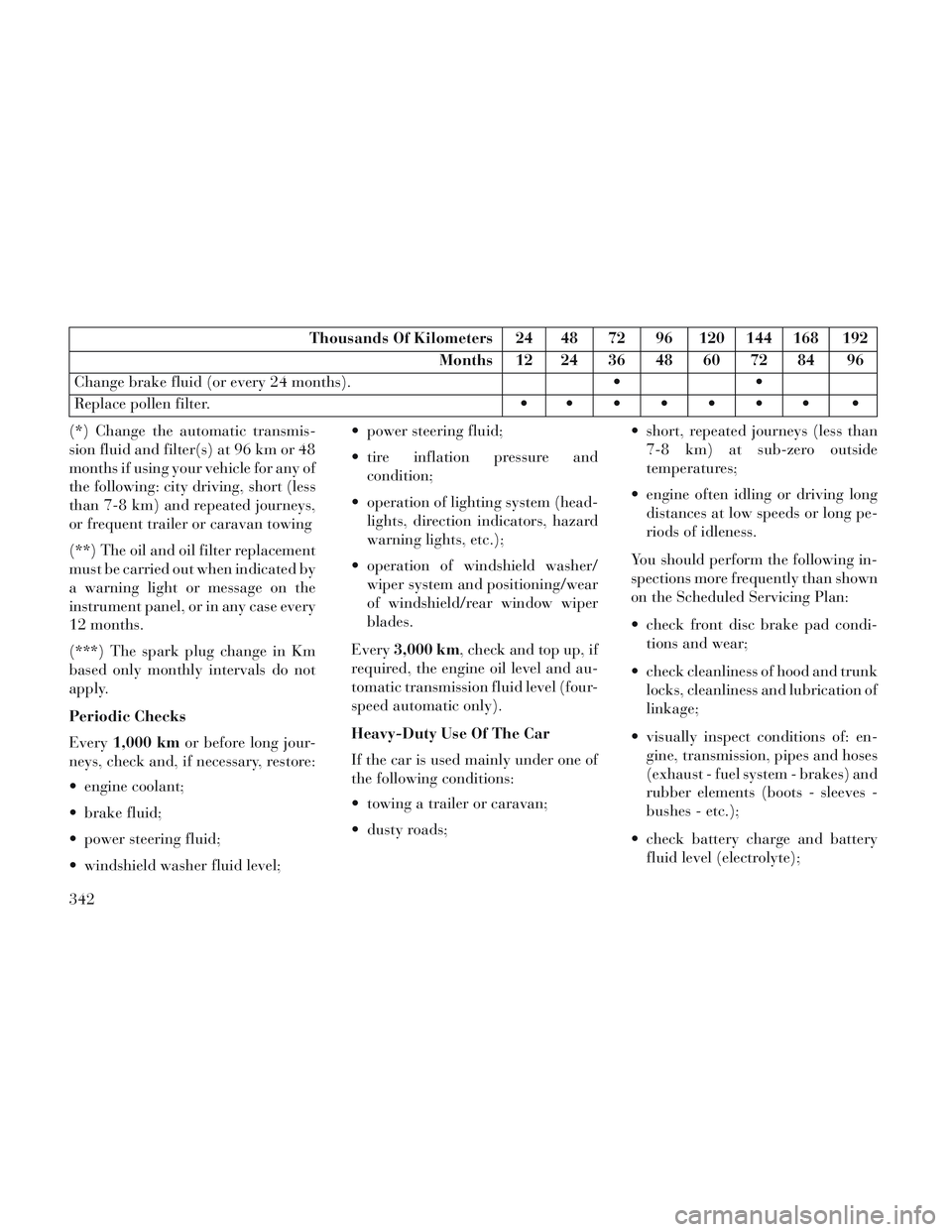
Change brake fluid (or every 24 months).
Replace pollen filter.
(*) Change the automatic transmis-
sion fluid and filter(s) at 96 km or 48
months if using your vehicle for any of
the following: city driving, short (less
than 7-8 km) and repeated journeys,
or frequent trailer or caravan towing
(**) The oil and oil filter replacement
must be carried out when indicated by
a warning light or message on the
instrument panel, or in any case every
12 months.
(***) The spark plug change in Km
based only monthly intervals do not
apply.
Periodic Checks
Every 1,000 km or before long jour-
neys, check and, if necessary, restore:
engine coolant;
brake fluid;
power steering fluid;
windshield washer fluid level; power steering fluid;
tire inflation pressure and
condition;
operation of lighting system (head- lights, direction indicators, hazard
warning lights, etc.);
operation of windshield washer/ wiper system and positioning/wear
of windshield/rear window wiper
blades.
Every 3,000 km, check and top up, if
required, the engine oil level and au-
tomatic transmission fluid level (four-
speed automatic only).
Heavy-Duty Use Of The Car
If the car is used mainly under one of
the following conditions:
towing a trailer or caravan;
dusty roads; short, repeated journeys (less than
7-8 km) at sub-zero outside
temperatures;
engine often idling or driving long distances at low speeds or long pe-
riods of idleness.
You should perform the following in-
spections more frequently than shown
on the Scheduled Servicing Plan:
check front disc brake pad condi- tions and wear;
check cleanliness of hood and trunk locks, cleanliness and lubrication of
linkage;
visually inspect conditions of: en- gine, transmission, pipes and hoses
(exhaust - fuel system - brakes) and
rubber elements (boots - sleeves -
bushes - etc.);
check battery charge and battery fluid level (electrolyte);
342
Page 352 of 364

Periodic Checks
Every1,000 km or before long jour-
neys, check and, if necessary, restore:
engine coolant;
brake fluid;
power steering fluid;
windshield washer fluid level;
power steering fluid;
tire inflation pressure and condition;
operation of lighting system (head- lights, direction indicators, hazard
warning lights, etc.);
operation of windshield washer/ wiper system and positioning/wear
of windshield/rear window wiper
blades.
Every 3,000 km, check and top up, if
required, the engine oil level and au-
tomatic transmission fluid level (four-
speed automatic only). Heavy-Duty Use Of The Car
If the car is used mainly under one of
the following conditions:
towing a trailer or caravan;
dusty roads;
short, repeated journeys (less than
7-8 km) at sub-zero outside
temperatures;
engine often idling or driving long distances at low speeds or long pe-
riods of idleness.
You should perform the following in-
spections more frequently than shown
on the Scheduled Servicing Plan:
check front disc brake pad condi- tions and wear;
check cleanliness of hood and trunk locks, cleanliness and lubrication of
linkage; visually inspect conditions of: en-
gine, transmission, pipes and hoses
(exhaust - fuel system - brakes) and
rubber elements (boots - sleeves -
bushes - etc.);
check battery charge and battery fluid level (electrolyte);
visually inspect condition of the ac- cessory drive belts;
check and, if necessary, change en- gine oil and replace oil filter;
check and, if necessary, replace pol- len filter;
check and, if necessary, replace air cleaner.
346
Page 354 of 364
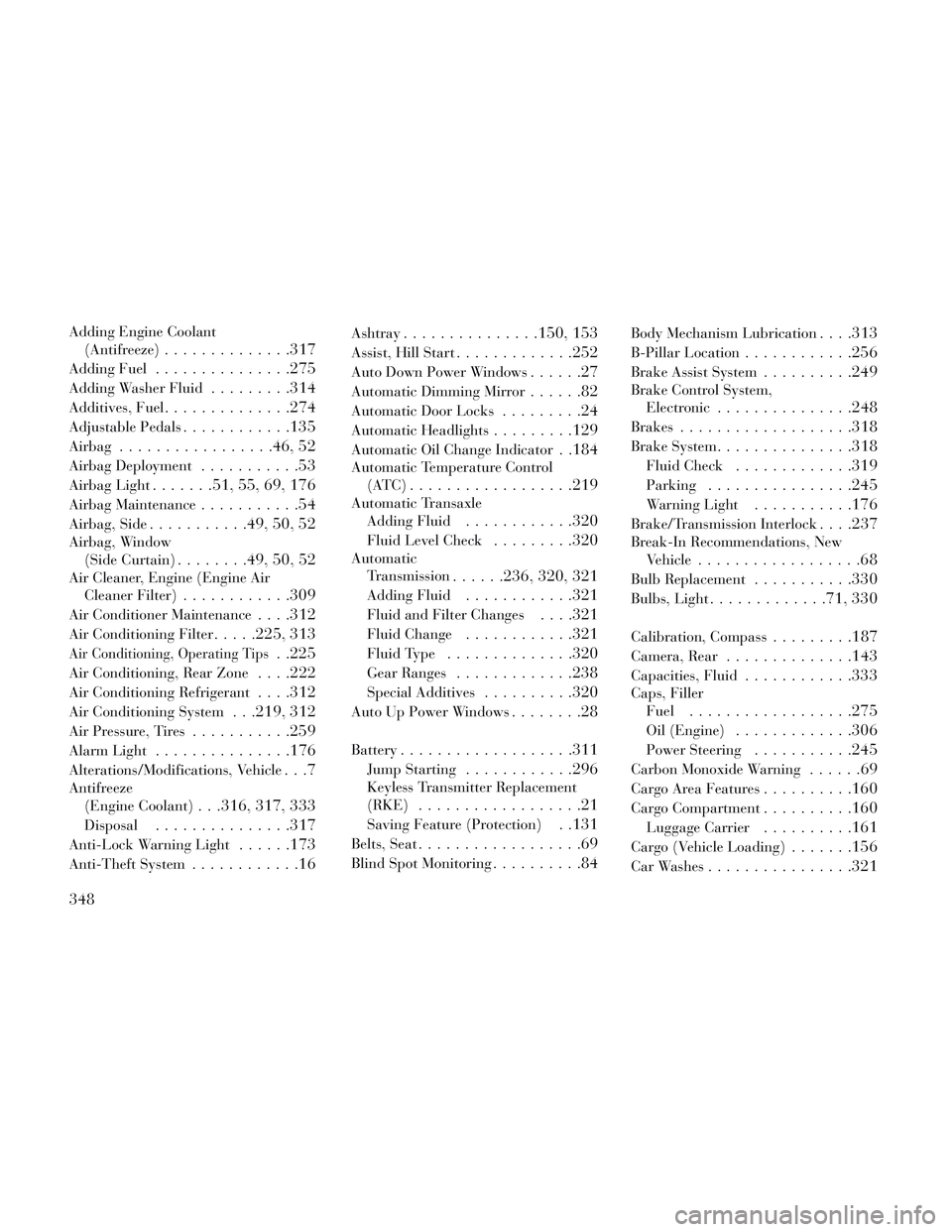
Adding Engine Coolant(Antifreeze)
............. .317
Adding Fuel.............. .275
Adding Washer Fluid.........314
Additives, Fuel..............274
Adjustable Pedals............135
Airbag.................46, 52
Airbag Deployment...........53
Airbag Light.......51, 55, 69, 176
Airbag Maintenance...........54
Airbag, Side...........49, 50, 52
Airbag, Window
(Side Curtain)
........49, 50, 52
Air Cleaner, Engine (Engine AirCleaner Filter)
............309
Air Conditioner Maintenance. . . .312
Air Conditioning Filter.....225, 313
Air Conditioning, Operating Tips. .225
Air Conditioning, Rear Zone. . . .222
Air Conditioning Refrigerant. . . .312
Air Conditioning System. . .219, 312
Air Pressure, Tires...........259
Alarm Light.............. .176
Alterations/Modifications, Vehicle...7
Antifreeze
(Engine Coolant)
. . .316, 317, 333
Disposal.............. .317
Anti-Lock Warning Light......173
Anti-Theft System............16
Ashtray...............150, 153
Assist, Hill Start.............252
Auto Down Power Windows......27
Automatic Dimming Mirror......82
Automatic Door Locks.........24
Automatic Headlights.........129
Automatic Oil Change Indicator. .184
Automatic Temperature Control
(ATC)
..................219
Automatic TransaxleAdding Fluid
............320
Fluid Level Check.........320
AutomaticTransmission
......236, 320, 321
Adding Fluid............321
Fluid and Filter Changes. . . .321
Fluid Change............321
Fluid Type............. .320
Gear Ranges.............238
Special Additives..........320
Auto Up Power Windows........28
Battery.................. .311
Jump Starting............296
Keyless Transmitter Replacement
(RKE)
..................21
Saving Feature (Protection). .131
Belts, Seat..................69
Blind Spot Monitoring..........84
Body Mechanism Lubrication. . . .313
B-Pillar Location............256
Brake Assist System..........249
Brake Control System,
Electronic
.............. .248
Brakes.................. .318
Brake System...............318
Fluid Check.............319
Parking................245
Warning Light...........176
Brake/Transmission Interlock. . . .237
Break-In Recommendations, New
Vehicle
..................68
Bulb Replacement...........330
Bulbs, Light.............71, 330
Calibration, Compass.........187
Camera, Rear............. .143
Capacities, Fluid............333
Caps, Filler
Fuel
..................275
Oil (Engine).............306
Power Steering...........245
Carbon Monoxide Warning......69
Cargo Area Features..........160
Cargo Compartment..........160
Luggage Carrier..........161
Cargo (Vehicle Loading).......156
Car Washes................321
348
Page 355 of 364
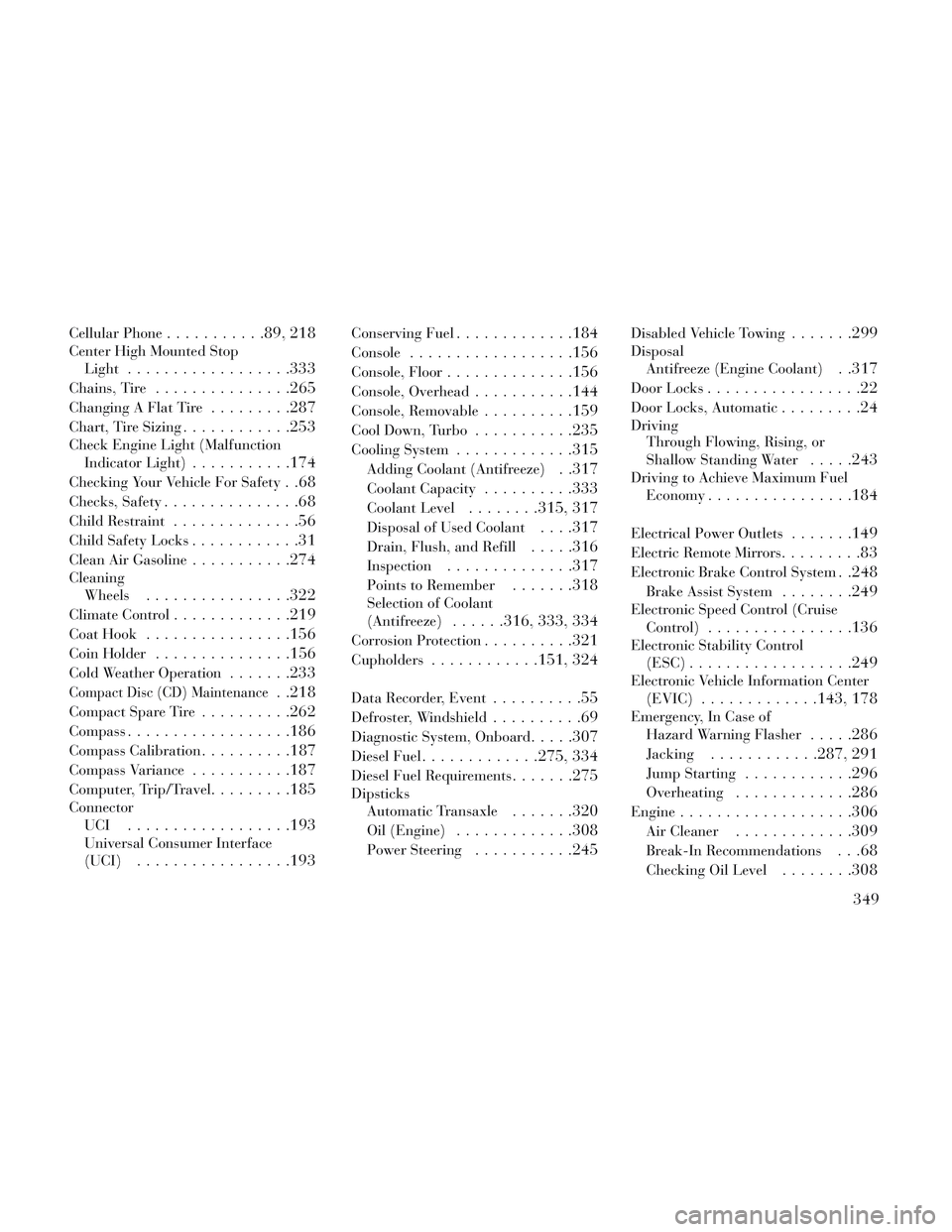
Cellular Phone...........89, 218
Center High Mounted StopLight
..................333
Chains, Tire.............. .265
Changing A Flat Tire.........287
Chart, Tire Sizing............253
Check Engine Light (Malfunction
Indicator Light)
...........174
Checking Your Vehicle For Safety. .68
Checks, Safety...............68
Child Restraint..............56
Child Safety Locks............31
Clean Air Gasoline...........274
CleaningWheels
................322
Climate Control.............219
Coat Hook................156
Coin Holder.............. .156
Cold Weather Operation.......233
Compact Disc (CD) Maintenance. .218
Compact Spare Tire..........262
Compass..................186
Compass Calibration..........187
Compass Variance...........187
Computer, Trip/Travel.........185
Connector
UCI
................. .193
Universal Consumer Interface
(UCI)
.................193
Conserving Fuel.............184
Console..................156
Console, Floor..............156
Console, Overhead...........144
Console, Removable..........159
Cool Down, Turbo...........235
Cooling System.............315
Adding Coolant (Antifreeze). .317
Coolant Capacity..........333
Coolant Level........315, 317
Disposal of Used Coolant. . . .317
Drain, Flush, and Refill.....316
Inspection..............317
Points to Remember.......318
Selection of Coolant
(Antifreeze)
......316, 333, 334
Corrosion Protection..........321
Cupholders............151, 324
Data Recorder, Event..........55
Defroster, Windshield..........69
Diagnostic System, Onboard.....307
Diesel Fuel.............275, 334
Diesel Fuel Requirements.......275
Dipsticks
Automatic Transaxle
.......320
Oil (Engine).............308
Power Steering...........245
Disabled Vehicle Towing.......299
DisposalAntifreeze (Engine Coolant)
. .317
Door Locks.................22
Door Locks, Automatic.........24
DrivingThrough Flowing, Rising, or
Shallow Standing Water
.....243
Driving to Achieve Maximum Fuel
Economy
................184
Electrical Power Outlets.......149
Electric Remote Mirrors.........83
Electronic Brake Control System. .248
Brake Assist System........249
Electronic Speed Control (CruiseControl)
................136
Electronic Stability Control(ESC)
..................249
Electronic Vehicle Information Center(EVIC)
.............143, 178
Emergency, In Case ofHazard Warning Flasher
.....286
Jacking............287, 291
Jump Starting............296
Overheating.............286
Engine.................. .306
Air Cleaner.............309
Break-In Recommendations. . .68
Checking Oil Level........308
349
Page 356 of 364
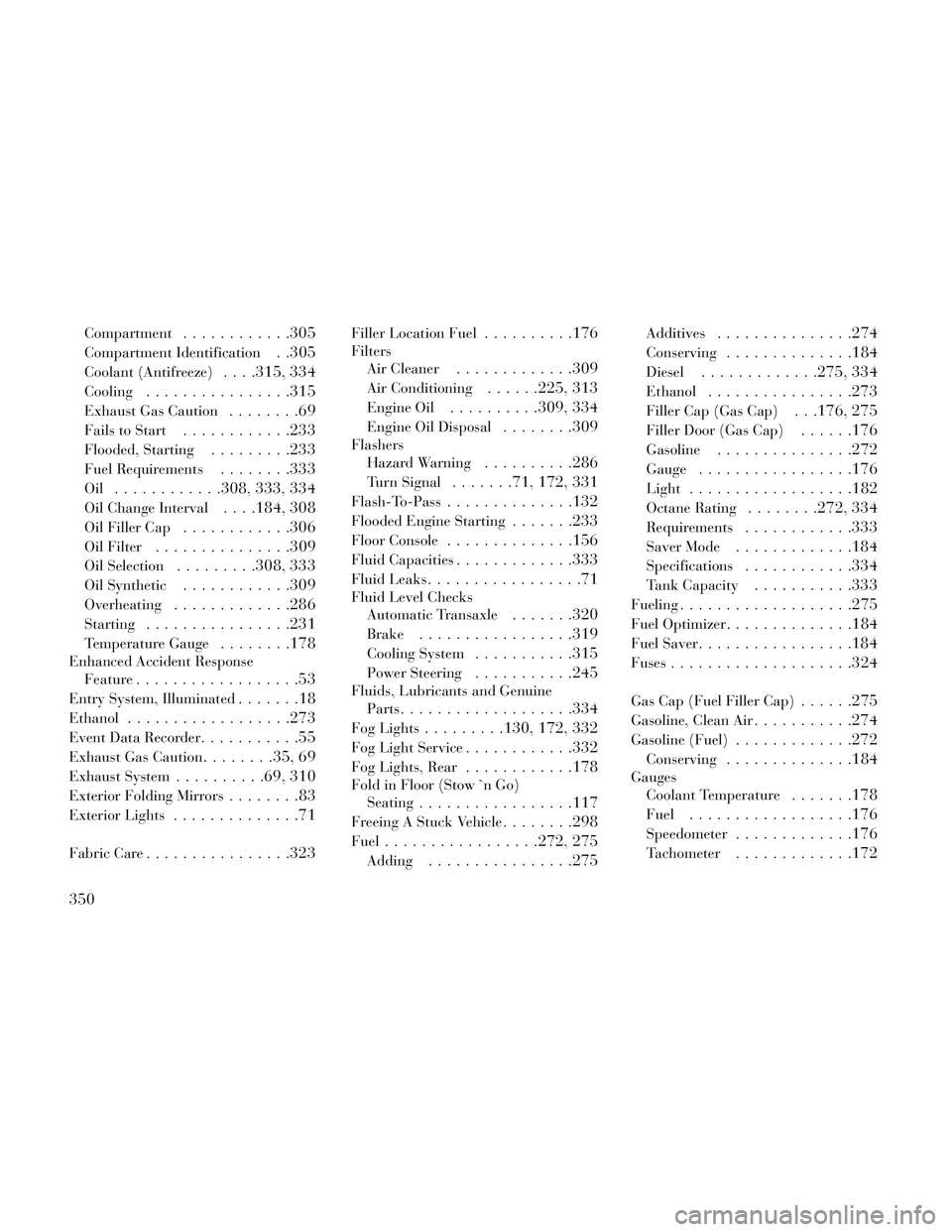
Compartment............305
Compartment Identification. .305
Coolant (Antifreeze). . . .315, 334
Cooling................315
Exhaust Gas Caution........69
Fails to Start............233
Flooded, Starting.........233
Fuel Requirements........333
Oil............308, 333, 334
Oil Change Interval. . . .184, 308
Oil Filler Cap............306
Oil Filter...............309
Oil Selection.........308, 333
Oil Synthetic............309
Overheating.............286
Starting................231
Temperature Gauge........178
Enhanced Accident Response
Feature
..................53
Entry System, Illuminated.......18
Ethanol..................273
Event Data Recorder...........55
Exhaust Gas Caution........35, 69
Exhaust System..........69, 310
Exterior Folding Mirrors........83
Exterior Lights..............71
Fabric Care................323
Filler Location Fuel..........176
FiltersAir Cleaner
.............309
Air Conditioning......225, 313
Engine Oil..........309, 334
Engine Oil Disposal........309
FlashersHazard Warning
..........286
Turn Signal.......71, 172, 331
Flash-To-Pass............. .132
Flooded Engine Starting.......233
Floor Console..............156
Fluid Capacities.............333
Fluid Leaks.................71
Fluid Level Checks
Automatic Transaxle
.......320
Brake.................319
Cooling System...........315
Power Steering...........245
Fluids, Lubricants and GenuineParts
.................. .334
Fog Lights.........130, 172, 332
Fog Light Service............332
Fog Lights, Rear............178
Fold in Floor (Stow `n Go)
Seating
.................117
Freeing A Stuck Vehicle........298
Fuel.................272, 275
Adding................275
Additives.............. .274
Conserving..............184
Diesel.............275, 334
Ethanol................273
Filler Cap (Gas Cap). . .176, 275
Filler Door (Gas Cap). . . . . .176
Gasoline.............. .272
Gauge.................176
Light................. .182
Octane Rating........272, 334
Requirements............333
Saver Mode.............184
Specifications............334
Tank Capacity...........333
Fueling.................. .275
Fuel Optimizer..............184
Fuel Saver.................184
Fuses................... .324
Gas Cap (Fuel Filler Cap)......275
Gasoline, Clean Air...........274
Gasoline (Fuel).............272
Conserving..............184
Gauges
Coolant Temperature
.......178
Fuel..................176
Speedometer.............176
Tachometer.............172
350