bonnet Lancia Ypsilon 2015 Owner handbook (in English)
[x] Cancel search | Manufacturer: LANCIA, Model Year: 2015, Model line: Ypsilon, Model: Lancia Ypsilon 2015Pages: 315, PDF Size: 10.85 MB
Page 29 of 315

Exit Trip
You can automatically exit the TRIP function once
all the values have been displayed or by holding
the button
down for more than 1 second.
SYMBOLS
Some car components have coloured labels whose
symbols indicate precautions to be observed
when using this component. Under the bonnet
there is also a label that summarises all the
symbols.
25
GETTING TO
KNOW YOUR CAR
SAFETY
STARTING AND
DRIVING
WARNING LIGHTS
AND MESSAGES
IN AN EMERGENCY
SERVICING AND
MAINTENANCE
TECHNICAL
SPECIFICATIONS
INDEX
Page 94 of 315

WARNING
A heavy load that has not been
secured may cause serious injuries in
the event of an accident.
WARNING
If you are travelling in an area with
limited opportunities for vehicle
refueling and you wish to bring petrol with
you in a petrol can, you must do so in
compliance with current regulations and
using an approved can, appropriately
secured to the load securing attachments.
However, by doing so, you increase the risk
of fire in case of an accident with your
vehicle.
BONNET
OPENING
Proceed as follows:
❒pull lever A fig. 65 in the direction indicated by
the arrow;
❒move lever B fig. 66 to the left as shown in the
figure;
❒lift the bonnet and, at the same time, release the
supporting rod C fig. 67 from its catch D, then
insert the end of the rod into housing E in
the bonnet (large hole) and push to safety
position (small hole), as shown in the figure.
WARNING
The bonnet may drop suddenly if the
supporting rod is not positioned
correctly.
fig. 65L0F0096
90
GETTING TO
KNOW YOUR CAR
SAFETY
STARTING AND
DRIVING
WARNING LIGHTS
AND MESSAGES
IN AN EMERGENCY
SERVICING AND
MAINTENANCE
TECHNICAL
SPECIFICATIONS
INDEX
Page 95 of 315

Use both hands to lift the bonnet.
Before lifting, check that the
windscreen wiper arms are not raised
from the windscreen, that the car is stationary
and that the handbrake is engaged.
fig. 66L0F0097fig. 67L0F0095
91
GETTING TO
KNOW YOUR CAR
SAFETY
STARTING AND
DRIVING
WARNING LIGHTS
AND MESSAGES
IN AN EMERGENCY
SERVICING AND
MAINTENANCE
TECHNICAL
SPECIFICATIONS
INDEX
Page 96 of 315

CLOSING
Proceed as follows:
❒keep the bonnet raised with one hand and
remove rod C fig. 67 from housing D with the
other, inverting the opening motion, then fit
it back into its catch;
❒lower the bonnet to approximately 20
centimetres from the engine compartment and
let it drop. Make sure that the bonnet is
completely closed and not only fastened by the
safety catch by trying to open it. If it is not
perfectly closed, do not try to press the bonnet
lid down but open it and repeat the procedure.
IMPORTANT Always check that the bonnet is
closed correctly to avoid it opening while the car is
travelling.
WARNING
Perform these operations only when
the car is stationary.
ROOF RACK/SKI RACK
The attachments A fig. 68are located in the areas
illustrated in the figure and can only be accessed
with the doors open. The Lineaccessori Lancia
includes a dedicated roof rack/ski rack for this
car.
WARNING
After travelling for a short distance,
check that the fixing screws for the
attachments are correctly tightened.
fig. 68L0F0098
92
GETTING TO
KNOW YOUR CAR
SAFETY
STARTING AND
DRIVING
WARNING LIGHTS
AND MESSAGES
IN AN EMERGENCY
SERVICING AND
MAINTENANCE
TECHNICAL
SPECIFICATIONS
INDEX
Page 107 of 315
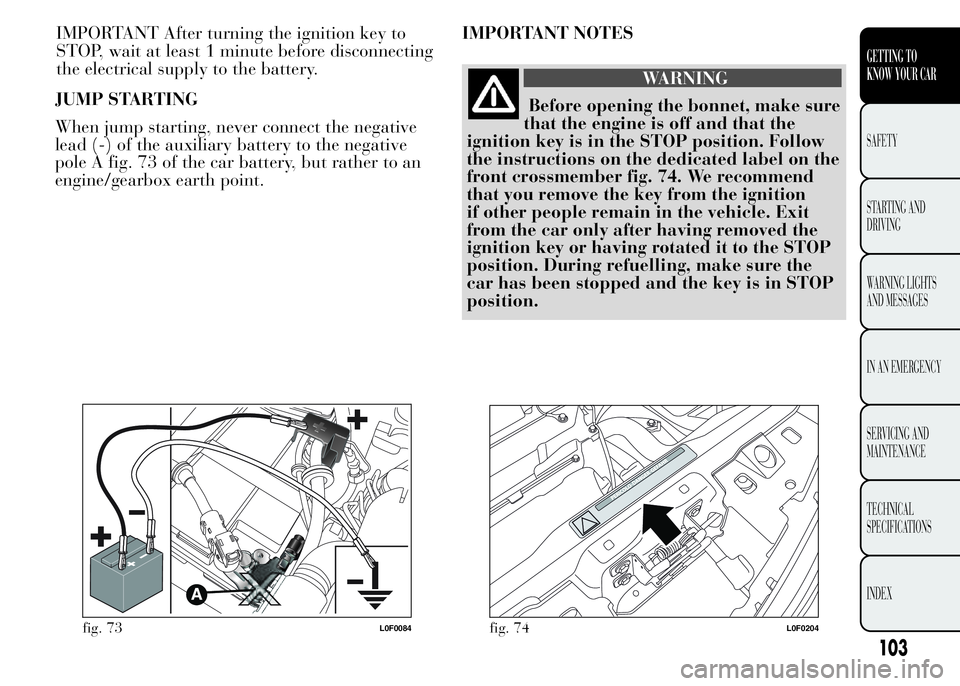
JUMP STARTING
When jump starting, never connect the negative
lead (-) of the auxiliary battery to the negative
pole A fig. 73 of the car battery, but rather to an
engine/gearbox earth point.IMPORTANT NOTES
WARNING
Before opening the bonnet, make sure
that the engine is off and that the
ignition key is in the STOP position. Follow
the instructions on the dedicated label on the
front crossmember fig. 74. We recommend
that you remove the key from the ignition
if other people remain in the vehicle. Exit
from the car only after having removed the
ignition key or having rotated it to the STOP
position. During refuelling, make sure the
car has been stopped and the key is in STOP
position.
fig. 73L0F0084fig. 74L0F0204
103
GETTING TO
KNOW YOUR CAR
SAFETY
STARTING AND
DRIVING
WARNING LIGHTS
AND MESSAGES
IN AN EMERGENCY
SERVICING AND
MAINTENANCE
TECHNICAL
SPECIFICATIONS
INDEX
IMPORTANT After turning the ignition key to
STOP, wait at least 1 minute before disconnecting
the electrical supply to the battery.
Page 179 of 315

MAIN BEAMS (blue)
The warning light switches on when the main
beams are turned on.
LEFT-HAND DIRECTION
INDICATOR (green) (intermittent)
The light comes on when the direction indicator
control stalk is moved downwards or, together
with the right-hand indicator, when the hazard
warning light button is pressed.
RIGHT-HAND DIRECTION
INDICATOR (green) (intermittent)
The warning light turns on when the direction
indicator control lever is moved upwards or,
together with the left indicator, when the hazard
warning light button is pressed.
“DUALDRIVE” ELECTRIC POWER
STEERING ON (green)
The CITY indication appears (an icon appears on
the display on some versions) when "Dualdrive"
electric power steering is activated by pressing the
corresponding button (see the "Dualdrive electric
power steering" paragraph in the "Knowing
your car" section). Press the button again
to switch off the CITY indication (or the icon on
the display).
DOORS/BONNET/LUGGAGE
COMPARTMENT OPEN
The warning light switches on (on some versions
together with a message and a symbol in the
display) when one or more doors, the boot or the
bonnet or the tailgate are not properly closed.
An acoustic signal is activated with the doors open
and the car moving.
175
GETTING TO KNOW
YOUR CAR
SAFETY
STARTING AND
DRIVING
WARNING LIGHTS
AND MESSAGES
IN AN EMERGENCY
SERVICING AND
MAINTENANCE
TECHNICAL
SPECIFICATIONS
INDEX
Page 223 of 315
219
GETTING TO KNOW
YOUR CAR
SAFETY
STARTING AND
DRIVING
WARNING LIGHTS
AND MESSAGES
IN AN EMERGENCY
SERVICING AND
MAINTENANCE
TECHNICAL
SPECIFICATIONS
INDEX
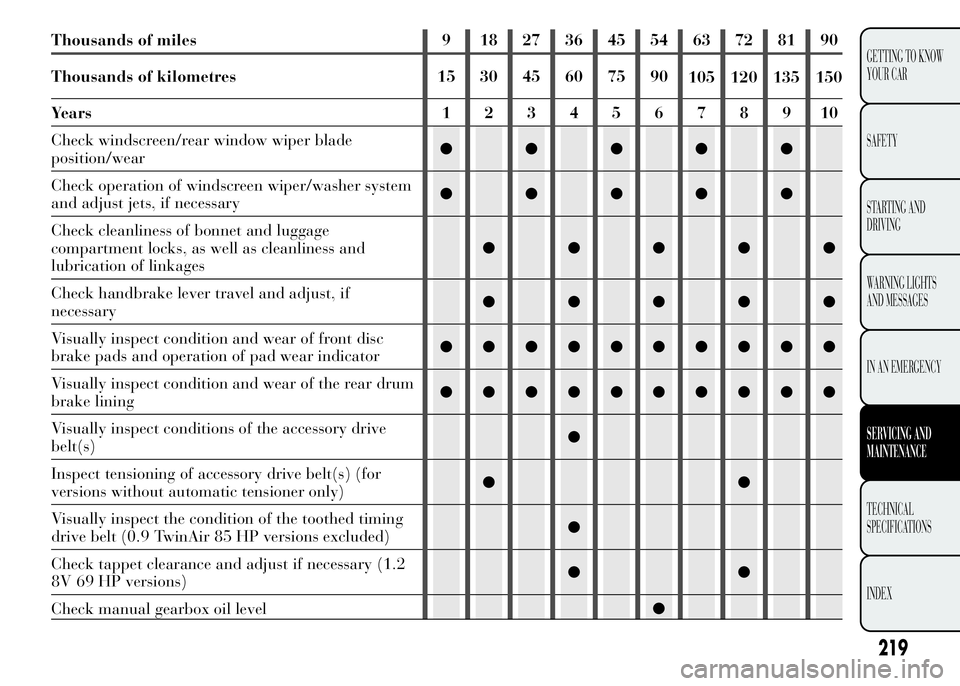
Thousands of miles 9 18 27 36 45 54 63 72 81 90
Thousands of kilometres 15 30 45 60 75 90
105 120 135 150
Years12345678910
Check windscreen/rear window wiper blade
position/wear●●●●●
Check operation of windscreen wiper/washer system
and adjust jets, if necessary●●●●●
Check cleanliness of bonnet and luggage
compartment locks, as well as cleanliness and
lubrication of linkages●●●●●
Check handbrake lever travel and adjust, if
necessary●●●●●
Visually inspect condition and wear of front disc
brake pads and operation of pad wear indicator●●●●●●●●●●
Visually inspect condition and wear of the rear drum
brake lining●●●●●●●●●●
Visually inspect conditions of the accessory drive
belt(s)●
Inspect tensioning of accessory drive belt(s) (for
versions without automatic tensioner only)●●
Visually inspect the condition of the toothed timing
drive belt (0.9 TwinAir 85 HP versions excluded)●
Check tappet clearance and adjust if necessary (1.2
8V 69 HP versions)●●
Check manual gearbox oil level●
Page 226 of 315
222
GETTING TO KNOW
YOUR CAR
SAFETY
STARTING AND
DRIVING
WARNING LIGHTS
AND MESSAGES
IN AN EMERGENCY
SERVICING AND
MAINTENANCE
TECHNICAL
SPECIFICATIONS
INDEX
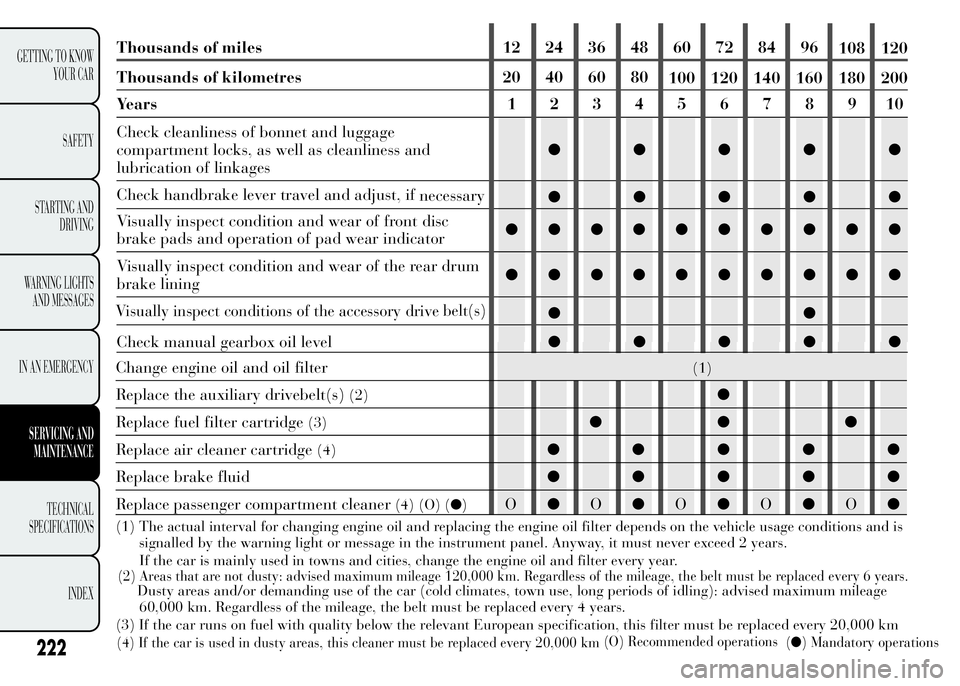
Thousands of miles 12 24 36 48 60 72 84 96
108 120
Thousands of kilometres 20 40 60 80
100 120 140 160 180 200
Years12345678910
Check cleanliness of bonnet and luggage
compartment locks, as well as cleanliness and
lubrication of linkages●●●●●
Check handbrake lever travel and adjust, if
necessary
●●●●●
Visually inspect condition and wear of front disc
brake pads and operation of pad wear indicator●●●●●●●●●●
Visually inspect condition and wear of the rear drum
brake lining●●●●●●●●●●
Visually inspect conditions of the accessory drivebelt(s)●●
Check manual gearbox oil level●●●●●
Change engine oil and oil filter(1)
Replace the auxiliary drivebelt(s)(2)●
Replace fuel filter cartridge
(3)●●●
Replace air cleaner cartridge
(4)●●●●●
Replace brake fluid●●●●●
Replace passenger compartment cleaner
(4) (O) (●)O●O●O●O●O●
(1) The actual interval for changing engine oil and replacing the engine oil filter depends on the vehicle usage conditions and is
signalled by the warning light or message in the instrument panel. Anyway, it must never exceed 2 years.
If the car is mainly used in towns and cities, change the engine oil and filter every year.
(2) Areas that are not dusty: advised maximum mileage 120,000 km. Regardless of the mileage, the belt must be replacedevery 6 years.Dusty areas and/or demanding use of the car (cold climates, town use, long periods of idling): advised maximum mileage
60,000 km. Regardless of the mileage, the belt must be replaced every 4 years.
(3) If the car runs on fuel with quality below the relevant European specification, this filter must be replaced every 20,000 km
(4) If the car is used in dusty areas, this cleaner must be replaced every 20,000 km(O) Recommended operations
(●) Mandatory operations
Page 227 of 315
223
GETTING TO KNOW
YOUR CAR
SAFETY
STARTING AND
DRIVING
WARNING LIGHTS
AND MESSAGES
IN AN EMERGENCY
SERVICING AND
MAINTENANCE
TECHNICAL
SPECIFICATIONS
INDEX
PERIODIC CHECKS
Every 1,000 km or before long journeys, check and,
if necessary, restore the following:
❒engine coolant, brake fluid and windscreen
washer fluid level;
❒tyre inflation pressure and condition;
❒operation of lighting system (headlights, direction
indicators, hazard warning lights, etc.);
❒operation of screen washer/wiper system and
positioning/wear of windscreen/rear window
wiper blades.
Every 3,000 km, check and top up, if required, the
engine oil level.
HEAVY-DUTY USE OF THE CAR
If the car is mainly used in one of the following
conditions:
❒towing a trailer or caravan;
❒dusty roads;
❒short, repeated journeys (less than 7-8 km) at
sub-zero outside temperatures;
❒engine often idling or driving long distances at
low speeds or long periods of idleness;
the following checks must be performed more
frequently than prescribed in the Scheduled
Servicing Plan:
❒check front disc brake pad conditions and wear;
❒check cleanliness of bonnet and boot locks,
cleanliness and lubrication of linkage;
❒visually inspect conditions of: engine, gearbox,
transmission, pipes and hoses (exhaust - fuel
system - brakes) and rubber elements (boots -
sleeves - bushes - etc.);❒check battery charge and battery fluid level
(electrolyte);
❒visually inspect condition of the accessory drive
belts;
❒check and, if necessary, change engine oil and
replace oil filter;
❒check and, if necessary, replace pollen filter;
❒check and, if necessary, replace air cleaner.
CHECKING FLUID LEVELS
WARNING
Never smoke while working in the
engine compartment: gas and
inflammable vapours may be present, with the
risk of fire.
WARNING
Be very careful when working in the
engine compartment when the engine
is hot: you may get burned. Remember that
the fan may start up if the engine is hot: this
could injure you. Scarves, ties and other loose
clothing might be pulled by moving parts.
Be careful, when topping up, and take
care not to mix up the various types
of fluids: they are all incompatible with
one another and could seriously damage the
car.
Page 234 of 315

BATTERY
Battery F (see previous pages) does not require the
electrolyte to be topped up with distilled water. A
periodic check carried out at a Lancia Dealership
is, however, necessary to check efficiency.
REPLACING THE BATTERY
If necessary, replace the battery with another
original battery with the same specifications.
Follow the battery manufacturer's instructions for
maintenance.
USEFUL ADVICE FOR EXTENDING THE
LIFE OF YOUR BATTERY
To avoid draining your battery and make it last
longer, observe the following instructions:
❒when you park the car, ensure that the doors,
tailgate and bonnet are closed properly, to
prevent any roof lights from remaining on inside
the passenger's compartment;
❒switch off all roof lights inside the car: the car is
however equipped with a system which switches
all internal lights off automatically;
❒do not keep accessories (e.g. sound system,
hazard lights, etc.) switched on for a long time
when the engine is not running;
❒before performing any operation on the
electrical system, disconnect the negative
battery cable;
❒completely tighten the battery terminals.
230
GETTING TO KNOW
YOUR CAR
SAFETY
STARTING AND
DRIVING
WARNING LIGHTS
AND MESSAGES
IN AN EMERGENCY
SERVICING AND
MAINTENANCE
TECHNICAL
SPECIFICATIONS
INDEX
IMPORTANT If the charge level remains under
50% for a long time, the battery is damaged
by sulphation, reducing its capacity and efficiency
at start-up.
The battery will also be more at risk of freezing
(this can happen as early as -10°C). Refer to
the paragraph "Car inactivity" in "Starting and
driving" if the car is left parked for a long time.
If, after buying the car, you wish to install
electrical accessories which require permanent
electrical supply (alarm etc.) or accessories which
influence the electrical supply requirements,
contact a Lancia Dealership, whose qualified staff
will evaluate the overall electrical consumption.
WARNING
Battery fluid is poisonous and
corrosive. Avoid contact with the skin
and eyes. Keep open flames away from the
battery and do not use objects that might
create sparks: risk of explosion and fire.
WARNING
Using the battery with insufficient
fluid irreparably damages the battery
and may cause an explosion.