steering wheel LAND ROVER DISCOVERY 1999 User Guide
[x] Cancel search | Manufacturer: LAND ROVER, Model Year: 1999, Model line: DISCOVERY, Model: LAND ROVER DISCOVERY 1999Pages: 1529, PDF Size: 34.8 MB
Page 116 of 1529

LIFTING AND TOWING
08-3
Remove the propeller shaft fixings, remove the shaft
from the vehicle.
If the front axle is to be trailed turn ignition key to
position '1' to release steering lock.
The steering wheel and/or linkage must be
secured in a straight ahead position. DO NOT use
the steering lock mechanism for this purpose.
Towing eyes
The towing eyes at the front and rear of the vehicle
are designed for vehicle recovery purposes only and
must NOT be used to tow a trailer or caravan.
Front:A single towing eye, set behind a removable
panel in the front spoiler. DO NOT use the front
lashing rings for towing.Rear: A pair of towing eyes at the rear of the vehicle
can be used as lashing rings and for towing another
light vehicle.
Page 136 of 1529

MAINTENANCE
PROCEDURES 10-13
Steering box
Check
1.Check steering box for fluid leaks.
Adjust
1.Check that there is no backlash in steering box
with road wheels in straight ahead position.
Adjust if required.
+ STEERING, ADJUSTMENTS,
Steering box - check and adjust.
Battery
Check
1.Check battery condition by checking colour of
condition indicator.
lGreen = O.K.
lBlack = Battery requires charging.
lClear/white = New battery required.
Clean
1.Clean and grease battery terminals with
petroleum jelly.
Page 154 of 1529
MAINTENANCE
PROCEDURES 10-31
Road/roller test
WARNING: Roller test must be restricted to 3
mph (5 km/h). If 2 wheel rolling road is to be used,
disconnect propeller shaft from the transfer box
output shaft driving the axle which is NOT on the
rolling road.
Testing
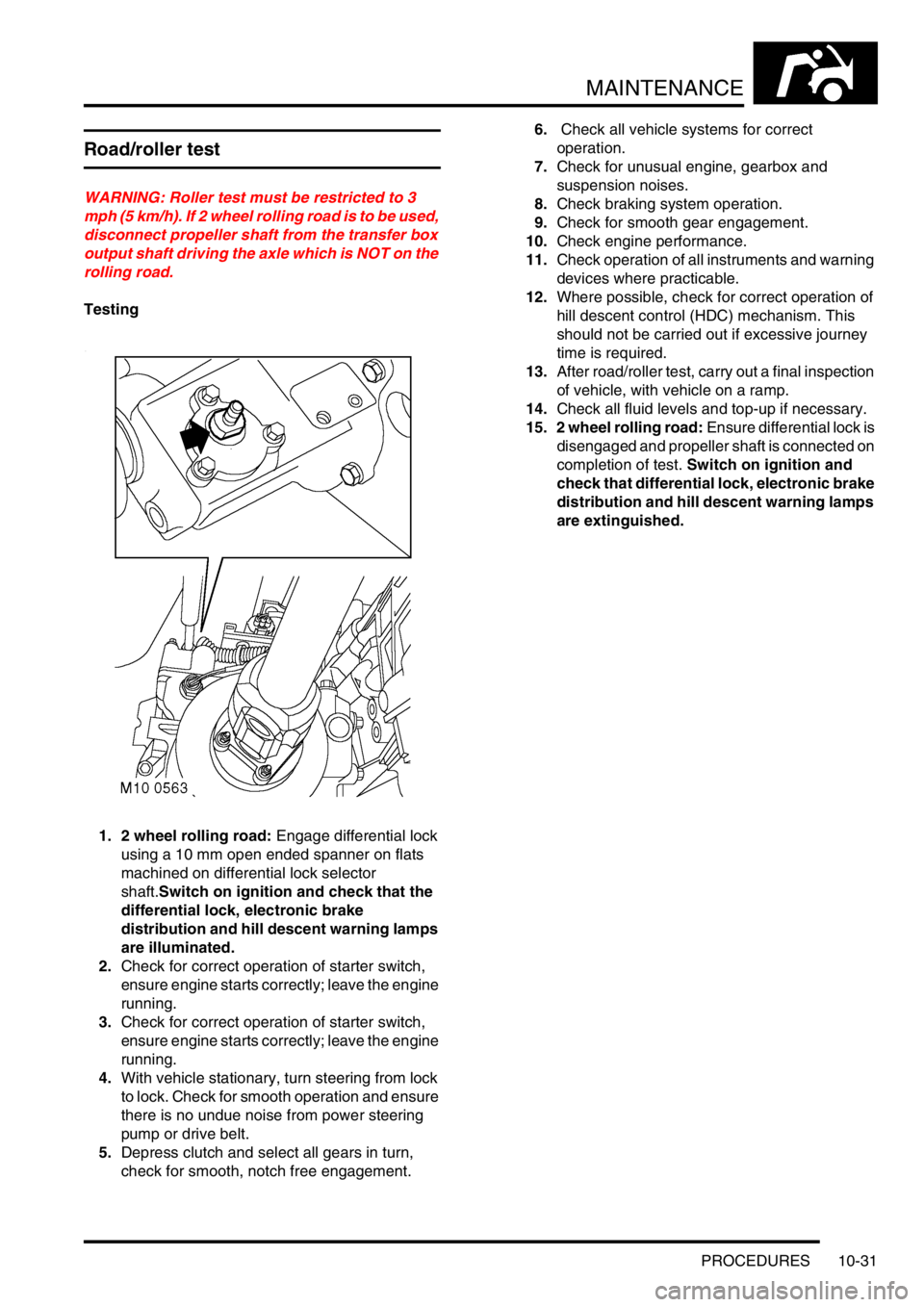
1. 2 wheel rolling road: Engage differential lock
using a 10 mm open ended spanner on flats
machined on differential lock selector
shaft.Switch on ignition and check that the
differential lock, electronic brake
distribution and hill descent warning lamps
are illuminated.
2.Check for correct operation of starter switch,
ensure engine starts correctly; leave the engine
running.
3.Check for correct operation of starter switch,
ensure engine starts correctly; leave the engine
running.
4.With vehicle stationary, turn steering from lock
to lock. Check for smooth operation and ensure
there is no undue noise from power steering
pump or drive belt.
5.Depress clutch and select all gears in turn,
check for smooth, notch free engagement.6. Check all vehicle systems for correct
operation.
7.Check for unusual engine, gearbox and
suspension noises.
8.Check braking system operation.
9.Check for smooth gear engagement.
10.Check engine performance.
11.Check operation of all instruments and warning
devices where practicable.
12.Where possible, check for correct operation of
hill descent control (HDC) mechanism. This
should not be carried out if excessive journey
time is required.
13.After road/roller test, carry out a final inspection
of vehicle, with vehicle on a ramp.
14.Check all fluid levels and top-up if necessary.
15. 2 wheel rolling road: Ensure differential lock is
disengaged and propeller shaft is connected on
completion of test. Switch on ignition and
check that differential lock, electronic brake
distribution and hill descent warning lamps
are extinguished.
Page 366 of 1529

ENGINE MANAGEMENT SYSTEM - V8
DESCRIPTION AND OPERATION 18-2-67
SET+/RES switches
The cruise control system uses two steering wheel switches labelled SET+ and RES.
The SET+ switch performs the set speed, tap up and accelerator functions. The RES switch performs the resume and
suspend functions.
With the cruise control master switch on and the vehicle in the cruise control operating speed range, one press of the
SET+ switch stores a speed value in the cruise control ECU. If the switch is pressed and held while the vehicle is
under cruise control operation, speed increases until the switch is released. At this point the cruise control ECU stores
the new speed value. If the switch is tapped (held down for less than 0.5 second) the cruise control ECU increases
vehicle speed by 1 mph (1.5 km/h).
If the RES switch is pressed while the systems is inactive (no stored values) the system will not respond. If there is
a stored value in the cruise control ECU memory and the switch is pressed, the cruise control system operates and
holds the vehicle at the stored road speed. If the cruise control system is active and the RES switch is depressed,
the cruise control ECU deactivates cruise operation but maintains the current set speed value.
Input/Output
The input from the SET+ switch to the cruise control ECU is either 12 Volts or an open circuit.
The input from the RES switch to the cruise control ECU is either 12 Volts or an open circuit.
The following diagnostic information is available through TestBook:
lThe state of operator switch SET+.
lThe state of operator switch RES.
ECU operating parameters (connector connected)
Pin No. Condition Volts Ohms
4 Ignition in position II, SET+ switch
releasedMore than 10,000
4 Ignition in position II, SET+ switch
pressed12
2 Ignition in position II, RES switch
releasedMore than 10,000
2 Ignition in position II, RES switch
pressed12
Page 396 of 1529

ENGINE MANAGEMENT SYSTEM - V8
REPAIRS 18-2-97
Switch - cruise control (set/resume)
$% 19.75.33
Remove
1.Remove the key from the starter switch.
Disconnect both battery leads, negative lead
first. Wait ten minutes before starting work.
2.Remove driver's airbag module.
+ RESTRAINT SYSTEMS, REPAIRS,
Airbag module - drivers.
3.Release remote control switches multiplug and
leads from steering wheel base.
4.Disconnect remote control switches multiplug
from harness.
5.Remove 2 screws securing remote control
switches to steering wheel base.
6.Release and remove remote control switches
from steering wheel.
Refit
1.Fit remote control switches to steering wheel
and secure with screws.
2.Connect remote control switches multiplug to
harness.
3.Secure leads and multiplug to base of steering
wheel.
4.Fit driver's airbag module.
+ RESTRAINT SYSTEMS, REPAIRS,
Airbag module - drivers.
Switch - clutch pedal - cruise control
$% 19.75.34
Remove
1.Remove 3 fasteners and move driver's side
lower closing panel aside.
2.Disconnect multiplug from clutch pedal switch.
3.Remove switch from pedal bracket.
Refit
1.Engage switch fully into pedal bracket location
and connect multiplug.
2.Position lower closing panel and secure with
fasteners.
Page 681 of 1529

FRONT AXLE
54-2 DESCRIPTION AND OPERATION
Description
General
The front axle consists of an axle casing with a differential unit attached to the right of the vehicle centre line. A wheel
hub is installed in a steering knuckle at each end of the axle casing and connected to the differential unit by a drive
shaft.
Axle casing
The axle casing is of welded construction, with brackets on the casing exterior for attachment to the front suspension.
Yokes at each end of the casing incorporate upper and lower ball joints for attachment of the steering knuckles.
A differential cover on the front of the axle casing contains an oil level plug for checking and replenishment of the
differential lubricating oil. A magnetic drain plug is installed on the underside of the casing. An oil seal is installed in
each end of the axle casing to prevent leakage past the drive shafts.
The interior of the axle casing is ventilated through a breather tube inserted in a red plastic sleeve in the top of the
casing. The open end of the breather tube is located in the left rear corner of the engine compartment.
Differential unit
The differential unit is of the spiral bevel type, lubricated by splash oil. The unit consists of a differential carrier
attached to a pinion housing. In the pinion housing, the pinion is splined to a drive flange which is secured with a bolt
and washer. An oil seal prevents leakage past the drive flange.
Steering knuckle
The steering knuckles are mounted on upper and lower ball joints in the yokes at the end of the axle casing. A tension
collet, in the lower mounting point of each steering knuckle, accommodates manufacturing tolerances to enable the
correct tightening of both ball joints. Lugs are incorporated on the steering knuckles for attachment of the steering
system drag link and track rod.
Page 682 of 1529
FRONT AXLE
DESCRIPTION AND OPERATION 54-3
Wheel hub
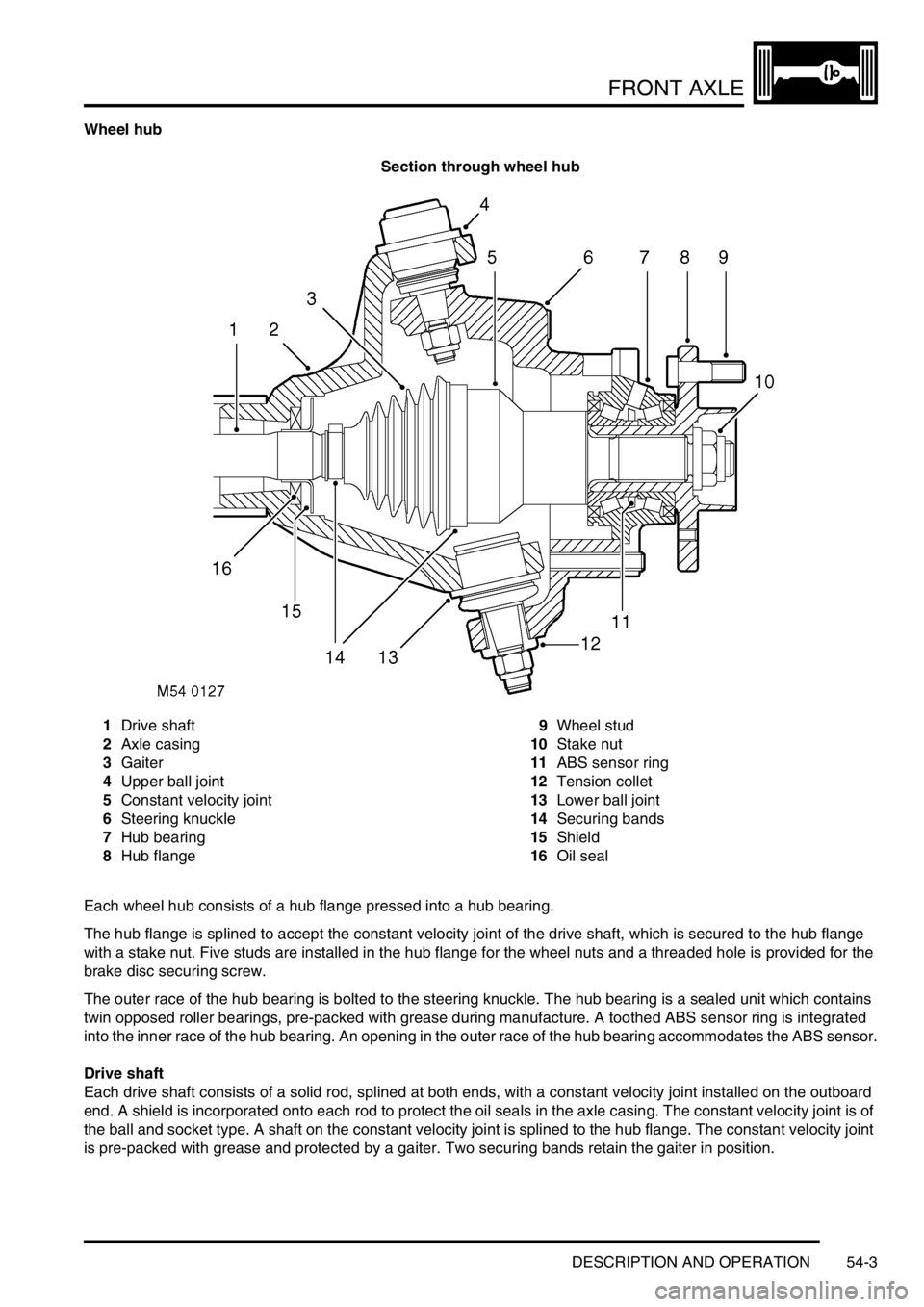
Section through wheel hub
1Drive shaft
2Axle casing
3Gaiter
4Upper ball joint
5Constant velocity joint
6Steering knuckle
7Hub bearing
8Hub flange9Wheel stud
10Stake nut
11ABS sensor ring
12Tension collet
13Lower ball joint
14Securing bands
15Shield
16Oil seal
Each wheel hub consists of a hub flange pressed into a hub bearing.
The hub flange is splined to accept the constant velocity joint of the drive shaft, which is secured to the hub flange
with a stake nut. Five studs are installed in the hub flange for the wheel nuts and a threaded hole is provided for the
brake disc securing screw.
The outer race of the hub bearing is bolted to the steering knuckle. The hub bearing is a sealed unit which contains
twin opposed roller bearings, pre-packed with grease during manufacture. A toothed ABS sensor ring is integrated
into the inner race of the hub bearing. An opening in the outer race of the hub bearing accommodates the ABS sensor.
Drive shaft
Each drive shaft consists of a solid rod, splined at both ends, with a constant velocity joint installed on the outboard
end. A shield is incorporated onto each rod to protect the oil seals in the axle casing. The constant velocity joint is of
the ball and socket type. A shaft on the constant velocity joint is splined to the hub flange. The constant velocity joint
is pre-packed with grease and protected by a gaiter. Two securing bands retain the gaiter in position.
Page 685 of 1529
FRONT AXLE
54-6 REPAIRS
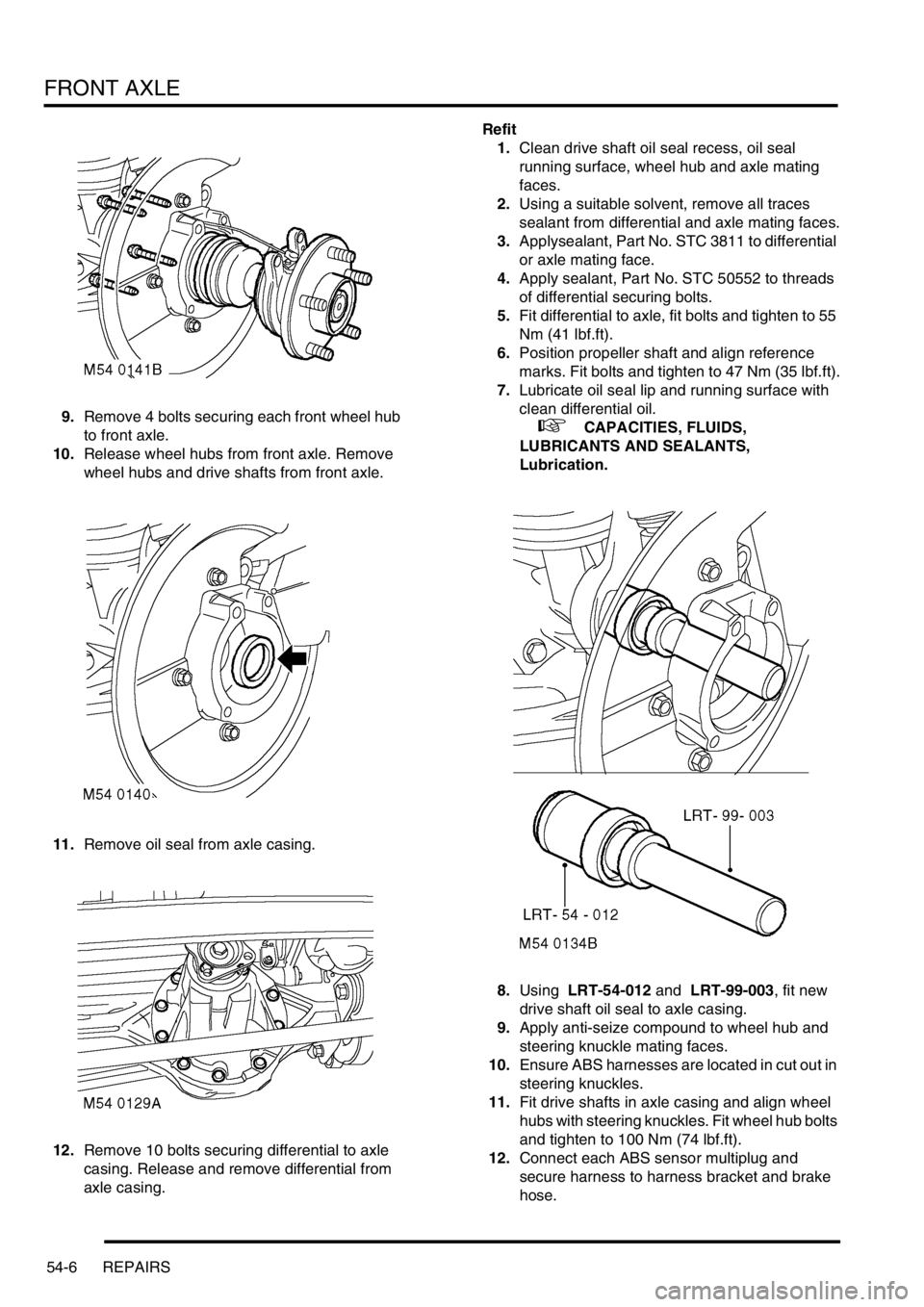
9.Remove 4 bolts securing each front wheel hub
to front axle.
10.Release wheel hubs from front axle. Remove
wheel hubs and drive shafts from front axle.
11.Remove oil seal from axle casing.
12.Remove 10 bolts securing differential to axle
casing. Release and remove differential from
axle casing.Refit
1.Clean drive shaft oil seal recess, oil seal
running surface, wheel hub and axle mating
faces.
2.Using a suitable solvent, remove all traces
sealant from differential and axle mating faces.
3.Applysealant, Part No. STC 3811 to differential
or axle mating face.
4.Apply sealant, Part No. STC 50552 to threads
of differential securing bolts.
5.Fit differential to axle, fit bolts and tighten to 55
Nm (41 lbf.ft).
6.Position propeller shaft and align reference
marks. Fit bolts and tighten to 47 Nm (35 lbf.ft).
7.Lubricate oil seal lip and running surface with
clean differential oil.
+ CAPACITIES, FLUIDS,
LUBRICANTS AND SEALANTS,
Lubrication.
8.Using LRT-54-012 and LRT-99-003, fit new
drive shaft oil seal to axle casing.
9.Apply anti-seize compound to wheel hub and
steering knuckle mating faces.
10.Ensure ABS harnesses are located in cut out in
steering knuckles.
11.Fit drive shafts in axle casing and align wheel
hubs with steering knuckles. Fit wheel hub bolts
and tighten to 100 Nm (74 lbf.ft).
12.Connect each ABS sensor multiplug and
secure harness to harness bracket and brake
hose.
Page 688 of 1529
FRONT AXLE
REPAIRS 54-9
Seal - oil - front axle casing
$% 54.15.04
Remove
1.Raise front of vehicle.
WARNING: Do not work on or under a
vehicle supported only by a jack. Always
support the vehicle on safety stands.
2.Remove road wheel.
3.Remove front brake disc.
+ BRAKES, REPAIRS, Brake disc -
front.
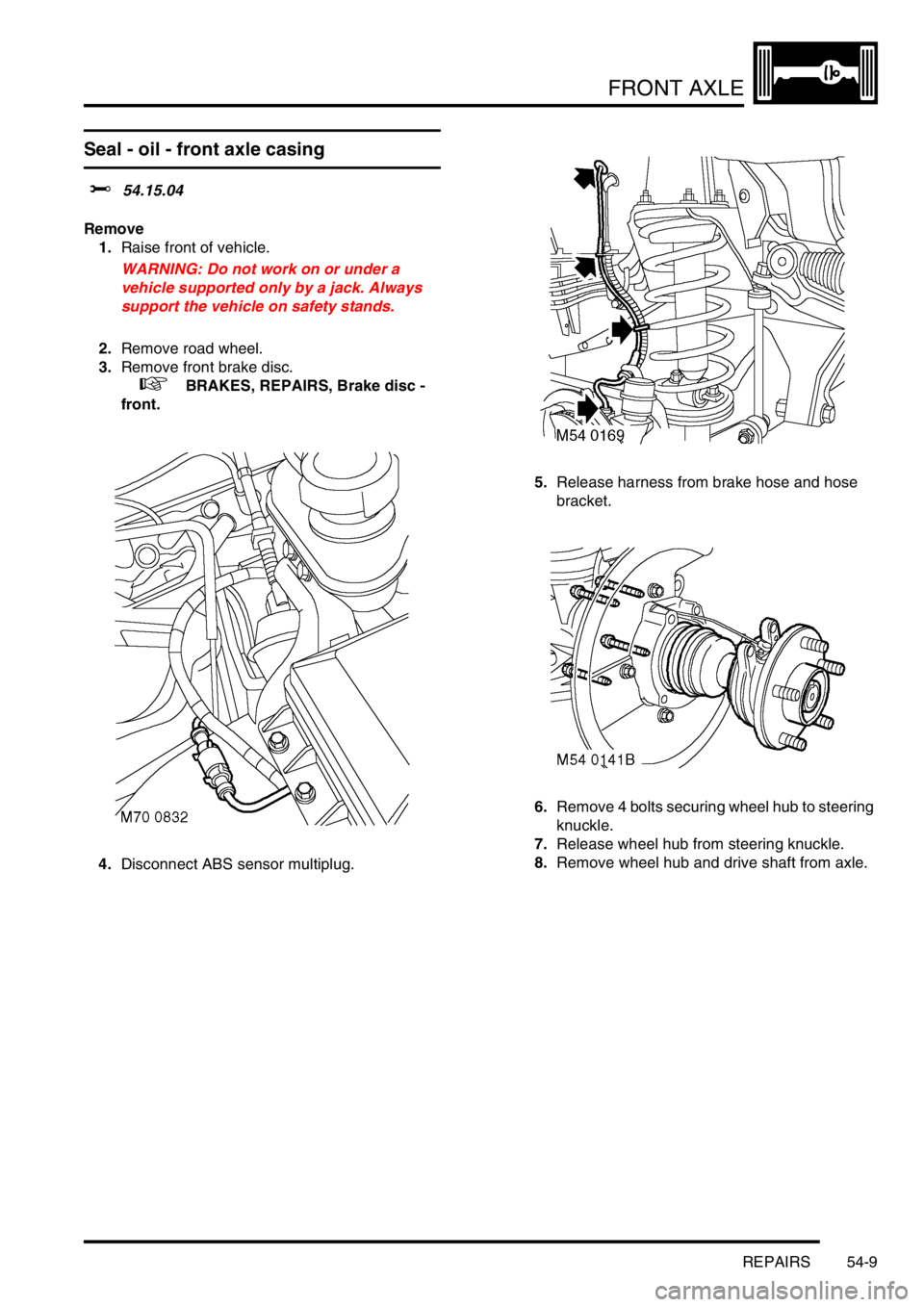
4.Disconnect ABS sensor multiplug.5.Release harness from brake hose and hose
bracket.
6.Remove 4 bolts securing wheel hub to steering
knuckle.
7.Release wheel hub from steering knuckle.
8.Remove wheel hub and drive shaft from axle.
Page 689 of 1529
FRONT AXLE
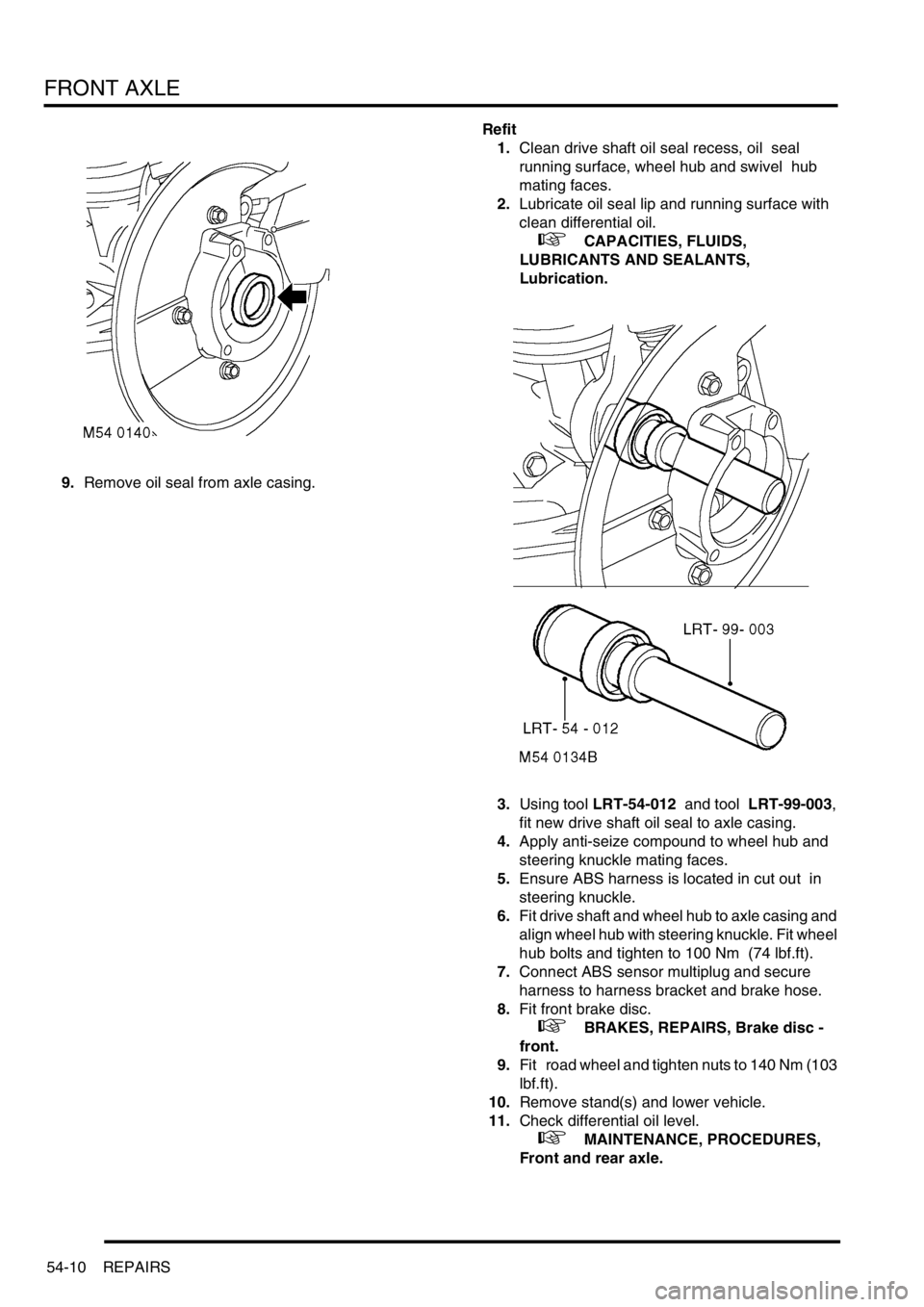
54-10 REPAIRS
9.Remove oil seal from axle casing.Refit
1.Clean drive shaft oil seal recess, oil seal
running surface, wheel hub and swivel hub
mating faces.
2.Lubricate oil seal lip and running surface with
clean differential oil.
+ CAPACITIES, FLUIDS,
LUBRICANTS AND SEALANTS,
Lubrication.
3.Using tool LRT-54-012 and tool LRT-99-003,
fit new drive shaft oil seal to axle casing.
4.Apply anti-seize compound to wheel hub and
steering knuckle mating faces.
5.Ensure ABS harness is located in cut out in
steering knuckle.
6.Fit drive shaft and wheel hub to axle casing and
align wheel hub with steering knuckle. Fit wheel
hub bolts and tighten to 100 Nm (74 lbf.ft).
7.Connect ABS sensor multiplug and secure
harness to harness bracket and brake hose.
8.Fit front brake disc.
+ BRAKES, REPAIRS, Brake disc -
front.
9.Fit road wheel and tighten nuts to 140 Nm (103
lbf.ft).
10.Remove stand(s) and lower vehicle.
11.Check differential oil level.
+ MAINTENANCE, PROCEDURES,
Front and rear axle.